Carissa Halston's Blog, page 6
May 8, 2013
Other cities are eating all my friends
Within the past three weeks, I learned that several of my friends are leaving Boston: one to Brooklyn, one to Houston, one to Portland (Oregon, not Maine), two to LA, and two to Manhattan.
It always upends me when people leave the places where I met them. It makes them difficult to imagine. I doubt anyone’s ever thought of someone living against a theatre backdrop or within a vacuum (which I imagine as a shadowy gray), though that might be a more honest depiction than the mental image I have of, let’s say, my friends John and Elisa, who left Boston nearly two years ago to move to Denver. When I think of them, I imagine them in a log cabin on the side of a perpetually snow-covered mountain.
I wish I were kidding.
I’ve never been to Denver, so even though I’ve seen photos of John and Elisa which have been taken since they moved, I think of them in a place that’s 105% artifice and I rarely feel anything about it remotely resembling shame because, to me, there are only two cities in existence: home and not-home.
This is not to be confused with here and not-here, as in where-I-am vs. where-everything-else-is, rather, there’s a quality that exists in the very few places that encompass home. Luckily, for me, Boston has most of them. When I’m away from Boston, I count the hours until I can go home. When I’m in Boston, I’m glad I don’t have to be somewhere else, even when those somewhere elses are places I might like–like Denver (maybe).
But what about my friends who are being wooed away from Boston to places I’ve actually visited? Places like Brooklyn and Manhattan and Portland?
I have a series of scenic spots that I then imagine them in. For Manhattan, it’s usually Morningside Heights or Bryant Park or Delancey Street. For Brooklyn, I think of Smith Street or Greenpoint. For Portland, I think of Powell’s Books and the Hawthorne Inn and that huge hill I walked up to see Mount Hood. I don’t know why those places stand out so, other than being pretty, though I guess that’s the entire point of scenery.
It’s also worth noting that my friends are all abandoning ship to get on other ships (i.e., they’re leaving one city for another). City living is hard to kick and impossible to replicate. I grew up an hour north of Philadelphia, but spent very little time there at all. Though after I’d chosen a different city as my home, I felt better saying that I’d never held an allegiance to another, which is silly because who (other than me) really cares? Is one city better than another? Are they even comparable?
Sidestepping the entire Boston-vs-New York City debate, I find it funny the way we get wrapped up in place while also ignoring the time in which we live there. Historian David Rosner writes:
Memory plays an immense trick on those of us who write about the history of New York. We often depend on memoirs that shroud the city’s past in a glorious aura that contrasts dramatically with our view of today’s city. In the writings of politicians, authors, and even historians, the city of past generations seems marvelously exciting, exhilarating, organized, and wholesome.
He goes on to discuss how we glamorize the past (in the roaring 1920s, they talked about the “gay” nineties; in the 1950s, they missed the 1920s, etc.). It’s a greener-grass conundrum, but all too familiar to anyone who’s ever had a conversation with someone at least fifteen years their elder. So let’s dispense with the familiar and instead consider how the manipulation of the past affects the future–what we specifically do to the future when we hold it up against the past, like before and after photos (though before and later photos would be more appropriate): We sell the future. We barter with it. We hope and beg and plead that it will be better than where we are now, but we’re selling the future to its later self. What we’re doing is buying hope, investing in all the emotions we’ll have later–eventually, sometime–by betting/praying that later will be better than now because it was for someone else, once upon a time, in the past.
Consider that: We buy and sell the future with the currency of what’s past.
The stories of other people’s lives affect our expectations for our own. And, honestly, how could they not? As adults, we want what we grew up with, only better, and the way we know that there are alternatives is through what we know/glean/assume from other people.
So we choose cities based on suggestions. On advice. On our misshapen (reshaped?) expectations, as filtered through other people’s experiences and, with any luck, our own experiences too. And we balance all of that on the hope–may it not be misdirected–that we will find whatever it is we want/need from the cities we choose while we happen to be in them. There are places I’ve lived that I’ve sworn off as future cities–New York is one of them. Every borough. I’ll never go back. I know part of that was the time we were there, but it was also the place itself. It wasn’t the worst place I’d ever lived (that prize goes to my hometown), but it wasn’t home.
That said, as Randolph and I prepare for our own plans to move (which will include another city, though we’ll be back in Boston with fair frequency), I hope I can remember that home is not an exhaustive list and the future is always (and only ever will be) indicative of what we’ve made of the present.


May 2, 2013
TONIGHT
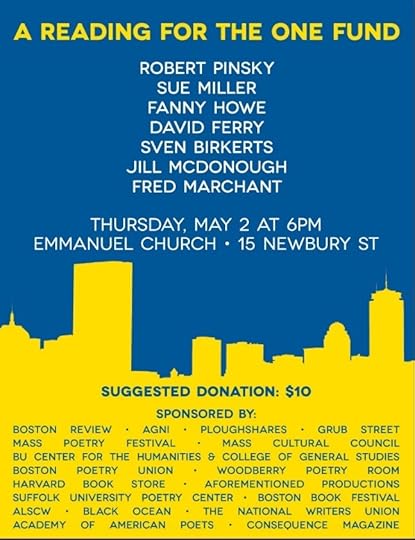
Be there, Boston. For anyone who’s coming to this reading, thank you in advance. For those of you who can afford to, anyone who donates $100 or more gets a bag full of journals and books from the sponsors. We’ll be tossing in issues of apt, as well as copies of Michael Lynch’s Underlife and Portico.
Hope to see you there!
April 25, 2013
Reminders!
Tomorrow night, I’ll be reading with James Tadd Adcox, Krysten Hill, Robert Kloss, and Glenn Shaheen! Details here–hope to see you then!
Also, Aforementioned will be co-sponsoring a reading that will raise money for Boston’s One Fund. It’s happening soon–next Thursday night! We’re honored to be a part of the event, so I’ll be plugging this left and right as soon we’ve got a promotional image.
Speaking of, I have more details about the staged reading of The Daughters. You can find them below:

April 19, 2013
Safe, but not yet over
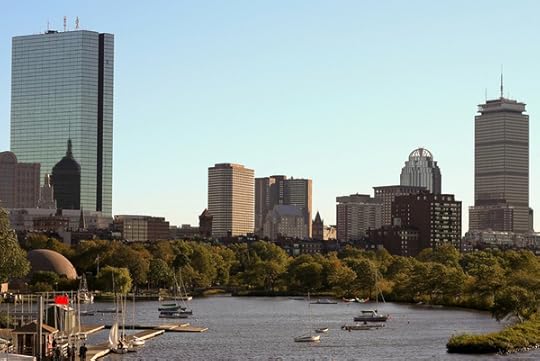
Photo credit: Randolph Pfaff
Let me begin by saying I’m relieved.
Let me continue by saying I told Randolph earlier, “I don’t want to watch the news all day.”
But then we did.
We live near Boston Harbor, so we weren’t part of the lockdown. But we stayed in anyway and watched as Boston held its breath. We trusted our officials–our brave, impressive police officers; our capable politicians–and they served us well today. They took care of the citizens of Boston, of Cambridge, of Watertown. With every officer they could spare, they cared for and looked after us all.
They took into custody a man suspected in hurting complete strangers, in attempting to destroy tangible things like buildings and people, as well as intangible things, like morale and spirit. They took him into custody alive. They were careful to do so, thankfully. But please consider the meaning of what we’re saying here: he is in custody.
Custody has two definitions: 1/imprisonment and 2/the protective care or guardianship of someone or something, especially regarding legal parental responsibility.
Emphasis mine.
Dzhokhar Tsarnaev is 19. He has lived in the US for at least ten years–the majority of his life. He and his family sought asylum in the US and built a life in Cambridge, where he attended grade school and high school. He enrolled in college locally as well–at UMass Dartmouth–and, as of last September, he is a naturalized US citizen. Dzhokhar is, unarguably, American. As an American, the US provides him, as the US provides all its citizens, protective care and guardianship.
But Dzhokhar is also an immigrant, so he will be marginalized as an immigrant. This marginalization will be tied to his brother, Tamerlan Tsarnaev–the other suspect–who is, according to many sources, a Muslim. To some people, that will translate additional layers of otherness. There is already talk of Muslim extremism. Whether extremism is even a possibility, to some people, it will become fact. It will be another way in which these suspects differ from “real” Americans. There are a hundred ways in which they’ll be analyzed, but this will linger and, for some, will stick. It will be the answer to two important questions: How can we figure out the rationale behind their actions? and How to make sense of the senseless?
Some reports have already taken up that helm, stating that Tamerlan may have corrupted his brother, that in 2010, Tamerlan said he didn’t have any American friends and didn’t understand Americans. But, , Tamerlan “like[d] the USA.” He felt you could succeed “if you are willing to work.”
So, how would one get from liking the US to claiming a lack of understanding? Well, let’s say that Tamerlan experienced what so many “real” Americans do once they reach adulthood–disillusionment. Perhaps he didn’t succeed, despite hard work. Perhaps he encountered alienation due to religious difference or cultural difference. Perhaps there were day-to-day things that, rather plainly, wore the shine off the US. We can only surmise the details. However it arrived, let’s say disillusionment came. For those of us who have been disillusioned, the reaction normally includes a combination of disappointment and anger.
And even for those who might claim to have never been disillusioned, every one of us knows anger. It’s easy to feed and easy to cling to.
Now let’s consider what it might mean to be the younger brother of an angry, disillusioned young man. From all the interviews done to establish character, all Dzhokhar’s friends/neighbors/teachers uniformly described him as nice, quiet, and polite. And, now, imagine there’s an opinionated force holding sway over a quiet, polite one. Imagine that the person closest to you, the person most like you racially, religiously, and in personal experience–imagine that person was angry and reacting based on that anger. Then think about how you might feel if that person were your brother, a person who steered your life and your choices. Imagine that you thought you could change things for him. Imagine being hopeful in a way that allowed you to think you could reverse someone’s disillusionment.
I am not saying this is the way things are. I am merely guessing, surmising, actually, for two reasons. 1/I spent my own young adulthood wanting so badly to be bright or happy enough to reverse someone’s dark days and outlook, and 2/There is a gray area surrounding what so many of us want desperately to be starkly black or white.
So, with that in mind, I am urging everyone in Boston–in fact, everyone in general–to remember that this will be messy. We have a lot of claims. We have a lot of contradicting accounts. We will learn in the coming weeks and months what is true.
But here is what I can guarantee to you tonight: Regardless of what happens, Dzhokhar Tsarnaev is a person. A damaged person (though not necessarily mentally ill) and a person who will most likely be difficult for most Americans to understand. But we need to try not to black-and-white this. We need to try not to marginalize him and, conversely, we need to not dismiss him as some anomaly. Otherwise, Dzhokhar is going to cease being a person and instead be a sound byte. He’s going to be a poster child for every 19-year-old, for every Russian, for every immigrant, for every angry young man. And those who would also be cast into those same groups will have to answer for Dzhokhar’s actions.
Similarly, those who helped him and those arrested who may have helped him–even if they didn’t–will be written into a mounting narrative, will be part of an investigation separate from the criminal one. It will be part of the thread of American life that occurs in the wake of terror, in the ongoing war against it, which is both a structure that the government created and a creature that society sustains. And, despite our best efforts, that narrative will make Americans turn away from each other. It will make it difficult to get close to people. It will be easier to doubt the existence of goodness in “others” and it will be even easier than it is right now to believe that there’s something inherently wrong with us due to age or race or anything other than creed (and, by creed, I don’t mean the Christian sort; I mean the belief systems we all respectively employ to guide our choices). Creed is the only thing that we should each cite to explain our actions and it is what we should ask others for when expecting them to explain theirs. But instead of asking for or even waiting for an explanation, we are generally quick to doubt and quick to judge because no one wants to invest in another person’s issues when our own are already so difficult to endure.
Let me close by saying that this will not be easy. This will be difficult and it will be sad. It already is. We are celebrating in Boston tonight. We are joyous for the lack of a foreseeable threat and relieved that the existing threat has been identified and extinguished. Yet our anger remains, rightfully so, and unfortunately, shallowly so as well. Few will think about what that anger stems from, beyond retribution. Most won’t consider how our anger might be like Tamerlan’s or Dzhokhar’s, which is, of course, what led to this in the first place. They won’t consider how a person cast as an “other” can also be strikingly familiar.
April 15, 2013
On Boston
I was not at the marathon today. I was not anywhere near it. I live just two miles away, but I used to live much closer. I used to live in Back Bay. But even if I never had, even if I lived in (and had only ever lived in) Cambridge or Somerville or Southie or Roslindale, Boston is tightly knit and the entire city–the entire metro area–feels like home. Regardless of which neighborhood/neighboring city I’m in, it always feels like I’m in the city’s heart.
I was scared this afternoon. Scared of losing someone I know, scared of future threats, scared of all that is outside my control. I wanted to wrap my arms and my mind around the city and everyone in it and keep them safe. I wanted to mend the injured. I wanted to magically erase the damage and the loss.
I still want that.
I cannot imagine what it must have been like to have been there. I am actively trying not to imagine it. Instead, I am hoping that our recovery will be swift and our renewal will be whole because renewal is the healthiest option in the face of destruction.
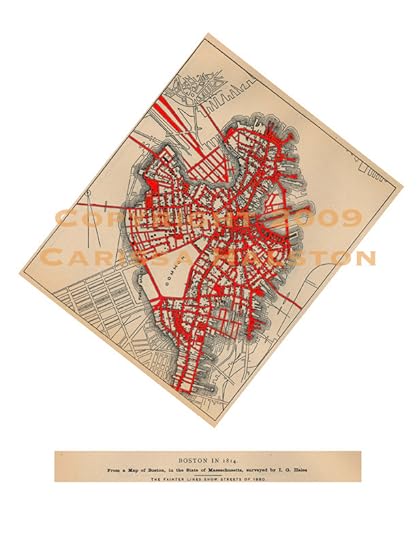
And I’m focusing on an image that I made a few years ago that visually epitomizes what Boston means to me. It’s based on a map from the late 1800s. I digitally altered the streets to paint some of them red:
April 10, 2013
Interview at Stated Magazine
Last fall, Daniel Nester was kind enough to include me among a group of authors being interviewed for his undergraduate course on the art of writing interviews.
Earlier this week, the fruits of his students’ labor went up on Stated Magazine, an online journal devoted to publishing interviews of people who create things.
My interview is among them, a little excerpt is below, but you should also go to the site to read the entire thing:
KAYLA KUILEMA: In The Mere Weight of Words, what influenced you to write about Meredith and her tragic news regarding her father’s diagnosis?
CARISSA HALSTON: I started writing Mere’s story with the intention of writing about a person who had difficulty speaking. That difficulty complicated her estrangement from her father, as her awareness of her altered speech compounded with her awareness of her father’s awareness. She felt his scrutiny, always. So, when the book opens and she’s privy to news about him without actually receiving it from him, a role reversal occurs (though the reader won’t know that for another eighty pages).
I’m not sure that Mere sees the news as tragic. I think she immediately starts processing what was left unsaid between them, but doesn’t actually acknowledge her father’s health until she sees him. And even then, it’s not his tragedy she’s considering.
April 3, 2013
Upcoming events
Though they’re spaced apart, I feel like all these events are happening at once–though that’s probably the events planner in me talking.
Either way, here’s where you can find me (in public), now through June:

Monday, April 8: Literary Firsts
The three-year anniversary of Literary Firsts! I founded this series three years ago and have been so honored to work with such talented, humbling writers. Please be there next week (only five days away!) to help me celebrate the work of every writer who’s read at the series so far, as well as Reyna Clancy, Myfanwy Collins, Chris Marstall, and William Pierce, who will help usher us into our fourth year. It will start at 7pm at Middlesex Lounge. It’s free and open to the public and I would love to see you there.
Friday, April 26: Lorem Ipsum reading
Featuring James Tadd Adcox, Caroline Crew, Robert Kloss, Glen Shaheen, and–me. I was thrilled to have Tadd and Robert read at the AWP Literary Firsts, so I’m even more excited to read with them, as well as with Caroline and Glen, at the always awesome Lorem Ipsum Books. 8pm. Admission is free, but you should definitely buy a book while you’re there. If you do, I’ll give you a hug. (I may hug you anyway.)
Friday and Saturday, May 17-18: “The Daughters” at the Dorchester Fringe FestivalYou may have read my story, “Sacramento: 2006″ in Newfound last year. Or “1964, Berkeley” in Consequence. Or “On Tender Hooks [Seattle, 1931.]” in The Massachusetts Review. Even if you haven’t, you should know that those three stories are related (in more ways than one). They’re sections of a three-part story called “The Daughters,” which involves four generations of guilt, obligation, and war, and I cannot communicate how excited I am to say that Aforementioned will be producing a staged reading of the play adaptation at the very first Dorchester Fringe Festival in May. The cast will include Jennifer O’Connor, Timothy Hoover, Randolph Pfaff, and me, among others. Admission is free and open to the public. I’ll list more information as I have it (like the whens and wheres), but please, please come to this. I’d love to pack whatever space they give us.
Friday, May 31: Release party for Michael Lynch’s Underlife and Portico
I want everyone to read Michael Lynch’s poetry. Michael writes about suburban life in a way that’s both shrewd and reverent. He takes what you already know–what you live everyday–and reveals it through a dangerously lovely interiority. It’s there in his poem, “Lost.” It’s there in each of the opening pieces of his book, Underlife and Portico. I love and believe in this book so steadfastly. That’s why I am going to be at the release party for the second edition of U&P (the permanent edition of the book that we’d been waiting to make since we put out the first edition in 2009). If you are in the Boston area, I want to see you there. I want to put this book in your hands. So please join me at Brookline Booksmith on Friday, May 31, at 7pm when Michael will read with Nicole Terez Dutton and Erica Anzalone and we will celebrate this beautiful book. Admission is free, but you’ll also want the book, which is a steal at $8.
June 14-June 30: Vital
There’s a theatre company in Boston called Whistler in the Dark and if you haven’t seen one of their productions yet, you’re doing yourself a great disservice. I am honored to be part of a collaborative show they’re running in June called Vital, which will combine the work of five local writers into one performance. I had a very difficult decision in attempting to figure out a story to send them, but I chose “Extensions,” (published as an ebook last June by short story impresario, Troy Palmer, at Little Fiction). It’s now out of my hands, but it will soon be in yours–in your hands and eyes and ears. So let me know when you’re going. I’ll sit next to you. It’ll be a tiny party.
March 21, 2013
Newfound reviews The Mere Weight of Words

Just in case you haven’t seen the latest issue of Newfound, you should get over there for a review of The Mere Weight of Words, wherein Jaime Groetsema writes:
“Carissa Halston’s words punctuate. They weave intricate and subtle narratives and cast long, dark shadows; her words build intimate and complex characters that will resound emotionally with readers…Halston deliberately gives her readers a work that is sharp and complex with beautiful linguistic details that are complemented by narrative moments of heartbreak and sorrow.”
So grateful to Newfound for such a thoughtful review.
Also, while you’re over there, check out the rest of the new issue, including fiction from Michael Kimball and Robert Kloss (have you seen the AWP Literary Firsts videos yet?) and non-fiction from Nick Flynn!
March 11, 2013
AWP 2013 recap
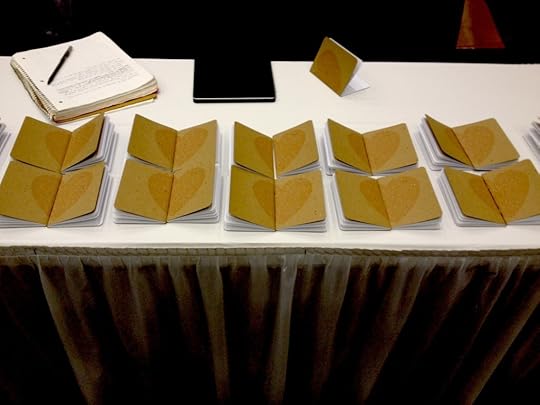
Journals from the Wordnik table
AWP highlights, in the order in which I remember them:
Hosting Literary Firsts. I love it every time, but this was such a memorable event. All the readers were so on. Videos are forthcoming, videos I will watch over and over.
Hearing Emily Mitchell read from The Last Summer of the World
Hearing Vanessa Veselka read from her novel-in-progress. !!! (I will stop at three exclamation points for the sake of propriety, but know that this deserves so many more.)
Hearing Josh Weil read “I Want You to Know That I Know That He Loved You” at the AGNI party
Hearing Heidi Julavitz read from The Vanishers
Heidi Julavitz telling me I was her wingman during her reading–call and response, me calling, her responding: YOU’RE AWESOME! … YOU’RE PSYCHIC!
Meeting so many people I only knew online–Melissa Febos, Vanessa Veselka, Gregory Crosby (who blurbed Underlife and Portico!), Troy Palmer, Alban Fischer, Lam Pham, Alexis Pope, Justin Daugherty, Sarah Fawn Montgomery, Jordan Scott, and Susan McCarty’s fiance, who specifically stopped by the table to give me her regards (how sweet!)
Seeing people I don’t see nearly enough, including Dolan Morgan, Tom Oristaglio, Steven LaFond, Elisa Gabbert, John Cotter, Denise Warren, Bill Pierce, Karyn Polewaczyk, Andra Hibbert, Karissa Kloss, Robert Kloss, James Tadd Adcox, Cat Parnell, Askold Melnyczuk, and our dear AP authors: Gillian Devereux and Michael Lynch
Karissa Kloss’s greeting to me at Literary Firsts: “Hello, trouble.”
Hearing the phrase, “I’m a lexicographer,” and turning around to see Emily Brewster
Drive-by hugs from Lori Hettler, John Reed, Ethan Gilsdorf, Siena Oristaglio, Daniel Nester, Danielle Jones-Pruett, Evan Perriello, and Matt Salesses
Seeing people at multiple events! Krysten Hill, Kurt Klopmeier, and Colin O’Day
Seeing editors who are now friends: Michael Thurston and Jim Hicks
Meeting the Fourteen Hills crew, all of whom were so incredibly nice: Ari Moskowitz, Kelly McNerney, and Miah Jeffra
The apt release party, wherein I laughed and sighed and gasped and loved every reader so, so much.
Special thanks to everyone who stopped to see us at table M4
Extra special thanks to our tablemates from Anomalous Press, especially Erica Mena-Landry and Shannon Walsh
And, of course, thanks (always) to Randolph Pfaff
March 6, 2013
Just in time for AWP–
–the Phoenix asked three writers (Junot Diaz, Askold Melnyczuk, and me) about living and writing in Boston.
Read what we’ve got to say here.