Carissa Halston's Blog, page 3
May 1, 2015
On May Day
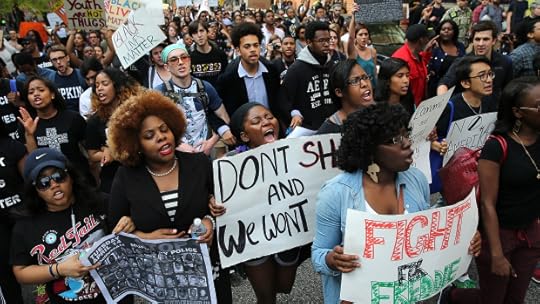
Photo by Win McNamee/Getty Images
fit jock guy fuckersToday is May 1, 2015.
May 1 is commonly known as May Day, or International Workers’ Day.
I’ve celebrated May 1 every year since 2000, but admittedly, my reasons have always been selfish.
Fifteen years ago today, I moved out of my father’s house.
It was a quick decision. I packed some bags. I filled two boxes. I didn’t leave a note.
—
I grew up in Pennsylvania but I currently live in Baltimore, which sometimes feels too close to PA for my liking. That aside, I find Baltimore an easy place to live.
Last year, there was a May Day rally in Baltimore calling for higher minimum wage, full rights for immigrants, and more opportunities for black youth.
This year, there will once again be a May Day rally in Baltimore, but activists will devote their efforts entirely to protesting police brutality.
—
In Margaret Atwood’s novel The Handmaid’s Tale, Atwood creates a republic called Gilead—formerly known as the United States—wherein the government severely oppresses and subjugates women, homosexuals, and people of color.
The members of the underground group that longs to overthrow the governing forces of Gilead refer to themselves as the Mayday resistance.
—
The week before I moved from my father’s house, I was crossing the parking lot near the bookstore where I worked. A woman asked me if I wanted to help victims of domestic violence: for five dollars, she would give me a box of sturdy garbage bags.
I was happy to donate. She gave me the bags.
Those were the bags I packed when I moved.
—
The May Day rally is one of many protests in Baltimore’s recent history. The protestors are responding to the death of Freddie Gray. Gray died while in police custody. Depending on the source, Gray’s death was a complication of “a severe spine injury” or a “broken neck.”
—
A quote from The Handmaid’s Tale: “Mayday used to be a distress signal….for pilots whose planes had been hit…Do you know where it came from?…Mayday?….It’s French…From m’aidez. [Which translates to] Help me.”
—
The reason I said yes to the woman who was selling bags in the parking lot had to do with my growing awareness that my home life wasn’t ideal.
Although my decision to move was quick, the events leading up to my decision were not. It took years of complicated grief to reach May 1, 2000. I grew up adoring my father. He was the only parent I had.
—
Experts state that if Freddie Gray had been taken to the hospital, he would’ve survived. The job of a police officer is “to protect and serve.” Care is an integral part of protection, which raises the question of where and when protection begins and ends. And, in this case, why it ends at all.
—
In The Handmaid’s Tale, all women must wear government-mandated veils, even the servants, a group of older women referred to as Marthas, who are the only people of color to function individually in the novel. Atwood’s description of them as afterthoughts is telling:
“She puts the veil on to go outside, but nobody much cares who sees the face of a Martha. Her sleeves are rolled to the elbow, showing her brown arm.”
—
If asked, I know my father wouldn’t consider his method of parenting to be abusive. And when I think about brutality, when I think about “real” violence, I suppose my upbringing doesn’t seem that bad.
After all, he gave me a place to live. He clothed and fed me.
But he also gave me a broken nose. As in, it was a “gift.”
To be clear: although my father hit me, he wasn’t the one who broke my nose. He paid a doctor to do it.
Before my surgery, I looked more obviously Arabic.
—
There are various stories circulating from the media about Freddie Gray’s injury. He did it to himself. He had a pre-existing injury. He was in a car accident and had surgery the week before his arrest.
The latter two have been proven false. The self-sustained injury has been cited to an eyewitness, however:
—
The only mention of African-Americans in Gilead besides the Marthas occurs when news of their essential banishment is broadcast:
“Now we can see a city, again from the air. This used to be Detroit. Under the voice of the announcer, there’s the thunk of artillery. From the skyline, columns of smoke ascend.
‘Resettlement of the Children of Ham is continuing on schedule,’ says the reassuring pink face, back on the screen. ‘Three thousand have arrived this week in National Homeland One, with another two thousand in transit.’ How are they transporting that many people at once? Trains, buses? We’re not shown any pictures of this.”
—
When I was sixteen, I once tried to tell the sister of a close friend that my father regularly hit me. She called me a liar. She told me she’d been in an abusive relationship, and therefore knew “real” abuse when she saw it.
When I told her to ask my brother (who, without question, received more of my father’s physical temper than I ever did), she had no response. She refused to engage any further.
The one time I tried to tell the police about what was happening at home, my father denied it while I was there in the room. They told me to call if anything got out of hand. This being in the era before cell phones, I told them he would unplug the phone once they left.
Of the officers, two were male and one was female.
Two days after that conversation, the female officer visited me at home when she knew my father would be at work. She asked how I was doing. I showed her that the phone was unplugged.
She nodded, her preferred method of disengagement.
—
For the most part, protests in Baltimore have been peaceful. I expect the May Day protest later today will be similar.
Still, I worry about the information that will circulate should any of it go wrong. I worry that one misstep will be mistaken to stand in for a march.
Worse, I worry that no one will ask what happened after that.
—
Late in Atwood’s novel, the place where the protagonist lives is revealed to be Harvard Square in Cambridge. Cambridge is just north of Boston, a city I lived in for a long time, a city that (like Baltimore) has a history of racial tensions.
But it’s worth noting that Cambridge is most well known as the home to two illustrious institutions: MIT and Harvard. Atwood didn’t set her novel there by random chance. Even among the educated, especially among the elite, systems of government can go horribly awry.
—
Even when a relationship begins as it should—and make no mistake: the interactions between the police and the public is as much a relationship as is that between a father and daughter—unless there are checks and balances, and the side with more power is held accountable for his/her/its actions, there cannot and will not be peace.
To make a donation to the United Way of Central Maryland to help restore Baltimore, click here.


April 4, 2015
Come see me at AWP15!
Oh, my dears. This year is still so young and so much of it has been difficult. I broke my leg in two places at the end of February. I spent four weeks not walking. I taught online. I slept a lot. I had lunatic dreams.
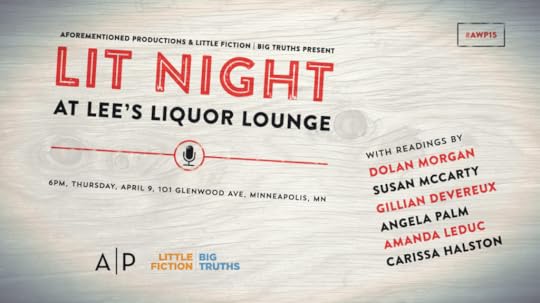
But I’m finally up and around again, so I’m relieved to say I’ll be in Minneapolis/St. Paul next week for AWP! If you’re at the conference, I hope you’ll swing by table 1920 during the book fair and say hello. I’ll be there with Randolph and all our Aforementioned wares, plus, we’ll be tabling with our friends at Little Fiction | Big Truths, and throwing an offsite reading on Thursday night at Lee’s Liquor Lounge.
I’m thrilled to be reading for Little Fiction alongside Angela Palm and Amanda Leduc, and we’ll also have Gillian Devereux, Dolan Morgan, and Susan McCarty representing Aforementioned! It’s going to be such a great night, so click the image below to check out the Facebook invite, and even if FB isn’t your thing, I hope you’ll stop by the reading. I’ll be reading from my novel-in-progress, and I’d love to see you there!
February 21, 2015
Susan McCarty’s ANATOMIES
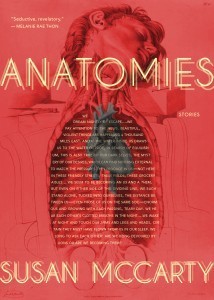 If you trust me at all as an editor, if you value my opinion as a reader, if you want a story collection that will make you swoon over sentences and laugh over premises and swing your fist in the air at the sheer scope of it, you’ll order Susan McCarty’s debut collection, Anatomies, due out June 15.
Also, check out these blurbs! And just $13 (shipping included!) for almost 275 pages? Plus I designed it, inside and out? This book’s like a basket of bargains!
October 30, 2014
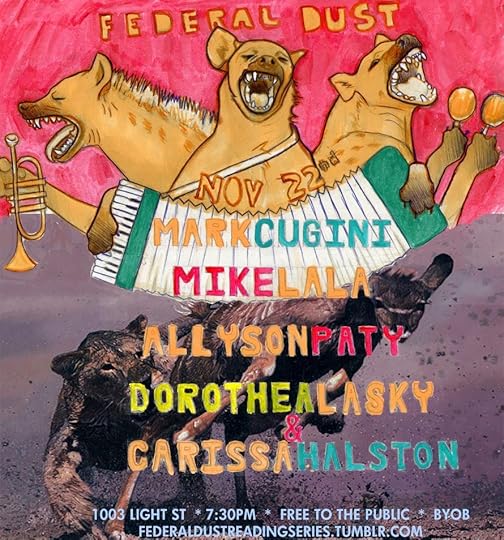
Baltimore reading at Federal Dust
Matthew Zingg hosts a series in Baltimore called Federal Dust.
He was kind enough to invite me to read next month.
Saturday, Nov 22. 7:30pm.
Me and you, Baltimore. Let’s do this.
August 24, 2014
Where have you been?
Writing.
(Every day since Dec 15, 2013, I’ve been working on the fourth draft of a long (and getting longer) work-in-progress. The third draft had 52 chapters. It wasn’t a thing I could show to anyone because it didn’t make much sense. And the ending wasn’t there. It was there. It just wasn’t there. The third draft was around 95,000 words and 375ish pages. The fourth draft has 73 chapters. I’m 250 pages in. I’ve revised 14 chapters. It’s 500+ pages. I want to finish this draft by December 2015. I want someone else to be able to read it and understand what’s happening. I can do this.)
(I’ve also been working intermittently on a short story collection. It has six stories, all lengthy. It includes some experiments: a story about two sisters with an unhealthy bond—one works as a counselor, the other works [briefly] for NASA (100% done); a story about a woman who works in a meat packing plant and stops eating (99% done); a story that tracks a familial death drive over the course of three generations of women (100% done); a story about a guy haunted by his mother, tortured by his girlfriend, and worried sick about his grandmother (100% done, but 40% needs revision); a story about a flight attendant who wants to be a pilot and who regularly has sex with passengers (100% done, but 40+% needs revision) ; a fairly drastic revision of “The Mere Weight of Words,” retitled “Merely” (99% done). I’ll have to get both sixty-percenters up to at least 95% by May. I [think I] can do this.)
Editing.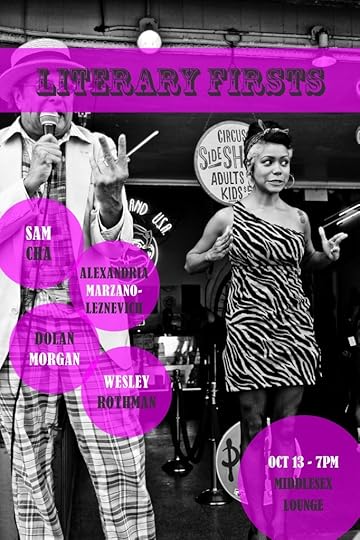
(I’ve been working diligently on four books (not mine). Dolan Morgan’s story collection, That’s When the Knives Come Down (just published on Aug 20), Liam Day’s poetry collection, Afforded Permanence (forthcoming from AP in December), the fifth issue of apt (dedicated entirely to long fiction (yay!), due in January 2015), and Susan McCarty’s story collection, Anatomies (forthcoming from AP in Summer 2015!). It’s been really rewarding. These books are going to kick ass, if they’re not already kicking.)
Designing.
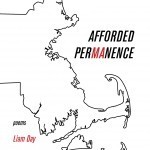
(I’ve designed the covers and interiors for Liam’s book and Susan’s book, and I’ve made the promo image for the October Literary Firsts reading. Soon, I will design apt 5. And that will be stunning.)
Revising.
(Some syllabi revision. More fiction revision. Just in case you’re wondering how revising differs from writing—well, that’s tricky. Because I revise as I write, the actions are inextricable for me. But even if I didn’t revise right away, every new draft comes with new sentences, or old sentences with new words. So I like to think of revising as an opportunity to write again or to write brand new. So I’m always revising. I’m revising everything. To quote Randolph, “I’m writing the second draft of my life.”)
June 10, 2014
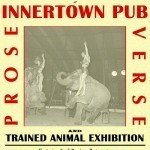
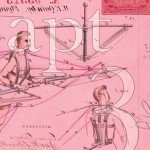
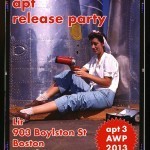
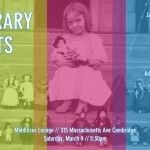
Book covers and flyers and words as images
Recently, I was tooling around in InDesign and I made a few mockup covers for a friend’s forthcoming book. She asked if I’d ever studied graphic design. I said I hadn’t, which is true, though for a couple semesters in college, I was going to be an art major. One of the many reasons I switched majors is because I can only sort of draw. Translation: it takes me forever to draw anything I actually like. Writing is similar, though I’m more committed to that, and it takes less time, or maybe I’m just used to it.
But, for ten short months, I studied drawing (Drawing I and Drawing II) and illustration (Illustration I) and sequential art (Graphic Novel I). Oddly enough, I never took a graphic design class. I say oddly because the only visually creative thing I do with any regularity is design promotional images for Aforementioned and Literary Firsts.
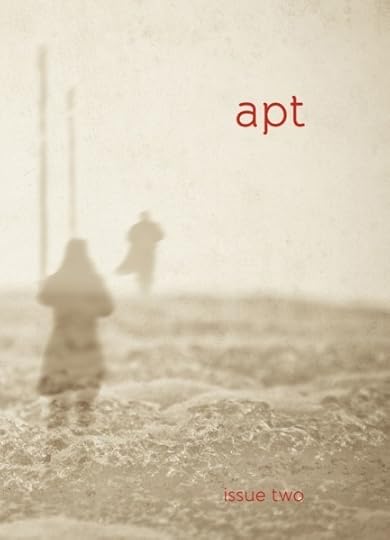
For a while, Randolph did all the design work for us. Now we share the labor—it basically falls to whoever has time. But here are the things I’ve made for AP and LF. It’s nice to look at them together like this. I hope I can show you the cover for my friend’s book. I can’t wait until it’s a real thing.










March 14, 2014
Among Wallace and Beattie
 The Mere Weight of Words got a nice write-up from Dazed in their article collecting “the ultimate novellas.”
In it, Lauren Oyler called Mere “[a] potent exploration of the cerebral.”
Girl after my own heart.
Also, I can now say my work has been listed alongside that of David Foster Wallace and Ann Beattie (which is to say, my day and week and year have been basically made).
You can check out the full article here.
January 12, 2014
Ten years
This year marks a decade since I left Pennsylvania.
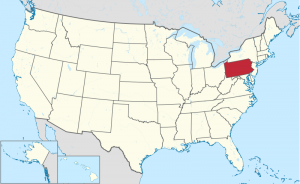
I was born there. I grew up there. I lived there for twenty-three years.
For the most part, I actively disliked being there. I didn’t hate it, but I never loved it. It wasn’t home. It wasn’t comfortable. Even the parts of PA1 that I like (Philadelphia, Mt. Hope, New Hope) are not what I’d call welcoming. They’re fine to visit—but it stops there. Mostly, I think of the rest of PA (the parts I’m not from) as respites from where I grew up: the Lehigh Valley.
To try to encapsulate what it’s like growing up there, I’m going to try to tell you what the Lehigh Valley isn’t: a city.
Since leaving PA, I’ve lived in three different cities (or, if you want to be pedantic, five different cities in three metropolitan areas), all of which have discernible skylines.
The Lehigh Valley has two tall buildings:
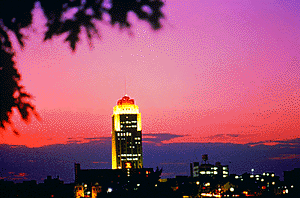
1/The main offices of PP&L (Pennsylvania Power and Light), located in downtown Allentown, and
2/Martin Tower (frequently mispluralized by locals into Martin Towers), located on the more pleasant side of the Allentown/Bethlehem border.
My concern is with the former.
A quick Google search will tell you that the PP&L building was once the world’s tallest building. At 322 feet and twenty-four stories, you’ve probably correctly surmised how long ago that was. Even as a kid, I knew the building wasn’t tall, but my father worked for PP&L (probably still does), so it seemed (like him) large enough, and imposing in its way. Its imposition is what stands out strongest to me now. No matter where I went in Whitehall (the tiny suburb where I was raised), it felt like I could always see that building. I always found it when we were in the car. I found it and watched it and thought it was watching me. I had a clear view of it from the window of my bedroom. I used to look at it at night, feeling unsettled by its arrogance (it seemed at times haughtily aware of its status as Allentown’s only “real” building) or upended by its indifference (it seemed also aware that I knew it was Allentown’s only real building, and therefore expected more from it, yet it didn’t care what I wanted, because it was just a building for fuck’s sake).
The only time I liked the PP&L building was during Christmas, when there was a Christmas tree on one side of the building and a candle on the other. It seemed less ominous with images on its flank. But even they became like everything else in the Valley: predictable and, after seeing them for so many years, staid.
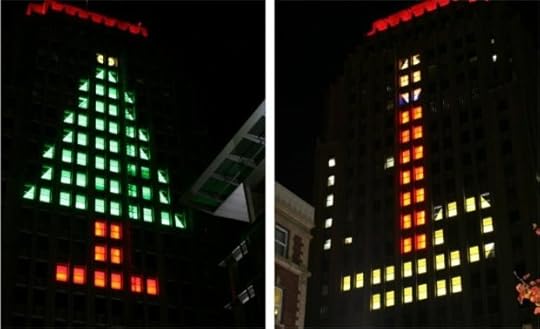
Their consistency, and the building’s consistent presence, seems in retrospect proof positive that the Lehigh Valley would never change. And I knew, as young as thirteen, that I would never change if I stayed there.
And man, did I want to change.
At thirteen, I’d decided that I was going to move to New York as soon as I turned eighteen. But I was sick of New York by the time I turned seventeen. Also—and I think this is a sentiment that plagues my thoughts about that city still—New York was always my father’s city, and by the time I moved out of his house, I felt I’d gotten enough from him. I wanted a city of my own.
Sometime during my last year in Whitehall, during my final teenaged hurrahs, I decided I would move to Boston.
NB: I’d never been to Boston. I didn’t know anyone there. I didn’t know anything about it at all, except that I’d gotten a pamphlet from Emerson College (which I may or may not have requested). Immediately, I loved the photographs: here was a city with trees.
I grew up next to a forest. If you look at my childhood corner of Whitehall on satellite view, you’ll see what I mean. The A is the house I grew up in. The green space is, as you surely guessed, the trees.
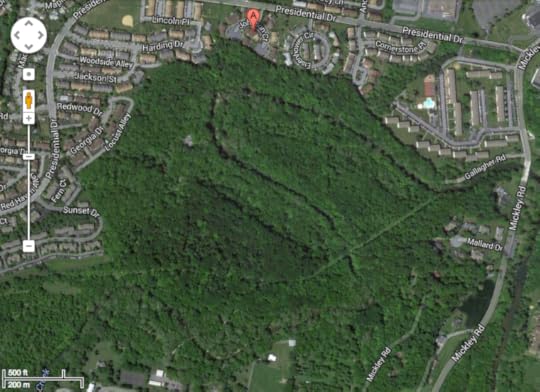
(If you look at it on Google Earth, it’s like SimCity married Legend of Zelda.)
Boston made sense to me, not just for the trees, but for its promise. It was something that might be mine. And even if it changed, I could change with it.
So, at nineteen, I started telling my friends I was leaving.
Then I left.
But I didn’t get far. I had no idea how to start. All I knew was that I had to get out of Whitehall. The farthest I could go was Bethlehem: seven miles (or, in PA measurement, nine minutes) away from Whitehall. But since I didn’t drive (I still don’t), it seemed a world away.
Still, I made plans to visit Boston. Road trips. Getaways. An ill-conceived, but awesome thing called Party Car. All of them fell through. I had to wait.
But I had left Whitehall. I’d done that at least. But Bethlehem, which was nice enough (think charming tourist trap), was still in the Lehigh Valley, so still stagnant and still, in its way, suffocating. It wasn’t just me. So many of my friends felt it. During the three years I spent in Bethlehem, I did some very stupid things to blow off steam. Emotionally stupid, very naive things.
Implicit: Mistakes were made.
Without implicating the few friends I still talk to from PA, I’ll say my last year there was dramatic and heartening and volatile and sad.
Explicit: Bridges were burned.
I finally decided to jump ship, whether I was ready or not. Miraculously, I’d made two friends in Boston (thank you, internet). Serendipitously, I’d fallen for a girl who gave me the best gift I never thought to ask for when she said, “I’ll buy your bus ticket online. Just pay me back.”2
We went to Boston. We visited for two and a half days. I knew I’d made the right decision. I just had to get there.
I went back to PA and saved money and my friendships fell apart and my boss at work tried to cut my hours (effectively trapping me there) and I saved money somehow anyway and I had the worst birthday of my life, and two days later, I met Randolph.3
Since I was moving to Boston and Randolph was planning to move to New York, since I was dating someone else and Randolph had just gotten out of a long relationship, since I’d been routinely falling for writers ever since I was sixteen and Randolph would say things like “All the writing I’ve published is in academic journals,” since I thought he was boring and Randolph thought I was that girl,4 and since he’d say things like, “Well, I don’t really read fiction,” it didn’t seem like things were going to work out.
But, after a breakup and only a little coaxing (both on my part), I convinced Randolph to do all of the following: 1/cease his plans to move to New York; 2/move up to Boston with me instead, 3/give fiction a chance.
A year later (2005), we founded a theatre company, small press, and literary journal.5 A year after that (2006), we got married. A year after that (2007), we moved to New York6 so I could start college. A year and a half later (2009), we moved back to Boston. A year after that (2010), I founded Literary Firsts. A year after that (2011), Randolph started writing.7 A year after that (2012), I graduated from college. A year after that (2013), I started graduate school and we secured national distribution for our small press.
And now, this year, we’re releasing our first full-length collections, I’m working on a novel and a short story collection, and Randolph and I are celebrating ten years of complementary insanity.
Carissa Halston and Randolph Pfaff
2004-
(now featuring six books in print, two on the way, 8+ years of archives at apt, boatloads of reading/editing experience, one lunatic cat, and scads of plans for the future)





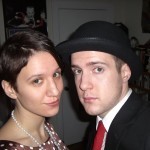

(photos from way back when)
1 pronounced pee-ay, which is a given if you’re from there.
2 I didn’t have a credit card or a debit card, so this was an impossibility made possible.
3 technically the second time I met him, though I had to meet him that first time to make the second time count.
4 Not to be confused with Marlo Thomas, “that girl,” according to Randolph, is a girl who’s different for the sake of being different. It should be noted that this is not particular to gender, and you can just change “girl” to “guy” and end up with the same annoying archetype.
5 Seven and a half years later, we’d officially be a non-profit organization.
6 Every mistake is an opportunity to learn.
7 I’m cursed.
December 17, 2013
Lists of lists
It’s the end of the year, which means listmakers have been compiling the year’s best books into neat and tidy lists for at least 2.5 weeks. I said it last year, and I’ll say it again: it’s the middle of December. 2013′s still got two more weeks. Also, I’ve only read 33 books so far this year, so I plan to read at least two more books before the year’s out.
That said, I did take part in a listmaking activity, but only because I was able to write about anything I wanted and because the man behind the lists was Troy Palmer, who runs the ever-impressive Little Fiction.
My list features ten calls to literary arms. You can read them here.
Also, as long as we’re on the subject of lists, I want to take this time to show my appreciation for the amazing people I’ve worked with this year, either at apt or Aforementioned or Literary Firsts or AGNI. This is not meant to be exhaustive, but I had such a great time working/spending time with the following writers/artists: Anthony D’Aries, Michael Thurston, Danielle Jones-Pruett, Sarah Sweeney, Steven LaFond, Sarah Fawn Montgomery, Denise Warren, Dolan Morgan, Lam Pham, Alexis Pope, Michelle Cheever, James Tadd Adcox, Sam Cha, Elisa Gabbert, John Cotter, Melissa Febos, Adrian Todd Zuniga, Robert Kloss, Vanessa Veselka, Chris Marstall, Myfanwy Collins, Reyna Clancy, William Pierce, Daniel Evans Pritchard, JoeAnn Hart, Daniel Nester, Tony McMillan, Michael Lynch, Nicole Terez Dutton, Kim Triedman, Anne Champion, Michelle Seaton, Molly Howes, April Ranger, Amber Burke, Lena Bertone, Krysten Hill, James Grinwis, Mary Cafferty, Janelle DolRayne, Justin Lawrence Daugherty, Andra Hibbert, Michael Nagel, Meg Thompson, Emily-Jo Hopson, Amanda Deo, Kacy Beck, Michael Chaney, Celine West, Dillon J. Welch, Johnny Magdeleno, Sally Molini, Mark Cunningham, E. Tomaszewski, Anthony Opal, Jen Michalski, Margaret Eaton, Christine Langill, Pat Hanahoe-Dosch, Eric Blix, Mercedes Lucero, Caroline Reid, Tracy Dimond, Nina Boutsikaris, Gabriel Schlesinger, Josh Cook, Jen Knox, John Gorman, Paige Taggart, Carolyn Zaikowski, Rich Ives, Melissa Barrett, Priya Chandrasegaram, Amanda Chiado, Gregory Crosby, C.E. Garrett, Ben Gunsberg, Suzanne Lee, Kate Nacy, Kevin O’Cuinn, Emily O’Neill, Nikola Petković, Samuel Piccone, Matt Thompson, Justin Waldron, Liam Day, Tony Tulathimutte, Selena Anderson, Sarah Mathews, Robin Mork, and of course, in every capacity, always, Randolph Pfaff.
Happy end of the year, all. Thanks for reading.