Carissa Halston's Blog, page 4
November 17, 2013
Death of a translator (in memory of William Weaver, 1923-2013)
 Many of you have probably heard of Italo Calvino–writer extraordinaire, fabulist, and author of several influential works, most notably, Invisible Cities and If on a Winter’s Night a Traveler.* If you know Calvino, you also know he was an Italian writer, which means if you’re reading this text, you’ve probably only read Calvino in translation.
My dear friend Robin was the first to encourage me to read Calvino’s work, but she stressed that I should be careful of whose translation I read. She gave me her recommendation: William Weaver.
I’d been curious about translation in the past. I’d wondered, when reading a translated text, whether I loved the original author’s work or whether I loved the translator’s. In reading William Weaver’s translations of Calvino, I learned that I loved both.
Weaver and Calvino had an auspicious start to their writer/translator relationship, which began shortly after Calvino had fired a different translator for taking liberties with his work. As a result, Weaver went out of his way to make sure Calvino felt included in the translation process, which often led to consideration of the original text as well as the translation:
With Calvino every word had to be weighed. I would hesitate for whole minutes over the simplest word—bello (beautiful) or cattivo (bad). Every word had to be tried out. When I was translating Invisible Cities, my weekend guests in the country always were made to listen to a city or two read aloud.
Writers do not necessarily cherish their translators, and I occasionally had the feeling that Calvino would have preferred to translate his books himself. In later years he liked to see the galleys of the translation; he would make changes—in his English. The changes were not necessarily corrections of the translation; more often they were revisions, alterations of his own text. Calvino’s English was more theoretical than idiomatic. He also had a way of falling in love with foreign words. With the Mr. Palomar translation he developed a crush on the word feedback. He kept inserting it in the text and I kept tactfully removing it. I couldn’t make it clear to him that, like charisma and input and bottom line, feedback, however beautiful it may sound to the Italian ear, was not appropriate in an English-language literary work.
Falling in love with foreign words (with any words) is a writer’s occupational hazard. However, I envision translators holding their words to a higher standard than love. They may love words, but loving them is, of course, not enough. Love is imprecise. Love is, often, not synonymous with respect.
Translating, like editing, is often considered an invisible art, but I’d argue that it’s more visible when more than one translator is at work.** Lydia Davis wrote an insightful response to a negative review she’d read of her translation of Proust’s Swann’s Way—in the review, Davis was accused of paring down Proust’s language in an attempt to make her translation a more signature version. (NB: Hers was the first translation since the original translation, which had scholars diving to parse the differences.) An excerpt from her rebuttal:
It is not difficult for an experienced writer to compose a cadenced sentence. But my aim was, precisely, to follow the lead of Proust’s own text as closely as possible, unadorned by my own interpretation, uninflected by my own writing style, not simplified, but not complicated, not obscured, but not “updated.” And because of the beauty of Proust’s prose, the work was an endless pleasure; what a privilege to spend one’s day deciding to toss out the nice enough “catastrophic deluges,” for instance, in favor of the more peculiar, but closer, “diluvian catastrophes.”
I’ve never attempted to translate another writer’s work (and, though I am in awe of the art of translation, I likely never will), but I imagine that shedding your own aesthetic style is like teaching yourself to walk, long after you’ve already learned. While this new method may be more ornamental or more circuitous than your usual gait, it will get you to your destination faster and more efficiently (and, likely, through the appropriate entrance) than you would had you followed your usual protocol.
That said, I also imagine translation must be like learning how to not talk—how to measure, how to refurbish your words for someone else’s voice. My most recent book features a woman whose speech production is greatly reduced after she becomes paralyzed, a topic I chose to write about for many reasons (physical paralysis as paralleled with emotional paralysis), but mainly because I found the idea terrifying. I find the idea of translation far less scary, but still an undertaking that requires a great amount of patience and will to be successful.
William Weaver was immensely successful. When I read his translations, I find I want to live in them. I want to fashion a house for myself with his thoughtful, deliberate words because I know they’ll hold.
* – If you haven’t heard of Calvino, I’d start with Invisible Cities, then go to Mr. Palomar, then hit his collection of essays, Six Memos for the New Millennium. Before you delve further, check the translator just so you can be aware of the nuance occurring.
** – To see what I mean, look at Calvino’s Complete Cosmicomics, which was translated by Martin McLaughlin, Tim Parks, and William Weaver. If you’re not yet ready for Calvino, there are other teams of translators. Etgar Keret’s work is regularly translated by Miriam Schlesinger and Sondra Silverston. Borges’s Ficciones was edited by a crew referred to (in every edition I’ve ever encountered) only as “Emece Editores.”


November 2, 2013
I will read things. You will listen.
Yesterday, I was talking to Carolyn Zaikowski about possibly doing a mid-Atlantic or west coast tour together sometime in the not too distant future.
Then I found out she’d be reading in Baltimore next Saturday, so I said, “Great! We can talk about it then!”
Then, less than twelve hours later, I was invited to read at the same venue on the same night.
So, I can say (with fair certainty) that the future is rapidly approaching.
To that end, if you’re in Baltimore next weekend, you should show up to Say It with Writing next Saturday to hear me and Carolyn AND Jamie Iredell (!). Reasons to come include:
a nice range of contemporary fiction
that just so happens to be free
and will also, as it turns out, be followed by a party
So if you don’t like contemporary fiction, come for the party. And if you don’t like parties, come for the fiction.
And if you don’t like either of those things, come anyway so we can try to change your mind.
Also, for my dears in Boston, I’ll be coming at you twice in January:
FIRST in co-emceeing capacity (with the always lovely Randolph Pfaff) at Brookline Booksmith for the apt release party on Saturday, January 18;
THEN at Literary Firsts on Monday, January 20, I’ll be functioning in full host/reader force–and Carolyn will be reading that night too! She’ll be the fiction reader. I’ll be the confessional reader. My reading will NOT be recorded, so you’ll want to be there in person for this one.
Also, as a friendly reminder, you can keep track of all appearances (if you so desire) on the events page.
And now I have to run because I have to go to a different reading where I will just be in the audience, which is good because that’s where I like to be.
October 11, 2013
Variations on a Life in B
I miss my old apartment. The new one is nice. There’s a skylight near my desk.

But I miss the ceiling in the old apartment. (And I kind of miss my hair.)

Maybe I just need to turn my light on.

(This is called procrastination. It’s clearly time to read.)
October 3, 2013
Recipient of Bambi Holmes Award from Fourteen Hills
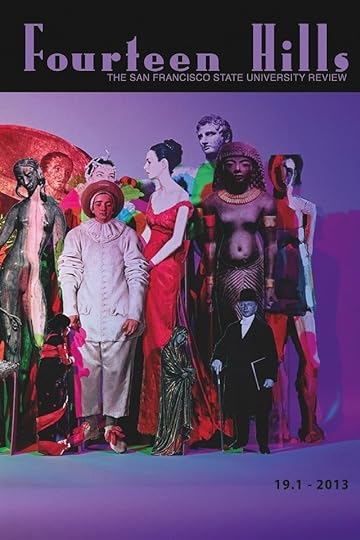 Late last year, I received news that Fourteen Hills was accepting my short story, “Hacking and Packing.”
Getting that news was a thrill, but also a relief. H&P is a dark story, and it went through quite a few iterations before I could get it to work. Darkness being the acquired taste that it is, I was grateful my work had found such a noteworthy venue.
Gratitude, though, doesn’t cover my excitement over the e-mail I recently received from Juliana Delgado Lopera, the Fiction Editor at Fourteen Hills—she was writing to tell me I’d won this year’s Bambi Holmes Award, which honors an emerging fiction writer published in the journal over the past year.
Juliana was very kind to say she found my work “poignant [and] well-crafted . . . You shed light on the grotesque, the absurd, the intense in inventive and compelling ways.”
I’ve written an essay about the editing process I went through while drafting H&P, which will appear on their site with the release of issue 20.1. That reminds me of another thrilling point—Fourteen Hills just turned twenty years old! I get excited that apt is eight years old. I’m going to lose consciousness when it reaches twenty.
You can get a copy of Fourteen Hills 19.1 (the issue wherein H&P appeared) here, which I highly recommend as you’ll be supporting SPD, the editors at Fourteen Hills, and all the writers who I’m lucky enough to call co-contributors.
September 10, 2013
The good news + Literary Firsts
A few weeks ago, I posted about some good news that I couldn’t yet discuss.
We were able to talk about it the next day, so we did. On Facebook and Twitter and the AP site and apt, but not here, so here goes: Michael Lynch’s Underlife and Portico is the winner of this year’s Jean Pedrick Chapbook Prize! We’re so proud of him and of his book that we’re offering a free copy of U&P with a purchase of the most recent issue of apt.
We mentioned this over at the apt site, but no one’s taken us up on it yet.
Dear reader, let it all start with you.
And, if you already have apt 3, you can buy Michael’s book right here.
Also, while I have your attention, the next Literary Firsts reading is less than five weeks away! As always, I hope to see you there, Boston/Cambridge/everyone.
Until then, whet your literary whistle on the lovely promo image—

August 26, 2013
Reviews, nominations, recommendations, and good news
To quote Oscar Wilde, “I’m so full of interesting information, I feel like the latest edition of something or other.”
I’ve been meaning to write about this for nearly a month now, but between working, packing, moving, and unpacking, I’ve been waist-deep in boxes and editing. But no more procrastinating: I’m honored to say my short essay/review, “Stories about Scars,” has been nominated for inclusion in next year’s Best of the Net anthology. A hundred thanks to Molly Gaudry and the Lit Pub crew for nominating me and for publishing my work in the first place!
Speaking of nominating and publishing, yesterday afternoon, we received great news for one of AP’s authors and I want to talk about it now, but I have to wait until official word has been posted. So, I will hold my tongue until I’m allowed to say more (but please know that there is much to say).
I can say that the news sent me to NewPages, looking for semi-related information/reviews and, as I scrolled through their August edition, I saw the cover for Mere. I’d sent NewPages review copies of Mere months ago, so I’d all but forgotten to look for a review. I was delighted to read the following from reviewer, Karen Seehaus Papson:
“Carissa Halston was born in the wrong time. Her careful, precise use of language and acute awareness of the nuances in each painstakingly chosen word seem like attributes more suited to a woman from Emily Dickinson’s era. Yet, Halston’s novella The Mere Weight of Words, first and foremost a tale of language, is rooted in today’s world through her examination of how casually words can be used. … Halston certainly understands what motivates her character, and that is the real source of power in this novella. … It’s clear that Halston has a way with words, and she has no doubt earned the devotion of a new set of readers with this volume.”
You can read the full review here. Also, I think this means that NewPages and I are in love. Maybe.
And, finally, the recommendations.
First, a recent fascination: the most recent issue of Harper’s includes an essay from William T. Vollman, “My Life as a Terrorist,” wherein Vollmann details what he can from the contents of his FBI file (which he had to sue the government in order to see). The FBI suspected him of being both the Unabomber and the anthrax mailer. Three pages from his FBI file have been posted to Harper’s website. The tone is laughable, but also (in context) chilling. The contents of this file were written in earnest. This is not satire. Read the first page below and all three pages here.

Second recommendation, a novel: Bill Cotter’s Fever Chart. I bought this book way back in 2009 (the year it came out). I picked it up because its mesmerizing cover caught my eye (whoever designs the hardcovers for McSweeney’s has a firm grasp of my aesthetics and a firmer grasp on my purse strings (see: the hardcover editions of Deb Olin Unferth’s Vacation, John Brandon’s A Million Heavens, Bill Cotter’s Fever Chart, Rebecca Lindenberg’s Love: An Index, and Paul Legault’s The Emily Dickinson Reader—beautiful, all). I read Fever Chart’s dust jacket and first page, took it home, and said, “I will get to this soon.” Soon came four years later, but better than not at all. Cotter’s language is smart without going over your head. His voices are consistent, be they male or female, Bostonian or New Orleanian. His characters are vulnerable and insane and relatable and hateful and human and selfish and real.
An excerpt, wherein the protagonist, Jerome, imagines his injured hand (which remains injured throughout much of the book) whole and useful and able, a metaphor for Jerome’s desire to more easily cope with stress and change and people, hand-as-personality:
“Just like they say, old wounds ache more in the rain. My hand whined with especial vigor during the cold, acidic rainstorms. I took a lot of ibuprofen and acetaminophen and ordinary headache powders, but they didn’t do much except twine the guts and eat money. The only thing that really helped was to lie in bed and imagine my hand as whole and flexible, gripping a subway balance bar—an act I considered the most demanding of the full range of a hand’s sensitivity and motion. I rode this subway all over, up and down and crosstown on every line, all day and night, in every season, squeezing the bar, anchoring myself during the hard turns and starts and stops, the muscles in my hand constantly adjusting to the minute changes in velocity and position that an old subway car on fifty-year-old pitted-steel tracks can deliver to a healthy, powerful grip in unconscious but full surety of its purpose. It was the closest I’d ever come to meditation. But even that didn’t help much.”
A warning: the book is harrowing. Passages are difficult to read, recurring instances of sexual assault, violence, murder. An insistent and terrifying portrayal of the institution that is mental health in the US pervades so much of the book, it’s a character unto itself. But as scary as that is, as much as it knocks you around as you read it, that’s how funny it is. That’s how heartwarming and genuine it is. Bill Cotter has written a masterful and moving work. Fever Chart is a firecracker. Read it, read it, read it.
August 2, 2013
Somehow
Tonight, I repeated things like, “We’ll be back in two months,” and “This isn’t goodbye.”
I taught Krysten how to box step. I sang Megan a song. I blew bubbles that landed whole on the grass in the Greenway. I danced in the fountains. Jamie jumped into my arms. Jo got a semi-lewd greeting. Dan offered to drop his Rs for me. Angie got her feet wet for me. Shannon renamed us Person A and Person B. Steven helped me navigate a crowded saint’s feast. Tim brought a watermelon and cut it with a Leatherman. Lindsay reminded us of our city’s marketable history. Greta reasoned that city parks are unquestionably odd. Janaka and Randolph rubbed Celan tattoos. Karyn related how she recently punched a car, which prompted the story about the time Randolph punched a cab on School St and a car in Harvard Square. Colin suggested Cafe Vittoria. Randolph walked me home.
Oddly, it was Lisa that made me cry.
We didn’t see each other—she stopped by when I’d run home—but she left a gift, a recognizable memento. A thing that says nothing louder than Boston. I was so upset that I missed her (because I haven’t seen her in months), but if I’d seen that any sooner, I’d have cried all the more and I didn’t want to cry tonight.
Because it’s not goodbye.
We’ll be back in two months.
So it isn’t goodbye.
We’ll be back in two months.
It isn’t goodbye.
It just isn’t goodbye.
It can’t be.
July 25, 2013
A found poem about vaginal health
Years ago, I heard about the benefits that pineapple consumption has for vaginal health. But, having a citric acid allergy, I have to be wary of how much citrus I consume.
So, about thirty minutes ago, I took some time to look up how much pineapple juice was necessary to obtain optimal vaginal health, and along the way, I found some of the most ridiculous sentences I’ve ever read.
In the name of curation, I’ve arranged the best (of the best?) into a found poem, which I call “You Too Can Write Like a Crazy and Wind Up on Page One Google Results When Searching for pineapple vag” *,**
As you could probably assume, [sic] is applicable from top to bottom.
You Too Can Write Like a Crazy and Wind Up on Page One Google Results When Searching for pineapple vag
Naturally, our vagina along with our eyes, are self-cleaning organs (fun fact).
These [tips] can help cleanse, tighten, and improve the vaginal flora.
Along with this, they can help you get rid of a smelly vagina.
Lets face it: your vagina is a dark, dank, breeding ground for a whole lotta disgusting nonsense!
Meat makes your meaty flaps salty.
No one wants sticky overly salty and dry love juices.
Avoid spices, coffee, alcohol,
junk food, salt and
anything that belongs to American,
South American, Asian,
European or Inuit cuisine.
Take out your old tampons.
Use disposable washing clothes to clean the vagina.
While showering or taking a bath, rinse your vagina with lots of water,
especially if you use soap.
A healthy vagina is as clean and pure as a carton of yoghurt.
If your vagina could smile, it would.
But make sure that food goes in your mouth.
* – To be fair, I also looked up “care and keeping vagina” and “what foods are good for vaginal health pineapple”
** – Also, I made Randolph read this aloud and he kept saying, “I can’t say that,” to which I replied, “JUST READ IT.”
For those of you who might think I’m being unfair or judgmental in sharing these out-of-context sentences, feel free to look them up and read the comments following the articles. That’s what I call judgment.
July 16, 2013
Not that I care, but–
I just received this notice from YouTube:
Dear Carissa Halston:
We have disabled the following material as a result of a third-party notification from Estate of Raymond Carver claiming that this material is infringing:
This Is an Experiment – Episode 37: Page 118 of Raymond Carver’s Will You Please Be Quiet, Please?
http://www.youtube.com/watch?v=wyuwKfqPmVY
Please Note: Repeat incidents of copyright infringement will result in the deletion of your account and all videos uploaded to that account. In order to prevent this from happening, please delete any videos to which you do not own the rights, and refrain from uploading additional videos that infringe on the copyrights of others. For more information about YouTube’s copyright policy, please read the Copyright Tips guide.
If one of your postings has been misidentified as infringing, you may submit a counter-notification. Information about this process is in our Help Center.
Please note that there may be severe legal consequences for filing a false or bad-faith notice.
Sincerely,
— The YouTube Team
My This Is an Experiment reading from Raymond Carver’s Will You Please Be Quiet, Please? has been removed from YouTube.
To clarify, the recording of my reading of a single page from a story written by Raymond Carver has been removed because the people who have an interest in making money off of Raymond Carver’s work think I committed copyright infringement.
I just want to state here that what I did is covered under fair use, under the first clause, that being:
Purpose and character
The first factor is regarding whether the use in question helps fulfill the intention of copyright law to stimulate creativity for the enrichment of the general public, or whether it aims to only “supersede the objects” of the original for reasons of personal profit.
I assume it didn’t occur to the people who run Raymond Carver’s Estate that one reader sharing a single page from a book—much like excerpting the same amount of text in, let’s say, a review—might actually entice another reader to pick up said book.
But, hey, who wants to actually talk about reading anyway? Literature’s just a business, right? It’s just a subheading under publishing, right?
As long as I’m trotting out that first clause though, I just want to underline the last section from the excerpt above: whether it aims to only “supersede the objects” of the original for reasons of personal profit.
I read from fifty different books by fifty different writers for more than five weeks because I LIKE TO READ. I like to talk about reading with other people who also LIKE TO READ. I didn’t make a profit. I wanted others to profit. I wanted others to share this experience—e.g. READING—with me. The only people who would actually profit from this would be—wait for it—the estate of Raymond Carver because they’d get a cut of the money that would change hands if anyone who saw that video was moved to buy the book.
I’m not saying that I alerted anyone who hadn’t already heard of Carver of his existence or his work. However, there is now no chance the estate will make any money off the video, though they claim that I somehow benefited from it. But that’s fine. You go ahead and take those zero dollars, Executors of Raymond Carver’s Estate. I hope you buy yourself something priceless.
Sifting through the heft
Only three weeks (or so) left before our big move, so we’re going through our books and clothes and trying to get rid of/donate whatever we can.
Randolph’s currently trying on his older pairs of glasses–looking at the future through the past. Or maybe seeing what the future looked like then: blurry.
We’re getting rid of 250+ books. I’ve filled three bags with clothes. We’re getting rid of the TV/VCR combo that one of my oldest friends–I miss you, Neil–gave me when I moved into my first apartment at eighteen. That means getting rid of the two dozen VHS tapes I’ve hung onto for the past thirteen years, mainly from the cartoons that ran as part of MTV’s Oddities: The Maxx, Aeon Flux, The Head. But also some late 90s romantic comedies: The Truth about Cats and Dogs, Kissing a Fool, among others. I’m doing this from memory. I haven’t watched any of the tapes or even looked at them since we moved back to Boston four years ago.
These are easy decisions to make. It’s easier to leave things behind than it is to leave the place itself.
Last night, I hosted Literary Firsts–the series I started after spending two years away from Boston (in New York) and returning, wanting to do more with/for the Boston literary community. The air conditioner at the Middlesex is broken, and though they had portable units and fans, we all remarked on the temperature. But everyone stayed because the readers transcended the heat. They made it a joy to be in that room. They reinforced my decision to keep Literary Firsts where it is. I think of it as part of Boston and Cambridge and the work I’ve done here, but more so the work that all the writers who I’ve had the great opportunity to work with have done in its name.
I’m trying not to think of this as goodbye. I keep emphatically telling everyone that it really isn’t goodbye. We’ll be back in October, then January, then April, then July. Then we’ll play that same tune on repeat for as long as it takes for us to come back.