Carissa Halston's Blog, page 5
July 5, 2013
Women’s challenging work
After reading an article on Buzzfeed about “The 25 Most Challenging Books You Will Ever Read,” a list that I posited would include Infinite Jest* and Ulysses (which it did) and no female writers or, if there were a female writer, it would probably be Ayn Rand (there were four books by female writers: Joanna Russ’s The Female Man, Ayn Rand’s Atlas Shrugged (the inclusion of which tasted like bitter vindication), Djuna Barnes’s Nightwood, and Virginia Woolf’s To the Lighthouse), I took to Twitter to share the list and comment that there were no contemporary female fiction writers included, tagging it with a perfunctory Peanuts-esque *sigh*.
Randolph asked me who I would’ve included. Gillian Devereux asked the same thing, via Twitter, this morning. I first named Lionel Shriver, then told them both that it was less the exclusion altogether of female writers of contemporary fiction and more the reasoning that fuels it. The larger problem is the way fiction writing is pitched to women as opposed to the way it’s pitched to men. Men need to write the Great American Novel in order to live up to their predecessors. Women, however, need to break stereotypes about genre (romance, etc.), and their books still get tagged as “women’s fiction.” Gillian said that the writers she first thought of were either dead (and therefore disqualified in the “contemporary” argument) or pigeonholed by genre. She mentioned Octavia Butler, Shirley Jackson, Patricia Highsmith, and James Triptree Jr. We then went back and forth, naming more women, still alive and well, who write challenging fiction (or, in some cases, non-fiction):
Lionel Shriver (mentioned above)
Toni Morrison
Lydia Davis
EJ Levy (there’s one essay I’m thinking of in particular–a prize to the first person who finds it)
Margaret Atwood
Amy Bloom
Kate Atkinson
And now I’m going to toss in a few others: Shani Boianjiu, whose first novel, The People of Forever Are Not Afraid, includes an immensely strange subplot that culminates in the torture of a sub-tertiary character who gets tortured not for political reasons, but in the name of love and sustained mental peace for one of the protagonists–challenging on an ethical level, if nothing else; Leni Zumas, whose first book, Farewell, Navigator, features so many screwed up characters whose desires and wills are not spoonfed to the reader, whose characters’ behavior can easily be tagged as “assertive” (a term I’ve heard leveled at the work of female writers when readers/critics don’t know how to say, “I didn’t expect an unlikeable character to come from a woman’s pen”) but who are actually realistically rendered and all the better for it; Maud Casey, whose short story collection, Drastic, has such lyrically beautiful phrases describing characters doing very troubling things in attempts to access untouched/long-dead parts of themselves, which is not just a female reaction, dear readers, but a human one.
Something else to ponder: Most of the writers mentioned above write fiction (or non-fiction) that is also funny–even Morrison in her brutally heartbreaking way has a sense of humor. This is, I think, a woman’s coping mechanism in life, and a stylistic method of coping on the page. We’ve all been accused of taking ourselves too seriously (of not laughing at a misogynist joke, of not being gracious enough when accepting that we need to be excluded from certain boys’ clubs activities, of not willingly shutting up when it’s obvious that voicing the need for equality makes people uncomfortable), so we laugh. We laugh and we render serious work while also being seriously funny.
However, when you look at the works that actually made it on that list–not to slight Joanna Russ, but I’m talking about the two that most people have heard of (Woolf’s To the Lighthouse and Rand’s Atlas Shrugged) and the one most people who are bothering to read this post have probably heard of (Barnes’s Nightwood)–these are deeply serious, unfunny books.
So, to be part of the cerebral pantheon of literature, do we need to write only deeply philosophical books? Do we need to shed any and all voice that betrays gender? Could we, if we even wanted to, do such a thing? Or is it easier to adopt a male-sounding or gender-neutral pseudonym (see the male names/the sly use of initials listed above)?
And a final general question, sad though it might be: Is there any chance of actually building a readership of people–rather than men or women–who actually seek out challenging work? That I even need to ask gives weight to a response that I’m too optimistic to consider, even on my lowest days.
* – As an aside, I was heartened to read the description and chosen excerpt for Jest, neither of which maligned it (as many people who haven’t actually read/finished reading the book so often do), but instead focused on its emotional accessibility, which is the facet that makes the book so engaging (not to mention its compelling plot, Wallace’s brainy mastery of form, and his ability to realistically create a vast chorus of voices that put character actors to shame).


July 3, 2013
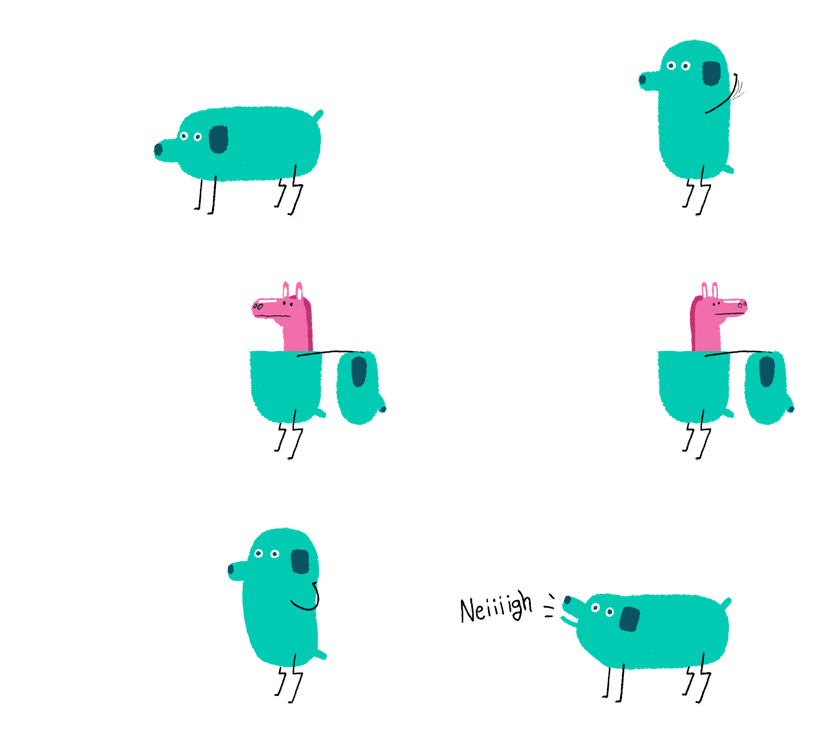
Charles Huettner
I want Charles Huettner to illustrate and/or animate my thoughts and/or life.
I just spent a fair amount of time squealing and cooing over his Tumblr archive page.
I also laughed at this louder than is acceptable in polite company.
Absurdist/surreal art tickles me.
July 2, 2013
Against the author’s wishes
Today’s Google Doodle is in honor of Franz Kafka’s 130th birthday and features a rendering of Kafka’s most well-known character, Gregor Samsa:
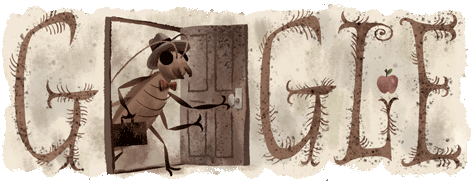
A cute tribute and a nice thought, except that Kafka explicitly stated that he never wanted cover art of The Metamorphosis to feature any visual representation of Gregor as an insect (pinning his physicality down to a certainty ruins the metaphor of man-as-bug). His exact words (albeit, translated): “The insect itself cannot be drawn. It cannot even be shown from a distance.”
In depicting Gregor’s insect form, the artists at Google have actually gone against the author’s wishes.
I wonder how many other works of literature have been co-opted against their creators’ wills. Certainly, one could point to dozens of film adaptations, but there are certain literary references that get rendered/ruined over and over and over again. The top three that come to mind are: The Wizard of Oz, The Scarlet Letter, and Moby-Dick.
I wonder what would have happened had L. Frank Baum said, “You must never render the silver slippers.”* Or if Melville had said, “To draw the white whale is to undo the hold he has over Ahab.” Or if Hawthorne had said, “There could never be a visual compelling enough to properly convey the appearance of Hester’s shame.”
I guess the same thing that happens now. They characters are drawn, the fans get angry, and with any luck, more people discover the books.
* Though they were ruby slippers in the film, they were silver slippers in the book.
July 1, 2013
StoryTapes
A few months ago, I had the pleasure of talking to Eliza Smith at StoryTapes about a number of things, mostly involving writing flash fiction, coming-of-age stories, the self, etc. Unfortunately, I wound up not recording a word I said, so we recently had a second take–during which I remembered to actually record my responses–and we talked about voice, linguistics, why I write in the second person, direct address in fiction (mine as well as others’), the reasons I avoid gendering my characters, and the relationship a reader has with an author.
Eliza layered it alongside a reading of my two stories, “Tonguing It” and “How to Fly,” as well as some lovely music that made me feel like my life is a fancy retro video game. I may have to make a playlist from them called “Theme Songs.”
You can listen to the interview (with sweet accompaniment by Andy Puls, Borrisokane, and Johanna Samuels) over at the StoryTapes site.
Good Fucking Design
I have a feeling these sentences are going to get me through grad school (and potentially the rest of my life):
“Question fucking everything. Have a fucking concept. Learn to take some fucking criticism. Make me fucking care. Use fucking spell check. Do your fucking research.”
[image error]
Buy the poster (for me?) or view other goods from GFD here.
June 21, 2013
Moved to words
My subject line is clearly a take on the phrase “moved to tears.” I’m sorry it wasn’t more clever.
In light of the recent post I wrote, then revised, then revised, then revised, then took down, then put back up, here’s the list that used to be at the end. I wrote it because I wanted to say more about the work that I’ve recently read and enjoyed. More than, “Yeah, I liked that” or “It was all right.”
I may also write a list of books I didn’t finish reading (of which there were only a few) and/or books I was told I would like, then turned around and hated. If I do so, I promise to extrapolate on what I found lacking in the works in question.
So—
The year is half over. I’ve read less than I would’ve liked (isn’t that always the way?) but, of what I’ve read, the things I’ve liked? I’ve loved.
What follows is a short list of what I loved most and why.
First, the long of it—the books:
A Million Heavens by John Brandon
The book is told from seven or eight perspectives, one of which is a wolf. It straddles the divide between life and death (one of the characters is dead), responsibility and guilt, nostalgia and grief. It’s funny in a dry way and sad in a beautiful way. The best part is that once you think you’ve got the plot figured out, Brandon pulls an ace so subtly to remind you that what you think you know about people is not always what’s true.
A standout sentence: These humans were stranded in the desert and above them hung a moon that was also a desert.
Zazen by Vanessa Veselka
I gave a lecture on writing dialogue a couple months ago and wound up pulling examples from contemporary literature with strong, compelling voices. Among them, I used the opening paragraph of this smart dystopian novel. Veselka’s narrator is both unsentimental and vulnerable, a mixture we so rarely encounter in literature. Best of all, her images are so clear, you can see them. Also, it has one of the finest last lines I’ve read in contemporary fiction.
A standout sentence: Because the search for authenticity is a well without a bottom.
The People of Forever Are Not Afraid by Shani Boianjiu
Some of the funniest novels are about war. Catch-22. Slaughterhouse Five. And now, The People of Forever Are Not Afraid. In spare, direct language, the novel follows three friends from high school through their mandatory military service in the Israeli Defense Forces and the few years that follow. Starting from the established, very unfunny topic that is war, this book has every reason to not be as funny as it is. But during its serious moments, of which there are many, an inversion takes place. What Boianjiu has made funny is again turned on its ear to become very serious indeed.
A standout sentence: I did not see who fired it, or where it hit; I only heard it; growing bigger as it passed through the sand and the line and the cement barricade where I was still trying to almost break a fall I was not having.
Second, the short of it—stories:
“City/Body: Fragments” by Susan McCarty
I love Susan McCarty’s writing so much. I read this very recently and was struck by the pacing, how tightly everything fits together, but how loose the narrative feels. Her word choice is always spot-on. Her imagery hauntingly lovely. And just when she’s broken my heart, she makes me laugh.
A standout sentence: You are running unsteadily now, really more of a lope than a run; certainly this lead-assed shamble will not save your life.
Faith Gardner is the queen of lush language. She can take a story about two poor little girls—two poverty-stricken orphans—and make it read like a fairy tale. But we’re reminded that the original fairy tales never ended well. Her concision, what she decides to tell from the girls’ perspectives vs. what comes out in third-person is a dream and a nightmare and I can’t shake either.
A standout sentence: The sisters with the sunset hair and grapefruit lips sipped their sodas and watched the clouds swallow the world out the window.
June 18, 2013
Thoughts on Reading/Expectations
Earlier this week, Justin Lawrence Daugherty (of Sundog Lit fame) posed the following questions on Twitter:
Still not buying the whole “Taipei as the messiah of literature” thing, guys. Maybe I just need to read the book. Still seeing so much “this guy is a genius” stuff. We throw that term around way too easily, anyhow, but…There is nothing from reviews or discussions of the book that make me say, YES, I need to read this. Much of the discussion surrounding Taipei seems to be all: is Tao Lin a genius? Is he saving literature? Is he a movement? Boring. Question is, why does lit need saving? Why do we need to proclaim some earth-breaker has arrived? I really want to have an honest dialogue about this. Because I’m missing something, maybe. But, it seems a tired argument.
I unloaded on poor Justin. You can go look at Twitter to see what was said, but basically, the topic changed from readers’ reactions to one book (Taipei) to readers’ reactions to any book. We agreed that readers/reviewers generally ignore what a reader should do—engage with a text after they’re finished reading it—but it seems that most readers can’t be bothered. No one wants to say anything beyond “I loved it.” or “I hated it.” We don’t even consider how extreme those reactions are—love and hate, the ends of the spectrum. Most readers won’t even try to support those extremes with anything beyond “YOU HAVE TO READ THIS” or “STAY AWAY AT ALL COSTS.”
The worst part of that situation is we’re then ignoring the work in question. We’re not discussing it. We’re letting the work “speak for itself.” As lovely as that idiom sounds, work NEVER speaks for itself. It needs a viewer, a reader—an audience. It needs discussion (and, despite recent sentiment to the contrary, I don’t believe that negative criticism is the ONLY way to generate a worthwhile discussion about a book. I’m not so naive that I mistake the general public’s desire for schaudenfreude for actual interest). A book needs to be praised and criticized (notice I mentioned both), not ignored. In choosing to ignore what we read, to read halfway, to give up reading, to not give an author the benefit of the doubt, to not suspend your disbelief, to not admit bias or expectations or preconceived notions you have about a book (NB: it is okay to have/admit to having all of the above), you’re doing a disservice to yourself as a reader and to the work you’re choosing to read.
In short order, here are two examples of the ways in which readers shortchange themselves and each other by either dismissing a book before they’ve read it or ignoring a book’s merits once they’re finished reading it.
1/You’re with a friend in a book store. You pick a book from the shelves. The book is The Juror or The Hobbit or The Three Musketeers or Slaughterhouse Five or Ishmael or Bridget Jones’s Diary or Self-Help or The Idiot.
Your friend says, “I love that book!”
You buy it, read it, and hate it.
You try to talk to your friend about this book they love. They say things like, “It’s so funny!” or “It’s so sad,” or “It’s so good!”
You say things like “It was boring,” or “It was lame,” or “It put me to sleep.”
You and your friend have nothing more to say. You can’t muster anything beyond these empty phrases that don’t get at the heart of what makes a book resonate with readers. You assume that you and your friend have very different tastes. But it’s probably not true. You just want different things from your literature. But you can’t be bothered to articulate what those things are.
2/You see a friend reading a book. The book is The Catcher in the Rye or The Charterhouse of Parma or Heart of Darkness or Middlemarch or Congo or It or Mrs. Dalloway or Twilight or Harry Potter and the Sorcerer’s Stone.
You say, “Ugh. I hate that book.”
I could stop there and allow you to figure out, on your own, the subtle trauma you’re inflicting on your fellow reader, but let’s delve into your unhelpful critique.
Let’s assume your friend is halfway through the book and enjoying it.
“Really?” your friend says. “What didn’t you like about it?”
“I don’t even remember. All I know is it was awful.”
Let’s say you didn’t finish the book. That’s fine. You don’t have to finish reading books you’re not into.
But here’s a tip: Don’t act like you have any place to discuss a book you haven’t even taken the time to read. You want to bitch about disliking a book? You have to finish read it. And you have to know why you disliked it—you thought it was boring? It put you to sleep? How about getting to the bottom of your boredom? Did you find it repetitive? Which part? How about the tedious descriptions Pip (of Great Expectations) related about having bread-and-butter in his pantleg? Did you find that wearisome? Would you rather have had character development or an exploration of setting or anything remotely having to do with the progression of the plot?
If you noticed that my tone changed just back there and I seemed a little more huffy than before, it’s because I’ve taken time to actually care about what I’m reading. Reading takes time. It’s an investment. If I’m reading a book I don’t like, you can BET I have half a thesis brewing in my mind about how and why this author can bite me. Clearly, I’m not saying you need to be 100% erudite in your needs as a reader or even your dismissal of what you’d rather not read, but just knowing why you don’t like what you don’t like makes you a smarter, better reader. If you consider a book like a intellectual meal (and, really, you should), admitting what you want from a book is like cultivating your palate.
Also, I know it’s hard not to dismiss books you simply don’t want to read. I get that it’s easier to just choose books based on the list that shows up in the sidebar on Facebook. But if you only have the same friends suggesting books to you (or, in this case, the same algorithms), you’re only going to find things that are similar to books you’ve already read. The oft-quoted “I don’t know art, but I know what I like” is apropos here, though in an altered (maybe attenuated) form: “I don’t care what I read as long as I like it.” You’ll like it because it’ll be a mashup of things you’ve read and liked before, but probably derivative and certainly not challenging the way “new” literature has the potential to be.
But maybe I’m discrediting you. Maybe you ignore those sidebar ads. Maybe you prefer to go to book stores and/or libraries and glance around and choose books at random. Maybe you read dust jackets and spend hours trying to choose which book to read. Most readers who elect to read blind, as it were, just want what we all want—to be wooed by jacket copy, to get a taste of what’s inside (maybe an excerpt above the blurbs?), to then tear into the book and have the book, in its way, tear us back.
And, honestly, that’s really all you need to do to review a book. You need to read everything on the outside, followed by everything on the inside, and you need to be willing to have your worldview changed (every book has the potential to change you, if only you’d let it). Some might argue that a reviewer needs to do research in order to review a book or they should have a deeply vested interest in the material. I would argue that a reader shouldn’t have a specific disinterest in the material in question, but otherwise, a reviewer should have the book itself (and all the marketing that normally accompanies publications nowadays) and just one statistic: how long the writer has been plying his or her craft.
I don’t mean that the reviewer should know whether the book in question is a debut or where the author went to school, or which publications are in the author’s credits (because, believe it or not, that doesn’t actually matter), rather I want/hope/wish more reviewers bothered to learn whether this book is part of an ongoing conversation, whether the author has an oeuvre—themes, orbits, whatever you want to call them—because writers tend to go through movements (just like other artists), and it might shed some light on what the author is “trying to do” with his or her latest book.
I know that seems irksome, but consider it this way: most people place a lot of importance on first impressions. Think about the last time you met someone you disliked. Think about how long it took to get over that initial impression. Let’s say it was a friend of a friend.
Another brief example:
You meet this friend of a friend at a party; let’s call him Doug. You have other friends at the party; you introduce your friends to Doug. You, like any other rational human being, give Doug the benefit of the doubt in assuming that he’s both sane and friendly. These assumptions are supported by his having made your mutual friend’s acquaintance. But then Doug starts telling lies about your mutual friend. Stupid, harmless lies. Things you know aren’t true, like, “Yeah, we got matching tattoos after serving in Iraq together. But then we had them removed ’cause, you know, we need real jobs someday, right?”
You know your mutual friend never served in Iraq. You know he doesn’t have tattoos. You want to say something, but you don’t want to look like an asshole. So, you turn to your mutual friend and say, “Dude, your friend kind of sucks.”
“Who, Doug? Don’t worry about him, he’s cool.”
“He’s doesn’t seem cool. He seems like a toolshed.”
“No, no. That’s just how he gets to know people.”
“By lying?”
“Yeah. He likes to mess with his friends. That’s how you know he likes you.”
If this seems idiotic, remember people actually say things like this. But follow me now as I alter the example to apply it to literature:
“What are you reading?”
“I’m not even sure I can really explain it. It’s this fucked up sort of travelogue. At least I think it’s a travelogue.”
“Okay…”
“But I don’t even know what’s real because the narrator is all over the place and the scenes keep changing and it’s not linear—I feel like the author is kind of messing with me because she’s got this ironic tone, but at the same time, it’s also really earnest? So she seems untrustworthy, but it’s in this way that I can’t look away from. Does that make sense?”
“Sort of…”
“…”
“So can I borrow it when you’re done?”
Q: Why do we accept this sort of deceit from a book—even want it from a book—when we wouldn’t want it from a person?
A: [Sidestepping the fact that we are far more likely to accept artifice in a thing we know is made up...] Because it’s easier to accept a thing as surprising/difficult/confusing if you’re warned in advance. Knowing beforehand that someone is going to lie to/mess with you (which is not remotely the same as suspecting someone will lie to/mess with you) makes it somehow easier to bear once it occurs.
In other words, it’s easier to accept difficult material—to want a challenge—when you feel like you’re in control (insofar as you can be with something that’s published before you read it). When we feel like we’re receiving a methodical kind of madness, we consume it whole. If a book has an internal kind of logic (even logic that seems to work against us), we take the time to learn the rules. We feel proud because we did so. We became experts on the book’s logic’s rules. We officially “get” it. And “getting” a thing usually feels like you’ve been incepted into some all-inclusive club.
Now that you’re comfortable—think about the last time you felt like you were outside of that group who “gets” something. Consider how frustrating it is to hear about that thing you don’t get. To hear how great it is. To hear how great everyone else thinks it is. That’s what it’s like to be inundated by readers who say
YOU HAVEN’T READ THIS YET?? IT’S SO GOOD. IT’S LIKE GETTING HEAD FROM A DEITY. IT’S LIKE A THOUSAND CUTE CAT VIDEOS PLAYING AT THE SAME TIME. IT’S LIKE ALL YOUR FAVORITE AUTHORS GOT TOGETHER AND WROTE BOOKS TOGETHER—BUT INDIVIDUALLY—AND THEN DEDICATED THEM ALL TO YOU. THAT MAY SOUND LIKE AN EXAGGERATION, BUT IT’S NOT. JUST READ THE BOOK. YOU’LL UNDERSTAND.
Or, conversely,
OH NO. DON’T READ THAT BOOK. THAT BOOK CAUSES STERILITY. THAT BOOK CAUSES ME TO SAY EMPTY, CYNICAL, MOSTLY BASELESS THINGS THAT CAN’T BE TESTED OR PROVEN, E.G., THAT BOOK KILLED MY NEIGHBOR’S DOG. THAT BOOK WILL MAKE YOU BORING. IF YOU READ THAT BOOK ALL THE WAY TO THE END, YOU’LL HAVE BAD SEX FOR THE NEXT SEVEN YEARS. THAT BOOK WILL GIVE YOU HALITOSIS AND COTTONMOUTH AND DANDRUFF. WHATEVER YOU DO, DON’T READ THAT BOOK.
It’s horrible, but we’ve all done something like this. We’ve all been wound up just at the moment someone happened to mention a book/story/poem we love or hate, so we said stupid things to defend/tear down the book/story/poem that so deserved our hearts/ire. Seriously, every one of us has done this. You may still do it. So, if you would, I want you to do something to offset it: I want you to admit that you have things you want from the things you read. You probably read specific websites—CNN, HuffPo, Fox News, WWTDD, whatever. You visit those sites because you have preferences. You read literature for the same reasons.
However, what you get from a literature—what literature is capable of giving you—is different/better than anything else you can read (the news, tabloids, cereal boxes, et al.). But in order to get that special something out of lit, you need to allow yourself to think/feel/explore whatever it is in you that keeps you reading in the first place. Do you read to feel less isolated? Less afraid? Less without? Do you read for entertainment? For solace? For beauty? Do you read to learn? (You may be nodding to all of these. Or none. Both are okay.) Learning to think about a book, learning to admit your expectations, learning to engage with a text and say, “Here’s where I stopped liking it,” or “This is what kept me going,” or “This sentence is beautiful/confusing/unclear/moving.” All of that is what will bring you closer to being happier with/more fulfilled by what you read. And if you’re made unhappy by it, at least you’ll know why.
And now, I punctuate my argument with a list.
Thoughts on Reading/Expectations (plus a short list of fiction that’s moved me so far this year)
Earlier this week, Justin Lawrence Daugherty (of Sundog Lit fame) posed the following questions on Twitter:
Still not buying the whole “Taipei as the messiah of literature” thing, guys. Maybe I just need to read the book. Still seeing so much “this guy is a genius” stuff. We throw that term around way too easily, anyhow, but…There is nothing from reviews or discussions of the book that make me say, YES, I need to read this. Much of the discussion surrounding Taipei seems to be all: is Tao Lin a genius? Is he saving literature? Is he a movement? Boring. Question is, why does lit need saving? Why do we need to proclaim some earth-breaker has arrived? I really want to have an honest dialogue about this. Because I’m missing something, maybe. But, it seems a tired argument.
I unloaded on poor Justin. You can go look at Twitter to see what was said, but basically, the topic changed from readers’ reactions to one book (Taipei) to readers’ reactions to any book. We agreed that readers/reviewers generally ignore what a reader should do—engage with a text after they’re finished reading it—but it seems that most readers can’t be bothered. No one wants to say anything beyond “I loved it.” or “I hated it.” We don’t even consider how extreme those reactions are—love and hate, the ends of the spectrum. Most readers won’t even try to support those extremes with anything beyond “YOU HAVE TO READ THIS” or “STAY AWAY AT ALL COSTS.”
The worst part of that situation is we’re then ignoring the work in question. We’re not discussing it. We’re letting the work “speak for itself.” As lovely as that idiom sounds, work NEVER speaks for itself. It needs a viewer, a reader—an audience. It needs discussion (and, despite recent sentiment to the contrary, I don’t believe that negative criticism is the ONLY way to generate a worthwhile discussion about a book. I’m not so naive that I mistake the general public’s desire for schaudenfreude for actual interest). A book needs to be praised and criticized (notice I mentioned both), not ignored. In choosing to ignore what we read, to read halfway, to give up reading, to not give an author the benefit of the doubt, to not suspend your disbelief, to not admit bias or expectations or preconceived notions you have about a book (NB: it is okay to have/admit to having all of the above), you’re doing a disservice to yourself as a reader and to the work you’re choosing to read.
In short order, here are two examples of the ways in which readers shortchange themselves and each other by either dismissing a book before they’ve read it or ignoring a book’s merits once they’re finished reading it.
1/You’re with a friend in a book store. You pick a book from the shelves. The book is The Juror or The Hobbit or The Three Musketeers or Slaughterhouse Five or Ishmael or Bridget Jones’s Diary or Self-Help or The Idiot.
Your friend says, “I love that book!”
You buy it, read it, and hate it.
You try to talk to your friend about this book they love. They say things like, “It’s so funny!” or “It’s so sad,” or “It’s so good!”
You say things like “It was boring,” or “It was lame,” or “It put me to sleep.”
You and your friend have nothing more to say. You can’t muster anything beyond these empty phrases that don’t get at the heart of what makes a book resonate with readers. You assume that you and your friend have very different tastes. But it’s probably not true. You just want different things from your literature. But you can’t be bothered to articulate what those things are.
2/You see a friend reading a book. The book is The Catcher in the Rye or The Charterhouse of Parma or Heart of Darkness or Middlemarch or Congo or It or Mrs. Dalloway or Twilight or Harry Potter and the Sorcerer’s Stone.
You say, “Ugh. I hate that book.”
I could stop there and allow you to figure out, on your own, the subtle trauma you’re inflicting on your fellow reader, but let’s delve into your unhelpful critique.
Let’s assume your friend is halfway through the book and enjoying it.
“Really?” your friend says. “What didn’t you like about it?”
“I don’t even remember. All I know is it was awful.”
Let’s say you didn’t finish the book. That’s fine. You don’t have to finish reading books you’re not into.
But here’s a tip: Don’t act like you have any place to discuss a book you haven’t even taken the time to read. You want to bitch about disliking a book? You have to finish read it. And you have to know why you disliked it—you thought it was boring? It put you to sleep? How about getting to the bottom of your boredom? Did you find it repetitive? Which part? How about the tedious descriptions Pip (of Great Expectations) related about having bread-and-butter in his pantleg? Did you find that wearisome? Would you rather have had character development or an exploration of setting or anything remotely having to do with the progression of the plot?
If you noticed that my tone changed just back there and I seemed a little more huffy than before, it’s because I’ve taken time to actually care about what I’m reading. Reading takes time. It’s an investment. If I’m reading a book I don’t like, you can BET I have half a thesis brewing in my mind about how and why this author can bite me. Clearly, I’m not saying you need to be 100% erudite in your needs as a reader or even your dismissal of what you’d rather not read, but just knowing why you don’t like what you don’t like makes you a smarter, better reader. If you consider a book like a intellectual meal (and, really, you should), admitting what you want from a book is like cultivating your palate.
Also, I know it’s hard not to dismiss books you simply don’t want to read. I get that it’s easier to just choose books based on the list that shows up in the sidebar on Facebook. But if you only have the same friends suggesting books to you (or, in this case, the same algorithms), you’re only going to find things that are similar to books you’ve already read. The oft-quoted “I don’t know art, but I know what I like” is apropos here, though in an altered (maybe attenuated) form: “I don’t care what I read as long as I like it.” You’ll like it because it’ll be a mashup of things you’ve read and liked before, but probably derivative and certainly not challenging the way “new” literature has the potential to be.
But maybe I’m discrediting you. Maybe you ignore those sidebar ads. Maybe you prefer to go to book stores and/or libraries and glance around and choose books at random. Maybe you read dust jackets and spend hours trying to choose which book to read. Most readers who elect to read blind, as it were, just want what we all want—to be wooed by jacket copy, to get a taste of what’s inside (maybe an excerpt above the blurbs?), to then tear into the book and have the book, in its way, tear us back.
And, honestly, that’s really all you need to do to review a book. You need to read everything on the outside, followed by everything on the inside, and you need to be willing to have your worldview changed (every book has the potential to change you, if only you’d let it). Some might argue that a reviewer needs to do research in order to review a book or they should have a deeply vested interest in the material. I would argue that a reader shouldn’t have a specific disinterest in the material in question, but otherwise, a reviewer should have the book itself (and all the marketing that normally accompanies publications nowadays) and just one statistic: how long the writer has been plying his or her craft.
I don’t mean that the reviewer should know whether the book in question is a debut or where the author went to school, or which publications are in the author’s credits (because, believe it or not, that doesn’t actually matter), rather I want/hope/wish more reviewers bothered to learn whether this book is part of an ongoing conversation, whether the author has an oeuvre—themes, orbits, whatever you want to call them—because writers tend to go through movements (just like other artists), and it might shed some light on what the author is “trying to do” with his or her latest book.
I know that seems irksome, but consider it this way: most people place a lot of importance on first impressions. Think about the last time you met someone you disliked. Think about how long it took to get over that initial impression. Let’s say it was a friend of a friend.
Another brief example:
You meet this friend of a friend at a party; let’s call him Doug. You have other friends at the party; you introduce your friends to Doug. You, like any other rational human being, give Doug the benefit of the doubt in assuming that he’s both sane and friendly. These assumptions are supported by his having made your mutual friend’s acquaintance. But then Doug starts telling lies about your mutual friend. Stupid, harmless lies. Things you know aren’t true, like, “Yeah, we got matching tattoos after serving in Iraq together. But then we had them removed ’cause, you know, we need real jobs someday, right?”
You know your mutual friend never served in Iraq. You know he doesn’t have tattoos. You want to say something, but you don’t want to look like an asshole. So, you turn to your mutual friend and say, “Dude, your friend kind of sucks.”
“Who, Doug? Don’t worry about him, he’s cool.”
“He’s doesn’t seem cool. He seems like a toolshed.”
“No, no. That’s just how he gets to know people.”
“By lying?”
“Yeah. He likes to mess with his friends. That’s how you know he likes you.”
If this seems idiotic, remember people actually say things like this. But follow me now as I alter the example to apply it to literature:
“What are you reading?”
“I’m not even sure I can really explain it. It’s this fucked up sort of travelogue. At least I think it’s a travelogue.”
“Okay…”
“But I don’t even know what’s real because the narrator is all over the place and the scenes keep changing and it’s not linear—I feel like the author is kind of messing with me because she’s got this ironic tone, but at the same time, it’s also really earnest? So she seems untrustworthy, but it’s in this way that I can’t look away from. Does that make sense?”
“Sort of…”
“…”
“So can I borrow it when you’re done?”
Q: Why do we accept this sort of deceit from a book—even want it from a book—when we wouldn’t want it from a person?
A: [Sidestepping the fact that we are far more likely to accept artifice in a thing we know is made up...] Because it’s easier to accept a thing as surprising/difficult/confusing if you’re warned in advance. Knowing beforehand that someone is going to lie to/mess with you (which is not remotely the same as suspecting someone will lie to/mess with you) makes it somehow easier to bear once it occurs.
In other words, it’s easier to accept difficult material—to want a challenge—when you feel like you’re in control (insofar as you can be with something that’s published before you read it). When we feel like we’re receiving a methodical kind of madness, we consume it whole. If a book has an internal kind of logic (even logic that seems to work against us), we take the time to learn the rules. We feel proud because we did so. We became experts on the book’s logic’s rules. We officially “get” it. And “getting” a thing usually feels like you’ve been incepted into some all-inclusive club.
Now that you’re comfortable—think about the last time you felt like you were outside of that group who “gets” something. Consider how frustrating it is to hear about that thing you don’t get. To hear how great it is. To hear how great everyone else thinks it is. That’s what it’s like to be inundated by readers who say
YOU HAVEN’T READ THIS YET?? IT’S SO GOOD. IT’S LIKE GETTING HEAD FROM A DEITY. IT’S LIKE A THOUSAND CUTE CAT VIDEOS PLAYING AT THE SAME TIME. IT’S LIKE ALL YOUR FAVORITE AUTHORS GOT TOGETHER AND WROTE BOOKS TOGETHER—BUT INDIVIDUALLY—AND THEN DEDICATED THEM ALL TO YOU. THAT MAY SOUND LIKE AN EXAGGERATION, BUT IT’S NOT. JUST READ THE BOOK. YOU’LL UNDERSTAND.
Or, conversely,
OH NO. DON’T READ THAT BOOK. THAT BOOK CAUSES STERILITY. THAT BOOK CAUSES ME TO SAY EMPTY, CYNICAL, MOSTLY BASELESS THINGS THAT CAN’T BE TESTED OR PROVEN, E.G., THAT BOOK KILLED MY NEIGHBOR’S DOG. THAT BOOK WILL MAKE YOU BORING. IF YOU READ THAT BOOK ALL THE WAY TO THE END, YOU’LL HAVE BAD SEX FOR THE NEXT SEVEN YEARS. THAT BOOK WILL GIVE YOU HALITOSIS AND COTTONMOUTH AND DANDRUFF. WHATEVER YOU DO, DON’T READ THAT BOOK.
It’s horrible, but we’ve all done something like this. We’ve all been wound up at the moment someone brought up something we loved or hated and then we said stupid things to defend/tear down the book that so deserved our hearts/ire. Seriously, every one of us has done this. You may still do it. So, if you would, I want you to do something to offset it: I want you to admit that you have things you want from the things you read. You probably read specific websites—CNN, HuffPo, Fox News, WWTDD, whatever. You visit those sites because you have preferences. You read literature for the same reasons.
However, what you get from a literature—what literature is capable of giving you—is different/better than anything else you can read (the news, tabloids, cereal boxes, et al.). But in order to get that special something out of lit, you need to allow yourself to think/feel/explore whatever it is in you that keeps you reading in the first place. Do you read to feel less isolated? Less afraid? Less without? Do you read for entertainment? For solace? For beauty? Do you read to learn? (You may be nodding to all of these. Or none. Both are okay.) Learning to think about a book, learning to admit your expectations, learning to engage with a text and say, “Here’s where I stopped liking it,” or “This is what kept me going,” or “This sentence is beautiful/confusing/unclear/moving.” All of that is what will bring you closer to being the best reader you can be—a reader who gets the most you can out of whatever it is you’re reading, without feeling like reading is just one more thing you arbitrarily do with your time/life.
I could go on and on with this, but I’m going to instead punctuate my argument with a list.
The year is half over. I’ve read less than I would’ve liked (isn’t that always the way?) but, of what I’ve read, the things I’ve liked? I’ve loved.
What follows is a short list of what I loved and why.
First, the long of it—the books:
A Million Heavens by John Brandon
The book is told from seven or eight perspectives, one of which is a wolf. It straddles the divide between life and death (one of the characters is dead), responsibility and guilt, nostalgia and grief. It’s funny in a dry way and sad in a beautiful way. The best part is that once you think you’ve got the plot figured out, Brandon pulls an ace so subtly to remind you that what you think you know about people is not always what’s true.
A standout sentence: These humans were stranded in the desert and above them hung a moon that was also a desert.
Zazen by Vanessa Veselka
I gave a lecture on writing dialogue a couple months ago and wound up pulling examples from contemporary literature with strong, compelling voices. Among them, I used the opening paragraph of this smart dystopian novel. Veselka’s narrator is both unsentimental and vulnerable, a mixture we so rarely encounter in literature. Best of all, her images are so clear, you can see them. Also, it has one of the finest last lines I’ve read in contemporary fiction.
A standout sentence: Because the search for authenticity is a well without a bottom.
The People of Forever Are Not Afraid by Shani Boianjiu
Some of the funniest novels are about war. Catch-22. Slaughterhouse Five. And now, The People of Forever Are Not Afraid. In spare, direct language, the novel follows three friends from high school through their mandatory military service in the Israeli Defense Forces and the few years that follow. Starting from the established, very unfunny topic that is war, this book has every reason to not be as funny as it is. But during its serious moments, of which there are many, an inversion takes place. What Boianjiu has made funny is again turned on its ear to become very serious indeed.
A standout sentence: I did not see who fired it, or where it hit; I only heard it; growing bigger as it passed through the sand and the line and the cement barricade where I was still trying to almost break a fall I was not having.
Second, the short of it—stories:
“City/Body: Fragments” by Susan McCarty
I love Susan McCarty’s writing so much. I read this very recently and was struck by the pacing, how tightly everything fits together, but how loose the narrative feels. Her word choice is always spot-on. Her imagery hauntingly lovely. And just when she’s broken my heart, she makes me laugh.
A standout sentence: You are running unsteadily now, really more of a lope than a run; certainly this lead-assed shamble will not save your life.
Faith Gardner is the queen of lush language. She can take a story about two poor little girls—two poverty-stricken orphans—and make it read like a fairy tale. But we’re reminded that the original fairy tales never ended well. Her concision, what she decides to tell from the girls’ perspectives vs. what comes out in third-person is a dream and a nightmare and I can’t shake either.
A standout sentence: The sisters with the sunset hair and grapefruit lips sipped their sodas and watched the clouds swallow the world out the window.
June 7, 2013
Regarding overwhelming everydayness
I’ve worked, on average, 55-60 hours a week for the past month and a half.
I’ve had many headaches. I’ve lost many hours of sleep.
I am trying to create more hours in my day. I am weaning myself off of social media (Facebook is work. I’m not looking for another job.), though leaving one usually means an upswing in another. (Goodbye Facebook? Hello, Twitter.)
I taught my last class for the semester this week. I have one more faculty meeting, then one computer meeting, then that’s it.
I have two large AP projects to work on this month, one of which will be announced in July (I hope). Once those are finished, I am devoting myself at finishing the fourth draft of my novel and reading as much as I can to prepare for the fall.
Hold me to this, internet. Help me keep this promise—
I will finish the next draft of Conjoined States;
I will read ten books between June 23 and August 27;
I will spend time enjoying where I live;
I will catch up on sleep.
May 25, 2013
The Daughters recap and other (forthcoming) theatre
Last week, I had the immense honor of being part of the first ever Dorchester Fringe Festival. I unfortunately missed the first evening because of our rehearsal schedule, but I’m told it was SRO, which is a coup for an event that was marketed entirely via word of mouth.
What I saw of the festival on Saturday completely explains the demand. We showed up midafternoon and heard a musician named Kendall Ramseur (who was both a formidable singer and cellist), caught this spring installment of Write on the DOT (congratulations to Aaron Devine for steering the helm for so long and to Mitch Manning for taking over), and got to see a short play by my friend, April Ranger. I was so happy to be in the room for all of these acts, but I felt especially lucky to be an audience member for April’s play, “Civilized Rituals.” It was smart and funny and moving and I hope April has an entire evening of shorts soon because more people should know about her work.
The festival closed with the staged reading of “The Daughters,” which made me nervous and elated and concerned. It’s not a light, breezy play. It’s about war, more personal than political, and it was the first time we got to perform the show all the way through (rehearsal schedules forbade our being in one room at the same time before the festival). My nervousness was amplified because of my part in the production—it’s strange to spend 90% of rehearsal time as a director, then step into an acting role during the final 10%. But I was so proud of everyone involved and so grateful for Lillian’s, Tim’s, Jen’s, and Randolph’s dedication/hard work. The process will help me when the time comes to put the prose pieces together again (they were published separately) and I’m already starting to think about form because I want those choral voices to come across on the page the way they did in the play*.

In other theatre-related events, I’m really excited to be taking part in a collaborative/devised play with Whistler in the Dark called Vital. It was recently listed in The Boston Globe‘s critic’s picks for art and theatre this summer, which I hope will increase the audience/interest in the production. The project, nutshelled, is as follows: Meg Taintor (artistic director at WitD) asked five local writers (Miranda Craigwell, Jonathan Clark, Tyler Monroe, April Ranger, and me) to contribute a first-person narrative that satisfied this prompt:
“We’re not on our journey to save the world but to save ourselves.
But in doing that you save the world. The influence of a vital person vitalizes.”
– Joseph Campbell
After receiving work from each writer, they assigned each story to an actor and then started breaking them down, seeing where lined overlapped, where text served more than one story, where it served every story, and built the production from there.
For my part, I started writing something new based on the prompt, but it got long, then longer, and is still in-progress as I type this, so I sent something older that I thought fit the bill–my short story, “Extensions,” which you can read at Little Fiction. I’m excited to see what Whistler does with it and how it changes and merges with the other stories. Vital is running June 14-June 30 at The Charlestown Working Theatre and, if you’re in the Boston area, I hope you’ll go see it.
* – Just in case you’ve never read any of my short fiction, my work is largely informed by theatre** and dialogue and, as a result, I write a lot of dialogue-heavy prose, some of which is unattributed/deals with overlapping thoughts/speech, though “The Daughters” pushes that recurrence to the point of echo, in both narration and dialogue, which becomes an integral part of the characterization of each daughter.
** – Also, just in case you’ve never seen any of my plays, you should know that they’re largely informed by prose fiction and, as a result, often feature narrators, direct address, and descriptions of actions right before/as they happen.