
Melissa Holbrook Pierson's Blog, page 5
September 24, 2011
Up in the Air
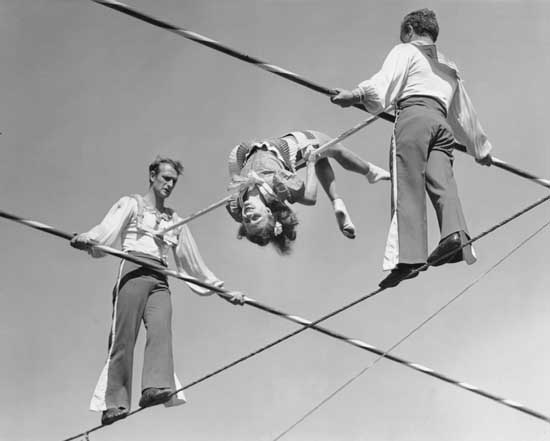 Where does it come from, trust, and what is its use? Does it exist only to give you courage to do things you shouldn't? Such as love?
I've been thinking lately about this amorphous thing. It is not made of substance, yet it is the very foundation on which you build things of great substance. Your life and all it contains, for instance. Where does it come from--childish hope?
I refer not to love which is given: that is always its own reward. And I refer not to the love we offer so joyously to our children, to our friends, and to our dogs, who alone may be counted on to never change suddenly in midstream: I just decided I don't love you anymore, so I'll see you later. The trust in a dog's return of affection is never misplaced. If anyone is looking for the primary reason we choose as companions domestic canines by the million, there you go.
(I was recently sent--by a fellow dog person, of course--the Mad TV skit in which a man stands on a ledge outside his apartment, ready to end it all, while his wife tries to talk him down. She gets sidetracked by her pets, though, a dozen ankle-biters who get cooed at, wovey-dovey, while he gets readier by the minute to jump. She finally thinks to ask him why--it's because she loves the dogs more than him, of course.)
One cannot always know what children are thinking.
Children are hard to understand, especially when
careful training has accustomed them to obedience
and experience has made them cautious in conversation
with their teachers. Will you not draw from that
fine maxim that one should not scold children too
much but should make them trustful, so that they
will not conceal their stupidities from us?
These are the words, written in 1776, of Catherine the Great of Russia. They illustrate, to devious ends, how trust leads to openness, and openness to the fullest experience of relationships in which nothing needs to be hidden. In this utopia made of trust, the energy one would otherwise devote to manipulation need never be expended. It may be spent in happier ways.
Recently I had cause to write in a notebook: "Insecure people are inherently untrustworthy." And so it is that trust is the chicken-or-egg question rolling endlessly from one side of a life to the other. Being unable to trust one's primary caretaker makes one insecure; then one turns around and later proves himself unworthy of trust.
We have all heard of people who exemplify the sad craziness of falling in love with those who are transparent liars and cheats, but who nonetheless elicit trust from their victim. "He told me he was never going to [fill in the blank] again!" "And you believed him?" "Yes! He promised!"
Oy.
But how can any of us really know? We go on our merry way, trusting in all sorts of things--the electric light that will go on when we flip the switch, the sun that rises every morning (so far!), the honesty of our elected officials, the promise and the vow and the kiss. Is it all a big craps shoot? Maybe someday we will be able to determine the logarithm of trust, that which will render heartbreak a thing of the past--the princess telephone of emotion.


September 17, 2011
Out There
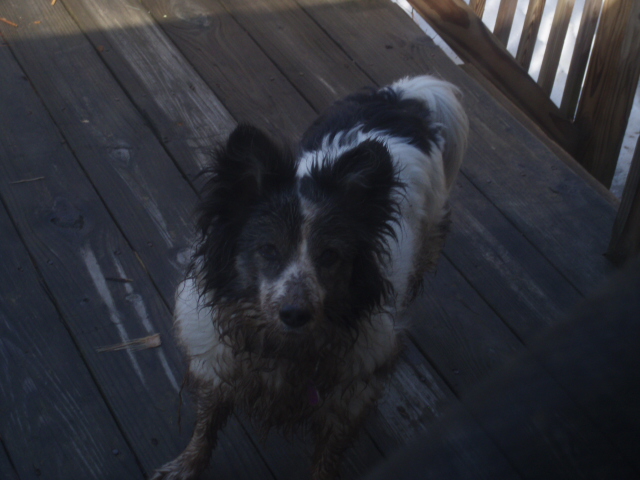 Last weekend, I went on a date with my dog.
The sun, which I'd feared had spun off into the farther universe never to return again, finally came out. It had rained for weeks, it seemed. We hadn't had a decent walk in a long time. It was Friday evening; I was feeling too restless to stay at home. Besides, I was curious about what had happened to the small town of Phoenicia in the floods. Suddenly I knew what I wanted to do: walk up the side of a mountain just outside town, then take Nelly out for a nice dinner. Even if I would be the one eating it.
It would be my first dinner out alone in so many years I can't count. I never liked it back then, fearing I wore the visible badge of the pathetic. I usually armed myself with a book. I wanted to be braver than that now, but I have to admit I wasn't: I brought a pad of paper on which to write. Just in case the muse visited, you know.
Phoenicia has always been a magnet to me. I love the way the mountains cup it; I love the fact that Main Street is two blocks long, then vanishes into the formidable green. I wanted to buy a house there. Now I'm glad I didn't: Phoenicia is sort of cursed.
Their library burned a few months ago. And every time it rains, now, the town is flooded.
There were piles of food and supplies in Rotary park, left for anyone who needs them. There was a board for posting help needed/help offered. The streets were coated with silt and mud, and huge piles of dirt that had been
scraped up stood everywhere.
I watched two women, one maybe a young sixty, come out of Mama's Boy across the street from where Nelly & I were dining. They were eating ice cream cones. They walked over to the restaurant, where they spied someone they knew on the patio behind me. I heard the older woman say, "Did you see my house? It collapsed just yesterday." She then reached down to pet Nelly, and tell me she was just like the dog she'd wanted to get a while ago. Now, she said, she was glad she didn't. But I said, "Do--for when you rebuild." She smiled and said, "Yes, that can be my reward."
I felt bad for every moment I've ever spent pitying myself. This woman, who'd lost everything, could smile, and hope for a dog.

September 10, 2011
Disbelief
 The traditional gift for a tenth anniversary is made of tin.
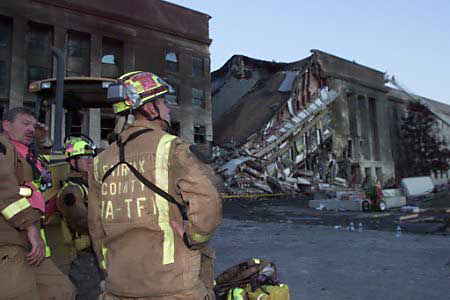
Perhaps that is why the tenth anniversary of the terrible, momentous events of September 11 are bringing out the conspiracy theories again. Apparently nothing got the doubters going quite like the structural damage of the Pentagon, which seemed to them impossible to square with a commercial jetliner going into the side of this building. They don't see airplane debris (or if they do, it was what was surreptitiously brought there later, no matter that it would be hard to hide such maneuvers in the hours following one of the most well-publicized and photographed events of the century). Every picture of this site has been scrutinized, stared at until it's a miracle the photos themselves didn't burn, and reposted online overlaid with impressive-looking lines, arrows, and angles supposedly pointing out the fact that there is something being hidden from us.
Of course there is something hidden: the answer why. Not the complex, distant historical answer; political theorists have plenty of explanations, most of which make sense and most of which none of us have any use for. But the answer why destruction and death rained suddenly one beautiful blue-sky day, and made us wonder: God, why?
According to the experts who have considered the proliferation of conspiracy theories in the wake of large and effectively incomprehensible events, it is more comforting to believe not that we are random targets but rather are worthy of elaborate, careful constructions of huge scope intended to dupe us. We are prized. And the long unraveling--the deceptions never fully unreeled, they are that big--keeps the thing from ever having an end. We can study it forever. It is never over; "over" is the point at which you bury the dead.
It is as impossible to describe what was truly felt that day as to catch the tail of a kite, line cut, that becomes smaller and smaller against the white of a large sun. Everyone has their story, every detail etched with acid on the memory's plate. You remember exactly where you were when you heard. Or, for so many of my friends, where they watched the black smoke billowing into the sky, which building roof or avenue they stood on as they watched a tall tower sink to the ground like a poleaxed animal. That sight was impossible to fully grasp either with eye or emotion. The gray ash fell everywhere over the city, and then our world.
I know exactly where I was, and why. My child's second birthday. The parents visiting. The phone call, bizarrely from across the ocean, the voice asking in French: Are you all right?
As we sat eating breakfast outdoors on the patio, the planes must have gone directly overhead; they followed the line of the Hudson River south to reach their objectives.
Later, the first time I revisited the city that had been like my second parents, the city that raised me to adulthood, the bus came around the spiral of roadway pouring us into the Lincoln Tunnel. I saw that great cityscape, but now with something missing that had seemed it would always be there (the Twin Towers were how I, directionally challenged, oriented myself when emerging from the subway: ah, there--that's south, then). The gasp undid me.
When people hear that September 11 is my son's birth date, they for a moment look stunned, as if they don't know how to respond. Is it a tragedy? No, not for me. It allows the happiness of hopeful new life to pull on the other end of the line that is pulling back with eternal sadness. I don't know why, either.
This week, as if on cue, the leaves started falling from the trees.

September 3, 2011
These Thoughts (After a Storm)
*
The first fortune cookie that cracked open, empty, brought forth a nervous laugh. It went sort of like "uh-ha-ar-a-aah." But the second one, a week later, caused nothing outward. Just a sudden cold inside. I am to have no future? Or, maybe: I am to write my own future. That came from the brave little imp who lives inside me. He is very perverse.
*
Drinking a gin & tonic right now from a purple glass. I bought the set because on the box it said "Happy."
*
Children love ghost stories because they get scared. Then they get scared.
*
The term "glacial erratics" sounds like a poem.
*
He kept opening the basement door to shine a light down on the strange sight of two and a half feet of water, just sitting there.
*
In the woods, nothing looked different. In our yards, the devastation was breathtaking. This is the difference between nature and domestication.
*
Friday night, and where is everyone?
*
While the rain fell, I read out loud from a set of booklets that had brought magic into my childhood, and sent me out into the woods to see what evidence of fairies there I could find, as had the photographer and author, Ellen Fenlon. Each book cost 29 cents. A Woodland Circus. Signs of the Fairies. The Fairy Church in the Woods. In the pictures, things looked like other things. "We saw some little mayapple umbrellas stuck in the ground because it had been raining earlier." "The bloodroot shows each fairy just how to wrap a leaf around himself to make a nice warm coat." There are many, many orchids pictured--all of them, all of these wonders of nature, photographed in the woods of northeastern Ohio. I don't think there are many orchids left. On the final page, the author's biography: "Ellen Fenlon lives at 945 Hessel Drive in Akron, Ohio. She is helping to save the woods from being cut down so that all the little animals and plants won't be chased out of their homes. That way your children and grandchildren will have a place where they can go and visit them." The year was 1962. I go visit them in these books now.
*
The days when the electricity was out had more hours in them.


August 27, 2011
The Night Road
 Riding north on the Thruway late last night. The entire rest of the world save myself and the steady breathing of the engine--well, maybe every once in a while the cold fingers of the air pressing on my neck, and maybe a sudden awareness of my hands on the grips, the right one starting to cramp--was merely a suggestion. The world reduced to Might exist; might not. And That's not my concern anyway.
There was only me in a large blackness. This led to a long riff on the nature of riding as ideal metaphor: We are all essentially alone; we glance off substances, and we occasionally sense others as well as the ether around us, but we're always riding alone.
Actually, this thought did not occur to me, true though puerile. That's because I was busy doing it. There was no time to think about it.
Here's what I was really thinking: Thank god you got off Long Island intact--those freaking urban drivers are maniacs. I love feeling the risk of an Infiniti taking off my footpeg at 85, don't you? And man, my taillight must look so small they won't know what exactly it is until they hit it. I wonder how well the reflective tape on my jacket and helmet is doing? And does 287 really turn into 87, or do I have to exit? Wait--that was a deer crossing sign: Pay attention! Do not forget!
Does my high beam suck too much power? Is it okay to run it against oncoming traffic?
I can't see the watch I velcroed onto the dash; you know, I thought it had a luminous dial. Oh well. The tach's gone, too, broken; the only thing I have to gauge my passage the speedo, and the wheels and dials (so lightly calibrated! so meticulous in all they measure!) inside of me. That's how we really know we're going, no need for anything else really. I have the sensation of being here. It's small enough and big enough all at once.
Actually, the metaphor is apt. I am going through it alone. My dear friend, the one who has always been there for me, in times of trouble and of happiness but mainly the former, which is why he is so dear, is once again counseling me. "Until you see that being alone is not lonely, Melissa, until you are able to embrace solitude and being with yourself, you will not be happy."
The ride alone last night was composed of solitude, and I could see exactly what Tony meant. I felt it. I've had rides that were lonely, so that's how I knew. This felt different. Full and rich: simple, just a straight shot up the highway on a late summer evening, but sufficient unto itself. I was attentive to the risks, but not their prisoner; I knew I would be home in two hours, but I was happy I was not there yet; I trusted the thousands parts of the little Guzzi valiant underneath me, every working piece (every clap of the tappets audible in their millions when I listened--the amazement of it!) put together with love, in love, and loved in return, which is how she runs.
There have been moments recently, I regret to report, that have caused a lump of self-pity in my throat: Why do I have to handle all this alone? Just a little help. That's all I want!
I know the response this will call forth from my friends, but they can save their energy: I've already excoriated myself for it. Now I would like to report some new knowledge. I can turn anything around, at least in my mind, even if it doesn't stack the firewood or fight with the school district or repair the broken shower. That's because those aren't the real problems, I now see; feeling that they are is the problem. All our big battles are always fought alone, whether our armies contain one, or two. The victories, too, belong to each in isolation. So I can keep the phillips-head screwdriver in the bathroom, and that takes care of that. The rest is just like that ride on the night road: done, and everything.

August 20, 2011
Girls on Motorcycles

{The piece that follows was written for the Women Who Ride seminar at the 2011 national BMW rally, in Bloomsburg, Pennsylvania, on a July weekend that was the hottest I've ever endured. Reference is made to that in the third paragraph below. This short piece, I realized, encapsulates my past four years. And it points to the future.}
***
In a profound and complex way, motorcycles have given me a life. They have brought love, both for an object and with other people; after making it once, I don't think I'll ever make the mistake again of finding myself paired with a man who doesn't ride. But more important even than that, motorcycles have given me a subject.
For in the deepest part of me, I am a writer (as well as a rider) and I don't know that I would be one without motorcycles. It was the intense, jumping-up-and-down, collaring-strangers-in-the-street passion I felt for them that gave me an idea I could not let go of until I had exhausted many pens, a tree and a half, and a prototype laptop. The result, although I did not know it when I began scribbling simply because I had too many thoughts in my head and they were going to cause it to explode if I didn't offload them, was my first book.
Although I didn't conceive it as something I was writing as a woman for women, the fact is (last time I checked) I am a woman and that colors every nuance of how one looks at the world and its phenomena. Men and women, even in the pursuit of a common passion, necessarily experience it differently. We literally have different brains. Then there is the fact that we are perceived differently by the rest of the world—but I have to tell you that, despite what they think, I have never ridden while wearing a bikini, with the sole exception of the ride here, but at least it was under my Aerostich—while we too perceive things differently. My pride in the long history of my sisters who rode—a history as long as that of this machine—was equal parts "Hey, see here! We can do it too, and well!" and pure human joy. It was not the whole story, just as men do not own it all either, but I did not want it excised. I wanted it there, emphatically.
I wanted everything there. I thought I had put it all there, everything I could possibly say about bikes, and then I closed the cover. Done.
But what we believe about what we are doing is not always what is in actuality what really happens.
After a long period during which the aforementioned mistake was practiced at length, I faced the same crisis so many of us do—fifty percent of the population, I am given to understand. This has a way of unmooring you from all that is familiar, all you thought was stable and permanent. For a while afterward, you just float. For me, it was motorcycles that reappeared to provide an anchor in choppy waters.
Or rather, it was motorcycles as delivered by one person. A very, very persistent person by the name of John Ryan. At first I just thought he was one of those messianic boosters that our sport occasionally creates. But no. As I slowly learned, he is sui generis—no one lives or thinks as he does about bikes, and no one does what he does on them.
It was a blessing not only to be riding again, but also to have a puzzle to ponder: briefly, in the case of John, it was "W. T. F.??" I had known about the Iron Butt Rally, certainly, in what I was beginning to refer to as my First Motorcycle Life, but then I'd just figured they were a tiny group of fringe fanatics who were so deep into something ungraspable by the rest of us that they were merely a footnote. I'd already written that footnote; I think I took care of them in a sentence. Done.
Then my brain started chewing again on the subject of motorcycles—ever various, I now know—and what in particular extreme long-distance riders like John were doing. And lo and behold, I had a new subject. A new bike, and a new book.
New friends. New destinations. New life. If a woman ever needed these, it was me. If a machine can ever give such gifts, it is the motorcycle.

August 13, 2011
Art Persists
 With pretty much everything sliding into the crapper--my personal life, London, the stock market, and new power to the Tea Party front for the corporate interests that won't stop until they've sucked us dry like the world's freaking biggest mosquito, the government having run out of repellent--it didn't look like there was any bright spot anywhere in my vicinity. Until my son and I leaned back last night and gave ourselves up to a film.
Last Christmas I had gravely disconcerted him. We needed something new for the top of the tree. When I stumbled on the image of the dove of peace, above--sporting flak vest and a laser target on his chest--I knew I'd found the perfect thing. So Today. (Unfortunately, also so Yesterday and Tomorrow.) I printed it and tied it on with a silk ribbon. I then had my very own Banksy for the tree; my son, thankfully not yet attuned to the sad ironies of the grownup world, was disturbed. I told him I found it oddly hopeful: at least someone was watching, and speaking the truth. With the keen succinctness of art.
Banksy is a British street artist whose work is subversive, haunting, poignant, knife-sharp, humorous and/or disturbing. It's unrelentingly smart. And--though this seems painfully obvious, even if to me it is the point--he has always done it because he had to, not because he was making things to sell. A lot of it was precisely observant of the institution of commerce, in fact, though one cannot really blame him for the eventuality that its very success in this endeavor has lately made it hugely valuable in the buy-and-sell art world.
The art world makes me want to vomit, actually, not only because it is filled with reprehensible characters who position their impossibly fashionable selves at the sharp pinnacle of the food chain, but because they eat artists whole and spit out their bones on the sidewalk. I had a taste of this (um, not an artist) working in a gallery in the eighties, and dating an artist. And now I know brilliant artists who can't get the time of day from a gallery; thus they are in despair almost to the point of giving up their work.
Don't give up--take it to the streets! That, in part, is the message of hope in Banksy's marvelous, surprising movie Exit Through the Gift Shop. It is a window on the life of the enlivening world of street art (aka graffiti, in some sense, but a full bloomed, legitimate genre of its own). And it is a subtle, wise discussion of commerce, the necessity of persisting against difficulties, and true art vs. simulacra produced for the purpose of selling--and the fact that the public is often so stupid they can't tell the difference.
I needed to watch this, right now, at this very moment, it seems. Giving up, in every particular, had been looking like the informed choice. But now I don't think I should. Nor should any of us. We need to take to the streets, because that is what is left to us now. There, we can make people wonder. Make people see. Make art, and persist.


August 6, 2011
Just a Wee Tiny Despair
 Here at the swimming hole, Nelly is tied on a long line. She ventures out--freedom is mine!--and then she hits the end and feels the implacable rigor of The Tree. She is tethered, an unusual state for this free-ranging dog, because there are people here with food. (And where, I submit, are there people in America who don't sally forth without food anymore? I know we're hardwired as animals to eat whatever food is available, but hasn't this gotten ridiculous? What meal is it that these people are eating at 3:30 in the afternoon--tea? With submarine sandwiches?)
Nelly too is wired, programmed, habituated, reinforced, and possibly drawn by supernatural beings to obtain food. Now--and here is the secret that many people don't get--some dogs are born like this, and some aren't. It's not a moral thing, though that's the gloss one hears over and over: "My dog is a good dog. He won't steal food." Ahem. To a dog, as long as there aren't bared fangs in the proximity, anything is fair game. On a plate or not. What is a plate?
Until someone can give me a plausibly logical explanation of how a member of another species learns the concept of ownership--something that's messed us up, for sure, and leads to taxes, wars, partisan fighting, and the whole Housewives franchise, to mention a few of the pits dogs have not fallen into--I won't buy it. Just as I no longer believe in the tooth fairy, having been the tooth fairy for some nine years now.
Which brings me to my small despair. No, not that after said nine years, I have pretty much run out of ideas for what to put under the pillow, before he has run out of teeth. And no, not that Nelly is driving (has driven?) me nuts with her incessant vocalizations--why didn't I get one of those good dogs, one of the quiet ones?
(I say, like a mantra, what trainer Kim told me long ago, when I had also reached the end of my rope: "You get the dog you need," meaning the struggle to overcome her problems will somehow lead me directly to the problems I must struggle with inside myself.) My companionable despair has to do with how dogs are treated--and the book I feel I must write about it.
Five years now, and I've been spinning my wheels. The way in has not shown itself. No subject has seemed as big, or as impenetrable. I don't know how to say what I know I want to say--desperately want to say--in a way that will yield better results than it has at any number of parties.
Take one last week. The chitchat turned to dogs, and to trainers. As always, there was murmured approval for one of the telegenic proponents of old-fashioned German military thread of training (developed by Konrad Most at the turn of the last century). William Koehler popularized the style, though if you have a drop of genuine love for animals in you, you might want to spare yourself the nausea that follows on studying his methodology. He is alive and well (though he himself is dead) in the trainers that people today adore. They look stricken if you dissent: I literally cannot count the times I got into conversations at parties in the past six years--yes, flirtations that were going quite well, thank you, with smiles and deep eye-locks and all the rest--when such a dissent from me caused the immediate dynamiting of good feeling and turned it to rubble. So quickly. But I can't not say what I know: that our sad, sick love of domination because it makes us feel good to hurt, to make others fear us, is harming the animals we purport to love. And do. The myth of dominance in regards to dogs--just Google it--has been put to rest by scientists with knowledge far greater than mine. (Hence a seed of the despair.) And the way of hope--an obedient dog, as well as a happy one, who has been taught without pain or fear--is readily available. But people don't want it. Why? The despair grows.
It bloomed full open, when a guest, a gentle young woman, revealed that a movie had been made about the local trainer I call The Nazi (I've seen him teach his clients to kick their dogs, and his prime arsenal consists of neck injury by collar pops and repetitive yelling, which nonetheless don't work all too well, witness the time I walked by his class with Nelly in a perfect heel, while his students' dogs were breaking all over the place). And she smiled as she declared herself a fan of the guy after seeing it.
Why are we so attracted to punishment? Why do we fear, and belittle, kindness? Moreover, kindness that works, because it is scientifically grounded in how mammals learn? A law, rather than a myth. Why? Why the persistence and valorization of methods that hurt, and that don't even work? Why our blindness?
Why the demonization of a treat? Please, folks, it's just food. It's just what the dog is programmed to want more than just about anything, although in their time, water, freedom, the door opening, a tennis ball, can be more desired, and hence should be used. The one thing it's silly to think a dog wants--though people do it all the time--is praise. Hello? Words in English? Where do those appear in canid evolution, pray tell?
If my life depended on a dog doing what it has been taught, then I will find a dog who has been clicker trained. (My clumsy shorthand for operant conditioning.) It is what the Navy realized, when it was placing people's lives on the line when it was training dolphins for top-secret work. They hired a man named Bob Bailey, who in 1962 became the Director of Animal Training for the Navy. This is not an outfit that has any place for sentimentality; they must know that something works, and they must be damn sure of it. And Bailey found that only operant conditioning could give that level of reliability. In his illustrious career as an animal trainer--across 140 different species, and thousands of individual animals--he has proved beyond a doubt that what works is positive reinforcement. It is also, just coincidentally, humane. He has said that if aversives worked, he would have certainly used them; but the uncontrollable fallout from their use is too dangerous when lives are at stake. He meant the lives of humans. But he could as well have meant those of our companion animals, whose troublesome behaviors are often exacerbated by punishment-based training to the point where euthanasia is required.
It is possible, if one searches, to find the trainers who have been called in to mop up the messes created by our beloved television personality, the one who gives us permission to frighten, hurt, and dominate our dogs--and smile while he is doing so. He tells us it is right, and we happily believe.
My despair crystallized in the deeply dismayed gazes of the dinner guests whose paeans to the local trainer were not seconded by me. The conversation froze. I froze too, thinking, How? How can I say what I know in my heart and in my mind?
If I cannot get it across to some friends gathered around the cheese plate on the kitchen counter, and if I cannot get it across to some guy who was already leaning toward "Maybe I could give you a call sometime?", how the hell can I write a book about it?
Oh, it's a good thing my despair is so small.

July 30, 2011
Connected
 As the years wind on--given the fact that this summer is going by in about three minutes, I predict I'll be checking in to the assisted living center sometime late fall--I try to stay healthy. I'm not real good at that, though, because evil temptations unveil themselves before my inability to resist like buff young men, winking their dark brown eyes from under locks of curling hair. So my longevity plan consists largely of friends.
Being connected to others socially and familially is one of the best predictors of a healthy longer life. Besides the fact that a life without friends isn't really worth living.
But there is a special type of friend: the girlfriend. It may come as a surprise to some (and it's possible that I'm aberrant in this, being aberrant in so much else), but there is a point in a young girl's life when she desires a girlfriend more than she desires any boy ever made, or even conceived of by Hollywood's fabulist machine or author of transporting fiction. There's an intensity and excitement to the friendship that is all-consuming, like a four-story fire.
The first girl I ever fell in love with (for it was that, love: blinding, filled with craving for her presence) was Beth. It was high school. She was a fabric artist, dark and yearning, moody and fun. She took me horseback riding on her family's farm. She was the Older Girl (one year) and I was breathless with the news that she apparently considered me a friend. One night we put Joni Mitchell's Blue on the record player in her room. In the morning, it was still turning round and round. Nine hours, and every song on the A side is now permanently burned into my soul.
Several years ago I heard that Beth had died. The thought that a chunk of life--time, energy, blood, discovery, everything that is ever is or will be--had been cut out and then pushed through the side of the universe to leave such a hole (the way an eye is cut out of a pumpkin, leaving only absence) was impossible to hold in the brain. It actually hurt the neurons.
In college, freshman year, I met Beatrice. Corner room across from mine. Abstract painter, beauty. We sometimes walked the campus hand in hand. I posed for a life-size portrait. She posed for my Yashica and its Plus-X film. The next three years we joined forces with other girls, other tight friends, to live in on-campus housing. After that, she found us an apartment together in Hoboken, and we launched ourselves, together, though also increasingly separately, toward bigger life. She showed me her New York, the one she had grown up in, all the places that became my own.
Nearly thirty years later, today, her voice on the phone, buoying me. She knows me, and loves me, I think, and cares for me. And I her.
Someday, maybe, we will shop for our canes together. I hope so. They will be stylish, unusual, and she will make a joke and laugh with that quick knowing laugh of hers. I think we will always be friends, until the bitter end, which will be sweet therefore. Because she's mine.

July 23, 2011
Rally Round
 They come from all over. They've packed up to depart at first light. It might take them two or three days. There's that moment--crystalline, kept forever in the small jewel box of such images--when they take the last turn of a thousand, and then they have arrived. Spread before them is a sacred ground. The movable nation.
 The call of the rally is the motorcyclist's muezzin--the ritual call to prayer. It is what the summer is made for, unless you are truly hardcore. Unless difficulties make you smile, and party all the better. Unless you are up to camping in Bavaria in winter (left) at the Elefanten rally. Actually, this looks like a ton of fun to me.
Because there is something about gathering with your tribe. Strange as you may be, there are at least a hundred others just like you. What a relief.
I am one of those people who rarely turns down an invitation. If I have to break the speed limit to get to two parties on the same night at opposite sides of the county, well, so be it. I love gathering.
But there is nothing like a motorcycle gathering. I'll stand on my head and balance a chair on my foot, metaphorically speaking, to rearrange the calendar to get to the one or two rallies that are most important to me. And why are they important?
Well. For one thing, there's that crystalline moment. What--a split second of a vision? That's what you go for? A day or two of riding, so many gallons of precious fossil fuel?
No, not exactly. For the expectation of that moment, something even more ephemeral.
It is the same expectation that precedes the party. Plan what you will wear (lay out the gear). Take pleasure in arranging the conveyance (the straps cinched down just so on the camping equipment, clicked together as neatly as the pieces of a puzzle). The route taken is the embarkation on a slowly building crescendo of anticipation (the backroads map placed in the map pocket, highlighted). All of it drives toward the moment of arrival.
So tonight the bike is washed (after a fashion; my scattershot approach to everything, including washing, shows on my bike, which actually looked worse after it dried than it did before I first turned the hose on it). Tire pressure checked, oil checked. The clothes are folded on the chair upstairs, ready to be packed, while on the kitchen counter sits a bag of miscellaneous foodstuffs (hey, it's possible that when you get to the motel, the thing you'll want more than anything is a plastic cup of pinot grigio from a paper carton and some salt-and-pepper cashews, so it's best to bring these along for the eventuality).
One thing I know. I will not know what will happen this weekend. I could meet my new best friend. I could meet a thousand of them. I am prepared. I am even prepared to take a jaded view of the religiosity of this particular event, an industrial-strength meeting of the tightest and (some might say) most sanctimonious of all marques. I have to tweak them, just a little bit. So I had a sticker made to put on my bag lest anyone have any doubts about my true allegiance: "My other bike is a Moto Guzzi." Still, I quiver with excitement. I do not know what might happen. But I know what I hope.
A couple of weekends ago, I was found at another gathering that has taken its place on my calendar as one that I will not miss. It was local, so I didn't have to pack, or release all that much greenhouse gas. But there was the flutter of excitement that to me will always accompany meetings of motorcyclists. For most who had pulled in to the parking lot at the lodge for an hour of tire-kicking before a show ride to lunch, this was merely a pleasant way to pass a Sunday in July. But for me, it was and will remain something far greater. Two years ago, this vintage ride out of Woodstock was the place where, as I now assign its true importance, life began again for me. There were people to talk to again. New hope. New affiliations. A new purpose. And a new date on the calendar, every year. Where we get together, and I arrive.

Melissa Holbrook Pierson's Blog
- Melissa Holbrook Pierson's profile
- 19 followers

