Rob Kitchin's Blog, page 201
September 9, 2012
Lazy Sunday Service
 In between the bouts of sweating and shivering courtesy of a dose of flu I've been reading Derek Robinson's book Goshawk Squadron, shortlisted for the Booker Prize back in 1971. It certainly dispells a load of myths about chivalry in the skies in the First World War and is a very frank tale of young men whose life expectancy was days and weeks once they got to the front. Should have a review up in the next few days.
My posts this week
August reviews
Review of The Devil All the Time by Donald Ray Pollack
Writing in the dark
Online television programmes and videos about the crisis in Ireland
Review of We Are the Hanged Men by Douglas Lindsay
Fall-guy witness


September 8, 2012
Fall-guy witness
‘I saw nothing, man. Nothing.’
‘You were here when it happened. You must have seen it.’
‘I never saw nothing. I was minding my own business. When I heard the shots I hit the floor.’
‘Well, who else did you see when you was minding your own business?’
‘Nobody. I saw nobody.’
‘A man’s been shot dead. We need to find who killed him.’
The young man shrugged.
‘We can protect you them from them.’
‘You couldn’t protect anyone from those guys.’
‘Which guys?’
‘Any guys. I ain’t no fall-guy witness and I ain’t dying for no dead man.’
A drabble is a story of exactly 100 words

‘You were here when it happened. You must have seen it.’
‘I never saw nothing. I was minding my own business. When I heard the shots I hit the floor.’
‘Well, who else did you see when you was minding your own business?’
‘Nobody. I saw nobody.’
‘A man’s been shot dead. We need to find who killed him.’
The young man shrugged.
‘We can protect you them from them.’
‘You couldn’t protect anyone from those guys.’
‘Which guys?’
‘Any guys. I ain’t no fall-guy witness and I ain’t dying for no dead man.’
A drabble is a story of exactly 100 words
September 6, 2012
Review of We are the Hanged Men by Douglas Lindsay (Blasted Heath, 2012)
 DCI Robert Jericho used to be the most famous detective in Britain having solved a series of high profile cases. Then his wife, the love of his life, vanished. Ten years later he’s a sullen, morose copper working in the small cathedral city of Wells, drifting through a stream of meaningless relationships. Then a tarot card of the hanged man arrives in the post, quickly followed by his boss agreeing to him being a judge and mentor on Britain’s Got Justice, the latest reality television show by uber-TV mogul Steven Washington. Jericho doesn’t have the right disposition for reality television. He’s silent and broody and he doesn’t give a damn about the show and its vacuous contestants. All he wants to do is find out who is sending him tarot cards and why, and he certainly doesn’t want the contestants actively involved in his cases. But since the police force has signed an all-access contract with the TV company, he doesn’t have a choice. Then one of the contestants disappears. Jericho thinks it’s a stunt by the producers, but he’s wrong. His old nemesis is back at work and he’s definitely someone you don’t amateurs trying to tackle, even if it does make good TV and headlines.
In We are the Hanged Men Lindsay mercilessly satirises reality television to great effect. At points the story appears to hang on a comic flight of fantasy, but as unlikely as parts of the premise seemed somewhat paradoxically they also felt wholly plausible given the pervasive and intrusive nature of reality television and how society is presently governed. Indeed, the story is very nicely plotted, thickly laced with dark humour, with a little bit of everything thrown in - drama, intrigue, humour, mystery, tension, romance. It has some wonderful observational touches, played out through some excellent dialogue and scenes. The characterisation is very well done, especially the reluctant and gloomy Jericho, his bitchy and resentful boss, the ambitious and morally bankrupt television producers, and the celebrity-seeking contestants of dubious character and abilities. There are a number of feints and twists and turns, and the story builds to a dramatic climax that has a satisfying resolution whilst also leaving the way open for a follow-on book. A sign of a great book is that the reader is always looking to create time to read a few more pages and as they near the end there’s a palpable sense of disappointment that the story will soon end. We are the Hanged Men was one of those books and it’s my read of the year so far.


September 5, 2012
Writing in the dark
I've taken the plunge and started a new academic book on Monday. I now have a draft of the preface, so all I have to do now is write the rest of it. The plan is to have a working draft by January/February time. I'm not sure how realistic that will be as I'm still the head of two departments and all my teaching is this semester, but I'm going to give it a go. I'm experimenting a little with this book. I've no real base material to work off, I've no idea what the argument will be (just the focus), I'm not doing any planning, and I've not sought a book contract in advance. Instead, I'm just going to write and let it self-organize into a structure, then pitch an entire draft to a publisher once I've finished. Hopefully it'll all come together. If nothing else, I'll learn a lot. 
September 4, 2012
Review of The Devil All the Time by Donald Ray Pollack (Harvill Secker, 2011)
 1945 and Willard Russell returns home from the terror of combat in the Pacific islands a changed man. En-route to West Virginia he stops at the Wooden Spoon cafe in Meade, southern Ohio, falling for the charms of Charlotte, the waitress. After a few days with his mother and her attempts to match-make him with a local orphan girl, Helen, he returns to the cafe for a new life. Helen, a religious girl falls for Roy, a charlatan, hustling preacher always accompanied by Theodore, a guitar-playing cripple confined to a wheelchair. Both Willard and Helen start families at the same time, Charlotte giving birth to Arvin, Helen to Lenora. Disaster strikes both families. Helen is murdered a few months after Lenora’s birth, Roy and Theodore vanishing at the same time. Eight years later, Charlotte dies of cancer despite Willard’s prayers and sacrifices to keep her alive and Arvin is sent to his grandmother, to grow up with Lenora. In Meade, Lee Bodecker plots to become the sheriff and his younger sister hooks up with Carl, a photographer, their strange romance leading down a path of murder. In the meantime, Roy and Theodore eke out a living, Roy dreaming of seeing his daughter once again. The paths of the main characters seem to barely intersect as they swirl around each other, but fate is set to draw them back together just as Arvin and Lenora reach their mid-teenage years, with darkness and violence never far away.
The Devil All the Time is noir to its core, relentless dark and bleak with hardly a thin crack of light of hope and redemption on the horizon. The book has many positives. It is beautifully written in well crafted and evocative prose, delivered in an even, rhythmic cadence. The story is well rooted in time and place, capturing the rural mid-West in the post-war period, and the murky social relations, petty crime and more that shaped communities and the bonds between family members. The characters are well realised, their weaknesses, vices, foibles and back story nicely penned. The whole book had the feel of craft to it, both the story and the physical artefact - the book is beautifully produced. And yet, for all this, I wasn’t fully captured by and immersed in the story. And I should have been: The Devil All the Time is carefully sculpted, literary, crime fiction. Don’t get me wrong, this was a very good and engaging read, but it could have been stellar. On reflection, I think the issue was that for most of the book the narrative seemed liked a set of well written, interlinked vignettes stretched out over a fifteen year span, so the arc of the story felt like loose connections rather than being tight, taut web. Pollack does pull all of the threads together, but there’s no change in tempo as it nears the end; more a quiet, understated but violent resolution and an opening for the tale to continue. Overall, a polished and evocative slice of country noir that portrays starkly the dark underbelly of rural America.


September 3, 2012
August reviews
 I managed quite a bit of reading in August, aided by taking a two week break at the start of the month. A lot of solid, enjoyable reads. The Last Policeman, The Man on the Balcony and The Science of Paul were the pick of the bunch, with the latter my book of the month.
Ghost Money by Andrew Nette ***.5
The Last Sunrise by Robert Ryan ***
The Last Policeman by Ben Winters ****
The Science of Paul by Aaron Philip Clark ****
The Sleepwalkers by Paul Grossman ***
The Man on the Balcony by Majs Sowall and Pers Wahloo ****
A June of Ordinary Murders by Conor Brady ***.5
Child 44 by Tom Rob Smith ***
Day After Day by Carlo Lucarelli ***.5
Disgrace by Jussi Adler-Olsen ***
Blackbirds by Chuck Wendig ***.5
A Long Silence by Nicolas Freeling **

September 2, 2012
Lazy Sunday Service
 I do enjoy a good pun. I don't use them that often, but here's two in quick succession from a piece 'that what I wrote', as Ernie Wise would have put it. Re-reading it the other day made me chuckle. Funny what small pleasures makes you smile.
‘Siobhán is … well, Siobhán is Siobhán. She has the pick of the bunch. She’s Snow White, I’m one of the dwarves ― Dopey or Grumpy or … what the hell were the names of the other dwarves anyway?’ he asked bashfully.
‘I think you might be selling yourself a bit short, Grant.'
My posts this week
Review of The Last Sunrise by Robert Ryan
Vienna crime fiction?
Odd, random echoes
Residential property prices 2006-2012
Review of Ghost Money by Andrew Nette
Both too old for this

September 1, 2012
Both too old for this
‘Oh, god.’
‘It lives.’
‘What time is it?’ He rolled over onto his side.
‘Almost midday.’ She was sitting on an armchair reading a book.
‘What time did I get back?’
‘I’m sure next door can tell you, you tried to let yourself into their house.’
‘Feck. I’m never touching whiskey again.’
‘You gave them the remains of your kebab.’
‘Or kebabs.’ He sat up on the sofa, holding his head.
‘It’s time you looked for your own place, Tom.’
‘What? Ah, come-on, Sis. It won’t happen again.’
‘It will and I’ve had enough. We’re both too old for this.’
A drabble is a story of exactly 100 words.
‘It lives.’
‘What time is it?’ He rolled over onto his side.
‘Almost midday.’ She was sitting on an armchair reading a book.
‘What time did I get back?’
‘I’m sure next door can tell you, you tried to let yourself into their house.’
‘Feck. I’m never touching whiskey again.’
‘You gave them the remains of your kebab.’
‘Or kebabs.’ He sat up on the sofa, holding his head.
‘It’s time you looked for your own place, Tom.’
‘What? Ah, come-on, Sis. It won’t happen again.’
‘It will and I’ve had enough. We’re both too old for this.’
A drabble is a story of exactly 100 words.
August 30, 2012
Review of Ghost Money by Andrew Nette (Snubnose Press, 2012)
 The mid-1990s and Max Quinlan, the son of an Australian soldier and Vietnamese mother, has left the Victorian police force after messing up a case whilst on secondment to Bangkok, Thailand. Now he finds himself back in the city hunting for Charles Avery. His sister and a bunch of Melbourne investors are keen to know what the lawyer turned gem dealer has done with their ten million dollar investment in his latest business venture. All Quinlan finds in Bangkok is the dead body of Avery’s partner and evidence to suggest that he has fled to Cambodia. Quinlan heads after him to the city of Phnom Penh trying to pick up his trail. The country is still finding its feet after the rule of the Khmer Rouge and occupation by the Vietnamese, trying to heal the wounds of genocide and a dysfunctional society. Hooking up with an Australian journalist and his Cambodian assistant, Quinlan starts to find Avery’s trail. It's clear, however, that Avery has been dealing with some very dangerous characters, others are hunting for him, and finding him is going to be a fraught process. Undaunted, Quinlan pushes on, determined to catch-up with his quarry.
Andrew Nette spent a number of years in Cambodia as a journalist in the 1990s and it shows. The real strength of Ghost Money is the sense of place and historical contextualisation. Nette drops the reader into the landscape, culture and politics of the country, without it dominating the story, and one gets a real sense of what ordinary people have been through during various regimes and the unsettled legacy they now find themselves in. And he does a good job at detailing how an outsider such as Quinlan negotiates this complex terrain. The story itself is a relatively standard search for a missing person who doesn’t want to be found and has got themselves into a situation they can’t handle. The plot unfolds with some twists and turns as Quinlan homes in on his target, despite the various threats and warnings given to him. There were a couple of things that didn’t seem to quite sit right, however. The first was Quinlan’s naivety - he was an experienced ex-cop, yet he wanders into really dangerous situations with no real forethought. The second was motivation - I couldn’t understand why Quinlan was willing to risk his life to find Avery, a man he has no connection to or affinity with other than he was hired to the job, and why he didn’t just walk away. In general, the characterisation is fine, though Quinlan and the other central actors were somewhat skin deep, their back story substituting for personality and character at times. Other than those quibbles, the story rattles along as a real page-turner. Overall, an entertaining and informative story that gives a real sense of Cambodia in the mid-1990s.


August 29, 2012
Odd, random echoes
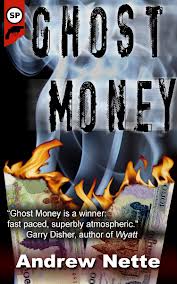 I finished reading Ghost Money by Andrew Nette last night and should get round to putting up a review tomorrow. Although the story was very different to Robert Ryan's The Last Sunrise (which I reviewed on Monday), it also had a couple of odd echoes. Both were set in South East Asia (Cambodia and Burma/Southern China respectfully) and both involved the hunt for two million dollars worth of gold lost from a US military plane. Pure coincidence in the plot hook (there is nothing else in common between them in terms of plot or how the story is told) and that I read them back to back, but nonetheless oddly unsettling. I'm now onto US Mid-West noir set between the end of the Second World War and the 1960s - Donald Ray Pollack's The Devil All the Time.