Rob Kitchin's Blog, page 200
September 21, 2012
Review of Homicide by David Simon (1991, Canongate)
 From January 1st until December 31st 1998 David Simon took a year’s sabbatical from his job as a journalist with the Baltimore Sun and hung out in the Homicide unit of the Baltimore Police. He went to work every day, just like the detectives, he visited the crime scenes, accompanied them on searches and stakeouts, eavesdropped on interrogations, sat in on criminal trials, and drank with them in bars until the early hours, all the while keeping his eyes and ears open and taking copious notes. The result is a Homicide: A Year on the Killing Streets, a detailed 650 page, small print, book that tells the story of that year - a year in which there were 236 murders in the city of Baltimore. Simon uses real names, he details the often fraught relationships between officers, documents the sometimes convoluted and vicious office politics, exposes the tremendous pressures that the cops are under from their bosses, the media, politicians and public, and reveals the sordid and dangerous lives of victims, perpetrators and those caught up in investigations. It’s a warts and all expose that shows the cops in both a good and negative light. It’s a brilliant piece of ethnographic research and an excellent read. Although organised by time, rather than simply write the book as a detailed diary, Simon used particular cases and officers to explore in detail various aspects of the job, crimes and judicial service, and moreover he mixes up the writing style and perspective to keep the narrative fresh. At times it reads like a novel, one that tries to capture the full complexity of police departments and cases. And even though it involves a large cast, it is easy to follow the dozens of threads and personalities. Which suggests that there’s scope for crime fiction that manages to be more realistic in its scope, cast, politics and drama. The book also provided a launch pad for Simon’s move into television, most recently as the writer and executive producer of The Wire. A fascinating, disturbing and excellent read.
[image error]


September 19, 2012
Vienna reads

 I'm off to Vienna very early tomorrow morning. After all the recommendations I received, I've bought two novels to accompany me on the trip - Brenner and God by Wolf Haas and A Death in Vienna by Frank Tallis. Hopefully, they'll both be great reads. Reviews in due course.
September 18, 2012
Review of Last Seen Wearing by Colin Dexter (Pan, 1976)
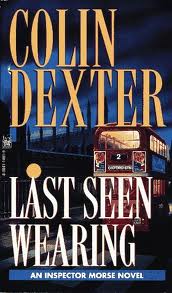 Whilst following up on a cold case involving the disappearance of teenage school girl, Chief Inspector Ainley has died in a traffic accident. The case is passed to Morse, who is less than enamoured to be given a two year old missing persons file where all the leads seem to have gone dead. Two days after Ainley’s death, however, a two sentence letter arrives stating that she is alive and well. Morse doesn’t believe it. In his head, the letter is a hoax because Valerie Taylor is dead. She must be after all this time. Forced to pursue the case, he starts to delve into the live of Valerie, a girl who seemingly liked the company of older men, trying to discover what happened to her.
There are two elements that raise Last Seen Wearing above usual police procedural fare. The first is the plotting and the second the characterization. Dexter maps out a wonderfully constructed story of feints and blind alleys as Morse stumbles from one line of reasoning to another, his theories constantly dashed on the rocks of empirical evidence. Every time it appears he has found a path forward, it turns into a cul-de-sac. This is not a tale of a genius cop who always finds his quarry, but is rather more Clouseau in his bumbling, much to Lewis’ delight. Morse and Lewis are both well drawn, somewhat complex and paradoxical characters. Morse, for example, is both cultured and coarse, buying the Sunday Times and the News of the World as his Sunday papers and dragging Lewis into a strip club on a visit to London. The support cast of suspects were also nicely realised. As always, Oxford and its surrounds provide a scenic backdrop. Overall, a very enjoyable read.


September 16, 2012
All due respect
 My short story - Nearly Extinct - has just been published in Vol 36 of All Due Respect. Freddie Carlingworth is 83 and the last of his line, waiting in a nursing home for the great heave-ho. Terry Watson is his 48 year old care assistant, stuck in a dead-end job clearing up after incontinent old men. Two lives going nowhere fast, but Freddie has a plan for them to make a mark on the world - to rob a bank. An old man in a wheelchair wearing a Mr Bean mask and carrying a sawn-off shotgun being pushed by a professional nobody disguised as Elvis in his bloated phase. Click over to All Due Respect to find out how they got on.
Lazy Sunday Service
 I spent part of yesterday afternoon wandering round a couple of Oxford bookshops. I picked up two history books, but once again left without any fiction. For some reason, pretty much every time I've visited a bookshop recently I've left empty-handed, except when I am picking up something I have ordered. It's a strange feeling. Like going into a cake shop and leaving without a cake. Nothing quite seems tasty enough. Oh well, I have a few books on the TBR to keep me going, including one of the book's I picked up yesterday which is set halfway between Oxford and London in the small village of Mednemham.
My posts this week
Review of No Sale by Patrick Conrad
Oxford jaunt
The prince and me
Review of Goshawk Squadron by Derek Robinson
Man on a mission

September 15, 2012
Man on a Mission
‘Harry? Hey, Harry, where you going?’
The man didn’t reply. Just bustled his way past a cop standing guard at the door.
Landers glanced down at the body again. She was barely beyond her school years, naked except for a blue-green silk scarf wrapped round her neck.
‘Fuck.’ He hurried from the house.
Harry had almost reached their car, a clapped-out Ford that looked at home the neighbourhood.
‘Harry! Wait.’
The big man yanked open the driver’s door. ‘He’s a fucking dead man.’
‘Take it easy, will you.’
‘A dead man,’ Harry repeated, dropped into the car and sped off.
A drabble is a story of exactly 100 words
The man didn’t reply. Just bustled his way past a cop standing guard at the door.
Landers glanced down at the body again. She was barely beyond her school years, naked except for a blue-green silk scarf wrapped round her neck.
‘Fuck.’ He hurried from the house.
Harry had almost reached their car, a clapped-out Ford that looked at home the neighbourhood.
‘Harry! Wait.’
The big man yanked open the driver’s door. ‘He’s a fucking dead man.’
‘Take it easy, will you.’
‘A dead man,’ Harry repeated, dropped into the car and sped off.
A drabble is a story of exactly 100 words
September 13, 2012
Review of Goshawk Squadron by Derek Robinson (Cassell, 1971)
 At 23, Stanley Woolley is old beyond his years, a major in the Royal Flying Corps in charge of a squadron of SE5a biplanes. Unlike the young pilots he commands, most of whom are from privileged backgrounds, he understands the air war to be as a brutal, squalid and wasteful as the trenches, not a chivalrous, dignified joust between gentlemen. Through a tough regime of training he tries to equip the pilots with the skills and ruthlessness to survive and to shoot the enemy quite literally in the back. In turn, they hate him for his seeming lack of ethics, general callousness, and absence of respect. But Woolley doesn’t care. He knows that they’ll all be dead within weeks despite his efforts and that their deeds will have had barely a negligible impact on the war. The only thing they can do is to keep trying to shoot down the Germans before they themselves are killed. Something that Woolley excels at.
Goshawk Squadron was shortlisted for the Booker Prize in 1971. It was criticised by some former RFC pilots who felt it denigrated the memories of those who fought the air war. Others praised it for showing the true nature of a war that was brutal mass slaughter and it was no different in the air to other services. Pilots were flying planes made of principally of wood, canvas and wire, and the engines were treated with castor oil to keep them lubricated, the fumes of which acted as a laxative that was countered by alcohol. Pilots often flew several missions a day traversing two sets of trenches where they were liable to be shot at from both sides, plus sustained anti-air barrages, to face superior planes. Tensions and fears were high amongst pilots, most of whom had only recently finished school, and they often let off steam in local villages. Robinson captures the true dark nature of war; it’s brutal realities. The tale is relatively straightforward, following the men’s exploits and relationships over a few months. The action sequences are excellent and the opening couple of chapters are amongst the best I’ve read in a while; the writing really alive on the page, laced with dark humour. It then settles down, becoming a little more mundane. Whilst some of the men are well drawn and distinctive, others are pretty indistinguishable and under-realised. And in Woolley he pushes the callous leader, who really believes he is doing the right thing by his men by trying to harden them to be ruthless, to its limits. Overall, an engaging, well written novel that shows war for what it really is.


The Prince and me

 Last night I collected the Cantemir Prize from Prince Radu of Romania on behalf of the Berendel Foundation for The Map Reader. It was a small, but very nice event in Trinity College, Oxford University. Lots of very nice things were said about the book. I had a quick skim of it myself on the train down from Birmingham. I think I'm going to have to re-read it, as it contains a heap of interesting essays. Strange how you forget work you wrote and put together! Wiley-Blackwell really did an excellent job with the production - it has the look and feel of a nice book. After a couple of speeches I received a handcrafted diploma (based on a 1920s royal design) in a beautiful leather bound folder, both made in Bucharest. If you click on the diploma photo, you should get a better view of it. Off to the conference now, which should be interesting.
Oxford jaunt
 Off to Oxford today to collect the Cantemir Prize for The Map Reader this evening from Prince Radu of Romania on behalf of the Berendel Foundation. Seems it will be relatively informal, but I need to say a few words of thanks which I'll jot down on the plane over. Not really sure of dress code, but I've packed a tie, so that should cover things off. Hopefully I've not left things too tight on the timing. I couldn't face a 6am flight to arrive seven hours early, so I've an early afternoon flight. Train is due into Oxford at 5.15 and we're meeting at 6pm for a 6.30 start. I can trust British trains, right? Should be interesting evening and conference, which follows tomorrow and Saturday.
September 12, 2012
Review of No Sale by Patrick Conrad (Bitter Lemon Press, 2012, in Dutch 2007)
 Victor Cox is a professor of film history and a keen collector of movie paraphernalia and trivia with a soft spot for black and white noir movies. Coming up to retirement he’s spent so much time watching and studying movies that he sometimes finds it difficult to distinguish between reality and the imaginary. Seemingly every person or situation bears an uncanny resemblance to a film star or a movie scene. When his wife is murdered, he becomes a suspect. And the police become even more intrigued when he can be directly linked to two earlier murders, both of which are based on movie scenes. Chief Superintendent Fons Luyckx doesn’t believe that Cox had anything to do with the murders, but when two more happen over the next couple of years the evidence seems difficult to refute. More worryingly, Cox himself becomes increasingly convinced he might be living a double, Jekyll and Hyde, life.
No Sale is a clever, literary crime novel. It is written and plotted in the style of a noir crime movie, using its stock of characters, sensibilities and tropes, and it is thoroughly intertextual in its make-up, blending together elements of dozens of movies without ever becoming a mere pastiche. Victor Cox is a wonderful character, drifting somewhere between reality and the imaginary, caught in a plot that Alfred Hitchcock would have delighted in committing to film. Whilst the resolution had no real surprise, the killer was a choice of three and it was telegraphed from a pretty long way out, and there’s some obvious gaps, such as the lack of any media interest in the cases, especially given how they all link to one person, neither really seemed to matter. This book was more about the journey, the interconnections, the trivia, the little puzzles, and above all the set of well drawn characters - the lush wife, the wise-guy police officer in love with a prostitute, his by-the-numbers partner who takes everything at face-value, the femme fatale, the innocent victims, the larger-than-life and salt-of-the-earth lowlifes - and how they swirl around Cox. An enjoyable read, which I’m sure would have been even better if I were a film history buff.