Rob Kitchin's Blog, page 198
October 14, 2012
Lazy Sunday Service
Every Friday and/or Saturday for the past six weeks I've either presented a paper at an event or organised a conference. It's been quite a diverse set of talks: transforming the crisis (Cork); mapping humans (Oxford); the science behind urban development (Vienna); housing and planning (Athlone); the US election (Maynooth) and mapping Ireland (Tallagh). Thankfully, I'm getting my weekends back for the foreseeable future. I also don't have another public talk in the diary until the new year (I was meant to be going to Malaysia and Singapore in two weeks time, but other matters intervened). Instead I can hopefully crack on with the new (academic) book, which is progressing, but more slowly than I hoped.
My posts this week
Review of Istanbul Passage by Joseph Kanon
Pasting over the cracks in a story
Review of The Moving Toyshop by Edmund Crispin
Measuring Ireland's Progress: Benchmarking against the past and other countries
Oxford Dictionary up on Amazon
Review of Death in the Clouds by Agatha Christie
Why do I always attract the weirdos?
My posts this week
Review of Istanbul Passage by Joseph Kanon
Pasting over the cracks in a story
Review of The Moving Toyshop by Edmund Crispin
Measuring Ireland's Progress: Benchmarking against the past and other countries
Oxford Dictionary up on Amazon
Review of Death in the Clouds by Agatha Christie
Why do I always attract the weirdos?


October 13, 2012
Why do I always attract the weirdos?
‘Why do I always attract the weirdos?’ Jenny moaned.
‘They’re all weirdos,’ Tessa replied. ‘They’re men.’
‘But they have their uses,’ Katie said.
‘Yeah, but only one.’
‘Tessa!’
‘What? It’s true. They’re good at taking out the bins.’
‘The last one who came up to me smelt like he lived in a bin,’ Jenny said and took a sup of her lager.
‘At least they provide you with good anecdotes.’
‘There has to be a least one nice man out there.’
‘And here he comes now. Your knight in shining armour.’
‘Oh god, he even looks like a bin man!’
A drabble is a story of exactly 100 words.
‘They’re all weirdos,’ Tessa replied. ‘They’re men.’
‘But they have their uses,’ Katie said.
‘Yeah, but only one.’
‘Tessa!’
‘What? It’s true. They’re good at taking out the bins.’
‘The last one who came up to me smelt like he lived in a bin,’ Jenny said and took a sup of her lager.
‘At least they provide you with good anecdotes.’
‘There has to be a least one nice man out there.’
‘And here he comes now. Your knight in shining armour.’
‘Oh god, he even looks like a bin man!’
A drabble is a story of exactly 100 words.
October 12, 2012
Review of Death in the Clouds by Agatha Christie (1935, Hamlyn)
 Hercule Poirot is flying from Paris to London. In the same section of the plane are ten fellow passengers - a Parisian lady, a countess and her friend, a businessman, a dentist, a hairdresser who has won the Irish sweepstakes, a Harley Street doctor, father and son archaeologists, and a detective author - who are served by two stewards. As they near the airport at Croyden, one of the stewards tries to wake the Parisian lady, Madame Giselle, only to discover that she is dead. At first it appears that she has died of a reaction to a wasp sting, but the ever observant Poirot finds at her feet a small blowpipe dart disguised as a wasp. The puzzling questions are who killed her and how were they not observed doing it given that none of the passengers witnessed another using a blowpipe? On landing Inspector Japp of Scotland Yard is on hand to investigate. It soon transpires that Madame Giselle was a wealthy moneylender who profited from making loans to selected individuals and made sure they paid by holding damaging information about them, and her will leaves her fortune to the daughter she gave away at birth. Whilst Japp flounders, Poirot uncovers some fairly clear links between some of the passengers and Madame Giselle, though others appear to have no connection or motive for her death. Through careful deduction he slowly pieces together what happened on the plane before denouncing the culprit.
Death in the Clouds is a classic locked room mystery - a murder is committed in a space occupied by thirteen people, yet no-one witnesses the crime and all of them could conceivably have a motive for the death. Christie excels at creating such puzzles and telling them in an engaging, often witty voice, that is all show and no tell. The secret is clever plotting that slowly reveals how various elements of the murder were committed and why, but which keep as many suspects in the frame as possible until a final denouement whilst feeding the reader red herrings and leading them down false paths as they try to determine the killer’s identity. Her telling is aided by well drawn characterization, especially Poirot and Japp, and some nice observational touches that keep matters plausible. There are two weaknesses to her style of storytelling, however, both evident in Death in the Clouds. First, the story is all about the puzzle and rarely do they open up wider reflective questions for the reader. The effect is a tale that is intriguing but which lacks contemplative depth. Second, it is almost impossible for the reader to deduce the identity of the murderer before the denouement as some crucial clues are held back and often they are quite outlandish. Nevertheless, Death in the Clouds is an enjoyable read and Poirot is a delight.

[image error]
October 11, 2012
Oxford dictionary up on Amazon
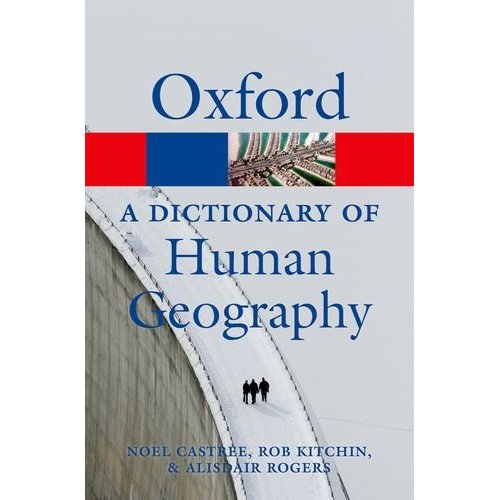 I've noticed that my co-authored, forthcoming book - the Oxford Dictionary of Human Geography - is available for pre-order on Amazon. It will be formally published in April 2013. I was recently asked what the main differences are between it and the Dictionary of Human Geography published by Blackwell. In a nutshell, our dictionary has more entries (over 2100 vs c.1000); wider coverage across the discipline; more variety in entry type (biographies, places, events, books, organisations, in addition to concepts and methods); length of entry (more concise); level of entries (aimed at undergraduates and interested generalists rather than advanced postgrad and academics); style of entry (very clear with limited use of jargon); consistency in entries (all written by the three authors rather than an edited collection); price (£11.99 vs £24.99); its much smaller and lighter. Whilst some might view them as competing texts, I think they're complementary, with the Blackwell dictionary having longer, more advanced entries.
October 10, 2012
Review of The Moving Toyshop by Edmund Crispin (1946, Penguin)
 Richard Cadogan is a struggling poet of some renown. Having extricated an advance out of his publisher he heads to Oxford for a week’s holiday, setting off late. The train halts in Didcot and he hitchhikes a lift the rest of the way arriving around midnight. Dropped at the edge of the city, he walks in. Drawn to a shop whose awning has been left down, idle curiosity leads him to try the door. Finding it unlocked he enters an empty toyshop, then climbs the stairs to flat above where he discovers the body of an old woman who’s been strangled. Just as he’s leaving he’s knocked unconscious. Waking four hours later he makes his escape and heads for a police station. When they return to the shop it is no longer a toyshop but a grocer’s and there’s no sign of a body. Had Cadogan been dreaming or had an elderly woman been murdered the night before? His Oxford don friend, Gervase Fen, decides to investigate, convinced of foul-play.
The Moving Toyshop is a locked room, crime farce. Crispin writes in taut, tight prose, that is all show and no tell so that the plot moves along a jaunty pace. The characterisation is nicely observed, especially the double act of Cadogan, the poet out of his depth, and Fen, the bright detective who ignores the law. The other principles are also well penned. The plot is quite intricate, and the puzzle is agreeably knotted. A streak of dark humour runs throughout and as the story unfolds the farce deepens, so that by the end there are dozens of people chasing each other round Oxford in a set of caper sequences. The only real issue is that plot does rest on a set of coincidences and actions that are unlikely, which the author tries to paste over by conversing directly with reader (see post yesterday). In many ways this doesn’t really matter as the story remains a very enjoyable romp. Overall, a fun and engaging tale.


October 9, 2012
Pasting over the cracks in a story
 On Saturday I read The Moving Toyshop by Edmund Crispin (pub. 1946). It was great fun, but the story rested on a few coincidences and the principle characters acting in odd ways. Crispin's strategy for dealing with this is to appeal to the reader through his character's interactions that a suspension of disbelief is perfectly credible or entirely appropriate. He also injects a few quips re. the author and publisher. They actually work quite well to diffuse problematic plot devices and reinforce the sense that the book is a crime farce. Here's a few examples:
'Don't spurn coincidence in that casual way,' said Fen severely. 'I know your sort. You say the most innocent encounter in a detective novel is unfair, and yet you're always screaming out about having met someone abroad who lives in the next parish, and what a small world it is.'
'Well, I'm going to the police,' said Cadogan. 'If there's one thing I hate, it's the sort of book in which characters don't go to the police when they've no earthly reason for not doing so.'
'My dear fellow, are you all right? I was making up titles for Crispin.'
'Let's go left,' Cadogan suggested. 'After all, Gollancz is publishing this book. I wonder - '
'After all, it's a somewhat unusual business, isn't it?'
'So unusual that no one in his senses would invent it.'
'It will work,' Fen responded confidently, 'because no one expects this sort of trick outside of a book.'

October 8, 2012
Review of Istanbul Passage by Joseph Kanon (Simon and Schuster, 2012)
 Leon Bauer, a businessman in Istanbul, has spent the Second World War undertaking errands for the American consulate and helping his wife rescue Jews escape from Europe. In the post-war period he finds himself performing the same roles, only his wife is in a clinic having had a nervous breakdown. His American handler has arranged for Bauer to meet someone off a boat, a man who was a senior figure in the Romanian fascist regime, someone who persecuted Jews but has valuable information about the Russian intelligence services. His job is to hide the man until he can be flown to Washington for debriefing. Only someone else is also waiting at the docks, leading to a shootout. Unsure who to trust, and with the Americans, Russians and Turks hunting for his charge, he seeks a safe passage for them both out of the country.
 In Istanbul Passage Kanon envelopes the reader in the city in the immediate post-war era - a city on the fulcrum between East and West in a country seeking to remain somewhat neutral in the coming cold war. Kanon expertly recreates its cultural landscape and sense of place - the melting pot of sights and sounds; the busy waterways and markets; the contrasts between rich and poor; and the political and diplomatic haunts of consulates, hotels and private parties. The characterisation is keenly observed, especially Leon Bauer, who is given the unenviable task of keeping alive a war criminal, someone hated by the Jews he helps rescue, and who finds himself caught in both a political drama and an unfolding romance. The plot is intricately woven and as the story unfolds Kanon ratchets up the tension, performs twist after twist, and shifts the moral terrain. Indeed, with regards to the latter, the story poses questions about obligation, duty and loyalty in relation to work, family and strangers. The result is a thoughtful and engaging page-turner. It certainly whetted my appetite for his other books.


October 7, 2012
Lazy Sunday Service
 I'm having a golden age of crime fiction weekend. Yesterday I read The Moving Toyshop by Edmund Crispin (1946) and today I've made a start on Death in the Clouds by Agatha Christie (1935). Both are tightly plotted, witty, and all show and no tell. A lot to be learnt on that front by some contemporary writers, I feel.
My posts from last week
September reviews
Residential property price register launched
Last seen wearing
Data visualizations of residential property price register
Review of The Killing of Emma Gross by Damien Seaman
The geography of actual sales prices
Review of The Golden Scales by Parker Bilal
Forty minutes to transfer terminals

October 6, 2012
Forty minutes to transfer terminals
She tugged at his jacket. ‘Put it on later.’
He snatched his bag from the tray and shuffled after her, clutching his belt.
A tinny voice announced: ‘Final call for flight ...’
‘Geoff, come-on!’
‘I’m coming.’
‘We’re going to miss it!’
‘We’ve got fifteen minutes.’
‘That’s when it departs, not when they close the doors. Hurry up!’
They half-walked, half-jogged through a shopping mall masquerading as a departure lounge, reaching a corridor that seemed to go on for forever.
He slowed to a walk, panting. ‘Forget it, Sandy. We’re not going to make it.’
‘Geoff! Come-on.’
They started jogging again.
A drabble is a story of exactly 100 words
He snatched his bag from the tray and shuffled after her, clutching his belt.
A tinny voice announced: ‘Final call for flight ...’
‘Geoff, come-on!’
‘I’m coming.’
‘We’re going to miss it!’
‘We’ve got fifteen minutes.’
‘That’s when it departs, not when they close the doors. Hurry up!’
They half-walked, half-jogged through a shopping mall masquerading as a departure lounge, reaching a corridor that seemed to go on for forever.
He slowed to a walk, panting. ‘Forget it, Sandy. We’re not going to make it.’
‘Geoff! Come-on.’
They started jogging again.
A drabble is a story of exactly 100 words
October 5, 2012
Review of The Golden Scales by Parker Bilal (Bloomsbury, 2012)
 A former police inspector, Makana lives on a rickety house boat in Cairo having fled Sudan seven years previously, forced out by Islamic extremists who killed his wife and daughter. He now ekes out a living as a private investigator, fed jobs by Inspector Okasha, a friend in the Egyptian police and by word of mouth. One morning he summoned to the penthouse apartment of Saad Hanafi, a self-made man who owns a vast property empire, dozens of businesses and a football club, the Dreem Team. Hanafi wants Makana to find their missing star player, Adil Romario, a playboy figure who’d like to star in movies. Aware of Hanafi’s notorious reputation for playing dirty, Makana agrees to undertake the job, knowing that he is only being given a partial version of the story as to Adil’s disappearance. It doesn’t take him long to discover that the Hanafi empire is in trouble and not all is well in the aging kingpin’s household. Determined to locate Adil, he is thrust into Cairo’s rich and seedy underbelly, tangling with a Russian gangster, Islamic fundamentalists, the intelligence services, and an English mother searching for the daughter abducted many years earlier.
The Golden Scales has all the ingredients of a good crime thriller - colourful, engaging characters, a strong sense of place, social context and politics, a tangled knot of competing interests and intrigue, and well written prose. For the most part it’s a very good read. Makana is a wonderful character with an interesting back story, and the sense of place is excellent, dropping the reader into modern day Cairo and the Red Sea resorts. Where the story is slightly let down is with some elements of the plotting. Generally, it is nicely constructed and it builds towards a tense climax. However, there are a couple of points which don’t really add up. For example, Cairo is a massive city, yet Makana meets the English woman searching for her child quite by chance in a restaurant and somehow decides that she is somehow linked to the Hanafi case. There is no basis for that assumption, and meeting her and splicing the threads together is a massive coincidence and plot device that is clumsily executed. The resolution is also a little clunky with Hanafi’s reaction seeming out of character. These awkward moments undermine what is otherwise an interesting and enjoyable tale.