Rob Kitchin's Blog, page 203
August 17, 2012
Review of The Man on the Balcony by Majs Sjowall and Per Wahloo (1967, translated 1968)
 The summer of 1967 and a mugger and a child killer are stalking the parks of Stockholm. The jaded and tired Detective Inspector Martin Beck and his colleagues are under pressure to catch the killer before he strikes again. However, there’s precious little evidence to go on. Eventually they find two witnesses, the mugger who is given up by a jilted girlfriend and a three year old boy who’d been playing with a small girl when she was snatched. One is reluctant to talk, the other can barely put a sentence together. As the summer unfolds, the number of victims grows and the public pressure rises, and the police hope for a break that will identify the perpetrator.
 The Man on the Balcony is the third instalment of the Martin Beck series of police procedurals written by the husband and wife team of Sjowall and Wahloo between 1965-75. The books are characterised by an understated social realism. Beck and his colleagues are normal, everyday people with differing egos, foibles, frailties, talents and opinions, trying to balance work with their home lives. The investigation unfolds in fits and starts, with painstaking footwork, frustrating interviews, and little doses of luck. There’s little machismo, no maverick geniuses and little in the way of heroics - just the police getting on and doing their jobs. In this book, Sjowall and Wahloo start to broaden out the focus from Beck to introduce more of the team and the characterisation is keenly observed. The plot is fairly standard police procedural fare and hinges on a couple of coincidences, but what makes the story work is the realism and its telling. There’s a lovely cadence to the storytelling, a kind of gentle, instant rhythm. Overall, a solid addition to the series.


August 16, 2012
Review of A June of Ordinary Murders by Conor Brady (New Island, 2012)
 At the height of a sweltering hot Dublin summer in June 1887 two bodies are found in the Phoenix Park, their faces disfigured. The case is assigned to the Detective Sergeant Sam Swallow of G Division, the unit of Dublin Metropolitan Police that investigate ordinary and special (political) murders in the city. Unable to identify the bodies, the investigation almost immediately stalls. Shortly afterwards another body is discovered. Tension in the city is already high given growing nationalist unrest, an imminent royal visit as part of Queen Victoria’s Golden Jubilee, and the death of Ces Downes leader of one of Dublin’s most prominent criminal gangs and the manoeuvring to take over her empire. Swallow is put under pressure from his superiors and the media to solve the cases quickly, but as he slowly makes progress political forces work to halt his advance. Stubborn, cynical and resourceful, Swallow is prepared to see the case to its resolution regardless of who he upsets and its consequences.
A June of Ordinary Murders is an engaging historical police procedural. The start is quite ponderous and has too much show and not enough tell, with Brady spending time setting out the organisation of the Dublin police force, sometimes repeating certain information, and positioning the main characters. As the story unfolds the storytelling becomes more lively with a number of intersecting subplots, and the tale progresses to a nice resolution. The set-up is fairly standard police procedural fare, with Swallow being somewhat of a maverick, outsider cop with an idiot boss in Inspector Boyle and who is used to battling the interfering forces of the media and elite classes (in this case the British administration and city official). The characterisation is generally good throughout, especially Swallow, though the criminal classes and Boyle felt a bit caricaturish (also it’s difficult to take seriously any character named ‘Pisspot’, especially someone meant to be a ruthless criminal boss). The historicisation is well done, transporting the reader to late nineteenth century Dublin and its inequalities and political machinations. Overall, after a stilted start, A June of Ordinary Murders is an enjoyable multi-layered tale and a fine addition to Irish crime fiction. I look forward to Swallow's next outing.


August 15, 2012
New arrivals
I always get a little edgy when my working TBR drifts below ten books. Thankfully a box of supplies has turned up to replenish the stock. Expect reviews of these books some time in the near future.
Parker Bilal - The Golden Scales
Paul Grossman - Sleepwalkers
Joseph Kanon - Istanbul Passage
Donald Ray Pollock - The Devil all the Time
James Reasoner - Dust Devils
Ben Winters - The Last Policeman
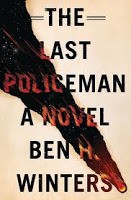

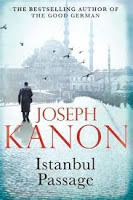


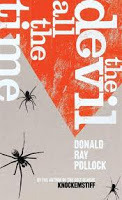

Parker Bilal - The Golden Scales
Paul Grossman - Sleepwalkers
Joseph Kanon - Istanbul Passage
Donald Ray Pollock - The Devil all the Time
James Reasoner - Dust Devils
Ben Winters - The Last Policeman


August 14, 2012
Review of Child 44 by Tom Rob Smith (Simon and Schuster, 2008)
 1953 at the tail end of Stalin’s rein, paranoia and fear pervade society, with millions being denounced and sent to the gulags in the quest to create a perfect society. Leo Demidov is an idealistic agent of the system who works for the state security service, the MGB, investigating and arresting enemies of the state. Whilst Leo is aware of the political machinations within his own organisation, he does not question the system as a whole. However, his idealistic veil is slowly removed, first through having to persuade a colleague that in a country with zero crime his young son could not have been murdered, then witnessing the death of an innocent man at the hands of a MGB colleague, and being asked to investigate the political activities of his wife. Denounced, he is exiled to a new city and demoted to the bottom rung of the militia. There he discovers that child murderer is at work; a murderer the state refuses to acknowledge exists. Determined to investigate further, he’s forced to go on the run in order to bring the killer to justice.
Child 44 is an assured and competent debut. The novel starts with a well crafted opening hook and unfolds at a steady pace. The historical contextualisation and sense of place is good throughout, with Smith depicting a paranoid and oppressed society where even the security services and family members are afraid of each other. The characterisation is solid, especially the idealistic and often naive Leo Demidov, and his more worldly-wise wife, Raisa. The prose is for the most part fairly workmanlike and the story fits the category of historical police procedural thriller, rather than a literary novel, as I’ve seen it described elsewhere. The plotting is well handled up until near the end. The twist was purely a literary device and undermined the credibility of the story. It could have been resolved in a more straightforward manner, which for me at least would have been more satisfactory. Overall, an engaging and crafted story with a contrived resolution.


August 13, 2012
Reviews up on Goodreads and Amazon
 It has taken me a little over three months, but I have finally uploaded all my Blue House reviews up onto Goodreads and Amazon. If you want to take a look all the ones on Goodreads they're here. It would have been a heck of a lot easier to have done them as I went along. If you've been following me on the Goodread's site, you will no longer be bombarded with updates! I hope they prove useful to both readers and authors. I'm still getting used to Goodreads, but it's an interesting site. I've just ordered a handful of books based on the recommendations it threw out, so it'll be interesting to see whether they match my tastes.
August 12, 2012
Lazy Sunday Service
 This last week I've been catching up on some historical crime fiction, one set in Russia in the 1950s, the other in Ireland in the 1880s. Expect reviews of Child 44 by Tom Rob Smith and A June of Ordinary Murders by Conor Brady some time this week. Back to work tomorrow and no doubt a large list of emails and sizable pile of admin and marking. Can hardly wait.
My posts this week
A year of drabbles
Review of Blackbirds by Chuck Wendig
Review of Disgrace by Jussi Adler-Olsen
A frustrated book buyer
Review of Day After Day by Carlo Lucarelli
On the ropes

August 11, 2012
On the ropes
Carter ducked left, then danced right. A blow caught his ribs, followed by a jab to the temple. He blindly threw a punch, hitting nothing but thin air.
Thought: there has to be a better way to make a living.
His head swivelled, his jaw tugging at its sockets. He tottered backwards, the ropes halting his fall. Instinctively he raised his gloves, pulling them in tight to his face and body.
Thought: where’s the damn bell when you need it?
He tried to soak up the punches. Then he was staring up at the lights.
Thought: why is he counting?
A drabble is a story of exactly 100 words.
Thought: there has to be a better way to make a living.
His head swivelled, his jaw tugging at its sockets. He tottered backwards, the ropes halting his fall. Instinctively he raised his gloves, pulling them in tight to his face and body.
Thought: where’s the damn bell when you need it?
He tried to soak up the punches. Then he was staring up at the lights.
Thought: why is he counting?
A drabble is a story of exactly 100 words.
August 10, 2012
Review of Day After Day by Carlo Lucarelli (2000, translation 2005, Vintage)
 Alex works for an internet provider, policing their chat rooms. It’s a pedestrian job and he spends most of his day mourning the departure of his girlfriend back to Denmark from Italy and fending off nervous reaction to his dog, a Staffordshire bull terrier that people confuse for a pit bull. Ispettore Grazia Negro and two colleagues are staking out a criminal who is murdered without them even being aware of it. The crime seemingly has few clues as to the killer’s identity. A short while later a man is assassinated in an airport lounge whilst being protected by a security detail, yet the killer seemed anonymous entering and leaving the scene. Ever alert, Negro spots a connection between the murders: the image of a pit bull. She starts to search for other deaths where a pit bull is linked to the case, even in the most tangential ways. At the same time Alex has started to take a keen interest in an internet chat room notionally concerned with pit bulls. Unwittingly he has found a key to the killer’s identity, but he’s also made himself a potential target. The question is whether Negro can apprehend ‘the pit bull’ before he strikes again.
As with all of Lucarelli’s other translated novels (all reviewed on this blog), Day After Day is a relatively short book (in this case 225 pages in a small, pocket format). And as with the other books it is engagingly written with some very nice observational touches (I particularly liked those about silences and motorway driving) and it seems slightly underdeveloped. Lucarelli writes very tightly, with little in the way of subplots or misdirection or dead-ends. The style is all tell and little show. The result is a fairly linear plot which hurtles towards its inevitable conclusion. Yet his prose, quality of storytelling and the character of Ispettore Negro makes the reader want more. As with all his books then, I’m conflicted in rating Day After Day. On the one level, it’s a great read, a literary piece of crime fiction, on another level it is too straightforward and underdeveloped. Overall, a tightly written, entertaining read which could have benefitted with a little fleshing out.


August 9, 2012
A frustrated book buyer


A couple of days ago, Bernadette over at Reactions to Reading posted her reads of the month. Two of the books took my fancy: Black Wattle Creek by Geoffrey McGeachin and Paving the New Road by Sulari Gentill. Neither are available on Amazon.co.uk or Amazon.com, nor Book Depository. I've previously tried to buy McGeachin's other Charlie Berlin book, The Digger's Rest Hotel. It's available as an audio book but not a paper or e-book. I've twice had pre-orders for White Dog by Peter Temple cancelled because of delays in being published in the UK, despite the fact that it was published in 2004 in Australia (it is now available at hardback price). I've also tried to buy Kel Robertson's second novel, Smoke and Mirrors, a winner of Ned Kelly prize for crime fiction in 2009, but to no avail. I've read the first book in the series because a friend in Australia sent me a copy.
It's pretty difficult to be Fair Dinkum about Australian crime fiction when it is almost impossible to buy the crime novels published there. In an age of globalised cultural production, Internet buying and e-books, I find it very odd that English language books are still being limited to geographical regions. I can read reviews of books, but I can't buy them. It's a practise that seems limited to fiction. I think all of my academic books can be bought anywhere on the planet relatively easily. It is very frustrating to potential readers and I suspect also authors who's audience is being deliberately limited. I know that this is to do with the selling of rights and the launching/marketing of books in different locales, but it seems to me that there should be an opportunity for readers to purchase books online that might not yet be available in bookstores. If nothing else it might create a buzz about a book, including reviews, and actually aid the selling of rights in different regions. Especially as so many of the books I'm interested in will probably never be published in other regions.
Anyway, what I want to know is this: can somebody recommend an Australian online bookstore that will post the books to Ireland at a reasonable rate? Or perhaps an alternative way to buy Australian crime fiction that is presently not available in the Europe or North America? I know books in Australia are relatively expensive, but I can live with that. I just want to be able to read the books that I want to read.

August 8, 2012
Review of Disgrace by Jussi Adler-Olsen (2008. Penguin, 2012 in translation)
 Kimmie has lived on the streets of Copenhagen for twelve years despite owning a luxurious mansion. A rich, wild child in her youth, who was expelled from boarding school, she now wanders the city stealing food and clothes, muttering to herself and drinking whisky to make the voices in her head go silent. All the time she is watching her back, afraid that her former school friends will catch-up with her before she reveals their dark secrets. Their hunt is about to intensify as an old murder case, to which one her old gang has confessed and is in prison, has landed on Carl Morck’s desk in Department Q in the Danish police force. Morck is not really sure why it is in the cold case pile given it has been resolved, but decides to look into it regardless. His investigation soon catches the former boarding school pals attention, now all part of the elite of Danish society, who move to get his snooping stopped. The question is, who will get to Kimmie and her secrets first?
 Disgrace is a fairly straightforward police procedural thriller that slowly builds to a suspenseful climax. The strengths of the book are the characterisation, pacing, and page-turning prose. Carl Morck, Assad his Syrian colleague, and Rose his new administrator, are all well constructed characters whose prejudices and personalities lead to some entertaining exchanges. Where the book has some serious problems, depending on how much you want to suspend your sense of realism, is the plot. I’m willing to believe that an elite, rich group of people can hide isolated actions and draw on networks and favours to cover up their sadistic assaults. But to do so over twenty odd years with no rumours or accusations or cases is not credible. Nor is the fact that they can’t find a homeless person in Copenhagen over a twelve year period using professional private detectives (especially when Assad finds her in less than an hour) or that the file Morck is using has enough circumstantial evidence in it that the person who has been compiling it could have acted several years earlier. Nor is the fact that the cold case unit consists of three people - a detective, a non-police helper and an administrator, and they are afforded no additional resources, even when the scope of the investigation becomes apparent. In fact, there are loads of elements of the story that make little sense when reflected on. That’s hardly the point though in this kind of tale, where realism is not going to stand in the way of a good story. And for the most part it is an engaging story. It’s just a shame that I didn’t believe large chunks of it. Nonetheless, an entertaining enough tale, with a strong central cast of characters.