Rob Kitchin's Blog, page 184
March 11, 2013
The Case of the Strange White Van
I haven't posted a short story on the blog for a while, except for the weekly drabble. This story is my entry to Patti Abbott's flash fiction challenge - to write a tale about a white van. I wrote it last spring, but couldn't decide where to submit it to as it doesn't really fit the remit of most crime fiction outlets, as you'll see if you read on. I'm usually pretty ambivalent about my own fiction, but I actually quite like this one and I might well write some more tales involving the same characters. Hopefully, you'll enjoy it as well.
The Case of the Strange White Van
As the offices of a private investigator went, 4 Chestnut Grove was the bees knees as far as P.I. Kevin Carter was concerned. Beggars couldn’t afford to be choosers and rent free digs for a gumshoe down to his last brass cents were a godsend.
The house was the third in a row of seven that backed onto open fields. The first was little more than breeze block walls, eight feet high. The second was missing a roof, windows and doors. The third, fourth and fifth had roofs made of red tiles and weathered doors, but bare window frames.
The final two were sealed and had internal stud walls, though a number of their windows had been smashed. They had been claimed by a small gaggle of local teenagers who would congregate in and around them in the evenings and swap coarse humour and awkward flirtation. On the weekends they would drink cans of cider and bottles of cheap vodka, playing music on their mobile phones as they gradually vandalised the dilapidated units, unlived in since they were built four years previously.
P.I. Kevin Carter pushed aside brambles in the overgrown back garden and entered his offices through the unlocked back door. He took off his fedora and mac and hung them on a stand.
‘Hold all calls, cupcake,’ he said to the secretary and passed into the hallway. ‘I’m working on a very important case.’
He clambered up a pallet he’d leant against two long planks, then worked his way up steps he’d nailed onto the right-hand plank to reach the upper floor.
He turned and hollered down into the hall below. ‘And don’t let that rattlesnake, Sam Spade, bother me. He’s a two bit liar and a braggart. He’s done his last day’s work for the Carter Detective Agency.’
Through with instructing Agatha Christie in her duties, he snuck carefully to the bay window at the front of the house and peeked out cautiously. The potholed road was empty. Opposite were the fenced off concrete bases for an unrealised second row of units. Beyond them a hawthorn hedge partially obscured the rest of the village.
Happy he was alone, he moved to what would have been a back bedroom and pushed aside a slab of wood and tugged out a cardboard box. It contained the tools of his trade -- a magnifying glass, a compass, a pad and pen, fingerprint powder and a brush, a small pair of binoculars, a torch, some spare batteries, a penknife, a water pistol in case the dames got hysterical or the situation turned ugly, and a stash of detective magazines. His pride and joy, a tiny silver camera, always stayed in his pocket, handy to record vital evidence.
He pulled a magazine free, sitting down on two stacked breeze blocks and opened the pages, searching for an interesting story.
‘Kevin?’ A woman’s voiced shouted from outside. ‘Kevin are you in there? It’s time for your tea.’
‘Drat,’ P.I. Carter muttered, stuffing the magazine back in the box and covering it with the board.
‘Kevin? Come-on, love. What have we told you about playing in there? It’s not safe.’
‘It’s as safe as houses,’ P.I. Carter muttered as he climbed down to the hallway.
‘I thought I told you to hold all my calls?’ he said to Agatha as he slipped on his hat and coat. ‘I think it might be time to get a new secretary; one that knows how to deal with crazy older people.’
***
‘Well, look who it is -- if it isn’t that low-down rat, Sam Spade. What’s the matter, Spade, got no home to go to?’
P.I. Carter didn’t wait for an answer, but moved from behind a low wall and crouch-walked to the edge of a dense thicket of brambles. Kneeling in damp weeds he stared over at a white van parked outside of number seven.
‘I told you we were through,’ he whispered. ‘I have a new sidekick now. Meet Sherlock Holmes. Sherlock this is Sam Spade. He’s too fond of the drink, the ladies and fighting for proper detective work. Sherlock’s just put the famous Professor Moriarty behind bars.’
P.I. Carter glanced over his shoulder. ‘What’s the matter, Spade, you can’t take a hint? Now, scram.’
P.I. Carter crept around the brambles and shuffled along the edge of a concrete base to get a better view of the house. He pulled his camera from his pocket and took a photo of the van’s license plate. There was no sign of its occupants.
‘I’ll go this way,’ P.I. Carter pointed to his left. ‘You go that,’ he said to Sherlock, pointing right. ‘And be careful, this country is full of dangerous and desperate men. They’ll kill you as soon as look at you.’
‘Indubitably,’ Sherlock muttered, setting off.
P.I. Carter watched him stalk back to the brambles and disappear. His sidekick was going to need more than a funny hat and a large magnifying glass if he wanted to solve the big cases. He shook his head and darted off, running low.
As he made his way across the weed-infested piles of builder’s rubble P.I. Carter could see that Sherlock was already in place, sitting cross-legged on the ground under the back window. As he neared the house he accidentally kicked a glass bottle, sending it twirling across the rough ground and clinking off the wall.
‘Drat!’ he muttered, dropping down next to Sherlock.
‘What was that?’ a man said from within the house.
‘What was what?’ another voice answered.
‘I thought I heard something outside.’
‘Oh-oh,’ P.I. Carter muttered. ‘Come-on.’
He sprinted along the back of the houses and dashed in through the back door into his agency offices.
‘Quick, everyone upstairs,’ he said, running through to the hallway.
As they scrambled up the pallet, he made the introductions. ‘Sherlock, this is Agatha. She’s the office secretary. Agatha, this is our new detective, Sherlock Holmes. We’ll hide in the bathroom. I have a rope there for an emergency escape.’
***
Wearing his mac and hat, P.I. Carter entered the kitchen where a radio was broadcasting the six o’clock news. ‘Gardai are still searching for a gang of four men who robbed a Leitrim post office at gunpoint this afternoon.’
A woman turned the sound down and turned from the washing up to face him.
‘And where are you going?’
‘Detectiving with Agatha and Sherlock.’
‘What happened to Sam Spade?’
‘He had to go. I’m undertaking a new investigation - The Case of the Strange White Van.’
‘You’re not going to that ghost estate are you? I’ve told you a thousand times, it’s not safe. You’re to stay away. Do you hear?’
‘We’re working a stakeout,’ P.I. Carter said, ignoring her concerns.
‘You’re to be back before it gets dark, it’s a school day tomorrow. I don’t want to have come looking for you again. And try and stay out of trouble. People don’t like peeping toms.’
‘Agatha and Sherlock don’t have to go to school and we’re not peeping, we’re on a stakeout.’
‘Well, they’re older fictional characters, dear, and they’ve already finished school. They’ll just have to do the stakeout whilst you’re in class.’
‘But we’re about to crack this case wide open!’
‘Well, you better get it solved in the next hour or so, hadn’t you, Kevin?’
‘Come-on, Sherlock,’ P.I. Carter said, opening the door. ‘Let’s leave this dame alone so she can finish the dishes.’
***
‘Maybe they’re builders,’ P.I. Carter said to Sherlock. ‘In which case the company offices could be in danger.’
They’d had the house that the van was parked outside under observation for the past forty five minutes. P.I. Carter raised his binoculars and stared at the downstairs window. There were shadows moving inside, but that was as much as he could determine. The light was fading fast and there were no street lamps on Chestnut Grove. If they was going to solve the case, then he’d need to act soon.
‘Come-on, let’s get closer,’ he said, rising to his feet, crouch-running across the road to the side of the van.
He crept to the edge of the vehicle and peeked round the side.
‘Okay, let’s go,’ he muttered, then dashed to the front corner of the house, leaping over a pile of flattened tin cans. Catching his breath, he gingerly slid along the wall to the front window. He could hear the voices of two men talking inside, but couldn’t quite make out their words. A third voice added to the conversation.
After a couple of minutes, P.I. Carter carefully peered through the smashed window into the gloom. There were three men sitting in a half circle on thick planks of wood resting on breeze block piles. On the floor in front of them was a pile of bags. One of the men leant forward and pulled something from one of the bags.
A car pulled into the estate, its headlights bouncing along the house facades.
‘Oh-oh,’ P.I. Carter said.
He dug his camera out of his pocket and poked it through the broken pane. The room lit up in a brilliant flash.
‘Drat!’ He’d forgotten to turn off the flash.
He faced the car pulling up behind the van and took another photograph.
‘Come-on, Sherlock, let’s split this joint.’
He set off like a gazelle with its tail on fire just as the front door to the house burst open.
‘Oi, you. Stop!’
‘Get him!’ a voice said from the direction of the car.
P.I. Carter burst in through the front door to his offices.
Sam Spade was leaning against the wall, chewing a blade of grass. ‘Don’t worry, kiddo, I’ll stop them. I’ve already sent Agatha upstairs.’
P.I. Carter scrabbled up the pallet and onto the right hand plank. Just as he reached the upper floor, the front door banged open.
‘There’s the little bastard,’ said a tall, thick-set man with a black stubble.
‘Well, he’s trapped now. Throw us down the camera, little fella, and we’ll leave you alone.’
P.I. Carter stretched out his hand to help Sherlock up the last couple of steps, then winked at Sam Spade and stepped back out of sight.
‘Little bollix,’ the second man said. ‘Come-on, let’s get him.’
P.I. Carter dashed to the would-be bathroom and threw his escape rope out of the window. He tugged on it to test it was secure, then clambered out the window. Back in the hallway there was an almighty crash as the pallets, planks and two beefy men fell to the ground.
‘Despite all his faults, Sam Spade is a man of his word,’ he said, looking up to Sherlock. ‘I’ll go for help. You look after Agatha.’
He lowered himself to the ground and ran along the narrow path through the back gardens, brambles scratching at his trousers, and out onto the main road, not stopping until he reached a phone box. He dived in, shutting the door behind him.
‘Who were they?’ Sherlock asked.
‘They were horrible,’ Agatha added.
‘It’s elementary, my dear Sherlock,’ P.I. Carter said, staring at the small screen on the back of his camera. ‘It’s those gangsters who robbed the post office!’
He picked up the phone and dialled 999.
***
Two days later, having re-built his staircase, P.I. Carter sat in his upstairs office. Although the robbers had fled the scene, the photographs of the van and car’s license plates, along with the three men counting the money, meant they were apprehended half an hour later as they drove along a country lane.
Taking a pair of scissors he cut out the headline story in Leitrim Observer: "Boy Detective Solves Post Office Robbery."
‘This is going to be great for advertising,’ he said to Agatha Christie, Sherlock Holmes, and Sam Spade. He pasted the cutting into a scrap book and shut its pages. ‘I declare The Case of the Strange White Van now closed.’
END
I have another story involving a white van in, starring my hapless, feckless cops Harry and Pete. It's called Speeding; click-on the link to take a read.
The Case of the Strange White Van
As the offices of a private investigator went, 4 Chestnut Grove was the bees knees as far as P.I. Kevin Carter was concerned. Beggars couldn’t afford to be choosers and rent free digs for a gumshoe down to his last brass cents were a godsend.
The house was the third in a row of seven that backed onto open fields. The first was little more than breeze block walls, eight feet high. The second was missing a roof, windows and doors. The third, fourth and fifth had roofs made of red tiles and weathered doors, but bare window frames.
The final two were sealed and had internal stud walls, though a number of their windows had been smashed. They had been claimed by a small gaggle of local teenagers who would congregate in and around them in the evenings and swap coarse humour and awkward flirtation. On the weekends they would drink cans of cider and bottles of cheap vodka, playing music on their mobile phones as they gradually vandalised the dilapidated units, unlived in since they were built four years previously.
P.I. Kevin Carter pushed aside brambles in the overgrown back garden and entered his offices through the unlocked back door. He took off his fedora and mac and hung them on a stand.
‘Hold all calls, cupcake,’ he said to the secretary and passed into the hallway. ‘I’m working on a very important case.’
He clambered up a pallet he’d leant against two long planks, then worked his way up steps he’d nailed onto the right-hand plank to reach the upper floor.
He turned and hollered down into the hall below. ‘And don’t let that rattlesnake, Sam Spade, bother me. He’s a two bit liar and a braggart. He’s done his last day’s work for the Carter Detective Agency.’
Through with instructing Agatha Christie in her duties, he snuck carefully to the bay window at the front of the house and peeked out cautiously. The potholed road was empty. Opposite were the fenced off concrete bases for an unrealised second row of units. Beyond them a hawthorn hedge partially obscured the rest of the village.
Happy he was alone, he moved to what would have been a back bedroom and pushed aside a slab of wood and tugged out a cardboard box. It contained the tools of his trade -- a magnifying glass, a compass, a pad and pen, fingerprint powder and a brush, a small pair of binoculars, a torch, some spare batteries, a penknife, a water pistol in case the dames got hysterical or the situation turned ugly, and a stash of detective magazines. His pride and joy, a tiny silver camera, always stayed in his pocket, handy to record vital evidence.
He pulled a magazine free, sitting down on two stacked breeze blocks and opened the pages, searching for an interesting story.
‘Kevin?’ A woman’s voiced shouted from outside. ‘Kevin are you in there? It’s time for your tea.’
‘Drat,’ P.I. Carter muttered, stuffing the magazine back in the box and covering it with the board.
‘Kevin? Come-on, love. What have we told you about playing in there? It’s not safe.’
‘It’s as safe as houses,’ P.I. Carter muttered as he climbed down to the hallway.
‘I thought I told you to hold all my calls?’ he said to Agatha as he slipped on his hat and coat. ‘I think it might be time to get a new secretary; one that knows how to deal with crazy older people.’
***
‘Well, look who it is -- if it isn’t that low-down rat, Sam Spade. What’s the matter, Spade, got no home to go to?’
P.I. Carter didn’t wait for an answer, but moved from behind a low wall and crouch-walked to the edge of a dense thicket of brambles. Kneeling in damp weeds he stared over at a white van parked outside of number seven.
‘I told you we were through,’ he whispered. ‘I have a new sidekick now. Meet Sherlock Holmes. Sherlock this is Sam Spade. He’s too fond of the drink, the ladies and fighting for proper detective work. Sherlock’s just put the famous Professor Moriarty behind bars.’
P.I. Carter glanced over his shoulder. ‘What’s the matter, Spade, you can’t take a hint? Now, scram.’
P.I. Carter crept around the brambles and shuffled along the edge of a concrete base to get a better view of the house. He pulled his camera from his pocket and took a photo of the van’s license plate. There was no sign of its occupants.
‘I’ll go this way,’ P.I. Carter pointed to his left. ‘You go that,’ he said to Sherlock, pointing right. ‘And be careful, this country is full of dangerous and desperate men. They’ll kill you as soon as look at you.’
‘Indubitably,’ Sherlock muttered, setting off.
P.I. Carter watched him stalk back to the brambles and disappear. His sidekick was going to need more than a funny hat and a large magnifying glass if he wanted to solve the big cases. He shook his head and darted off, running low.
As he made his way across the weed-infested piles of builder’s rubble P.I. Carter could see that Sherlock was already in place, sitting cross-legged on the ground under the back window. As he neared the house he accidentally kicked a glass bottle, sending it twirling across the rough ground and clinking off the wall.
‘Drat!’ he muttered, dropping down next to Sherlock.
‘What was that?’ a man said from within the house.
‘What was what?’ another voice answered.
‘I thought I heard something outside.’
‘Oh-oh,’ P.I. Carter muttered. ‘Come-on.’
He sprinted along the back of the houses and dashed in through the back door into his agency offices.
‘Quick, everyone upstairs,’ he said, running through to the hallway.
As they scrambled up the pallet, he made the introductions. ‘Sherlock, this is Agatha. She’s the office secretary. Agatha, this is our new detective, Sherlock Holmes. We’ll hide in the bathroom. I have a rope there for an emergency escape.’
***
Wearing his mac and hat, P.I. Carter entered the kitchen where a radio was broadcasting the six o’clock news. ‘Gardai are still searching for a gang of four men who robbed a Leitrim post office at gunpoint this afternoon.’
A woman turned the sound down and turned from the washing up to face him.
‘And where are you going?’
‘Detectiving with Agatha and Sherlock.’
‘What happened to Sam Spade?’
‘He had to go. I’m undertaking a new investigation - The Case of the Strange White Van.’
‘You’re not going to that ghost estate are you? I’ve told you a thousand times, it’s not safe. You’re to stay away. Do you hear?’
‘We’re working a stakeout,’ P.I. Carter said, ignoring her concerns.
‘You’re to be back before it gets dark, it’s a school day tomorrow. I don’t want to have come looking for you again. And try and stay out of trouble. People don’t like peeping toms.’
‘Agatha and Sherlock don’t have to go to school and we’re not peeping, we’re on a stakeout.’
‘Well, they’re older fictional characters, dear, and they’ve already finished school. They’ll just have to do the stakeout whilst you’re in class.’
‘But we’re about to crack this case wide open!’
‘Well, you better get it solved in the next hour or so, hadn’t you, Kevin?’
‘Come-on, Sherlock,’ P.I. Carter said, opening the door. ‘Let’s leave this dame alone so she can finish the dishes.’
***
‘Maybe they’re builders,’ P.I. Carter said to Sherlock. ‘In which case the company offices could be in danger.’
They’d had the house that the van was parked outside under observation for the past forty five minutes. P.I. Carter raised his binoculars and stared at the downstairs window. There were shadows moving inside, but that was as much as he could determine. The light was fading fast and there were no street lamps on Chestnut Grove. If they was going to solve the case, then he’d need to act soon.
‘Come-on, let’s get closer,’ he said, rising to his feet, crouch-running across the road to the side of the van.
He crept to the edge of the vehicle and peeked round the side.
‘Okay, let’s go,’ he muttered, then dashed to the front corner of the house, leaping over a pile of flattened tin cans. Catching his breath, he gingerly slid along the wall to the front window. He could hear the voices of two men talking inside, but couldn’t quite make out their words. A third voice added to the conversation.
After a couple of minutes, P.I. Carter carefully peered through the smashed window into the gloom. There were three men sitting in a half circle on thick planks of wood resting on breeze block piles. On the floor in front of them was a pile of bags. One of the men leant forward and pulled something from one of the bags.
A car pulled into the estate, its headlights bouncing along the house facades.
‘Oh-oh,’ P.I. Carter said.
He dug his camera out of his pocket and poked it through the broken pane. The room lit up in a brilliant flash.
‘Drat!’ He’d forgotten to turn off the flash.
He faced the car pulling up behind the van and took another photograph.
‘Come-on, Sherlock, let’s split this joint.’
He set off like a gazelle with its tail on fire just as the front door to the house burst open.
‘Oi, you. Stop!’
‘Get him!’ a voice said from the direction of the car.
P.I. Carter burst in through the front door to his offices.
Sam Spade was leaning against the wall, chewing a blade of grass. ‘Don’t worry, kiddo, I’ll stop them. I’ve already sent Agatha upstairs.’
P.I. Carter scrabbled up the pallet and onto the right hand plank. Just as he reached the upper floor, the front door banged open.
‘There’s the little bastard,’ said a tall, thick-set man with a black stubble.
‘Well, he’s trapped now. Throw us down the camera, little fella, and we’ll leave you alone.’
P.I. Carter stretched out his hand to help Sherlock up the last couple of steps, then winked at Sam Spade and stepped back out of sight.
‘Little bollix,’ the second man said. ‘Come-on, let’s get him.’
P.I. Carter dashed to the would-be bathroom and threw his escape rope out of the window. He tugged on it to test it was secure, then clambered out the window. Back in the hallway there was an almighty crash as the pallets, planks and two beefy men fell to the ground.
‘Despite all his faults, Sam Spade is a man of his word,’ he said, looking up to Sherlock. ‘I’ll go for help. You look after Agatha.’
He lowered himself to the ground and ran along the narrow path through the back gardens, brambles scratching at his trousers, and out onto the main road, not stopping until he reached a phone box. He dived in, shutting the door behind him.
‘Who were they?’ Sherlock asked.
‘They were horrible,’ Agatha added.
‘It’s elementary, my dear Sherlock,’ P.I. Carter said, staring at the small screen on the back of his camera. ‘It’s those gangsters who robbed the post office!’
He picked up the phone and dialled 999.
***
Two days later, having re-built his staircase, P.I. Carter sat in his upstairs office. Although the robbers had fled the scene, the photographs of the van and car’s license plates, along with the three men counting the money, meant they were apprehended half an hour later as they drove along a country lane.
Taking a pair of scissors he cut out the headline story in Leitrim Observer: "Boy Detective Solves Post Office Robbery."
‘This is going to be great for advertising,’ he said to Agatha Christie, Sherlock Holmes, and Sam Spade. He pasted the cutting into a scrap book and shut its pages. ‘I declare The Case of the Strange White Van now closed.’
END
I have another story involving a white van in, starring my hapless, feckless cops Harry and Pete. It's called Speeding; click-on the link to take a read.


March 10, 2013
Lazy Sunday Service
 This week coming sees the release of Philip Kerr's latest Bernie Gunther novel, A Man Without Breath, the ninth in what, so far, has been an exceptional set of novels. The moment new tome arrives it'll go to the top of the pile. If you're unfamiliar with the series, it's well worth checking out - historical crime fiction at it's best. The new novel is set in 1943 in Poland, the first of the books to focus exclusively on the Berlin cop's exploits during the war (the others are mainly set either before or after). The back cover blurb:
It is winter, 1943. Bernie Gunther has left the Criminal Police and is working for the German War Crimes Bureau based in Berlin. Reports have been circulating of a mass grave hidden in a wood near Smolensk. The grave's whereabouts are uncertain until, deep in the Katyn Forest, a wolf digs up some human remains. Rumour has it that the grave is full of Polish officers murdered by the Russians - a war crime that is perfect propaganda for Germany. But it needs a detective of subtle skill to investigate this horrific discovery. Cue Bernie Gunther...
My posts this week
A story stretched too far
Review of A Death in Bordeaux by Allan Massie
The Twelfth Department
Review of White Dog by Peter Temple
Fallen behind
March 9, 2013
Fallen behind
‘Where’s Jen?’
‘She’s right behind me.’ Mark turned and stared down the dark, empty lane.
‘Well, she isn’t any more,’ Steve said, stating the obvious.
‘She was there a minute ago.’ Mark said, starting to amble back the way they’d come.
‘Jen?’ Sally shouted.
Silence.
‘Jen?’
‘Fuck. Maybe she slipped into the ditch?’ Mark suggested. ‘She was pretty drunk.’
‘And maybe you should have been walking with her,’ Sally said, trotting past him.
‘I was walking with her.’
‘Is that why she’s disappeared?’
‘You were racing ahead. She fell behind.’
‘So it’s our fault?’
‘Where the hell is she?’
‘Jen?’
A drabble is a story of exactly 100 words
‘She’s right behind me.’ Mark turned and stared down the dark, empty lane.
‘Well, she isn’t any more,’ Steve said, stating the obvious.
‘She was there a minute ago.’ Mark said, starting to amble back the way they’d come.
‘Jen?’ Sally shouted.
Silence.
‘Jen?’
‘Fuck. Maybe she slipped into the ditch?’ Mark suggested. ‘She was pretty drunk.’
‘And maybe you should have been walking with her,’ Sally said, trotting past him.
‘I was walking with her.’
‘Is that why she’s disappeared?’
‘You were racing ahead. She fell behind.’
‘So it’s our fault?’
‘Where the hell is she?’
‘Jen?’
A drabble is a story of exactly 100 words
March 8, 2013
Review of White Dog by Peter Temple (Quercus, 2011, pub in Australia in 2003).
 Sarah Longmore is about to stand trial for the murder of her former lover, a property developer who’s business was in trouble. Jack Irish has been hired to look into her defence and the veracity of her claims that she’s innocent given that it appears to be an open and shut case. Jack’s partner has just taken a job in London, so he has plenty of time to investigate Longmore’s story. It doesn’t take long for him to start to question her guilt and not much longer for others to warn him to quietly drop his snooping. But once something has got under Jack’s skin, he finds it difficult to walk away. The question is whether he’ll be walking at all if he doesn’t let the case slide.
White Dog is the fourth and (so far) last book in the excellent Jack Irish series set in and around Melbourne about a former lawyer who divides his time between being an investigator, debt collector, furniture maker, horse-racing gambler and watching Aussie rules football. Like all of Peter Temple’s novels, White Dog is a nice mix of hardboiled crime and literary voice and observational asides. In a genre full of workman-like prose, Temple writes with a fresh tone. The narrative is layered and sometimes almost elusive or veiled, the reader as unsure as to what is happening as Jack. It’s an intriguing and beguiling style. As usual, the characterisation is excellent, especially Jack and the Youth Club, an elderly group of football supporters that prop up the local bar, and Jack’s horse racing friends. The plot is tight and engaging and there’s a nice sense of place. Overall, a first rate read and I’m hoping that now the first two books have been adapted for television that Temple will resurrect what has been a stellar series.

March 6, 2013
The Twelfth Department
 An advanced copy of The Twelfth Department by William Ryan turned up in the post yesterday. It's the third installment in the Captain Korolev series set in Moscow in the late 1930s. It's duly been shuttled to the top of the to-be-read pile. The first two books in the series are well worth checking out. Here are links to my reviews of The Holy Thief and The Bloody Meadow.
March 5, 2013
Review of Death in Bordeaux by Allan Massie (Quartet Books, 2010)
 In the spring of 1940, an old family friend of Superintendent Lannes is found dead in an alley in Bordeaux. The victim had clearly been tortured and mutilated. Lannes starts to investigate, suspecting that the man had been murdered not because of his sexuality but for political reasons. The phoney war is holding, politicians are posturing, and he is soon warned to drop the case. Lannes, however, is unwilling to fully let go, continuing to probe, all the while worrying about his son who has been drafted into the army and is positioned facing the Germans. In the meantime, he investigates hate mail sent to a prominent Bordeaux family, headed by a callous patriarch. As France falls and a new government is put in place, Lannes has to adjust to working in a police force collaborating with the enemy. He still hasn’t let the original case drop, but pursuing it becomes increasingly dangerous and he has to contemplate letting justice slide to avoid becoming a victim himself; a compromise he has difficulty coming to terms with.
The premise of Death in Bordeaux - a cop constrained by circumstance - is an interesting one. Massie manages to keep the uncertainty and concessions working until the last page, but the tension is undermined somewhat by a fairly long-winded narrative, pedestrian pace, and the contrived nature of the plot concerning de Grimaud family. Lannes is an interesting enough cop, dogged and reflective, who worries for the safety of his family, and feels increasingly at sea in the new political terrain, and the characterisation in general is nicely done. And there is a good sense of place and historical contextualisation. However, I never really connected with the story, which felt ponderous and flat. Overall, a run of the mill, historical police procedural.

March 4, 2013
A story stretched too far?
I'm a good chunk into a book. It's an okay read, but I've been having problems with the believability of some of elements of the plot in what is meant to be a realist piece of crime fiction. That's fine, I can live with plot devices if they're not too clunky or stretch things too far. However, last night I reached a point where the believability got stretched to, what seemed to me, breaking point. Here's a brief summary of events:
An abusive husband is stabbed whilst out walking.
His wife’s alibi is that she was visiting a back-street abortionist the evening he was killed.
Her teenage daughter corroborates her story, but the abortionist (who would have been committing a crime herself) doesn’t.
The wife’s mother was convicted of killing her husband in the same fashion.
There is no material or forensic evidence (no weapon, no clothes with the victim's blood on, etc) and no witnesses to the stabbing.
The police charge the wife with murder on the basis she'd been heard to threaten taking revenge for her beatings and her alibi only being supported by her daughter.
Would the police really charge her with murder on the basis of a contested alibi and a supposition that murder runs in the blood, when there is no hard evidence or witnesses? On what basis are they going to convict her other than loose conjecture? Would it even last two minutes in a court of law? Does this sound reasonable or far-fetched to you? I'm going to soldier on, but my faith in the story has been undermined for now.
An abusive husband is stabbed whilst out walking.
His wife’s alibi is that she was visiting a back-street abortionist the evening he was killed.
Her teenage daughter corroborates her story, but the abortionist (who would have been committing a crime herself) doesn’t.
The wife’s mother was convicted of killing her husband in the same fashion.
There is no material or forensic evidence (no weapon, no clothes with the victim's blood on, etc) and no witnesses to the stabbing.
The police charge the wife with murder on the basis she'd been heard to threaten taking revenge for her beatings and her alibi only being supported by her daughter.
Would the police really charge her with murder on the basis of a contested alibi and a supposition that murder runs in the blood, when there is no hard evidence or witnesses? On what basis are they going to convict her other than loose conjecture? Would it even last two minutes in a court of law? Does this sound reasonable or far-fetched to you? I'm going to soldier on, but my faith in the story has been undermined for now.
March 3, 2013
Lazy Sunday Service
In the last few days I have finally managed to do a block of writing for the first time this year. All I seemed to do in Jabuary and February was read, with the occasional break for teaching and admin. In fact, I can't remember doing so much concentrated reading in a block before: exam papers, coursework, Master's theses, PhD thesis, drafts of other people's papers and chapters, papers submitted to the journal's I edit, refereeing for other journals, book proofs, academic papers and books related to a project I'm undertaking, and novels. Whilst it has been interesting, it's also been frustrating to be stuck reading, editing and commenting on other people's work, rather than getting on with my own. Hopefully I'm now over the hump and can make some progress. I'd better do as I've short story to write and three papers to be ready by the end of the month. Better get a move on.
My posts this week:
Stiffed cover
Review of Six Bad Things by Charlie Huston
Review of Too Big To Know by David Weinberger
February reads
Three new arrivals
That's all there is to it
My posts this week:
Stiffed cover
Review of Six Bad Things by Charlie Huston
Review of Too Big To Know by David Weinberger
February reads
Three new arrivals
That's all there is to it
March 2, 2013
That’s all there is to it
‘Where is she?’
‘She’s not coming. She’s decided to withdraw her evidence.’
‘She’s doing what? She can’t. She ...’
‘Ginny.’
‘He got to her, didn’t he? Didn’t he?’
‘What did you expect? Of course he got to her.’
‘And you let him. Jesus. He’ll do it again, you know.’
‘I’m not her guardian, Ginny. I don’t have her under twenty four hour surveillance. He got to her; that’s all there is to it.’
‘That’s not all that there is to it! He rapes young women. Threatens to kill them.’
‘I’m sorry, okay.’
‘No, it’s not okay. Fuck. Fucking bastard.’
A drabble is a story of exactly 100 words
‘She’s not coming. She’s decided to withdraw her evidence.’
‘She’s doing what? She can’t. She ...’
‘Ginny.’
‘He got to her, didn’t he? Didn’t he?’
‘What did you expect? Of course he got to her.’
‘And you let him. Jesus. He’ll do it again, you know.’
‘I’m not her guardian, Ginny. I don’t have her under twenty four hour surveillance. He got to her; that’s all there is to it.’
‘That’s not all that there is to it! He rapes young women. Threatens to kill them.’
‘I’m sorry, okay.’
‘No, it’s not okay. Fuck. Fucking bastard.’
A drabble is a story of exactly 100 words
March 1, 2013
Three new arrivals


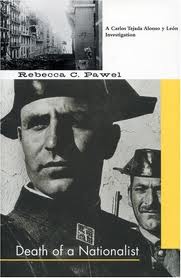
Mrs P of Mrs Peabody Investigates recommended a few contemporary crime fiction books set between the 1930s-50s. I've just picked three of them up from the bookshop.
The Murder Farm by Andrea Maria Schenkel
Death of a Nationalist by Rebecca Pawel
Last Rights by Barbara Nadel
Looking forward to giving them a go.