Rob Kitchin's Blog, page 183
March 23, 2013
Stonework
George stared at the pile of grey-blue stones, then bent down and selected one, weighing it in his calloused hands, twisting it round, taking in its shape. He turned to the half-built wall and slotted it into place. Testing its fit, it toppled to one side. He pulled it free, turned it ninety degrees and tried again. Unsatisfied he placed the stone in another slot, then dropped it to one side. He stared at the wall, then at the hill across the valley, before gazing back down at the pile of stones, content in the cadence and silence of work.
A drabble is a story of exactly 100 words.


March 22, 2013
Review of The Big Gold Dream by Chester Himes (Avon, 1960)
 Alberta Wright has found God via Sweet Prophet Brown’s sermon at a street service on 117th Street, Harlem. At the height of her religious fervour, she seemingly drops dead. Her partner, Sugar Stonewall, dashes from the scene not wanting to be around when the cops turn up. He arrives back at their apartment to find that Alberta’s estranged husband has sold all her furniture, having failed to find her secret stash of cash. But Sugar and her husband are not the only one’s hunting for Alberta’s money and soon the furniture buyer is murdered at his shop. Coffin Ed Johnson and Grave Digger Jones, two black detectives working the Harlem beat, start to investigate, aware that the body count might rise before they manage to administer justice.
The Big Gold Dream is the fourth book in the Coffin Ed and Grave Digger series. The strongest element of the story is the sense of place and contextualisation as to life and hustles in Harlem in the 1950s. However, the characterisation is wafer thin, with next to no back story with respect to any of the various characters, and the two lead detectives hardly feature at all. What keeps the story together is the plot and pace. Himes keeps the action moving along in a reasonably convoluted tale about finding a supposed small fortune hidden by a somewhat naive woman. The telling is a little ragged in places, but it’s a reasonably entertaining caper.

March 20, 2013
Reading tensions
Over the past couple of months I've been wrestling with the balance between reading fiction and work-related material. The dilemma is that I have a lot of books I need to read to help me write the academic book I'm working on, but not enough time to read them. The obvious solution is to scale back on the fiction to slot the non-fiction in. I've been resisting that, but it's fairly obvious that something is going to have to give and it needs to be the fiction reading. So, expect a lessening of crime fiction reviews on the blog over the coming months, after which normal service should hopefully resume. My plan is to still post at least one fiction review a week; more if I continue to resist the need to scale back.
March 19, 2013
Review of The Twelfth Department by William Ryan (Mantle, 2013)
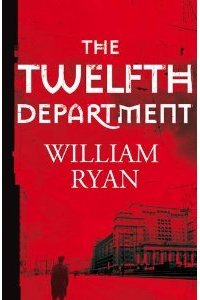 Moscow, 1937, Captain Korolev, a divorced detective with the local militia is looking forward to spending a week with his young son, who is visiting him for the first time in a while. He’s barely met Yuri off the train when he’s asked to investigate the death of an important scientist, shot in the back of the head in his exclusive apartment near to the Kremlin. The scientist has managed to rise up the greasy pole to attain his own research institute through a mix of promising results from dubious science and denouncing colleagues. Korolev knows the case is a poisoned chalice given the interest of a colonel in the Twelfth Department of the NKVD and he’s relieved when it’s taken away from him. His respite is short-lived, however. Not only is he directed back to the case, but he becomes a pawn between two sparring NKVD departments and Yuri disappears. The challenge is to solve the case whilst negotiating a booby-trapped tightrope in a country where failure has dire consequences and to save his son. No easy task, but at least he’s armed with tact and guile, and has the support of friends and enemies, all of whom may share his fate if he fails.
The Twelfth Department is the third instalment in Korolev series and sees the detective back in his native Moscow after his excursion to the Ukraine in his last outing. Ryan does an admirable job of recreating the tension and paranoia of pre-war Russia, and the ways in which ordinary people try to survive and get by in the system. Korolev is canny, street-wise and willing to take a risk, but he isn’t corrupt nor anti-establishment, instead trying to be a good citizen and comrade in a regime that oppresses many. Given his job, he is tested often, and in The Twelfth Department Ryan provides a nice conumdrum to solve both in terms of the case and in surviving being a pawn in a game between NKVD departments. Indeed, this is a well-paced, plot-driven story, and whilst the characters are nicely penned, they are caught in the moment of the story and the reader learns little of their back story or wider situation and it would be interesting to learn a little more about Korolev and his colleagues in the next book. In compensation, there is a strong sense of place, good contextualisation, and vivid atmosphere. Overall, an enjoyable read and solid addition to what is shaping up to be a very good series.
I was fortunate enough to be send an advance copy by the publisher and The Twelfth Department is not published until May, so you have plenty of time to get your advanced order in.

Norwegian by Night
 I bought Norwegian by Night by Derek B. Miller from the local bookstore on Saturday afternoon. I finished it yesterday morning. It's one of the those books you devour in a couple of sittings and manages to convey just about every kind of emotion. The lead character - an eighty two year old former Marine now living with grand-daughter in Oslo - is a wonderful creation. I'm still mentally digesting the story about how he goes on the run with a small child after witnessing the murder of the boy's mother. I'll post a review in the next week or so, but suffice to say it's worth checking out. Of the three covers I've seen browsing the internet, this one is my favourite.
March 17, 2013
St Patrick's Day reading
 Happy St Patrick's Day. Given it's a day to celebrate all things Irish I've gone back through my reviews and picked out all the novels written by Irish authors in the last twelve months. There are some cracking stories here, so why don't you join in the festivities by tracking down at least one of them and giving it a read. Or if you want something you can read right now, you could try my short story from earlier in the week, The Case of the Strange White Van, set in Leitrim.
Ratlines by Stuart Neville
The Devil I Know by Claire Kilroy
I Hear Sirens in the Street by Adrian McKinty
Red Ribbons by Louise Phillips
The City of Shadows by Michael Russell
Slaughter's Hound by Declan Burke
Even Flow by Darragh McManus
A June of Ordinary Murders by Conor Brady
Ghost Town by Michael Clifford
My other posts this week:
Property tax evaluation model and what it means for residential property owners
Review of Last Rights by Barbara Nadel
White van stories
Review of Thirteen Hours by Deon Meyer
Stick or twist?
March 16, 2013
Stick or twist?
‘So, how’s life?’
Susie placed her wine glass on the table. ‘It’s okay.’
‘That good?’
‘I think it might be time to move on.’
‘Again? You’ve only been with them two months.’
‘From Simon.’
‘Simon? Are you crazy?’
‘I ... well, I just ...’
‘Do you love him?’
‘Yes. I ... yes.’
‘And he’s treats you well.’
‘I wouldn’t have lived with him for eight years if he didn’t.’
‘And the bedroom?’
‘Good.’
‘So what’s the problem?’
‘It just feels ... stale.’
‘Stale can be refreshed. Finding something better might be more tricky.’
‘But it could be exciting.’
‘Or lonely.’
A drabble is a story of exactly 100 words.
Susie placed her wine glass on the table. ‘It’s okay.’
‘That good?’
‘I think it might be time to move on.’
‘Again? You’ve only been with them two months.’
‘From Simon.’
‘Simon? Are you crazy?’
‘I ... well, I just ...’
‘Do you love him?’
‘Yes. I ... yes.’
‘And he’s treats you well.’
‘I wouldn’t have lived with him for eight years if he didn’t.’
‘And the bedroom?’
‘Good.’
‘So what’s the problem?’
‘It just feels ... stale.’
‘Stale can be refreshed. Finding something better might be more tricky.’
‘But it could be exciting.’
‘Or lonely.’
A drabble is a story of exactly 100 words.
March 15, 2013
Review of Thirteen Hours by Deon Meyer (Hodder, 2010)
 Benny Griesel’s home and work life seem to be drifting away from him. He’s been sober for six months, but his wife has still not let him return to the family home. At work he’s been eased to one side, assigned the role of mentor to a new crop of detectives. The day starts badly when he gets an early morning call about the discovery of a body. A short time later he receives a second call; another body has been found. Both are high profile: a young American tourist and the owner of a successful record label. His day is going to be busy and stressful, giving advice to two rookie detectives. Then he discovers that a second American tourist is being chased by a gang of men intent on killing her. Griesel is ordered to take charge of finding and protecting the young woman. But not only is she running scared, she believes that some of the men pursuing her are police officers. The clock is ticking and time is running out for both the woman and Griesel.
Thirteen Hours starts at a brisk pace and hurtles along to its tense conclusion. The journey, however, is not overly linear, with Meyer managing to create a layered, complex and compelling story consisting of two intersected plotlines. The contextualisation is excellent, particularly with respect to the dynamics and politics of the Afrikaans music industry and the South African police force, and the social geography of Cape Town. The characterisation is very nicely realised, especially Griesel and his fellow cops, and Meyer is particularly good at portraying the interplay and dynamics between characters and how these evolve over time and in context. The only slight niggle was the sense that woman being chased should have really been able to find safety in such a large and busy city, especially once she knows the US authorities are also looking for her, yet when she does find refuge she takes a bath rather than calling for help. Other than that, this is a great read - a tense, fast-moving, textured thriller - which definitely whets the appetite for spending more time in Griesel’s company.

March 14, 2013
White van stories
 Yesterday, Patti Abbott posted links to all the entries to her 'white van' challenge - to write a short story involving a white van. I haven't yet found the time to work my way through all of them, but if you're interested in some short pieces of flash crime fiction head over to Patti's blog pronto. And here's the link to my story - The Case of the Strange White Van.
March 13, 2013
Review of Last Rights by Barbara Nadel (Headline, 2005)
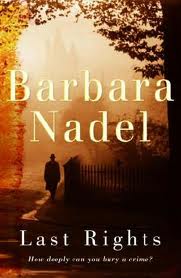 1940 in London at the height of the blitz, undertaker and First World War veteran Francis Hancock’s nerves are in shreds. Unable to descend into the shelters for fear of being buried alive, he wanders the streets in a dazed madness as the bombs fall all around him. One night he comes across a man who claims to have been stabbed before staggering off. Two days later, the man turns up in Hancock’s funeral parlour. The police think he died from shock caused by a bomb blast, but Hancock discovers a small pinprick on his chest which he believes was created by a hat-pin. Initially, the police are not interested, but after a post-mortem examination they arrest his wife, disbelieving her alibi and aware that she has a chequered history and possible 'bad blood', her mother having murdered her step-father with a hat-pin through the heart. Hancock is not convinced of the woman’s guilt and having taken in her teenage daughter sets about trying to contact her estranged sisters and to discover who did kill the man.
Last Rights is a kind of a hard-edged cozy: undertaker, Francis Hancock, turns amateur detective, investigating a murder when the police do not at first seem interested, continuing when he feels that they have arrested the wrong person. The edge is provided by the blitz, working class conditions, prostitution and the black market, and some unsavoury characters. The story unfolds at a reasonable clip and Nadel’s style is quite engaging. There is some nice contextualisation with respect to the blitz and the Jewish community in London, the sense of place is quite strong, and the characterisation and familial relations are well realised. Where the book suffers is with respect to the plot. The premise is interesting but the execution is weak and contrived at times and the killer is somewhat obvious from a long way out. There were a number of elements of the story that I just simply did not believe, not least the actions of the police, which made little sense. Overall, the makings of a good series, but this opening story was undermined by an improbable plot.
3 stars