Rob Kitchin's Blog, page 182
April 6, 2013
Plane Envy
 Penny pointed to a tiny silver glint in the sky tailed by two long contrails. ‘I bet that’s going somewhere nice.’
‘America probably,’ Tom replied. ‘Or maybe Canada.’
‘My dad says he might have to move to Canada for work. There or Australia.’
‘You’d be going as well?’
‘Why, would you miss me?’
‘No. I mean, yes. I ...’
Penny slipped her hand into his. ‘We’re all staying. It’s just him that would go. He’d send back money.’
‘Sometimes I wish I could just get on a plane and fly away.’
‘When here is so wonderful?’
‘Because it’s so wonderful.’
A drabble is a story of exactly 100 words.


April 5, 2013
Review of Missing in Rangoon by Christopher G. Moore (Heaven Lake Press, 2012)
 Some missing people don’t want to be found, some PIs don’t want to go where they might be hiding, and some parents don’t care about the wishes of the first two. Rob is the former, hiding out in Burma (Myanmar) with his singer girlfriend, Vincent Calvino is the Thai-based PI who has little desire to travel across the border to find him, and Osborne is the persistent, rich, dying father who wants to be reunited with his wayward son. At first, Calvino refuses Osborne’s pleas, but when his good friend, Colonel Pratt of the Thai police, asks him to accompany him on an undercover operation to find the source of methamphetamine trade, Calvino relents and takes on the case of finding Rob. After years of being a closed society, Rangoon is just starting to open up, but it’s still a very different place to Bangkok and Calvino has little local knowledge, nor contacts. It doesn’t take long to establish, however, that he’s not the only one looking for the missing man.
Missing in Rangoon is the thirteenth outing for Moore’s New York born and Thai-based PI, Vincent Calvino and the first in the series I’ve read. I had no problems dropping into the series and the book works fine as a standalone. The strength of the story is the nicely realised sense of place and the social, political and historical contextualisation with respect Thai and Burmese culture, especially the latter as it slowly opens up after years as a closed state, as understood by a well-embedded farang (foreigner), and there are some nice observational touches throughout. The characterisation of Calvino and his Thai cop buddy, Colonel Pratt, are nicely done, though some of the other characters are little more than caricatures acting out cliched roles. The plot was engaging and for the most part worked well, though there were a couple of moments that felt a little clunky, and at times there is too much show rather than tell, some of which was redundant with points laboured and repeated. Overall, despite a couple of quibbles, an entertaining and enjoyable sojourn into complex terrain of Rangoon.

April 4, 2013
Review of Blood from a Stone by Donna Leon (William Heinemann, 2005)
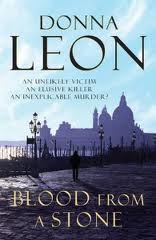 A few days before Christmas an African street vendor is shot dead whilst selling bags in a square in Venice. Commissario Brunetti is assigned to the case, but makes little initial headway given that the man’s fellow illegal immigrants have seemingly melted away into the Venetian underworld. When both the ministries of internal and foreign affairs show an interest in the case, Brunetti is order to hand over the investigative material and warned to drop his investigation. Intrigued and holding back evidence, he continues to probe, though he seemingly makes little progress.
Blood from a Stone is a curious kind of police procedural, as much about feints and duplicity as detection. It is told in an understated way and drifts along without any urgency. The plot is relatively thin -- Brunetti starts to investigate a murder but is then warned off, regardless he keeps surreptitiously picking away at it despite seemingly going nowhere -- but that hardly seems the point. The tale is more about Venice, Italian food, Brunetti’s family life, the petty office politics of the police, and a social commentary on how immigrants are imagined and treated and the West interferes in African politics. Leon does a nice job of creating a sense of place, time and social context, and letting the reader float along with the narrative as if on a gondola. An entertaining, mild-mannered story.

April 2, 2013
Review of A Man Without Breath by Philip Kerr (Quercus, 2013)
 It’s winter 1943 and former Berlin cop, Bernie Gunther, is working for the German War Crimes Bureau investigating supposed crimes committed by Allied forces. Rumours are starting circulate about a grave of Polish officers in woods outside of Smolensk and Gunther is flown from Berlin into German occupied Russia to investigate. The area is littered with mass graves, not all of which the German’s want to be discovered. But if the rumour is true then it could prove to be a useful piece of propaganda which can used to drive a wedge between Russia and its allies. The grave, however, turns out to be just one problem for Gunther to deal with, along with disgruntled and plotting senior officers and the murder of two local signals operators. Matters are not helped by the detective’s gruff style and his ability to rub people up the wrong way. With the Russians set to advance on their positions, Gunther needs to oversee the grave excavations, solve the local murders and move to safer terrain.
 I’m a great fan of the Bernie Gunther series. I’ve read all nine books, buying the last few in the first weeks of release. A Man Without Breath is a solid enough addition to Bernie’s story, though it is by no means Kerr’s best work. Kerr writes with a very strong and engaging hardboiled voice. His characters are vivid, the historical and social contextualisation and sense of place are excellent. And so it is with A Man Without Breath. There are three issues with the story, however, that undermine its telling somewhat. The first is Kerr has tried to cram in too many plotlines and incidents - the Katyn woods massacre and subsequent German propaganda, the plot to kill Hitler by Wehrmacht officers, the Rosenstrasse demonstration by German wives at the arrest of their Jewish husbands, the Gleiwitz incident that started the Second World War, Spanish Fascist experiments on Republican prisoners, several murders that occur whilst Gunther investigates the Katyn massacre, and a love affair. Any two of these would have been sufficient hooks for a strong, tight plot, but the combination of all of them leads to a bit of a muddle. Second, the book is overly long (over 500 pages in hardback) and not just because of the plotlines -- several passages could have been tightened up or deleted as they were largely redundant to the plot. Third, Kerr has Gunther murder a relatively innocent character in cold blood when there were other solutions. Bernie is no saint, but his appeal is that he has a strong moral compass in a corrupt regime and the people he tangles with are mostly monsters; he witnesses, investigates and avenges war crimes, but he doesn’t commit them. The action bumped me firmly out of the story and changed my whole view of the character. The effect of these three issues were to deaden the read, which was a shame, as given the place, time and themes of the book this had the potential to be excellent. Regardless, it’s an interesting and mostly enjoyable read and I look forward to the next instalment in Bernie’s adventures.

April 1, 2013
April reviews
 Another good month of reading. My book of the month was Peter Temple's White Dog. I really do hope that Temple resurrects the excellent Jack Irish series.
 Norwegian by Night by Derek B Miller ****
Beautiful, Naked and Dead by Josh Stallings ****
The Twelfth Department by William Ryan ****
The Big Gold Dream by Chester Himes ***
Last Rights by Barbara Nadel ***
Thirteen Hours by Deon Meyer ****.5
A Death in Bordeaux by Allan Massie ***
White Dog by Peter Temple *****
March 31, 2013
Lazy Sunday Service
 I'm reading Missing in Rangoon by Christopher G Moore at present. The setting, weather and culture is certainly different to cold, rural Ireland. The story is peppered with some nice observational touches. I liked this one as it captures how I think the relationship between my academic work and creative writing:
"As with many reinventions, the original platform remained functional underneath. The Colonel was still a cop who played the saxophone and not a saxophonist who played at being a cop."
My posts this week:
Review of Norwegian by Night by Derek B Miller
Review of Beautiful, Naked and Dead by Josh Stallings
A Murder in Venice
March 30, 2013
A Murder in Venice
 The three visiting academics stared at the body floating in the canal.
‘You know him?’ the inspector asked.
‘He’s a professor at the university,’ Göran replied.
‘We were waiting for him,’ Sigrun added. ‘He said he kept Italian time, not Swiss.’
‘The dead are always late,’ the inspector said. ‘And often in life also.’
‘Water is life,’ Rafaela, the hydrologist, muttered.
‘Not if you’re drowned, Signora,’ the inspector replied. ‘You’re going to have to stay in Venice for now.’
‘For how long?’ Göran asked.
‘As long as necessary. There are worse places to be. Unless you’re the murderer, that is.’
A drabble is a story of exactly 100 words.
March 28, 2013
Review of Beautiful, Naked and Dead by Josh Stallings (Heist Publishing, 2011 )
 Moses McGuire is not sure what he hates most -- himself or the rotten world he finds himself living in. Having been drummed out of the marines and served time, he’s approaching forty, his wife has left him, and he’s working as a bouncer at a run-down strip club in LA. He’s surrounded by losers and hardened and criminal souls, and his closest friends are Kelly, a waitress at the club who declines to strip, and bottles of whiskey. Contemplating whether to end it all with a bullet through the back of his mouth, he receives a phone call from Kelly asking him to come and rescue her from two thugs from her past. By the time he catches up with her she’s been tortured and murdered and McGuire gains a new purpose in life: revenge and justice. And he doesn’t really care who he pisses off in the process of exacting them -- the cops, FBI, the mob, or those working in the strip and prostitution industry -- or if he’ll end up dead. All that matters is making those responsible pay, and he has the attitude, wheels and firearms to make sure that happens.
Beautiful, Naked and Dead is a hardboiled caper novel that starts at a fair clip and keeps motoring along until its bloody climax. Everything about the book is hard-edged with soft undertones: the characters, the plot, the prose. Moses McGuire at one level is a cookie-cut hard man, but Stallings makes him a little vulnerable and complex with a firm moral compass despite his own shady past. The other characters are a little one-dimensional and cliched, but they perfectly fit the plotline and the fast-paced action. The strength of the plotting is the relentless pace, nicely realised action scenes and interchanges between characters, strong contextualisation within the stripping industry, and sense of place. Adding to the whole effect is Stalling’s tough writing voice that is nicely expressive and engaging. Overall, an entertaining read that has possible movie-script written all over it.

March 25, 2013
Review of Norwegian by Night by Derek B. Miller (Faber, 2013)
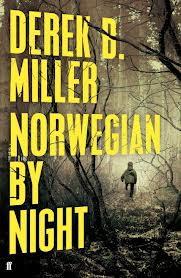 Following the death of his wife, eighty two year old Sheldon Horowitz has recently moved to Oslo to live with his grand-daughter and her husband. After a stint as a marine in Korea, he's spent most of his life running a watch and clock repair shop, grieving over the death of his son in Vietnam, for which he blames himself, and looking over his shoulder for North Korean spies bent on exacting revenge for the soldiers he killed during the war. Unable to speak the language and unsettled by the move and regrets in life, he seems increasingly disconnected from the world and his grand-daughter believes he might be starting to suffer from dementia. When the upstairs neighbour appears on his apartment doorstep with her young son after a violent argument he takes them in. But the respite is short lived. Her attacker breaks down the door and kills the mother as Sheldon and the son hide in the closet. Afraid the police might hand the boy over to the killer, the two fugitives slip away, intent on making their way to a summer cottage and sanctuary. Not sharing a language, the old man and young boy sneak through the Norwegian landscape, drawing on Sheldon’s in-grained marine training, as the cops, family, and the mother’s killer search for them. He might have failed his son, but Sheldon isn’t going to fail the small boy he’s christened ‘Paul’.
There’s a lot to like about Norwegian by Night, especially the wonderful lead character of Sheldon Horowitz. He’s cranky, difficult, complex, indignant, lovable, principled and caring. Derek Miller gives him great depth by charting a detailed back story and providing him with a difficult quest. He surrounds him by other well realised characters and there are some very nice interchanges between them. The plot is relatively straightforward in terms of Sheldon and the young boys journey, but Miller adds depth and layers through the use of remembrance and contextualisation, and it builds to a tense and dramatic climax. Much of the story is a wonderful read, shifting the reader through a full spectrum of emotions. However, the story drifts a little in the middle, providing back story material for other characters rather than keeping the focus more centrally on Sheldon and ‘Paul’, and Paul is the most underdeveloped character in the book (we never once get to see the world through his eyes, unlike several other characters). I was fine with the resolution, but the ending for me was a little too sudden leaving a number of loose ends with regards to the fate of different characters beyond Sheldon. Overall, this was a very good read and highly recommended to readers who like character-driven crime fiction.

March 24, 2013
Lazy Sunday Service
 I'm off to Venice for a couple of days this week to attend a meeting and present a talk. I was hoping to read Alibi by Joseph Kanon, which is set in the city in the 1946, when I was there but the order hasn't arrived at the local bookshop. I have an unread Donna Leon book on the bookshelf, Blood from a Stone, so I'm going to give that a go instead. I've not been to Italy before, so I'm looking forward to trip, even if it's only a short visit.
My posts this week
Review of The Twelfth Department by William Ryan
Norwegian by Night
Reading tensions
Unfinished estates and the local property tax
Review of The Big Gold Dream by Chester Himes
Detailed maps of every unit on unfinished estates exempt from the local property tax
Stonework