Rob Kitchin's Blog, page 188
January 25, 2013
Review of Liar Moon by Ben Pastor (Bitter Lemon Press, 2012)
 September 1943 and Wehrmacht Major Martin Bora wakes in an Italian hospital minus a hand, with the doctors fighting to save his leg, a victim of an attack by partisans. The Italian government have recently switched sides, dividing the country into two, with the North still controlled by the Fascists. As he starts to make his recovery he is asked to help the local police investigate two cases: the murder of a local Fascist hero, and an escaped mad man who has taken to killing people indiscriminately. Reluctantly he agrees, forming an uneasy alliance with Inspector Sandro Guidi, aware that the case is politically charged and that he still has to perform his usual duties. The murder seems a relatively open-and-shut case, the main suspect being the victim’s young widow, but neither Bora or Guidi are convinced of her guilt, though for different reasons.
 The real strength of Liar Moon is the character of Martin Bora and the moral ambiguities around his persona and actions. He’s reserved yet direct, determined, ruthless, and principled, driven by a deep sense of conviction and his aristocratic family tradition. He’s a soldier in an army of a corrupt and corrupting regime, trying to hold the line between murder and killing, on the one hand relentlessly hunting down partisans and on the other subverting the hunt for Jews. And losing his hand and nearly losing his leg is not going to slow him down. Moreover, he remains loyal and dutiful to his wife, despite their failed marriage. My sense is that regardless of the storyline, he’d be an interesting character to spend some time with. In Liar Moon, Pastor places him in an interesting historical terrain - Northern Italy just as Italy changes sides - and pairs him with an Italian police inspector to investigate the death of a local Fascist. She creates a nice sense of place and history, and captures the awkward relations between Axis allies. For the most part the plot worked well, but faltered at the resolution, which was contrived and came too much from left-field. This was a shame as the story was coasting along very nicely up to that point. Nevertheless, this was a thoughtful and enjoyable tale and if the other books in the Bora series are translated I’ll be reading them in due course.


January 24, 2013
Some media pieces from today
 The formal announcement of my ERC Advanced Investigator award has received a whole bunch of media attention today. If anyone is interested I'll be on the RTE 6 o'clock TV news later on. Earlier today I did radio pieces on Morning Ireland (RTE Radio 1) and KFM. The Irish Times covered it twice (here and here), and there were pieces in the Irish Daily Star, Journal.ie, Silicon Republic, Tech Central, and Business and Leadership.
Some tasty US imports
 A nice parcel turned up in the post today. Five crime novels from the US, all of which I picked on the basis of recommendations and best of 2012 lists. Now I have to work out where to slot them into the to-be-read pile, though I'm saving Devil in a Blue Dress for my trip to LA in April.
January 21, 2013
Review of Icelight by Aly Monroe (John Murray, 2011)
 The winter of 1947 and London is in the grip of a big freeze, with limited fuel supplies and food and clothes restricted by rationing. Peter Cotton has been reassigned from colonial intelligence in the Foreign Office’s Colonial Service to Operation Sea-snake, designed to try and protect valuable assets from American pressure to tighten security and the homophobic and paranoid attentions of MI5, MI6 and a MP who has established his own intelligence network. One such asset is Alexander Watson, an atomic scientist who is vital to Britain’s attempts to join the nuclear age, who picks up men for fleeting sexual encounters. Aided by Derek, a rent-boy in South London, and Sergeant Dickie Dawkins of Special Branch, Cotton tries to keep a watching brief on Watson and others, but then the scientist is arrested and he is pulled into the murky world of inter-agency rivalries and their hired help in the form of a pair of Glasgow razor boys. The issue is no longer simply protecting Watson, but how to also protect himself.
Icelight plunges the reader into the frosty world of London in the Winter of 1947 and the emerging cold war. Monroe creates a vivid sense of place and of social history, with the shortages of just about everything, the black market, and the feeling that Britain is teetering on the edge of a new age, shorn of its empire and beholden to its ‘special relationship’ with America. And as relations with the Soviet Union sour and a new political war starts, Monroe focuses on the tensions, rivalries and paranoia that flower within and between British intelligence agencies. She does so through a captivating but, at times, complex and convoluted plot that involves a fairly large cast of characters. I don’t mind admitting that occasionally I felt I was wandering in icelight, and at a couple of points I stopped and backtracked to reposition my bearings. What holds the book together is the premise, some lovely passages of writing (I thought the scene with Cherkesov in a restaurant was wonderful), a general sense of social and historical realism, and some nice characterisation. Cotton is an interesting lead character, who is worldly, shrewd and standoffish, and is complemented by the more earthy Dawkins, and the other characters are well penned. Overall and intriguing and entertaining read, that whilst complex is thought provoking and nicely resolved.

January 20, 2013
Lazy Sunday Service
 I've just finished reading Liar Moon by Ben Pastor, set in 1943 in Northern Italy and featuring Wehrmacht Major Martin Bora (review to follow this week sometime). The first book was Lumen set in Poland in 1939. Both books are interesting because they explore notions of honour and morality in a time of war; Bora, for example, is prepared to kill but not murder; to hunt partisans but not send Jews to their deaths (or at least give them the opportunity to escape). According to Goodreads there are eight books in the series, and if the rest are translated from Italian, I'll probably work my way through the set. As yet, I can't see any plans on the Bitter Lemon Press site for the third book to be released, but I'm hoping that it's in the pipeline.
My posts this week
Review of The Devil I know by Claire Kilroy
The TBR grows ...
Fair dinkum
Contemporary, historical crime fiction set in the 1930-50s
Review of Go With Me by Castle Freeman
The evidence proves otherwise
January 19, 2013
The evidence proves otherwise
‘I never touched her.’
‘Mr Stevens, you were observed to hit Ms Fenton by two witnesses. You punched her in the face and broke her jaw.’
‘I was still in the pub. They saw somebody else attack her.’
‘You broke two fingers in your right hand. The hand you used to hit Ms Fenton.’
‘I didn’t lay a finger on her.’
‘Are you a habitual liar, Mr Stevens?’
‘Are you a habitual wan...’
‘I see you have a quite a temper. It makes you violent, as my client can testify.’
‘I’m not lying!’
‘I think you’ll find the evidence proves otherwise.’
A drabble is a story of exactly 100 words
‘Mr Stevens, you were observed to hit Ms Fenton by two witnesses. You punched her in the face and broke her jaw.’
‘I was still in the pub. They saw somebody else attack her.’
‘You broke two fingers in your right hand. The hand you used to hit Ms Fenton.’
‘I didn’t lay a finger on her.’
‘Are you a habitual liar, Mr Stevens?’
‘Are you a habitual wan...’
‘I see you have a quite a temper. It makes you violent, as my client can testify.’
‘I’m not lying!’
‘I think you’ll find the evidence proves otherwise.’
A drabble is a story of exactly 100 words
January 18, 2013
Review of Go With Me by Castle Freeman (Duckworth Overlook, 2008)
 In a small rural town in the backwoods of Vermont Sheriff Wingate arrives at work to find a young woman sleeping in her car, clutching a paring knife. Lillian claims she is being stalked by Blackway, a local bad cop who lost his job after she complained of being shaken-down. There’s no evidence though that it was Blackway that smashed up her car and killed her cat. Wingate’s advice is to leave town before Blackway escalates the violence, but the woman is not going to run away like her boyfriend; she wants Blackway dealt with. The sheriff sends her to an old sawmill where some of the town’s men gather to drink and chat to ask for their help. They send her off with Lester, a wily old-timer, and Nate the Great, a massive young man with more brawn than brains. Whilst the pair feel they are a match for Blackway, Lillian is having second thoughts, but once they’re on his trail there’s no backing out.
Go With Me is a country noir novella, full of atmosphere and sense of place. The great strength of the book, however, is the characterisation, dialogue and prose. Freeman’s style is all show and no tell, and with a few deft sentences he paints a vivid picture. The dialogue is absolutely spot-on, with some very well penned scenes where people are talking over and past each other, or at cross-purposes, or where conversations have nice elliptic loops, and sometimes all of these at once. The story itself is divided in two main strands. The first is Lillian’s quest to deal with Blackway aided by Lester and Nate. The second is four old timers chatting about their chances of success as they drink the day away in the mill. They are nicely complementary, the second providing a kind of contextual commentary on the first. The plot moves at a relatively swift pace to a tense conclusion. Whilst the book worked very well as a novella, and would provide a very good basis for a movie, my sense was the story was a little too linear, with no twists or turns or subplots, and if worked up into a longer piece could have been exceptional. Nonetheless, Go With Me is an engaging and enjoyable slice of country noir.

January 17, 2013
Contemporary, historical crime fiction set in the 1930-1950s
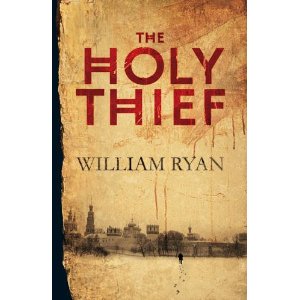 Yesterday a colleague asked if I could recommend some crime fiction set in 1930s-1950s. I jotted down a bunch of suggestions on a sticky note. Last night I decided it would be better to email her links to various reviews and then decided I might as well share it here. So, if you're interested in historical crime fiction in this period, then you might like books by these authors (I've only picked one book per author, but there are others reviewed on the blog if you search for them). If you have any other suggestions, please leave a comment.
Icelight by Ali Monroe (London 1946, review in next couple of days)
The City of Shadows by Michael Russell (Dublin/Danzig 1934)
Istanbul Passage by Joseph Kanon (Istanbul, 1946)
The Envoy by Edward Wilson (S.E. England, early 1950s)
The Foreign Correspondence by Alan Furst (Paris 1939)
Silesian Station by David Downing (Germany/Poland 1939)
A Lily of the Field by John Lawton (Vienna 1934/London 1948)
A Few Right Thinking Men by Sulari Gentill (Australia 1931)
Lumen by Ben Pastor (Poland, 1930)
The Holy Thief by William Ryan (Moscow 1936)
Half Blood Blues by Esi Edugyan (Paris/Berlin 1939-40)
Bury Me Deep by Megan Abbott (Arizona, 1931)
The Silver Stain by Paul Johnston (Crete 1942/2003)
Stratton's War by Laura Wilson (London 1940)
A Beautiful Place to Die by Malla Nunn (South Africa 1952)
Field Grey by Philip Kerr (France/Cuba/Germany 1931/1954)
The Information Officer by Mark Mills (Malta, 1941)
A Trace of Smoke by Rebecca Cantrell (Berlin 1931)
Death in Breslau by Marek Krajewski (Breslau 1933)
Alone in Berlin by Hans Fallada (Berlin 1940)
Carte Blanche by Carlo Lucarelli (Italy 1945)
HHhH by Laurent Binet (Czechoslavakia, 1942)
Restless by William Boyd (Pairs, Belgium, US 1939-41; UK 1976)
The Last Sunrise by Robert Ryan (India, Burma, Singapore, China 1941/1948)
The Sleepwalkers by Paul Grossman (Germany 1932)
The Red Coffin by Sam Eastland (Russia, late 1930s)
The Hanging Shed by Gordon Ferris (Scotland 1946)
January 16, 2013
Fair dinkum
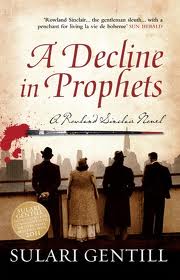
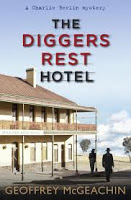 After a protracted process and quite a bit of frustration, The Diggers Rest Hotel by Geoffrey McGeachin and A Decline in Prophets by Sulari Gentill, arrived via its second courier from Australia yesterday (thanks, Pauline and Cian). As I've noted before (here and here) it's blumming difficult to be fair dinkum about Australian fiction when it's nigh on impossible to buy! Now I've managed to get my hands on these, I'm looking forward to tucking into them.
January 15, 2013
The TBR grows ...
 I've been on a bit of book buying binge over the past couple months and my active to-be-read pile has got up to about 50 books between fiction, popular non-fiction and academic books. Not large in the context of some people I know, but very large for me (I usually only have about 10-15 in the pile) - all told it's about half a year's worth of reading. In particular, I've been snaffling up fiction books. Above is my tbr on that front (easier to see if you click on it) and I've 8-10 others ordered and another 7 or 8 on the kindle. Given I've been quite selective in my choices, I at least know it's going to be a very good few months of reading! However, I must stop buying books until I've worked my way through them all! On the other hand, all the fiction on the pile is only about 4 months of reading, which isn't very long at all really ...