Rob Kitchin's Blog, page 189
January 14, 2013
Review of The Devil I Know by Claire Kilroy (Faber and Faber, 2012)
 Tristram St Lawrence, the son of the Twelfth Earl of Howth, has been living in exile and working as a translator when the transatlantic flight he is on makes an emergency landing in Dublin in 2006. In an airport hotel he meets Dessie Hickey, a former classmate from school, now a builder-cum-developer. Tristram’s employer and sponsor, the financier, Monsieur Deauville, is interested in Ireland’s boom and Hickey’s prospects. He instructs a reluctant Tristram to set up Castle Holdings and to finance Hickey’s scheme to develop a large site in Howth, to the north of the city. Soon Dessie and Tristram are funnelling European investment money into a shoddy development, bribing politicians, and have become involved in an investment consortium buying up properties in the UK, Europe, the Middle East and China. Then the Lehman Brothers bank collapses ...
The Devil I Know is a Faustian, allegorical and satirical tale of the boom and bust in Ireland told through the eyes of Tristram St Lawrence and his tragic foray into property development in the dying days of the Celtic Tiger. Setting the book in the two weeks leading up to the centenary of the 1916 uprising, the catalyst for independence, and using the narrative form of a testimony at an inquiry were inspired choices, setting the excesses of the Celtic Tiger and the loss economic sovereignty against the quest for self-determination, and framing the tale so it speaks directly to the reader. Kilroy’s prose is light, expressive and witty, and she keeps the story moving at fair clip. The plot captures the characters (the deluded, naive investor; the jack-the-lad builder/property developer; the social climbing wife, the crooked politician; the greedy corporate financiers; and the faceless European backers), scams, sentiments, rhetoric, politics and naivety of the boom and the disbelief and unworldliness of the crash. The only bits that seemed to jar a little were the ending, where the story switches to a slightly different, more fantastical register, the lack of any ordinary folk and their role in the property frenzy beyond one scene where they clamour to put down deposits on shoe-box apartments, and the Anglo-Irish background of Tristram, who is portrayed as something of an innocent and deluded dupe, swept along by the party; the Anglo-Irish gentry are not traditionally played in this victim role, although the inversion is interesting in and of itself. Overall, an entertaining and enjoyable tale of modern Ireland’s rise and fall.


January 13, 2013
Lazy Sunday Service
 I bought Icelight by Aly Monroe and Ratlines by Stuart Neville yesterday in the local bookshop. Given I'd just finished Castle Freeman's Go With Me, I decided to moved Icelight to the front of the TBR pile. I'm a 130 pages in and enjoying it, but I'm wondering whether I've made a mistake reading book three of the series without having read books one and two. The main character, Peter Cotton, is a bit of enigma and I suspect I would have a better handle on him and his backstory if I'd read the first two. Oh well, nothing for it but to keep going and backfill at a later date. Do you read a series in order or skip around?
My posts this week
Dictionary proofs arrived
Review of The Silver Stain by Paul Johnston
Literary noir crime fiction
Favourite cover of 2012
Review of Broken Dreams by Nick Quantrill
The game is up
January 12, 2013
The game is up
Shivering. Teeth chattering. Breath steaming in the cold night air. In the distance a sharp whistle answered by two barks and barely audible voices. Pinpricks of light dance through bare branches. Losing his nerve, Lonny tumbles out from his hiding place and sets off through the forest, his thin clothes and brittle skin snagging on brambles. Another whistle, this time closer and to his right. He veers left, his foot catching on a root, and tumbles into wet leaves. Cursing he rises and hobbles on, knowing that he should have never had stopped; that the game will soon be up.
A drabble is a story of exactly 100 words
January 11, 2013
Review of Broken Dreams by Nick Quantrill (Caffeine Nights, 2011)
 After the death of his wife two years previously, Joe Geraghty has been trying to put his life back together again, working as a private investigator in Hull. He’s been hired by a local business man to investigate an employee’s absenteeism. On the night he’s jumped and mugged, the woman he has under surveillance is murdered. Initially considered a suspect, he starts his own investigation into her death. Married to a prime mover in the regeneration of Hull, the woman had a tangled personal life, including dealings with Frank Salford, a racketeer who has seemingly gone straight. Salford is also a key figure in the other case he’s looking into, that of a woman who disappeared a number of years earlier. Along with his colleagues, Don, a retired cop, and Don’s single mother daughter, Sarah, Geraghty works to solve the cases, sometimes working with the police, other times ploughing his own furrow.
The strength of Broken Dreams is the contextualisation and sense of social reality concerning Hull, its decline and faltering regeneration, and its people. Quantrill doesn’t romanticize the city, portraying its gritty urbanity, yet he clearly has soft spot for the place. Geraghty is a likeable enough character who is tenacious, slightly vulnerable, and doesn’t always take the most sensible course of action, and the other characters were well drawn and engaging. The writing is fairly workmanlike, but has good pace and is all show and no tell. For the most part the plot worked well and was quite compelling, with a good entwining of the main and subplot. However, there were a couple of editorial niggles that seemed to jar a little and the ending seemed to fall apart somewhat. On my reading, there seemed to be only two incidental clues pointing to the killer - neither enough on their own or together to prompt the conclusion that the person was guilty of murder. Moreover, there was no material evidence and no basis for a confession; Geraghty seemed to just intuitively know who it was. This was a pity as the plot had been unfolding nicely until then with several potential suspects in the frame. Nonetheless, Broken Dreams is an interesting PI tale and a promising start to the Geraghty series.

January 10, 2013
Favourite cover of 2012
 Picking my favourite cover of 2012 was a relatively straightforward affair. Chuck Wendig's Blackbirds is both striking and clever. A really brilliant piece of artwork. If only all covers had this amount of attention. I also have to say that I really liked JT Lindroos cover for my own book, 'Killer Reels' - another striking and clever image.
January 9, 2013
Literary noir crime fiction - looking for suggestions
 I've been having a browse back over my best reads selections for the last four years. There's three sub-genres of crime novel that I clearly like more than others: literary, noir, screwball noir, twentieth century history (esp. 1930s-1950s) - fiction that is dark, humorous and philosophical.
Absolute Zero Cool
by Declan Burke pressed all three buttons, as did
We are the Hanged Man
by Douglas Lindsay,
The Mystic Arts of Erasing All Signs of Death
by Charlie Huston, and
Secret Dead Men
by Duane Swierczynski. Two of those buttons are pressed by books such as
Crooked Le
tte
r, Crooked Letter
by Tom Franklin,
Brodeck's Report
by Phillipe Claudel,
Field Grey
by Philip Kerr,
Mixed Blood
by Roger Smith, The Cold, Cold Ground by Adrian McKinty,
The Holy Thief
by William Ryan,
Small Crimes
by Dave Zeltserman,
The Ones You Do
by Daniel Woodrell,
Half Blood Blues
by Esi Edugyan,
The Postman Alway
s Rings Tw
ice
by James M Cain,
Istanbul Passage
by Joseph Kanon,
The Foreign Correspondent
by Alan Furst,
Alone in Berlin
by Hans Fallada, and I could go on. Now I like lots of other types of crime fiction as well, but these kinds of books are consistently amongst my favourite reads.
I've been having a browse back over my best reads selections for the last four years. There's three sub-genres of crime novel that I clearly like more than others: literary, noir, screwball noir, twentieth century history (esp. 1930s-1950s) - fiction that is dark, humorous and philosophical.
Absolute Zero Cool
by Declan Burke pressed all three buttons, as did
We are the Hanged Man
by Douglas Lindsay,
The Mystic Arts of Erasing All Signs of Death
by Charlie Huston, and
Secret Dead Men
by Duane Swierczynski. Two of those buttons are pressed by books such as
Crooked Le
tte
r, Crooked Letter
by Tom Franklin,
Brodeck's Report
by Phillipe Claudel,
Field Grey
by Philip Kerr,
Mixed Blood
by Roger Smith, The Cold, Cold Ground by Adrian McKinty,
The Holy Thief
by William Ryan,
Small Crimes
by Dave Zeltserman,
The Ones You Do
by Daniel Woodrell,
Half Blood Blues
by Esi Edugyan,
The Postman Alway
s Rings Tw
ice
by James M Cain,
Istanbul Passage
by Joseph Kanon,
The Foreign Correspondent
by Alan Furst,
Alone in Berlin
by Hans Fallada, and I could go on. Now I like lots of other types of crime fiction as well, but these kinds of books are consistently amongst my favourite reads. What I'm after is suggestions for authors/books that fit the 'literary noir' label; books that make you think about life rather than simply being entertaining. Recommendations?
January 8, 2013
Review of The Silver Stain by Paul Johnston (Creme de la Crime, 2012)
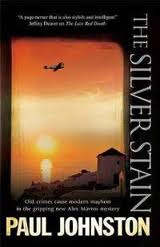 Athens based, private investigator Alex Mavros specializes in finding missing persons. When the star of a Hollywood movie being filmed on the island of Crete refuses to continue playing her role until her missing assistant is found, Mavros is flown in to track her down. The movie - Freedom or Death, about the invasion of Crete by elite German paratroopers in the Second World War - has stirred up bad memories, especially between an elderly English and former SOE agent and the German owner, and former paratrooper, of the hotel where the movie crew are staying. The former accuses the latter of war crimes, yet the latter is well regarded having contributed millions to the local economy and preserving heritage, and the former lives in a lawless enclave in the hills. As Mavros starts to investigate the woman’s disappearance he’s soon caught up in other local rivalries in the movie team, local politics, and criminal gangs, and also co-opted by the German hotel owner to recover some stolen ancient coins. Within a couple of days, however, he has recovered the coins and the traumatised missing woman but at the cost of a deadly vendetta. Moreover, he’s discovered that his own father played a pivotal role in the resistance against the German occupation, a role that has been falsely rewritten.
The Silver Stain uses the context of the making of a Hollywood movie about the past to examine both what happened then and its present day repercussions. Johnston does an excellent job of keeping both the past and present in frame, using the tale to illustrate how the past is variously remembered, used and contested, and how its legacy continues to rumble on. As such, the historical and political context and sense of place are particular strengths of the story, as is the characterisation. There is a fairly large cast, but each actor is well penned and vivid, and Mavros is an engaging lead character as the wily detective. The storyline itself is compelling, however, the plot strays towards being overly complex, with a large number of subplots, and it depends on an awful lot of coincidences to work. Moreover, Mavros too often succeeds where the odds are stacked against him, which pushed the narrative towards Indiana Jones territory a little too often. Whilst these plot devices create a lot of action and twists and turns, they also undermine the credibility of the story, particularly in the latter third. Less, I feel, might have been more. Nevertheless, The Silver Stain is an entertaining and enjoyable tale that rattles along at a fair clip.

January 7, 2013
Dictionary proofs arrived
 I took receipts of the proofs for the Oxford Dictionary of Human Geography this morning. 2,104 entries across 585 pages (315,000 words) which have to be diligently read by February 1st. Along with first semester exams and teaching a full module over the third week in January they should keep me busy. It might be a quiet month of book reviewing, though I have two lined up for later this week.
January 6, 2013
Lazy Sunday Service
 So the first week of the new year has already zipped by. Although I've spent it in rain soaked Ireland, virtually I had a few pleasant days in Crete courtesy of Paul Johnston's The Silver Stain, the review of which I'll post sometime next week. A week of reading in the winter sun would be nice right now. Instead, I'll be spending the coming week reading and marking exam scripts under grey skies. Oh well.
 My posts this week
Review of Dig Two Graves by Eric Beetner
The year that was ... 2012 retrospective
December reviews
Best reads 2012
Around the world in 2012
Review of I Hear Sirens in the Street by Adrian McKinty
New to me authors in 2012
Do we need to start building houses again?
2012 reading and reviews
Spinetingler best reads 2012
One drop three drip
January 5, 2013
One Drop Three Drip
One Two Three Drip
One Two Three Drip
One Drop Three Drip
Four four time. Perfect. Sometimes it plays in a weird rhythm. Five eights or ninths. Like strange Asian music.
Sitting on the damp concrete, my back against the mildewed wall, I tap out a beat on my knees, my foot tapping an imaginary bass drum.
Occasionally there’s a misbeat ...
One Two Drip Drip Four
.. and I add a jazz flourish.
You never can quite trust the slow leak.
It used to drive me half demented. Now it’s the soundtrack to my life.
One Two Three Drip
A drabble is a story of exactly 100 words
One Two Three Drip
One Drop Three Drip
Four four time. Perfect. Sometimes it plays in a weird rhythm. Five eights or ninths. Like strange Asian music.
Sitting on the damp concrete, my back against the mildewed wall, I tap out a beat on my knees, my foot tapping an imaginary bass drum.
Occasionally there’s a misbeat ...
One Two Drip Drip Four
.. and I add a jazz flourish.
You never can quite trust the slow leak.
It used to drive me half demented. Now it’s the soundtrack to my life.
One Two Three Drip
A drabble is a story of exactly 100 words