Rob Kitchin's Blog, page 191
December 30, 2012
Lazy Sunday Service
 It's very unusual for me to publish five reviews in a week, but there are two contributory factors. First, I'm often a couple of days behind with putting up reviews after I've finished a book and I want to make sure that books read in 2012 are reviewed before the year end, and second, I've spent a good portion of the past week reading, finishing a book every one or two days. Only one more review to go up, Eric Beetner's Dig Two Graves. I'm glad I've waited until the end of the year to publish my best of 2012 reads as two of the books I reviewed this week will make my top ten list - more on that on Tuesday.
My posts this week
Review of The City of Shadows by Michael Russel
Crime at Christmas
Review of Red Ribbons by Louise Phillip
Review of Crime at Christmas by C.H.B. Kitchin
Review of A murder in Iceland
Review of The Hitman's Guide to Housecleaning by Hallgrimur Helgason


Review of The Hitman’s Guide to Housecleaning by Hallgrimur Helgason (AmazonCrossing, 2008)
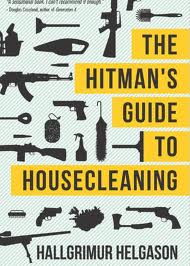 After serving in the Croatian Army in the 1990s, fighting a bloody battle with the Serbs, Tomislav Bokšić, more commonly known Toxic, has moved to New York, working as a hitman for the Croatian mafia. Between the war and the contract killing he’s dispatched over one hundred and twenty people. His flawless record of 66 contract hits is bought to an end when he erroneously shoots dead a FBI agent. The plan is to fly back to Croatia on a false passport but JFK airport is crawling with agents. Instead he jumps a TV evangelist, Father David Friendly, in the toilets, slips on the dog-collar and gets on a flight to Iceland, where Friendly is due to appear on a small born-again Christian television show. Drawing on his childhood Catholic upbringing, Toxic manages to fool his hosts. However, stuck on an island with no guns, no mafia, all but no murder, and surrounded by essentially good people who want to save his soul, he has the time and space to reflect on his violent past and his potential future.
At its heart The Hitman’s Guide to Housecleaning is a tale of redemption. Toxic is a repulsive character - a cold blooded killer, a selfish liar, and a misogynist. Through a combination of politically incorrect humour, pathos and flashbacks, Helgason tries to encourage the reader to empathise with him and his predicament. It’s a tall order, especially when Toxic remembers some of the horrendous, bloody events in which he’s participated. And just as you start to warm to him a little, a cold bucket of water is thrown from the page. The result is an oddly compelling, disturbing, jarring and comic tale. Indeed, Helgason uses comic touches to good effect and I found myself laughing out loud several times, admittedly to some fairly black, gallows humour. And whilst Toxic dominates the story, he’s surrounded by an interesting odd-ball cast. As with just about everything else about the story, the plot is a little over-the-top. That’s to be expected in what is essentially a screwball noir, but occasionally the plot devices are a little too much and the story teeters on the edge of ridiculousness. In addition, the tale doesn’t quite have enough reflective and remorseful moments, Toxic seemingly unable to fully transform himself. Overall, an entertaining romp and something of a page turner, but all the paradoxes didn’t quite add up.

December 29, 2012
A murder in Iceland
‘I want checkpoints placed on all routes out of town,’ Inspector Olafsson said.
‘Are you sure?’ the local police officer replied.
They both glanced over at the husband, his hands and chest covered in blood, his eyes vacant.
Olfasson sighed. Despite the dozen murders that happened each year in Iceland’s burgeoning crime fiction, he’d only investigated seven homicides in ten years. All but one had been an open and shut case, solved within a few hours.
This would be no different, but he wasn’t willing to sign-off the inquiry just yet.
‘We need to cover all possibilities,’ he said morbidly.
A drabble is a story of exactly 100 words.
‘Are you sure?’ the local police officer replied.
They both glanced over at the husband, his hands and chest covered in blood, his eyes vacant.
Olfasson sighed. Despite the dozen murders that happened each year in Iceland’s burgeoning crime fiction, he’d only investigated seven homicides in ten years. All but one had been an open and shut case, solved within a few hours.
This would be no different, but he wasn’t willing to sign-off the inquiry just yet.
‘We need to cover all possibilities,’ he said morbidly.
A drabble is a story of exactly 100 words.
December 28, 2012
Review of The Nameless Dead by Brian McGilloway (Pan, 2012)
The island of Islandmore lies in the no-man’s land of the River Foyle that separates the Republic of Ireland from the North; the border runs right down the centre of the small slither of land. In the past it has been used by fishermen, smugglers and as the site of a cillin - a non-consecrated burial site for children who died before they could be baptised. A recent submission to the Commission of the Location of Victims’ Remains suggests it was used in the Troubles as a burial site for one of those that 'disappeared'. As the Commission searches the island, using geophysics, a cadaver dog and diggers, for the body of Declan Cleary, who vanished in the 1970s after supposedly informing on a man that was then shot by the British Army, they find the body of a baby buried sometime in the recent past. The postmodern reveals that she had been strangled. Inspector Ben Devlin would like to investigate, but the law states that no death discovered by the Commission can be followed up on and prosecuted, even those that were not part of the Troubles. Undeterred he starts to poke around, but is soon distracted by a fresh murder; it seems the dig on the island has bought old animosities to the surface once again. Devlin starts to probe further into Cleary’s and the island’s past looking for clues, but is hampered by the fact that much of the case resides in North, outside of his jurisdiction.
The Nameless Dead is the fifth instalment of McGilloway’s Ben Devlin series. McGilloway has the full measure of Devlin’s world - his family, police politics and rivalries, his embedding in the social and criminal landscape of the border. The writing is very assured, with a lovely cadence and pace, and nicely balances plot, characterization, sense of place and contextualisation. With respect to the latter two, The Nameless Dead skilfully weaves together the troubles and sexual politics of the 1970s with the politics of peace and reconciliation and the social realities and landscape of the post-Celtic Tiger crash in the border counties. The plotting is particularly well done, interlacing a number of subplots to produce a layered and textured story that charts both the investigation and Devlin’s personal life. Whilst the focus is very much Devlin, importantly McGilloway also adds flesh to the series’ secondary characters, and the ongoing subplots adds to the overarching arc of the series. Overall, The Nameless Dead is a satisfying and superior police procedural in what is shaping up to be a very accomplished and enjoyable series.

The Nameless Dead is the fifth instalment of McGilloway’s Ben Devlin series. McGilloway has the full measure of Devlin’s world - his family, police politics and rivalries, his embedding in the social and criminal landscape of the border. The writing is very assured, with a lovely cadence and pace, and nicely balances plot, characterization, sense of place and contextualisation. With respect to the latter two, The Nameless Dead skilfully weaves together the troubles and sexual politics of the 1970s with the politics of peace and reconciliation and the social realities and landscape of the post-Celtic Tiger crash in the border counties. The plotting is particularly well done, interlacing a number of subplots to produce a layered and textured story that charts both the investigation and Devlin’s personal life. Whilst the focus is very much Devlin, importantly McGilloway also adds flesh to the series’ secondary characters, and the ongoing subplots adds to the overarching arc of the series. Overall, The Nameless Dead is a satisfying and superior police procedural in what is shaping up to be a very accomplished and enjoyable series.

December 27, 2012
Review of Crime at Christmas by C.H.B. Kitchin (Hogarth, 1934; reprinted Faber and Faber 2009)


Malcolm Warren is a stockbroker in the City. On Christmas eve his wealthiest client, Mr Quisberg asks him to increase his shareholding of the Harrington Cobalt Company before he travels out to Beresford Lodge, a large house in Hampstead Heath, to spend Christmas with his client and his other guests. Warren arrives just as Quisling and his secretary, Hartley, are leaving to travel into the city to meet the owner of a company intent on purchasing the same company in which he's just bought shares. After being shown to his room he joins the others for dinner, including Mrs Quisling, her daughters from her second marriage, Amabel and Sheila, her son from her first marriage, Clarence, Amabel’s would-be fiancée Len Dixon, the mother of Quisling’s secretary, Mrs Hartley, and Dr Green, Quisling’s right-hand man. Elsewhere in the house is another son, Cyril, who is being tended by the attractive young nurse, Ms Moon, and the house staff including Edwins the footman and several housemaids, cooks and gardeners. When Warren awakes on Christmas morning he discovers the body of Mrs Hartley on the balcony outside his room. It seems she had fallen from an open window whilst sleep walking. The news of the accidental death unsurprisingly unsettles the household and Warren witnesses a number of odd occurrences. Then he discovers a second body, this time most definitely the victim of foul play.
Crime at Christmas is the second novel in a short series of four books featuring Malcolm Warren. The first, Death of My Aunt, published in 1929 is considered something of a classic. Crime at Christmas follows a familiar trope of the golden age of crime novels - several people are staying in a large house and one of them dies. It could be an accident or it could be murder. The various family members, guests and domestic staff have varying status, relationships and conflicts, and the resident amateur detective sets about solving the mystery. With regards to the latter, Warren is somewhat of a fey, upper-class gentleman character and reluctant detective who hoards clues to protect reputations rather than handing them over to the police. Kitchin spins the tale out in an engaging fashion with a vivid cast of characters. However, in the latter half of the book the story starts to unravel, with the solution to the puzzle being a little ridiculous and difficult to believe, and the denouement weak. Kitchin himself seems to know this, with a final chapter that consists of a conversation between author and imagined reader that tries to provide reason to some of the more fanciful elements of the story. Overall, an engaging and mildly amusing story that suffers from a weak resolution. On the subject of production, I much prefer the Hogarth cover to the Faber and Faber one, which also lacks a synopsis or any details about CHB Kitchin or his work. It's great that some of his novels have been reprinted, but it would have taken very little effort to add some value to the books in terms of design and an intro.

December 26, 2012
Review of Red Ribbons by Louise Phillips (Hachette, 2012)
 A young girl who has been missing for two days is discovered buried in a secluded plot beneath elderberry trees in the Dublin Mountains. She’s been folded into a position of prayer, her hands clasped, her hair braided with red ribbons. Detective Inspector O’Connor is assigned to investigate the case and immediately contacts criminal profiler, Kate Pearson. The evidence from the crime scene unnerves Kate, suggesting that the murderer will strike again. The following day another girl disappears who reassembles in appearance the first. As well as the pressure of her domestic troubles, Kate is being pushed to help identify the killer and predict his next move. Meanwhile in the north of the city, Ellie, a patient confined to a psychiatric hospital has finally broken her silence on the death of her daughter fifteen years earlier; a murder she denies committing. What she has to say echoes with the recent deaths. Is she imagining the connection or is the same killer at work?
 Louise Phillips’ debut novel, Red Ribbons is a psychological police procedural set over a few autumn days. The story is told through three alternating voices: the killer’s, Kate Pearson’s and Ellie’s. Ellie’s voice in particular is very strong and engagingly written, but the characterisation of all three is well developed. In contrast, the other characters are a little thin and two dimensional. In particular, Detective Inspector O’Connor as the fourth central character is somewhat of an enigma and the reader learns little about him other than he’s an alpha male and under a lot of pressure. The writing is a little hesitant at first, but as the story unfolds it becomes progressively more assured and compelling, hooking the reader in. For the most part the plotting works well, though the timeline felt a little compressed, using a couple of plot devices to move the story along. Given the structure, where the reader knows the killer and his thoughts, the tale is more of a why-dunnit and whether he’ll get away with it than a who-dunnit. Yet, despite the relative transparency of the plot, Phillips manages to keep the tension high right to the final page. Indeed, from about halfway-on it was quite engrossing and I raced through to the end. Overall, an entertaining psychological thriller.

December 25, 2012
Crime at Christmas?
 Seasonal best wishes to all readers of the blog. I hope that you're having a nice, relaxing couple of days. Yesterday I started Crime at Christmas by my namesake C.H.B. Kitchin, set in London in the early 1930s (published in 1934) which starts on Christmas eve with the household waking to find one its guests dead on Christmas morn. Thankfully a fate that has not affected the Blue House. That said, my presents include a pair of binoculars, a book on forensic science and a high powered torch, so perhaps I might have to turn detective later in the day. Either that or it's a 'how not to get caught' kit.
December 24, 2012
Review of The City of Shadows by Michael Russell (Avon, 2012)
 It’s 1934 and the shadow of the war of independence and civil war still hangs over Ireland, their politics and factions infusing everyday life along with the rising power of the Church. On the continent, fascism is a growing force, particularly in Germany as the Nazi party consolidates its grip on government, terrorizes Jewish citizens and threatens other nations. When Stefan Gillespie, a detective sergeant in Dublin, stakes out a German back street abortionist, he little realizes he’s about to stumble into a tangled conspiracy of blackmail and murder that stretches from Dublin to Danzig. On entering the clinic Gillespie encounters Hannah Rosen, a strong willed Jewess who has returned to Dublin from Palestine to investigate the disappearance of her best friend. Very quickly Special Branch grabs the abortionist case from Gillespie and he swaps his attention to discovering what happened to Hannah’s friend, who’d been having an affair with a priest. As he starts to investigate it’s clear that others want him to drop the case and they’re prepared to use coercion if necessary. Gillespie is already vulnerable, a Protestant and single father to Tom in a country that favours neither status, but he’s also resilient and doesn’t react well to threats. Meanwhile, Hannah has followed the trail to the priest to Danzig, a free city under political siege by Nazis keen to reintegrate it into Germany.
The City of Shadows is quite simply a brilliant crime novel. Although his debut novel, Michael Russell has a wealth of experience as a television scriptwriter (Midsomer Murders, A Touch of Frost, Emmerdale) and it shows in the quality of the story, which works at every level - plotting, sense of place, historical contextualisation, characterization. Whilst the plot is expansive and complex, it is straightforward to follow and utterly compelling, grabbing the reader from the start and not letting up in intrigue or pace, and very well structured. There are plenty of twists, turns and feints, with the reader kept guessing until the very end as to the mystery of the disappearance of Hannah’s friend. Russell drops the reader into the landscapes of Dublin, rural Wicklow and Danzig, and the heady mix of state and religious politics both at a senior actor level and how it played out in everyday life. There is real attention to historical detail and recreating the social and political atmosphere of the time. Stefan Gillespie and Hannah Rosen are both wonderful characters, each trying to fight a system that is seemingly too large and powerful. Russell brings both to life and their fragile relationship is well penned, as are the myriad of secondary characters. Overall, The City of Shadows is a entertaining and gripping story that I thoroughly recommend.

December 23, 2012
Lazy Sunday Service
 There's a reason why it's always best to wait until the very end of the year to announce your best reads - in last few days you might read a cracker of a book. And that's precisely what I've just done. Michael Russell's The City of Shadows is a brilliant debut novel set in Dublin and Danzig in 1934/35 that scores highly on every level - plotting, sense of place, historical contextualisation, characterization. A really great read. I'll post a full review tomorrow.
My posts this week:
Review of The Black Box by Michael Connelly
Review of Standing in Another Man's Grave by Ian Rankin
Bosch, Rebus and Maxine
Review of The Information by James Gleick
Soon to be relaxing at the Diggers Rest Hotel
Preparing for the turkey shoot
December 22, 2012
Preparing for the turkey shoot
‘What the ... is the world about to end?’
‘Last shopping day before Christmas; what were you expecting? To have the place to yourself? Try the far end, perhaps there’s some spaces there.’
‘How about we head home? It’s going to be mayhem.’
‘And what are we going to eat on Christmas day? Tuna surprise? No doubt you haven’t bought presents yet either.’
‘I was hoping you’d be happy with a tin of salmon. Let’s come back later.’
‘They’ll be nothing left but tuna. We’re never doing that again. We either come out with a turkey or we die trying.’
A drabble is a story of exactly 100 words
‘Last shopping day before Christmas; what were you expecting? To have the place to yourself? Try the far end, perhaps there’s some spaces there.’
‘How about we head home? It’s going to be mayhem.’
‘And what are we going to eat on Christmas day? Tuna surprise? No doubt you haven’t bought presents yet either.’
‘I was hoping you’d be happy with a tin of salmon. Let’s come back later.’
‘They’ll be nothing left but tuna. We’re never doing that again. We either come out with a turkey or we die trying.’
A drabble is a story of exactly 100 words