Dan Jorgensen's Blog, page 443
May 6, 2017
Earth's inspiring beauty
Enjoying the beauty of Colorado’s West Slope on the occasion of my 70thbirthday week, I was reminded of the e.e. cummings’ poem below to post along with pictures from the experience.

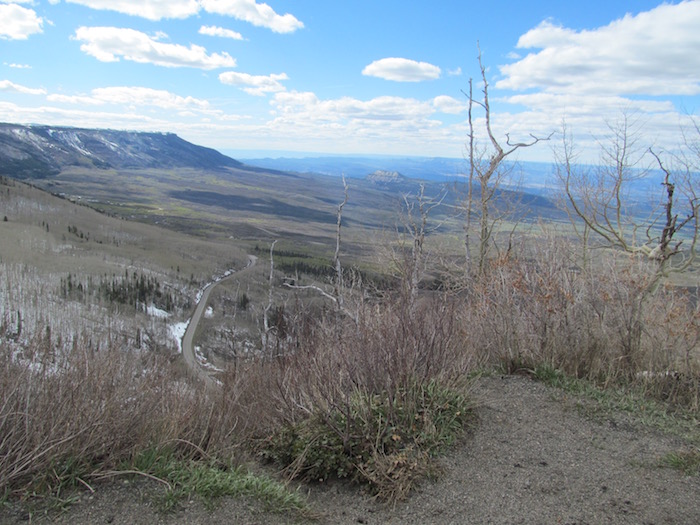

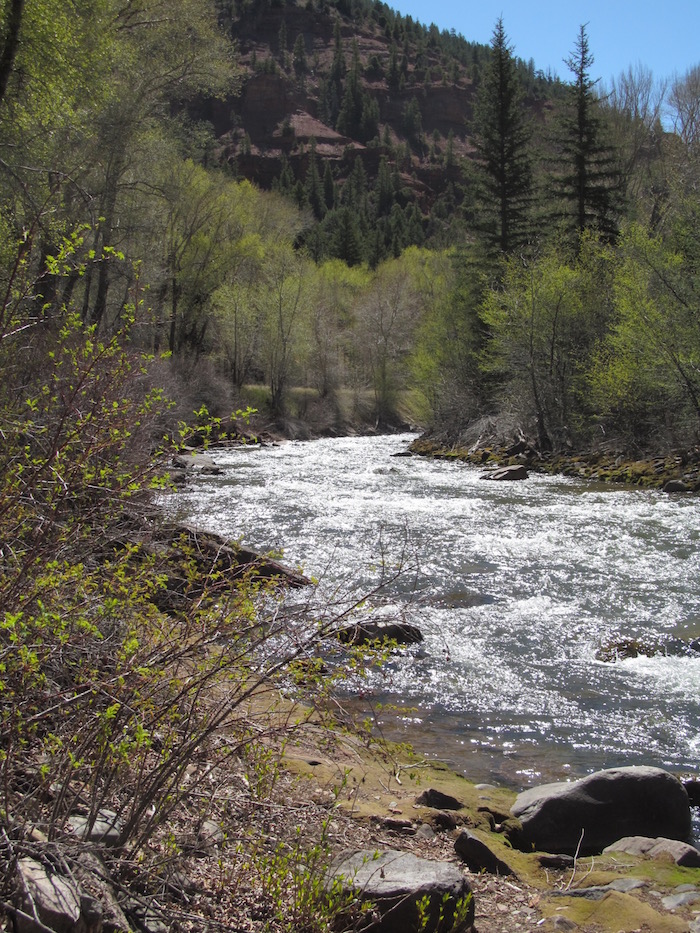 Writing becomes infinitely easier when inspired by the world within which we abide.For Saturday’s Poem here is cummings’ tribute to the beauty of a day and the earth around us.
 i thank You God for this most amazing
day:for the leaping greenly spirits of trees
and a blue true dream of sky; and for everything
which is natural which is infinite which is yes
(i who have died am alive again today,
and this is the sun’s birthday; this is the birth
day of life and of love and wings: and of the gay
great happening illimitably earth)
how should tasting touching hearing seeing
breathing any–lifted from the no
of all nothing–human merely being
doubt unimaginable You?
(now the ears of my ears awake and
now the eyes of my eyes are opened)
Share A Writer’s Moment with a friend by clicking the g+1 button below.


May 5, 2017
Every word written from the heart
“On the wagon sped, and I, as well as my comrades, gave a despairing farewell glance at freedom as we came in sight of the long stone buildings.” – Nellie Bly That quote came from the beginning of one of the most harrowing experiences a writer can put herself into – undercover reporting in a dangerous setting. And while it marked the start of a two-week living nightmare, it also marked the beginning of a reporting career that would catapult her into the role of the most famous reporter of her day.
Nellie Bly, born on this day in 1864 as Elizabeth Jane Cochran, not only set the standards for how undercover journalism should be done, but she also excited the imagination of the nation and the world with the things she was willing to do, putting her body on the line to “get the story and bring the truth to the world.”
The opening quote above came from her smuggled notes out of the infamous Blackwell’s Island, a New York insane asylum in the 1880s. Her reporting from there blew the lid off the terrible ways the inmates were treated and led to vast reforms. It was just the first of many, many things that this diminutive and imaginative reporter would do, including traveling around the world alone to attempt to break the record of the fictional Phileas Fogg in Jules Verne’s book Around The World in 80 Days. She did it in just over 72 days.
Bly is a key character in my book And The Wind Whispered, set in 1894. I’ve strived hard to keep the character true to the fortitude and actions of this amazing woman. The Amazing Nellie Bly was her title in those days. It still applies today, and the reporting world can be thankful that she was there to pave the way.
[image error] Nellie Bly
"I have never written a word that did not come from my heart," Nellie said. "And I never shall."
Nellie Bly, born on this day in 1864 as Elizabeth Jane Cochran, not only set the standards for how undercover journalism should be done, but she also excited the imagination of the nation and the world with the things she was willing to do, putting her body on the line to “get the story and bring the truth to the world.”
The opening quote above came from her smuggled notes out of the infamous Blackwell’s Island, a New York insane asylum in the 1880s. Her reporting from there blew the lid off the terrible ways the inmates were treated and led to vast reforms. It was just the first of many, many things that this diminutive and imaginative reporter would do, including traveling around the world alone to attempt to break the record of the fictional Phileas Fogg in Jules Verne’s book Around The World in 80 Days. She did it in just over 72 days.
Bly is a key character in my book And The Wind Whispered, set in 1894. I’ve strived hard to keep the character true to the fortitude and actions of this amazing woman. The Amazing Nellie Bly was her title in those days. It still applies today, and the reporting world can be thankful that she was there to pave the way.
[image error] Nellie Bly
"I have never written a word that did not come from my heart," Nellie said. "And I never shall."
May 4, 2017
Using language in 'amazing' ways
“The real art is not to come up with extraordinary clever words but to make ordinary simple words do extraordinary things. To use the language that we all use and to make amazing things occur.” – Graham Swift
Born on this date in 1949, Swift is an English writer whose writing has consistently concerned itself with history and its subtle influences. He is best known for Waterland, a novel of landscape, history and family often cited as one of the ten most outstanding post-WWII British novels. For the past 20 years it has been a regular text used in the English literature syllabus in British schools. Waterland– starring Jeremy Irons – also is one of a number of Swift's books that have been made into major motion pictures. Another is the highly popular Last Orders, starring Michael Caine and Bob Hoskins. Last Orders, about a group of war veterans who live in the same area of London, was joint winner of the 1996 James Tait Black Memorial Prize for fiction.
A well-known public speaker, he said he’s really rather shy, which is why he chose writing as a career. “One of the things that probably drew me to writing was that it was something you could get on with by yourself,” he said. “Publishing means going public. But the actual activity could scarcely be more invisible. And private.”
Share A Writer’s Moment with a friend by clicking the g+1 button below.
May 3, 2017
Very young or very old; always the 'write' age
“Anyone who is going to be a writer knows enough at age 15 to write several novels.”– May Sarton
So, today is my 70thbirthday and as comedian Jack Benny once said, “Age is strictly a case of mind over matter. If you don't mind, it doesn't matter.” One writer I’ve long admired and who always said, “age didn’t matter” whether it was at age 15 (when she first began) or at age 70, was May Sarton.
I share today’s birth date with Sarton – (that’s the day, not the year since she was born in 1912) – and I’ve always enjoyed her writing, especially her poems about the earth and nature, many written after she reached age 70. Among them was her thoughtful and thought-filled poem, December Moon. On this anniversary of both of our births, I thought I’d share it – a terrific example of what you can produce whenever you pay attention to those “writers’ moments” that surround you.
December Moon
Shining there in the moonlight
So calm, untouched and white
Snow silence fills my head
After I leave the window.
Hours later near dawn
When I look down again
The whole landscape has changed
The perfect surface gone
Criss-crossed and written on
Where the wild creatures ranged
While the moon rose and shone.
Why did my dog not bark?
Why did I hear no sound
There on the snow-locked ground
In the tumultuous dark?
How much can come, how much can go
When the December moon is bright,
What worlds of play we'll never know
Sleeping away the cold white night
After a fall of snow.
Share A Writer’s Moment with a friend by clicking the g+1 button below.
May 2, 2017
Write it as it 'needs' to be written
“The main rule of writing is that if you do it with enough assurance and confidence, you’re allowed to do whatever you like. (That may be a rule for life as well as for writing. But it’s definitely true for writing.)
"So write your story as it needs to be written. Write it honestly, and tell it as best you can. I’m not sure that there are any other rules.
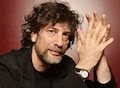 At least, not ones that matter.” – Neil Gaiman
And so … enough said. Happy writing and here's to many "Writer's Moments" – with assurance and confidence of course.
Share A Writer’s Moment with a friend by clicking the g+1 button below.
May 1, 2017
Destiny and a term for the ages
“Destiny is a good thing to accept when it's going your way. When it isn't, don't call it destiny; call it injustice, treachery, or simple bad luck”– Joseph Heller
Born on this date in 1923, Heller authored novels, short stories, plays and screenplays, and his satire on war and its bureaucracy – Catch 22 – became part of the lexicon and a synonym for an absurd or contradictory choice.
First written under the title Catch 18 and not intended to be longer than a novelette, Catch 22 was not only Heller’s first novel but also one that was literally years in the making. He said the idea for the opening and the main character John Yossarian “just came to me” one morning in 1952, and he wrote the first chapter in just days. But it took over 8 years before he finally could flesh it all out and complete the book.
 A “slow, but steady” novelist, he came up with the concept for his second book Something Happened after the overwhelming success of Catch 22, which made him a millionaire. Like his first, the second novel took nearly 8 years to complete, althugh he did write the screenplay for Sex and The Single Girl and an episode for McHale’s Navy in between – along with numerous short stories, a couple of plays, and a number of commentatries. He also became a successful creative writing teacher at Yale, Penn and CCNY.
 When once asked about the long period of time between his books, he said he didn’t think it was unusual, noting, “Every writer I know has trouble writing.”
Share A Writer’s Moment with a friend by clicking the g+1 button below.
April 30, 2017
As 'tasty' as tasy can be
“A novelist writes a novel, and people read it. But reading is a solitary act. While it may elicit a varied and personal response, the communal nature of the audience is like having five hundred people read your novel and respond to it at the same time. I find that thrilling.” – August Wilson
Born this week in 1945, Wilson's work was highlighted by the series of ten plays, The Pittsburgh or Century Cycle, for which he received two Pulitzer Prizes for Drama. Each of the10 plays is set in a different decade of the 20th Century, depicting the comic and tragic aspects of the century’s Black experience. His masterpiece Fences was the first adapted for the movies and nominated for an Academy Award this year.
I met and spent some time with Wilson in 1987 while he was writing, directing and producing theater in St. Paul, Minn. It was shortly after he wrote Fences, for which he won both the Pulitzer and a Tony. In the early ‘90s, I attended a talk he did about another in the series, The Piano Lesson, for which he won a second Pulitzer and the New York Drama Critics Award.
Wilson had the remarkable ability to make everything he said and wrote crackle with enthusiasm and life. I think any aspiring writer or actor who listened to his talks would walk out fired up about writing or acting and ready to get busy trying to emulate what he had just shared. It was after I first talked to him that I wrote my one and only play, The First Day, and also started acting in community theater.
Wilson said his aim was to sketch the Black experience in the 20th century and "raise consciousness through theater.” He was fascinated by the power of theater as a medium where a community at large could come together to bear witness to events and currents unfolding. “I think my plays offer white Americans a different way to look at black Americans.” [image error]August Wilson
“In creating plays," he said, "I often use the image of a stewing pot in which I toss various things that I’m going to make use of—a black cat, a garden, a bicycle, a man with a scar on his face, a pregnant woman, a man with a gun." The results were as tasty as tasty can be. Share A Writer’s Moment with a friend by clicking the g+1 button below.
Born this week in 1945, Wilson's work was highlighted by the series of ten plays, The Pittsburgh or Century Cycle, for which he received two Pulitzer Prizes for Drama. Each of the10 plays is set in a different decade of the 20th Century, depicting the comic and tragic aspects of the century’s Black experience. His masterpiece Fences was the first adapted for the movies and nominated for an Academy Award this year.
I met and spent some time with Wilson in 1987 while he was writing, directing and producing theater in St. Paul, Minn. It was shortly after he wrote Fences, for which he won both the Pulitzer and a Tony. In the early ‘90s, I attended a talk he did about another in the series, The Piano Lesson, for which he won a second Pulitzer and the New York Drama Critics Award.
Wilson had the remarkable ability to make everything he said and wrote crackle with enthusiasm and life. I think any aspiring writer or actor who listened to his talks would walk out fired up about writing or acting and ready to get busy trying to emulate what he had just shared. It was after I first talked to him that I wrote my one and only play, The First Day, and also started acting in community theater.
Wilson said his aim was to sketch the Black experience in the 20th century and "raise consciousness through theater.” He was fascinated by the power of theater as a medium where a community at large could come together to bear witness to events and currents unfolding. “I think my plays offer white Americans a different way to look at black Americans.” [image error]August Wilson
“In creating plays," he said, "I often use the image of a stewing pot in which I toss various things that I’m going to make use of—a black cat, a garden, a bicycle, a man with a scar on his face, a pregnant woman, a man with a gun." The results were as tasty as tasty can be. Share A Writer’s Moment with a friend by clicking the g+1 button below.
April 29, 2017
Our 'gifts' for the giving
“The gifts that one receives for giving are so immeasurable that it is almost an injustice to accept them.” – Rod McKuen
Born on this day in 1933, singer-songwriter, musician and poet Rod McKuen was one of the best-selling poets in the United States during the late 1960s and '70s. McKuen, who died in 2015, produced more than 30 books of poetry, and hundreds of recordings of popular music, spoken word poetry, film soundtracks and classical music. He earned two Academy Award nominations and one Pulitzer nomination for his compositions. I've always admired his works The Earth, The Sea and The Sky and his beautiful, sentimental ballad If You Go Away. For Saturday’s Poem, from his string of poems that are simply titled with numbers, here is: Twenty
People riding trains are nicethey offer magazinesand Chocolate-covered cherries,they offer details you want most to know about their recent operations.If I’d been riding home to youI could have listened with both earsbut I was on my way away.
Across from methere was a girl crying (long, silent tears)while an old man held her hand.It was only a while ago you said,Take the seat by the window, you’ll see more.
I filled the seat beside mewith my coat and books.I’m antisocial without you.I’m antiworld and people too.
Sometimes I thinkI’ll never ride a train again.At least not away.
Share A Writer’s Moment with a friend by clicking the g+1 button below.
April 28, 2017
The 'Making You Think' moments
“The book to read is not the one which thinks for you, but the one which makes you think.” – Harper Lee
Born in Alabama on this date in 1926, Nelle Harper Lee became one of America’s most acclaimed novelists even though she wrote just two books. But, of course, the first of those was her “classic,” To Kill a Mockingbird. Published in 1960 it achieved immediate success, rocketing to the top of most bestseller lists and winning the 1961 Pulitzer Prize. That singular achievement led to her being awarded the Presidential Medal of Freedom in 2007.

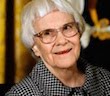 Harper Lee in 1960 and in 2007Lee also was feted for assisting Truman Capote (the model for her character Dill in Mockingbird) in his research for his 1966 masterpiece In Cold Blood. Between them, Lee and Capote created a new kind of journalistic reporting, obtaining “notes” from a primary source without actually writing them down. Both were able to remember things in minute detail, and they would spend hours after interviewing sessions re-creating those interviews. Their skill with the technique led to sources to “opening up” in ways they might otherwise have not wanted to do.
Lee lived her last 50 years as a recluse. Until her death in 2016, she granted almost no requests for interviews or public appearances. And with the exception of a few short essays, she published nothing further until 2015 when her so-called “prequel” to Mockingbird – Go Set A Watchman – came out. Mockingbird’s universal acceptance had seemed to cause her to freeze up when it came to further writing.
“I never expected any sort of success with ‘Mockingbird’ … I just sort of hoped someone would like it enough to give me encouragement,” she once said. “I got rather a whole lot, and in some ways this was just about as frightening as the quick, merciful (writing) death I'd expected.”
A Writer’s Moment with a friend by clicking the g+1 button below.
April 27, 2017
Both a conduit and a storyteller
Celebrating 1,000: Today’s post marks 1,000 consecutive days of posts to A Writer’s Moment. Thanks for reading! - - - - - - - - - - - - - - -“Hemingway was really early. I probably started reading him when I was just 11 or 12. There was just something magnetic to me in the arrangement of those sentences. Because they were so simple - or rather they appeared to be so simple, but they weren't.” – Joan Didion
Like Didion, I was impressed by Hemingway from the start of my own writing career, and today, on the occasion of the 1000th entry in “A Writer’s Moment,” I thought about him and what I like about writing. Hemingway was many things, some admirable, some not, but above all he was a great observer of life, of the human condition, and of nature. If you want to read some great short stories, read hisHills Like White Elephants, and The Killers – maybe among the best in the English language.
Being a journalist first, I tend to follow the “understated writing style.” Hemingway was perhaps the first to be famous for it, focusing on sensations while using simple sentence patterns, an economy of words, and active verbs. Not a bad model to follow, whether the writing is journalistic, creative – or both.
My “writer’s moments” have mostly been in journalism. And while feature writing has been my forté I’ve enjoyed working on novels too. I like the idea that while a novel takes place in the larger world, there's always a part of it that ends up being personal - even if I didn't know it at the time. As a writer, I’ve been fortunate and glad to serve as a both a conduit and a storyteller because people need stories, not only to share in life but in order to live it too.