Dan Jorgensen's Blog, page 446
April 6, 2017
Drawn from one's surrounding life
“[The writer] must essentially draw from life as he sees it, lives it, overhears it or steals it, and the truer the writer, perhaps the bigger the blackguard. He lives by biting the hand that feeds him.” – Charles R. Jackson
Born on this date in 1903, Jackson was an American author widely known for his mostly autobiographical novels, including The Lost Weekend, published in 1944 and adapted into an Academy Award-winning Best Picture in 1945. The novel – his first – and subsequent film thrust Jackson into a limelight in which he wasn’t always comfortable, although he did enjoy a fairly distinguished lecture circuit career from the book and film successes.
A native of New Jersey, he attended Syracuse University, studied journalism, and wrote for a number of newspapers before gravitating over to books – both writing and selling them. He wrote several more novels with varying success and also wrote a number of well-received short stories coupled with a very successful stint as a scriptwriter for radio soap operas. But his career was derailed by illness and alcohol.
Hospitalized for a number of years with both tuberculosis and alcoholism, he had about a 15-year hiatus before writing one more successful book, another somewhat autobiographical novel A Second-Hand Life, shortly before his death in 1968.
Jackson blamed his demise more from the early successes he had than from his longtime illness. “The writer knows his own worth,” he lamented, “and to be overvalued can confuse and destroy him as an artist.”
Share A Writer’s Moment with a friend by clicking the g+1 button below.


April 5, 2017
Counting down to 1,000
Countdown to 1,000: April 27th will mark 1,000 consecutive days of posts to A Writer’s Moment. Thanks for reading!
- - - - - - - - - - - - - - - - - - -
“Not only is it OK for a woman to write about a tough guy, but it might even help sell him.” – Ann Maxwell
Born on this date in 1944, Ann Maxell started as a science fiction writer even though she really didn’t read any sci-fi herself until college. A native of Milwaukee, she grew up reading the Classics and majored in English Literature, but as a stay-at-home mom who didn’t like TV, she started reading sci-fi while her son was napping. Claiming to have read all the sci-fi books in the nearby library and second-hand book store, she decided to write one herself, even though she had no creative writing training. And the rest, as they say, is writing history.
Today, she has written over 50 novels, ranging from science fiction to historical fiction to romance, mystery and suspense, some in collaboration with her husband Evan. Her novels have been published in 21 languages with some 23 million in print. Her collaboration with Evan developed out of his career as a crime reporter. Their first crime novel together led to a series about a couple named Fiddler and Fiora, all published under the name A.E. Maxwell. Two of those books – The Frog and the Scorpion and Just Enough Light to Kill – won major awards. Together they’ve also produced
 4 best-selling suspense novels.
“The good news, when you write with another, is that you never have an empty page in front of you,” Ann said. But, the bad news is ... you never have an empty page in front of you.”
Share A Writer’s Moment with a friend by clicking the g+1 button below.
April 4, 2017
A unique bond: author & reader
“There's a unique bond of trust between readers and authors that I don't believe exists in any other art form. As a reader, I trust a novelist to give me his or her best effort, however flawed.”– Dan Simmons
Simmons, who was born on this date in 1948, is an award-winning author of science fiction, horror and fantasy, sometimes all within the same novel. A typical example of Simmons' intermingling of genres is his World Fantasy Award winner Song of Kali, a tale surrounding a mysterious cult that worships the Indian god Kali.
After a number of modest successes, Simmons became internationally renowned for Hyperion, which won the 1989 Hugo and Locus Awards for the best science fiction novel. He followed that with 3 more books and several short stories in a series that concluded with another award winner, The Rise of Endymion, also winner of the Locus and a finalist for the Hugo. Don’t be surprised to see a SyFy Channel series arriving soon.
Simmons is a master at connecting stories to bits and pieces or characters from Classic literature ranging from Dante’s Inferno to H.G. Wells’ Time Machine.
 And, he also writes mysteries and thrillers and enjoys moving among and between genres, something he finds relaxing.
“ I think it's one of the strangest attributes of this profession that when we writers get exhausted writing one thing, we relax by writing another.”
Share A Writer’s Moment with a friend by clicking the g+1 button below.
April 3, 2017
Working hard and doing more
“The land of literature is a fairy land to those who view it at a distance, but, like all other landscapes, the charm fades on a nearer approach, and the thorns and briars become visible.” – Washington Irving
Born on this date in 1783, Irving is one of America’s earliest and most beloved storytellers, best known for his short stories "Rip Van Winkle” and "The Legend of Sleepy Hollow,” both in his book The Sketch Book of Geoffrey Crayon, Gent. The Sketch Book (as it is best known) was the first widely read work of American literature in Britain and Europe. It also helped advance the international reputation of American writers.
Being a short story writer was only a small part of Irving’s vast portfolio. Also a noted essayist, biographer, historian, and diplomat, he served as U.S. Ambassador to Spain in the 1840s – a time when relations between our young nation and the well-established European nation were crucial. He is credited as one of the leading diplomats of his time.
Among Irving’s historical writings were best selling biographies of George Washington, Oliver Goldsmith, and Muhammad, and histories of 15th-century Spain on subjects such as Christopher Columbus, the Moors and The Alhambra. Using his celebrity, Irving pushed tirelessly for stronger copyright laws to protect the young American writing community at a time when their works often were pirated. Ultimately, he was instrumental
 in helping create international copyright laws. In a piece of great advice for those who write, he noted, “One of the greatest and simplest tools for learning more and growing is simply working hard and doing more.”
 Share A Writer’s Moment with a friend by clicking the g+1 button below.
April 2, 2017
A critical review of good writing
“A novel is a static thing that one moves through; a play is a dynamic thing that moves past one.” – Kenneth Tynan
One of the most impactful theater critics of the mid-20th Century, Tynan was born on this date in 1928 and in his relatively short lifetime (he died at age 53 of emphysema) he became a force in the theatrical world, which often regarded him with a mix of awe, fear and hatred, according to fellow writers.
His understanding of what made good writing (and a good show) led to his eventual appointment as literary manager of the British National Theatre Company. In that role he not only greatly expanded the Theatre’s reach and choice of plays but also established his own worldwide reputation.
Tynan's career first took off in 1952 as a young theatre critic for the London Evening Standard. In 1954, he joined The Observer and it was there that he rose to prominence. After becoming part of the National Theatre’s management team, he continued his writing as a film reviewer. During the final decade of his life he lived in California, writing often for The New Yorker and doing screenplays and theatrical pieces, including the very popular Oh, Calcutta!
 He also kept diaries that have been much studied, both in writing courses and by historians.
 “A good drama critic is one who perceives what is happening in the theatre of his time,” Tynan wrote, when asked what advice he might give to aspiring critics. “A great drama critic also perceives what is not happening.”
Share A Writer’s Moment with a friend by clicking the g+1 button below.
April 1, 2017
Giving energy through good writing
“The pleasure that I take in writing gets me interested in writing a poem. It's not a statement about what I think anybody else should be doing. For me, it's an interesting tension between interior and exterior.”– Marilyn Hacker
American poet Hacker, who was born in New York in 1942, often employs strict forms in her poetry: for example, writing in sonnets as in her acclaimed verse novel, Love, Death, and the Changing of the Seasons. Among her 11 books of poetry is Presentation Piece, which won the National Book Award, and the amazingGoing Back to the River. Her writing often speaks for the marginalized or for those who are suffering, especially from cancer.
 “Good writing gives energy,” said Hacker, “whatever it is about.” For Saturday’s Poem, here is Hacker’s: Invocation This is for Elsa, also known as Liz, an ample-bosomed gospel singer: five discrete malignancies in one full breast.
This is for auburn Jacqueline, who is celebrating fifty years alive, one since she finished chemotherapy.
with fireworks on the fifteenth of July.
This is for June, whose words are lean and mean as she is, elucidating our protest.
This is for Lucille, who shines a wide beam for us with her dark cadences.
This is for long-limbed Maxine, astride a horse like conscience.
This is for Aline who taught her lover how to caress the scar.
This is for Eve, who thought of AZT while hopeful poisons pumped into a vein.
This is for Nanette in the Midwest.
This is for Alicia, shaking back dark hair, dancing one-breasted with the Sabbath bride.
This is for Judy on a mountainside, plunging her gloved hands in a glistening hive.
Hilda, Patricia, Gaylord, Emilienne, Tania, Eunice: this is for everyone who marks the distance on a calendar from what's less likely each year to "recur.”
Our saved-for-now lives are life sentences -- which we prefer to the alternative.
Share A Writer’s Moment with a friend by clicking the g+1 button below.
March 31, 2017
The need to create an alternative world
“There are many reasons why novelists write, but they all have one thing in common - a need to create an alternative world.” – John Fowles
When I give talks on writing and the process writers follow, I often quote British author John Fowles, who was born on this date in 1926 and wrote as many thoughtful and thought-provoking things about writing as anyone I’ve read. And writing wasn’t even his first career choice. Fowles set out to be a literary teacher, taking a job at a small school in Greece that later became the setting for his book The Magus. Even though he had that novel ready to go in 1960, he held off after coming up with the idea for The Collector, his ultimate first novel that would establish his reputation.
Published in 1963, The Collector went on to a massive paperback release, noted by the publisher as "probably the highest price that had hitherto been paid for a first novel.” By 1965 it also had been made into a nailbiting movie (if you’ve never seen it, find it, and settle back to be thoroughly entertained). His next major work, published after he
 released The Magus (a moderate hit), was 1969’s international blockbuster The French Lieutenant's Woman. Released to critical and popular success, it was eventually translated into a dozen languages, adapted as a feature film starring Meryl Streep and Jeremy Irons, and cemented Fowles' international literary reputation.
 While fiction was his forte’, Fowles also was a noted essayist, taught English as a foreign language to immigrant children, and earned minor acclaim as a poet – something he said should not be considered unusual. “We all write poems,” he noted. “It is simply that real poets are the ones who write in words.”
Share A Writer’s Moment with a friend by clicking the g+1 button below.
March 30, 2017
Helping 'right' wrongs with 'power of the pen'
“My doctrine is this, that if we see cruelty or wrong that we have the power to stop, and do nothing, we make ourselves sharers in the guilt.” –Anna Sewell
Born on this date in 1820 in Norfolk, England, Anna Sewell wrote one of the all-time Classic young adult novels, Black Beauty. And yet, she intended to write a missive directed at those who worked with horses to shame them into providing better treatment. Written over a 6-year period (between 1871 and 1877) and published just shortly before her death in 1878 from tuberculosis, Sewell was shocked and angered by what she termed “cruel treatment of some of our best friends.”
Mostly too weak to write because of her debilitating illness, she would sometime scribble notes on small pieces of paper and other times dictate what she wanted said to her mother, who then transcribed the notes and read them back to her for final editing.
Sewell sold the novel to local publisher Jarrolds in November 1877, when she was 57 years old. She said "a special aim [was] to induce kindness, sympathy, and an understanding treatment of horses.” She died five months after her book was
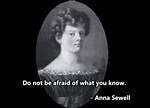 published, but lived long enough to see its initial success and realize that it would, indeed, have a major impact. Laws were passed for more humane treatment, many sparked by the outrage of her book.
“Now I say that with cruelty and oppression it is everybody's business to interfere when they see it.”
Share A Writer’s Moment with a friend by clicking the g+1 button below.
March 29, 2017
A unique and impactful storyteller
“I love artists. I find them fascinating. To me, there really is a genuine magic in what they do.” – Elizabeth Hand
Hand, who was born on this date in 1957 in Yonkers, New York, studied drama and anthropology in college and thought of a career on stage before getting into writing. Since 1988, she has lived in coastal Maine, the setting for many of her stories, and she also lives part-time in Camden Town, London, the setting for her historical fantasy novel Mortal Love and short story "Cleopatra Brimstone.”
While Science Fiction and Fantasy have been focal points for many of her works, she said she didn’t read much Science Fiction as a kid. “I was a total Tolkien geek - but I started reading Samuel Delany and Angela Carter and Ursula LeGuin in high school, and I was definitely taken with the notion that here was a literature that could explore various notions of gender identity and how it affects the culture at large.”
Also a writer of television and sci-fi movie spin-offs, Hand is co-author of the DC Comics’ cult favorite Anima. Her most recent book, 2016’s Hard Light, continues a series of genré-blending novels that combine psychodrama, suspense, mystery and art. Hard Lightwas a sequel to 2012’s Available Dark, which was a sequel to 2008’s Generation Loss, winner of the first Shirley Jackson Award for Outstanding Achievement in Psychological Suspense. The trio of books have cemented Hand’s place
 as a unique and impactful storyteller.
 “I never think about genre when I work,” she said. “I've written fantasy, science fiction, supernatural fiction . . . suspense. Genrés are mostly useful as a marketing tool, and to help booksellers know where to shelve a book.”
Share A Writer’s Moment with a friend by clicking the g+1 button below.
March 28, 2017
Writing his way to an impactful life
“You cannot teach creativity - how to become a good writer. But you can help a young writer discover within himself what kind of writer he would like to be.” – Mario Vargas Llosa Born on this date in 1936, Peruvian writer, politician, journalist, essayist, and college professor Vargas Llosa won the 2010 Nobel Prize in Literature and is one of Latin America's most significant novelists and essayists. Some critics have said he’s had a larger international impact and gained a greater worldwide audience than any other writer of his generation.
Vargas Llosa’s novels include comedies, murder mysteries, historical novels, and political thrillers and several have been adapted as feature films. Most of his works have been translated into multiple languages, expanding his reach as a writer. Literary critic Harold Bloom included his novel The War of the End of the World (also a movie) in his list of essential literary works in the Western Canon. A staunch liberal and a leading voice for liberal causes throughout Latin America, he used his celebrity as a well-known
 writer and essayist to launch a 1990 bid for the Peruvian presidency, a race he lost to Alberto Fujimori. Since then he's continued his prolific writing career but sometimes decries the isolation writing can bring.
“Writing a book is a very lonely business,” he once said. “You are totally cut off from the rest of the world, submerged in your obsessions and memories.”
Share A Writer’s Moment with a friend by clicking the g+1 button below.