
Discover new books on Goodreads
See if your friends have read any of Tentatively, A Convenience's books
more photos (1)

Tentatively,’s 2025 Year in Books
Take a look at Tentatively,’s Year in Books, including some fun facts about their reading.
Tentatively, A Convenience’s Followers (248)


3,184 books
|
48 friends

2,251 books
|
365 friends

1,812 books
|
587 friends

561 books
|
254 friends

2,011 books
|
246 friends

780 books
|
1,529 friends

1,541 books
|
108 friends

370 books
|
516 friends
More friends…
Tentatively, A Convenience
Goodreads Author
Born
in Baltimore, The United States
Website
Genre
Influences
YOU & them
Member Since
October 2007
URL
https://www.goodreads.com/tentativelyaconvenience
Thanks to the idiocy of Goodreads policy my books are no longer easily found & do not all appear here. Instead, 5 of them appear under "Tentatively a Convenience": https://www.goodreads.com/author/show... .
My name is "tENTATIVELY, a cONVENIENCE". It is NOT "Tentatively, A Convenience". The completely disrespectful push for conformity is on. Such 'normalization' of my spelling, wch I've been using since 1979, is a symptom of what I call "AU", Artificial Unintelligence - both that of algorithms wch can't possibly cope w/ the human imagination & that of robopathic humans - say the type of person who studied creative writing w/ a professor who isn't a creative writer & who isn't published. This type of person then proceeds to learn 'how to be Thanks to the idiocy of Goodreads policy my books are no longer easily found & do not all appear here. Instead, 5 of them appear under "Tentatively a Convenience": https://www.goodreads.com/author/show... .
My name is "tENTATIVELY, a cONVENIENCE". It is NOT "Tentatively, A Convenience". The completely disrespectful push for conformity is on. Such 'normalization' of my spelling, wch I've been using since 1979, is a symptom of what I call "AU", Artificial Unintelligence - both that of algorithms wch can't possibly cope w/ the human imagination & that of robopathic humans - say the type of person who studied creative writing w/ a professor who isn't a creative writer & who isn't published. This type of person then proceeds to learn 'how to be creative' in a completely uncreative way & goes on to not be a creative writer or to be published either but to still be convinced that they're qualified to edit actual published actual creative writers. That's a form of regrettably delusional behavior fostered in them by their inability to educate themselves outside of potty training.
Alas, some GoodReads fiend has removed my date of death! I had it as "September 3, 1953" - before my date of birth so that my death won't happen in my lifetime. Some humorless GR person must want me to die. Foo on them.
Making matters even worse, my bk "footnotes" has been removed from the database here & I'm now listed as the author of "15" bks instead of the correct SIXTEEN. "footnotes" was still for sale online the last time I checked so I highly recommend getting a copy before they disappear altogether.
OTHERWISE, please read this extensive interview w/ me by poet/essayist Alan Davies as part of "Otoliths 27" ( http://the-otolith.blogspot.com.au/20... ). It's a DOOZY, I promise. It'll also hopefully be published as a small & cheap bk
ALSO, my friend Anthony Levin-Decanini has started an excellent new (as of mid 2013) improvising series called "Crucible Sound" in Pittsburgh at Modernformations Gallery & I was honored by his interviewing me regarding improv for his relevant blog. I quite like the interview & I hope you do too. Here's the link for part 1:
http://cruciblesound.blogspot.com/201...
& the link for part 2:
http://cruciblesound.blogspot.com/201...
I hope you find it interesting enuf to subscribe to the blog & to check out the other programs. If you're in or nearby Pittsburgh, PLEASE ATTEND THE CRUCIBLE SOUNDS! Things like this don't last forever, but while they do they can be quite lively!!
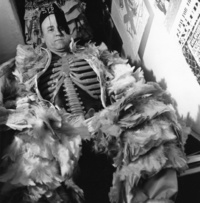
The photo of me is by my friend Julie Gonzalez. Maybe someday I'll write a bio in here but, in the meantime, I'll just sign w/ some of my email signature:
electronically signed,
He-Who-Has-Written
Amir-ul Kafirs
Some tenuous beginnings of P.N.T. (Perverse Number Theory):
(for all x)x = (for all x)x (Anything is Anything)
(A Double Negative As Not A Positive)
(A finite quantity represented as a set containing
an infinite quantity of its subdivisions
(such as its subdivision in terms of rational numbers)
does not equal the same finite quantity
represented as a set containing an infinite quantity
OF A DIFFERENT DEGREE of its subdivisions
(such as its subdivision in terms of irrational numbers).)
m + n does not equal n + m is isomorphic to x
the ceiling of x is greater than or equal to the ceiling of the ceiling of x
(Enough is Enough)
The Formula o ...more
To ask
Tentatively, A Convenience
questions,
please sign up.
Popular Answered Questions

Tentatively, A Convenience
I go to the Emergency Room. I get the bill.
Tentatively, A Convenience
As far as I 'know', most of these questions have been created by Goodreads staff to stimulate the 'Goodreads authors' to make public statements that m…moreAs far as I 'know', most of these questions have been created by Goodreads staff to stimulate the 'Goodreads authors' to make public statements that may be of interest to people ON Goodreads. That's all well & good. The questions are generic & more or less irrelevant to my actual praxis but that's ok. I aim to please. SO, how DO I deal with writer's block?
1st off, I don't have "writer's block". EVER. Or any other kind of creative block. Why don't we hear about "Composer's Block" or "Pornographer's Block"? Maybe the writers who have writer's block are simply impotent, people w/ no ideas worth translating into texts in the 1st place.
2nd. when I see a writer's block I want to carve it, I want to carve a swan into it & watch it melt. Is that sadistic? I don't think so, the writer's block isn't able to feel pain. Or is it? There's always Hylozoism. Maybe the writer's block is ALIVE! Did you ever think of that you insensitive impotent sniveling writer?!
3rd, when I see the writer's block I wonder whether it's a Rubik's Cube. Maybe I just need to twist those little facets until everything lines up, until everything is 'perfect'. But what wd it say to US if it cd talk? 'Please, STOP, my reactive arthritis is killing me'?
4th, there's always the risk of getting the writer's block PREGNANT. I've known thousands of deadbeat writer's block dads. Sure, they act like they're completely comfortable w/ having knocked up a block, a chip off the old block.. but are they really? Look out for those furtive glimpses at table corners, room corners.. They're thinking of the wee ones.. & that one night stand when they had to PROVE to themselves that they weren't impotent, when they were going to stick it to that writer's block no matter what it took. But did they think further? NooOooOoooOo.. Bad plotting, bad narrative structure, no outlining, no thinking of how-it-wd-all-end. (less)
1st off, I don't have "writer's block". EVER. Or any other kind of creative block. Why don't we hear about "Composer's Block" or "Pornographer's Block"? Maybe the writers who have writer's block are simply impotent, people w/ no ideas worth translating into texts in the 1st place.
2nd. when I see a writer's block I want to carve it, I want to carve a swan into it & watch it melt. Is that sadistic? I don't think so, the writer's block isn't able to feel pain. Or is it? There's always Hylozoism. Maybe the writer's block is ALIVE! Did you ever think of that you insensitive impotent sniveling writer?!
3rd, when I see the writer's block I wonder whether it's a Rubik's Cube. Maybe I just need to twist those little facets until everything lines up, until everything is 'perfect'. But what wd it say to US if it cd talk? 'Please, STOP, my reactive arthritis is killing me'?
4th, there's always the risk of getting the writer's block PREGNANT. I've known thousands of deadbeat writer's block dads. Sure, they act like they're completely comfortable w/ having knocked up a block, a chip off the old block.. but are they really? Look out for those furtive glimpses at table corners, room corners.. They're thinking of the wee ones.. & that one night stand when they had to PROVE to themselves that they weren't impotent, when they were going to stick it to that writer's block no matter what it took. But did they think further? NooOooOoooOo.. Bad plotting, bad narrative structure, no outlining, no thinking of how-it-wd-all-end. (less)


|
How to Write a Resumé - Volume II Making a Good First Impression 2nd edition
4.80 avg rating — 5 ratings
—
published
1991
|
Error rating book. Refresh and try again.
Rate this book
Clear rating
|

|
Paradigm Shift Knuckle Sandwich & other examples of P.N.T. (Perverse Number Theory)
it was amazing 5.00 avg rating — 2 ratings
—
published
2008
—
2 editions
|
Error rating book. Refresh and try again.
Rate this book
Clear rating
|

|
Not Necessarily NOT Very Important
liked it 3.00 avg rating — 2 ratings
—
published
2003
|
Error rating book. Refresh and try again.
Rate this book
Clear rating
|

|
HiTEC (Histrionic Thought Experiment Cooperative) "Systems Management"
it was amazing 5.00 avg rating — 1 rating
—
published
2009
|
Error rating book. Refresh and try again.
Rate this book
Clear rating
|

|
The Kavyayantra Press Reading Series: "vii"
it was amazing 5.00 avg rating — 1 rating
—
published
2010
|
Error rating book. Refresh and try again.
Rate this book
Clear rating
|

|
Puzzle Writing
it was amazing 5.00 avg rating — 1 rating
—
published
1994
|
Error rating book. Refresh and try again.
Rate this book
Clear rating
|

|
But Not Limited To:
it was amazing 5.00 avg rating — 1 rating
—
published
2020
—
2 editions
|
Error rating book. Refresh and try again.
Rate this book
Clear rating
|

|
THE SCIENCE (volume 1)
it was amazing 5.00 avg rating — 1 rating
|
Error rating book. Refresh and try again.
Rate this book
Clear rating
|

|
Everybody Loves a Poetry Critic (volume 1: January 8, 2008 - December 8, 2012)
it was amazing 5.00 avg rating — 1 rating
—
published
2026
|
Error rating book. Refresh and try again.
Rate this book
Clear rating
|

|
Everybody Loves a Poetry Critic (volume 2: January 10, 2013 - December 28, 2020)
it was amazing 5.00 avg rating — 1 rating
|
Error rating book. Refresh and try again.
Rate this book
Clear rating
|
Tentatively,’s Recent Updates
|
Tentatively, Convenience
rated a book really liked it

|
Error rating book. Refresh and try again.
Rate this book
Clear rating
|
|
review of Lionel Fenn's Time: The Semi-Final Frontier by tENTATIVELY, a cONVENIENCE - October 23, 2026 I picked up this bk b/c it was pocket-sized & featured time travel - an easy read for when I go on walks. I didn't have high expectations. At 1st I review of Lionel Fenn's Time: The Semi-Final Frontier by tENTATIVELY, a cONVENIENCE - October 23, 2026 I picked up this bk b/c it was pocket-sized & featured time travel - an easy read for when I go on walks. I didn't have high expectations. At 1st I thought it was too much in what I consider to be the minor subgenre of 'Silly SF': "We have an intruder. Someone has snuck aboard the Angus without my permission. I think, all in all, that means we're already in trouble. "Then you'd better not waste any more time, Captain. Call a Yellow Alert, tell Ms. Maynard to secure the Bridge, alert Sick Bay, and let's get moving! "Consider it done, Doc! "One more thing, Captain, before you go out there and face the troops. "What's that? "Your girdle's loose." - pp 4-5 That bit of girdle silliness & starting off w/ a Star Trek take-off rubbed me a little bit the wrong way (considering that I never have liked Star Trek very much - in contrast to Doctor Who, The Outer Limits, The Twilight Zone, The Prisoner, The Avengers, Quatermass, etc) "Ship's Log, the CISS Angus, Captain Dirk R. Winslow, Commander. All remarks to follow are coded NEED TO KNOW, Headquarters Only, immediate transmission, scrambled. TravelDate . . . uh . . . Doc, what's the date? "Today? "Yes. "54.217.37951.3 "What's that, March? "Think so. "Then why don't they say so? "Well, it doesn't sound very official, does it? I mean, you say, it's the seventeenth of March, whatever year, 2512, something like that, it doesn't really sing, does it? It doesn't have that sort of Deep Space resonance the folks back home expect, if you see what I mean. "It's stupid, is what it is." - p 3 You see what I mean. But it quickly just became entertaining for me & I enjoyed it. A 19th century luxury train time travels & finds itself in a giant warship storage rm in outer space. That's funny enuf, in itself. Where will it go from there? ""Tell Major Juniper that the train is a time machine, and he's to handle it with the utmost care." "The voice sounded wounded. "But, sir, he's always careful." ""Gladys, he blew up Xerxes 23." "Major Steele snickered." - p 41 The mission of the warship is to diplomatically or otherwise supress a rebellion for wch this background is provided: "As the histories of every halfway decent and a couple of really disgusting civilizations that ever existed anywhere at any Time in any place have always showed, there were always a few malcontents who thought they would rather be free and poverty-stricken than be part of the Establishment and richer than God. It had something to do with spirituality; it also had something to do with the fact that the Rebels found it passing difficult to get a decent job once they had rebelled. Therefore, the only sensible course of action was to overthrow the Establishment, set up their own Establishment, and be free and richer than God, all in the same lifetime." - p 49 "At that moment the doors gurgled and hissed open, and four soliders stepped into the room. Two were Sergeant Larue and Private Gordon; the other two he had never seen before and therefore understood that they, most likely, would never make it back alive." - p 94 For me, that's another Start Trek reference b/c on Star Trek when there's a landing party that consists of the main characters & a couple of extra grunts it's more or less guaranteed that the extra grunts will get killed on-planet. That was one of those too-predictable elements that contributed to my dislike of Star Trek. THAT was funny, as was the below: ""You got a name, soldier?" Larue asked in idle, time-killing conversation. ""No, sir." "The sergeant stared in disbelief. "Mister, you have to have a name. Everybody has a name. You can't get into the Service without a name. Nobody would talk to you if you didn't have a name." He pointed to the young man's fellow marine on the west side of the hill. "What's her name?" ""She doesn't have one either, Sergeant." ""What? You aliens or something?" ""No, Sarge," the nameless marine answered in astonishment. "We're as much from Earth as you are." ""Theh what the hell is your name?" ""Well, the guys . . ." He winced and squirmed a little in embarrassment. "The guys, they call me Cannon Fodder. Can, for short." "The giant turkey drew nearer; Major Steele trotted around the base of the hill. ""Can?" ""That's right, Sarge." ""And what do they call her?" ""Cannon Mudder."" - p 113 "And Diego decided two things: "First, he might be able to handle those Gannetians, even if they were huge spiders, if he could convince himself they were only giant turkeys disguised as huge spiders. Which probably wasn't going to work, he wasn't all that stupid, but as long as he kept trying he might be able to function well enought to either keep from screaming, or keep from dying. Preferably both." - p 144 ANYWAY, this was fun. I was hypothetically reading something like 5 or 6 other bks at the time & this was the main one I chose to breeze thru precisely b/c it was easy & a no-brainer. So much for my intellectual discipline. ...more |
|
|
|
|
|
Tentatively, Convenience
rated a book really liked it

|
Error rating book. Refresh and try again.
Rate this book
Clear rating
|
|
review of E. C. Tubb's Symbol of Terra by tENTATIVELY, a cONVENIENCE - October 8, 2026 As I've mentioned in some of my other Dumarest of Terra reviews, EC Tubb was recommended to me by the owner of my favorite bkstore in PGH, Caliban. B/c of this, I review of E. C. Tubb's Symbol of Terra by tENTATIVELY, a cONVENIENCE - October 8, 2026 As I've mentioned in some of my other Dumarest of Terra reviews, EC Tubb was recommended to me by the owner of my favorite bkstore in PGH, Caliban. B/c of this, I got & read Tubb's Moon Base, a stand-alone novel, not a series, & liked it so I decided to try other things by him. An online search led to my buying 16 Dumarest of Terra novels from eBay. THAT led to my getting a 17th one from the series from a bkstore. 17 is roughly half of the total number of the series. I started reading them from the earliest one 1st. They've been ok, maybe better than ok but I can't say I ever became totally enthusiastic. I was initially under the impression that there're 31 bks in the series but a recent inquiry revealed that there're 33 - w/ the last 2 having been written considerably later. Hence, 31 was originally intended to be the last. This one's #30. The trajectory of the series is such that it's implied that Dumarest's search for Earth will be resolved somehow, perhaps he'll find it, perhaps he'll give up. W/ this in mind, & w/ #30 being perceived as the penultimate bk in the series, it seems to me that Tubb put more trouble into making this a more developed story. At any rate, I read it & enjoyed it as that. Most of this series seemed to start somewhat anew w/ every novel. One might end in one way & have the next begin as if there'd been intervening time & adventures. This one, however, seems to pick up almost immediately after #29. "He said, "Did Chenault give you the gun?" ""Yes." ""Why? What were you supposed to do with it?" ""Sometimes there are predators. They come into the valley and hunt the creatures here. When they do I take care of them." ""And visitors?" Dumarest shrugged as she made no answer." - p 9 Whenever Earl Dumarest inquires of new people that he meets about Earth they usually act as if it's a mythical planet. ""Eden, Paradise, Heaven, Avalon—all legendary worlds, Earl. All with one thing in common; places of ease and beauty where pain is unknown and no one ever falls sick or grows old or dies. Hope-worlds, Pearse calls them. Planets built of imaginative longing. Born in conditions of despair and hardship; tales whispered to children to console them for their bleak and hopeless lives. Live, be good, and when you die those worlds will be waiting. With time the essential qualification became forgotten and now men actually believe such worlds exist and are waiting to be rediscovered together with others, El Dorado, Jackpot, Bonanza—a dozen others including Earth." ""Which is no legend." ""Pearse says otherwise. Have you read him? And the study by Mikhailovik on the subject? The work of Dazym Negaso?"" - p 60 Dumarest meets his most promisingly knowledgeable person yet, the hopeful possessor of the knowledge of Earth's coordinates. He interrogates Earl, in search of clues. "["]A ship must have carried you. As you rode with it you must remember its name." He paused, waiting. "Do you?" ""It had more than one name," said Dumarest. A fact he hadn't understood at the time. "When I joined the ship it was the Cucoco." ""And the captain?" ""Petrovna. Zuba Petrovna."" - pp 119-120 That's breakthru info that I don't remember being revealed in the previous bks I've read. ""The clue, Earl. You've given me the final clue. I know where Earth is to be found."" - p 122 Of course, Earl gets frustrated, after all this is the penultimate bk. I shd probably care about what happens in #31, does he finally reach Terra?!, but I don't, not really. Still, this was good, I'll rate it 4 stars. ...more |
|
|
|
|
|
Tentatively, Convenience
rated a book it was amazing

|
Error rating book. Refresh and try again.
Rate this book
Clear rating
|
|
review of H. G. Wells's Babes in the Darkling Wood by tENTATIVELY, a cONVENIENCE - September 30, 2026 The full review of this will be here: http://idioideo.pleintekst.nl/CriticB... once I get around to making the webpage for it. It seems to me that th review of H. G. Wells's Babes in the Darkling Wood by tENTATIVELY, a cONVENIENCE - September 30, 2026 The full review of this will be here: http://idioideo.pleintekst.nl/CriticB... once I get around to making the webpage for it. It seems to me that this 1940 novel of Wells's shd be one of his most famous ones but that doesn't appear to be the case. Acording to an online source, it was 1st published by Secker and Warburg in London in 1940 & then published in the edition I have by Alliance Book Corporation in New York in the same year. I was fortunate enuf to find this latter in 1st edition paperback, the edition I have is now 86 yrs old & still in good shape. In general, it appears to me that Wells's SciFi is famous & the straight novels are mostly unknown. I get that insofar as I like the SF the most too. Nonetheless, his straight lit tackles hard subjects of his time & does so w/ substantial thoroughness. This novel is exemplary in that respect. The 2 central characters are young people trying to look at & respond to a world in a helluva mess that they hope to counterbalance. They're in England wch is beginning to be at war w/ Germany (WWII). The struggles of this young couple are shown both at a local level, as they defy the 'morals' of the older people around them, & at an international level, as they get thrown into the war. For me, Wells's treatment of all this is brilliant & very insightful. I have to wonder how it was rc'vd in England at the time given that he's critical of the British government & of the old established ways as much, if not more, than he is of Germany. He even goes so far as to state that some of the Brits are culpable b/c they're sympathetic to the Nazis - something that, as far as I know, is historically accurate. This Alliance Book Corporation edition has ads on the back for 2 other bks: Beyond Tears by Irmgard Litten & Out of the Night by Jan Valtin. I've never heard of either of them but, judging by the blurbs, they both seem to be intelligently politically aware. From the Beyond Tears blurb: "In this personal indictment of the Nazi regime, more powerful in it simplicity than all the analytic discussions in their perplexity, in this home-spun story of a gragtuan struggle of a mother to save her son, accused only of humanitarianism, from the terrible tortures of the concentration camp." From the Out of the Night blurb: "This book will introduce you to a strange subterranean empire, an empire peopled with idealists turned plotters, with dreamers turned careerists, with rebels turned assassins, briefly, the generation orphaned by the first World War and condemned to become the makers of the present World War. This unique personal narrative weaves into one pattern the two great holocausts. OUT OF THE NIGHT is the tale of an irretrievably lost generation which has lived and worked underground in every quarter of the earth." In the introduction, the nature of the novel is explained: "Manifestly the novel of ideas and the play of ideas converge. My friend George Bernard Shaw has lived a long, vivid life, putting the discussion of ideas on to the English stage, to the infinite exasperation of generation after generation of dramatic critics, who insist upon puppets with heads of solid wood." - p xi Lately, I've become more appreciative of description as something that I feel incapable of. Wells begins w/ such: "A girl, still just short of twenty walked very gravely, lightly and happily beside her lover, a youngster of twenty-four, along an overgrown, sunken, sun-flecked lane in Suffolk. The lane ran sometimes between fields and sometimes along the boundaries of pleasant residences, and it led from the village green at the centre of all things to the cottage they occupied. It was early in June. Lilac was dropping but the may was at its last and best; and countless constellations of stitchwort, clusters and nebulae, celebrated a brief ascendency over the prmiscuous profusion of the hedge-banks." - p 3 Yes, I think a knowledge of plant-life is important. I lack it. Wells has his characters, Stella & Gemini, critiqueing their own privilege. "["]Why should I be worried because Chinese kids are being raped and disembowelled for fun by the Japs in Shanghai? Why should I be worried because they are being sold to the brothels and given syphilis and driven to death and all that, under the approving noses of our own blessed Pukka Sahibs in Hong Kong? Lousy Pukka Sahibs! Dirty old Blimps! . . . This, that and the other horror, up and down the world. That concentration camp stuff. . . .["]" [..] ""What can we do?" he echoed. "Oh hell! Stella, what can we do? Being a Communist! What's being a Communist? What good is it? Trotsky and Stalin don't matter a damn to me. Conscientious objectors—objectors to being alive, I suppose. This, this muddle, is life. How can we stand out of it? . . . Anti-Fascist? . . . What party is there to work with; what leader can one follow?["]" - pp 6-7 Wells introduces characters of varying degrees of presence, these characters can be referred to later as types w/o having to be present again. Balch, a reporter, is one of them. Gemini holds forth to him. ""We;re the heirs of a bankrupt world," said Gemini. "The religions, the patriotisms, have all killed one another. This war, this war that is going to drink us all up, will be a war about nothing, because the sense has gone out of everything. Worse than the War to End War. Whichever way it goes, things after it will be worse than ever.["]" - p 16 Balch holds forth in turn. "["]If they clap you into a uniform and put a rifle in your hand, you owe them no obedience. None. If they put an oath into your mouth it doesn't matter. No oath can hold you that you don't make of your own free accord. Whether you let fly at the man in front of you, or your office, or the ammunition dump or into the air or try potting the War Boss himself, depends upon just what you think will help most to release the Unrevealed World. . . ."" - pp 21-22 "["]Darkest hour before the Dawn! Hitler? What's Hitler? The ultimate Cain? The last parricide? Can he prevail? Don't tell me. Japan? A final black-out? The end of all things? No! A thousand times, No! Nerve storms. Fits of evil temper. I tell you the dawn's breaking.["]" - p 23 Balch & Gemini continue - w/ Balch introducing the idea of anarchy - something Wells apparently disapproves of. "["]This is what the Anarchists have been feeling their way towards. Shelley, Kropotkin. . . . If you can call Shelley an Anarchist.["]" [..] ""There can be no idea of anarchy in a world of reasonable men," said Gemini's submerged voice." - p 25 The local clergy visits Stella & Gemini at the cottage where they've gone to satisfy their 'non-sanctified' urges. Gemini introduces himself. ""Unperformed dramatist, Sir, mute poet, indispensible clerk in the Penguin Press organization, reserve literary worker for the Propaganda Department. Too lame for military service—leg crushed some years ago.["]" - p 29 How long will it be before Penguin is forgotten? There was a Penguin Books warehouse near where I lived when I was growing up outside of Baltimore City from the 1950s to the 1970s. B/c of this, there were Penguin Books easily accessible in my area. I loved threm, they were one of my favorite publishers. I read that they were absorbed by Random House in 2013 & that Random House has also been absorbed. Uncle Robert Kentlake is the borther of Stella's father. He's an intellectual influence of both Gemini & Stella. "Doctor Kentlake, pursued Gemini, allowing no intervention, treated the universe as being of one nature throughout, would have nothing to do with that ancient primary oposition. You couldn't call him materialist; you couldn't call him spiritualist. "Monist" was a better word." - p 39 "It was just as unreasonable to say the world was all matter, as it was to say it was all movement, or all electricity or all rhythm or all beauty or all imagination." - p 40 Yes, this is a "novel of ideas" expressed thru dialog between remarkable characters & there's nothing lazy about it. Atheism is one of the subjects broached. "["]We two—in all honesty—nrought up in a Christian country—do sincerely believe that Christianity, in itself, and apart from other humanising influences, has been an evil rather than a good thing in human life, and that for the past century or more in particular it has been a barrier to human enlightenment. We want you to understand clearly that we have no sort of religious belief at all, in Providence, in a Supreme Being or in anything of the sort. We two are Atheists right out["]" - p 47 Stella's uncle Hubert discovers that Stella & Gemini are living in unwedded bliss & sends them a threatening post saying he'll be there soon to put ane end to their relationship. "["]What you have done is an indictable offence. I shall come by the first train to-morrow. At considerable inconvenience to myself. I give you fair warning to clear out before I come to fetch her home. I may not be able to keep my hands off you. That's all. Clear out of my way before I get hold of you. Best for all parties. I may see red. Horsewhipping is too good for you, you filthy young hound."" - p 51 Now the time of this section is 1939. Things have changed. Nonrtheless, when my girlfriend & I went looking to rent an apartment in BalTimore in 1976 the man from the real estate agency refused to let us have an apartment b/c we weren't married - & we were both in our early 20s. The landlord refusing us had one of those red faces that usually signifies, to me, alcoholism or some other health problem. Do landlords in the US & the UK still refuse renting to unmarried couples? Probably. Somewhere. ""After all. This is just one single scribbled letter, and it has shattered us. All our self-satisfacrion." ""Has it shattered us? I don't think so, Gemini. We're kids yet. Rather helpless. We've jumped into what suddenly looks like an impossible situation. We are kids, you know. All the same, the things we have thought and said this last week; they hold good, Gemini?" ""Sound enough. But this brutality, this bawling vulgarity. . . ." ""But that is what we have known we were up against all along. We—we stand for life. Haven't we said that over and over again? We stand for the free, abundant, life. We are against compulsion, against uncriticised direction, against war. We've been talking all the time about war and how we had to put an end to it. Our sort of people.["]" - p 57 I've been an anti-war activist for most of my life & it never ceases to amaze me that the US has been at war the entire time. Surely, most people don't want war.. &, yet, here it is. Of course, it doesn't take a majority to create war, only a powerful minority, governments, arms manufacturers, religious fanatics.. "["]It doesn't matter hpw rotten the world is, they'll be against a better one. They've impulses to triumph, revenge, hate and cruel self-assertion that they know a better world would never allow. And a still greater multitude will bar every effort you make to spread this great idea of yours, out of fear. It seems so clear, sweet and reasonable to us, but the very first movement towards it will seem to them weird, horrible, wicked.["]" - p 64 Gemini's father, a judge, attacks him. "["]Bolshevism, Republicanism, Atheism. All very bright and witty no doubt and all completely silly." ""I believed in these things." ""Believed!" "There was no answering that. He passed to Gemini's life in London. "Idleness," he said. "Discursiveness. Ill-chosen friends. I know more than you suppose of the life you have led. I know of the parties you have attended, the hours you have kept. Studios, cocktail parties, night boozing with artists, actors, actresses and models, loose women, fantastic meetings and fights in the East End["]" - p 89 "["]do you imagine that you can stop the march of history now, just as you might hold out your hand to stop a bus, and go right back again to the beginning and start a new world?" ""That, Sir, is precisely what we think possible," said Gemini, "We are revolutionaries."" - p 95 "["]We think this quasi-Christian civilisation of yours in particular, with all its piled-up political and social associations, its mulish insistence on the thing that is—yes, Sir mulish. I must use the proper word is what stands in the way of that possible better world.["]" - p 100 "Secondly, we have agreed that in this gross, confused, moving and dangerous mass of a world as it is, there is hidden the possibility of a human existence of so general a happiness, such liveliness of interest and such abundance as no living species has ever yet known. Look at flowers, light in a thousand refractions, in sunsets, crystals, ripples, look at beautiful bodies, think of music, art, poetry—there are the mere fisrt intimations of the possibility of life a man might shape it. We believe that by a strenous readjustment of mental and social life, a good, lovely and continually progressive world could be carved out of this enormous dreadful world of today, as a sculptor carves loveliness out of block.["]" - p 116 Do I believe that? No, but I love reading the possibility expressed. "["]Fixing upon the 'Capitalist System' as the central evil in human affairs, was one the primary blunders of that purblind old pedant Marx. It was merely the current form of interception and appropriation in the nineteenth century. Uncle Robert has cleaned up all that. Thank heaven for Uncle Robert! No doubt there's something to be said for old Marx, but not now. Not until people have escaped from him." - p 118 Or, as I like to say, 'Thank the Holy Ceiling Light!' "A lot of them professed an ignorant and implacable communism. Even when they were not actually active communists they were agreed that Karl Marx was a tremendous authority upon political and social science. Why, they did not know. They thought strikes and hunger marches the quintessemce of politics and Soviet Russia heaven on earth." - p 194 "["]Our renascent Revolution (1939 pattern) has to keep statement alive and flexible. Ours is a new pattern of revolution. It is Post-Communism.["]" - p 119 Wells expresses a rejection of Anarchism AND postulates a "Post-Communism". That's very ambitious of him. So what does he choose to endorse? {"]into what a psychoanalyst calls the Unconscious, but which, according to your Behaviourist, is merely a multitude of reaction systems 'out of contact with your main directive system.' You see the difference? The psychoanalyst says they are down below in a dungeon, the Behaviourist says they are at large outside. All the difference in the world there. Jung, if I remember rightly, calls this accumulation of of inoperative mental stire the anima.["]" - p 178 Behaviourism - wch has gotten a bad rep w/ leftists as mechanistically control-freaking. That might be mainly b/c of B. F. Skinner's bk Walden Two wch I've never read but wch is sd to reject free will. It didn't come along until 1948, 8 yrs after this novel of Wells's so who knows what Wells's take on Behaviourism might've been if Walden Two had come a decade earlier. Stella goes to Cambridge, only to be disappointed. ""Strange, I'm going back to the very centre of the intellectual life of this most civilised country, I'm told it is, in the world. In some ways perhaps it is. I've been here two years and there is not a soul I can talk to about fundamental things, not a soul."" - p 192 Uncle Robert goes off on a rant of his own about the lacks of 'higher education'. "["]To this day you can go right through to a B.A. degree here in the blackest, most self-satisfied ignorance of the modern vision of the process of life in time. In that matter alone this venerable man-making organisation is, as a man-making organisation , a hundred years out of date.["]" - p 206 More or less every diatribe goes on at length. ""They have taught you a little Latin, less Greek, some French, German and any Itlian word you might meet in a musical score. Have they ever pointed out to you that there is hardly a single word in English, hardly an idiom, that has a precise equivalent in any of these other languages? Languages correspond—yes; but roughly and loosely.["]" - p 209 I've discussed this before, in various works, but esp in relation to languages that're disappearing. My friend Florian Cramer told me that my motto "Anything is Anything" has no direct translation in German. When my French Canadian friends tried to translate "tENTATIVELY, a cONVENIENCE" for me into French they always failed. Gemini, in pursuit of his revolutionay goals, has whereabouts no longer known to his English friends, even Stella, as a consequence of the chaos from the beginnings of the war. "Late in August, Gemini had started for what even in those last days was still the ambiguous wonderland of Soviet Russia, the land of a vague millenium obscured by enigmatic shadows." - p 217 Gemini's mom is a Women's Rights activist & a Christian Scientist. ""Christian Science. I do not think I could have gone on living without it. You realise there is no such things as bodily pain or physical evil. It is all imagination; it is within your control. Amd when disagreeable things have to be endured, you can realise they are not happening. You can treat them.["]" - p 222 Gemini's whereabouts are still unknown but a traveling vompanion of his appears in London & gives Gemini's eager friends & family an earful. "["]Riga was in utter confusion; swarming with Polish refugees, Jews, expropriated Balts trying to get to Germany, spies, Germans, Russians, frightened people of all sorts. The hotels and everything stacked with people trying to get away. We had the greatest difficulty in getting a room and a change of clothes. We had to buy everything. People would not take us in. We were unspeakably filthy and verminous after what we'd been through.["]" - pp 248-249 When Gemini is finally found he's in medical care in another country & denying all desire to see Stella or his mom. His mom comments on this to Stella. ""Well, you have to realise, Stella, that almost every man in the world finds it necessary to believe that he is beyond all comparison warm and wonderful, in fact incomporable as a lover, that there never has been and cannot be anyone to equal him—if not in the eyes of all womankind then at least to the lady on whom he confers the—the privilege. She is understood to be dazzled. She is enslaved. More than one, if possible. Some of them, like Casanova and Frank Harris, have written long books about their gifts in this respect. They make the monkeys in the zoo seem quite delicate little creatures. They call it virility nowadays. But probably you read more books than I do. These modern young men! You never know what you won't find on the next page. They really ought to be book-trained just as cats are house-trained. . . .["]" - p 284 So Gemini's in a mental hospital where a psychotherapist is getting paid good money to treat him. Gemini's mom goes to scope out the situation & ultimately has different ideas about what's to be done. ...more |
|
|
|
|
|
Tentatively, Convenience
rated a book liked it

|
Error rating book. Refresh and try again.
Rate this book
Clear rating
|
|
review of E.C. Tubb's Angado by tENTATIVELY, a cONVENIENCE - September 29-30, 2026 According to the results of an online search, there're 33 titles in the Dumarest of Terra series - w/ the last one in 2008, decades after what I thought was the last o review of E.C. Tubb's Angado by tENTATIVELY, a cONVENIENCE - September 29-30, 2026 According to the results of an online search, there're 33 titles in the Dumarest of Terra series - w/ the last one in 2008, decades after what I thought was the last one, 31 (1985). I doubt that I'll read the last 3, regardless of how much I may be engrossed in the hero's progress. Angado is # 29. I hardly took any reviewer's notes when I read this. Once again, the Cyclan are on Dumarest's t(r)ail, this time he's faked his death very convincingly. ""No," Avro had seen enough. "When did they leave?" ""Five days ago," Cardor added, "A week after the accident." "When Tron had died, and Valaban, and most important of all, Dumarest." - p 5 But, of course, Dumarest isn't dead & Avro eventually figures that out & the chase is back on again. Dumarest is on yet-another spaceship, w/ a roomie, & it appears that plague has broken out. "It had broken out in lumpy protrusions. an attack shocking in the speed of its progression. The woman jumped up and backed from the table, others following, cards spraying from the gambler's hand as Nossak slumped over the table. Within seconds Dumarest was alone with the sick man in a circle of staring faces. ""Get the steward," said Lissek. "He'll know what to do. He's got drugs." ""Drugs, hell!" Cranmer was harshly aggressive. "Get the captain. That man's got plague!"" - p 20 Dumarest is presented as killing multiple adversaries in every story. Nonetheless, he's also shown as showing mercy & as having a strong ethical code. He never glorifies his ability to successfully defend himself via his enemy's death. "Dumarest said, '"Did you hunt for food?" ""Of course not. It was for sport." ""Butchery, you mean. Killing for the pleasure of it. Standing in a hide and waiting for the beaters to drive the creature toward you. Waiting for it with a gun. What chance did it have?" Dumarest looked at his companion. "I've seen it. Spoiled bastards, rich, pampered, having fun. They don't see what they leave behind. The hurt beasts, wounded by too hasty a shot, dragging themselves away with their guts trailing after them. Some with broken legs or no leg at all. Animals blinded and left to starve. Hunting! Don't boast to me about hunting!"" - p 35 An ethic I share - although all of the meat I eat comes from the supermarket, meaning that I have other people do my killing for me - hardly anything to brag about. A recurring feature in most, if not all, of these serialized novels is "Lowtown", the area where the poorest people live & struggle - more or less inevitably at the mercy (or lack thereof) of capitalist predators. "A useless prayer and he knew it. Surgery could save the woman, cryogenic storage while new lungs were grown from fragments of her own tissue. Her body laved with selected antibiotics, strengthened with intraveous feeding, bolstered with supportive mechanisms. A long and tedious process even with the aid of slow time but she would live. "All it took was money. "Money Worsley didn't have. What no one in any Lowtown had. The stench which filled the air was the reek of abject poverty." - p 68 After many hardships that Dumarest gets him thru, the title character, Angado, gets back to his home planet where he's one of the aristocrats. "Spall prating about the hardships of poverty—after experiencing Lowtown his complaints were both trivial and ridiculous. Plaskit and his talk of personal combat—a man who would never dare risk his skin against an armed opponent. Or even an unarmed one; his talk was based on long-distance viewing and the safe slaughter of helpless game. Crixus who spoiled the air with words appertaining to the idealistic existence to be found when living close to nature in the wild. Deakin Epstein, Spencer—all fools unconscious of their folly, posturing, gesticulating, making sly allusions, asking pointed questions." - p 140 All in all, yet-another Dumarest of Terra novel, much the same as most of the others. I enjoyed it.. but I don't recommend it b/c there's too much else out there that I like more. Still, the ethics & class struggle are enuf to justify reading it on their own & there's much more than just those 2 things. ...more |
|
|
Sep 30, 2026 09:39AM
· like
· see review ·
preview book
See a Problem?
We’d love your help.
Let us know what’s wrong with this preview of
Angado by E.C. Tubb.
Thanks for telling us about the problem.
Not the book you’re looking for?
Preview — Angado by E.C. Tubb |
|
|
Tentatively, Convenience
rated a book really liked it

|
Error rating book. Refresh and try again.
Rate this book
Clear rating
|
|
review of E.C. Tubb's Nectar of Heaven by tENTATIVELY, a cONVENIENCE - September 13, 2026 Here I am, seemingly at the end of my life, age 73, not enuf income to live off of, basically blacklisted.. & I'm reviewing yet-another Dumarest of Terra novel. review of E.C. Tubb's Nectar of Heaven by tENTATIVELY, a cONVENIENCE - September 13, 2026 Here I am, seemingly at the end of my life, age 73, not enuf income to live off of, basically blacklisted.. & I'm reviewing yet-another Dumarest of Terra novel. Don't I have anything better to do? Why, yes, I do, thank you? for (not) asking. I don't really remember this one, even tho I read it a little more than 2 wks ago. No matter, I took notes. "Dumarest glanced at the mechanisms; tall, their fronts set with curved teeth, the whole moving on white treads. The operators sat back and to one side guiding the tearing action of the grabs which tore into the dirt and sent it in massed lumps to one side. If a worker should slip and fall the chances were high he'd be unnoticed, his body joining the dirt in a red-stained mass." - p 5 "Dumarest shrugged. The noise was born of desperation, of those who had hoped to accumulate a stake so as to move on from the trap that was Polis. A futile hope—the pay was too little to provide other than sustenance. Now, they had lost even that. But, tonight, the sharks would be hungry for a final killing." - p 8 Same old, same old, Dumarest is stuck on a capitalist planet where the contract laborers are exploited for all they're worth & Dumarest has to get out of the situation somehow, off the planet w/o having to take the risk of dangerous low passage, cryogenically preserved w/ too high of a chance of dying in the process. Not to mention the ever-present danger of pursuit by the Cyclan. "A question the cyber could have answered but never would. When old he would be taken, his brain freed of the hampering prison of flesh, placed in a vat of nutrient fluid and added to the other brains forming the tremendous complex of Central Intelligence. To live for endless millennia , conscious and aware, safely buried beneath miles of rock on a bleak and lonely world. His destiny and reward—if he did not fail." - pp 42-43 On the philosophical other-hand, there's a Brotherhood dedicated to trying to improve the human condition. "As it would teach him that, while a monk needed to feel, yet that feeling must not be too narrow, too intense. It was right to care for the sick—but all the sick. To be concerned over the poor—but all the poor." - p 47 & there's always lying to manipulate. "She said, "Did you know that Ashen was trying to extend his holdings to the north?" A lie and one she elaborated as he leaned a little closer. "Lobel let it slip," she improvised. "He overheard him talking to Chargel in the baths. A whisper—but you know how tricky the acoustics can be. If true it could mean they are plotting to attack Arment or Barracola."" - p 62 This novel, perhaps more than any of the others I've read in this series, centers around industrial espionage, a sort of stock-market manipulation, rather than outright physical war. Dumarest, of course, has integrity, something the majority or entirety of people around him lack. ""Forget him, Earl. I can't see why you bothered about him in the first place. He was shot, as good as dead; let him go and what you'd find would be all yours. Why did you bring him back? ""We were partners." ""So?" "She couldn't understand. To her partnerships were transient and used for personal gain. Allies were those on whom one was forced to make an agreement. Loyalty was a word without meaning." - pp 118-119 Tubbs returns again & again to depicting the rich as insensitive & unscrupulously self-serving. I suspect the author of having more than a little taste of class struggle. ""You are under stress, something Fiona may have forgotten. And she tends to a certain willfulness." "A selfish disregard—but when had the rich been otherwise? "Dumarest said, "Doesn't it irk you having to live under sufferance?" ""Can you name a single world where men do not?"" - p 124 Ha ha! ...more |
|
|
Sep 14, 2026 01:28PM
· like
· see review ·
preview book
See a Problem?
We’d love your help.
Let us know what’s wrong with this preview of
Nectar of Heaven by E.C. Tubb.
Thanks for telling us about the problem.
Not the book you’re looking for?
Preview — Nectar of Heaven by E.C. Tubb |
|
|
Tentatively, Convenience
rated a book really liked it

|
Error rating book. Refresh and try again.
Rate this book
Clear rating
|
|
review of E. C. Tubb's World of Promise by tENTATIVELY, a cONVENIENCE - August 22, 2026 I've read 14 of the Dumarest of Terra series so far (including this one) & it's been, predictably, an up & down experience for me. Most of them have been engaging review of E. C. Tubb's World of Promise by tENTATIVELY, a cONVENIENCE - August 22, 2026 I've read 14 of the Dumarest of Terra series so far (including this one) & it's been, predictably, an up & down experience for me. Most of them have been engaging, a few have been almost insufferably repetitious. This one was on the more enjoyable end of the spectrum b/c it deviated slightly & introduced the academic context at its most pernicious. That worked for me. There's often a carnival scene in wch thrills for the debauched are on offer. "drugs to heighten perception, others to increase the sensitivity of nerves so that a touch became an ecstasy, a kiss unendurable pleasure; compounds to dull, to distort, to change; salves, pills, tablets—the girl offered them all. ""And you, my lord?" Her eyes met Dumarest's. "Is there nothing you desire?" "Nothing she could supply and she must have read the answer in his eyes. Oddly her own filled with tears. ""I am sorry, my lord," she whispered, "So very sorry." "A sensitive? It was possible, carnivals and fairs were natural resting places for such misfits. But what had she seen to make her cry? What had she guessed?" - p 12 "A sensitive"? Always a good idea. As usual, Dumarest commits an act of dangerous heroism, this time to save a child from a genetically modified fighting creature, is nearly killed, & awakens under the medical care of a beautiful woman who just-so-happens to be the woman who engineered the fighting creature in the 1st place. Small world, eh?! ""Intravenous feeding," she explained, unnecessarily. "You've been under slowtime, six weeks subjective." "Over a normal day he had lain, his metabolism speeded by the drug, healing with accelerated tempo. Even though he'd been fed, his body showed signs of wastage. ""You were cut up pretty badly inside," she explained casually." - p 20 Yeah, What's new, there, eh, Dumarest? Gee, I wonder if this woman will seduce him? ""Earl?" She was insistent. "Drink, Earl, Drink!" "Light and music. Shine and glitter and the sweet brittle tinkling of endlessly ringing crystal. The perfume assaulted his senses and turned his yearning into an impatient fire. "Pheremones, chemical messengers emitted by her glands to trigger his masculine response. An aphrodisiac against which there was no defense. A demand impossible for him to resist." - p 26 The details of his depiction of an academic planet are one of Tubb's innovations here. "The fear was always present and each time after a new intake came the moment of truth. If student enrollment was low in certain subjects then she was wrong to have agreed they should be included in the curriculum. If tutors proved unpopular, the same. Too many mistakes and she would have demonstrated her failure to make valid judgments. One too many and her career would be in ruins. And she was too old to start again." - p 40 This is also the bk in wch the previous bk (The Terra Data my review: https://www.goodreads.com/review/show... ) is referred to as a more-or-less direct precursor to the events at hand. Most of the other bks start 'fresh', there're previously written-about events referred to but not as if they were of the recent past in the story timeline. Having read The Terra Data not long before this one, I enjoyed that. ""Did you know a man named Boulaye? A geologist?" As she nodded Dumarest reached out his hand and dropped something into her palm. "He sent you this." "She stared at it, not noticing the warning red flash from the lantern on the table, her eyes filled with the soft blue effulgence of the metal she cupped in her hand. A nugget large enough to fashion a delicate bracelet or a heavy ring. "Juscar," she said wonderingly, "So Rudi found his mine." "He had found it and lost it together with his life" - p 45 This was published in 1980. I was alive & partying in 1980, in my late 20s. I find this description of a party entertaining. "Someone with a taste for the bizarre had decorated the room with skulls and bones, death masks and symbols culled from ancient graves. The music matched the decor: wailing threnodies which stung the ears and sent ants to crawl over the skin; mathematical discords set in jarring sequences which created unease and irritation. A condition aided by the glare of strobotic lighting which three faces in unreal prominence with various shades of livid color." - p 49 Seems IRRITAINING as Herr Stiletto Studios might say. "And all from the same mold—students who had graduated to stay on and take post-graduate studies and then to become assistants and gain doctorates and gain a professorial chair; prisoners in a system which fed on itself to create more; academics lacking the spirit or courage to break free of the surrogate womb and blinding themselves to the reality beyond the university walls." - p 56 Well, I didn't take any more reviewer notes after referring to that to be quoted. I reckon there probably wasn't anything that seemed noteworthy to me. I'm sure Earl Dumarest of Terra came really close to what he was looking for, the coordinates to Earth, but was thwarted after some near-death struggles. I enjoyed it but I'm sure I can live w/o reaching the climax of all this, presumed to be in the last bk of the series. ...more |
|
|
|
|
|
Tentatively, Convenience
rated a book really liked it

|
Error rating book. Refresh and try again.
Rate this book
Clear rating
|
|
review of the Seth Siegelaub organized The Halifax Conference by tENTATIVELY, a cONVENIENCE - August 8, 2026 The complete review will eventually be on its own webpage here: http://idioideo.pleintekst.nl/CriticH... [The cover here is different from th review of the Seth Siegelaub organized The Halifax Conference by tENTATIVELY, a cONVENIENCE - August 8, 2026 The complete review will eventually be on its own webpage here: http://idioideo.pleintekst.nl/CriticH... [The cover here is different from the cover I have but the edition's close enuf] I picked up this bk b/c I saw that some of the artists in it are: Carl Andre, Elaine Baxter, Iain Baxter, Joseph Beuys, Daniel Buren, Jan Dibbets, Mario Merz, Robert Morris, Richard Serra, Robert Smithson, Michael Snow, & Lawrence Weiner. Of those 12, Burin, Dibbets, Merz, Morris, Iain Baxter (as "N.E. Thing Co."), & Weiner were in the Ursula Meyer edited Conceptual Art (1972) bk, an art bk probably in my top 10 of art bks of the most importance to me. Seth Siegelaub, the organizer of the conference, I knew of as one of the primary promoters of Conceptual Art, starting in the 1960s in NYC. As such, I was expecting this to be a document from an early conference in wch ideas about Conceptual Art wd've been bandied about. I expected it to be rich in ideas. INSTEAD? I found it to be rich in domineering political outspokeness. Even tho the conference took place over several hrs over 2 days I found that very little was accomplished by it. Many of the participants never even sd a word. All in all, reading the transcript was quite a weird experience for me, it was entering into an argument that didn't seem to really go anywhere. The appendix at the end from the Art Workers' Coalition is much more coherent & much less ego-driven. That sd, I'm glad I read this, I wonder if there're any conferences that're more recent that have this much conflict in them. "Disturbed by the video recording and public transmission of the conference, several artists—Richard Serra, Robert Smithson, and Robert Morris—refused to enter the boardroom to take part in the discussions. Led by an enraged Serra, they addressed the students directly on Oct. 5 about their concerns. Serra and Smithson left Halifax the morning of Oct. 6 without further participation. Morris remained to deliver his diatribe during Session Five." - p -v Unfortunately (unless I missed it somehow) there's no documentation of what was sd directly to the students. As a person who tries to document things thoroughly w/ vaudeo (video) it's difficult for me to relate to their objections, even w/ allusions to these objections expressed during the sessions I find them unclear. The 3 artists who bowed out in protest are all people whose work I'm familiar w/ so that was a disappointment. Some artists, such as Michael Snow, didn't speak at all.. so that was a disappointment. Joseph Beuys, Lawrence Weiner, & Carl Andre, all spoke quite a bit. I've had a strong dislike for Weiner's work, been somewhat indifferent to Beuys's, & been ambivalent to Andre's. Beuys "Yes. It is the same mind, you could say, that a new born child is able to make a good quality artwork politically. That is the same mind in another constellation... "Weiner "But he is less capable of an artist to talk about it. That's the difference: He can't tell you about it. That means he's politically irresponsible. Political irresponsibility which is a Marxist crime." - p 1-12 ??!! "a new born child is able to make a good quality artwork politically"??!! What?! I find that more than a little difficult to agree w/, a newborn child is more likely to be shitting itself, crying, & reaching for its mother's breast. If I were to do that as an old man it might be "a good quality artwork politically" but I think I'd have to make a good case for it. As for Weiner's reply that a newborn child is "politically irresponsible. Political irresponsbility which is a Marxist crime", I find that even more demented. If one were to put a newborn child behind the wheel of a moving truck & were then to jump out of the vehicle I don't think I'd hold the newborn responsible for the resultant accident, it wd be the adult who put the baby there that'd be in trouble. How can a newborn be expected to be "politically irresponsible" or politically ANYTHING when they're fresh out of the womb & completely unaware of any imperatives other than instinctual survival ones?! Weiner & Andre both come across as strident leftists of a Marxist bent (no anarchists need apply). That really surprised me since I'd never gotten that from their work. I imagine it's there, at least in Weiner's case, so I'll have to give it a more attentive look. Weiner has an extensive dialog w/ a painter that I'd never heard of named Richard Smith. "Weiner Well, would you agree with me on my position: After you make the art, when you make it, it's art. After, in any way that a culture accepts it. it becomes history, and it no longer is art, it's history. Would you accept that? Smith "No, I think that this is up to the individual response. Certain artworks in the past become solely history. Other artworks can be viewed as history, but you can also view them as tired." - p 1-16 Wow. I find Weiner's assertion interesting but it makes no sense to me. He proposes an 'either/or' situation in wch it's implied that no other possibility exists. Why are "art" & "history" mutually exclusive? Smith's reply is equally nonsensical to me: "Certain artworks in the past become solely history"?! Really??!! "you can also view them as tired"?!: These statements seem empty to me, in disguise as somehow 'logical'. "Weiner "I can't speak for anyone else left in this room, but perhaps there are artists who have accepted the designation "artist" as an economic survival measure. But they're not quite sure if they're artists anyway. They know that they're involved in cultural politics and they know they're involved in cultural action, but they don't know if they're artists. But they accept the designation "artist" as an economic survival method." - pp 1-24-1-25 To me, that's one of the more intelligent things that Weiner says. I don't usually call myself an artist b/c I think that art is an outmoded context for creativity, I prefer my own terminology. Unfortunately, the things I make are often reliant on an infrastructure for their presentation & that infrastructure usually operates under an arts umbrella. I make movies, e.g., & movie theaters are generally defined as places where art is presented. Declining the label "art" is likely to lead to lack of support by Arts Councils & such-like. Arts Reporters won't write about the work. Every creative activity 'has to' be corralled into the arts enclosure in order to be acceptable. Paintings sold out of an up-scale gallery are paintings that're being marked as being of investment value. The very same paintings sold at a yard sale are marked as worthless. The context is what determines the value, little to nothing of the actual object has a part in this determination. If the maker plays along w/ the established market they're much more likely to thrive financially. Outside that, they're barely respected at all. "Smith "So, it's cocktails. "(WEINER, SMITH, and DIBBETS rise and exit the boardroom. The others remain seated.) "END OF SESSION 1" - p 1-35 That's that for October 5, 1970. It doesn't seem to me that much was accomplished given that this was a situation full of fantastic promise. Andre "I don't know what to call it, "advanced art," um, although the word is hated, "experimental art," "research art," or what. Or whatever you want to call it. I don't care what the name is because I don't put any value on the container. "Weiner "How about "contemporary art"? "Andre "No, because, that includes Andrew Wyeth, who is in an entirely different commodity slot, I think." - p 2-74 Andre may not "put any value on the container" but I'm sure he'd object if his work were sold as Neo-Nazi Art or Cutie-Pie Art or Joseph-was-a-carpenter Art or some other wildly inappropriate contextualizing. The problem w/ wholesale labeling is that the maker's intentions aren't necessarily taken into consideration & the way the art is skewed in consequence becomes accepted as 'fact'. Andre "What I'm saying is artists and people related to art find a tremendous resistance to analysis, an economic analysis of their own profession, their own milieu, their own life-system within a larger life-system. If you go to your gallery, and try to negotiate terms with your gallery, they'll say: "Oh, it's so expensive. Expenses here, expenses there." And I'll say, what expensies? Let's see it in black and white. And they'll say, "Oh you can't write it down. You can't write it down. It's a lot." Whenever there is this mystification surrounding any area of human knowledge, know there's huggabug and skullduggery going on there." - p 2-76 That makes me far more interested in Andre then I've ever been before. I saw a wood sculpture of his at the Baltimore Museum of Art long ago, maybe as much as 45 or 50 yrs ago. It amazed me b/c it was basically just a box but there were no right angles, everything was very subtle & the joining was perfect, no seam cd be seen. As craft it was extraordinary. ANYWAY, what he says above about art world economics is very interesting to me. It seems to me that the 'value' of an art object is mainly as an object of investment manipulation. An artist makes something, if it's displayed by a gallery the gallery owners try to convince a potential buyer that the work will accrue value. From there, the object moves from one owner to another, each successive buyer gambling on a dramatic increase in value in a fairly short amt of time. The person stuck w/ the work at a high cost, unable to resell it at an even higher cost, is the loser - or a person w/ a longer-view vision of the value. Of course, the gallery owner will avoid being pinned down b/c they're taking a chance that they may not be able to maximally profit so they screw the artist as much as possible in the meantime. "Smith "Well, for instance, this conference. I was talking to the PR man from Benson & Hedges, and its cost his company £40,000." - 2-80 In 1970, when the conference happened, that wd've been the equivalent of $96,000 US. That's about $826,273 as of the time of this writing (August, 2026). That's quite an investment assuming that Benson & Hedges was hoping for cultural cred advertising. "In 1970, major cigarette brands like Benson & Hedges (owned by Philip Morris) typically invested tens of millions of dollars annually across total marketing and media campaigns. Exact per-campaign line-item budgets for individual brands from that era are proprietary and rarely published, but industry figures show parent company Philip Morris spent roughly $50 to $70 million per year on overall domestic advertising before the 1971 broadcast ban." - https://en.wikipedia.org/wiki/Benson_... It's interesting too that a "broadcasting ban" wd've been imposed w/in a yr of the Halifax Conference. Were they investing in a legal loophole for future adverttising? "Beuys "No, "quality" means very, very good work. Quality. "Andre "It's a bourgeois class myth. "Beuys "No. "END OF SESSION 2" - p 2-86 In the above, Beuys & Andre argue about the comcept of "quality". This interests me partially b/c in 2002 I was invited to be on a board of curators for a proposed performance series at the Brew House in Pittsburgh. There wasn't any overall unifying concept or any plan at all. One of the curatorial board members sd something to the effect that they just wanted to present "quality product". I thought that was funny b/c it seemed like a business term, something that might be in a supermarket ad - so I proposed that our series be called "Quality Product", a name that was immediately adopted. Adding to the humor, the same person who sd "quality product" then attacked me when I proposed that I give a performance, apparently not acknowledging that my previous history of roughly 45 yrs of performance might qualify me. Strangely enuf, she had scheduled her band to play, a band in wch she played guitar. Even tho I never heard of her band before or since she apparently didn't have any critiques of her own qualifications. People interested in my history as a 'performer' might be interested in this movie of mine: "You Hid to be There" - 1920 X 1440, 29.97fps - 3:08:08 - finished August, 2025 - on the Internet Archive here: https://archive.org/details/you-hid-t... An endnote to this section informs tha reader that: "On May 2, 1970, four months prior to the Halifax Conference, Carl Andre helped organize a protest by the ArtWorkers' Coalition alongside the Black Emergency Cultural Coalition at the MoMA, New York, for its "undemocratic" policies. The AWC originally included Andre, Lippard, John Perreault, Irving Petlin, Rosemarie Castoro, Hans Haacke, Max Kozloff, and Willoughby Sharp." - p 2-87 Now, Castoro & Haacke were also in the aforementioned Conceptual Art bk & Wllloughby Sharp was the editor of Avalanche magazine, another important publication to me. I wasn't expecting such a politically charged tone to this conference. Heightening this is that "Appendix D" is a section on the AWC that provides this: "The ArtWorkers' Coalition began to form in early 1969 through meetings held by several artists and critics in New York City. By Feb. 1969 thirteen demands had been identified, which were then boiled down to elevan in June, and finally revised slightly to apply to all museums in March 1970." [..] "1. The Board of Trustees of all museums should be made up of one-third museum staff, one-third patrons and one-third artists, if it is to continue to act as the policy-making body of the museum...." - p D-181 Of course, that's just the tip of the artberg but I just wanted to give you a taste. More political activism that informed the Halifax Conference was from Feminists. "Siegelaub (reading from a pad of paper) "A telegram that was read to me over the phone last night said: "Pay your dues. We are due for ours. Women Art Workers."" - p 2-41 A different endnote on p 2-87 informs the reader: "It has long been assumed Lucy R. Lippard was the author of the telegram read aloud by Siegelaub the morning of Oct. 6. Lippard has confirmed her contemporary critique of the Halifax Conference and thinks the telegram was likely sent on behalf of the Ad Hoc Committee of Women Artists" [..] "A telegram sent on the afternoon of Oct. 6, 1970, was recently discovered in a previously sealed and restricted folder held at the NSCAD University Library. This telegram reads as follows: "International Conference on the Future of Art Nove Scotia College of Art...Mail chauvinist pig artist stop everythin remove pants now that you've got that straight jerk-off on the future of art whil you still can replace pants contemplate your obsolescence. Te Sisterhood. [sic]" - p 2-87 This 2nd telegram was apparently from a different group of women than the 1st one. If I were a woman artist I'd probably feel that the almost entirely male participantion was an act of sexual discrimination & I'd feel angry. There were plenty of great women artists in 1970: Adrian Piper, Valie EXPORT, & Leonora Carrington immediately come to mind. I do want to make it clear, tho, that the emphasis on women artists in an artistic context can be just as cynical & explotative as its supposed patriarchical nemesis. To give an example: I was invited to be a part of a VHS video compilation around 2001. I might've been the 1st person to contribute, the 2nd was another man. The originator of the project realized that she cd get grant money if she made it an all-women compilation so the men were excluded. She made the all-women comp & got funding for it that she used to get a new computer, wch was she wanted all along. Was she righting the wrongs of exclusion of women in 2001? Hardly, for one thing she cdn't have cared less, for another thing, those wrongs had long-since been reversed. Her purpose was to get a new computer & she was just cynically exploiting the appearance of feminism to make it happen. But that was 2001, not 1970. In 1970 the sexism was clearly in favor of men. "Andre {Raising his voice gradually) "The Rockefeller family, the Mellon family, the Ford family. The families of ... "Murray (Bothered) "Oh my god! Essentially, how many of those families are really involved in art and the war effort? "Andre "Have you heard of the Mellon Foundation? The Rockefeller Foundation? The Museum of Modern Art?" - pp 3-92-3-93 Notice that Murray says "the war effort". That's a euphemism meant to sanitize mass murder. Conceptual Artist Hans Haacke did a great piece at MoMA where he asked attendees to drop ballots in a transparent box. One side was for people who opposed Rockefeller's support of the Vietnam War, the other was for those who were in favor of it. Most were against Rockefeller. Rockefeller was not only a politician, he was a money source behind MoMA. Hence Haacke's poll. "Held (Assertively) "It is essentially a question of good citizenship here. And so far the idea or the notion that the artist has the right solution on moral citizenship . . . I just think, ah, it doesn't make too much sense to me. I think it's conceivable to me that someone could be a fascist son of a bitch and a good artist. And you could have good art that's immoral." - 4-117 I can agree w/ that. It's not so cut'n'dry that 'good people make good artists make good art'. Look at Marinetti, primary mover of the Italian Futurists: he was allied from time-to-time w/ Fascist leader Mussolini & participated in the burning of a Communist bkstore. He was also more inspired than, IMO, most artists of the time. It's been previously mentioned that Robert Morris, one of the people who refused to participate in the conference, "remained to deliver his diatribe during Session Five." (p -v) Below is an excerpt from that: "Is there any sense, in addition, to the idea of putting out a book, which in itself is a certain kind of information passed on through another kind of medium? I think that's one of the great errors of our time. To put out something with peripheral and minor information, for us, continuous and always there, is . . ." - pp 5-155-5-156 ...more |
|
|
|
|
|
Tentatively, Convenience
rated a book really liked it

|
Error rating book. Refresh and try again.
Rate this book
Clear rating
|
|
review of H. G. Wells's Love and Mr. Lewisham by tENTATIVELY, a cONVENIENCE - August 3, 2026 I'm continuing my spree of reading work by H. G. Wells. I've read 5 SF bks by him & 6 'straight' realist novels. He's reputed to've written over 100 bks so I review of H. G. Wells's Love and Mr. Lewisham by tENTATIVELY, a cONVENIENCE - August 3, 2026 I'm continuing my spree of reading work by H. G. Wells. I've read 5 SF bks by him & 6 'straight' realist novels. He's reputed to've written over 100 bks so I've barely scratched the surface. I think he's remarkable. I feel like he's falling by the memory pool wayside. [I checked 2 bkstores recently, I found nothing by Wells at one & only The Time Machine & War of the Worlds at the other.] I hope to counterbalance that. I started off very enthusiastically reading this one.. then it became too sad for me. He depicts people trapped in their financial bracket. I've been there.. in fact, I'm still there, possibly worse than ever. I never had kids, partially b/c I felt like I cd never afford to take care of them. But even more importantly, I wanted to dedicate myself as much as possible to my 'work', wch I've done. Still, choosing to not have kids b/c you 'can't afford them' is one of those absolutely insane traps that many of us find ourselves in b/c we're constantly struggling & not privileged. Anyway, this bk isn't about not having kids, it's about being trapped in financial circumstances beyond one's control & drowning in it. There's an Introduction written by Benny Green. "Of the four Wellsian heroes rooted in the youth of their creator, George Edgar Lewisham is the only one not trapped behind the counter of a drapery emporium. While Hoopdriver, Kipps and Polly, their inchoate sighs muffled behind bales of cretonne at four-and-eleven-three-farthings, seem doomed to go haberdashing haplessly down a predestined path ending in a pensionless cul-de-sac, Lewisham is a sternly dedicated intellectual, a young man on the threshold of dazzling academic honours, a threadbare seeker after truth who digests six impossible irregular verbs before breakfast, whose every waking hour is dedicated to the subtlest of all the taxidermist's arts, the stuffing of his own brain with as many abstruse facts as can be acquired. With his degrees and his diplomas brandished like tilted lances, he will smash his way out of the prison of Class and become master of his fate." - p v No such luck. "the fifteen year-old Wells was swept up in yet another family campaign to turn him into a draper's assistant, a condition of life he had already so far outstripped that he records in his autobiography the comical incongruity of the juxtaposition between his daily duties and the speculative philosophic abstractions to which he was becoming increasingly committed. Discussing one day the nebulosities of pantheism and atheism with a fellow-prisoner, his ruminations were received as follows: 'God may be everywhere', said Platt, 'or God may be nowhere. That's HIS look out. It doesn't alter the fact we've got to stack these bloody cretonnes before eleven.' " - pp vi-vii "Mr Lewisham as a very carefully planned, and meticulously written book, one of his few attempts to compose a novel artistically instead of assaulting it journalistically. Years later the irrepressible empirical scientist in him regretted all the agonizing over midnight oil and thought that perhaps the outcome might have been better had Jamesian strategems been thrown to the winds and his muse allowed to rip. But for better or for worse, Love and Mr Lewisham makes a consciously controlled book, full of ironic undertones, not the least bitter of which is to be found in its title. Love and Mr Lewisham sounds like a hymn to romance, but that is not at all what is intended, as the reader very soon begins to realize. The story is a cautionary tale in which two elements of the title are in deadly opposition." - p viii Maybe it's the "meticulously written" aspect of this that I responded to so strongly when I 1st started reading it. On the other hand, I'm not really so sure I detected that any more than I have in the other Wells novels I've read. "Throughout a long and pugnacious life Wells swept aside with a derisory flick of his intelligence all the pernicious twaddle of the supernatural and the occult. He was the exemplary logician, whose intensity of gaze saw through the blowsy rhetoric of the politicians, the received wisdom of the priests, the canting hypocrisy of the moralists." - p xv But that didn't stop him from writing stories of the supernatural (see my review of H. G. Wells's A Dream of Armageddon - The complete Supernatural Tales here: http://idioideo.pleintekst.nl/CriticA... ). The relationship & conflict between Lewisham & his father-in-law, a fraudulent medium, is one of many interesting aspects of this bk. The 'medium' is smarter than Lewisham & better at argument & ultimately self-identifies as a 'knave'. Lewisham starts off as a 'nose-to-the-grindstone' scholar w/ efficient habits. "He was sitting facing the diamond-framed window, writing, writing fast, on a second yellow box that was turned on end and empty, and the lid was open, and his knees were conveniently stuck into the cavity. The bed was strewn with books and copygraphed sheets of instructions from his remote correspondence tutors." - p 4 The use of the inverted yellow box seems uncomfortable to me but Necessity is the Mother of Invention & I admire that. Lewisham's 1st love is moving away & communication between them seems unworkable. " 'How are you to write to me?' she asked, and they discussed a new obstacle between them. It would never do to write home—never. She was sure of that with an absolute assurance. 'My mother—' she said and stopped. "The prohibition cut him, for at that time he had the makings of a voluminous letter writer. The whole world was unpropitious—obdurate indeed. . . . A splendid isolation à deux." - p 42 Wells uses writerly tricks that I find amusing. One is where he addresses an imaginary observer w/in the world of his story: "(Surveying him, Madam, your eye would inevitably have fallen to his collar—curiously shiny, a surface like wet gum. Although it has practically nothing to do with this story, I must, I know, dispose of that before I go on, or you will be inattentive." - p 55 Mr Lewisham has taken to wearing a red tie. "Where had you seen a crowd—red ties abundant and in some way significant? The truth has to be told. Mr Lewisham had become a Socialist !" - p 56 Wells is always direct in his support of Socialism, his leading characters are always aware of how the class structures they're born into restrict the manifestations of their qualities & of their financial mobility. " 'And have you read Looking Backward?' " 'I want to.' " It's interesting that Bellamy's bk gets recommened in other bks I've read. I've read Looking Backward long ago but don't remember it any more. I've read something inspired by it by Mack Reynolds too.. but I don't really remember that either. What do you make of that?! Mr Lewisham finally meets his father-in-law, the con artist medium, Mr. Chaffery, in person. Chaffery knows that Lewisham disapproves of his chicanery so he proceeds to intellectually intimidate Lewisham. "He grimaced and dropped his glasses against his waistcoat buttons. 'I'm very glad of that,' he said, replacing them. 'The Dissenter, the Nonconformist Conscience, the Puritan, you know, the Vegetarian and Total Abstainer, and all that sort of thing. I cannot away with them. I have cleared my mind of cant and formulae.['] " - p 154 Chaffery continues: " 'Now I am prepared to maintain,' said Chaffery, proceeding with his proposition, 'that Honesty is essentially an anarchistic and disintegrating force in society, that communities are held together and the progress of civilisation made possible only by vigorous and sometimes even violent Lying['] " - p 161 & as an honest anarchist I'm somewhat inclined to agree.. but that's part of my critique of the status quo NOT a critique of honesty & anarchism. I often say that politicians MUST be liars in order to represent their constituency. " [']You know Right from Wrong ! My boy, so did Adam and Eve . . . so soon as they'd had dealings with the father of lies !' " - p 168 Lewisham is desperately trying to get a job so that he can make ends meet. To his dismay, the people in positions to help him get one have philosophies not that different from his father-in-law's. "For the first time in his life Lewisham faced the necessity of telling a lie in cold blood. He glassaded from the austere altitudes of his self-respect and his next words were already disingenuous. " 'I won't promise to tell lies if I'm asked,' he said aloud. 'I can't do that.' " 'Scratch it out,' said Blendershin to the clerk. 'You needn't mention it. Then you don't say you can teach drawing.' " 'I can't,' said Lewisham. " 'You just give out the copies,' said Blendershin" - p 180 All in all, this was an excellent realist novel. The thing is, I find reality depressing - at least social reality.. wch was where this novel was placed. ...more |
|
|
|
|
|
Tentatively, Convenience
rated a book really liked it

|
Error rating book. Refresh and try again.
Rate this book
Clear rating
|
|
review of J. G. Ballard's Hello America by tENTATIVELY, a cONVENIENCE - August 2, 2026 There was a time when J. G. Ballard was certainly in my Top 10 favorite SF writers, probably in my Top 50 writers in general. I read everything I cd get by him. Th review of J. G. Ballard's Hello America by tENTATIVELY, a cONVENIENCE - August 2, 2026 There was a time when J. G. Ballard was certainly in my Top 10 favorite SF writers, probably in my Top 50 writers in general. I read everything I cd get by him. Then, gradually, I started losing interest, I'd still get his bks.. but I wdn't read them. The last time I posted mention of any of them was a decade ago. I'm surprised to discover that I've listed 20 of his bks as ones I've read but I'm not sure I've actually reviewed any of them. If I have, I might've done so in my early days of Goodreads 'reviewing' when I wrote very superficially. Hopefully, this review will be more substantial. Ballard's Crash & Empire of the Sun have been made into big budget movies. I've read them both & liked them very much. I've witnessed both the movies too & was less enthusiastic about Cronenberg's Crash. I don't really remember Empire of the Sun. I've been told there's a movie of The Atrocity Exhibition too but I haven't witnessed that one. I made a movie in 1988 called "EYE-TRACKING" that uses text from The Atrocity Exhibition but it's very NO BUDGET & doesn't, really, deserve that much credit (even though I like it). Alan Price made a short computer animation based on The Crystal World in 1992. I remember that as very good. Hello America seems to me to've been written in the hope that it'd be turned into yet-another big budget movie. I hope it will be someday b/c it wd excellent as such. This was originally written in 1980, copyrighted in 1981, but this edition was released after Ballard's death in 2009. The setting is roughly 100 yrs in the future, the United States has been almost entirely deserted by its inhabitants & has turned largely to desert b/c of a damming of the Bering Strait. Transportation has reverted to more primitive manifestations b/c fuel has practically disappeared &, therefore, electricity has too. "As he reached the deck a cloud of soot-flakes fell from the funnel and covered the glowing fore-sail with hundreds of fireflies. Crew and passengers crowded the rail, waiting impatiently while the antique engines of the Apollo, clearly exhausted by the seven-week voyage across the Atlantic, laboured against the slack coastal water." - p 14 A small scientific expedition has come from Europe, complete w/ stowaway Wayne, to investigate high levels of radioactivity in abandoned US cities. "Dozens of towers rose through the afternoon light. Even at a distance of three miles the glass curtain walling of these huge buildings glowed like bronze mirrors, as if the streets below them were stacked with bullion. Wayne could see the old Empire State Building, venerable patriarch of the city, the twin columns of the World Trade Center, and the 200-storey OPEC Tower which dominated Wall Street, its neon sign pointing toward Mecca." - p 15 "Perhaps McNair saw in Wayne's determination to reach the United States something of his own intense need to get away from a tired and candle-lit Europe with its interminable rationing and subsistence living, its total lack of any flair and opportunity." - pp 15-16 Wayne rises in stature from stowaway to leader. " 'Think, Wayne—the forty-fifth President of the United States . . .' " - p 18 The 44th President, unbeknownst to Ballard, was Barack Obama, 2009-2017. Donald Trump was the 45th (& is currently the 47th). Hhmm, let's see, Wayne vs Donald. One of the characters is a pompous professor faking his 'knowledge'. "He now stood beside Professor Summers, calling out landmarks to her. " 'There's the Ford Building, Anne, and the Arab Quarter. If you look closely you can see the Lincoln Memorial . . .' " - p 21 Yeah, you know, the Lincoln Memorial in NYC?! (NOT) Damming the Bering Strait & the consequences? Ballard has always been a leading figure w/ dire prophecies about humanity-induced ecological change. "These impressive feats of geo-engineering steadily transformed the landscape of the American continent. Chief among them was the damming of the shallow waters of the Bering Straits between Siberia and Alaska. By pumping the cold Arctic water south into the Pacific, so that warmer Atlantic currents would flow into the Arctic Circle through the Greenland Gap, the entire climates of northern Europe and Siberia were revitalised. For the first time, winter temperatures rose above freezing point, permafrost melted, and millions of acres of wilderness were reclaimed for agriculture and coal-mining, summer wheat-crops were harvested well within the Arctic Circle." - pp 54-55 The expedition discovers small groups of nomads still surviving in what's left of the US. Some of them have taken their names from the surviving giant corporate signs. " 'You ask GM and Xerox. Weren't a vision at all, Captain.' " 'Dad's right—giant space-ship, no doubt about that, Captain.' The son, GM, a restless youth with a scarred face, lifted his ancient M16 to the dark sky. 'Higher than the OPEC Tower and Empire State together.' " 'Just hung there,' added his wife Xerox. She sat in tandem behind her husband, bright-eyed and pregnant, little more than a child. 'I thought it was coming to take us up to heaven.' " 'That's it, heaven . . .' The fourth nomad, Pepsodent, a strong, solemn young negro, spoke with a deep sigh. 'It moved off to the south, like telling us to leave, get away before the big quake comes.' " - p 70 One of the strange (& slightly irritating for me) things about Ballard's writing is his frequent use of simile: the pages are peppered w/ "like" such'n'such & "like" so'n'so". It's as if he cdn't be bothered to express it any other way. Then there's the psychology: "Under the guise of crossing America, as Wayne soon discovered, they were about to begin that far longer safari across the diameters of their own skulls." - p 81 The expedition reaches an unexpected version of Las Vegas where many aspects of 20th century US culture are still alive & well. Take the music, e.g.. "Ursula touched a tab, and immediately Elvis Presley filled the car with his powerful beat. An old style disc jockey cut in, his commentary a high-pitched gabble of show-business gossip, airline information and plugs for a local automobile dealer. " 'Ursula, for God's sake . . . ' Paco gripped the reverberating bowl of his helmet. 'We;re supposed to be on duty.' "Ursula grudgingly reduced the volume, her vivid eyebrows raised for Wayne's benefit. 'Paco, you're too serious . . . all the time that Stravinsky, Stockhausen and John Cage. When are you going to come dancing? Wayne, I'll show you my jive steps. Or maybe you're the tango type?' " - p 135 Elvis vs Cage & Stockhausen?! What's not to love? "The Giraffe paused among the pools of water in Fremont Street, raised its delicate muzzle in the rain-washed air and gazed at the glittering façade of the Golden Nugget. As it continued its elegant hobble along the deserted pavement, Wayne rested on the pedals of the Gossamer Albatros, three hundred feet above. The previous night's lightning had cut swathes through the jungle to the north of Las Vegas, driving this gentle creature into the suburbs of the city." - p 159 It's imagery like this that wd drive a Hollywood Blockbuster into fantastic splendour. Dr. Fleming is the mad scientist behind the more outré elements of the story. One of his inventions is a pedal-powered glider made of glass. " [']All you need is a diamond cutter and a reel of steel wire and you can turn one of these out a day. A team of forty or fifty men working together could build an air force in next to no time.' Dr Fleming smiled casually at Wayne. 'In fact, that's what I have in mind—forty-four men, to be exact . . . ' " 'Forty-four—?' " 'Forty-four Presidents!' Dr Fleming chuckled" - p 178 Why hasn't this been made into a big budget movie yet? It has more than the usual amt of everything-you-need. "When J. G. Ballard passed in April 2009, the reading world lost one of its most prophetic writers." - p 235 & I agree! ...more |
|
|
Aug 03, 2026 11:29AM
· like
· see review ·
preview book
See a Problem?
We’d love your help.
Let us know what’s wrong with this preview of
Hello America by J.G. Ballard.
Thanks for telling us about the problem.
Not the book you’re looking for?
Preview — Hello America by J.G. Ballard |
|
|
Tentatively, Convenience
rated a book really liked it

|
Error rating book. Refresh and try again.
Rate this book
Clear rating
|
|
review of tENTATIVELY, a cONVENIENCE's Dancing in the Streets by tENTATIVELY, a cONVENIENCE - August 1, 2026 This is something like my 34th bk.. not counting Artists' Bks, wch wd bring it up to 38, not counting Chapbks, wch wd bring it up to 40 or mo review of tENTATIVELY, a cONVENIENCE's Dancing in the Streets by tENTATIVELY, a cONVENIENCE - August 1, 2026 This is something like my 34th bk.. not counting Artists' Bks, wch wd bring it up to 38, not counting Chapbks, wch wd bring it up to 40 or more. Let's say 34. I try to make each bk (or group of bks) different from each other in terms of content focus. Some of them are big &, by my standards, expensive; some are small & affordable for just about everybody. This is in the latter category, 6X9", 74pp, full color, a mere $8.00. i WANT PEOPLE TO BUY THEM & READ THEM COVER TO COVER. My 1st bk is called: t he bk t he referent 4 wch consists of t he non-materialized transparent punch-outs from a letter/whatever stencil & it's not written anywhere on t he bk. I think you'll agree that that's a unique title. Dancing in the Streets ISN'T a unique title. Looking for my own bk online I find 5 others but not mine. One of them is called Dancin' in the Streets! & is edited by Sureealist Franklin Rosemont. I'm interested in reading all of them. Mine, I reckon, is modest in comparison to the others. Nonetheless, I was fortunate to be able to get photographs relevant to or from the following people & events: Mark Knobil, retired PBS cameraman Paula Gillen, retired photo editor for The New Yorker magazine & someone I've been collaborating w/ for almost 50 yrs (see my website about her here: http://idioideo.pleintekst.nl/CoGil.html } mIEKAL aND, cofounder of The Festival of the Swamps, Xexoxial Endarchy, & Dreamtime Village Vermin Supreme: Intergalactic Ruler (not metrical or divided into inches) etta cetera, anarchist activist & artist extraordinaire What?! Collective, What Collective? HiTEC (Histrionic Thought Experiment Cooperative), well, really, colorful character Carlee Freeman Visionary Arts Festival, featuring Stephanie the Hula-Hoop Tamer John-Allen Gibel, a shaman, a philosopher, & a demonstrator of the Chicken Dance to children in Chandi Bhanjyang Village, Chitwan, Nepal; John-Allen's essay "ON THE ONTOLOGICAL WEAPONIZATION OF THE INCONVENIENT: A TREATISE CONCERNING THE EXISTENTIAL HAZARD POSED BY THE OEUVRE OF tENTATIVELY, a cONVENIENCE, AND THE URGENT NECESSITY OF HIS ASSIMILATION INTO COMMERCIAL ENTERTAINMENT MEDIA AS THE SOLE AVAILABLE PROPHYLACTIC AGAINST CIVILIZATIONAL COLLAPSE" graces the end of Dancing in the Streets & provides an appraisal of my Guerrilla Playfare that only a rare fellow traveler cd provide. Dmitry Veleskevich's "City - a place for Dreaming" is presented in stills from its incarnation in my "Limpolysemia" movie of the IMP ACTIVIST conference of the same name. Kommisar Hjuler, a former senior police detective, now an avant-garde performer provides a slide of a nude woman dancing on the beach as part of the packaging for one of the many records he publishes tENTATIVELY, a cONVENIENCE, well, there're images of & from me throughout; there're 2 stills of a slackliner named Ethan from a tENT movie called "Slacklining (M)Usic" Claire Elizabether Barrett, a dancer imitating a pose on a relief in Ephesus, Turkey Grayson Morris, someone I know next-to-nothing about but he provided 5 highly appropriate photos of, yes, people actually dancing in the streets tENTATIVELY, a cONVENIENCE, yes, well, w/ some assistance from Julie Gonzalez, there're 4 series of a feeble old 72 yr old not-even-coming-close to his vitality of 40 yrs before - still, it was worth a try Adam Welsh, an artist & musician of exceptional ability to pay attn to detail These people provide a (quasi-)panoply of extraordinarily active cultural workers of the last half-a-century. By the by, I DID eventually find this bk for sale online here: https://www.amazon.com/Dancing-Street... ...more |
|
|
|
|

 Cognitive Dissidents
— 82 members
— last activity Nov 09, 2021 08:48AM
Cognitive Dissidents
— 82 members
— last activity Nov 09, 2021 08:48AM
A meeting place for people dedicated to subverting oppressive 'realities' by whatever means we're inspired to use. A meeting place for people dedicated to subverting oppressive 'realities' by whatever means we're inspired to use. ...more
 Goodreads Librarians Group
— 345707 members
— last activity 20 minutes ago
Goodreads Librarians Group
— 345707 members
— last activity 20 minutes ago
Goodreads Librarians are volunteers who help ensure the accuracy of information about books and authors in the Goodreads' catalog. The Goodreads Libra Goodreads Librarians are volunteers who help ensure the accuracy of information about books and authors in the Goodreads' catalog. The Goodreads Librarians Group is the official group for requesting additions or updates to the catalog, including: * Adding new books or editions * Editing book information (including covers) * Combining and merging book editions * Edits to page counts, quotes or awards * Correcting author profiles for authors not in the Goodreads Author Program If you're a Goodreads member with a new request, click Join Group. Once you're added to the group, you can post your question following this link. Simple requests (e.g. page count updates) typically take around 48 hours depending on the volume of requests, while more complex requests could take up to a couple of weeks (e.g. adding a new book). Authors, if you are a member of the Goodreads Author Program, you can edit information about your own books. Find out how in this guide. Keep in mind that Librarians don't: * Grant or give insights into Librarian applications / Librarian status * Move ISBNs or ASINs between editions * Help with non-catalog Support questions (e.g. How do I reset my password?) For help with these queries or to submit general questions, comments or feature requests, try Goodreads Help or use the Contact Us form. If you're a Librarian and want to process requests, please refer to our Librarian Manual to ensure edits are performed in line with Goodreads policies. ...more
 Working Class Readers
— 9 members
— last activity Sep 06, 2023 09:07AM
Working Class Readers
— 9 members
— last activity Sep 06, 2023 09:07AM
What sort of books do working class readers enjoy? Clearly all books! but OK if we are thinking reading in a class conscious way, what might we highli What sort of books do working class readers enjoy? Clearly all books! but OK if we are thinking reading in a class conscious way, what might we highlight to other working class readers. This might be books by working class writers; it might be books about working class lives or jobs or themes; but it might be something else! ...more
Oulipo
— 15 members
— last activity Mar 09, 2011 04:49AM
Raymond Queneau, Georges Perec, Italo Calvino, Harry Matthews, etc.
Feb 04, 2023 08:07PM
Feb 05, 2023 02:41AM