
Robert Koch
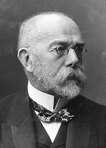
Heinrich Hermann Robert Koch (English: /kɒx/ KOKH,[1][2] German: [ˈʁoːbɛʁt ˈkɔx] (listen); 11 December 1843 – 27 May 1910) was a German physician and microbiologist. The bacterium itself was discovered by Filippo Pacini in 1854, but Koch "advanced the theory that bacteria exist as distinct species, each producing a unique clinical syndrome, and he discredited the popular notion that bacteria with different morphologies were derived from the same species"[3]As the discoverer of the specific causative agents of deadly infectious diseases including tuberculosis, cholera and anthrax, he is regarded as one of the main founders of modern bacteriology. As such he is popularly nicknamed the father of microbiology (with Louis Pasteur[4]), and as the father of medical bacteriology.[5][6] His discovery of the anthrax bacterium (Bacillus anthracis) in 1876 is considered as the birth of modern bacteriology.[7] Koch used his discoveries to establish that germs "could cause a specific disease"[8]and …more
edit descriptions of this character
No photos have been uploaded yet.
Books with Robert Koch

|
The Other Side of the Judeo-Christian History
by
—
published
2011
add/edit characters
|
|

|
Consciousness: The Concept of Mind and the Transcendence of Conventional Thought
by
—
published
2016
add/edit characters
|
|

|
Correspondence, Volume 1: 1868 - 1886
by
—
published
1959
add/edit characters
|
|

|
Correspondence Volume 3: 1891-1895
by |
|


