
George Berkeley
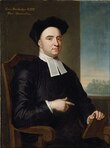
George Berkeley (/ˈbɑːrkli/;[5][6] 12 March 1685 – 14 January 1753) – known as Bishop Berkeley (Bishop of Cloyne of the Anglican Church of Ireland) – was an Anglo-Irish philosopher whose primary achievement was the advancement of a theory he called "immaterialism" (later referred to as "subjective idealism" by others). This theory denies the existence of material substance and instead contends that familiar objects like tables and chairs are ideas perceived by the mind and, as a result, cannot exist without being perceived. Berkeley is also known for his critique of abstraction, an important premise in his argument for immaterialism.[7]
In 1709, Berkeley published his first major work, An Essay Towards a New Theory of Vision, in which he discussed the limitations of human vision and advanced the theory that the proper objects of sight are not material objects, but light and colour.[8] This foreshadowed his chief philosophical work, A Treatise Concerning the Principles of Human Knowledge…more
In 1709, Berkeley published his first major work, An Essay Towards a New Theory of Vision, in which he discussed the limitations of human vision and advanced the theory that the proper objects of sight are not material objects, but light and colour.[8] This foreshadowed his chief philosophical work, A Treatise Concerning the Principles of Human Knowledge…more
edit descriptions of this character
No photos have been uploaded yet.
Books with George Berkeley

|
The Other Side of the Judeo-Christian History
by
—
published
2011
add/edit characters
|
|


