Jim Baumer's Blog, page 43
August 25, 2015
Exit Summer
Summer is fading. In some ways, it seems as though summer, at least the ones I remember as a kid—never arrived. You know the ones—full of friends, adventures—seemingly endless in duration.
I can always tell when summer begins getting antsy, commencing packing up the cottage,readying to return to wherever she goes until the following year in late May and early June. That’s when she’ll return for a few short visits, tidying up the seasonal digs, before arriving in glory in July. Then, if lucky, summer has a solid 6-8 week run, offering endless options and bliss.
With the release of another Farmers’ Almanac, local news directors all trotted out stock images and file video reminding us of last year’s snowy winter. If local TV news is anything, it is predictable. That was the big story for Monday.
Apparently, we’re in for a repeat of last winter and snow. So much for global warming in these parts.
Last night, I drove to Pine Point for an open water swim. It was my final prep for Sunday’s Challenge Americas Triathlon and this year’s Olympic-length effort. The beach was fogged in and the surf was rough. The mile swim was a tough one. I got banged around in the waves, wrapped in seaweed, and I lost track of some of my swim partners. Despite being reminded of the power of the sea, it was oddly peaceful just concentrating on my stroke, while occasionally looking up to site my course.

Open water.
Despite the foggy conditions, standing on the beach, post-workout, peeling of my wetsuit, I soaked in the natural world and my surroundings. The twilight cool on my damp skin felt wonderful. I was tired from fighting the surf and even a little queasy from being bounced around. But I was in the moment, experiencing the world around me—not some virtual representation of it.
As I sit here, trying to produce a couple hundred words to meet another self-imposed blogging deadline, I am reminded that I didn’t dance enough with summer yet again this year. My plans for spending every other weekend at the ocean went unrealized. I never sat in a seat at Hadlock Field, drinking beer and marveling at the skills of future Red Sox prospects. I did get out on my bike and log enough miles on the pavement to be reminded by my balky right knee that I’m no runner.
And also reminded that with each passing summer not maximized, it gets crossed off my list of seasons remaining. I’ll never have them back.


August 21, 2015
Anchors Away
Americans as a group don’t really know their history or their heritage. Ask them who one of the Founding Fathers were and they might tell you, Mark Zuckerberg. He may as well be because Facebook now serves as the nation’s media channel.
Nowhere is our American lack of awareness about who we are more obvious than when we start talking about the Constitution. I doubt few would know more than one or two of the constitutional amendments, and what they relate to. Most would probably get the First Amendment—freedom of speech. Maybe the Second, and guns—actually, it’s “…the right of the people to keep and bear Arms…”
Get beyond the second one and it’s the Wild, Wild West, however.
Take the 14th Amendment. That’s the one that addresses many aspects of citizenship and the rights of citizens. Section 1 of the amendment reads, “All persons born or naturalized in the United States, and subject to the jurisdiction thereof, are citizens of the United States and the state wherein they reside.”
So, if someone comes across our southern border illegally—possibly Texas or Arizona—while also being pregnant, and has the baby in one of our hospitals (at taxpayers’ expense), then that baby is a U.S. citizen. A common term for that process in today’s immigration parlance is, “anchor baby.” Granted, some don’t like the term and consider it offensive—like Tony Llama, a “reporter” for Good Morning America.
He yelled at Donald Trump, when The Donald used it, saying, “That’s an offensive term! People find that hurtful.”

On the cover of Time Magazine (Photograph by Martin Schoeller).
The burgeoning American list of “offensive” words is now one word longer. I’m sure many know that list better than their U.S. Constitution.
Trump doesn’t care, though. He’ll continue to use it, and sees Llamas as attempting to impose political correctness on him.
For people baffled (read, liberals and reporters) about the polling numbers for Trump that might be one reason. The “silent majority” likes it when a candidate for president doesn’t cower in the face of those trying to shut down free speech. And here we are again, back to the Second Amendment.
August 18, 2015
Late Summer Baseball
If you are still following Boston’s baseball team, the Red Sox, you are well aware that the odds of a post season this year are slim to none. In a town that’s grown entitled to having their professional sports teams play meaningful games late into their respective seasons, losing becomes a hard pill to swallow. Nowhere is this more prevalent than with the members of Red Sox Nation.
Winning a World Series in 2004, again in 2007, and then the improbable championship run in 2013 has only heightened expectations among its fan base. However, when you look at the reality of baseball played in places like Cleveland, Arlington, and San Diego, the carping about Ben Cherington and Red Sox ownership on sports talk radio ought to cease. It won’t, but winning championships nearly every season isn’t the norm—except perhaps if you are a follower of one particular franchise whose players are adorned in black pin stripes—a club with 40 World Series appearances. Dare I utter “the New York Yankees” in these parts?
I wouldn’t call myself a rabid Red Sox fan. I don’t have any interest in fantasy baseball—a digital, pixie dust approach to baseball that seems to be popular with a certain type of beta male. And while my fortunes don’t hang on every pitch made by this year’s group of sub-par hurlers assembled in Beantown, I’ve been enjoying the team the past few weeks in a way that I hadn’t earlier in the campaign.
Since what I’ve just written doesn’t jibe with the state of Red Sox fandom these days, let me at least put out some of my own baseball bona fides. I played the game through college and later, logged seasons toiling on Maine’s baseball diamonds with town teams and later, old-men’s leagues like the SMMBL, which in recent seasons has gotten much younger. I’ve also coached summer college league baseball in the Twilight League, one of North America’s oldest amateur baseball circuits—a league that’s well over 100-years-old. These days, I am a baseball umpire, spending my summers serving as the game’s arbiter. Oh—I also wrote a book about the history of the game in Maine.
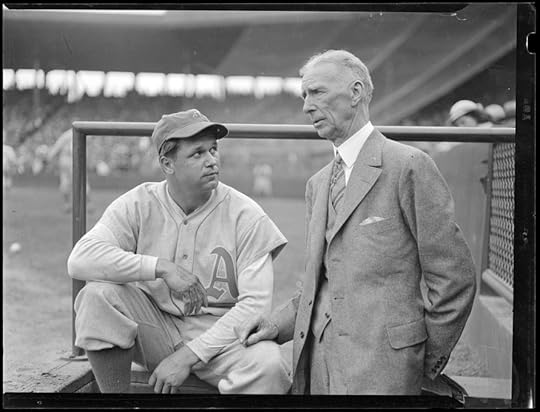
Baseball is deeply embedded in our culture.
I list all this to say that I have some experience around baseball. I also recognize that the game may not hold the same sway for today’s young kids—socialized by screens and gadgets—as America’s pastime had on my generation.
And yet, baseball still remains the perfect capstone to a day of work and challenges, IMHO. Its pastoral pace and rhythms hearken back to a time that wasn’t so frenetic. A time when the pace of life was more human and less frenzied.
So while other New England sports fans divert their attention to football with September’s approach, I’ll continue to catch Jerry Remy and Don Orsillo, doing the games on NESN, or tune in games on my portable radio, enjoying Dave O’Brien and Joe Castiglione’s calls.
The Red Sox are likely to lose 90 games again this season (they lost 91 in 2014). But wrapped in that futility is a silver lining. Young players like Jackie Bradley, Jr., Travis Shaw, and Rusney Castillo will (should) get to play every day. In fact, Bradley’s performance over the last week has been hopeful. An amazing defensive player, with a host of highlight reel catches to his credit, Bradley has yet to prove he can consistently handle Major League pitching. However, those of us still watching got to catch a glimpse of what might be possible with the 25-year-old outfielder this past weekend.
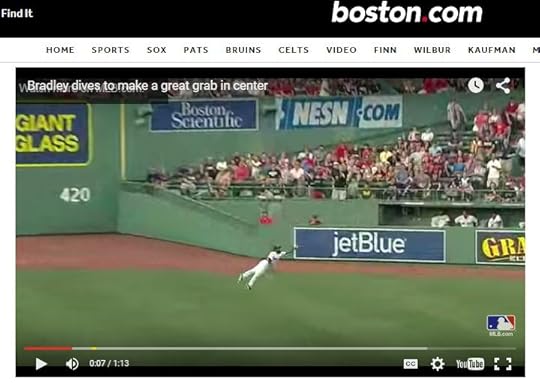
Jackie Bradley Jr. making another amazing catch.
For the first time, Bradley’s put together a week of offensive consistency that indicates he might be part of a brighter baseball future in Boston. And then on Saturday, his five hits—including two home runs and seven RBI—put him in the Fred Lynn category, at least for one magical afternoon.
August 14, 2015
Seniors and Technology
Google (and the U.S. Census) tells us that Maine is the oldest state in the nation. Our demographics aren’t working in our favor. Our senior population continues growing, unabated. So, what to do about it? Short of having more babies, there’s not much we can do.
Being part of a planning grant addressing seniors remaining in their homes in rural Maine, and now, employed visiting seniors a few times each week, I’ve continued to stay interested in the issue.
Of course, like just about every other problem or issue that’s raised in America, can you guess what the solution being proposed is for our aging population? Technology, of course. Because we know that technology solves every problem and makes our lives better and more enriching. {sarcasm}

Seniors prefer less technology, thank you!
I remain on an email list from my days managing the senior-specific grant. On a regular basis, I am the recipient of articles and information forwarded to me. I guess that passes for program management these days.
There was an article that arrived via the Gmail on Tuesday, courtesy of our “friends” at Kaiser Health. Live in rural Maine, or other rural parts of America—not to worry—just pick up the telephone. Who knew it was so easy to address aging in place? Except, these telephone and technology approaches don’t always work as well as they’re written up for the shills that are tasked to write these kinds of pro-medicine pieces.
As an aside, I receive daily emails from someone who aggregates freelance writing gigs. A day doesn’t pass when there isn’t at least one or two calls from some organization or agency looking for “experienced medical writers.” Lots of flacking happening on the medical front. Gotta’ get those puff pieces out there about technology supplanting our personal physicians.
For a few weeks now, I’ve been visiting a 73-year-old gentleman. It’s part of my new part-time gig I took to even out the ups and downs of freelancing. The man I visit would never present as having dementia. He’s vigorous and engaging, and when I drop by weekly, he wants me to help him with some project. We’ve been moving wood out of his garage, doing some landscaping tasks, or he has me drive him over to his storage unit with a load of his life he’s accumulated over the past 50 years. He’s trying to figure out what to keep, as he moves to a smaller place.
I’m enjoying my time with Mr. G because he’s fun to be with. I listen to his stories—like the one about how he’s “pissed at his doctor” for taking his license away from him. Oh, and Mr. G has a telemedical device in his kitchen that is supposed to monitor his pacemaker and he says “it never works.” When I asked him what happens when it doesn’t work, he told me “they send someone out to check on it (and me).”
Now we have Senator Angus King—a man that’s never seen a technological solution he didn’t want to adopt—pushing for more funding for telemedicine. Technology is always King’s best friend. Remember when he was governor of Maine? He’s the one who launched laptops in our schools. And how much smarter are our kids these days thanks to our former governor’s wisdom. {more sarcasm}
King, really a Democrat with an (I) next to his name is again going to the well of “the government will save us,” in this case, our seniors. Our aging population is an issue we better get a handle on, and probably should have been thinking about 25 years ago when something might have been done. The solution now—if there’s one forthcoming—isn’t emanating from the Beltway, coming from slicksters like King and his congressional cronies.
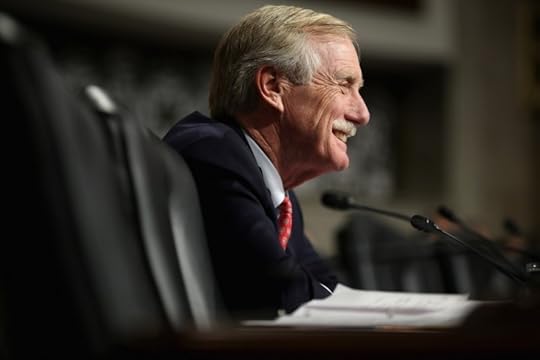
Angus King–not as independent as you think.
Seniors are the one group that don’t want more technology. They want to be treated with dignity and not have more gadgets introduced into their homes. So what’s driving the push to hook grandma and grandpa up with the latest tech gadget and downloadable app? Technoutopiansim is one possible reply.
Here’s another take I’m having on this.
Say your father or mother, living by themselves—or perhaps both of them are still alive. They’re in Maine and you’re living halfway across the country. Rather than reorder your lives in order to accommodate their needs and the changes everyone faces as they age, it’s much easier to think that you can Skype them, or have some telemedical device installed in their homes and “voila”!! Everything’s peachy again. Actually it’s not, but at lease you’ve assuaged your guilt.
I’m a big believer that we need more human interaction, not less. Too much of our lives are already spent dealing with technological solutions. Seniors, who have lived most of their lives in a world where face-to-face mattered, still prefer that—not a bunch of gadgets.
August 11, 2015
A Barrel of Monkeys
The political world is framed by surveys and polling data. You’ll hear that Candidate X is up in the polls by X percent. Or Candidate Y’s lead is “within the margin of error.” These are terms that anyone following political news, even in the most superficial manner, is familiar with. Sometimes I think quantification is the American religion.
After last Thursday’s Fox News/Facebook debate, the one where Megan Kelly ended up “stealing the show,” and upstaging The Donald, a survey came out that made me sit up and take notice. Not because of the data, no, but given the source.

Don’t end up in her cross hairs.
The oft-cited survey following the Kelly/Trump dustup has been the NBC/SurveyMonkey online survey. This particular tracking tool shows Trump leading the rest of the GOP field of 64 (it’s actually 17, right?) at 22 percent. Following the Trumpster are Bush and Walker at 10 percent. Rubio, one of the biggest flip-floppers on immigration, according to conservative firebrand, Ann Coulter, is tied with Ben Carson at 8 percent.
What I found interesting was that NBC, one of the Big Three networks, had opted to go with SurveyMonkey, a tool that every under-funded nonprofit I worked with used, any time we wanted to take the pulse on an issue we were working on, or wanted to survey a group of people we were collaborating with.
We used SurveyMonkey because we could take a simple poll, or gather more sophisticated market research in a user-friendly manner, usually by embedding a link in an email blast that we’d send out to a representative sample of people. The best part is for the information we were gathering, the tool was free.
I’m guessing that NBC News is using one of SurveyMonkey’s upgraded paid versions, likely their Gold or Platinum packages. Or perhaps SurveyMonkey has a customized function especially developed for the driveby media. But who knows, right? Given the competition coming from other sources for our news, maybe even might NBC is using free online tools and apps to get the job done.
Really. Do you trust anything that you see on the six o’clock news, or believe what other mainstream news sources tell you these days? I know I’m suspicious about any slants coming out from CBS, NBC, and ABC, as well as CNN, MSNBC, and any other cable news sources, not to mention the New York Times, the Washington Post, and the Wall Street Journal.
Thank God we have Facebook. We know that Zuckerberg would never lie to us.
August 7, 2015
Too Much Talk
So last night we had our first presidential debate of the 2016 campaign. This one featured only 10 of the large Republican field of contenders, or pseudo-contenders. Maybe the biggest accomplishment of Fox News (the debate’s host) was winnowing the Republican field of 64 (actually, there are only 17 “serious” candidates at this point) down to a workable number—even that is debatable.
No doubt I could spend Friday’s blog post space devoted to politics. But really folks, isn’t an August debate a full 15 months out from that fateful day in November when we choose someone else to lead us, a little premature? I know the driveby media at the NY Times and Washington Post have done a great job whipping up enthusiasm for the horserace, yet again. But like they always do, it’s more about the race, or a sentence taken out of context, than the actual issues facing ordinary Americans. And with politicians, you always have to take what they say with a grain of salt.
What I’d prefer to focus on this morning lingers in the vicinity of what I touched down on Tuesday—local economic development, and what this means for Maine’s future, near-term and possibly, longer term. That’s also a topic that you’ll never hear a national candidate talk about, regardless of whether we’re talking Donald Trump or Bernie Sanders. It’s also a topic that the media really doesn’t really do a very good job taking the pulse of—mainly because you can’t capture the nuance of it from your office on the upper floors of your news empire, or via Twitter and Facebook. It’s felt out on the streets, in the fields, your local farmers’ market or farm where you get to know your source of food, or other places where real people still congregate.
I’ve been thinking about this for a while now. I’ve also been blogging about it. There’s this post here, another one here, and the topic pre-dates the JBE, as I was talking about issues of local communities (including how media types mess up their coverage) back in 2008 on my old blog, Words Matter.
It frustrates me how so much of our economic and cultural buzz in Maine remains centered only on Portland. Granted, some of it makes sense since Portland is the state’s largest city and cultural hub, a key shipping port, and where most of our media is based. It’s also a city that’s gotten the lion’s share of attention from Mainebiz, and from journalists from away covering food. The story is mainly about Portland being a food Mecca, a foodie haven, the restaurant capital, or some variation on that story.
Occasionally, someone notices that other places in the Pine Tree State that aren’t named Portland, have functional local economies, and assets that aren’t restaurant-based. Take for instance the story that Mary Pols did on Skowhegan for the Maine Sunday Telegram. The article was a decent one, but I bet Ms. Pols was surprised to make her way to the gritty mill town on the Kennebec River, 150 miles north of idyllic Portland and its foodie overkill, and find that the community had running water and alas, a grist mill. It’s also the home of Amber Lambke, an entrepreneur (or “agripreneur, a term my friend Emily uses) to be reckoned with.
Having spent time in Skowhegan once a month at least, from 2006 through 2012, and occasionally since, I can tell you from experience that Skowhegan has been taking baby steps forward for a decade, or longer, to revitalize downtown and find the kinds of catalysts like Lambke and her Maine Grains, to drive their local-based economic recovery.
Unlike NPR’s Adam Davidson, anyone spending a bit of time in Skowhegan knew that the community had more going for it than teenage mothers, drug addicts, and high school dropouts who are unemployable—at least that’s how he portrayed the town back in 2007 on the national radio stage.
There are other places where things are happening around the state. Local Ag is usually part of the mix, like in Lewiston, where a group called Grow L+A is looking to promote the redevelopment of the Bates Mill, specifically Bates Mill No. 5. For the purposes of self-disclosure, I’ve been hired as a project coordinator for a couple of months to help shepherd elements of their process, including a public forum coming in September. But, I knew about L/A’s revival long before being welcomed on-board in some official capacity. My French-Canadian grandparents moved to Lewiston from Canada during a large influx of Canadian immigration during the late 18th and early 19th century. I know about the ups and downs of the community, now on the way up again, dating back to my days as a little tyke, shopping for school clothes on Lisbon Street.
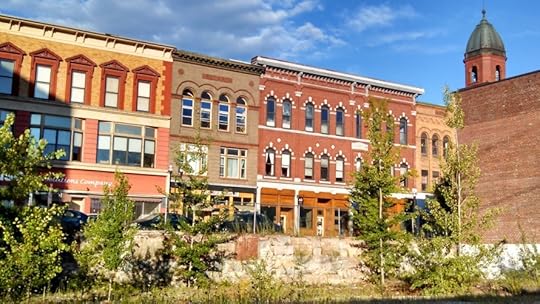
Downtown Lewiston, Maine, as dusk approaches.
I could also highlight positive elements in Biddeford (actually, I’ve already done that, on the pages of the Boston Globe), communities in Western Maine, like Norway and Bethel, as well as Brunswick, Bath, Rockland, and Eastport.
With all due respect to the likes of Donald Trump and his other Republican challengers, these places in Maine are going to sink or swim, not based upon who we decide to vote for in November of 2016—no, their long-term economic viability will be determined by local leaders and others invested in these local communities. It’s particularly exciting for me to see them thinking about local food, food hubs, mill redevelopment, and growing local-based economies that can be connected on a regional basis. This is the kind of stuff that tempers the overall economic gloom, and more important in my opinion—counters the false notion that someone in Washington (or Augusta), wedded to ideology and committed to slightly minor reforms will offer us long-term prosperity.
But that’s where many will continue to look and get caught up in all the hoopla and histrionics. It’s easier, I guess. Me, I prefer to roll-up my sleeves and put my boots on the ground in my own backyard and where I spend the majority of my waking hours.
It just makes too much sense to me.
August 4, 2015
Making Maine Self-Sufficient
I have been advocating for local economic development for as long as I’ve been blogging, dating back more than a decade. If Maine has any hope of creating resilience that might weather potentially stormy economic seas, it’s going to come via locals and local hubs of economic activity.
One of the state’s best sources of resilience is our local food economy. I’m not talking “foodie” ventures here, although I’m not opposed to high-end and trendy restaurants doing well, especially if they source from local farmers. But local food doesn’t have to be a high-end and pricey option for the elites, either.
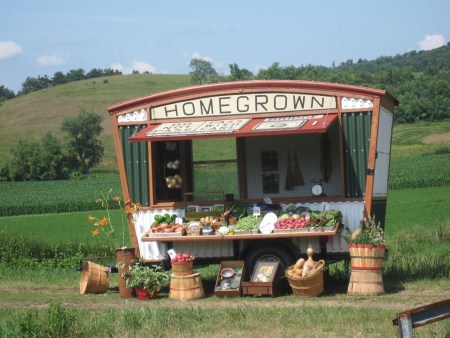
“Growing Your Own Food is Like Printing Your Own Money.”
That’s why I was thrilled to learn that Craig Hickman’s bill, LD 1291, encouraging food self-sufficiency, has become law in Maine. This was one of several bills that sought to advance the Local Food and Community Self-Governance Ordinance (LFCSGO) passed in 13 towns across the state.
If you don’t know Hickman, he’s an organic farmer, and a passionate advocate of farming and local food, who happens to be serving his second term in Maine’s House of Representatives. He represents the towns of Readfield, Winthrop, and part of Monmouth. He’s also a great example of a citizen legislator who has made a difference in a political climate that all too often has been centered on ideology rather than on what’s best for Maine’s future.
Given my own new project centered on creating a local, urban food hub and Grow L+A that has me excited to be back working in Lewiston-Auburn again, I thought it fitting today to highlight Hickman’s bill.
Better yet, why don’t I just point you over to his blog, Hickman in the House, where he does it better than I can.
July 31, 2015
Destroying Words
There was once a book, one that I learned about in school. Granted, when I first went to school back in the 1960s, the world was a different place. While it was beginning to shift and change, language was still fairly static. That’s no longer the case.
George Orwell wrote Nineteen Eighty-Four, or 1984 in 1949, which compared to when I began school could be considered the Dark Ages. The name he was given at birth (in 1903) was Eric Blair. I bet you didn’t know that.
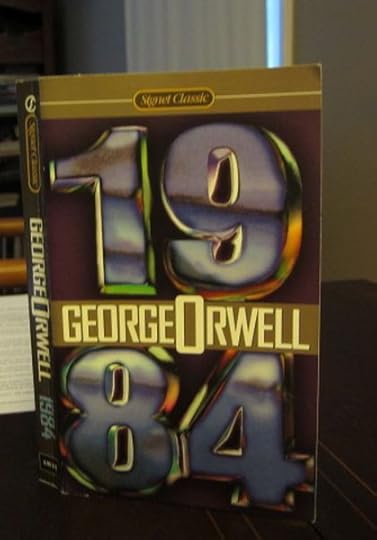
Big Brother is watching!
I used to have a blog called Words Matter. I named it that because when I was learning words and how to write them, they really did matter.
Orwell’s book had a profound effect on me when I first read it during my high school years, during the first term of a president named Reagan. I’ve subsequently read 1984 at least 15 times since then.
This morning the radio said that the University of New Hampshire, one of UMaine’s chief hockey rivals, had published a resource called the Bias-Free Language Guide. When I got home from work, I tried to find it on the interwebs and when I went to the link for the guide, it just took me to this generic “diversity” page. I later found out that the president of the university had requested that it be removed from the University of New Hamphire’s website on the interwebs. I was disappointed.
While stories like this one told me that the guide labeled words such as “American,” “homosexual,” “mailman,” “elders,” and “overweight” as problematic, I was hoping to view the document to see if there was some explanation. You see, these are all words that I use, both as a writer, and in my everyday speech. Writing and articulating is how I express myself. In fact, just the other night, I said to my wife, “I am overweight and I’m going to finally lose those 10 extra pounds I’ve been carrying around.” I’ve used “elders” publicly as a term of endearment for seniors, noting the word signified experience and even wisdom.
Of course, just like in Orwell’s prescient book, hate and censorship seem to be everywhere these days. And then, there are people trying to pass off politicized pieces like this one, as journalism, for a major American daily. Perhaps that’s why I’ve found the book to be one that continues speaking to me.
This passage, while written nearly 70 years ago, could have been written during our present time.
On page 45 (of my Signet Modern Classic version), Winston Smith, the book’s protagonist, is taking a lunch break during his work day at the Ministry of Truth. He runs into a colleague named Syme and they sit down at a table together in the canteen. Syme was the lexicographer who developed the language and dictionary of Newspeak. His job also involved destroying works. Syme would eventually be vaporized because he got on the wrong side of Big Brother. While orthodox politically, he was too smart for his own good—or too smart for the politically-correct Party types.
“How is the dictionary getting on?” said Winston, raising his voice to overcome the noise.
“Slowly,” said Syme. “I’m on the adjectives. It’s fascinating.”
The two exchange other pleasantries, while eating their bread and drinking the gin available. Syme speaks.
“It’s a beautiful thing, the destruction of words. Of course the great wastage is in the verbs and adjectives, but there are hundreds of nouns that can be got rid of as well. It isn’t only the synonyms; there are also the antonyms. After all, what justification is there for a word which is the opposite of some other words?”
Syme continues,
“Don’t you see that the whole aim of Newspeak is to narrow the range of thought? In the end, we shall make thoughtcrime literally impossible, because there will be no words in which to express it.”
We’re well on our way to that place.
July 28, 2015
The News Biz
It’s nearly impossible to find unfiltered news coming from the driveby sources. The New York Times runs a story on Hillary Clinton’s emails, then the Old Gray Lady furiously backpedals from it. The Washington Post tells us that the reason that Donald Trump is surging in the polls is due to stupid, white people. So much for our vaunted “fourth estate” and its objectivity.

News isn’t what it used to be.
There’s a reason why many conservatives don’t trust the media, citing its liberal bias. That suspicion of mainstream news isn’t limited entirely to those on the right, either.
My decision the past few weeks to bypass many of the mainstream sources where I’ve sought news in the past, has been a beneficial one. In fact, despite the continued protests of Hillary supporters by people that ought to know better, “educated” white people (for want of another term), about some supposed “right-wing conspiracy” against her, I’d say that much of the information I’ve been finding on the right, while slanted for sure, serves me better than the garbage being peddled from the left.
Leaving your usual corner of the interwebs, and departing from your tried-and-true circles of ideological knee-jerking is guaranteed to open you up to new and different ways of parsing the news. You might even be less impressed (bamboozled?) by candidates on the left and the right.
Thanks to Glenn Beck, I now know that Bernie Sanders lacked the good sense back in the 1980s not to put out an atrocious record (as in singing, not voting). Other non-driveby sources show Bernie to be less of a socialist, and more of a good Democrat.
Of course, both the left and right (with a few exceptions) continue to lob stones at Donald Trump, explaining away his support as simply a case of stupid (white) people.
Keep up the stellar reporting, media types.
July 24, 2015
Brighten Up
There’s no shortage of depressing topics to tackle on any given day. For whatever reason of late, the news seems worse than ever. Even our local stories have been angling towards the negative.
I was thinking about offering my two cents worth about our “fiscally conservative” governor granting raises ranging from seven to 23 percent to a group of his administrators. Then, like nearly everyone else, I’ve gotten sucked into the Marcy’s Diner news and Facebook vortex. But alas, the thought of stirring up controversy on a perfect Friday morning during the height of Maine’s tourist season is just too freakin’ depressing.
So instead, I’m touching down today on talk about female empowerment and volunteerism. Can’t get in any trouble with that, can you?
My wife trains with a group of woman called SheJAMs. I’ve written about them before. She would tell you that this group of gals has changed her life. I’d believe her, too. It’s benefited me, also.
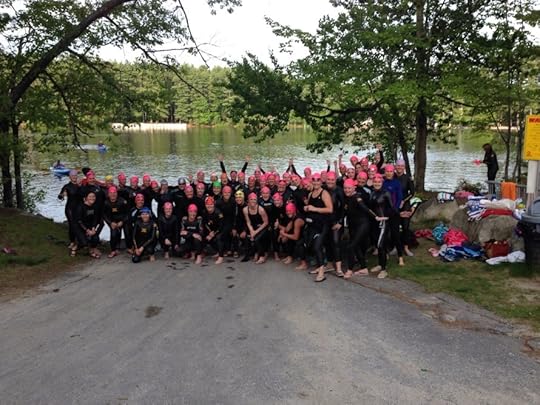
SheJAMs swim night, at Crystal Lake.
In a world where there are too many posers and hype that doesn’t deliver, groups like SheJAMs–which has changed women’s wellness right here in Maine—is the kind of authentic, good news story that I wish there were more of. In fact, one of their founders, Julie Marchese, is Tri for a Cure’s race director again this year. Julie’s the real deal, and I’m honored to have her call me, “Mr. B.”
Because of SheJAMs, who Mary first heard of when she participated in her first Tri for a Cure four years ago, I’ll be volunteering this weekend at this year’s event. Sometimes you’ve just got to try to do something good, no matter how small.
Actually, because my wife supports me in many positive ways, I decided to be her general gofer and “Mr. Do-Whatever-She-Needs-Me-To” in supporting her in her role as one of the volunteer coordinators for Sunday’s event that benefits the Maine Cancer Foundation. I’ll be just one of more than 500 people volunteering for this event.
Also, since I’ve preached about the need to give back through volunteerism and how social capital has been on the wane, I’m trying to walk my talk. Plus, as a triathlete, I always appreciate the volunteers supporting me whenever I’m competing. Then, there is the adage that talk is cheap, and cheaper than ever, again because likes on Facebook don’t really cost you anything.
One thing I’m sure about. I’ll be in a great frame of mind Sunday afternoon, after hustling about, trying to make this year’s Tri special for the ladies who are competing.