Jim Baumer's Blog, page 41
October 30, 2015
Stopping for School Buses
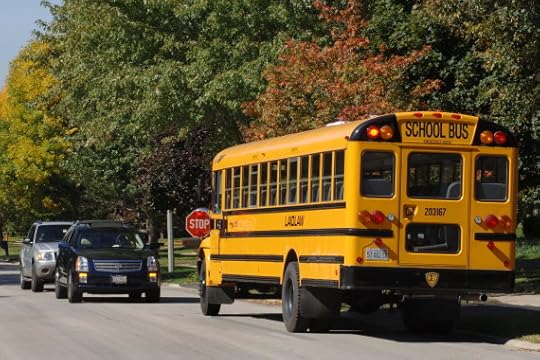
This means stop.
Let’s begin this week’s Friday blogging exercise with a little traffic safety review for you drivers. According to Maine Revised Statutes for Motor Vehicles, under Title 29-A, §2308: Overtaking and passing school buses, it reads as follows:
Stopping. The operator of a vehicle on a way, in a parking area or on school property, on meeting or overtaking a school bus from either direction when the bus has stopped with its red lights flashing to receive or discharge passengers, shall stop the vehicle before reaching the school bus. The operator may not proceed until the school bus resumes motion or until signaled by the school bus operator to proceed.
Penalty. A violation of this section is a Class E crime which, notwithstanding Title 17-A, section 1301, is punishable by a $250 minimum fine for the first offense and a mandatory 30-day suspension of a driver’s license for a 2nd offense occurring within 3 years of the first offense.
Most of you are probably wondering, “why is Jim turning the JBE into a blog on traffic safety and rules of the road?” What? Did you not see the WMTW-8 report by Katie Thompson, on idiot drivers passing stopped school buses in Cumberland? I guess those high-end, tony suburbs aren’t attracting civic-minded types any longer. No, just rich schmucks with “get the hell out of my way” attitudes that are always riding up on my ass when I’m simply driving the speed limit on rural backroads like Route 9, coming back from points south and headed back to the compound in Durham.
You would think with all the lip service being paid to “the children,” giving them better athletic fields, state-of-the-art schools, and all the other poppycock that gets bantered about regarding higher taxes and contributing to our “future,” these very same people, once behind the wheels of their 5,000 pound hunks of steel, would also value the safety of these very same “children.”
But instead, it’s more of the same kind of boorish behavior, lumped in with running red lights and texting while driving. It appears that we’ve become characters in a dystopian novel, ala A Clockwork Orange, or something Ray Bradbury would have written. For all our moral posturing and political correctness, we obviously care little about one another.
I’m not sure what’s at the root of any of this. Clearly, however, it’s just one more example of our societal spiral downward.


October 27, 2015
Richness follows Loss
I know that not everyone who reads the blog is a writer, or aspires toward the writing life. However, over the past few weeks, a window of reflection has opened, looking backwards. What I’ve been able to see with uncommon clarity, has been much of the past decade or more for me. Writing has been at the center of this period of time, what I characterize as my personal period of reinvention.
Life dictates that we move on from grief and loss. Outside of the death of immediate family members—and even then, superficiality predominates how others respond, with platitudes, or worse—clearly demonstrating some sort of structural disconnect and a deep-rooted denial related to death and dying in our culture. “Get over it and move on” is what we’re expected to do.
Over the weekend, I went through some of Bryant’s books. A demonstration of grace from his son, when he offered me the opportunity to go through his father’s collection of books, at the funeral service. He followed up with an email and we spoke by phone during the week. I planned to meet him on Saturday at his father’s apartment in Augusta.
Bryant had taught at Colby-Sawyer, with Wes McNair. There were several of McNair’s books sitting on his bookshelves. Most of them ended up in the two overstocked boxes I lugged out of the apartment and put in my trunk.
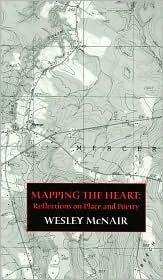
Mapping the Heart: Reflections on Place and Poetry (Carnegie Mellon University Press, 2002)
Since Saturday night, I’ve been making my way through Mapping the Heart: Reflections on Place and Poetry, a book of essays McNair released in 2002. McNair relates his own journey, starting out as a writer and more specifically—that of becoming a poet. I’ve long marveled at those who write poetry well. I once made an ill-fated attempt at writing some vestige of of what I thought passed for poetry while in college at UMO. The resultant rejection nearly prevented me from ever becoming a writer.
McNair’s book is much more than a “how to write” poetry kind of book. It should be read by anyone serious about developing their writing craft. Rich in insight, as well as observations about the difficulty inherent in becoming a writer, McNair’s book would be a welcome addition to any writer’s bookshelf.
If you’re not a writer, you probably consider the writing fraternity as a group of people with special talents. We’re not. Actually, having a modicum of talent is probably required (and Stephen King, in On Writing, says it’s essential), but so is being committed to working at it and then having the fortitude to ride out the inevitable periods when you might be the only damn person in the world who believes that you deserve to be called a writer. Writers are not so much born, I think. No, they’re forged during that period of doubt that McNair eloquently writes about.
Back to mentoring. There are never such an abundance of the true kind of mentors that losing two—first Dave Tomm and then, Bryant—doesn’t knock you back a peg.
McNair writes honestly and with warmth about his relationship with noted poet, Donald Hall. Hall happened to be living not far from where McNair had moved his young family, when he arrived to teach at Colby-Sawyer. The two struck up what would blossom into a long friendship after being introduced in 1976 by two of McNair’s former students. Hall was living in nearby Wilmot, New Hampshire (Colby-Sawyer is in New London), returning to the Granite State, and taking up residence in his “ancestral home,” as McNair describes it.
This was the period just prior to the release of Hall’s collection poems about New Hampshire, Kicking the Leaves. He was a major American literary figure in 1978, when the country still valued giants like Hall. Now, all it takes to be considered someone “of letters” is nothing even remotely connected to the kind of writing talent and devotion to craft that men like Hall possessed—merely a large enough Twitter feed and the capacity to blurt out 140-character streams of drivel reminiscent of someone with Tourette’s Syndrome seems sufficient in our current setting. But let’s not go there, today.
McNair recounts that Hall saw something in him, the aspiring poet who had yet to be published. He read his chapbook after he left it on Hall’s kitchen table on the way out the door after that initial visit. Hall in turn offered constructive feedback and encouragement. Why don’t more writers offer this to an understudy, like Hall did for McNair?
In a letter that McNair dates, July 8, 1980, Hall offers advice to McNair after he received yet another rejection slip for his manuscript from a publisher.
“I am sympathetic with your feelings, but let me tell you when you have published a book—nothing will happen; or at least it will seem that nothing has happened…Even if something happens, then you realize that the “something” is truly nothing. And after you have published eight books of poems (like Hall had—jb), you are still convinced that nobody reads you, and that probably you are no good anyway. Or at least you are convinced of that frequently. I have been going through quite a bad patch, in my feeling about my own ability, my past work, and certainly my present work.
There is only one place, or one moment in which one finds happiness, and it is always momentary—because that is the moment of the actual writing, and of course that [moment] is not always true.
So I do two things: I assure you that you will publish; and I tell you that it will not make any difference! But I don’t have a third thing to say: it makes a difference to me!”
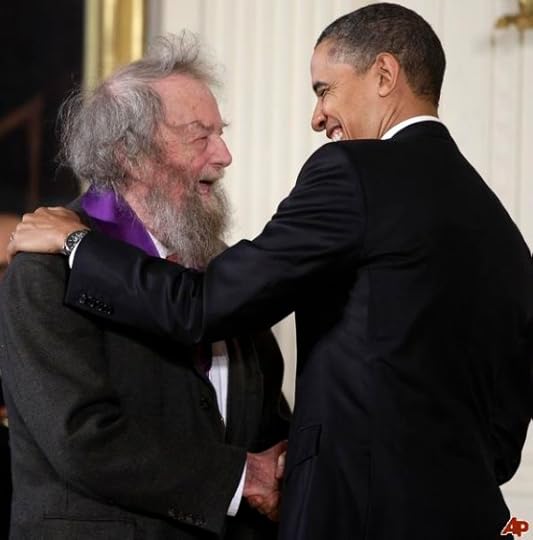
Poets and presidents; Donald Hall with President Obama.
Great advice from a literary great, to someone on their way up the ladder. Oh, and an update on our writers; Hall is still writing at 87, and McNair is going strong in his early 70s.
I’m enjoying McNair’s book and I’m looking forward to going through my boxes of other books from Bryant, including several about J.D. Salinger, and Mark Twain. I wonder what other riches I’ve been left with.
October 23, 2015
Acting Human
Humans require interaction. Some have posited that our need to connect is as necessary as food and water. It’s how we’re wired. Isn’t it odd how so much of our socialization now occurs in the digital realm, rather than face-to-face?
Technology always gets offered up as a worthy surrogate. Facebook has become the default portal where all of our so-called humanness gets played out—touch, taste, success, beliefs, even end-of-life drama. This has become our new “normal.”
Maybe social media and our lack of time spent in the presence of other humans signifies some higher order evolution. I’m guessing that it doesn’t, since studies indicate there are more lonely Americans than ever before.

Staring at a screen isn’t human interaction.
When my friend died, I was torn about whether to send out emails to people that knew him and at one time had close connections with him. While I did let a few people know initially, it wasn’t until after Saturday’s service that I sent out a handful of additional notes. I was struck by how many people had no idea that he had died. A few sent tender and heartfelt replies. Others offered perfunctory responses, or none at all. Our instant communication is mostly Balkanized, at best.
These “digital shortcuts,” which we justify as time-savers, may in fact be enacting a toll on society.
An article that I tracked down through some web research contained a powerful quote from a Boston-based school psychologist named Dr. Kate Roberts. Commenting on what she’s observed, it appears that technology is wreaking havoc on how families interact.
“Families text rather than have conversations. We’re living in a culture of sound bites, and that is not developing our verbal skills or emotional intelligence,” Roberts said.
Roberts went on and made reference to a course being offered at Boston College on how to ask a person out on a date.
“It’s like we’ve lost the skill of courtship and the ability to make that connection,” said Roberts.
In July, I was standing on Lisbon Street, outside Lewiston Public Library, after meeting with a project consultant that I’d be doing work with for the following three months. A car drove by, and someone yelled out, “hey Mr. B,” a pet name that my wife calls me, and one that has been adopted as my moniker by some of her SheJAMS friends.
I finally put two-and-two together and figured out who it was who drove by and yelled out to me; a woman who sat on the other side of my cubicle wall at the Lewiston CareerCenter for six years. I thought it was very odd that she didn’t follow-up with an email note, quick phone call, or even a Facebook message. Nothing.
That’s what our digital shortcuts have delivered—people that have lost the art of interacting in meaningful and human ways. So much for Facebook “friends.”
The past couple of weeks haven’t done anything to alter my perceptions about why face-to-face is far superior to any type of social media, whether it’s Facebook, Twitter, Instagram, or any other digital substitute.
October 20, 2015
Paying My Respects
In 2013, a friend passed away before he and I were able to schedule one final visit. He was a man I had come to consider a mentor, as well as a friend.
He had given advanced warning that his time was winding down—he’d been diagnosed with cancer—and had urged me not to “wait too long.” Foolishly, I treated him like another appointment on my calendar and when I found out he had died and I’d even missed the celebration of his life, I felt like a total heel.
The post I wrote honoring him back in April, 2013, touched on some of these things, but really didn’t do his life and influence justice. Rarely is it possible to perfectly capture one’s life in a blog narrative. So why do it?
Writers write, and often, we process through our craft.
Captured in the piece I wrote about and to Dave Tomm, was the thread that our lives are finite, with a set end date. Technology hasn’t yet solved that one—nor do I welcome “progress” ever offering us a drink from the cup of everlasting life. As to life after we die—I’ll leave that to the theologically-inclined to argue about.
After my friend died, I thought about another man, someone I’d developed an even closer bond to. In fact, it was this man who had originally introduced me to Tomm, the friend and colleague who died in 2013.
Some history is in order. In many ways, I’m summarizing much of what the past decade was all about for me and how the reinvention journey finally got up to highway speeds.
In August, 2006, I applied for and was hired by Bryant Hoffman at the Central/Western Maine Workforce Investment Board (LWIB). A long name for an organization that was never easy to explain to the man on the street. Under Bryant’s capable and measured tutelage, I’d learn all the inner workings of the state’s byzantine system of workforce development.
Hoffman served as the LWIB director from 2000, until he retired in 2010. He’d been hampered by a number of serious health issues that would have rendered a lesser man ineffective. But like the stoic German stock that I’m from, he persevered. I’m sure he was dealing with pain and other issues from a body that had been failing him from our first meeting and before. He never let on, however.
In 2009, he became very ill. It’s probably not an exaggeration to say that this medical condition was quite grave. He missed a month of work. During that time, he remained in close contact with my colleague, Judy, and I. He even convened some working lunches at his home in Winthrop, and the work continued. I wondered aloud whether Bryant would ever return. I shouldn’t have doubted him.
Bryant finally came back to the office in Lewiston. Judy and I both agreed that it was way too soon, and as a result, there were a few weeks when it seemed like our prior boss was gone and he wasn’t coming back. He was short with both of us, and I even confided in her that for the first time, Bryant had really pissed me off when he made some off-handed comment that cut like a knife during a public forum.
There is the realization now that he was in pain, and not himself. The “old” Bryant eventually returned over time, although something seemed amiss. Sometimes, his color would be almost gray, and we knew that Bryant’s health would continue to be an issue as long as he continued in this very demanding role.
His retirement in 2010 was an awkward time. While many think they know the circumstances, only Judy and I ever saw the juggling act required to keep the balky workforce system running smoothly (or at least, help it remain functional). I won’t take readers into the weeds with details. I will repeat what Bryant often said to me, “Baumer, this work will make you schizophrenic.” I came to understand what he meant.
I got an important lesson in the value of working for someone special, when after Bryant retired, the LWIB board installed a weak director that they had handpicked. My guess about the choice had to do with knowing that they’d be able to lead him around by the nose. No unilateral acts on the part of this guy.
Anyone that knows me well, knows how little I respected the new boss. I’m sure he knew this. Finally, when given the opportunity—after using Judy and I to learn the ropes and make him look good—we were shown the door in 2012.
I don’t want to focus on the lesser lights, today. There are plenty of them out there. This is my tribute to someone that I consider one of the five greatest people I have had the privilege of knowing, personally.
Bryant and I forged a friendship. Never before had I bothered to maintain even a cursory relationship with an ex-boss.
His obituary intimates that he possessed the required bona fides and credentials. However, he wasn’t the type to flaunt the letters and credentialing following his name, either. He’d been a former academic, a college professor and a dean, a man with his Ph.D. in English. He often referred to himself as a “recovering academic.” He was self-deprecating, and never lorded his education over anyone.
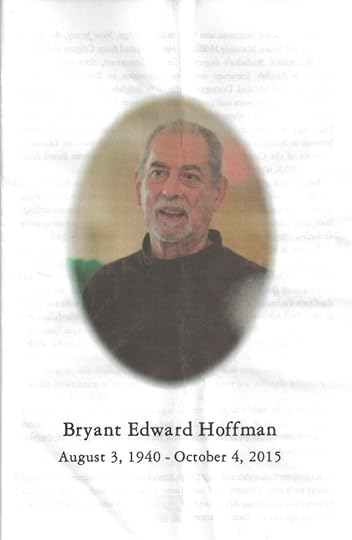
I’ve lost a mentor and a friend.
At the same time, if anyone was paying the slightest attention (and too few were), they would have recognized that this wasn’t some yokel. More times than I care to admit—even given my passion to learn and my enrollment in the University of Autodidactica—I was out of my element with this man. Bryant, with the ease of drawing a breath, would casually throw off a phrase, quote, or reference, and I’d run back to my desk or jot it in my notebook during a meeting, to be sure I looked it up that night; that way, the next time he mentioned something similar, I wouldn’t’ be such an ignoramus.
One time when I mentioned how much I wished I’d have had the opportunity to go on and study for an advanced degree, in reference to his own Ph.D., he said, “Baumer, it only means pile it higher and deeper.” He never needed people to call him, “Dr. Hoffman.”
Judy and I remained in touch after our layoff. The small team that I was admitted to in 2006 was only three deep. We soldiered on after Bryant retired, but it was never the same. I credit her with helping me understand Bryant in a way that only someone perceptive like her, could. Like when I tried to call him a few months after he retired to see how he was doing and we had a brief and awkward phone exchange.
“Bryant hates talking on the phone. Send him an email—you’ll get a better response,” she said.
I’ll remain forever grateful for that, Judy. You allowed me a window into the man, as well as forging a connection and a bond that would remain strong right up until he died, a few weeks ago.
Last October around this time, Wes McNair was launching his new book, Lost Child: Ozark Poems, inspired by the demise and eventual death of his mother. The stories are about McNair returning to rural Missouri, and his mother’s family.
I knew Wes and Bryant had been colleagues at Colby-Sawyer. Bryant was McNair’s dean, and he always spoke fondly and with great respect about McNair, Maine’s former poet laureate. Bryant admired Wes and his determination to continue writing and staying relevant with younger readers. The talk and book signing was being held at Waterville Public Library, a place that figured prominently in the LWIB work Bryant and I did, and even afterwards.
I sent him an email mentioning I was planning to make the drive up and I’d prefer to have someone along for the ride. It’s an hour away from my home, and to be quite honest—I was only planning to go if Bryant agreed to accompany me (but I didn’t tell him my ulterior motives). My plan was really about getting these two literary giants together once again.
McNair was superb and likely performing as usual. I remembered Bryant saying that “Wes is a great reader,” when he and I would talk about some of my own adventures out on the book talk circuit, and McNair’s name came up. The best part of the evening was standing in the background and seeing that these two men respected one another and McNair was genuinely surprised—and I think pleased—to see Bryant at the event.
I treasured the time up and back in the car. We had one of our great conversations about life that night. I expressed how much he’d meant to me and my appreciation for his continued friendship.
Bryant knew a bit about my struggles and challenges, as I’d kept him in the loop about my free agent adventures since 2012. I also shared successes with him. He was genuinely happy for me when my byline began popping up in places like the Boston Globe. He let me know about his own life, and how much he was enjoying being back in the classroom, teaching again.
I have many emails that I’ve kept from Bryant. On the Tuesday two weeks ago that I received the email from his daughter, Kirsten, sharing the sad news of her father’s passing, I came home and read through them. I was struck by how often Bryant offered an encouraging word—not in some perfunctory, Pollyanna-ish way that is so common—but from a place of depth and understanding. I couldn’t help but recognize how much he’d come to mean to me, even though we only saw one another a few times a year. We did stay in touch through semi-regular email notes, however.
While I’m sad that I’ll never get to see my old friend again, I treasure the memories I have of working for him, and our periodic lunches I’d scheduled with him over the past three years. I worked to cultivate our friendship.
We live at a time when true mentoring has fallen out of favor. It’s been replaced by a misguided faith attributing far too much weight to credentials and degrees—things that are earned by seat time and being able to give the right answer on standardized tests. Real life wisdom and traditional good sense is being lost, and blindly genuflecting at the alter of techno-utopianism isn’t helping.
I waited too long to see Dave Tomm. Once again, I’d been thinking I was overdue reaching out to Bryant. We saw each other in July, just prior to a planned journey down the Mississippi River. He told me he was teaching a class on Mark Twain in the fall at UMA, for their Senior College. The year before, he’d taken on Salinger.
The drive to Winthrop on Saturday was gorgeous, via an unfamiliar and winding route that took me through South Monmouth to the church on Route 135 in Winthrop, where Bryant’s final service was being held. The fall foliage, in peak form, illuminated by the bright October sunshine, was splendid. He had been an active congregant at St. Andrew’s Episcopal Church for as long as I have known him, and before. I’m so glad I was able to be there.
Judy was there. We haven’t seen one another for at least two years, after spending much of our work time together for a period of six years, from 2006 to 2012. We both share rich personal memories of Bryant, as a boss, a leader, but also, as a compassionate and caring human being. We had a few chuckles about the difficulty we both had in finding the church, as Bryant was never great with directions and finding places.
His daughter offered a short but touching eulogy for her Dad. She said he was regularly “reinventing himself, always with grace.” She also mentioned being “kind, curious, strong, and brave.”
That’s the Bryant I remember and I’ll keep those memories close.
October 16, 2015
Hold the Bacon
Bacon is popular. How popular you ask? Well, Americans eat nearly 18 pounds of it, yearly. Our English brethren, the Brits, consume an equal amount each year. Supposedly, bacon is addictive because it contains six types of umami, which produces an addictive neurochemical response.
Don’t tell that to President Obama. He’s made a point of denying bacon to all prisoners locked up in federal prison facilities. Does our brilliant president not realize that he’s going to cause a whole lot of jonesing in federal jails?
Actually, the feds have removed bacon, along with pork chops and ham, along with all other pig products from menus at 122 federal prisons. That means the nation’s 206,000 federal inmates won’t be tasting savory bacon until they’re back on the streets.
It’s not clear what’s behind this ban of pork in the nation’s jails. According to the Bureau of Prisons and their spokesman, Edmond Ross, the decision is solely based on a “survey of prisoners’ food preference.” Apparently, they just don’t like pork.
Not to get all conspiratorial, but something seems odd about this. I tend to concur with the National Pork Producers Council and their spokesman, Dave Warner, finding it hard to believe inmates said, “no” to bacon.
And of course, this has gotten conservatives’ dander up. Jihad Watch, in an article by Robert Spencer, intimated that there was more to this than pork being pooh-poohed by prisoner consensus. Or better, maybe pork isn’t popular because more and more of federal prisoners happen to be of Muslim persuasion.
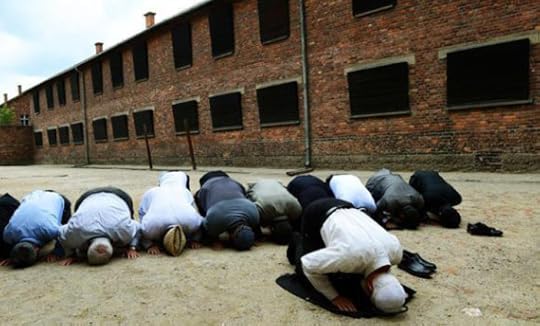
Muslims make up significant portion of U.S. prison population.
Did any enterprising reporters at the New York Times, or the other mainstream mouthpieces for progressive propaganda dig a little deeper on this? I think you know the answer to that one. Spencer asks, “does the increasing number of Islamic jihadist and other Muslim inmates account for this? “Apparently Dana Williams, another BOP spokesman didn’t’ say and no reporter bothered to ask him.
So, could the pork ban be bogus? It’s a possibility, especially when there have been grumblings from inmates’ families that the ban is due to complaints by Muslim inmates.
Spencer finds it interesting that their (the BOP’s) decision “just happens to coincide with Sharia at a time when the Obama Administration and Islamic advocacy groups are actively working in numerous fields to make special accommodation for Islamic laws and mores, and when some Muslims around the world are becoming increasingly aggressive in demanding non-Muslims conform to their ways of living.”
October 13, 2015
Hold Onto Your Cars
Lies and propaganda are unleashed on a regular basis. Sometimes, it seems nearly impossible to know what to believe anymore. One whopper being touted by someone (environmentalists?) is that Millennials don’t drive cars.
There have been a number of articles that indicate that Generation Y are not embracing automobiles like previous demographic groups, especially the Baby Boomers, who cut their teeth riding around in the backseat of gas guzzling behemoths built in Detroit. Some of this may just be wishful thinking. Progressives are notorious for this. That and demanding one thing for you, and another for them. But that’s another blog post for another day.
Since August, I’ve been writing articles on cars for a trade magazine group out of Dallas, Texas. It started with a book review, and moved on from there. I enjoy the work, and as a result, I’m paying closer attention to what’s going on in the automotive world.
I happen to like cars—I always have. It saddens me to think we’re heading into a world of driverless cars, ruled by Google. But maybe the scenario of “Peak Car” is further down the road than we think.
According to J.D. Power, Millennials are actually the fastest-growing class of car buyers. Who knew? Perhaps now that they’ve been able to find a job that pays more than coffee barista wages, they’re thinking about big ticket items.
Millennials want cars, too.
Even more interesting, Millennials aren’t flocking to cities, like we’ve been led to believe. No, they’re planning a move to suburbia, just like their Boomer parents.
So what other shibboleths should we take with a grain of salt?

Not your father’s Toyota.
October 9, 2015
Face Time is Happy Time
Not sure when it happened, but we’ve all been sold a bill of goods. The people in charge (aka, TPTB) know that united we stand, and divided, we fall. Well, maybe not divided so much, as simply no longer personally connected. Social media doesn’t count. Want to know why?
First, let me state that there is this idea moving towards meme status that the hivemind has accepted that says that “Facebook is great for connecting.” Here’s my thoughts on that—“poppycock!” And I’ve actually got some research to back me up. And what is that research, pray tell?
Well, studies have been done with subjects, aged 50 and up. Apparently, face-to-face interaction (as opposed to Facebooking) is more apt to ward off depression. Very interesting, indeed.
Face-to-face trumps Facebook.
From a study, published in the Oct. 5 issue of the Journal of the American Geriatrics Society, researchers found that those surveyed were happy and less depressed if their interactions were of a personal, human variety—not the kind preferred by machines and robots.
Investigators examined the results of a 2004-2010 survey that included nearly 11,000 people aged 50 and older. After adjusting the statistics so they wouldn’t be thrown off by factors such as high or low numbers of certain kinds of people, the researchers found an association between the types of interactions people had with others and their likelihood of depression symptoms two years later.
Depression rates weren’t affected by the level of communication by phone, letters and email. However, when people communicated the least with friends and family via in-person meetings — every few months or less often—they had the highest rate of signs of depression.
Two years later, 12 percent of those people showed signs of depression, the study found. By comparison, 8 percent of those who had in-person contact once or twice a month and 7 percent of those who met others once or twice a week showed signs of depression.
This would seem to align with my post back in August, about seniors and technology. Once more, we learn that techno-utopian solutions come up short. You can’t replace face-to-face, no matter what the snake oil salesmen tell us.
Once more, science confirms what a few of us already knew; interacting periodically with your fellow humans is healthier (and will make you happier) than hours and hours of screen time on your app-addled smartphone. An added benefit is that you’ll actually get to know some people around you, too.
October 6, 2015
On the Base
The closure of the former Brunswick Naval Air Station (BNAS) was a long, drawn-out affair. Like most impending events that you eventually find out were inevitable, this was another one that elicited hand-wringing, predictions of doom and gloom—not to mention—certain economic devastation. Brunswick was likely to dry up and blow away without Uncle Sam and the Pentagon sending shekels, keeping it afloat—at least that’s the version the media sold us.
The perspective is always different through the lens of hindsight. Looking back also provides perspective on how news stories get spun. I find it especially enlightening when political icons are judged by history. George Mitchell, everyone’s favorite Maine Democrat (if you’re a Maine Democrat) had this to say back in 1993, when he was Senate Majority Leader, in a news brief I located from the Boston Globe. [via ProQuest]
Senate Majority Leader George J. Mitchell said yesterday that he is optimistic Maine’s Navy bases will be spared when the Defense Department’s list of recommended bases for closure s released. The Portsmouth Naval Shipyard in Kittery and the Brunswick Naval Air Station could potentially be on the list Secretary of Defense Les Aspin will present to the Defense Base Closure and Realignment Commission. [The Boston Globe, March 6, 1993]
BNAS was on the list, and it wasn’t spared. So much for the wisdom of ole’ George, Mr. Maine Democrat. Actually, there’s more political wrangling to this story, as Mitchell ended up leaving the Senate and as a result, Maine lost some clout in Washington. That might actually have had more to do with the closure than Mitchell being a lousy prognosticator.
When BNAS closed in 2011, it affected 2,687 active duty personnel and 583 full-time civilian personnel. That was a significant loss of jobs along with the economic ripple effect that accompanied the closure.
Fast forward four years and the former Naval Air Station is in the process of redevelopment under the care of the Midcoast Regional Redevelopment Authority (MRRA). Since redevelopment began, there are more than 70 businesses occupying the former base, and according to various news sources, more than 700 new jobs have been created.
Being that the JBE wants to be your go-to source for local news, at least local in terms of drawing a 30-mile ring around the JBE compound, I was able to dig a bit deeper for my readers. According the MRRA’s very own Redevelopment News newsletter that number is actually 730 jobs—which they cite as being “60 percent more than projected four years into this project. The newsletter goes on to report that they “expect to have more than 800 employees here in high-paying, quality positions by the end of the year.”
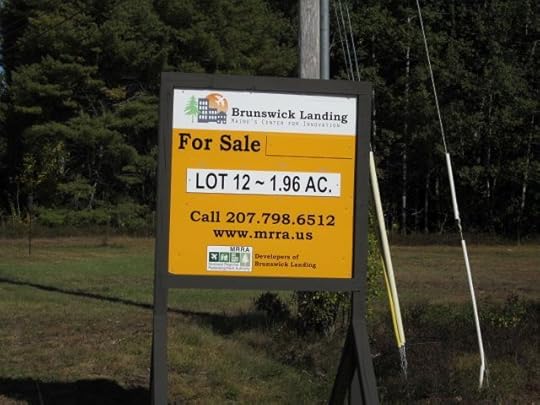
Plenty of space for development, at Brunswick Landing.
Steve Levesque, MRRA’s executive director, was lauded by Senator Susan Collins, for his work in revitalizing the former military installation. Collins led Maine’s congressional delegation back in June, presenting Levesque with the 2015 Community Leadership Award on behalf of the Association of Defense Communities.
This award is part of the Association’s annual awards program, which recognizes communities, military installations, public officials and military leaders demonstrating strong leadership, innovation and excellence. [from Targeted News Service, June 24, 2015]
I guess creating one job for every four lost constitutes success in an empire in decline. Actually, this article, which highlights that all is not peachy-keen in Brunswick, especially with the local town council, puts the number of jobs lost at the base at closer to 5,000 total. Also, there have been issues regarding hazardous materials at the site. The entire base is actually considered a federal Superfund site. According to one local group, Brunswick Area Citizens for a Safe Environment, they have concerns about groundwater and places that were used to dump hazardous materials; this included garbage, waste oil, pesticides, solvents, paint, and aircraft and automobile parts.

Mölnlycke Health Care is one of Brunswick Landings 70+ tenants.
Here’s some personal backstory on BNAS, or Brunswick Landing, using the current moniker. Back in the 1990s, I worked for Central Maine Power Company. Things aren’t the same there, either, as they are now owned by a Spanish multinational, Iberdrola. Back when I worked for CMP, you could make a living wage reading meters. Now, smart meters have eliminated those kinds of jobs. Technology is a wonderful thing.
During that period (actually, it was 1987 through 1995, but no one’s counting), we were required to go on base and read several electrical meters, for billing purposes. This required crossing the runway. Of course, there were planes taking off, so we had to have a Navy official ride with us, in order to obtain clearance to cross the runway. Simply gaining entry to the 3,200 acres required stopping at a guard station just off the Bath Road and submitting credentials of some kind.
With the closure of BNAS, one of the big changes is that you now have open access to most of the former Navy base. No more guards at the guard station. That’s very weird for me.
I’ve been on campus several times over the last few years. Shortly after the base was closed, someone I used to work with during my workforce days, drove me around and pointed out some of the development that had just begun, after MRRA took over.
On Sunday, Mary and I loaded our bikes on the back of her SUV and made the short drive over to Brunswick. We were going to spend the brisk October Sunday, tooling around greater-Brunswick, including exploring the former military base, on two wheels, rather than four. There’s no better way to see the sites than via bicycle.
There are some nice trails and pathways for bicyclists. A Google search showed me that there is now a bike/pedestrian entrance to Brunswick Landing via Pine Street. The path takes you out around the runway, parallel to busy Bath Road.
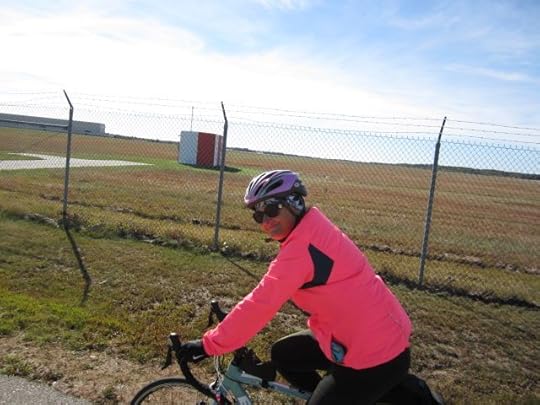
Miss Mary, biking by the old BNAS runway.
Once on the old base, there are a host of places to explore. We rode towards the easternmost perimeter of the grounds, following some of the outer roadways. There is now a Maine Army National Guard Reserve Center domiciled where the former ordinance grounds were. While the entire 3,200 acres of the Brunswick Landing campus was pretty deserted on a Sunday, this portion of the grounds was eerie, or “creepy,” as Mary described it.
We eventually made our way around the contours of the landing strip, by the golf course (now open to the public), and out the gate located off Route 123 and Middle Bay Road.
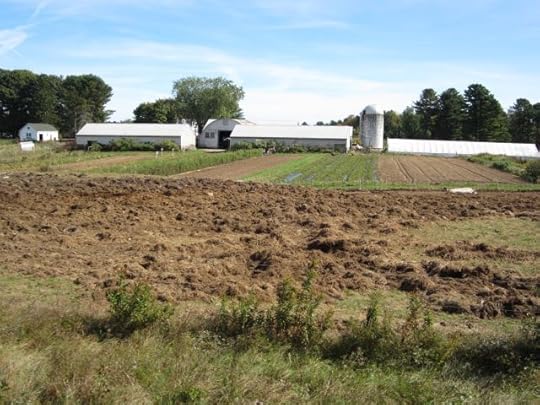
Crystal Spring Farm, in Brunswick.
Then, we headed out to Maquoit Bay, around Woodside Road, down Pleasant Hill Road (past Crystal Spring Farm, where Mary visits the farmers’ market every Saturday), and back to the parking lot off Pleasant Street, near downtown. We rode just under 20 miles and saw Brunswick in a totally different manner than the usual way, behind the wheel of a car.
Once our bikes were loaded on the back of the RAV4, we were set on lobster rolls and seafood chowder at Erica’s Seafood, off Basin Point in Harpswell. A perfect October Sunday adventure, now in the books.
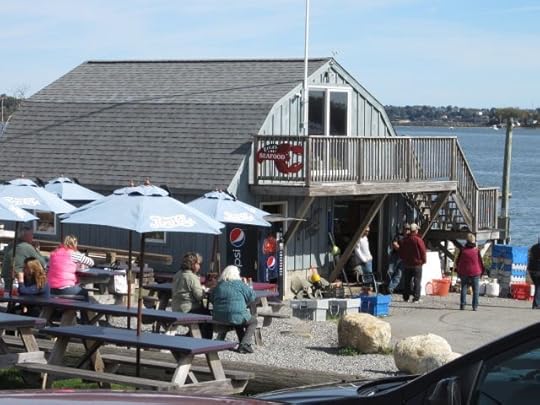
Lobster rolls and seafood, at Erica’s Seafood, in Harpswell.
October 2, 2015
Finding Balance
Do you remember walking the balance beam in elementary school? While the beam was only inches off the ground, it was daunting for some, more than others. The students who were able to walk the length of the beam were able to focus on the task at hand and concentrate.
Could genetics be in play, here? It’s possible.
A person’s balance is enhanced by three things: the part of the inner ear called the vestibular system; sensory nerves in your muscles, tendons, and joints; and your eyesight. People with better balance are likely able to coordinate these three things. Balance is likely a combination of genetics and also training.
I’ve never been very good on a skateboard. I also wear glasses, so it’s possible my balancing abilities are negatively impacted by my eyesight.

I was never very good on a skateboard.
I have part-time work where I spend some of my week with seniors. I’ve become keenly aware that as we age, we are more prone to diseases that affect our vision—like cataracts, glaucoma, diabetic retinopathy, and macular degeneration. Then, there are those that affect our feet and legs, along with vestibular degeneration.
There are other physical issues that are problematic, too.
Are you sitting around all day? Americans are more sedentary than ever. Get up periodically—stand up, move, and stretch. This article is worth reading—with some great tips that I’ve incorporated into my work day. Could you make them part of your daily routine?
I follow the news and try to stay current on what’s happening around me. Sometimes, I have to switch off the idiot box, however. There’s only so much negativity that I can take and without becoming a downer. Actually, I don’t get much of my current events programming via the television. Radio news and the internet can be just as bad. Don’t be an ideological crank.
How adept are you at maintaining some separation from drama and controversy? Probably not as skilled as you ought to be.
Turn off the television, close your laptop, get out of your chair, stand on one leg, and admire something in nature today. That would be a great first step towards bringing some balance into your life.
September 30, 2015
Another Mill Closes
WCSH-6 ran the following graphic on Maine’s mill workforce between 1960 and the present. I saw it flash across the screen during their 5:00 a.m. newscast this morning before I heading out for my morning swim at the Y.
The graphic and story looks like it was produced by the NBC affiliate in Bangor, WLBZ-2. The feature was a telling one and I grabbed a screenshot representing the shedding of paper mill jobs from their website just so I’d have it.
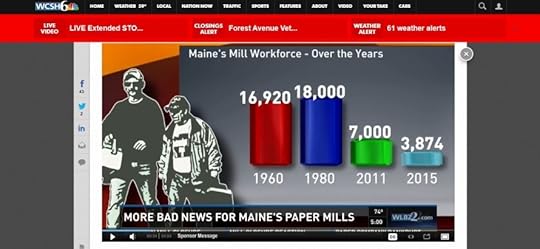
The demise of papermaking in Maine; 1960-2015. (WCSH-6)
This is captures the story of Maine manufacturing—especially the state’s paper industry over the last 50 years-—as well as anything I’ve seen. It also represents a part of Maine’s past that’s disappeared and it’s never coming back.
With the closure of Old Town Fuel and Fiber, another 195 Maine workers have lost their jobs. This follows on the heels of Lincoln Paper and Tissue, which announced it was filing for bankruptcy the day before. In August, Verso Paper in Jay announced that it would be laying off 300 workers.
Maine’s perpetually-angry governor, Paul LePage, blasted the legislature, calling them “stupid.” Of course, as the smartest man whenever he’s in the room, he has a plan to revive papermaking in Maine. It’s all about energy, according to LePage. He says that Maine’s mills can’t compete because our electricity costs are too eye. He wants bigger gas pipelines coming into New England to drive down gas prices for power plants. He also wants Maine to change regulations so we can buy cheaper electricity from Canada.
LePage, along with natural gas flacks like Portland attorney, Tony Buxton, continue trumpeting natural gas as a panacea to all of our state’s economic woes. I wrote about the same issue last December for the short-lived alt weekly, DigPortland. The article remains archived on my freelance writing website if you care to read it.
Here is the video of Don Carrigan’s report that parallels the mill closing report above, also courtesy of WCSH-6.