Jim Baumer's Blog, page 39
January 12, 2016
Ziggy Played Guitar
[I wrote this Monday night]
As we age, it’s an ongoing battle not to become a nostalgia act—in the music we listen to, the books we read, the clothes we wear—especially when others our own age are entrenched in the past.
I see it on Facebook. In the people that I once knew, went to school with, and most of whom I likely haven’t seen face-to-face in 35 years. And yet, we somehow have some tenuous connection that Mark Zuckerberg is able to exploit?
Last week I was listening to KEXP, one of the stations I enjoy streaming, given the sad state of radio in my own region. I prefer to listen to music that was written and recorded in the last decade and stations like KEXP (from Seattle) play a mix of newer music, while recognizing some of the pioneers and icons of rock and their contribution to the history of the genre.
David Bowie would be one of the latter. In fact, KEXP highlighted Bowie, celebrating his birthday last Friday, with what they were calling “Intergalactic David Bowie Day,” playing a shitload of his music, old, and new, including his latest (and last) album, Blackstar.
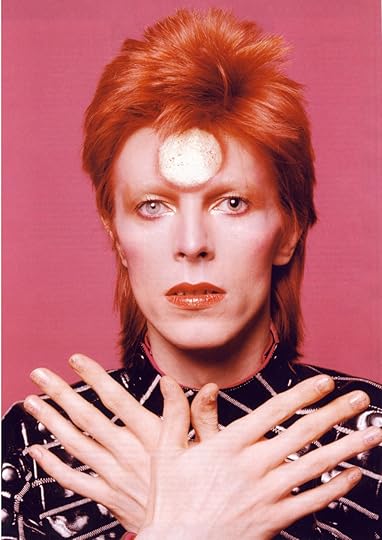
David Bowie, as Ziggy Stardust (circa 1973).
I was thinking about Bowie last Friday, about his contributions to music over the last 50 years (basically, my lifetime), and his influence on a host of younger musicians that I was a fan of during the 1990s, including bands like Nirvana, who covered “The Man Who Sold the World.” Bowie always set his own course, from the glam-rock of the early 1970s, and Ziggy Stardust through Diamond Dogs, and well beyond.
Reinvention gets a lot of mileage here at the JBE. The topic also gets bandied about in various circles and contexts, but few people truly embrace reinvention and change with vigor and gusto. Bowie certainly did, right up until the very end.
David Bowie died yesterday, after apparently battling cancer for 18 months. I heard the news on my early morning drive to the Bath Y, for my regular Monday swim.
I’ve heard all manner of Bowie tunes most of the day, as KEXP has been playing much of his catalog, and now, WCYY and Mark Curdo is paying tribute to the man and his music. It’s interesting hearing certain songs that were on the radio when I was in high school, and recognizing others that ruled subsequent decades. Bowie’s music never went out of style—he wouldn’t allow it.
There are a handful of tunes that would rank up there as my favorite Bowie tunes, but this one is my all-time David Bowie song that I never grew tired of hearing. He was attuned to the demise of Detroit, long before it became fodder for journalists and pickings for investors looking to acquire property and exploit the city for pennies on the dollar.
So my nostalgic nod takes me back to magazines like Creem and Circus, reading about Bowie and 70s glam-rockers, and remembering a time when the first whiff of collapse was in the air, and Bowie picked up on it in the song he wrote on his first U.S. tour.


January 8, 2016
Desperately Seeking Simpatico
I like words. I even used to have a blog with the title, Words Matter. Yes, they do.
One of the many benefits to being a reader is that unless you are reading material aimed at second graders, you are apt to find unfamiliar words that stretch and if you take the time to look them up—build your vocabulary. I know—having a robust vocabulary pegs puts me back in the 1950s when we still had a middlebrow culture—rather than the dumbed-down, brain-addled one here in the second decade of the 21st century.

Can you spell as well as a 14-year-old? (AP Photo/Andrew Harnik)
I’m halfway through my second book of 2016. It’s a book about the collapse of Detroit City. On page 62, there is the following sentence, about midway down the page:
In the same that microsocieties formed at Zuccotti Park and other Occupy encampments in 2011 provided, for the simpatico, an exhilarating glimpse of freedom, postindustrial Detroit could be an unintentional experiment in stateless living, allowing for the devolution of power to the grass roots.
–Mark Binelli, Detroit City Is the Place to Be: The Afterlife of an American Metropolis
It’s an excellent book. Binelli is a terrific writer. I’ll be returning to Detroit and the book and likely review it. But I want to pull one word out of that sentence, the word being “simpatico.”
Simpatico is an adjective, another category of words I adore. It means, “congenial or like-minded; likeable: I find our neighbor simpatico in every respect.
People want simpatico—maybe they even crave it? It’s why we associate with people that see the world like us, enjoy some of the same hobbies; the same music; the same books, etc.
Simpatico is what we’re often participating in on Facebook—at least most of the time—when we think we are riding in the “first class” section when it comes to our version of “the truth,” and that the “other side” might have a screw lose, or something worse.
Keep that in mind when you’re strutting your political opinions (or waxing philosophical on some other subject). Some of your “friends” are like-minded; the rest of us think you’ve taken leave of your senses.
That’s not to say that you aren’t entitled to your opinion. It’s just that if your purpose in using social media is sociability, it’s possible that your posturing is having the opposite effect.
January 5, 2016
Becoming Extraordinary
We are officially into 2016. It’s also that six-week block on the calendar when resolutions are both foremost and in danger of extinction.
How would you like to be extraordinary this year? Let’s start by looking at some definitions of the word.
Extraordinary (adjective):
beyond what is usual, ordinary, regular, or established: extraordinary costs.
exceptional in character, amount, extent, degree, etc.; noteworthy; remarkable:
Last Friday—officially, “New Year’s Day,” Mary and I participated in our first Lobster Dip. Basically, it was a dash across a portion of beach, running into the surf and then, plunging into ice-cold ocean water guaranteed to numb you from head-to-toe. It was also friggin’ exhilarating!
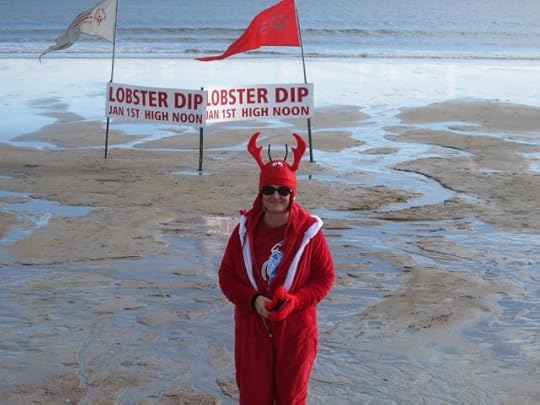
Miss Mary; keeping warm pre-dip.
Life is short. Why spend so much of it muddling along with the mundane?
My wife is exceptional (and extraordinary). It’s only taken me about 35 years to truly understand her qualities (I’m a slow-learner).
When we met in high school, we were both young and idealistic. We found love, however, and it’s managed to grow, evolve, and push us both towards our better selves. That’s kind of what positive relationships ought to foster.
But back to jumping into the ocean in January. Nuts, eh?

Mary makes the paper, above the fold.
Actually, it’s part of a progression that Mary’s been on for years. As chief blogger at the JBE, I get to trumpet my own triumphs (as well as documenting some of the struggles). Mary on the other hand doesn’t care to have a blog. Oh, she’ll throw stuff up on Facebook from time to time—it’s the digital world we’re living in—but she really has inspired me to push the envelope, especially in terms of the physical side of things. She’s the one who got me off the couch and got me tri-ing. The fact that I’m approaching my third anniversary of being a swimmer is a testament to her.
I read some of the FB comments related to her New Year’s updates. They were a combination of admiration, respect, and also congratulatory. A few expressed accolades like “amazing,” “impressive,” and “awesome.”
Mary would be the first to say that what we both did on New Year’s Day was fun, but wasn’t that big of a deal. Like other things in our lives, we talked about it, set some plans in place, and the beauty of doing it with someone else—we became accountable to someone to make sure we followed through.
Looking to Mary as your example, set the bar just a little higher in 2016. You’ll have lots of adventures to look back on in 12 months, and you’ll be feeling rather extraordinary, too.
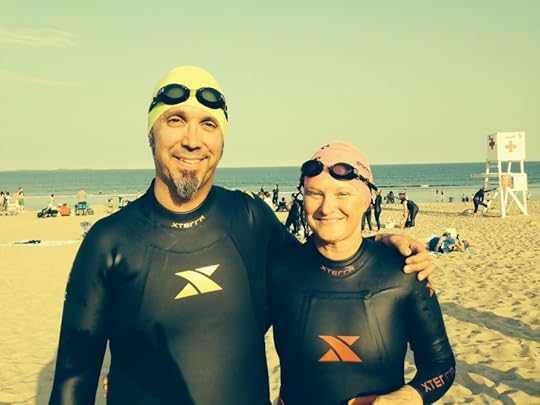
Mary and the JBE with our wetsuits, prior to a summer tri.
January 1, 2016
Another Year of Books and Reading
With the commencement of a brand new year, I set out once again reaching for what I’ve established as my personal baseline figure for books to read over a twelve-month period. While far from being scientific, I arrived at my number of books to read per month, and in the course of setting the bar, I learned that I’m way above the average number of books read annually by almost all other Americans. I now believe that doing so keeps me sharper (I think) than less ambitious types.
As it shakes out, my bedrock number of 36 books read is triple the U.S. average, at least according to Pew Research, my researcher of choice in this matter. The “average American” in the U.S. reads 12 books per year. That’s a paltry number, but it’s the average. That means many of the people you work with and interact with read a lot less than that.
My wife reads a lot of books. My son once more hit a reading number that dwarfs my own 2015 total of 53 books, which exceeded my goal for the year, but fell short of last year’s total of 66.
Previous end-of-year book summaries also served as attempts at advocacy, citing the benefits of being a reader. Two would be broadening your awareness and increasing knowledge. But I have to remind myself periodically that we live in a time when ignorance trumps all else—most wouldn’t consider broadness an asset—and they wear ignorance like a coat of arms.
Not only are Americans light readers, I’d go one step further—if they do read anything at all, their tendency is towards books offering cover and validation to their views on politics, culture, and any other subject that they have an awareness about. Or, they read simply for pleasure and escape. I get that and I’m not opposed. Miss Mary is a reading-for-pleasure kind of girl.
My 2015 reading list seems a bit more pell-mell than some of my previous ones. Scroll down and take a look back at 2013 and 2014, and you be the judge.
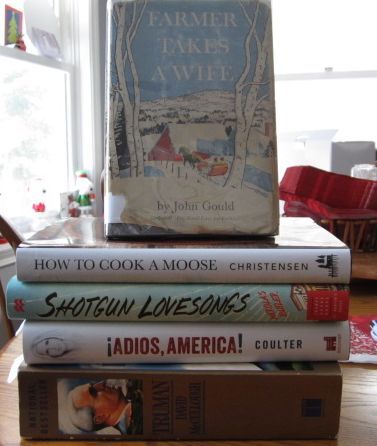
John Gould and a few other books from 2015.
Sometimes my reading choices are dictated by research needs related to articles I’m working on. The John Gould and E.B. White selections in February were for an article I was working on for Down East Magazine that ended up being published in November. This also commemorated the 70th anniversary of Gould’s best-selling, Farmer Takes a Wife, long ago out-of-print.
Gould is a Maine treasure, and one of those “forgotten writers” that I’ve touched on before, here at the JBE. I’d never read the book before (even though I’d heard many old-timers refer to it when talking about Gould). I’m glad that it landed on my 2015 booklist. I also received a hard-to-find copy from Santa at Christmas, to add to my library.
I read my first Turgenev novel. Russian literature is often cited as having special merit. This one was also for a short-lived monthly reading club my sister and I planned in 2015 that fizzled after a mere four months. My excuse to her was that I’m not really a “book club person.” It’s probably an indication of the randomness of my reading choices, and maybe even a lack of discipline that others have that participate in monthly book clubs. A larger circle of readers might make a longer run possible.
In April, I was prompted to read one of my favorite 2015 selections. The Baffler (Baffler No. 27) featured a terrific article by a woman named Catherine Tumber, about Buffalo, New York. The article, fairly long, but very readable, touched on some intriguing ideas for economic development, especially development in places in the U.S. that have been gutted by de-industrialization. She offered much greater detail about this in her book, Small, Gritty, and Green: The Promise of America’s Smaller Industrial Cities in a Low-Carbon World.
Tumber’s book became 2015’s rival to books read during prior book seasons, like George Packer’s nonfiction work in 2013 that I hyped (and harped about) to anyone that would listen. And like with Packer and the essential themes so relevant to what’s happening all around us, economically, my evangelism fell on deaf ears. Actually, most of what I talk about and blog about is ignored. It is a strange time when bloggers with little depth and breadth of knowledge acquire large followings, and bloggers (and writers) offering up important topics on a regular basis are dismissed. (insert Packer link from JBE)
There is much to commend in Tumber’s book, especially for planners and economic development types in our own state and in communities like Lewiston-Auburn, Waterville, and even Portland. Instead, economic developers that spend more time on Twitter than they do broadening their understanding of their profession think they’re doing great things, hollowing out what remains of viable local business culture, and building big-box monstrosities that will be empty in 25 years, if not sooner.
A book like Tumber’s is yet another reminder of the idiom, you can lead a horse to water….and also how common it is to encounter lesser lights (some might say, “idiots”) claiming membership in the state’s economic development fraternity.
I don’t read much fiction—2015 was no different in that regard. However, I did make my way through James Kunstler’s World Made By Hand trilogy last year, in May and June. Like Tumber’s ideas, Kunstler’s take on collapse should be common knowledge among the majority of people who call themselves informed about what’s going on economically. Instead, he has a cult following (albeit, a good-sized cult, I think) that laps up everything he writes, whether it’s his nonfiction work (of which I’m a fan of), or his weekly ruminations at his blog, Clusterfuck Nation.
My wife wouldn’t be considered a “true believer” in terms of collapse or post-petroleum scenarios, but she loved Kunstler’s novels after I suggested she download the first one. She ran through all three and eagerly awaits his fourth and final installment due out at some point in 2016.
Once I read the first novel (World Made By Hand), I blew through the other two. I liked The Witch of Hebron, the best (novel #2). Sometimes it’s hard to envision what a post-petroleum world might look like. I credit Kunstler for trying his fiction-writing hand and offering up a narrative of that possibility.
Politics, like religion, tends to divide people. That division is dependent on where you reside ideologically or theologically. Interestingly, people’s views on these topics often part ways with facts. Or, if facts are presented, they often are merely “proof texts” supporting preconceived ideas.
After seeking much of my own source material the past two decades from places that could be characterized as “leftist” or “progressive,” I had an ideological falling out with some of these sources last year. While I don’t plan on getting into a long treatise on specifics, let’s just say that places like Democracy Now, the aforementioned magazine, The Baffler, and other progressive websites lost their luster for me midway through the year. The controversy about the Confederate flag was one area where I grew tired of the left-wing talking points because in my opinion, they lacked a factual basis, and weren’t historically grounded.
John Coski’s excellent book centered the controversy squarely on facts and the history of the Confederacy, and its central (and currently maligned) symbol. Again, it represented personal initiative based on informing myself and understanding the issue, as well as serving as a counterpoint to the slant and framing offered by the revisionists—especially popular ones, like this guy, who gets far too much intellectual credit for regularly “stirring the shit” on race.
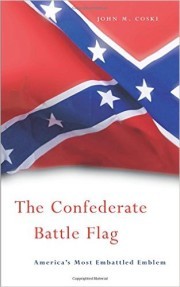 The Confederate Battle Flag: America’s Most Embattled Emblem is considered an essential book concerning the history of the flag and all the various meanings the flag has acquired over time. Coski’s effort and writing reminded me of some of my favorite Southern historians—James McPherson (who I also read in 2015), Shelby Foote, C. Vann Woodard, to name just a few—all who offer a rendering of Southern history from their unique, experiential perspective, as well as cultural understanding.
Because people don’t read, it’s pie-in-the-sky to think anyone will take on a 400-page book as a starting point in figuring out why things happen, or how we arrived at the Balkanized state of matters we find ourselves in at the moment concerning Confederate history and yes, race relations, too. It’s so much easier to lob pejoratives like “racist” and “Nazi” and be done with the matter. Personally, I think we’d live in a better and a truly more humane country if citizens brushed up on some of their history. Coski’s book would be a great starting point for elitists that consider demonizing southerners as acceptable.
In scrolling through this year’s list—especially some of my summer selections—you might notice that there are titles that tilt to the conservative side of the ideological aisle. Ann Coulter, Michael Savage—a few names that make the blood boil for progressives—even though most of them have never spent five minutes reading one of their books, or listening to someone like Savage, one of America’s most popular talk radio hosts. Again, in America, it’s accepted that you draw your line in the ideological sand and label those different than you, “the enemy.” Divide and conquer continues its legacy of effectiveness in the land of the free and home of the brave.
There are recurring threads that run through the posts I’ve put up over the past three years. One of them is my own fitness quest, including becoming a triathlete, and finding a home in the pool, as a swimmer. Health is a foundational element in these endeavors.
When my bathroom scale seemed stuck on a number that was 10-15 pounds heavier than I was pleased with, I knew I needed to look at my food intake. The paleo diet isn’t new and the idea of eating “like a caveman” has been written about by a number of people.
The book that introduced me to a regimen that I’ve been following since August was John Durant’s, The Paleo Manifesto: Ancient Wisdom for Lifelong Health. To say this book opened me up to not only a different way of eating, but also, an alternative way of approaching life, work, and fitness would be a disservice.
I’m pleased that paleo eating has delivered the hoped for weight loss. More important, it’s pointed me in a brand new direction that I believe will continue producing physical gains and benefits.
Working in and around Maine’s senior population the past couple of years has provided firsthand experience with the issues central to aging and aging in place. One part big-picture in terms of Maine’s demographics making us the oldest state in the U.S., I’ve also come to consider my own life’s journey, which is bringing me ever closer to the place where I’ll also end up as one of those seniors.
Susan Jacoby’s exceptional and even-handed book on aging was another title that I pitched to others, especially if their aim was acquiring a handle on aging without all the “happy talk.” The best kind of nonfiction writing in my opinion is the kind that offers an alternative narrative, especially to the poppycock that ignores reality. But of course, in our culture of “experts,” professionals have a standard script and for whatever reason—and I think I could cite an extensive list of them—they can’t and/or won’t vary from what I consider an incomplete narrative on the topic.
This pattern presents itself over and over whenever anyone writes a book that “leaves the compound” on an issue, and Jacoby’s book certainly doesn’t pander towards the peanut gallery. Like most of the books that I’ve invested time in reading and understanding in past—by Kunstler, John Michael Greer, Packer, Neil Postman, or Morris Berman—just about any book that doesn’t deliver Kool-Aid and perpetuate the myriad of myths circulating east, west, north, and south will be dismissed, or read by a small subsection of those Americans who read at all—remember, that number is quite small.
For sheer enjoyment (if you can define reading about the brutality of war as “enjoyment”) coupled with enlightenment, Mark Bowden’s Black Hawk Down: The Story of Modern War would be my pick in 2015.
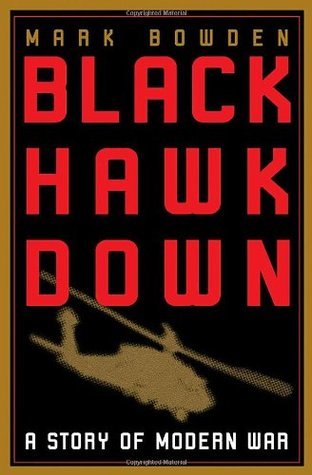
Bowden’s battle-tested tour-de-force isn’t a new book—it was released in 1999 and the events recounted occurred back in 1992. I picked it off the shelves at my local library during my end-of-year quest to cut through the PC bullshit being dispensed on terrorism, Islam being a “religion of peace,” and because a blogger I read regularly mentioned the book. Sgt. Thomas Field, one of the soldiers killed in Mogadishu, was from my hometown of Lisbon Falls.
I vaguely remember the events Bowden wrote about. I also was clueless about why they took place and some of the political backstory behind them. I recall that Field was one of the U.S. Army Rangers sent to Somalia to ferret out the underlings of Mohammed Farah Aidid. They took part in an urban battle that left Field and 17 U.S. servicemen dead, and 78 wounded. Worse, the still photograph that was circulated through the media of a mutilated dead solder being dragged through Mogadishu’s streets with Somalis jeering and cheering was of Field. It caused a reassessment of our purpose in being there in the first place. However, I was too busy with my life at the time to remember much more about the battle, soldiers like Field who paid the ultimate price in laying down his life, and being reminded once again that presidents from Bill Clinton to our current one have presided over an ambivalent and some might say “failed” foreign policy. I wanted to “go back” and reconsider what had taken place. Bowden’s highly readable and vivid narrative is one of the best books I’ve tackled over the past decade.
One of my own motivations in continuing reading and reading regularly is to remain connected to the past. History matters and not considering the past often dooms us to relive it, sometimes with the same cast of characters. Think Hillary Clinton, if you must—her husband was president during the period that Bowden wrote so eloquently about.
And that my friend, is a wrap on last year’s reading.
Happy 2016!
December 27, 2015
End-of-year Blog Settings

Re-calibrating my blog settings.
After publishing like clockwork for 50+ weeks since last year at this time (I think I’ve varied twice), the week following Christmas finds my blog schedule set on “random.”
How was everyone’s holiday? Despite my downer post, pre-Christmas, I actually rallied Christmas Eve and managed to keep the cheer rolling through Christmas Day. Perhaps it was my sister’s Baumer Bingo and assorted prizes (although, I came up empty). It might have been my ability to “screw up” whatever emotion is called for, whether I’m “feeling it,” or not. It might have simply been the magic of Cointreau and some holiday cocktails I tossed together over the two days of our holiday celebration.
Spending December 25th at the beach was a new experience. Miss Mary and I drove to Popham Beach State Park, along with what seemed to be everyone else in Southern Maine, as 60 degree December weather doesn’t happen every year on Christmas. Cars were lining the road as we approached the park gate (locked, as all park personnel had the day off). Many others decided to take their afternoon celebrations to the seashore.
I’ll likely not publish any new content on Tuesday. With the news fast still in effect, and Miss Mary taking a few days off from the work grind, the two of us will likely be out and about much of the week between our Christmas and New Year’s Day. That’s when we’ll be doing braving winter water temps for our Lobster Dip, January 1, ringing in 2016—and it’s for a good cause, too!
My next major post is likely to be by annual book round-up. I’ll be wrapping up my 2015 reading selections with a few thoughts on the various books read. Once again, I hit and exceeded my three-books-per-month reading goal for the year. Here’s a look back at last year’s prodigious reading record. This year fell slightly short of that but not by a lot.
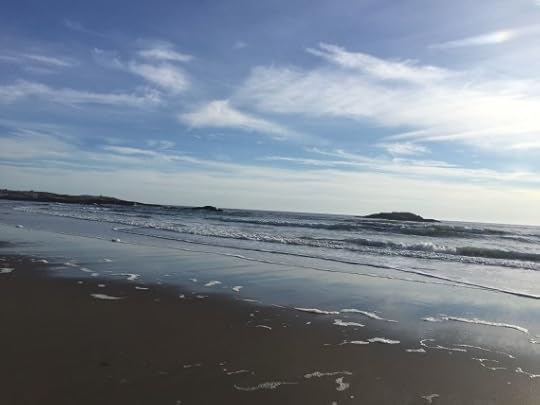
No white Christmas this year.
December 22, 2015
The Meaning of Christmas
In A Charlie Brown Christmas, poor Charlie Brown just can’t get into the spirit of the season. The opening dialogue reveals much about the next 30 minutes, as Charlie tells Linus that he thinks “there must be something wrong with me,” because he can’t get with the program of Christmas.
He then articulates all the things that aren’t right with him and the season.
Feelings
Lacks understanding about the season
Always ends up feeling depressed
Linus embodies friendship, while also demonstrating some tough love. He chides his buddy, “Chuck,” for being “flawed” because of his inability to get into Christmas, and taking a “perfectly wonderful season like Christmas, and turn(ing) it into a problem.” Most people are like Linus—at least those that love the holiday—in that they don’t get those of us that are more like Charlie Brown than Linus and the other Peanuts characters.
My melancholy at Christmastime (or, to remain PC, “The Holiday Season”) dates back as far as I can remember. That’s not to say that I don’t have fond memories of Christmas as a child.
Actually, the high-water mark for personal Yuletide memories are the extended family gatherings that took place when I was a wee tyke of seven, or eight. I got to see my cousins, favorite aunts and uncles; we had both sides of the family jammed into our ranch-style house on Woodland Avenue, and all seemed right with the world.
Probably it wasn’t as much fun for my mother, having to balance the logistics of food, where to shoehorn people in, and how things would work out with opposing sides of the family gathered under one roof, etc. But my recollections are that things went swimmingly.
I actually married into Christmas. My wife, Miss Mary, who I affectionately have dubbed “Mary Christmas” for her love of all things Christmas cheer, adores the December holiday, especially if it has a Peanuts orientation. No matter how much my behavior mimics Scrooge or even The Grinch, she’ll remain enthused right into the New Year.
Yet, despite having a sunny Christmas-lover as my bride, my sentiments still parallel Charlie Brown’s. From my less than joy-filled perspective, it does seem that the over-commercialization of the holiday overshadows all the other positive aspects—as if the only reason for the season is to shop, shop, shop—this only compounds my feelings. And with the commercial aspects, beginning earlier and earlier every year (think Black Friday), the dread now extends for a full six weeks.
At the point in the Charles M. Schulz classic when Charlie Brown and Linus leave the Christmas play rehearsal to find a tree, you know things aren’t going to go well for America’s most famous loveable loser. And it doesn’t. Letting his sentimental side to get in the way, Charlie Brown chooses a pathetic tree to bring back to the auditorium and present to the group.
Of course, he is castigated by the cast, being called “stupid,” “hopeless,” “dumb,” and then, the entire group begins laughing and mocking him, including his own dog, Snoopy. And then, he does what many of us have done, or what have done in that situation—he compounds it by beating himself up, agreeing with the group assessment. That’s Christmas in America—get with the program, or get out!
Then, Linus launches into his beautiful soliloquy, from the Gospel of Luke. I never watch this animated special without tearing up at this point. Linus nails it! He also demonstrates what friendship means, even when paired with a sad-sack like Charlie Brown.
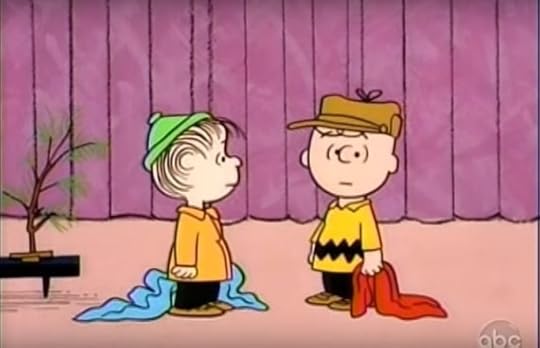 “That’s what Christmas is all about, Charlie Brown.”
While Christmas doesn’t have to be imbued with the kinds of religious significance that many Christians insist on for the day, it does seem to require being something more than just another orgy of consumption.
Of course that’s never going to change and in fact, will continue to be driven by retail sales reports and all manner of reporting that drives that never-ending November/December narrative. The real meaning of Christmas? There is none. Most Americans lack depth and as long as they haven’t maxed out their credit lines, they’ll just continue shopping and wondering why everyone else isn’t doing the same, while bitching about the crowds at the mall.
As for me, I’ll have to figure out a more creative way to get through the six-week slog that some still call Christmas, or now, the all-inclusive Holiday Season.
December 18, 2015
Fasting From the News
I don’t enjoy this time of year. I’ll likely elaborate on my holiday melancholy next week, with a Christmas-themed post. Lack of December daylight doesn’t help, and neither does 50 degree, Seattle-type weather. Sometimes it takes effort to ward off the gloom.
Compounding the holiday humbug I’m feeling, the news—especially the binary back-and-forth among people of good cheer this political cycle—it seems downright maniacal. In fact, if I believed in evil in the “principalities and powers” sense outlined in scripture, I might assign it to the work of the dark one.
Despite decorations, demonic spirits masquerading as politicians, and winter darkness, nothing can stop the JBE from cranking out content—whether writing for hire, or remaining true to his Tuesday/Friday blogging routine.
Sometimes when things aren’t working, it’s important to change it up. Nothing worse than maintaining routines that deliver negative results.
Beginning last Friday, I decided to limit my news consumption. Other than 5 minutes with the morning news team at WMTW-8, mainly for my daily weather fix, I’ve been in the midst of a news blackout. Dr. Andrew Weil deems these self-imposed withdrawals, “news fasts.”
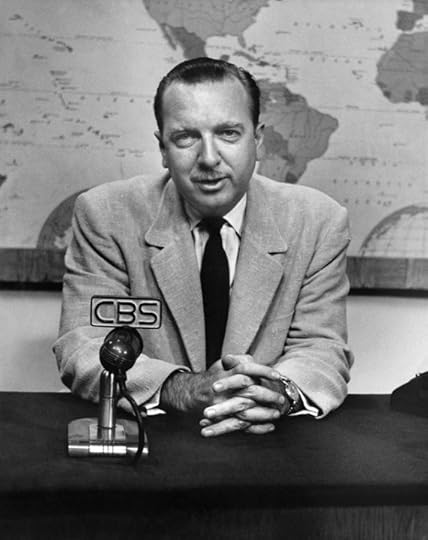
The news today can’t be trusted.
In the same way that studies tell us that occasional abstaining from food for a time delivers health benefits, there is bound to be value in abstaining from the constant carnage and white noise of the news cycle, as well as the fear and outrage it engenders in many.
Weil and others advise taking a few days—even up to a week—and tuning out news entirely. Weil especially, advises that you’ll experience a change when you do this, such as noting “a difference in your state of mind and body.” He also states that you’re probably going to be “less anxious, less stressed, less angry, and less fearful.”
I admit that listening to music instead of talk radio has been a nice change. Not reading the usual news sites has also offered respite from the usual agitation that crisis-mongering tends to produce in me. I’ve also been working at padding my yearly reading list with a book or two before New Years Eve.
Wondering what other things I could change up?
December 15, 2015
Writers Writing About Maine
Maine is one of our nation’s 48 contiguous states, as opposed to the continental definition that lets Alaska and Hawaii into the mix. The Pine Tree State, as it’s often called, was admitted to the union in 1820 as the 23rd state, part of the Missouri Compromise.
Even better, our motto, Dirigo, means, “I lead.” When Maine (and a handful of states) held their elections in September (while much of the rest of the nation held theirs in November), the pre-New Deal Republican adage that “as Maine goes, so goes the nation” made perfect sense.
Yet, for all this talk about Maine being a leading light, writers and others have been getting our state wrong as long as writers (and others) have been offering their insights on the American experience, which means for as long as we’ve been a state, and before that—a northern outpost of Massachusetts.
Libraries are treasure troves, full of undiscovered gems. It’s not uncommon for me to have a couple of books in mind during one of my weekly runs to Curtis Memorial Library in Brunswick, and to arrive back at the compound with an additional three or four books I just “happened upon” during my time navigating the stacks. That’s always been one of the library’s lures for me. I’m not sure how the experience will be when libraries stop being repositories, and turn into just another digital archive, which they’re likely to become at some point. Hopefully I’m dead when that happens.
Sunday, I was looking through the Travel & Languages section for books about my home state. As a writer I’ve never lost my fascination (and equal parts frustration) with Maine’s portrayal by various literati (or worse, the Twitterati), not to mention some lifestyle magazines. It’s as if most Mainers know little or nothing about their own state. Worse, they rarely question or seem flummoxed by the ongoing misrepresentation of the state and its people, save perhaps the hipster theme park of Portland. Even then, most writers writing about the state’s largest city seem tone deaf or write their pieces without a critical eye, or anything approaching nuance. Plus, all they seem capable of writing is yet another restaurant review, or pimping the latest hop bomb from yet another new craft brewery that’s opened. Basically, the equivalent of Chamber boosterism and cheerleading.
But, I’d be remiss in believing and perpetrating misinformation that this is a recent phenomenon. While I often think that the tendency has picked up momentum during my own tenure as a writer that’s not the case.
For a moment, let me offer up a sidebar to today’s topic. While longtime Mainers get our state wrong in their descriptions and understanding, it seems to be a common scourge inflicted on us by people from away, or perhaps worse—people from away who move here and think they know Maine better than the natives. I could easily develop a list of writers that fit that category; in fact, many of them are the most popular and widely read types, the ones you’ll hear talked about incessantly on MPBN’s Maine Calling program, or raved about by other writers who’ve lived here for a year or two.
And then, you have so-called journalistic gadflies who show up from time to time with some time-sensitive story that they manage to totally mess up. A case in point—Lewiston’s mayoral run-off last week. Actually, I was pleased to read Scott Taylor’s concise piece on Medium, detailing exactly how these types of writers got the election ass-backwards. Taylor, a reporter with the Lewiston Sun-Journal, took issue with how the city where his newspaper is based got absolutely trashed as some rural hick town, being labeled as “Trumpland” by some New York City-based travel writer (who likely never bothered visiting Lewiston) impersonating a journalist, and the race wrongly characterized as some kind of bellwether of national portent.
My November essay in Down East Magazine danced around the edges of this, although I framed it more about a specific writer, like John Gould, and why his back catalog is mostly out-of-print, while a writer like E.B. White’s work is still available and being read. There’s more to that story, which I wasn’t able to delve into given their imposed word count limit.
Two years ago, I wrote a blog post, “Forgotten Writers,” where I made the case for reading Kenneth Roberts. At that time, I was making my way through his book, Arundel, a book that had been recommended by another Maine writer worth seeking out, Sandy Phippen. You ought to go back and read that post.
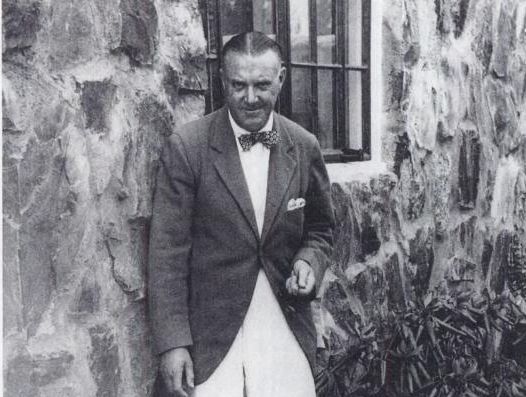
Writers like Kenneth Roberts wrote accurately about Maine.
What I didn’t know then was that Roberts had penned another short book called, Don’t Say That About Maine! Roberts was one of the state’s staunchest defenders. Written in 1948 and first appearing in The Saturday Evening Post as an essay in response to historian Arnold Toynbee’s patronizing comments about the state in A Study of History, representing Maine as a place made up primarily of “woodsmen, watermen, and hunters…” and that Mainers are “unimportant” and “unsophisticated.”
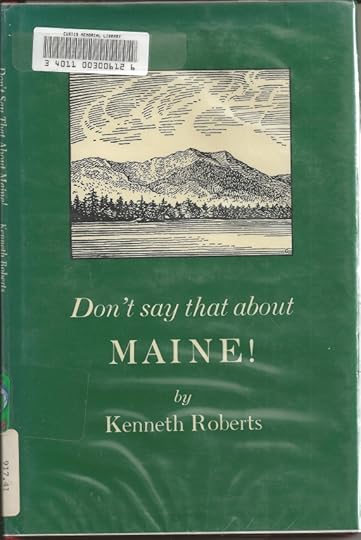
Don’t Say That About Maine!
Roberts uses a pithy 5,000+ words to put Toynbee (and historians like him) in their place, standing up for Maine as a locale with far more breadth and depth than Toynbee’s caricature revealed. Hooray for writers like Roberts, leaving us with some realism in his depictions of the state.
Too bad there are far more writers like Toynbee, and too few realists like Roberts being read these days.
December 11, 2015
Fluff it Up
It’s Friday and time for another post. It seems that a pile of jeremiads are stacking up, on a variety of topics germane to the news cycle at the moment. First and foremost in my ever-growing slush pile of things to blog about is the lying mainstream media. I also jotted down a bunch of stuff the other day about the mayoral run-off that happened Tuesday, one town over.
Again, the media’s misinformation was central to some of my concerns—not the least being national reporters meddling around where they have no business treading, and even less understanding of local matters. Hacks like this one—elitists really—love to belittle places like Lewiston (aka, Trumpland, Maine) and the people that live there. Voters voting for a candidate she can’t understand from her urban zip code? Call them stupid, ignorant, or wracked with fear. But anyone keeping score knows journalism now equals propaganda, at least coming from the driveby set.
But since we are in the midst of the holiday season—even though it doesn’t feel like Christmas to me—I’m going to defer writing about topics that divide and keep it light. Maybe I’ll start a tradition of easier-on-the-eyes and lower stress blogging on Friday—call it something like Fluffernutter Friday. Apparently the sandwich of the same name has a New England backstory.
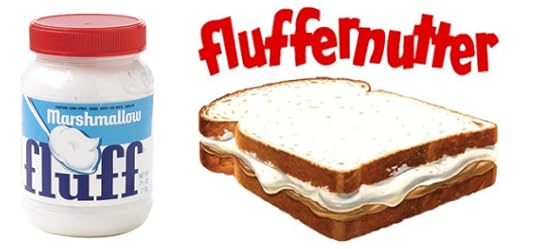
Fridays are for Fluffernutters.
Speaking of lighter, and maybe happier fare—later today, I’ll be on a train headed south, to Boston. At 7:30, I’ll be in my seat at TD Garden for the Celtics tip-off.
I usually attend one game per year in-person. It’s rare that my son isn’t sitting to my left or right. He’s the one who scored the tix for the hottest home game of the young basketball season.

Steph Curry is scary good.
If you’ve been living under a rock or don’t follow The Association, the Celts’ opponent, the defending NBA champion Golden State Warriors, roll into Boston Friday night with a 23-0 record. No post-championship letdown for these guys. Stephen Curry, their exciting guard, is considered a prime candidate for league MVP. The guy was pretty damn good last year. Unbelievably, he seems to have improved every aspect of his game over the summer. Hope he doesn’t’ go off for 40+ against the good guys in green.
This afternoon, after disembarking at North Station, I plan to walk over to Union Oyster House for a drink and some chowder. It’s a thing with me when I’m in Boston, and I haven’t been in a while.
Happy thoughts, everyone.
December 8, 2015
Dogs and Cats
When our Sheltie, Bernie, died in 2009, Mary and I were crushed. Say whatever you want about animals not measuring up to the status of fellow humans—losing a beloved pet that has been an integral part of your family for 15 years hurts just like losing a human loved one.
He was the only dog I’ve ever had. When he was gone, it left a void in our household. Of course, life goes on.
Mary and I discussed getting another dog numerous times. The verdict was always, “we’re too busy,” and “a dog is like having a child.” The premise being—you can’t come and go as you please. Still, I missed having a pet around the house, especially as the amount of time I spent working at home increased.
A cat was never an option, or so I thought. I’m not sure why. We’d had cats when Mark was small and we even had a couple of energetic and enjoyable cats when we moved out to the country from Lisbon Falls in 1989. They were outdoor cats, coming and going as cats are want to do—until they disappeared—likely devoured by a wild animal in the dark. With Bernie’s arrival, we became a dog household.
When you live out in the woods and there are fields nearby, you are also in the midst of mouse country. One July evening this summer, I was up in my office writing and listening to baseball on the radio when I heard Mary scream. I went downstairs to find a mouse climbing the screen slider between the living room and our outdoor deck. We had a mouse in the house!
I managed to subdue the critter only to have another one show up in our kitchen this fall. Traps and other so-called mouse-control devices didn’t address the problem. Mary is pretty laid back and easygoing—except when it comes to mice living in the pantry. They had to go!
One morning I said to Mary, “you know the best way to get rid of a mouse, don’t you?” She looked at me, a question mark written on her face. “A cat,” I said, answering my own question.
It wasn’t long before she came home with a video of a beautiful chartreuse kitten residing at the Animal Refuge League in Westbrook. This kitten was a dead ringer for perhaps the best cat we’d ever owned, Shauna, who disappeared after we’d moved out to Durham.
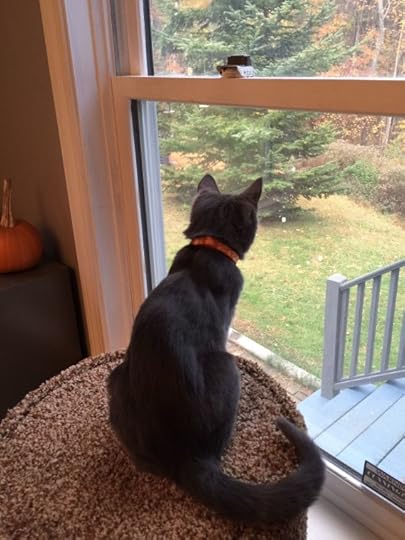
Lucy perched on her cat house, watching the birds.
After years of considering myself a “dog person,” I never thought I’d want another cat roaming around the house. The little kitten in the video sure was cute, though. And she also knew how to play to the camera, too.
Lucy took up residence with us in early October. When she first came home, she was skittish and seemed like she’d never warm to Mary and me. Of course, some cats take time. Now, it’s rare not to have Lucy following me around, or wanting to jump in my lap in the afternoon when I’m working. More often than not, she’ll curl up in a little ball and fall asleep while I’m writing or doing other work.
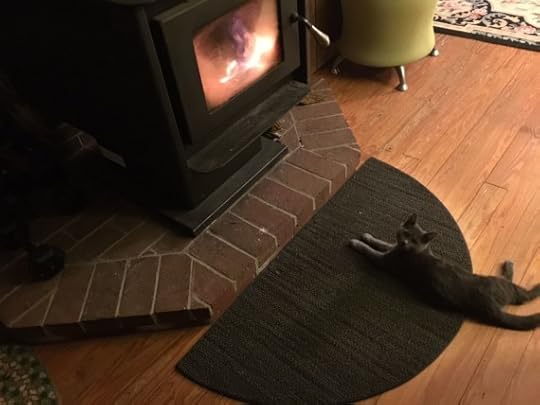
Making herself at home, in front of the fire.
Maybe being a cat person isn’t such a bad idea after all? Research seems to bear out that cats (and pets in general) are good for humans. They help reduce stress, especially with men. A mere 15 to 30 minutes of interaction with a dog or cat causes a drop in cortisol, a hormone associated with stress. It also increases serotonin in the brain, the chemical associated with well-being.
And then there’s this.
Adnan Qureshi, a professor of neurosurgery and neurology at the University of Minnesota, followed 4,500 people. In 2008, he announced that those owning a cat were 40 percent less likely to die from a heart attack than those without a Lucy in their lives. Quereshi indicated that owning a dog didn’t offer the same protection, although the statistical reasons lacked explanation.
There are those who think 21st century Americans have become obsessed with their pets. That may be true, but writers like Katherine C. Grier, who wrote Pets in America: A History, reveals that our nation’s past was filled with pets, too. George Washington, Teddy Roosevelt, Harriet Beecher Stowe, and Mark Twain were all pet-lovers. In fact, Twain often liked to wear a cat called Lazy “around his neck like a stole.”
Like 21st century Americans, our forebears loved their pets too. According to Grier, the pet care industry began catering to people and their pets after the Civil War. Trade catalogs and advertisements from that time indicate that, by the 1870s, an expanded array of products for the care of birds, dogs, and cats were available, from tonics to prepared foods.
If you’d told me six months ago that I’d be living with a cat, I’d have said you were “crazy.” But having a cat like Lucy around has brought some unexpected joy and companionship into my life.
Our mice have disappeared. If not for them, we wouldn’t have Miss Lucy in our lives.