Jim Baumer's Blog, page 44
July 21, 2015
Parenting Skills
Whatever happened to that tried and true, time-tested axiom about children—that they were to be “seen and not heard”? Apparently, it went out the window with many other common sense conventions from yesteryear.
On Saturday, a local restaurant owner basically told two stupid parents unable to control their toddler that it wasn’t acceptable for their kid to scream and carry on for 40 minutes in her restaurant. And of course, social media—whose biggest claim to fame is that it gives a platform to dolts with opinions not warranting the light of day—has been flooded in typical lynch mob-style, with tirades from “internet moms” against her via Facebook.

Screaming kids ruin restaurant dining.
Note to parents (yes, you doltish “internet moms”) of young children; your kids aren’t the center of my universe, especially if I’m eating in a restaurant and your kid’s acting like a brat. Address the boorish behavior like an adult, or take the kid out of the restaurant. Don’t leave it up to the owner of a busy diner to deal with your lack of parenting skills.
While I’ve opined about my time spent in fundamentalist Xianity—with much of it being negative—one piece of advice/training that was beneficial, came via Jack Hyles’ book on child-rearing. He had that right, in IMHO. Of course, his advice was old-fashioned. Discipline aligned more closely with the “spare the rod, spoil the child” school of parenting (dating back a few thousand years, btw) is no longer looked upon kindly by the permissive types raising kids today. Of course, we’re now reaping the legacy sown by red diaper doper baby parents, who bought into the hands-off permissiveness perpetrated in the 1960s that has left us with kids screaming at the top of their lungs for 40 minutes when they aren’t given their pancakes on time.
This type of scene isn’t limited to restaurants, either. I see it in the supermarkets, on airplanes (oh, joy!) and almost any place where there’s a mother (an “internet mom?”) and her kids. Fathers (perhaps he’s an “internet dad”) aren’t any better, either. They just stand around like brow-beaten surrogates, the “new” secondary role that men have been relegated to, all part of America’s 21st-century archetype for the family.
But back to the story at hand. Marcy’s Diner is an old-school type of “hash house” that Portland used to have more of, prior to the landing of the hipsters and their assorted hipster palaces and eateries. Co-owner, Darla Neugebauer, doesn’t seem to concerned with kow-towing to the PC police, either. Behave in her place, or else! Good for her!!
Oh, and one more thing. While far from being scientific, I’d guess that the FB comments on Marcy’s break along the lines of whether you find Portland invigorating, or too full of itself these days. I’m down with the latter.


July 17, 2015
The Speed of Information
Technology, despite all the tributes, alms, as well as religious devotion delivered via never-ending paeans to its superiority and ability to make us a nation better than ever before, simply enhances our downward drift. Leading the way for the obeisant is social media—Twitter, Facebook, Instagram, and who knows what else.
I have a 94-year-old man that I spend two mornings a week with. He suffers from macular degeneration and is legally blind. I read him the Wall Street Journal, and some local news from either the Bangor Daily News, or the Portland Press Herald. I then wrap up my visit with something history-related from a book we’re working our way through.
He was a successful businessman, heading up a company with more than 100 employees for more than 50 years with branches across the U.S. Like many men of his WWII generation, he cultivated a daily habit of reading America’s business paper. I mention all this to say that regularly consulting the WSJ is probably going to flavor an occasional blog post, or two. Like the following story. Or should I say, a hoax, a false flag, about Twitter.
Millennials and Generation X don’t read daily newspapers. They seek out their own personalized oracles, likely programmed on their phones. Even Boomers are clueless when it comes to parsing the news. Perhaps that’s why they continue to be such easy dupes.

Birds once had the market locked up on tweets.
So from Wednesday’s WSJ, a story about Twitter got floated via social media—mainly on Twitter. Of course, a host of so-called journalists jumped on it, because being first in reporting something is now more important than getting the facts straight. Simply another symptom of our social media-addled culture.
What is increasingly troubling for me is how quick younger journalists are to jump on Twitter, not even bothering to follow-up with phone calls or any other fact-checking. It’s on social media so it must be true. WRONG!!
It’s not just happening on the business side of the news cycle, either. Politics is another place where journalism by Twitter is prevalent. “Gotta’ tweet it out before someone else beats me to it” drives all reporters younger than 30 (or perhaps 40).
So you have a rash of similar stories about Donald Trump, who by the way, is sucking all the political oxygen out of the room right now, leaving the rest of the field gasping for breath. Even right-wing talk radio is divided on The Donald. Beck and “The Golfer” are in the anti-Donald camp (Beck and Limbaugh like Walker), with Mike Gallagher pro-Trump, and even the irascible Michael Savage offering a tepid early endorsement of Trump, “if he’s serious” about running.
This kind of story is typical, clocking in at just over 500 words, probably pecked out while scrolling through his Twitter feed, by a 30-something journalist.
Of course that qualifies as long-form journalism these days, when stacked against the Twitter-style journalism offered by the Washington Post’s political editor, Rebecca Sinderbrand.
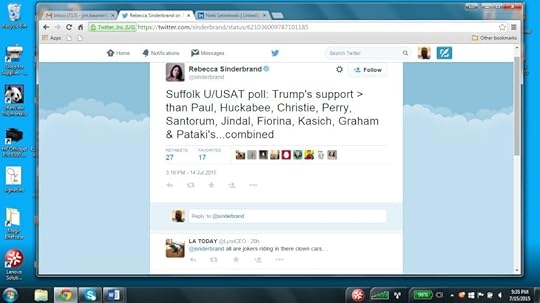
Journalism by Twitter, very common these days.
Culled from this “stellar” article at The Weekly Standard (Hillary beats Trump!!) I realize that to most journalists these days, Twitter snark is superior to anything investigative—basically, 140 characters trumps 2,000+ words. Since when did laziness become a primary skill set for journalists, even those working for one of America’s leading dailies?
Another shining example of what America’s finest universities are churning out.
And yet, you manage to marvel about the state of the nation and that Americans know absolutely nothing about government, business, or pretty much anything else, save Caitlyn Jenner, and their mob rule responses to flags and symbols.
July 14, 2015
An Honest Conversation
So you want to talk about the road to success, eh? Seriously? Success often masquerades as Lady Luck. Finding the pathway that leads to the doorway of success isn’t simply maintaining the status quo, either.
How are you at managing adversity? Let’s talk when your prospects seem hopeless, and the light coming from the other end of the tunnel is most likely a train. That’s the kind of conversation I’m interested in having.
It’s never easy going through a rough patch. I think it becomes more difficult during these social media-influenced times, when it seems like everyone else is having a ball, and you’re sitting at home, alone, with a can of cheap beer and some second-rate movie from 1937 on the idiot box. When the losing streak stretches out for weeks and then months, being resilient is a requisite, but it sure as hell isn’t easy getting up each and every day and turning your frown into a big fat smile for the doubters to see.
And just like that, someone throws you a bone—or two—and the funk comes to an end.
Life’s funny like that.
July 10, 2015
At the Festival
I’ve probably written more about Moxie than any Mainer. I might even be approaching Frank Potter’s legendary output—who knows. Clearly, given that Mr. Potter’s Moxie canon is print-based and pre-interwebs, we know that he wasn’t Moxie blogging.
When I rewind back to 2004, the memories are still fresh of the late Sue Conroy, convincing me to take on the PR and marketing that year, joining the small band putting on the Moxie Festival. That was merely year 22 (if my Moxie math is right) of what’s now become the 33rd running of one of Maine’s, if not the nation’s, most unique and intriguing summer festivals. What began with 13 postcards and 500 people (according to one version) blossomed into a festival attracting upwards of 50,000 people to Central Maine and the sleepy town of Lisbon Falls.
Summers in Maine are way too short. Festivals abound. In addition to celebrations about Moxie, Mainers also fête clams, lobsters, blueberries, and even ships, both big and tall.

High-flying Moxie
I’ll be spending time in my hometown of Lisbon Falls on this weekend, for sure. My little sister again will be the hostess for another Moxie Recipe Contest. Cooking with Moxie! It doesn’t get any better than that for summer fun, does it? And Jon Bon Jovi’s look-a-like will be fronting Bon Jersey out behind the elementary school where I learned to read.

Talkin’ ’bout the Townies.
Next Thursday, you can find me in Yarmouth, for the pre-Clam Festival opening at the Yarmouth History Center. I’ll be talking about town team baseball and telling a few stories about the Yarmouth Townies.
Good times in the ole’ home state!
July 7, 2015
Rally Round the Hype
It’s Tuesday morning posting time, and I need a topic. I guess Bernie Sanders is as good as it gets right now.
In these late days of empire, Lady Liberty’s political process has become just as dysfunctional and corrupt as all of her other assorted accoutrements and jangling bangles. Take for instance the four-year political cycle for president—as soon as the new occupant’s wife changes the drapes at 1600 Pennsylvania Avenue, it’s time to start thinking about the next election, shaking down voters for cash.
Of course, Mr. Obama can’t have a third term (thanks to Mr. Roosevelt). If he could, he’d be out doing what he does best, giving speeches and campaigning. Instead, we’re forced to endure the contrast of just plain tired,the old, and the hilarious—between Hillary, Bernie, and the ever-expanding Republican field—a full 17 months out from our next American coronation.

“Hello, Portland, Maine!!” (Troy Bennet photo/Bangor Daily News)
I know Bernie Sanders was in Portland last night for another one of his rallies. Thanks to Twitter and Facebook, and all the other sunshine-y social media sites, Bernie arrived in Hipsterville to an adoring throng of 7,500 (oh, I guess it was 9,000).
I’m not too surprised. For all of Portland’s perceived hipness, the city’s just a smaller version of every other place that’s been afflicted by “great places to live” syndrome. That means that Portland if full of people chasing the latest flavor of the month—whether that’s a culinary concoction—or a 74-year-old socialist running for president.
Here’s what I know. Bernie won’t be president. Here are just a few reasons.
It’s too early. Again, we’re 17 months out. What’s Sanders been doing other than being a lone wolf in DC, from Vermont, of all places? Vermont’s pretty white, btw. If he manages to keep this up ‘til the Iowa Caucus and the media starts rooting through his garbage, then we’ll find out just how “revolutionary” ole’ Bernie is. Until then, this is all just political theater.
He’s too old. America isn’t going to elect a 74-year-old for president, especially someone who at one time ran as a Socialist.
The Democratic apparatus doesn’t want Bernie for president.
Winning elections for president isn’t the same as a conducting a speaking tour. Shoot, if Elizabeth Warren decided to hit the circuit, we’d find Bernie’s attendance figures start to plummet. It’s easy being the anti-Hillary candidate.
If for some strange turn of events, Sanders manages to get the nomination, he’d end up being yet another political footnoot, a McGovern-type electoral disaster. What? You don’t think the Republican dirty tricks machine wouldn’t exploit the hell out of Sanders’ socialism? Are you that stupid?
We are now living in an age where candidates for president are really just actors, reading off a script. Yes, “alternative” scripts sell, and of course, people are easily duped when it comes to politics. Remember Obama’s meteoric rise up the polls, and his ascendancy? That seems like so 2008, doesn’t it? Him and all those outdated talking points centered on “hope and change.”

Drinkin’ the Bernie 2016 Kool-Aid–oh, yeaahh!!
My question for all the drinkers of the Bernie Kool-Aid at the moment is this—what’s Bernie really done while collecting his congressional paycheck? Where is his great revolutionary arc prior to his time in DC? What kind of legacy does his have in Vermont prior to becoming a professional politician? And just how paradigm-altering is this avowed “independent” since he decided to embrace Leviathan and run as a Democrat?
Actually, Sanders isn’t really very Che at all. This guy called him a “technofascist disguised as a liberal,” back in 2011. But, maybe’s he’s changed his stripes.
I know, I’m not supposed to ask those questions right now. I mean, Hillary’s doing her darned well best at answering as few as possible at the moment, anyways. And given that Clinton’s now cordoning off reporters and they gotta’ file some stories to eat, Bernie’s as good as it gets right now, since it’s all really about the spectacle and feeling good for now.
My experience tells me, “don’t believe the hype.” However, if you want to get all charged up and emotional, have at it. A Bernie 2016 sign will make for a nice artifact in your garage someday, alongside that yellowed McCarthy sign from 1968, and your Perot stickers.
July 4, 2015
A Flag is Just a Flag

Painted-on flag; Georgetown, Maine.
Flags come in all kinds of shapes and sizes. Flags are imbued with symbolism and meaning, too.
Some people fly their chosen flags. Flags can be objects of veneration, instilling in some nationalistic fervor.
I’m not really much for flags, although flags painted on rocks are kind of cool.
Happy July 4th!
June 30, 2015
My Truth is Better Than Yours
Boiling every political argument down as being either conservative or liberal is a limiting critique—a binary straightjacket, so to speak. This kind of posturing has poisoned the current political well for sure.
What it’s also done very well is to create an undeserved smugness on one side, or the other. Where this smugness often gets exhibited in these heady digital days is on social media platforms—Twitter and Facebook, mainly.
Like the other day.
There’s been a lot of what some might call “news” swirling about via the mainstream news cycle. News and what was once journalism tends to get filtered left or right, depending on where you get your news from. But even so-called “neutral” sources, places like NPR and the New York Times, with “all the news that’s fit to print,” slant stories that promote a bias and rarely expand the narrative beyond the most narrow of parameters.
What I find frustrating and it even sometimes makes me angry is when someone coming from a particular persuasion posts something like what I read on one of my social media feeds the other night.
It’s been a bad week for racists, homophobes, right-wing preachers and GOP presidential candidates. But it’s been a great week for America and humanity. The rest of you should get out of the way.
I read it a couple of times. It really hit hard.
This certainly wasn’t the first time someone I know (or someone I don’t know, for that matter) has posted something so smug, condescending, and marginalizing of those not holding their views on a particular topic. What really hit hard is the recognition that if you don’t accept the Supreme Court’s new view on marriage, or are “thumbs up” with the Confederate Battle Flag being lowered (or worse, vandalized), then you are a homophobe and a racist. Better, you are not an American, or even human. Then, on top of all of that, you should just get the (fuck) out of the way! Nice. Being reduced to less than human, or 3/5ths of a human is a technique utilized to later inflict savagery on those deemed “less than human.”

Bearing pitchforks and torches.
Interestingly, some of this is coming from people that at one time seemed capable of nuance and at least were willing to sort the facts and not simply throw their lot in with the mob. Not any longer, apparently.
In light of what’s happening in California with what’s being called microaggressions, I can see the day coming when if you don’t hold the views of the majority, or what’s “true” at that moment—whatever those views happen to be at the time—then you will become marginalized, shouted down, or even worse. At the very least, you’re less likely than ever to want to share your opinions on any topic. It doesn’t matter if you have taken the time to dig a little deeper, hoping to arrive at a nuanced understanding, and can even make your case based on history, or science, or other more rational means than pure emotion. None of that matters any more. “This is what democracy looks like.”
John Michael Greer had another well-written and studied post on his blog last week. Touching on a host of issues related to how we nationalize (and internationalize) our delusional capabilities on a host of things, like climate, foreign policy, and economics, he touched down on how our education continues to promote a limited binary way of seeing everything.
In the same way, if you memorize a set of disconnected factoids about history, you haven’t learned history. This is something of a loaded topic right now in the US, because recent “reforms” in the American public school system have replaced learning with rote memorization of disconnected factoids that are then regurgitated for multiple choice tests. This way of handling education penalizes those children who figure out how to learn, since they might well come up with answers that differ from the ones the test expects. That’s one of many ways that US education these days actively discourages learning—but that’s a subject for another post.
As I’ve written many times before, there are “accepted” narratives, and then, there are those alternative narratives that diverge from the well-paved superhighways populated with groupthink. Not all of the latter are valid, but most of what’s accepted on almost any topic benefits those in power and the corporate overlords in charge. These hallowed (but narrowed) storylines make us all like putty in their hands, dividing people, keeping them stupid and ignorant, even if they are allowed to think they are operating with “the truth.”
If you read any history at all, you’ll know that the majority has been wrong countless times before. In fact, we often smugly think, looking back at “those people” that we’d never have done that. Of course not. You would have had the backbone and spine and risked personal injury or death, and have been the outlier. Right!
June 26, 2015
Puzzle Pieces
Living in free agent nation is nothing, if not challenging. Sometimes your daily task becomes trying to find a way around those proverbial bumps in the road. Then, there are those stretches when the stars align and things magically slide into place. When that happens, you find it’s all too easy to get lulled into thinking that this could become the norm.
A project lasting six months, a regular monthly writing gig, or a grant to manage are all examples of the stability that I’m lacking at the moment.

Free agent puzzle-making.
I often explain my adopted career trajectory as being similar to puzzle-making. Sometimes, all the pieces in the puzzle fit together and you are able to coast for a bit. Then, your grant ends, the project is completed, or your writing gig gets cancelled. When these things happen, you are forced to go back to the table, and begin piecing together seemingly disparate pieces.
I’m happy to report I’ve been able to connect enough pieces recently, and I now have a corner of the current puzzle completed. I’m still struggling to connect the rest of the pieces at the moment.
June 23, 2015
I Don’t Want to Hear It
We all have opinions. Most of us have strongly-held ones. The desire to share my opinions, as well as some of what I thought was foundational information behind those opinions, were reasons why I started blogging back in 2003.
I still have opinions. Many of them have evolved over time. Having an opinion and sharing it is also seems fraught with danger, 12 years later. Now, I’m less likely to add my two cents worth to whatever battle is being waged over symbols, or people’s preferences.
Being hesitant to weigh-in on the Battle Royale raging at the moment also leaves a limited amount of topics to write about at times, or so it seems. Also, that’s what Facebook and Twitter are for. Spending time wasting words via a blog seems so 2006. No one seems interested anymore in reading several hundred words. 140-character tweets are now de riguer with the cool kids holding court, ruling the turf formerly held by bloggers. Who cares if they have nothing behind their prattle except their strongly held opinions?

“La, La, La, La…”
My previous post touched down on binary thinking. I’ve mentioned the topic enough before. I won’t go there again today. I will only say that our inability to have a dialogue on a variety of tough subjects, even those deemed by our arbiters as “controversial,” doesn’t bode well for us. Screaming louder than your foes, or using your newly-found majority status doesn’t indicate rightness, either.
Perhaps I’ll just blog about the weather and puppies—no one is opposed to sun and cuteness, right?
June 19, 2015
The Search for Threes
I’ve mentioned the flaws of binary thinking before. The concept—framing things in terms of duality, or opposites—isn’t a new concept, and it tends to be the way that most issues are discussed in America and arguably, the West.
From a philosophical standpoint, the origins of this kind of thinking date back to Aristotle and Descartes. They first structured this type of logic, which consists of dividing, distinguishing and opposing items. When you see things in a binary construct, there’s no room for in-between or shades of gray; everything is black or white, good or bad, nice or ugly, good or evil, etc. It is the law of “all or nothing.”
Unfortunately, this kind of dualistic framework often leads to dead-ends, and at the very least, can divide people unnecessarily.
One of the best explanations and the one that really made me sit up and take notice, was written by John Michael Greer, and posted a few years ago at his blog, The Archdruid Report.
Greer takes the origins back even further than Aristotle and Descartes. He writes,
Most of the snap decisions our primate ancestors had to make on the African savannah are most efficiently sorted out into binary pairs: food/nonfood, predator/nonpredator, and so on. The drawbacks to this handy set of internal categories don’t seem to bother any of our primate relatives, and probably became an issue—like so much that’s part of magic—only when the rickety structure of the reasoning mind took shape over the top of the standard-issue social primate brain.
The problem with this snap-judgment way of seeing and making sense of the world is that in our current, non-hunting society, the binary framework eliminates the middle ground. In fact, we don’t even recognize a middle position. More often than not, it leads to division and conflict.
Think about our politics. Our choice is vote Democrat, or vote Republican. The coin flip could be Jeb Bush or Hillary Clinton, with our hopes pinned to one of them for four more years! Of course, right now, Democrats are twisting themselves into pretzels, trying to parse the importance of Bernie Sanders run for the White House, pinning their hopes on a 73-year-old former Socialist.
Binary thinking delivers diatribes on Twitter, like those I read related to the shooting in North Carolina, with a so-called black anti-racist leader, saying something akin to “All white people are racists.” I guess the binary of that would be that black people aren’t. The flipside coming from white politicians might be painting all black women as welfare queens.
Binary thinking in politics leads to governance by conflict. This is what’s taking place in Augusta right now, with a governor who refuses to consider compromise or anything that doesn’t align with his own narrow, black/white views. It’s his way, or no way! If you don’t go along with his fragmented vision, he mocks or denigrates you, like calling a respected legislator, “an architect of pork.” Anyone that loves this kind of binary freak show, howl in approval.
As I wrote in an email to a friend the other day, “once you step off the binary train, that’s all you have left—and it’s impossible to get back on.” Your options for dialogue also become limited, unless you prefer to just go through the motions and discuss issues in the standard black/white dialectic. This creates dissonance.
I could argue that we are living in an empire that’s in decline. If so, I think things will continue to devolve over time. That’s a difficult worldview to truly get our heads around because it is the polar opposite from the kind of thinking we’ve been conditioned to practice from the earliest age.
We have been taught to think of America as a “city on a hill,” and a place of never-ending progress—things are supposed to get better and if they aren’t improving, then it’s someone else’s fault, most often the nearest politician. Other convenient scapegoats are loved ones, friends, jobs, and our geographic location.
I like Greer’s suggested exercise of first recognizing the binary that you are confronting. Recognition is the first step. Then, look for a third option, turning it into a ternary.
The next time you get stuck in a binary trap or conflict, look for the third option.

“Threshold,” by UK artist, James Hopkins.