
Jane Brocket's Blog, page 32
November 11, 2012
sunday leaves
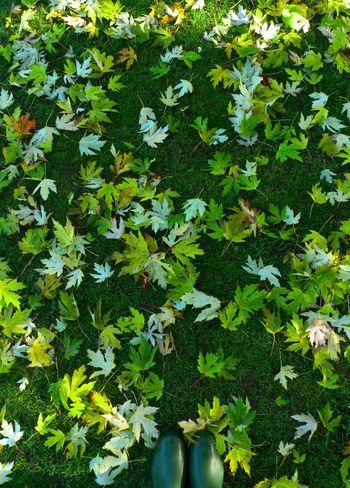
Sunday leaves on a walk in the morning + Sunday leaves in a novel in the afternoon + birthday cake left over from last night's party = perfect November Sunday.
So far this month I've been reading The Diary of a Privincial Lady by EM Delafield, Anderby Wold by Winifred Holtby, and later today as we light the fire and Simon watches the rugby and Phoebe does her homework and the light fades and I get comfortable on the settee, I shall be rereading Patience by John Coates which I already know qualifies as the perfect Sunday afternoon read.
And that's the end of the official Reading Week for Tom and Alice and here on the blog, although happily every week can be a reading week when you're not tied to university timetables.


November 10, 2012
saturday print
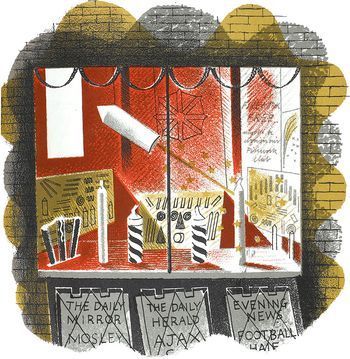
[Fireworks Eric Ravilious in High Street by JM Richards and Eric Ravilious, first published 1938, reprinted by V&A Publishing in 2012]
We are lucky enough to live round the corner from an independent shop that delivers newspapers each and every day, in wind and rain and snow, by 6.30am. The newsagent section is just one part of its business; it's also a Post Office, small supermarket, off-licence, general emergency shop, and a place for Tom to do his Christmas shopping at 10.55 pm on Christmas Eve. We call it the 'Blue Shop' because when we moved here from Brussels, Tom and Alice hadn't yet learned to read (all children learn when they are six there, and spend the time till then acquiring pre-literacy skills - an excellent way to do it), and the word 'Mace' meant nothing to them. Even though it hasn't been blue or Mace for years, has been through quite a few colour changes, and is now yellow and green, it's still fondly known as the 'Blue Shop', and we are all immensely loyal to it.
I grew up with a brilliant newsagent's just up the road. It delivered Mum's newspaper, and our comics at the weekend. I was sent to pay the papers every Saturday when I was young, and I find it amazing that I am still paying paper bills in person at a time when most newsagents have either disappeared or stopped delivering, having fallen victim to a lack of paper boys and girls, and competition from supermarkets. And I appreciate this anachronistic service every single day - on weekdays when I wake up to a cup of tea and a read of the Guardian in bed before 7am, and at weekends when I can sit for longer surrounded by papers and supplements and magazines, and bless the Blue Shop.
[The Blue Shop even sells fireworks, just like the newsagent of my childhood, and the newsagent of Eric Ravilious' 1938 High Street (a beautiful book with lovely illustrations of shops and businesses).]
November 9, 2012
friday books (do furnish a room)
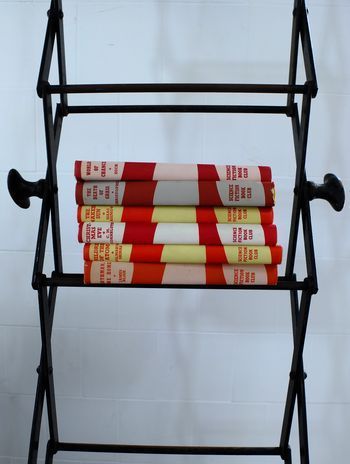
Some books are simply beautiful.
I know the old saying 'books do furnish a room' (also a title) is very true, but is it the same if you have never read them or have no intention of reading them? These books, published by the Science Fiction Book Club, looked amazing in there studio where we photographed my quilts. They were part of a series that has the same design of cover in different colours (royal blue, yellow, purple, emerald green); I was very taken with them, would love to own a collection, and even thought that I might be seduced by the covers into reading the contents.
But, deep down, I know I wouldn't, and therefore I wouldn't be able to bring myself to have them on my own shelves. Maybe I'm being too high-minded, maybe I should not be surprised by the fact that books are bought to co-ordinate with interiors rather than minds, maybe I should just pretend I'm a Sci-Fi nut and get over this preciousness. But no, if books do furnish a room, I want that room to reflect my tastes in literature rather than graphic design. However, if the former comes packaged in the latter (as with Persephone, early Virago, most Penguins), I consider any room that contains such books very well furnished indeed.
November 8, 2012
thursday reading
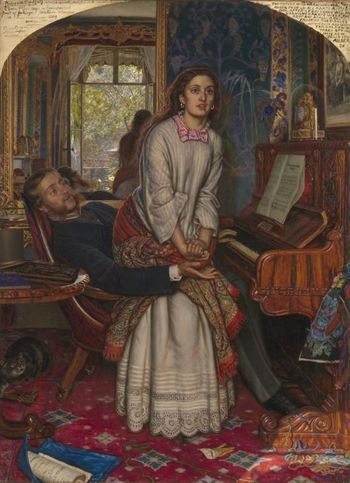
[The Awakening Conscience (1853) William Holman Hunt]
Years ago, when the children were little and we were in the midst of reading many fine illustrated books by the likes of Janet and Allan Ahlberg, Shirley Hughes, Sarah Garland, John Burningham, Quentin Blake, Helen Oxenbury, and Jill Murphy, I came across a thought-provoking article by Anthony Browne whose Willy books we all enjoyed. In it, he wrote that children need to develop their 'visual literacy' just as much as their verbal literacy. They, and the adults they become, need to be able to read/decode images for patterns, symbols, clues and messages, metaphors, jokes, and irony.
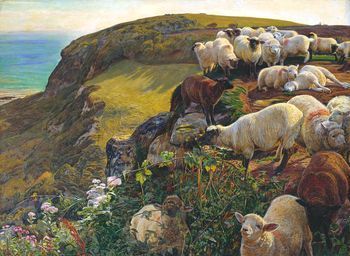
[Our English Coasts ('Strayed Sheep') 1852 William Holman Hunt]
These thoughts came back to me when I saw the Pre-Raphaelites at the Tate last week. Now there's an exhibition that requires a high level of visual literacy; these painters are nothing if not determined to cram in as many messages and symbols and morals as possible into their canvases. William Holman Hunt, in particular, likes to take the moral high ground wherever possible; as he grows older the enormous painting get odder and more bizarre, and have the effect of making me feel horribly queasy.

[The Triumph of the Innocents (c.1883) William Holman Hunt]
Although I have always been interested in the PRs, I've never considered myself a true devotee, preferring instead to pick and choose the works I like. And, once again, what comes out of a walk round the exhibition is a sense of young men trying too hard to convert the world to their ideas by making viewers aware of every last message of an image (not mention the fact that virtually all their women look utterly miserable or sullen or ill). Far better are the more subtle, natural, less overtly demanding portraits and scenes and moments of everyday life. But you couldn't ask for a better tutorial in visual literacy than the exhibition as a whole.
November 7, 2012
wednesday words
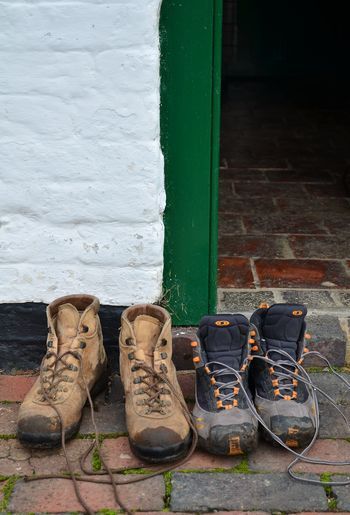
[photos taken at Lengthsman's Cottage]
Oh, the internet is a marvellous thing indeed, and for a while I wasn't sure it was necessary to carry on buying the Landmark Trust Handbook now that so much of the information is on the website. But old habits die hard, good wrting lives on, and the Handbook is undoubtedly still the best way to read about the Landmark Trust and its properties.
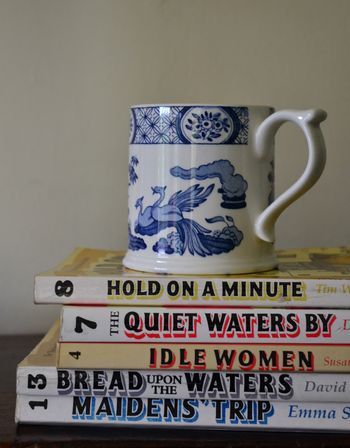
[all LT places have the same 'Old Chelsea' china]
We have been taking LT holidays since Phoebe's first summer, and have stayed in follies, priories, forts, palaces, cottages, towers, and a railway station. It all began when we were living in Belgium and wanted to spend our holidays abroad ie the UK so we could also see family. We continued with LT holidays when we moved back because they were/are excellent places for children (no TV, lots of space, brilliant locations, enormous imaginative possibilities, endless games of hide-and-seek, nothing fancy or breakable) and for adults (no TV, well-equipped kitchens, good choice of books, plenty of architectural interest, entertaining and informative log books, the chance to explore little-known, underdiscovered parts of the country, no worries about children wrecking the place).
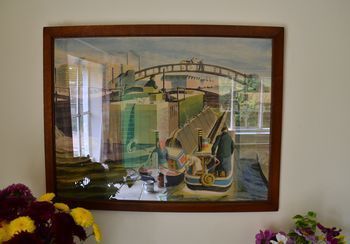
[They also all have interesting, location-related pictures. This is Grand Junction Canal (1938) by Lynton Lamb from the Contemporary Lithographs series.]
On our recent LT break, I spent time reading the Handbook as I always do in a LT place as it's the perfect time to indulge in imagining future holidays, but this time I also analysed just why it is such a successful piece of writing.
The Handbook has it own individual style and vocabulary. Unlike other holiday brochures, it never goes in for excitement, overtstatement, exclamation marks, and hyperbole. Instead, it builds up the image of a thoroughly sensible, thoughtful, balanced, and civilised business which chooses not to exaggerate, and to treat its readers as intelligent, interested, and literate. I made a list of frequently used adjectives and phrases because I wanted to understand why the Handbook makes me want to book a stay in a LT property for every week of the year, and they include: fine, important, 'old, simple and good', handsome, impressive, magnificent, curious, sober, 'solid and gracious', elegant, noble, remarkable, well-mannered, splendid, 'unusually well built', pleasant, distinguished.
It's all very unshowy, yet completely unstuffy. When you consider the immense architectural and historical value and significance of its property portfolio, the Trust could so easily slip in to BBC Four-style drama and excitement (Lucy Worsley would be in her element dressing up and living in the style of any place she booked). Instead it concentrates on fact (very Pevsner) while at the same time conveying the special character of each location, and suggests that you, the discerning reader, will be capable of enjoying yourself there. It's clever and persuasive, and even though I may never have thought of staying in a water tower/pigsty/ruin/gatehouse, I certainly want to after reading the Handbook.
November 6, 2012
tuesday text
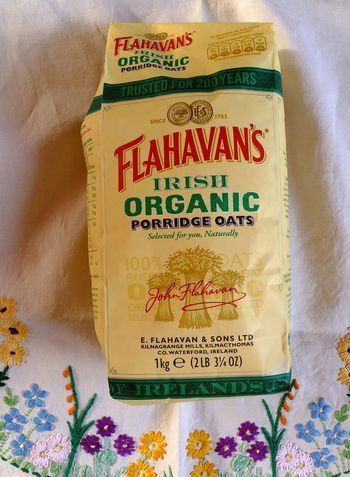
I have never liked cereal for breakfast - far too much like chewing cardbooard - so have never been one for reading the back of a cereal box while eating. The rest of the family, though, are great readers of food packaging, and I often have to retrieve it from the bin where I have unthinkingly thrown it while cooking so that they, Tom in particular, can consider calorific values, producers' claims, and marketing hype.
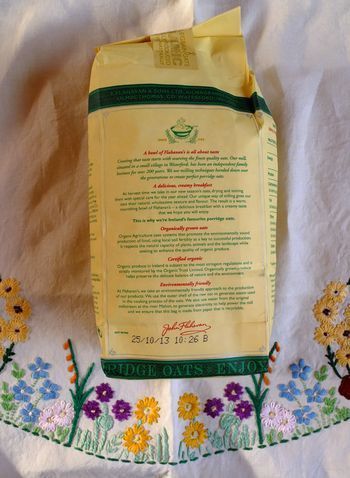
But now I have my own favourite breakfast reading. Apart from the wonderfully old-fashioned graphic design on the paper bags of Flahavan's Porridge Oats, there's also plenty of text about Irish oats, family values, porridge history, and how to make it. It's all very warm and comforting, and these are indeed the best oats I have come across (the big brand names fail dismally in our informal taste tests) and they produce a really brilliant, creamy, tasty winter breakfast.
Simon makes his porridge with water, adds sultanas, and drizzles honey on top. This is far too puritanical for me, and I make mine with milk then sprinkle over golden caster sugar and finish with a small swirl of cream (who ever said breakfast had be to merely fuel for the day when it can be delicious, too?). And now, after years of wondering why my porridge didn't taste like the best bowl of porridge I ever had which was made by a friend, I have realised what exactly it is that makes porridge taste truly porridgey, and it's a pinch of salt. But I'm sure the health police would never allow that to be printed on the packet.
[Flahavan's Oats and text are available from Waitrose, Tesco, and Asda.]
November 5, 2012
monday book
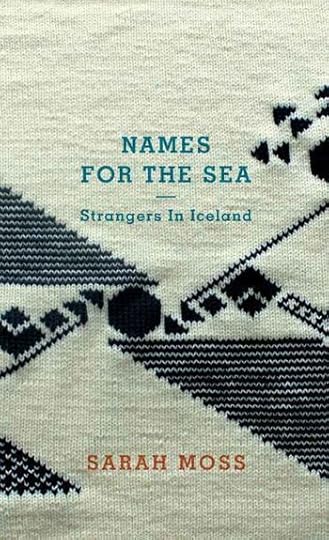
[excellent book cover with a clever, Iceland-related knitted design]
It's Reading Week for Tom and Alice's universities, so I am having a reading week here.
I read by Sarah Moss when we were staying in the little lock-keeper's cottage recently. When we weren't walking, we were reading in comfortable chairs, warmed by the very crackly log fires that Simon made in the 200 year old range. The heat and cosiness turned out to be significant to the enjoyment of the book which does a wonderful job of making you feel the cold, the wind, the ice, the snow of Iceland; this is not a book you'd want to read while shivering at a bus stop or in an underheated room.
I'm not sure how I came to read it; I think I'd heard mention of knitting in it, and the idea of a year in Iceland fits in well with my fascination (obsession) with Antarctica, and the way that humans deal with extremes of cold. Plus, as someone who has spent six years as an expat with young children, I wanted to find out what it would be like to turn up in Reykjavik and cope with the new way of life.
Sarah Moss writes extremely well and I enjoyed the early, more personal chapters the most. I wasn't as interested in Icelandic banks and trolls and volcanoes as I was in the sections on the culture of knitting, Icelandic society, food, design, education, family life, dark days and long nights, landscape and skies. These, and the ideas of 'foreign-ness', were what made the book so interesting for me.
But, as a former 'trailing spouse', I found myself wondering what her husband made of it all and, more to the point, what he did every day when the children were at school/nursery. Disappointingly, there is very little about him - there is mention of some bread-making, but very little else. This makes for a curious Anthony-shaped gap in the centre of the book. As anyone who has moved abroad and taken a young family with them knows, it's an arrangement that it has to work for everyone in order to succeed. So by the end of the book, I wasn't seduced into wanting to visit Iceland (although I'd be happy to see the strange landscapes, do some knitting, and swim outdoors in some of the many pools), but it did make me spend a lot of time considering once again the infinitely interesting subjects of family life and domestic arrangements.
November 4, 2012
season of rain and murky dampness
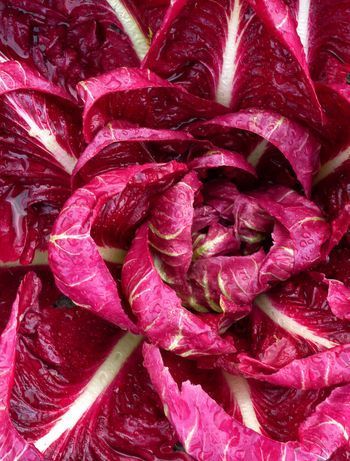
It's hardly a Keatsian autumn. It's all a bit unexciting colourwise as the leaves are either falling quickly or failing to show off on the trees, and the palette is too earthy for my liking - I prefer more oranges, golds, crimsons, and russets. But there are a few dots of colour around; a couple of shaggy, late, amber dahlias amongst the black ruins of summer flowers, radicchio in a garden we visited, my own chilli harvest.

Time to retreat indoors for another look at Dreaming in Color which I've already read once from cover to cover. As well as being a fascinating read (his has been a life full of personality and personalities), Kaffe Fassett's autobiography is crammed with a brilliant selection of colourful illustrations which makes it just the thing for a murky November day.
November 2, 2012
six inches under
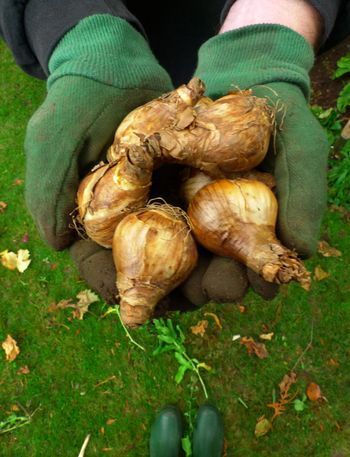
A beautiful, sunny, mild afternoon, a few bags of multi-purpose compost, a well-worn trowel, an obliging husband who has come home from work early just to help, cups of tea made by the teenager indoors who is claiming essays have to be written, and a lot of determination to get the job done. That's all it has taken today to get the bulbs in the ground and pots. We are nearly at the bottom of the 25kg sack, and have planted all the other varieties of daffodils I bought (in smaller quantities - I only made the one mistake, thank goodness). They are snugly six inches under, and I can now think about the hyacinths, muscari and alliums. We are not mentioning tulips yet, though. That's a bulb too far.
October 31, 2012
a library of my own
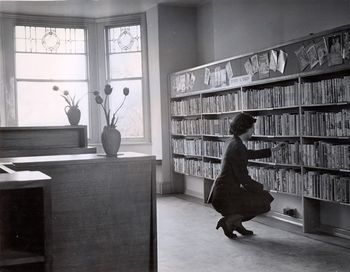
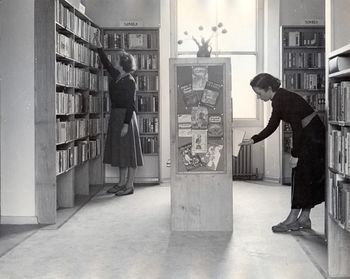
This is where my library habit began. When I started borrowing books in this local library, it was exactly like this, although the tulips must have been put there specially for these photos which were taken to publicise the opening in the mid-1950s. It was always warm and quiet, very sealed and hushed, a little bookish world of its own. There was a children's library upstairs which I worked my way round, and I can remember clearly when I was allowed to start using the adult library downstairs ahead of the usual age (12, maybe) and the immense delight and excitement I felt at being given the larger number library tickets in the grown-up colour of card, and doing my best not to attract attention downstairs in case I was sent back upstairs. My best friend Janet would walk home from junior school with me via the library and she would wait outside while I changed my books; as soon as I went inside, I felt like a different person, and even today when I go into a library I like (the British Library and Senate House Library especially), I get the same feeling.
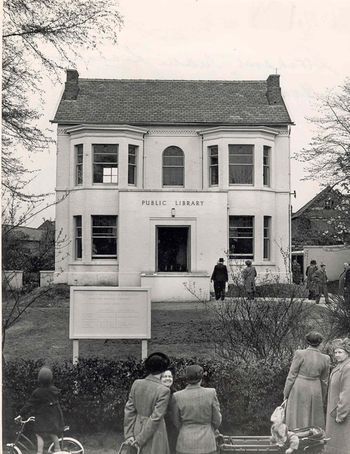
[the day of the opening]
But much as I loved the library, when I got to 13, I wanted to own the books I really liked, the books that were important to me, the ones I knew I'd go back to time after time. I wanted a library of my own, so I saved up pocket money and birthday money, worked in a hairdresser's then a fish and chip shop, and started buying books. I had a small bookcase in my bedroom and kept my books on one shelf, lining them up at either end and it was a very exciting day when they met in the middle and I had a whole shelf of books.
As I got older, I spent a great deal of time in second-hand bookshops which is where I bought all my orange Penguin Classics (it was only on high days and holidays that I got new books - receiving brand new copies of Thomas Hardy novels when I was 15 felt very extravagant). I still have all these Waughs, Lawrences, Orwells, Steinbecks, Hemingways, Drabbles etc, and they make perfectly good reading copies; just a couple of weeks ago I re-read Brideshead Revisited in a very old edition, the same one I'd read as a teenager. (I was shocked by how miserable and cynical it was, how at odds with popular perception, how dismal Sebastian's life became as he was ravaged by alchohol and guilt, how unpleasant everyone is, how cruel Waugh could be.)
These days, I don't go to local libraries so much (the nearest is far too noisy - nothing like the wonderfully peaceful library above, or the two libraries at school that I also haunted for seven years), but I am still filling shelves with books, still deriving enormous pleasure from my own library, still seeing owning books as a mix of luxury and necessity. I've been reading a lot more recently than I have for quite a while, and I've been grateful once again that I am fortunate enough to be surrounded by books.
Jane Brocket's Blog

- Jane Brocket's profile
- 27 followers

