
Jane Brocket's Blog, page 28
January 29, 2013
grauniad recipe


fragments

[ruins of the medieval Coventry cathedral]
I never thought I'd want to go back to Coventry. I lived there for two years in the mid-80s and it wasn't a happy time. I didn't appreciate the state-of-the-art 60s shopping precinct, the state-of-the-art 60s railway station (now listed), ditto the 60s Belgrade Theatre (also listed), the concrete monstrosity that was Lanchester Poly, the suitably morose Larkin connections, and I hated the ring road that cut round - and cut off - the centre. I used to depart from the always freezing cold station with a light heart and return with a very heavy one. Mid-way through my time there, I met Simon and over the course of the next year I pretty much spent 51 weekends in Slough, and he spent one in Coventry. Yes, Slough was a glamorous destination by comparison (although it was more for what is was near than any intrinsic appeal).
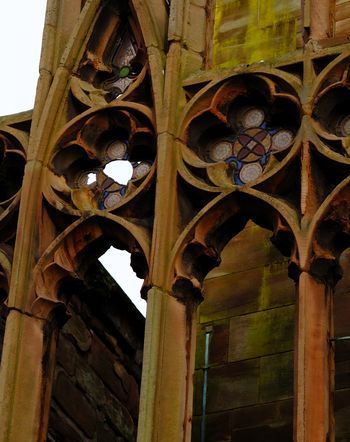
[fragments of stained glass in the ruins]
But Coventry kept popping up when making plans for my Grand Provincial Tour because of its cathedral and its art gallery. Together they made a compelling reason to visit - and these days I'm able to appreciate 60s architecture (distance and age do add charm to the views) and Larkin's brand of provincialism. Now the station (with Larkin poem on a plaque on Platform 1) is a concrete and glass shoe-box worth arriving at, Larkin's boyhood house at 1 Manor Road (round the corner from the station, demolished to make way for the ring road) can be imagined, and the cathedral is to be approached with great interest because I'm keen to know more about John Piper and his acclaimed Coventry paintings and stained glass.
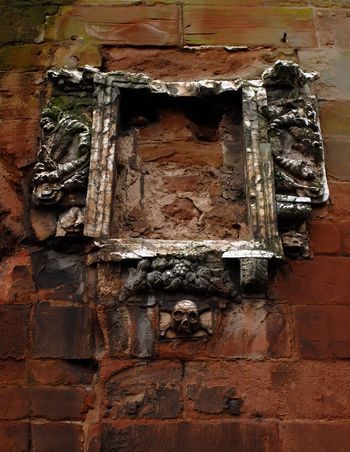
[skull and crossbones]
What I found were amazing fragments of an energetic, forward-looking city in the midst of some horrible post-war and later developments. They brought back fragments of memories of living there, but mostly I saw the place with new eyes. I'd forgotten about the dramatic deep red sandstone of the cathedral ruins (the same sandstone that struck me all those years ago when I saw the ruins of nearby Kenilworth Castle), and I'd forgotten just how impressive and moving the ruins are. It was an inspired idea to leave them untouched after the bombing of November 1940, and they serve as a powerful argument for peace.

[Ecce Hom0 (1934-35) by Jacob Epstein, in the ruins]
I've been to spectacular ecclesiastical ruins before (Tintern Abbey/Fountains Abbey) but they have been ruins for centuries; it's very different wandering around the remains of a cathedral that was ruined in my Mum's childhood. It's not surprising that there's a feeling of tenacity and strength emanating from the two cathedrals that sit side by side.
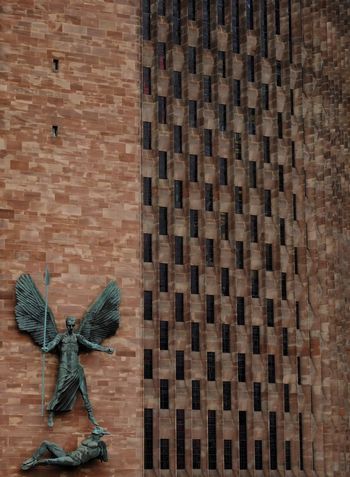
[St Michael and the Devil (1956-58) Jacob Epstein, new cathedral]
For together they make an emphatic statement of faith, not just in religion but in humanity. It's a shame it costs £8 to get into the new one (the ruins are free) because no-one should be put off going inside. The outside is ultra-1960s, and the inside is a masterpiece. It's worth going round with a guide for free (it was so quiet yesterday that I had a lovely and very informative guide to myself for an hour), then going round again to look at details. I didn't take photos because sometimes a camera is a distraction, plus nothing can convey the atmosphere, the light, the proportions, and the very living, changing beauty of the place. The 1960s stained glass was the highlight and there is masses of it to enjoy (quilt inspiration in every window) in every colour imaginable. There's also tapestry, carved stone tablets, etched glass windows, sculpture, beautiful fixtures, and an incredible ceiling. But the very best moment was standing, awestruck, in front of Piper and Reyntiens' Baptistery Window, and seeing how all the fragments of colour come together to make a glorious whole.
January 25, 2013
literary and philosophical

It's all well and good seeing the sights of a city on foot in snow and sleet and slush, but sometimes it's necessary to go inside and get warm. Much as I like cafes and bookshops, I can't spend all my time and money in them (plus, Newcastle is sadly lacking in the latter), but Newcastle's founding fathers and subsequent generations of enlightened benefactors and builders have created plenty of warming-up spots, most of which are free.
The joint highlight of my visit was the Lit & Phil, just by the station in a magnificent 1825 building. This is dry, cosy, welcoming and completely stuffed with books. It's a wonderful independent library which anyone can use, the rooms are spectacular, it has tea and coffee, newspapers and journals on offer, librarians to consult, and a warm atmosphere of bookishness. It's well used, clearly well loved, and it's quite exceptional. I would say it's one of the nicest libraries I have ever read in, and I was happy to sit by the bust of Bewick who was one of the original subscribers.

[Baltic]
The Baltic Centre for Contemporary Art is on the opposite side of the river, and the opposite side of visual spectrum. Where the Lit & Phil is packed to gills with literary culture the Baltic, which is equally imposing and grand in scale, has virtually nothing inside. Sure, there is an obligatory enormous entrance, shop, cafe etc but where is the art? There was a two-floor exhibition which I did my best to linger in, but really this place could hold ten times as much art and still feel spacious.

I wouldn't call the Central Arcade warm inside, but it definitely warrants a 'vaut le détour' to see the incredible, warm cream and brown faience by Burmantofts.

[above the door to what is now Revolution]
And if you fancy a warming dram or pint at any time of the day, there are plenty of bars and drinking places housed in amazing former banks and offices and clubs, still with many of the orginal fixtures and fittings. (The Centurion Bar in Newcastle Station is also worth looking at as it has a fine Burmantofts interior.)

The Laing has a truly over-the-top entrance (now on a tiny side street, so easy to miss) which declares its substantial intentions to impress and edify and educate. It has a fine collection including marvellous paintings of Newcastle (I particularly liked those of the various bridges), some Bewick woodcuts and blocks, local glass and pottery, and a highly eclectic mixed bag of donations and acquisitions. It's splendid inside, the cafe contains two Burne-Jones stained glass church windows, the displays are thoughtful, varied, and the place is full of art. But empty of people.
[Alderman Fenwick's House, late C17]
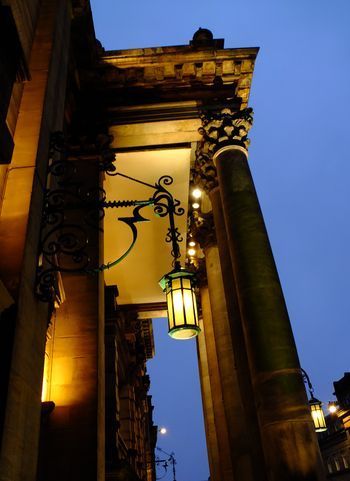
I didn't go into the theatre, but it would be just the place to warm up on 19 & 20 February when the brilliant Trocks will be performing there.
And finally, the other favourite place for warmth and atmosphere: the City Pool where there is still a Turkish Bath (separate men's and women's days). There are very few left in the country now, and this one hasn't changed since it was opened (mahogany changing rooms, marble massage slabs) - and it's a fantastic place to get truly warm on horribly cold winter days. It felt like being in the south of Spain in August - not quite Turkey as I couldn't manage the hottest of the three rooms. It's extremely good value and you can stay for up to three hours and swim as well (the pool has been beautifully restored, and I had a lovely swim looking mostly at the pale blue vaulted ceiling). I was told that it's very popular, and yet the whole place is under threat of closure. Time for the enlightened governors of the Lit & Phil to step in, I think, and create a path between the pool and the library.
January 24, 2013
walking tour

[Tyne Bridge (1928) and High Level Bridge from the Millennium Bridge]
To get a cheap train ticket you need to book well in advance. So it's a shame you can't get similarly long-range weather forecasts that allow you to reserve not just date, time, seat but also sun, rain, ice according to personal preference. As this extra option is not available yet, I managed to pre-book a train to Newcastle for Monday, the snowiest, most transport-crippling day of the winter so far. And yet I got there only half an hour late (all credit to East Coast Trains), having had the rare delight of seeing all the countryside between London and Newcastle completely under snow, wearing big walking boots (not my usual city footwear) and ready for my walking tour (part of my GPT).

A few years ago I read Jenny Uglow's fantastic biography of the wood engraver, Thomas Bewick, who was an inveterate walker and thought nothing of walking the twelve miles home from Newcastle to Cherryburn (and sometimes back in the same day) in all weathers. The image of him striding along in snow, biting winds, and gales while looking carefully at the landscape, river, birds, animals and people, had stayed with me. And now, by chance, I had the chance to walk in his footsteps in equally cold weather - but this time in the city where he lived and worked.

[Tyne Bridge and Gateshead Millennium Bridge from the High Level Bridge]
This was my first visit and I wanted to see as much as I could, and I wasn't going to let sleet/rain/snow/wind/slush/appalling light put me off. I walked, and I walked, and I walked, kept warm that way, and discovered the most amazing city. I didn't just follow Bewick's tracks round the old city, I also looked at Georgian Newcastle, Victorian Newcastle, C20 Newcastle, contemporary Newcastle, cultural Newcastle, riverside and bridge and railway Newcastle, and parts of Gateshead.

[the stunning High Level Bridge (1849), with trains rumbling overhead on the upper section]
I discovered a city to like enormously. Friendly but not over-familiar, very down-to-earth, with no frills or furbelows, airs or graces, but a great deal of proud, grand traditions and architecture. I loved the mix of styles, the fact that the spectacular Georgian centre (Grainger Town) has been left to stand, the wonderful Grainger Market is still alive and buzzing with activity, there are many excellent municipal amenities and a stunning 1960s Civic Centre, and the city lit-up at night is utterly beautiful (no wonder the place is famous for its after-hours activities). It's not a rich city these days, but it's full of riches.
January 20, 2013
he's my brother

A big, thick, nicely illustrated biography is perfect reading for snowy days. Especially a well-written biography of an interesting character such as an elusive, contradictory, elegant, enormously talented and well-connected artist who died far too young and under-appreciated.
I'm fascinated by the way people choose to live their lives, the choices they make, the opportunities they take or create or miss, and a good biography will get close to its subject but also view him or her from a more objective distance, and reveal something of the contrast between private and public, domestic and official. The Laughter and the Urn, the 1985 biography of Rex Whistler by his brother, Laurence, does all this, and I would recommend it for long sessions on the settee with tea, quilt and fire, as the snow falls, the light fades, and the world grows quiet.

I often choose ex-library copies when buying on abebooks because I like the stamps and marks, knowing where they came from, and how many people have read a book now sadly marked 'DISCARDED'. This book hadn't been taken out very often which is a shame because it's a truly compelling, thoughtful biography by a poet and writer, but also a brother. I don't think I've ever read a biography of a one brother by another before, and realised early on what a huge difference it could make. Having just read the newest book about RW which is excellent but more a general overview of his life and work than a true biography, it was marvellous to get a much closer understanding of RW's personality from LW's accounts of their shared world of childhood, and the revealing, often funny details of the family and school life - and only a brother who was there could have written these.
There is some ambivalence in fraternal relations in the central section of the book (LW, seven years younger, often felt overshadowed by his immensely successful, social butterfly brother, and at times appears to despise or at least mistrust the 'bright young thing'/socialite circles in which he moved) and the information about the 1920s and 30s is mostly public knowledge. But the brother-biographer comes into his own in the early years (as above), and again in the final years (1939-44) when they were both soldiers, and LW is meticulous in covering RW's war experiences. In these two sections he writes quite differently, with a sense of their bond and closeness but never worship, nostalgia or sentimentality. There is humour, clear-sightedness and a fair placing of RW where he deserves to be for posterity and, above all, deep brotherly love and affection.
I finished it last night, a little stiff from sitting still for so long, and very moved by the final chapters. Today I'm still thinking about what we choose to value or overlook, and how an artist or writer can miss out the acclaim he or she deserves when alive. Apart from Edith Olivier, high society and the art world never really appreciated RW and his talents, not in the way his family did when he was young and his fellow-soldiers did when he was older. There was much wringing of hands and elegant letter-writing when he died, but there could have been far more active acknowledgement of his wonderful talents and output while he lived. Too often we don't realise or articulate how much something or someone means to us they are taken away.
January 18, 2013
the more it snows

[Snow in Russell Square (c1935-40) Stanislawa De Karlowska (Birmingham)]
...the lovelier it looks, the less likely I am to get to London to see it, and more I'd like to. I'd be very happy wandering again around the squares of Bloomsbury to see them blanketed in snow, but trains aren't running, schools are closing, and BBC Radio Berkshire have phoned to ask if I'll give Tony Blackburn an update on what's happening in my area.

[ Snow in London (c1935) Richard W Marriott (Worthing Art Gallery)]
Which is funny, because I can only update on what's happening outside my window, and I'm not too sure he wants a running commentary on how well my violet hyacinths are doing and how beautiful they look with a backdrop of thick snow, and big, fat, swirling flakes.

[Rooks, Hyacinths and Snow (c1935) Winifred Nicholson]

I could put my coat and wellies, hat and gloves on, though, and do a little Pooh-style pondering and measuring of snow to show that I'm a well informed reporter.

[Illustration by EH Shepard]
Then I could share my thoughts with him and his listeners, because I'm considering who has painted snow best. EH Shepard illustrations have lodged in my brain since childhood and he captures snow brilliantly just by making little marks on lots of white space. The Impressionists, particularly Monet and Sisley, evoke the softness and light-play of snow, while Russian artists paint snow scenes with vigour and energy and drama. Dutch painters show just how many things you can do in the snow - I love their action-packed snowy crowd scenes - and Scandinavian scenes are often quite everyday as befits countries which deal with snow sensibly and efficiently. Unlike here, where the best you can hope for from local radio is a cutting-edge report from a housebound flapjack-maker.
January 15, 2013
perambulation

[8 Fitzroy Street Vanessa Bell (Eastbourne)]
A true perambulation, a walk around a territory, an inspection of an area on foot. This is what I did yesterday, covering a good deal of Bloomsbury from west to east, and finding all kinds of things to keep me interested and to deflect my attention from the cold and rain. Bloomsbury is great walking territory ; there are guided walks which sound excellent, or you can take a fairly shambolically planned route like mine which follows personal whims and fancies, and incorporates good cafes, excellent architecture, many famous and historical locations, a mix of neighbourhoods, and a lovely sense of London life. I didn't take photos, partly because of the dreadful light, but also because there are times when I just like walking and looking and taking things in without feeling the need to stop and record (I still don't understand why people go to concerts only to see most of the action through a phone camera).
Itinerary and highlights:
Start: Warren Street tube, a Charles Holden station (1934) which much have looked incredibly futuristic and beacon-like when first built.
Round the corner to Honey & Co, lavishly praised in the FT and the Guardian, so worth a try for breakfast. Chaotic service but excellent Fitzroy buns, their version of the Chelsea bun made with sour cherries and pistachios.

[Fitzroy Square (1923-24) Christopher Nevinson (Tate)]
Now Fitzroy Street where Rex Whistler and others had studios, andf the very beautiful and elegant Fitzroy Square on one side. This, I think, is the nicest of all of V Woolf's London addresses. Fitzroy St runs into Charlotte St and is classic shabby, still slightly Bohemian London, with lots of tiny cafes with bad but characterful plastic fascias, any number of newsagents, and a touch of seediness.
Divert to Lantana just off Goodge St, a place I've wanted to visit for a while. I didn't stop - just picked up a couple of (not-fresh friands) for Simon & Phoebe - but I'd go back for coffee which they take very seriously.
Over to Store Street, with cafes and shops looking very self-consciously tasteful after the nicely uninhibited parts of Fitzrovia I'd seen, but worth a look because it leads to the spectacular Senate House (1932-37) which often stands in for Soviet Moscow as a TV and film location.

[Imperial Hotel, Russell Square Stanislawa de Karlowska (Nottingham). And this is what it looks like now.]
Then Russell Square, the Brunswick Centre (honourable mention of Skoob Books here) and the very atmospheric Marchmont Street: Kenneth Williams lived at no.36 for 20-odd years and the School of Life is at no.70. Next, Gray's Inn Road and the amazing Trinity Court (1934-5), then Mecklenburgh Square which was partly bombed in the war and now has a mix of styles, although one side still has a brilliantly grandiose and imposing terrace intact.

[Mecklenburgh Square, Winter Enslin du Plessis (Southampton)]
Here I had a break, to see friend, warm up, talk for a long time. This is why I came into London, the rest was just spur of the moment.
Back via Great Russell Street and British Museum-land, still with many funny, fusty little shops and businesses, where the highlight is the London Review Bookshop and Cafe which does great lunches and out-of-this-world cakes surrounded by books and copies of the LRB to read. Then on down a wet and puddly Charing Cross Rd which is now so sadly lacking in interesting bookshops to the National Portrait Gallery to see the Thomas Struth photos, a little exhibition of Marilyn Monroe photos, and for a quick stare at the awful portrait of the Duchess of Cambridge (people looking quite astonished and not sure how to compose their own faces in reaction to it).
End. Return to provincial life. Until the next time.
January 12, 2013
steaming
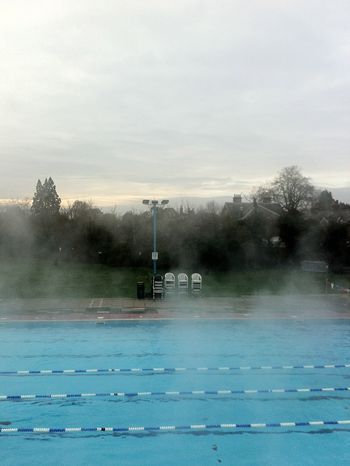
[yesterday morning]
Although I wish I were as hardy as the swimmers who leap into the Serpentine, or the ponds at Hampstead or the Serpentine, or the sea at Brighton all year round, the truth of the matter is that if I am going to swim outside in winter, it has to be in a heated pool. Not only is it more enjoyable, it's also so much more picturesque and atmospheric. On really cold days the steam rises thickly and fellow swimmers are invisible until they loom out of the mist. The spindly branches of the trees are outlined against the sky as if in charcoal, and any rains falls softly making little spots on the surface of the water. It's a quick dash from the changing room to the water (paving stones are wickedly cold under bare feet), and the warm water is easy to enter. I find the end of my nose gets a little chilly as I swim, but it's a small price to pay for breathing fresh air instead of overheated fumes.
I meet a friend for swims here in winter when the pool is quiet. There are a few regulars, some swimmers having lessons, the odd triathlete training and putting everyone to shame. It's open 365 days a year and it's a wonderful, down-to-earth, no-frills community pool. And there's a brilliant little cafe (and huge terrace overlooking the pool) where you can get big fry-up breakfasts, bowls of porridge, papers to read, and mugs of steaming tea to enjoy after a swim. I nearly said to 'warm up after a swim', but of course the joy of this place is that you never really get cold in the first place, no matter how low the tempearture.
January 11, 2013
grand provincial tour
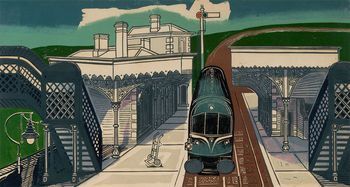
[Braintree Station (c.1961)Edward Bawden. In the Fry Gallery in Saffron Walden which is on the list.]
A while ago I wrote about my plan for a Grand Provincial Tour, a week of visiting provincial art galleries with some tea and cake, books and buildings thrown in for good meaurure. I know it was all fantasy, but it had its roots in reality. The basic premise of the Tour was to explore provincial towns with a simple cultural agenda, and as I'm still as keen as ever on walking around cities and towns, browsing in bookshops, looking at old shop fronts, finding good cafes and paintings, I see no reason why I shouldn't do the Tour, but just not as a single one-week tour, more a peripatetic tour.
This blindingly obvious solution only occurred to me last night after I'd been to Eastbourne for the day yesterday as I was telling Phoebe about my visit. I hadn't thought of it as the beginning of something, just an away-day on the train. But the more I think about it, the more it makes sense to see Eastbourne as No.1 on my list of Provincial Towns to Visit for Cake and Culture and More Besides. I already have plans to see another place to visit very soon, but the map of Great Britain is suddenly looking very exciting as I consider where else I could go.
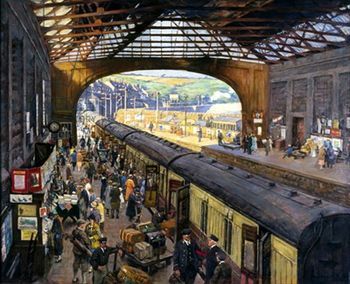
[The Terminus, Penzance Railways Station Cornwall (1925) Stanhope Forbes. In the National Railway Museum, York, which has been visited but is still on the list]
There is such a huge wealth of stuff to see and do all over the country that the possibilities are enormous; I always have a number of destinations on my list at any given time - at the moment these are St Ives, Salt's Mill and Wakefield - but it gets even more interesting once you start making real plans. All I need are some OS maps, a few Shell Guides, the spirit of Pevsner, Piper and Betjeman, an Art Fund pass, some train timetables, Google for the bookshops and cafes, a good pair each of shoes and glasses, and I'm off. I don't mind travelling alone as I've been doing this since I was a teenager, and there are times when I realise it's easier on my own because I don't have to make apologies for Victorian churches/musty second-hand bookshops/incomprehensible art installations/poor catering. But I also don't mind travelling with an uncomplaining companion who will enjoy whatever's on offer, read maps, be enthusiastic about lettering/railway stations/time-warp cafes, and not decide that it's time to leave after thirty minutes.
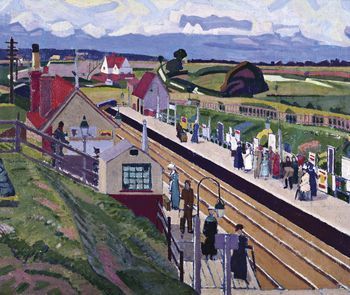
[Letchworth Station (1912) Spencer Gore. Also in the NR Museum in York]
So I'll be taking my Tour as and when I can, creating a personal map of provincial Britain (I may include some smaller places in/on the edges of London, too), travelling by train if possible. I have no schedule, no deadline, no pressure - just plenty of curiosity and a love of travel, no matter how provincial.
First stop of the Tour is Eastbourne - next post.
January 9, 2013
snug

My definition of the saying 'snug as a bug in a rug': me in bed under a duvet and quilt with books and hot-water bottle.

Now I'll be even snugger with John Betjeman et al as I've just knitted a hot-water bottle cover from a couple of skeins of cashmere yarn bought from here quite a few years ago. I never got round to using it, but always thought how good it would feel under my feet (almost as good as in my hands - it's amazing how sensitive feet are). So in an idle-I-can't-sit-and-watch-TV-with-nothing-to-do moment, I cast on 45 stitches on 4.5mm needles and knitted with double thickness yarn, making it up as I went along. I ran out of yarn to make a 100% cashmere back, so used a single strand plus a strand of Rowan wool/cotton yarn. I deliberately made sure the knitting was abnormally thick and tight in order to achieve maximum tactile pleasure and bottle insulation. It really is remarkably soft and warm, and makes being a bug even more enjoyable.

I may be some time abed.
Jane Brocket's Blog

- Jane Brocket's profile
- 27 followers

