
Jane Brocket's Blog, page 27
February 18, 2013
brighton black and white

There is also the other side of Brighton. The beautiful Regency side of white stucco terraces with bows and balconies, black wrought iron and glazed mathematical tiles, grand churches and sweeping crescents. Although it has symmetry, repetition and order, this is a more exuberant, expressive style than that of Georgian Bath, and it's as though the holiday spirit couldn't quite be fully contained. A walk along the Old Steine and round Kemp Town is a joy for anyone who likes bulging, bouncy facades, dramatic proportions, sheer verve - and a black and white palette.
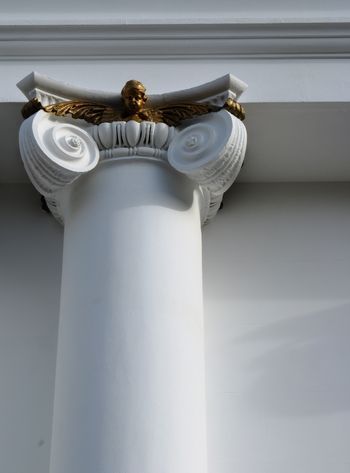
[St George's Kemptown]
We also went to the the Biba exhibition and wondered (well, I say 'we' but Simon had never heard of Biba - apparently it didn't make an impression on teenage boys in rural Humberside) if Barbara Hulanicki had in some way been inspired by the town where she spent much of her childhood and went to Art School. Because when I was 12 or 13, I bought the outfit of my dreams from the 'big Biba' in Kensington, a black and white ensemble that proved to be the acme and apogee of my fashionable life.

[Biba poster of Ingrid Boulting by Sarah Moon]
Biba had made an impression on me in Stockport. I dreamed of wearing Biba clothes every day, and of being able to shop at will in what looked like the heaven-on-earth London shop. I had Biba posters all over my bedroom wall (including the one above), wore Biba nail varnish in plum, brown and black (sometimes all in the same day), and wanted to look like the 'dreamy' - everything was always 'dreamy' in Biba-land and Jackie - and delicate Ingrid Boulting with the heart-shaped face, but that was a fantasy too far.

[Biba style]
But I did get to the big Biba in Kensington. It was on my first ever visit to London, and it was just me and my Mum. It was a huge event for me, an enormous treat, as there were four of us, no dad, one teacher's salary. Seeing the Biba exhibition made me realise what a huge impact that visit had on me; it's probably responsible for the love affair I've had with London ever since. Biba was just mesmerisingly fabulous, completely theatrical, full of gorgeous clothes and amazing people. I spent hours choosing what to buy (my poor Mum) and finally bought a pair of black and white striped, very wide jersey bell bottoms, a black long-sleeved, scoop-necked top with droopy, gathered cuffs, a very modish cloche hat in black, and a white fabric flower to go on it. Soon after, I wore it to a wedding in Manchester, realised Manchester (or the Manchester society I knew) wasn't quite ready for Biba, lost my confidence and never really wore the whole outfit again, although I wore the component parts separately.
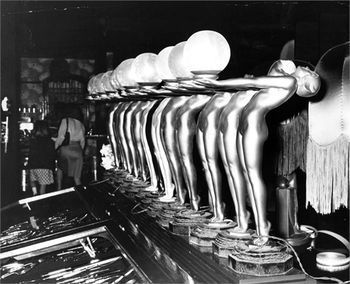
[Biba - nothing like this in Stockport in the 70s]
Looking back, I realise I should have stuck it out and blazed a little black and white trail in the North West. Too late, I see that the outfit was totally brilliant (and now very collectible). Brighton has kept faith with its black and white style for two hundred years, and no wonder: it's a classic. I should have done the same.


February 17, 2013
brighton breezy
Simon's introduction to proper, grown-up ballet with big white tutus and pointe shoes (as opposed to little girls with 'good toes' and pink outfits) came last night in the form of brilliantly skilful, muscular, graceful male ballerinas who are mesmerisingly physical and enthusiastic. We saw the Trocks in Brighton which could so easily be one their spiritual homes.
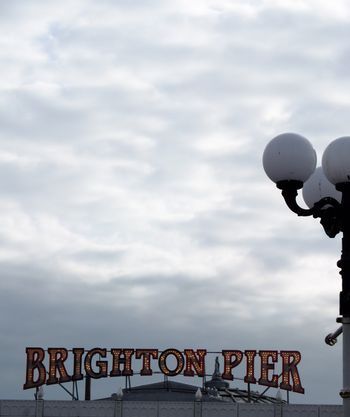
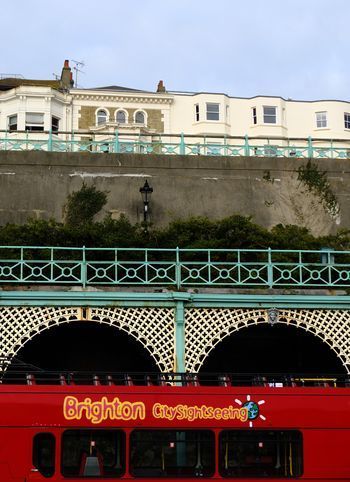
Brighton is busy, brash, with many barking mad buildings. It has a breezy holiday atmosphere even on a cold winter's day. It's colourful, energetic, and unpretentious. The crowds were almost too much round the Lanes and the pier, so we walked along Madeira Drive, following in the footsteps of Victorian visitors and admiring the half-mile long series of ornate iron arches over the walkway.
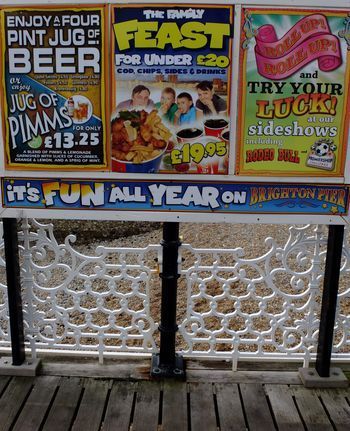
We had fish and chips, tea and cake, art and books, but (this time) we passed on the pier, the big wheel, booze, and 'kiss me quick' hats.

And this is exactly why I like Brighton: it can be just as raffish and/or refined as you like, and I would guess that it's this mix that the full house at the Dome came for and enjoyed.
February 14, 2013
20:20 vision

[red velvet cake for Alice]
For us the idea of Valentine's Day is lost in the mists of time and memories of giving birth to twins. Yes, it was twenty years ago today that Tom and Alice were born in a hospital outside Frankfurt. That's twenty years of twins and twenty years of double birthday cakes. And twenty years of beautiful bunches of tulips from Simon.
I had no idea on Saturday 13th February 1993 that I would be having the babies the next day (they were three and a half weeks early) so in the small hours of 14th February as I was whisked off in an ambulance, I kept asking Simon to bring my Valentine's Day tulips to the hospital (given on the 13th because those were the days when nothing was open on a Sunday). Sensibly he concentrated on things like toothpaste and slippers instead. But ever since then he's been making sure I do have tulips on 14th February.
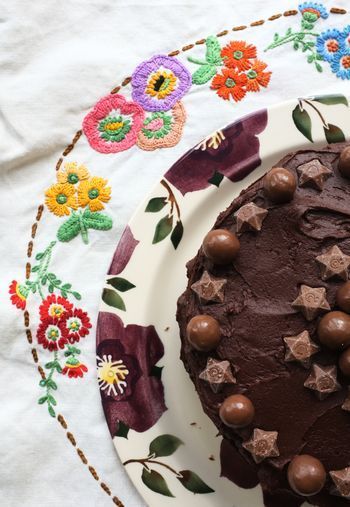
[chocolate cake for Tom]
I didn't have any vision of how Tom and Alice would be at 20. But as they both happen to be at home today (it's university reading week), I can say thay they are looking pretty good.

[tulips for me]
February 12, 2013
culture club
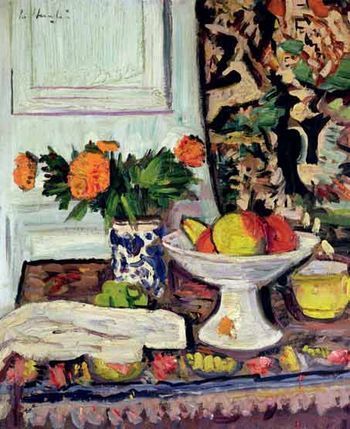
[Peonies in a Chinese Vase (1925) Leslie Hunter]
At senior school, a few of us were so keen to imbibe as much theatre, literature, film and art as possible that we thought about starting up a 'culture club'. But the idea never got off the ground and, anyway, I thought the name 'Culture Club' wasn't helping matters. (It never held back Boy George a few years later, though).
I've been continuing in this cultural vein ever since. So of course I booked in adavance for the Manet exhibition. Of course I made sure I was there for my timed entry slot. Of course I queued for the cloakroom, queued for the ladies, queued to get in, queued to buy postcards. Of course I made my way as slowly as everyone else round the rooms, craning my neck to see the paintings, waiting patiently for a gap to appear so I could see a whole one, waiting even longer to get close enough to read the captions. And I sped through the 'padding out' rooms (blown-up map of Paris, enlarged copy of painting, C19 photographs) which seemed to me to be there as crowd decompression chambers as much as anything else.
Of course, there were some absolutely wonderful paintings (but there were also too many poor ones - a bit of surprise). I loved the way Manet uses black paint but conjures up brilliant light effects, the way he captures personality and mood, the way that you can see the connection between him and his sitter. But you do come out feeling as though you've been extruded though a cultural sausage machine.
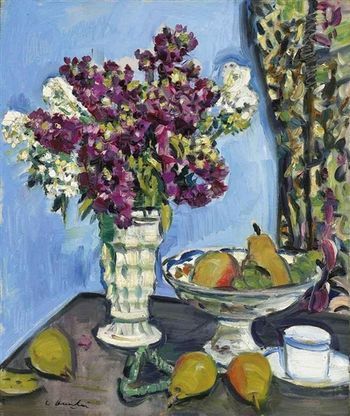
[Stocks in a White Vase (c.1930) Leslie Hunter
What a delight, then, to discover that just round the corner from the Royal Academy is the Fleming Collection, an 'embassy' for Scottish painting in a beautiful building. It's free to go in, virtually empty, and has just held a lovely exhibition of paintings by Leslie Hunter (1877-1931) who was one of the four Scottish Colourists. It was on two floors and there was a generous numbers of works (although, again, a few duds which served to highlight just how good Hunter could be).
Hunter once wrote, 'Everyone must choose his own way, and mine will be the way of colour', and this exhibition could not have been a greater contrast with the Manet in terms of palette as well as visitor numbers. Hunter's still lifes were the stars here, and the thickly applied paint, the gorgeous depth and vibrancy of his colours, the confidence and élan were wonderful to behold.
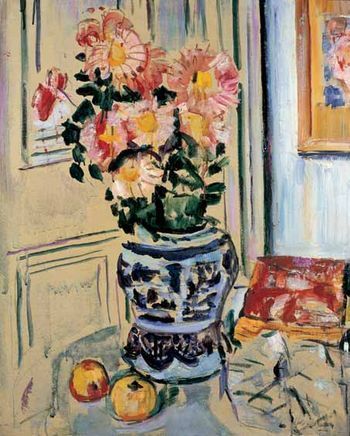
[Still Life with Marguerites (1930) Leslie Hunter]
In later life Hunter suffered 'increasing ill-health', a euphemism for drinking himself to death, and you can see the effects in the marguerites painting above. I can't imagine why it was chosen for the exhibition poster as it's a sad still life which looks as though it was painted while he was unwell and under the influence: the flowers are unsteady and listing, there are messy blood-red splashes and drips, and close up the whole thing looks desperate and wild.
Both Manet and Hunter died in their early 50s; Hunter ended up squandering his talent while Manet was not given enough time to explore the full extent of his gifts. Both were worth going to - but much as I love landmark exhibitions, these days I think any culture club I might belong to would have to meet in places where it's possible to actually see and breathe.
February 11, 2013
bun binge
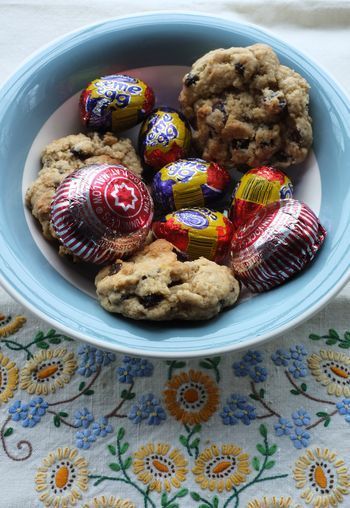
We have a full house, and I am surrounded by strong-willed people. People who are much, much better at self-control than me. A month without chocolate here, a month without fizzy drinks there, a total cutting-out of rubbish food until a bad habit has been broken, abstention from alcohol as required, a foregoing of biscuits for weeks on end. All I do is clear kitchen drawers of offending items, stop buying and baking further supplies, and offer tea and sympathy when temptation threatens to spoil good runs and personal bests.
Lent has become a testing time for other people. There have been big discussions about what will be given up this year and promises made to encourage and support. As I've never taken any notice of Lent in my whole life (and, it has to be said, neither have the others until the last couple of years when it has happened to coincide with, and be a good vehicle for, competitive denial/one-upsmanship/moral high ground claims), I am bemused by the enthusiasm being shown for asceticism.
But, like those coaches who travel behind the shocking thin elite cyclists in cushioned car comfort (and no doubt with a good supply of snacks), I am prepared to support my own team of Lent competitors. To this end, I am baking buns today, pancakes tomorrow, then hiding my chocolate for the next six and a half weeks.
February 7, 2013
underneath the arches

[Underneath the Arches: Cabaret]
I've always associated railway arches with Flanagan and Allen, secret trysts, the scene in Cabaret in which Liza Minnelli and and Michael York scream as the train thunders overhead, drips and shadows and echoes, unsettling sounds of footsteps as a man follows someone in too many black & white films, lockups and garages, bomb shelters and gruesome murders, and Victorian paintings of 'fallen women' who have have been cast out of their homes.
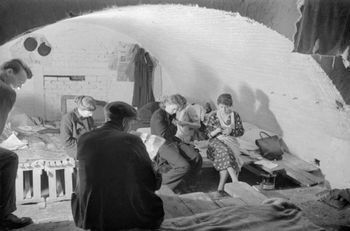
[Underneath the Arches: WWII bomb shelter]
So, not particularly pleasant associations, although I've always fancied emulating the Cabaret scene.
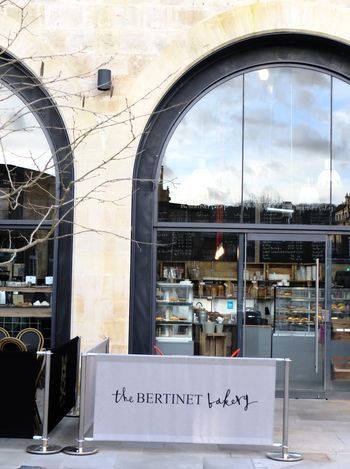
[Underneath the Arches: Bertinet Bakery]
But now I have to alter my image of railway arches into something much more wholesome and less threatening. Yesterday, I was in Bath early enough for breakfast and went to the new Bertinet Bakery which is sited in one of Isambard Kingdom Brunel's arches, part of the orginal Bath Spa station buildings and now part of the SouthGate development (lovely station now that you can see the front in all its curving, golden-stone attractiveness). The vaults are all freshly done outside, but the arches inside look more like something from an ancient church than a C19 railway structure. And as I ate, I began to see a pattern with railways and baking, raised arches and rising bread.
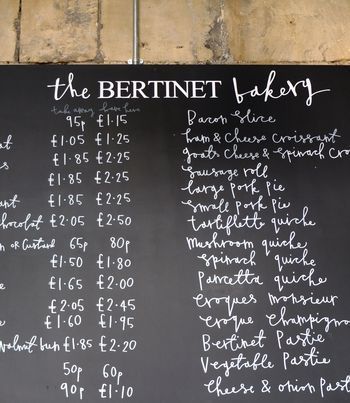
[Underneath the Arches: more interesting backboard writing]
The Exploding Bakery (post below) is set in a parade of shops by Exeter Central Station. St John Bakery is in one of the arches at Spa Terminus (aka Maltby St Market), as is Little Bread Pedlar, and Bea's of Bloomsbury. The bread-sellers of Borough Market compete with the sounds of the trains running on the line above, and now have a new viaduct. The address of E5 Bakehouse in Hackney is Arch 395. E8 also has the Yeast Bakery in Arch 354. There's soon going to be a Balthazar Railway Wholesale Bakery in Arch 189 & 190 at Waterloo (as in the famous NY Balthazar). I've just discovered that Hart's Bakery in Bristol which had such erractic opening schedules that I could never catch it, has just moved to an arch by the wonderful Bristol Temple Meads station (another Brunel design - maybe it's just a matter of time before we get a string of brilliant bakeries along the old GWR line?)

[Underneath the Arches: Bertinet breakfast]
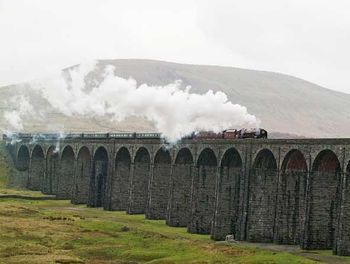
It makes sense. Railway arches can be found in urban areas near passing travellers and commuters, they are spacious, solid, no doubt be cheap to rent, and the ovens would help to keep them warm and dry. But no matter how hard I look, I can't find any of these admirable 'real bread' baking initiatives happening any further north than London. And yet there are more railway arches than you can shake a stick at in places such as Manchester and Sheffield and Birmingham. Just imagine what you could do in the arches of Stockport Viaduct. Or this:
February 4, 2013
playing with marble
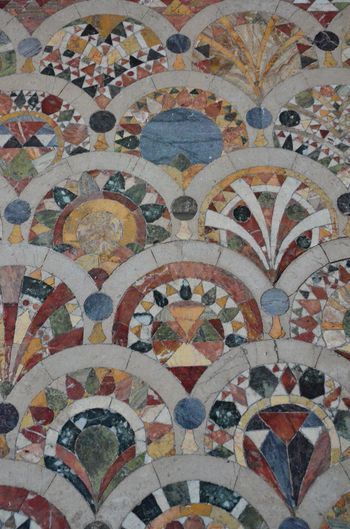
If ever you're in Exeter, there's a lovely church worth visiting. You pass it as you walk into the city from Exeter St David's station. It's St David's Church on the top of St David's Hill, and Betjeman described it as the 'finest example of Victorian church architecture in the south west'. Except it's not really terribly Victorian at all as it was built 1897-1900 by WD Caroe and is considered his masterpiece.
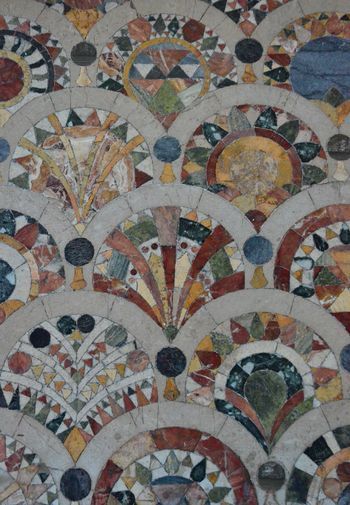
The exterior is a little confused as its Arts & Crafts simplicity is compromised by a little too much Gothic decoration and unnecessary additions, but we loved the interior which is startlingly beautiful, rich but understated. It has impressive and unusual ribs over narrow side aisles, a barrel-shaped wooden roof, lovely stained glass by Kempe, lots of Arts & Crafts detail in stone and carvings and glass, and even a wonderfully designed door handle. The real treat, though, was the inlaid floor in the sanctuary made with many colours of marble and stone and great numbers of repeating patterns, looking for all the world like hard, cold quilts and using what I recognise as many traditional, quilt designs.
So there was me thinking how amazing that quilt patterns can be found in churches - until I did a little research later and found that it's the other way round: quilters have been borrowing from other sources for a long, long time. These fabulous patterns were created by Lee Brothers of Bristol, but they were following a much older and better known set of brothers. It's a Cosmati-style pavement inspired by the work of several generations of the thirteenth-century Cosmati family of Rome who produced exquisite inlaid stonework in churches (not just floors) and in doing so seem to have created the templates for many quilt designs.
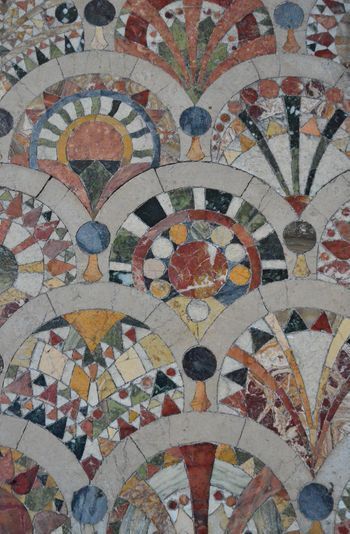
A little further delving revealed the fact that there is a superb C13 Cosmati Pavement in Westminster Abbey which has been restored recently. As I was going to be in London today, and as I hadn't been to the Abbey for at least 25 years, I thought I'd go and see some real Cosamti quilt inspiration. Well, I should have known. £18 to get in (St David's is free), crowds milling everywhere (St David's is empty), no photography (St David's doesn't seem to have a problem with it), and the pavement is raised up and roped off so you really can't see it properly anyway, unlike the floor in St David's to which you can get as close as you like. (But you can watch this.) Add to the fact that the Abbey is so full of stuff everywhere it looks like a hyped-up mad version of Sir John Soane's Museum and it's all a bit suffocating and difficult to enjoy. (The far quieter cloisters and the Chapter House are much more peaceful and quietly beautiful.)
But I am glad there are many more brilliant Cosmati creations, ancient and more modern, to be looked up and marvelled at, and maybe seen one day.
February 2, 2013
eating my words
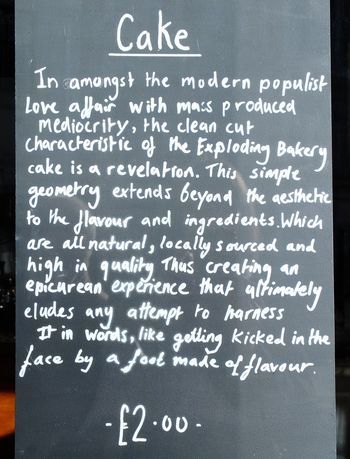
On this occasion, I am very happy to be proved wrong. I wrote the post below on Thursday. On Friday I ate delicious, fresh, good value cake baked a few feet away from where I was sitting in The Exploding Bakery in Exeter.
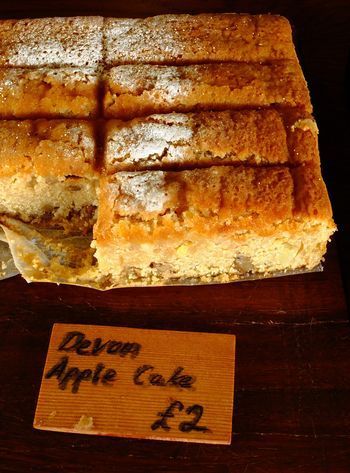
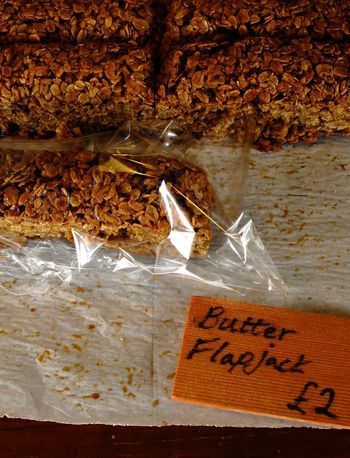
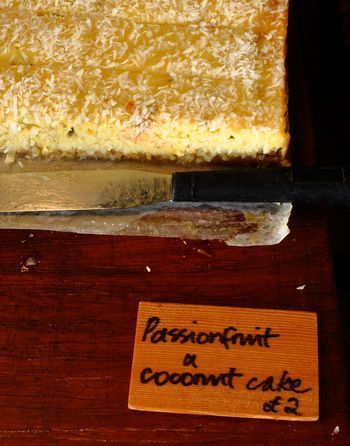
Great coffee and bread, too, and a fine mission statement.

January 31, 2013
baking peaks

[rock buns, recipe in Vintage Cakes]
I think the market for cake may have peaked. Like overbeaten egg whites and cream, it seems to have slumped recently. I have noticed collapsed cake businesses in sadly empty premises in several provincial towns, reflecting the reality that it's very hard to make cake pay.
Nevertheless, I have to admit I'm not sorry that the cupcake craze is now waning as I'm not fond of the word or the confection, the way the cake has become a caricature of itself, and the fact that all too often it is looked at and exclaimed over rather than eaten. Give me a fairy cake instead (or 'fairy bun' as I have always said) or, even better, anything that puts taste and texture before style and appearance.
It's ironic after such a cake-peak that it's becoming more difficut to get nice, fresh cake when eating out. Too many places (museums, galleries, cafes, hotels) source a wide range of cakes in order to join in the cake fun. But these turn out to be made by large industrial-style producers who are more concerned about price, profit margins, longevity and looks than ingredients, quality and authenticity. Their cakes look tired, bland and dull, and taste the same. Even the big names and caterers who made such an impression a short while ago would do well to do some random sampling in their concessions as there are some shockingly miserable and stale baked goods on sale at shockingly high prices. There are some exceptions (most recently the London Review Bookshop), but I don't think it will be too long before we are back to Kit-Kats and plastic-wrapped biscuits with our cups of tea - they are are simply safer, longer lasting, easier to store, and cheaper.
However, not all cake is sunk just yet; if we want decent treats, we can always go back to baking at home and producing good, simple, unshowy cakes made with fine ingredients. It seems I'm not the only one to reach this conclusion - by pure coincidence, just as I was rubbing the butter into the flour to make rock buns, this came onto Radio 4 and confirmed all I was thinking. (I also liked the Raymond Chandler reporting style and the classic quote about tarantulas and angel cake.)
January 30, 2013
art on walls

Coventry is very generous with its public art, and puts a great deal on display where everyone can see it as they move around the city. There's plenty of sculpture (most famously the statue of Lady Godiva) and, interestingly, a number of important post-war murals that were intended to enhance the newly built precincts, underpasses and shopping areas, but have mostly ended up being removed and placed elsewhere because they were no longer wanted, needed - or perhaps even looked at.
The most outstanding is this huge relief sculpture carved on Portland stone which is now on the exterior of the Herbert Art Gallery. In their 0riginal location the two sections were tucked away under stairwells and obscured by fountains in a shopping precinct, but they look far more impressive side by side on a 1960s brick wall on a busy street.

This is Man's Struggle by Walter Ritchie, a late pupil of Eric Gill, and something of a wayward character himself. It must have been pretty uncompromising, challenging stuff for its time and I would think a few commissioning councillors got more than they bargained for. But it was a bold and a brave commission in the first place, and is of a piece with the generally bold, modern approach the city took with its post-war buildings and public art. It would have been so easy to look backwards and play it safe and nostalgic. Instead, the council took a gamble, looked at the reality of post-war life which was inevitably going to be tough and very different, and they captured that spirit and energy instead.

There is also the tiled 1958 Cullen Mural which I didn't know about until I got home (good reason to go back - as well as to see the flying saucer-style circular market building), but I did see all the art on the walls of the excellent Herbert Art Gallery.

Inside and out, the walls of Coventry have plenty on offer.
Jane Brocket's Blog

- Jane Brocket's profile
- 27 followers

