Roy Christopher's Blog, page 7
December 1, 2023
I Thought I Lost You
Bay Area hauntologist and Deadverse alumna Mars Kumari proudly presents her debut record with Bruiser Brigade, I Thought I Lost You, available today.
 Mars Kumari I Thought I Lost You (Bruiser Brigade)
When the French philosopher Jacques Derrida defined the lingering Marxism of late-Capitalist society as hauntological, mashing together the words haunting and ontology, he couldn’t have imagined what the era might sound like. Mars Kumari captures the grief and grit of loss we all feel now, haunted as we are by what was here and is now missing.
Renowned Detroit artist collective Bruiser Brigade, host of cutting-edge artists like Danny Brown and Zelooperz, is proud to announce the upcoming release of Mars Kumari’s highly anticipated LP I Thought I Lost You. A mystery-ridden and heartfelt collage of textures, voices, tones, and the sounds of the breathing of forgotten machines, this hour-plus journey evokes a mournful amalgamation of tenebrous hip-hop, displaced jungle, upended dark ambient and bereft power electronics. Sharing tracks with underground and independent anti-heroes: Fatboi Sharif (Backwoodz Studios), dälek (Deadverse), Uboa (The Flenser), Lucas Abela (Justice Yeldham, dualplover), SAINT ZAIYA, L. Coats, Liiight, Censored Dialogue, and Big Flowers, among others. It’s a sound collage and force of plunderphonics. It’s a record that feels like a misplaced sense of what it means to be material.
Come lose yourself.
It’s Bandcamp Friday, so pick this up today!
Thanks for reading and listening.
More soon,
-royc.


November 21, 2023
Giving Thanks
As we gather together this week, here’s some book news I’ve gathered over the past few.
Oh, if you’re looking to get a jump on your holiday shopping, I have several books that make excellent gifts (hint, hint).
Read on!
 Jessica King on
DW,DD
Jessica King on
DW,DD
Last week, Jessica King posted this nice video review of Different Waves, Different Depths. She uses words like “punk,” “romance,” and “a little bit of existentialism” to describe these nine short stories.
As seen in the video, Jessica makes really cool dolls. Check out her Etsy shop!
 Josh Feit Writes…
As you know, I interviewed my friend and fellow poet Josh Feit a few weeks ago. Well, Josh posted about it on his blog. Here’s an excerpt:
Prolific pop culture critic and academic Roy Christopher wrote one of my favorite non-fiction books of the past five years, Dead Precedents: How Hip-Hop Defines The Future, which I’ve lovingly placed on my bookshelf right beside classic cultural texts Can’t Stop Won’t Stop: A History of the Hip-Hop Generation by Jeff Chang, Cut ‘N’ Mix: Culture, Identity and Caribbean Music by Dick Hebdige, and How Music Got Free by Stephen Witt (not as monumental, but a personal revelation).
I met Christopher in 2019 when I came upon his Dead Precedents reading at Elliott Bay Books. Knowing nothing of him beforehand, and suddenly captivated, I asked an audience question (which I never do) about William Gibson and Caribbean music. We ended up getting drinks next door at Oddfellows with his wife and our mutual friend, Charles Mudede (who had emceed the whole bookstore event.)
We have stayed in touch ever since; meaning, I subscribe to Christopher’s newsletter, and I’m continually awed by his non-stop writing and non-stop mind. I asked him to blurb my book The Night of Electric Bikes earlier this year, and he did.
So very nice. Check out Josh’s blog and his books!
 BDP at Chamblin’s Uptown in Jacksonville, Florida.The Return of the
Boogie Down
BDP at Chamblin’s Uptown in Jacksonville, Florida.The Return of the
Boogie Down
After selling out of its initial print run, our collection Boogie Down Predictions is available again! Pictured above on the counter at Chamblin’s Uptown in Jacksonville, Florida, BDP is a literary mixtape of the highest caliber. I mean, just look at it.
Can’t Stop, Won’t Stop author Jeff Chang says,
Roy Christopher’s dedication to the future is bracing. Boogie Down Predictions is a symphony of voices, beats, and bars messing with time, unsettling histories, opening portals.
 The Medium Picture
As I mentioned a few weeks ago, I’m hoping to have some news to share about The Medium Picture soon. I can say that it’s under review at a publisher I’d love to work with. So…
Think happy thoughts!
Thank you for indulging me every week,
-royc.
November 14, 2023
"Film My Life" Soundtrack
Anyway, I found this FML Soundtrack piece I did for Punk Noir Magazine in 2021. The prompt was What songs are playing during these key scenes in the movie of your life and why? I’m sharing the updated list here including links where you can listen.
Childhood:KISS “Shout It Out Loud”: My first favorite band was KISS. I saw them play live when I was 8. This is the first song I think of when I think of that time.
First Love:The Cure “A Night Like This”: Like every entry on this list, this one could be its own list. With that said, there’s still something about “A Night Like This” that captures the potential of that first encounter like no other song.
Teens:Minor Threat “Salad Days”: My teen mind was shaped by Ian MacKaye, Kevin Seconds, Robert Smith, Danny Elfman, Chuck D, Ice-T, and KRS-One.
I’ve already said too much.
Young Adult:Superchunk “On the Mouth”: I spent the already tough young-adult years in a stilted and stifling relationship. Mac McCaughan’s tales of young love’s beginnings gave me hope for something better.
First Heartbreak:…And You Will Know Us by the Trail of Dead “Mistakes & Regrets”: I once listened to this song on repeat for 13 hours straight. I was distraught.
Working Montage:Gang Starr “Work”: Premier’s bounce on this song is perfect for a getting-it-done montage. The lyrics about putting in work are just gravy.
Sex Scene:TV on the Radio “Wear You Out”: This is one of the only songs ever written about sex that’s actually sexy.
Writing Montage:Van Halen “Unchained”: It gets no better than this. Turn it up.
Old age:Abecedarians “They Said Tomorrow”: I think of old age as a period of summation. “They Said Tomorrow” is my favorite song ever. I first heard it in my teens, and it sums up a lot of things I felt then that still haven’t changed.
Death:His Name is Alive “I Can’t Live in This World Anymore / Home”: The perfect goodbye.
What would yours look like?
More Soundtracks:I made soundtracks for a few of my books as well. Check ‘em out:
Escape Philosophy: Journeys Beyond the Human BodyWith healthy servings of Deafheaven, Wolves in the Throne Room, Celtic Frost, and of course the mighty Godflesh, my Escape Philosophy playlist is just the thing to accompany the book.
Dead Precedents: How Hip-Hop Defines the FutureRepeater Books posted this playlist on their YouTube channel for my book Dead Precedents when it came out. It includes artists I talk about in the book like Tricky, Public Enemy, Shabazz Palaces, New Flesh, Rammellzee, dälek, Moor Mother, and Mike Ladd. In addition, this archived version of “Dead Precedents: The Lost Tapes” from The Mantle includes songs by dälek, Antipop Consortium, Danny Brown, clipping., and Cannibal Ox.
“Fender the Fall”:My time-travel love story, “Fender the Fall,” which is included in my new collection Different Waves, Different Depths, started out as a screenplay, so I had a soundtrack in mind as I was writing it. This playlist includes songs from both of the times in the story, 2002 (e.g., Sparta, The Notwist, …And You Will Know Us by the Trail of Dead, Rival Schools, et al.) and 1991 (e.g., School of Fish, The Jesus and Mary Chain, The The, Peter Murphy, et al.).
Thanks for reading and listening,
-royc.
November 7, 2023
Drugs of a Feather
A young boy puts a feather into his mouth… The Stash Riders: Scribble, Beetle, Bridget, Mandy, Tristan and Suze… The Thing from Outer Space, Game Cat, Dingo Tush, Bottletown, robodogs, droidlocks, and dreamsnakes… It’s about drugs and droogs. It’s about their misadventures in this and that Other world: Vurt. Scribble’s sister, his lover, Desdemona is lost, lost to the Vurt, that feathered, nethered world spinning somewhere inside of this one. If he is to get her back, if he is to grab her, he has to let go of something else.
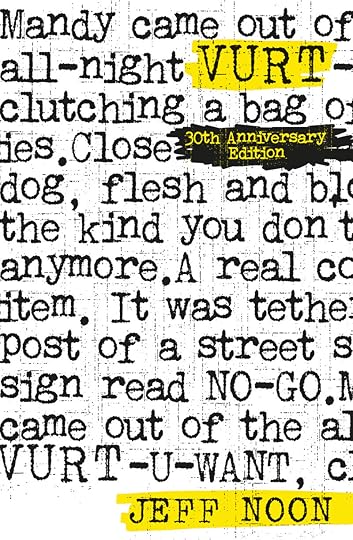 The cover of Angry Robot’s 30th Anniversary edition of Vurt, featuring the novel’s opening lines.
 I’m not telling this very well. I’m asking for your trust on this one. Here I am, surrounded by wine bottles and mannequins, salt cellars and golf clubs, car engines and pub signs. There are a thousand things in this room, and I am just one of them. The light is shining through my windows, stuttered by bars of iron, and I’m trying to get this down with a cracked-up genuine antique word processor, the kind they just don’t make any more, trying to find the words.
Sometimes we get the words wrong.
Sometimes we get the words wrong!
— Jeff Noon‘s Vurt, (p. 151)
In his introduction to Noon’s Cobralingus (Codex, 2001), Michael Bracewell writes, “Much of Noon’s best known imagery… derives its power from the literalizing of poetic language and the concretizing of images: the sudden opening up, within the landscape of the prose itself, of new routes to character and narrative, enabled by altering the meanings of words within the containers of their language.” The Shining Girls author, Lauren Beukes says that Vurt blew her mind, “not just for the story and the characters which absolutely caught the mood of where we were, but pushed language in insanely playful ways and delivered a kicker of an ending.” She cites Noon’s best known aphorism: “Form is the host; content is the virus.” To wit, Vurt‘s virus has infected everything from Beukes’ Moxyland (Angry Robot, 2008) to Steven Hall’s The Raw Shark Texts (Canongate, 2007).
“Vurt was written in a kind of dream state,” according to Noon. “I was working at Waterstone’s bookshop in Manchester during the day and writing it at night, usually really late into the early morning.” It started as half a play. “I’d spent a good number of years trying to make some money by writing plays, with no real success,” he says, “Someone else working there [at Waterstone’s] was a fringe theater director and was always asking me to write him a play.” Noon took Octave Mirbeau’s 1899 novel The Torture Garden and adapted it through the then new idea of virtual reality news of which was trickling over from America via magazines like Mondo 2000. When his director friend moved to Hong Kong, another co-worker started a small press and, being a fan of his plays, asked Noon to try writing a novel. He agreed. “And quite naturally,” he adds, “I took the basic plot I’d added to The Torture Garden as my starting point. It grew organically from that seed.”
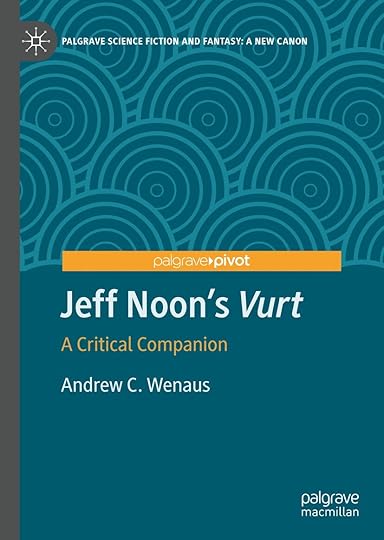 A Critical Companion by Andrew C. Wenaus.
Why? A voice told me to do it.
Which voice? The one that never stops.
— Jeff Noon’s Vurt, (p. 177)
In his book-length analysis, Andrew Wenaus distinguishes Vurt from other genre novels by pointing out its setting: Manchester, England. It’s grounded cyberpunk. It doesn’t ripple across international borders. It rips through multiple Manchesters. I found Noon’s book via the blurbs on the back of Doug Rushkoff‘s first novel, Ecstasy Club (1997), sometime during the wild-at-heart and weird-on-top 1990s. The music of that time is woven deep in the language of Vurt. Music is “without doubt my favourite art form,” says Noon, “and the one that saturates my waking life from morning till night. So, I always try to use techniques invented by musicians in my novels and stories, simply because musicians seem to get there first these days, in terms of an avant–pulp interface.” Among its pages you can hear the manic Madchester music of Happy Mondays, Stone Roses, The Charlatans, and Inspiral Carpets. Bracewell writes, “More than any other writer of his generation, Jeff Noon has assimilated the techniques developed in the recording of music and pioneered their literary equivalents,” and Noon explains, “My main insight was to realize that words, whilst seemingly fixed in meaning, are in fact a liquid medium. They flow. The writer digs channels, steers the course.”
Through the looking-glass course of Vurt, one can see shades of Twin Peaks, A Clockwork Orange, Neuromancer, Snow Crash, Star Wars, Donnie Darko, and Philip K. Dick, among other things. Vurt won the Arthur C. Clarke Award in 1994, and William Gibson called it “really fresh and peculiar at a time when we were constantly being told that lots of SF novels were really fresh and peculiar, but they often weren’t, particularly.” It is certainly fresh and peculiar — even now. The thing that makes it not only so poignant but also timeless is its passion. Under all of the made-up slang, vivid imagery, adjacent dimensions, drug talk, and other detritus of rave culture, there lies the urgency of a real human heart beating, the heart of a writer who cares about things.
We’re all out there, somewhere, waiting to happen.
— Jeff Noon’s Vurt, (p. 87)
Noon says of Vurt, “Like many a first novel it came out of a weird Venn diagram of influences: Gibson, Ballard, Borges, Lewis Carroll, techno music, dub culture, Mondo 2000, graphic novels, 1970s punk, and everyday life in the North of England in 1993. It’s amazing to think that Vurt is still on its journey, still traveling, and still finding new readers.” The newly released 30th Anniversary Edition is further evidence of that. This edition features a new Introduction by Adam Roberts, and a new Afterword by Noon himself about how the book was written.
If you’ve yet to take the trip, your yellow feather awaits.
ICYMI:Jeff Noon, Andrew Wenaus, and I — among many, many others — contributed to…
Many thanks to Jeff Noon for providing additional information about the new version of Vurt.
And thanks to you for reading,
-royc.
October 31, 2023
Weak Ties Gone Wild
One of the since-faded early concerns of the internet was “information overload.” The worry was that given the onset of abundant connectivity and content, we were being inundated with so much information that we’d never be able to process it all. Now we limit the flow in our feeds and find just what we need. The real danger of filter bubbles and echo chambers is a cultivated myopia: a limited view, a world of sameness, and an inability to see beyond the barriers we’ve erected for ourselves. As Jay Ogilvy once said, “If it’s not different, it’s not information.”
 My Sharpie rendition of The Strength of Weak Ties.
In the late 1960s, Mark Granovetter was studying how people found jobs. His 1973 article in the American Journal of Sociology, “The Strength of Weak Ties,” states that each person in a close social network is likely to have the same information as everyone else in that network. It’s the weak ties to other networks that lead to the new stuff. That is, weak ties are a more likely source of novel ideas and information—regarding jobs, mates, and other opportunities—than strong ones. Granovetter says, “I put the theory of weak ties together from a number of things. I learned about hydrogen bonding in AP Chemistry in high school and that image always stuck with me—these weak hydrogen bonds were holding together huge molecules precisely because they were so weak. That was still in my head when I started thinking about networks.”
Like most of my research interests, I first noticed these thresholds in music. I was looking at the tapes and CDs I had on hand one day, and I noticed that most of my favorite bands didn’t fit into established genres. They tended to straddle the lines between genres. In nature, these interstitial spaces are called edge realms. In her book When Plants Dream (Watkins Media, 2019), Sophia Rokhlin describes them as follows:
The edge describes the place where two distinct ecosystems meet. These are places of tension and unfamiliarity, territories of confrontation, where different ecosystems overlap and merge. The edge is found where a grassland meets a forest, where oceans reach the shore, where wetlands mediate between river basins and fields. Edges are hot spots of biodiversity that invite innovation, intermingling, and new forms of cooperation from various species. Edge realms are thresholds of potential and fecundity.
 Mutations inside Area X as seen in Alex Garland’s Annihilation (2018).
An edge realm is a wilderness, a mutant space ripe for new forms. In Jeff VanderMeer’s Southern Reach Trilogy, the mysterious Area X is just such a space. Its pollinations crossing well established boundaries, mixing into ever-new breeds and combinations. In his book about VanderMeer’s work, None of This is Normal (University of Minnesota Press, 2018), Ben Robertson writes,
Area X is something else, what has always already disrupted the processes by which by which borders are established between that and this, between one space or time and another space or time, between the human and whatever its other happens to be.
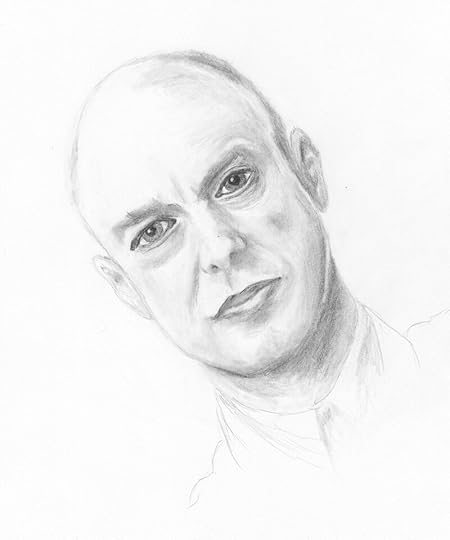 My pencil portrait of Brian Eno from
Follow for Now, Vol. 2
.
My pencil portrait of Brian Eno from
Follow for Now, Vol. 2
.The fertile ground is in between the established crops of others. The new stuff happens at the edges, in between the codified categories. Any old boring story from history can be made more interesting by varying viewpoints. In his 1996 memoir, A Year with Swollen Appendices (faber & faber), Brian Eno proposes the idea of edge culture, which is based on the premise that
If you abandon the idea that culture has a single center, and imagine that there is instead a network of active nodes, which may or may not be included in a particular journey across the field, you also abandon the idea that those nodes have absolute value. Their value changes according to which story they’re included in, and how prominently.
Each of us tell our own stories, including the cultural artifacts relevant to the narrative we’ve chosen. The long tail, the internet-enabled power law that describes “endless aisle” online markets, is an ironic attempt to depict a big picture that no longer exists. With its emphasis on the individual narrative, edge culture more accurately illustrates the current, fragmented state of mediated culture, subcultures, and the way that edge realms and social networks define them.
 My Sharpie sketch of a Boundary Object in use among 3 communities of practice.
The members and fans of subcultures—groups united by similar goals, practices, and vocabularies—represent what Etienne Wenger calls communities of practice. To translate differences and aid communication between these communities, they use what Susan Leigh Star and James Griesemer (1989) called boundary objects. A boundary object can be a word, concept, metaphor, allusion, artifact, map, app, or other node around which communities organize their overlaps and interconnections. These connective terms emphasize groups’ similarities rather than their differences, allowing them to communicate and reduce confusion between their disparate vocabularies. Boundary objects between different communities of practice open borders once inaccessible, circulating ideas into new territories.
Allusions, references, quotations, metaphors, and other figurative expressions provide the points at which multiple texts, genres, and groups connect and collaborate. “What I see instead of there being one line, many lines,” Eno explains in a lecture from 1992, “lots of ways of looking at this field of objects that we call culture. Lines that we may individually choose to change every day.” Hunting and gathering, picking and choosing, we can each make our own individual mongrel culture.
Mark Granovetter conceived the edge realms of these cultural networks way before we were all connected online, but his insight is all the more relevant today. “Your weak ties connect you to networks that are outside of your own circle,” he explains. “They give you information and ideas that you otherwise would not have gotten.” With our personal media, ubiquitous screens, and invisible, wireless networks, we live in a world of weak ties. You just have to reach out to find the new stuff.
Further Reading: The Medium Picture
This bit is excerpt from my notes for my manuscript, The Medium Picture, about which William Gibson says,
Very much looking forward to reading new Christopher, exactly the sort of contemporary cultural analysis to yield unnerving flashes of the future.
Details are still coming together, but I’m hoping to have some news to share about the book soon. In the meantime, there are excerpts and raw files on its website.
Many thanks to Claudia Dawson for her added insight on this topic. You should subscribe to her Many-Worlds Vision newsletter now!
And thanks to you for reading,
-royc.
P.S. Happy Halloween!October 24, 2023
Gaming the Change
“For the first time in history it is now possible to take care of everybody at a higher standard of living than any have ever known. Only ten years ago the ‘more with less’ technology reached the point where this could be done. All humanity now has the option to become enduringly successful.” — Buckminster Fuller
Though he said the above in 1980, Buckminster Fuller had been predicting that technology would solve the world’s poverty problem for decades before, and in 1977 the National Academy of Sciences confirmed that it would happen within one generation in their World Food and Nutrition Study. In addition to feeding everyone, Fuller was also an early proponent of renewable energy sources, and his research demonstrated that we had the ability to satisfy all of our energy needs, not rely on atomic energy, and phase out fossil fuels completely.
So what happened?
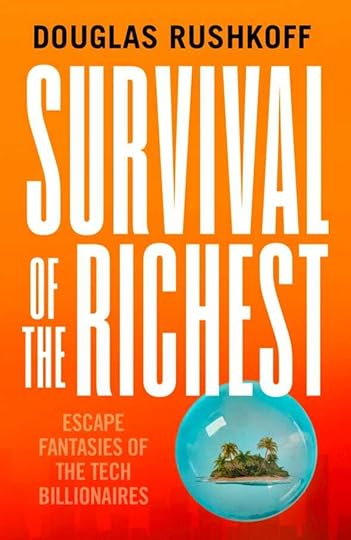
It’s easy to blame capitalism, but according to Douglas Rushkoff’s newest book, Survival of the Richest: Escape Fantasies of the Tech Billionaires (W.W. Norton & Co., 2022), which is now available in paperback, there was at least one coconspirator. A religious belief in technology’s sovereignty and its ability to solve any human problem, what Neil Postman called technopoly: “the submission of all forms of cultural life to the sovereignty of technique and technology.”
Technopoly and capitalism, or more specifically, technologists and capitalists.
Rushkoff starts off the book recounting a shady meeting with five billionaires. They are planning their escape from the encroaching end times, and they want to know how to insulate themselves from the hoards that will come for the fortunes they’ve amassed. They want to know where on Earth they can retreat and suffer the least impact from the inevitable climate collapse. They’d also like to keep the security teams under their employ from revolting.
This bunker, escapist mentality is what Rushkoff calls The Mindset:
The Mindset is based in a staunchly atheistic and materialist scientism, a faith in technology to solve problems, an adherence to biases of digital code, an understanding of human relationships as market phenomena, a fear of nature and women, a need to see one’s contributions as utterly unique innovations without precedent, and an urge to neutralize the unknown by dominating and de-animating it.
Whether by spaceship or Singularity, those with The Mindset are out to escape the mess of the lowly masses.
In the meantime, they have us distracted by devices, fighting each other over planted political stories and straight up made-up shit. While we’re online flaming our friends and family over illusory social and cultural divisions, they’re dowsing the world with gas, watching it all burn down. We are the pieces in the game they’re playing. Whether they eventually escape to an island, another planet, or a matrix in their minds, they’re not planning on taking us with them unless we pledge to help maintain their post-apocalyptic peace.
Rushkoff doesn’t share my pessimism for the broken promises of technopoly (see below). Like Buckminster Fuller, he still believes with the right tools and attitudes, we can right spaceship earth and turn things around.
Buckminster Fuller started his life’s work while on the verge of suicide. He realized that his life belonged to the universe, and he dedicated the rest of it to designing a better world for everyone. If only a little but of his spirit can survive in our technology maybe the rest of us will too.
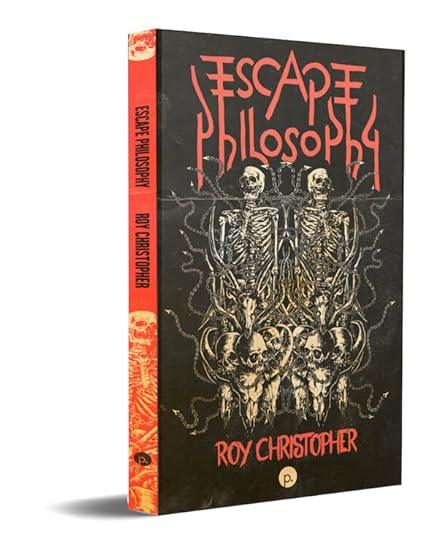 All the World’s a Grave:
Kind of a goth little brother to Survival of the Richest, my book Escape Philosophy: Journeys Beyond the Human Body (punctum books, 2022), explores the deeper, darker side of our corporeal escape fantasies. Here are a few excerpts:
“BODY: The Root of All People” on Apocalypse Confidential
“Crash Worship” from “MACHINE: Mechanical Reproduction” on Malarkey Books
And…
Thank you for reading,
-royc.
October 16, 2023
Josh Feit: Dwell Time in the Interstitial City
My introduction to Josh Feit’s work was through The Stranger, Seattle’s longest running alternative publication. There’s a line from an article he wrote about Brittany Spears for their “Yes, Logo” special issue in 2002 that I had quoted so often, I had memorized. I recited it to him when we finally met in 2019: “Authenticity comes from the moment you’re living in, not from the product you’re buying.”
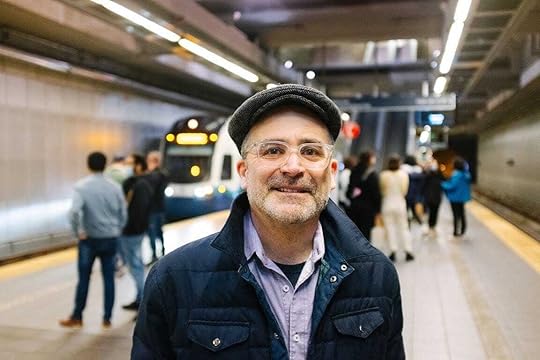
Feit has moved on to other creative work, most notably poetry. The Night of Electric Bikes (Finishing Line Press, 2023), his latest collection, meanders through urban terrain, wandering with wonder. About it, I wrote,
Josh Feit notes herein that urban planners call the time commuters have to wait for mass transit “dwell time.” The Night of Electric Bikes is dwell time well spent, like no matter where you’re headed, you’re already on your way. As Feit writes, “You have arrived. Your destination is found in others.” These poems are sidewalks and streets and cities made of stories, and within them, many more to explore. Take your time, the next one will be along soon.
His first collection was Shops Close Too Early (Cathexis Northwest Press, 2022), and he’s working on a new one now. I find it fitting that I committed Feit’s words about authenticity to memory, since capturing that authentic moment is the ultimate pursuit of poetry.
Roy Christopher: I got to know your written work originally through The Stranger. When did you start writing poetry?
Josh Feit: It’s fitting that you mention the time I worked as a news reporter. I spent years in the newsroom before I ever started writing poetry, but the whole time, I felt there was something poetic in the policy debates I was covering. People were clashing over how they wanted their city to work in a way that seemed almost existential. Anything from parking regulations, to a proposed employee head tax, to should we allow more density in the neighborhoods? The debates were so emotional. Where should the light rail station go? These technical discussions about dry subjects like zoning turned the cityscape into a personal canvass for people, and suddenly the discussions became metaphors for larger questions about living life itself.
These policy matters started segueing into verse for me when I was working as a speechwriter in the mayor’s office and my brain was spending more time in the margins of the Word doc on my computer screen where I imagined adding fanciful footnotes about: how mixed use development can be piano nocturnes and daffodils; how exclusionary zoning was a suspension of habeas corpus; and how sustainability was Billie Holiday at the Spotlight Club. The city planner is a DJ!
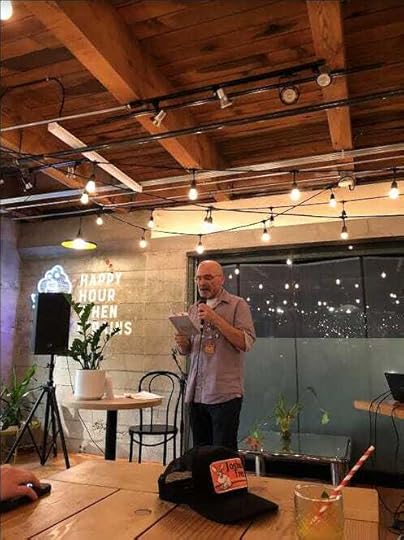 Feit reading at Good Weather Bike Shop, May 25, 2023.
RC: Speaking of, tell us about The Transit Singles.
JF: The Transit Singles! Oh, man. That’s an old project; very early poems that I’m not eager to share. Those videos are buried on the internet, somewhere. So, props to your detective chops for even finding those. But I’m still proud of the conceit. That was a musical outing more than a poetic one. The idea was to pair a poem with a transit oriented pop song re-imagined and performed as a Billie Holiday era nightclub piano ballad; for me, Billie Holiday’s small club dates in 1930s and ‘40s Manhattan are one of the crowning achievements of human kind’s city experiment. In my poems, I’ve cast her as replacing Athena as the Goddess of Cities.
For the pop songs, I went with Kris Kross’ “I Missed the Bus,” Lord Kitchener’s “Underground Train,” Berlin’s “Riding on the Metro,” Le Tigre’s “My My Metro Card,” and The Kinks’ “Waterloo Sunset.” I asked a pro-pianist diva, Leah Tousignant, to cover and record these songs Billie Holiday-style, and then I had an electronic musician Paco Cathcart of the Cradle make samples and loops out of my readings and float them underneath the songs. Kind of a mess. But the great thing is it led to a wonderful idea a few years later. For The Night of Electric Bikes book release reading this past spring, I asked Seattle electronic musician Rob Joynes to open the reading with ambient covers of a few transit pop songs; we went with a mid-60s set, The Impressions’ “People Get Ready (There’s a Train a-Coming),” The Hollies’ “Bus Stop,” and the Beatles’ “Ticket to Ride”). He showed up with his effects boxes and cords and laptop and big speakers and played a gorgeous set, singing the tunes over his atmospheric waves and drones with a dynamite female vocalist Malia Seavey accompanying him and his loops. The gig was at a local bike shop. It was a dream, so no recording.
RC: How did you come to focus on transit in Seattle?
JF: Transit was one of the topics that was always central to the city debates I had been covering as a reporter. And when I dug into the technical details of making transit systems work better, ideas like center platforms, pedestrian scrambles, road diets, and faster headways, the palette of metaphors expanded exponentially. This gave way to poems like “Dwell Time,” where the time we spend waiting at the bus can become a larger narrative about yearning.
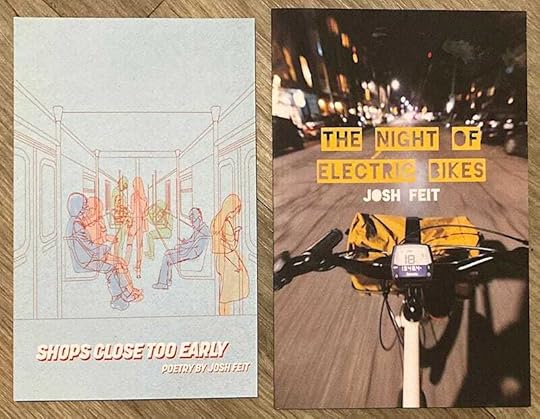 My copies of Josh’s books.
RC: That idea of “dwell time” really stuck out to me from The Night of Electric Bikes. The simple acknowledgement and further exploration of the interstitial spaces in our cities feels tangible to me as someone who hasn't had a car in 25 years. Walking, riding a bike, or taking the bus or train puts you in places that cars can't go. It's a different city!
JF: Lovely. Yes, and speaking more literally of interstitial spaces: This is how you bike home in Seattle, along interstitial streets, ever delusional you’ll find a route that avoids the hills. It's great, though. In this way you’re always zigzagging along back streets you’re unlikely to ever find driving in a car. Now that I know these routes, I do ride my new bike, my e-bike, along these quiet streets during late-night biking adventures home.
RC: What's coming up?
JF: I’m working on a sequence right now that features wayfinding poems; poems that chart and navigate trips. They’re set up like file path directions: “Bike north on Beacon Ave > West on S Columbian Way > ricochet off the pavement craquelure > live to tell> > continue onto 15th Ave S > …”
Over the course of the collection, these wayfinding poems become less about city geography, and start to chart other paths: events that lead to events, books that lead to books, thoughts that lead to memories.
These shorter wayfinding poems are paired with larger poems about retail kiosks in subway stations, ancient Athens, Joshua Tree, The Autobiography of Malcolm X, affordable housing, kiss and rides, greenhouses, Hermes, and other city subjects.
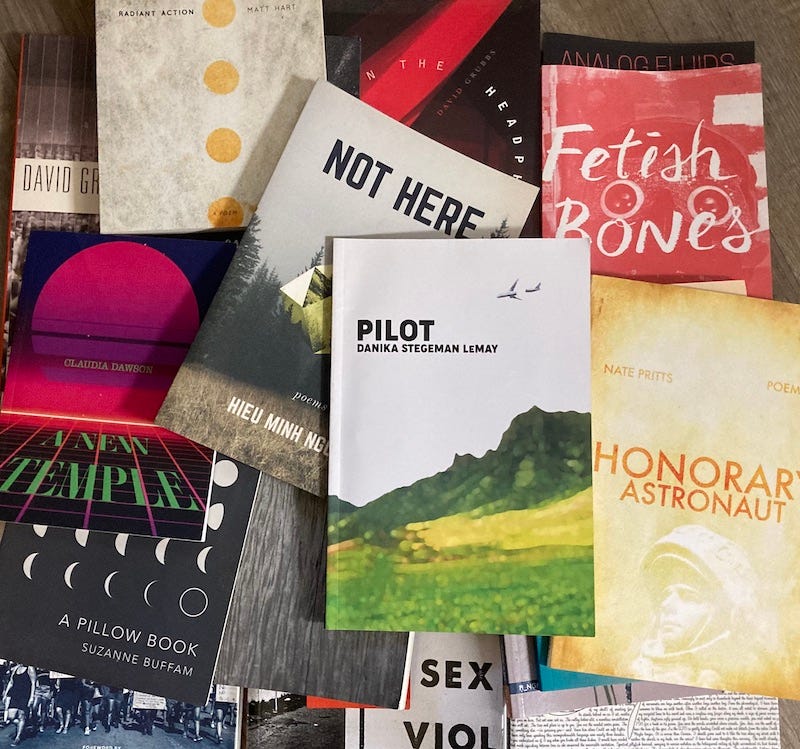
ICYIP:In case you’re into poetry, here are a dozen or so other books I recommend:
Danika Stegeman LeMay Pilot (Spork Press)
Krista Franklin Too Much Midnight (Haymarket Books)
Deborah “D.E.E.P.” Mouton Newsworthy (Bloomsbury Literary)
Claudia Dawson A New Temple (Phantom Kangaroo)
Camae Ayewa Fetish Bones and Analog Fluids (House of Future Sciences)
Matt L. Roar My War (Spork Press)
Hieu Minh Nguyen Not Here (Coffee House Press)
Suzanne Buffam A Pillow Book (Canarium Books)
Lynn Melnick Landscape with Sex and Violence (YesYes Books)
Joshua Edwards Castles and Islands (Liang Editions)
Kevin Coval A People’s History of Chicago (Haymarket Books)
David Grubbs Now That the Audience is Assembled and The Voice in the Headphones (Duke University Press)
Matt Hart Radiant Action (H_NGM_N Books) and Radiant Companion (Monster House Press)
Anything by Nate Pritts, especially Honorary Astronaut (Ghost Road), Right Now More Than Ever (H_NGM_N Books), and Post Human (A-Minor Press).
I even have a little book of them myself. :)
Thanks to Josh Feit for his time and attention and to you for yours,
-royc.
October 11, 2023
Digging Deep
The Intellect U Well Journeys: Afrofuturism book discussion at the African American History Research Center in Houston, Texas last weekend was a blast and a blessing! Many thanks to Deborah “D.E.E.P.” Mouton, James Stancil, Tonya Stancil, Davin Stancil, Suzanne Simpson, Lily Brewer, everyone at the Gregory School, and everyone who came out.
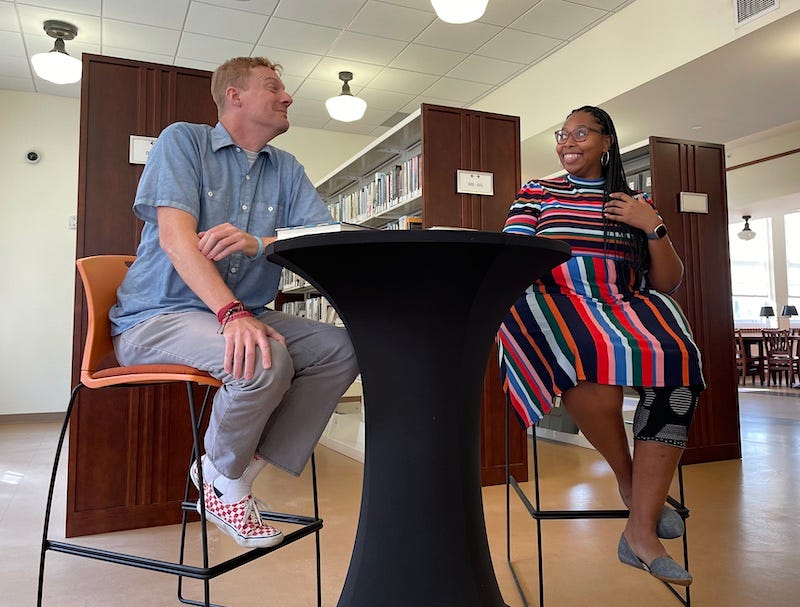 Me and Deep Mouton in Houston. Photo by Lily Brewer.
Deep Mouton’s book, Black Chameleon (Henry Holt & Co, 2023), takes hefty strides toward creating a Southern African-American mythology, its horror tempered by hilarity. Talking with her about it, Boogie Down Predictions, and our views on Afrofuturism, hip-hop culture, writing, poetry, performance, and scholarship was a privilege and a party. I hope we get to continue it sometime soon.
New Interview:If you’re at all interested in my take on teaching college, there’s an interview with me in the October issue of the University of North Florida’s Marketing and Communications Inside newsletter.
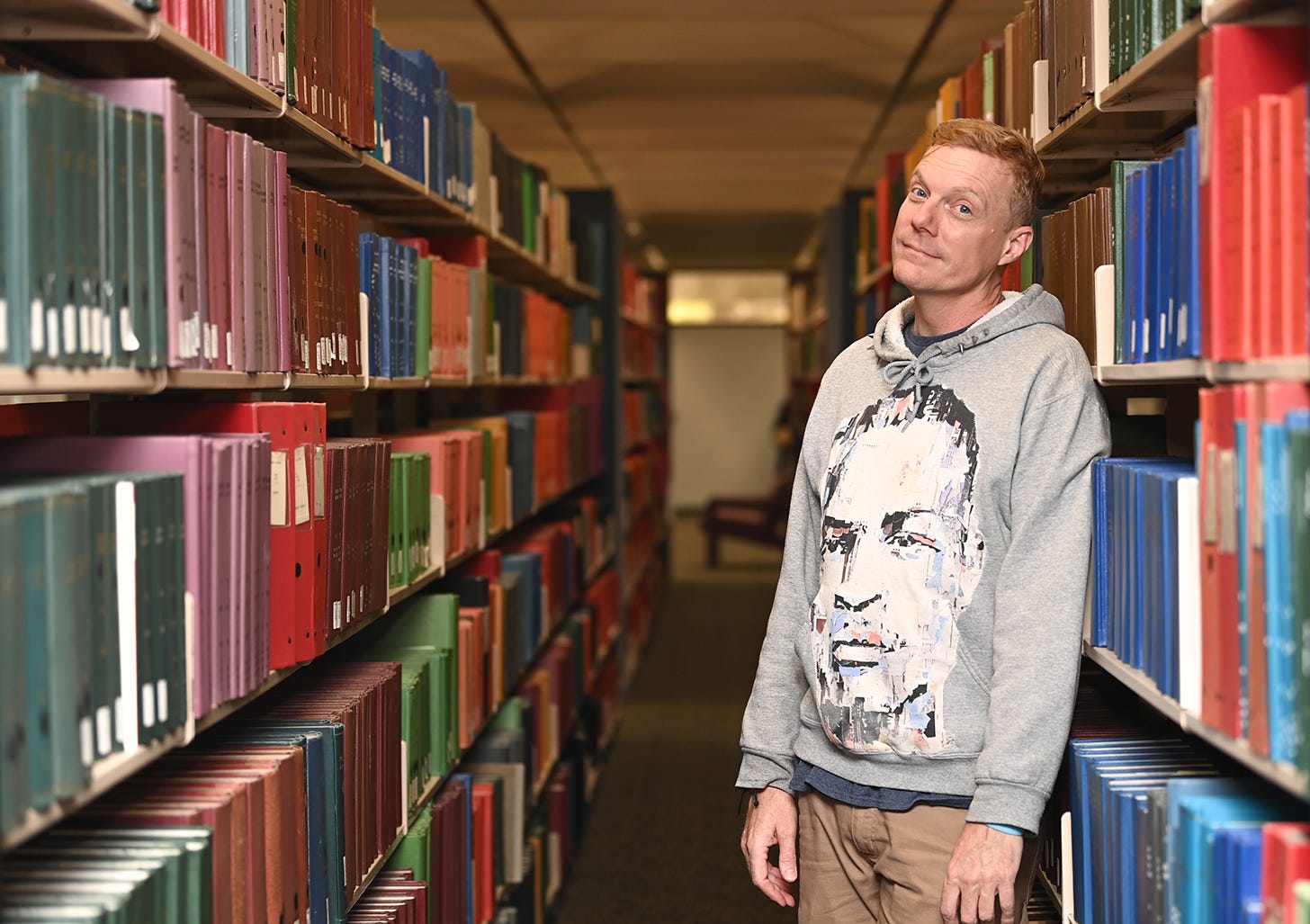 Me in the UNF library. Photo by Jennifer Grissom.
Here’s an excerpt:
Describe your teaching style and philosophy.
Ultimately, what I strive to create in a classroom, especially one teaching communication, is a space where the tone and style are determined by the discourse of those present. I see each class of students as a community. I am merely a guide.
How do you engage your students?
I tell them on the first day that I don't think teachers are smarter than students and that I believe learning and fun are not mutually exclusive. Using examples from their media, their experiences, and their lives is paramount to my approach. I do my best to meet them where they are.
What are your current research interests/previous interests?
Online I often use the tagline “I marshal the middle between Mathers and McLuhan,” which is of course intended to be cute and catchy, but it also sums up my research interests. On one side, I am interested in figurative language use, specifically allusions in media. I have found these especially prevalent in hip-hop lyrics. On the other side, I am interested in technology and media theory. While I investigate these two areas separately, I have found the space where they overlap especially interesting.
Read the whole thing on the UNF Inside site!
Faculty Book of the Month!Different Waves, Different Depths received the UNF College of Arts and Sciences Faculty Book of the Month Award for October!
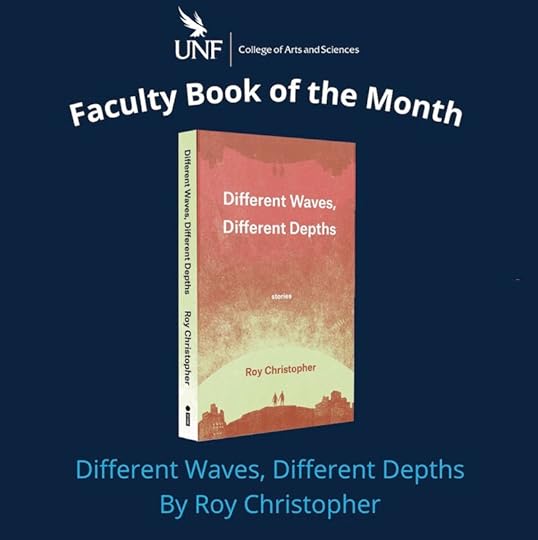 Booyah!
They write,
Dr. Christopher, a brilliant instructor from the School of Communication, brings you a captivating collection of nine stories that push the boundaries of genre. From mind-bending sci-fi to heartwarming romance and even a touch of reality TV, this book has it all!
If you don’t know, now you know.
As always, thank you for your continued interest and support.
And peace to everyone who’s keeping it clean this month. There’s nothing bad about it!
More soon,
-royc.
October 4, 2023
Danika Stegeman LeMay: A Spiral of Questioning
Poetry is one of our most radically subjective communication media. One person’s transformative verse is another’s cliché. We struggle to understand each other, yet we quickly tire of the same old words and phrases.
Meanings are malleable. Language bends and breaks under the stress of unintended use, abuse, or overuse. Like machine parts pushed past their limits, cogs stripped bare of their teeth, the words we use wear out, weakening the culture that carries them and our connections to each other.
The barriers to appreciation are also unreasonably high. Being into poetry is a strange burden to carry. Never mind being a poet.
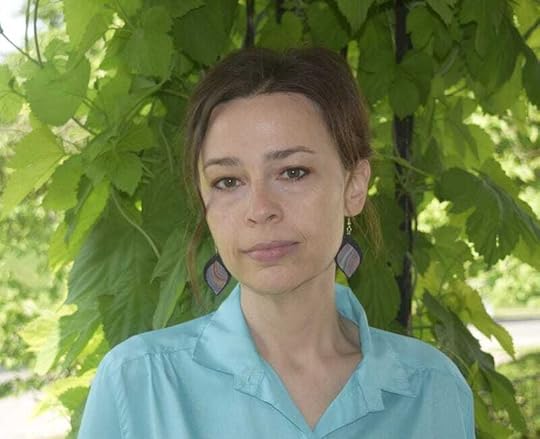
Danika Stegeman LeMay is a poet. She bends words and molds phrases, creating and transforming meanings. I’ve been reading her work and corresponding with her about it for a couple of years now. With her new book, Ablation, coming out next month, and a few other projects cued up behind it, I knew a more formal interview was well past due.
Roy Christopher: How did you get started writing in the first place?
Danika Stegeman LeMay: Oh, the usual: by listening to The Smashing Pumpkins’ Mellon Collie and the Infinite Sadness. Around the time that record came out, I had a really great 7th grade English teacher. I was painfully, cringingly shy until I was about 17 years old. Apparently my book reports or whatever were good, or the teacher understood I needed an outlet that allowed me to be quiet. There was some kind of writing conference for middle schoolers in the state of Minnesota, and the teacher got to choose one student and he chose me. I spent the day learning about writing at a local college and they gave us all journals to write in at the end. I think the theme of the conference was peace (very 1990s) and the journal had little zen quotes about being peaceful in it.
Instead of writing about peace I wrote what amounted to a very, very bad Smashing Pumpkins “song.” It was my first poem. More poems followed, and what’s really charming to me about that journal is that we weren’t quite really in the word-processing era yet. Like, if you wanted to save a draft, you had to have a floppy disk. So I’d write poems by hand and then re-write them by hand to make a revision. I re-copied so many poems in slightly different variations. Along with collage, repetition is an interest that's captivated me across time, so the fact that I wrote and re-wrote these pieces as my youngest poet self is sort of heartwarming.

RC: When did you know it was going to be a passion or a problem?
DSL: I think I knew it was going to be a passion/problem by the time I was getting ready to graduate from undergrad. I was trying to decide if I’d apply for MFAs or do something “practical” like law school. I was dating someone who was getting his MFA in printmaking at the time, and I asked him what he thought. He said to me, “you can't just not practice your art because it’s easier.” Because it’s not easy to love something and to want to pour all of your energy into it when you can’t make a living doing it. There will always be interruptions so you can afford to eat sandwiches or pay an ungodly amount for rent or see a doctor when you’re sick (but only like, insanely sick, or it’s probably not worth the cost). The number of times I’ve thought “I wish someone would pay me to write poetry.” But creating art out of love, desire, a kind of inner pull/force that I feel but can’t quite articulate has its own intrinsic value that has nothing to do with money. So most of the time I’d call it a passion, a “strong and barely controllable emotion,” rather than a problem.
When I think about writing as a “problem,” I think about “problem” more in the sense of physics or mathematics: an inquiry or investigation, rather than a matter of harm. It seems to me that my poetic projects and I unfold together; we figure out what forms we’ll take across time and space. It’s a spiral of questioning, a call and response.
RC: You’re quite prolific on social media, especially with your #lineaday series of posts. I always find that a pursuit becomes something different than I originally intended when pushed in such a way. Have you found out anything from the practice of posting daily?
DSL: I’ve come to appreciate the #lineaday posts I make as stories daily on Instagram in several ways. For one, it’s a way to exercise a muscle. Whether any of those lines get put into a larger piece or not, they’re a dedication to language that I make each day, and I consider writing a line a day a similar action to my daily yoga and meditation practices. It's a way to honor and shape the mind and voice by way of patterning and ritual. Writing a line per day is also a way to trick my mind into releasing anxiety around the generative act. I don’t pressure myself to be brilliant, a line is a line and doesn't have to be final. An Instagram story disappears after 24 hours. Like anything, it exists and it passes away. It reminds me life changes and is impermanent. Though of course I do save the lines in a Google doc... It’s material to use or not use in the future. It gives the generative process a spirit of play.
All these words I’ve piled up have softened and washed away some of my anxiety around having a blank page in front of me. I have this stockpile of material to refer to and riff off of. And I do often refer to that pile. During the pandemic, I took an online class about collage-based writing called “In Pieces” with Joshua Bridgwater Hamilton. I can't remember what the reading was, but we read a piece by Clarice Lispector. She talks about how she’d write snippets whenever they came to her--on scraps of paper, napkins, etc. and save and pile them up. Eventually, she’d wake up very early in the morning and work for hours, poring over these pieces and pulling them together. She said something about how that’s when the time and the energy and the struggle comes in, constructing the work into a whole entity from these pieces. In a way what she’s doing is collaging herself. I’m also a collagist at heart. I like to pull materials together, to consider juxtapositions and unexpected symmetries. Even when I started writing poems as a teenager, often what I was doing was collage, even if I didn't realize or understand that's what I was doing.
RC: I find the same. Sometimes it's just a juxtaposition—rubbing two things together to see what comes of their intersection—and sometimes it’s a whole pile of things that come together and transform into something else.
DSL: Transformation is, in my opinion, one of the most magical things we do. We look at a cloud and name it tree. Even a juxtaposition is a pile of transformation. What else would it be? The cosmos is vast and the one thing we know for sure is that it changes things. We work with materials on an infinitesimal scale in the same ways that they work on an infinite scale.
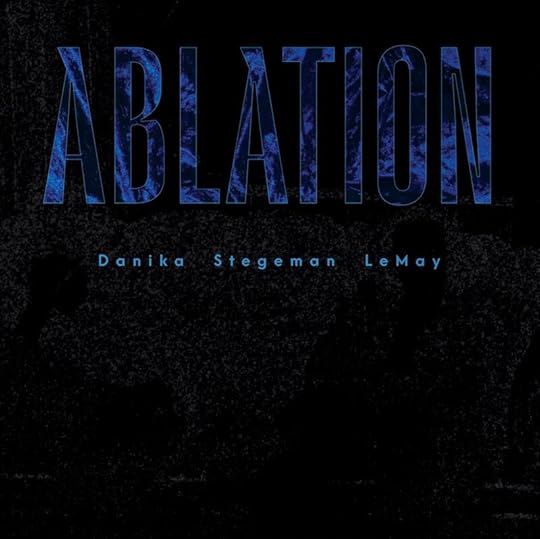
RC: Tell us about your latest project for 11:11, Ablation.
DSL: Ablation is a book I wrote about my mom’s death, becoming a mom to a daughter, inherited trauma, and how to acknowledge pain and loss while accepting it and realizing it exists alongside joy. In these liminal places of death and birth, we see perhaps more clearly that we are a line: fear and love, void and form, grief and acceptance, chaos and control, are two sides of the same door, and we're the door. The book moves through many forms to arrive at realization and acceptance. It contains images I’ve cut apart, re-assembled, and sewn. It reckons with images of the past that haunts it, and by it, I suppose I mean me. After my mom died, I found like 8 rolls of film from the early and mid-1990s that she'd never developed in her closet, while I was going through her things trying to decide what to keep and what to let go of. I developed the film, because that’s the kind of person I am. I will follow things to completion.
The images the photo lab was able to develop are haunting for a couple of reasons: they’re literally fucked-up—if you leave film to sit for years, you get double exposures, strange colors, dark fog, dust motes, and flares of light. They’re also fucked-up because part of the reason my mom never developed them is that they're mostly photos my brothers and I took the summer after my stepdad died in a head-on collision with a semi-truck when he was driving home from work when I was 13. He fell asleep at the wheel. It completely wrecked my mom, who’d had a painful life anyway, and had struggled with depression and other mental illnesses without diagnoses or any sort of medical help her entire life.
The photos themselves are haunted. You can feel our pain in them. Writing, collaging, taking a thing apart to understand it, rearranging it into something like hope, like future, like presence, and taping it back together is my way of coping with the world as I find it: both terrifying and radiant. The process of writing the title sequence, “Ablation,” which is a long, tightly-wound sequence of mirror cinquains, was that sort of collaging myself process I was talking about earlier. I originally wrote that sequence on postcards, but the form didn't quite feel right. When I arrived at the mirror cinquain, I worked and re-worked and carved and threaded the words into place. The other poems in the book either attempt to lean into form, as “Ablation” does, or into chaos. Both needed to be present.
This is a book I had to write to continue existing after the sudden and catastrophic loss of my mom. It’s a place where I can leave things, so I can move forward and create a better environment for my daughter. “Ablation” means three compelling and wildly diverse things: evaporation of ice from a glacier, surgical removal of tissue from a body, and the way a spacecraft or meteorite sheds material in the atmosphere. At its root, the word means “taking away.” Ablation is, by nature and necessity, much more vulnerable than my previous work. I had to learn to be vulnerable as a person while writing it. I feel that vulnerability is one of the book’s strengths, and I hope that its presence might be helpful to others moving through similar corridors.
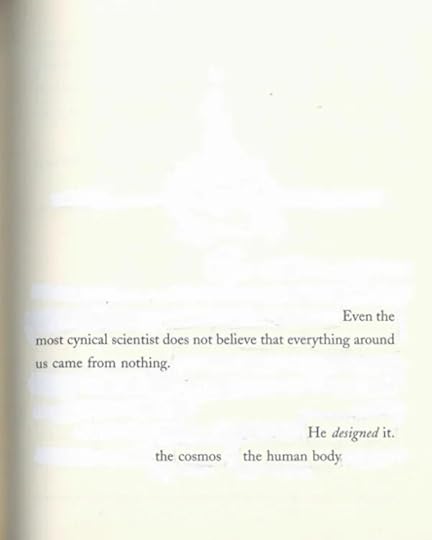
RC: What can you tell us about how your erasure project, GOD IS IN THE MALL, came about and your possible plans for its publication?
DSL: GOD IS IN THE MALL (GIITM) is actually the first full-length manuscript I finished. I wrote it alongside Pilot (Spork Press, 2020) and actually finished it before I finished Pilot. It's an erasure of a book called God Is in the Small Stuff for the Graduate, which was given to me by evangelical Christian relatives when I graduated from high school. I started circling words in pencil probably around 2006 or so. I got stuck pretty quickly, because the end of every chapter has a list of bullet points about how "God is in the small stuff" for the theme of that particular chapter. And I was like “what am I going to do with these lists?? It’s impossible to erase them in a productive way and make it a poem.” Years later, in probably 2014, I was riding the bus to work and had the idea to cut up a directory of the Mall of America and paste the names of the stores into the list parts of the chapters. So a bullet point that said “You can't stand up to the devil unless you kneel before God” became “You can't stand up to the devil unless you kneel before Nordstrom Rack.” And it went pretty quickly after that.
When I’d finished penciling in the words I wanted to keep and pasting the names of stores in, I began the process of painting white out over the rest of the text. I scanned every page, and, luckily, by the time I’d finished that, Adobe Acrobat had advanced to the point that you could actually edit words inside a PDF. So I spent a lot of time taking this raw material and turning it into a cohesive book, moving pages and deleting more text. I think it’s a fun book and at the same time it points to the problematic relationship between the United States’ version of Christianity and the capitalist system.
The book was a semi-finalist for the Sawtooth Poetry Prize run by (the now sadly non-existent) Ahsahta Press in 2017. It's been a little bit of a challenge to find the right publisher for GIITM, because every page needs to be printed in color and I'm not Mary Ruefle and the book is sort of specific and weird. You can read a good chunk of it in vol. 30 of Word for/Word. Shout out to editor Jonathan Minton for consistently being open to publishing the stranger forms my work takes; he also published an early version of the title sequence of Ablation in vol. 35 and is about to publish some pieces from what I hope will be my 3rd book, The Book of Matthew, in vol. 41. Matthew is actually the reason I haven't been actively looking for publishers for GIITM recently. I wrote Matthew alongside Ablation, and they're linked, in my mind. Like, Matthew is the aftermath, the shadow cast by Ablation. So I need those two books to come out back to back. I'll start looking for publishers for GIITM again after I find one for Matthew.
RC: Is there anything else you're working on you want to mention?
DSL: The Book of Matthew is finished, and I'm sending it out to publishers right now. It's a book of miracles constructed from 3 types of materials: erasures of each miracle found in The Gospel of Matthew cut from various editions of The New Testament, ecstatic poems (some based on dreams, some based on dreaming), and epistles written to a Matthew, a messenger, an angel of my own making. By the end of the book, these materials elide and coalesce. It’s a book of dissociation, science, spell-casting, prophetic vision, intimacy, and other sorts of magic. As hinted at above, while Ablation addresses the sudden loss of my mom and my childhood trauma directly, while Matthew addresses the aftermath: my patterns, my (un)consciousness, my longing. The book also reckons with acculturated ideas of femininity and power and contains a lot of references to Radiohead. I sort of had to write the Matthew poems alongside Ablation because Ablation was painful to write. Most of the poems in Matthew felt magical and fun to write. I'm really excited for a couple of those Matthew poems to come out from Carrion Bloom Books as a pair of microchapbooks soon: Familiar Birds: House of Mesh (I) and Familiar Birds: House of Suet (II). So watch for those.
In addition to the microchapbooks and the cut up miracles coming out in Word for/Word vol. 41, poems from Matthew will be out soon in FIVES (that one's a video poem actually), SOLID STATE, and mercury firs.
Right now I'm working on two things (have you noticed I like to write two things at once?). One is the sequel to Pilot, which I'm currently calling FARADAY; Pilot only uses scripts from the first 2 seasons of Lost, so FARADAY will cover the remaining 4 seasons. The other project I'm currently working on is called Wheel of Fortune; it's a long long book-length poem about endlessness and circles that I'm writing onto a rolodex I bought at an open-air flea market in May of 2021.
Preorder your copy of Ablation now, out from 11:11 Press on November 1st.
Thank you for reading,
-royc.
September 25, 2023
In a Language You Don't Understand
Last week, Fevers of the Mind published two poems I wrote recently. I am reposting them here for your reading convenience.
The Saddest ThingI thought I had seenThe saddest thing whenI saw a dead duckOn the sidewalkHer neck a broken question markAskingI thought I had seenThe saddest thing whenI saw a drowned cowSunk in the shallowsHer body a sack of meat and mudDrinkingI thought I had seenThe saddest thing, thenMimi Parker diedDark curls gone limpHer voice still up on a noteSinging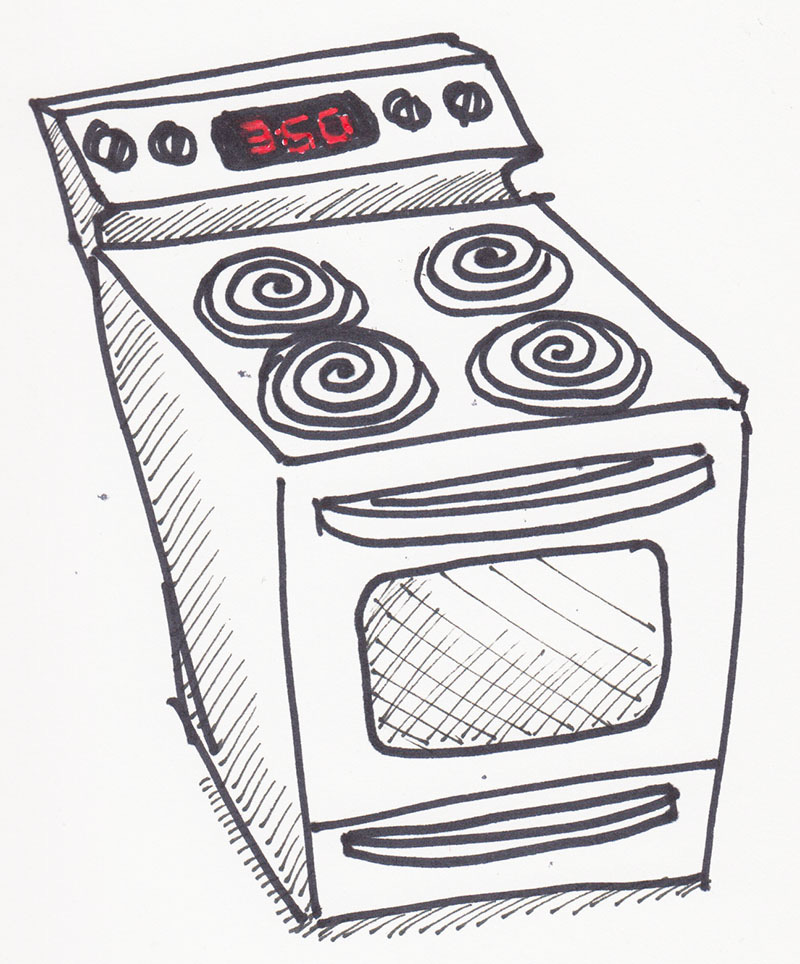 To Feel WarmI came home and The stove clock read 350And for a momentI thought I'd left the oven onPreheating the dayLike the Florida sunI did get the message you sentI'm pretty perceptiveEven if I can’t take a hintPerhaps we could prop each other upIf only to see what it meantTo feel warm
Fevers of the Mind previously published two of my other poems this summer (“San Diego” and “Like a Totem”) and a “Quick 9” interview with me in 2021.
Check out the site. Lots of good stuff up there.
ICYMI: Cover art by me.
If you like these little poems, I have a whole chapbook of them available from First Cut Poetry called Abandoned Accounts (Most of them are happier than the ones I shared above, so don’t be scared to check them out).
As always, thank you for reading,
-royc.