
Shevlin Sebastian's Blog, page 99
December 12, 2015
Heat and Lust

Dear Friends,My e-book journey continues.This time, it is a collection of adult short stories.Here is the link:http://www.amazon.in/Heat-Short-Stories-Shevl…/…/ref=sr_1_1… And here is the preface:
Most of the stories in this collection were written by a younger self. This self grew up in Kolkata and came of age in the 1980s. At that time, India was conservative and sexually repressed. Intermingling between the sexes was not easy. There were no Facebook/Twitter/Instagram/Whatsapp and Google hangouts. Or mobile phones. And yet, we managed somehow. We all had a few affairs… only the memories remain.
Some of the stories are based on gossip that I heard of people I hardly knew anything about. But I tried to flesh them out in my imagination. So, there are tales of the rage caused by impotence, the sexual frustration of fat people and how they try to solve it, and the metaphorical stabbing of one spouse on the other when an extra-marital affair comes to light.
The themes are ancient but I hope the treatment is different.
Human beings have behaved the same throughout history. This was confirmed to me by Dr. Irving Finkel, of the British Museum, who spent 30 years studying cuneiform tablets, belonging to the Mesopotamian society of 3000 years ago. And, at that time also, there were leaders who promised a lot, cheating businessmen and husbands and wives opting for divorce because they could not live with each other.
In this collection, only two stories have been published. ‘The Ageing Lion’ was published in the now-defunct Debonair magazine, while ‘The Inner Drama’ appeared in the Telegraph Colour Magazine in the ‘Fiction Selected by Khushwant Singh’ column.
Grateful thanks to ABP Private Limited, Kolkata, for giving permission to publish it.
I am surprised at the raunchiness and the liberal use of four-letter words by this younger self. But then we all go through this youthful phase.


December 11, 2015
Smashed By A Whale

 The Hollywood film, ‘In The Heart of The Sea’, highlights the sinking of the ‘Essex’, one of the most noted marine disasters of the 19th century
Photos: Chris Helmsworth in a scene from 'In The Heart Of The Sea'; the book cover
By Shevlin Sebastian
The Hollywood film, ‘In The Heart of The Sea’, has a quiet start. In 1821, the great American writer Herman Melville (Ben Whishaw) knocks on a boarding house door in Nantucket. He is allowed to enter after he shows a copy of a letter which he had sent earlier. It stated that Melville wanted to write about the ‘Essex’, a whaling ship that was destroyed by a massive sperm whale, in the Pacific Ocean.
The boarding house owner Thomas Nickerson (Brendan Gleeson) was a 14-year-old cabin boy on the ill-fated ship and one of the few survivors.
After initially refusing, Thomas is persuaded by his wife (Michelle Fairley) to tell the tale. So, the story is told in flashback.
It starts with tension at a ship owners’ meeting where First Mate Owen Chase (Chris Hemsworth) had been promised the captain’s position on the ‘Essex’, but it has been given to George Pollard Jr. (Benjamin Walker), who belongs to a famous sea-faring family.
Once they start sailing, these tensions persist. Pollard makes errors like going full-sail into a squall. They barely survive that. The Essex travels long distances but is able to kill a few whales only.
The aim is to boil down the blubber, of the dead whales, and the oil is taken back and used for various industrial purposes. In one stunning scene, a small hole is made on the head of one such whale, and Thomas is pushed down, so that he can collect some blubber from the inside.
At Ecuador, a Spanish ship captain tells Pollard and Owen about a large number of whales, 3000 nautical miles away, but warns about the presence of a 100 ft sperm whale that caused six crew members to lose their lives.
But carried away by greed and ego, Pollard and Chase decide to give chase. And the inevitable happens: the whale destroys the ship. And those scenes have been shown in vivid and dramatic style, thanks to the now-supreme power of 3D special effects. Thus far, the film moves at a fairly gripping pace, but it begins to lose a bit of steam when the sailors make their way back in three boats.
For 90 days they drift in the ocean. The action slows down, as they have no food or water, and in the end, they indulge in cannibalism, when a crew member dies, although it is not shown.
Nevertheless, the film, by top director Ron Howard (Apollo 13, A Beautiful Mind, Da Vinci Code) is worth a watch.
Riveting History
The film is based on a book by writer Nathaniel Philbrick called ‘In The Heart Of The Sea: The Tragedy Of The Whaleship Essex’. A New York Times bestseller, Philbrick won the National Book Award for Non-Fiction in 2000 for this book. In real life, Nickerson, at the age of 71, wrote an account, while Chase wrote a 128 page book immediately after his rescue. Philbrick used both accounts.
Here are extracts from Philbrick’s book: ‘The hot July sun beat down on the old, oil-soaked timbers [of the Essex] until the temperature below was infernal, but Thomas Nickerson explored every cranny, from the brick altar of the tryworks being assembled on deck to the lightless depths of the empty hold. In between was a creaking, compartmentalized world, a living thing of oak and pine that reeked of oil, blood, tobacco juice, food, salt, mildew, tar, and smoke. “Black and ugly as she was,” Nickerson wrote, “I would not have exchanged her for a palace.”
‘In July of 1819 the Essex was one of a fleet of more than seventy Nantucket whaleships in the Pacific and Atlantic Oceans. With whale-oil prices steadily climbing and the rest of the world’s economy sunk in depression, the village of Nantucket was on its way to becoming one of the richest towns in America.’
But Philbrick’s description of cannibalism, as seen through the eyes of the sailors of the rescue ship, 'Dauphin', off the coast of Chile, is unforgettable:‘First they saw bones – human bones – littering the thwarts and floorboards, as if the whaleboat were the seagoing lair of a ferocious, man-eating beast. Then they saw the two men. They were curled up in opposite ends of the boat, their skin covered with sores, their eyes bulging from the hollows of their skulls, their beards caked with salt and blood. They were sucking the marrow from the bones of their dead shipmates.
‘Instead of greeting their rescuers with smiles of relief, the survivors – too delirious with thirst and hunger to speak – were disturbed, even frightened. They jealously clutched the splintered and gnawed-over bones with a desperate, almost feral intensity, refusing to give them up, like two starving dogs found trapped in a pit.
‘Even though it is little remembered today, the sinking of the whaleship ‘Essex’ by an enraged sperm whale was one of the most well-known marine disasters of the nineteenth century. Nearly every child in America read about it in school. It was the event that inspired the climactic scene of Herman Melville’s Moby-Dick.
‘But the point at which Melville’s novel ends – the sinking of the ship – was merely the starting point for the story of the real-life ‘Essex’ disaster.’
(The New Indian Express, Kochi and Thiruvananthapuram)
December 10, 2015
“We have to Find a New Planet to Live On”

 Says Dr. Hameed Khan, of the National Institutes of Health, USA, while on a visit to Kochi
 Photos: Dr Hameed Khan by Ratheesh Sundaram. The universe
By Shevlin Sebastian
At a private interaction at the Kochi International Book Festival, Dr. Hameed Khan drops a bombshell.
“We are trapped in a dying solar system,” he says. “Our sun is collapsing. It has used up half of its energy. 500 million tonnes of hydrogen are used every second. This middle-aged star will run out of energy. We have to find a new home, and a new planet to live on. We cannot stay on this earth forever.”
Khan gives an example. “In 1987, there was a supernova explosion,” he says. “This was exactly the same as our planet: one earth, eight planets, and more than 140 moons. It exploded, because it kept on burning hydrogen, in the same manner as our sun.”
But where do we go?
“There are millions of solar systems in the Milky Way galaxy, as well as 100 billion galaxies,” says Khan. “The universe is so vast. It must be teeming with life. And there may be thousands of earth-sized planets all over the universe.”
But are they habitable?
“How do we know unless we do an intense search?” says Khan.
Dr. Khan is a Senior Scientist at the National Institutes of Health (NIH) in USA. He discovered the Aziridinyl Quinone that shuts off the gene that causes breast cancer. For this he received the 2004 NIH Scientific Achievement Award. His other interests include working on the Personal Genome Project.
“Each human cell carries 24,000 genes,” he says, while on a visit to Kochi to speak about the Genome Project to students. “In that, there are 16,000 good, 2000 non-functional, and 6000 bad genes. These bad genes could become mutated. Genes become bad for four reasons: radiation, chemical or viral infections or genetic inheritance. And you can get any one of the 6000 diseases which have a genetic basis.”
But through the genetic sequencing of the DNA, at one glance we can find out which genes are bad. “Ideally, to ensure that there are no tragedies like mental and physical disabilities or autism, the egg and sperm has to be tested before marriage,” says Khan. “And then one will be able to say whether you will have a healthy baby or not. This is one of the great advantages of sequencing.”
Not everyone agrees to these methods. In fact, the US government has banned research into stem cells. Because scientists will be able to manipulate, for example, the type of babies that can be born or extend human life upto 200 years.
“This ban is a great loss,” says Khan. “There should be freedom to do research.”
Incidentally, stem cells are got through the mix of the egg and the sperm. “The fertilised egg is full of stem cells,” says Khan. “It has the ability to make anything. We siphon it out through a tube, before it attaches itself to the womb and harvest it.”
Around one lakh cells can be grown in a petri dish. “You take some spinal fluid and put it into a cup of stem cells,” says Khan. “Soon, they will become neurons. You can inject it back. This will replace the damaged neurons. You can take fluid from the liver. It contains enzymes. Mix it with the stem cells and they will turn into liver cells. Put it back and your liver becomes healthy again.”
As to why all sorts of discoveries take place in the US and virtually nothing in India, the Hyderabad-born Khan says, “The USA is the richest country in the world. It is difficult to compare the two countries. On the first day I walked into the National Institute of Health, in December, 1971, in my job as a chemist, I asked, ‘Where can I get my chemicals’.”
Immediately, his boss took Khan to a basement of a building. What Khan saw amazed him. “Every chemical known to man was placed on numerous tables in an alphabetical order,” he says. “That day I realised that I am not going anywhere else. The NIH has a massive annual budget of $30 billion. This is just one institute. And there are so many others, like this.”
There are other advantages, too. “As a scientist, I have absolute freedom,” says Khan. “I don't have to ask permission from anybody to do my research.”
Government officials did two things that took the worry away from Khan. They provided him with a five-star accommodation and gave Khan a government credit card. “I could use it in any way I wanted,” he says. “So, the worry for money was over. I could give my attention to my work, without any distractions.”
Interestingly, the discoveries that are made can be highly lucrative. For example, Noble Laureates Herbert Boyer and Stanley Cohen discovered gene splicing, which allows scientists to manipulate the DNA of an organism. Their technique was the precursor of today's massive genetic engineering industry. Last year, Boyer's company Genentech made several billion dollars in profits.
Finally, asked to visualise the world one hundred years from now, Khan says, “Man will easily live to a hundred years, because of good food and medicine. We will all have our personal genome done. This will be our medical record. It will be stored in a genetic chip. In case of emergency, we can get instant and accurate treatment. Lastly, there will be lots of space travel.”
(The New Indian Express, Kochi and Thiruvananthapuram)
December 8, 2015
When An Elephant Came Charging

 COLUMN: LOCATION DIARYDirector Salam Bapu talks about his experiences on the film, 'Red Wine'
Photos: Salam Bapu; (from left): Mohanlal, Asif Ali, Fahadh Fasil and Salam Bapu
By Shevlin Sebastian
In October, 2012, director Salam Bapu was wandering around the forests near Kuruva Dweep in Wayanad. He was accompanied by location manager Salim Bava, 'Red Wine' scriptwriter Mammen K. Rajan, and other crew members. Salam was looking for a place where he could shoot some forest scenes, but was also keen that there should be some animals in it.
When Salam was walking, he saw an elephant coming from the opposite side. He immediately turned to Bava and asked whether it was okay. “He said it was fine,” says Salam. However, the elephant picked up pace. Nevertheless, they carried on walking forward, towards the animal, which was 200 metres away.
Suddenly, there was a shout: “Run away, the elephant is dangerous.”
When Salam turned he saw that Bava was far away. “In fact, he was the first to run,” says Salam, with a smile. “And he never alerted us.” The crew turned and began running very fast. In their fear, some of them fell down, got up, and ran again. In the end they all got away safely.
There was a particular reason why Salam wanted to shoot animals. In the film, Fahadh Faasil was playing Anoop C V, a part-time actor, who was fighting for the cause of the Adivasis. His close friend is Navas Parambam (Saiju Kurup), an advertising film-maker.
“According to the script, a resort comes up in a particular area, and it is causing damage to the environment as well as the animals,” says Salam. “That was why I felt it was necessary to show some animals.”
A few days later, the actors as well as the crew were travelling to the Muthanga area. Suddenly, Salam saw a herd of 20 elephants near the road. The excited director stopped the car.
Then he asked Fahadh and Saiju to pose near the elephants. “We took the scenes from a distance,” says Salam. “The cameraman, Manoj Pillai, was quite scared, in case the elephants made a charge at us.”
However, the herd remained peaceful. They carried on eating grass and took water from a nearby pond. “In a group elephants are far more relaxed than when they are alone,” says Salam.
The end result were authentic scenes. Later, many people asked Salam whether he had used graphics. He had to emphasise that these were actual scenes. “I have to salute the courage of Fahadh and Saiju,” says Salam. “They had no qualms about going near the elephants.”
Later, when the film was released, viewers told Salam that he had made a 'continuity mistake'. When they shot the scene, near the elephants, Saiju had borrowed the Nikon camera from the stills photographer, Mahadevan Thampi. But in other scenes, Saiju was shown using a Canon camera. “But since the shooting took place on the spur of the moment, we had no time to look for another Canon,” says Salam. “That was how the error happened.”
Nevertheless, Salam was happy that he got the scenes he wanted.
(The New Indian Express, Kochi, Thiruvananthapuram and Kozhikode)
December 6, 2015
Soothing To The Skin
 The Niramaaya store in Fort Kochi has an unique concept: the clothes are made with a mix of herbs and plants
 Photo of Tresella Agnes by Albin Mathew By Shevlin Sebastian
One sunny day, in November, David Timbs was wandering around Fort Kochi, when he came across the Niramaaya store. The nature therapist from Gisborne, New Zealand, was immediately interested. Niramaaya sold clothes which are made with plants and herbs. “Wearing clothes that potentially has a therapeutic effect is like killing two birds with one stone: looking good in fashionable clothing, and getting a herbal treatment at the same time,” he says.
Owner Tresella Agnes smiles when she hears this. The shop is cosy and warm. There are wooden benches to sit upon. At one side, there are flowering plants. And on wooden shelves, there are all types of items: shirts, pyjamas, t-shirts, dupattas, churidars, bedsheets, towels, mats and eye masks.
The eye masks are soft and soothing when placed over the eyelids. “It consists of flax seeds,” says Tresella. And soon, you can get a herbal smell. “That is aloe vera and vettiver,” she says. (Incidentally, Niramaaya is a Sanskrit word which means free from illness).
Interestingly, the most popular items are T-shirts and mats. “These are used by people who are into meditation and yoga,” says Tresella. “Our mats are soft and chemical-free. But we have an underlying layer of rubber, so it does not move around on smooth floors,” she says. Her customers are mostly from Europe, USA and Japan.
In fact, one regular client is the Tokyo-based yoga teacher Kyuko Tajima. “She takes about 120 mats every month,” says Tresella, who sends the material by Fed Ex. The prices of the products range from Rs 400 to Rs 2600.
So what is the process of making them? With the help of her husband Mathew Joseph, a chemist in a public-sector company, they buy organic yarn from Guntur, Andhra Pradesh and Erode, Tamil Nadu. Later, at their workshop, workers boil the plants and the herbs. The extract is then placed in a tub, mixed with water. Thereafter the yarn is put in.
To get the colour brown, they have to use myrobalan, aloe vera, and pomegranate. For yellow, it is different types of turmeric. And for grey it is triphala, vetiver and catechu. “We use anywhere between 12 to 14 herbs for each item,” says Tresella.
When the yarn is taken out, it is dried in the shade, and sent to a weavers' society at Kannur, 270 kms away. The workers then make the ready-to-wear products. “To make a yoga mat of 6 x 2.3 ft, they take one-and-a-half days,” says Tresella.
Asked the source of the herbs and plants, Tresella says that they buy it from the nearby town of Mattancherry. There is a place where organic produce is sold. Many of the sellers just collect the plants from ponds, streams and forests.
The one drawback of this method is that you don't get very bright colours, which is favoured by Indians. The range is blue, green, yellow, mauve, pink, grey, off-white and beige. “But in the bright sunlight of India, the colours don't last for long,” says Tresella. “They fade away, after a few months. However, in the temperate climates of the West, it remains for much longer.”
In fact, recently, a Dutchman dropped into the shop, pointed at the beige T-shirt he was wearing, and told an astonished Tresella, “I bought this from your shop last year.”
There are other fans, too. The Toronto-based Devan Nambiar says, “The clothes are beautifully-crafted and aesthetically-pleasing. It is also holistic, therapeutic, and environmentally-conscious.” Maivor Stigengreen from Sweden says, “What a joy to know that Tresella and Mathew are doing their bit to sustain life.” Adds Liz Cluskey of Leicester, UK: “The clothes are wonderful. This is an unique idea. We have not seen such a concept anywhere else.”
But the couple are not basking in the praise. In fact, Mathew is now trying to figure out a way to make the colours last a long time. “Both of us feel that the big market in future is going to be within India,” says Tresella. “So, Mathew is doing a lot of experimentation in his spare time.”
December 3, 2015
An Embrace of Dead Bodies

 The Turkish film, ‘Nekro’ focuses on the subject of necrophilia
 By Shevlin Sebastian
In the Turkish film, 'Nekro', there is a striking scene when actor Mehmet Yilmaz Ak, who plays Ihsan, a nurse in a state hospital, goes into the morgue. There he pulls out a trolley from a freezer. On it is a body covered by a white sheet. He pulls the sheet down. It is a naked young woman, her eyes open and lifeless.
Ihsan caresses the face and the body. Then he rubs cream on her legs and says, “Don’t get angry.” Thereafter he gets on top of her and says, “You are so sweet,” even as he simulates sexual intercourse.
On other occasion, Ihsan hides in a locker in the nurses' changing room and watches, through a gap, as they put on lipstick and gossip about one another. Once they leave, he steps out and caresses the nurses’ uniform which is hanging in a cupboard.
Ihsan is a loner. What deters people from befriending him is a black scar over one eye. It makes him look ugly. There is a scene where he is walking along a riverside, during a windy evening, and enviously watches a lone-struck couple throwing pebbles into the water. He yearns to be with a woman, but is unable to do so.
So, his interaction with corpses continues, and it is always with young women.
“It is a creepy film,” says Mehmet, on the sidelines of the All Lights India International Film Festival at the Cinepolis, Kochi. “Ihsan suffers from necrophilia. He only feels alive, when he is around dead bodies.”
But one day, at the morgue, Ihsan sees the dead body of a pretty woman and falls in love with it. He manages to take the body to his apartment. He lives above an irritating and inquisitive landlady who is always berating Ihsan because his rent is late or the roof is leaking.
Once Ihsan starts living with the dead body, he becomes excited. He buys lipsticks and new dresses for her. When he returns from work, he sits beside her, has his dinner and says, “How was your day?” Once, late at night, he carried her out and placed her in a boat and went rowing.
But the body is steadily decaying. Pieces of flesh are peeling off from the face and the legs. He tries embalming methods, but it is not working.
And, during this period, Ihsan’s character starts changing. “He starts to feel alive and more human,” says Mehmet. “Ihsan learns to communicate with people, does daily chores, plays cards with the men in the neighbourhood, and acts like a family man who cares about his house, and, of course, his beloved spouse.”
Meanwhile, the landlady gets suspicious. He asks Ihsan about a smell in his apartment. But when she tries to enter his apartment to investigate it, he prevents her.
Ihsan rushes to buy a freezer, which he puts in his bedroom and places the dead body. Things are moving towards the climax....
‘Nekro’, made by a young director, Pinar Sinan, is a movie that you watch with bated breath. It is exploring a side of abnormality that we rarely get to see in real life. And it is a consummate performance by Mehmet.
“To understand Ihsan well, I went several times to the morgue, to observe dead bodies,” says Mehmet.
The Turkish actor has only acted in four films over ten years. “I am very selective,” he says. “I only act in films where I am drawn to the character.”
However, the Turkish film industry is thriving. More than 200 films are released every year. “Most of them are comedies,” says Mehmet. “That is what the people like to see.”
Mehmet admits that 'Nekro' is not for a general audience. “It is for people who love art films,” he says.
Meanwhile, to earn his bread and butter, Mehmet acts regularly in television serials.
But things are not so rosy in Turkey. “The country is divided,” he says. “On one side, there are the supporters of President Recep Tayyip Erdoğan and his conservative Justice and Development Party, while on the other, there are the liberals and free-thinkers. One half of the population is willing to die for him, while the other half dislikes him.”
The Istanbul-based actor admits it is difficult to live in Turkey. “We are experiencing a loss of creative freedom,” says Mehmet. “There are bans on the press and television. I feel a lot of pressure. We don't know what is going to happen next. There was a bomb blast in Ankara, recently, where 120 people died. They had been marching for peace. It was a non-violent demonstration.” And just two days ago, there was another bomb blast on the Istanbul metro. Mercifully, there were no deaths.
So Mehmet is glad to be in Kochi. “It is a wonderful city, so different from Istanbul,” he says. “The food is exotic. The people are so kind. I am enjoying the warm weather because it is freezing in Turkey now.”
Mehmet breaks out into a warm smile when he says this.
(Published in The New Indian Express, Kochi and Thiruvananthapuram)
December 2, 2015
Knockout Punch

 The seventh film in the Rocky series, 'Creed', is riveting and moving at the same time
Photos: The poster of 'Creed'; Michael B Jordan plays Donny Creed
By Shevlin Sebastian
The Hollywood film, 'Creed', opens with eight-year-old Adonis 'Donny' Creed beating up an older boy in a Los Angeles youth facility. He is quickly pulled away by a guard.
Donny is the illegitimate son of boxing great Apollo Creed, of the highly successful Rocky series. It starred Sylvester Stallone as Rocky Balboa and Carl Weathers as Apollo. Donny's mother died young, so he was living in and out of various homes. And Apollo died even before Donny was born, so the latter had never met his father.
In an early scene, a black woman comes to the facility and says she wants to adopt Donny. She is Apollo's widow Mary Anne (Phylicia Rashad). Donny accepts the offer.
Suddenly, the scene shifts to 2015. Donny, a 21-year-old, is tying boxing gloves on, just before a fighting event at Tijuana, Mexico. He goes to fight local fighters, without telling his foster mother. She wants him to stay away from boxing, because his father had died in the ring during a fight. But even though Donny (Michael B. Jordan) lives in a mansion, drives a flashy car, and has a job in a securities firm, he feels empty. The urge to follow in his father's footsteps is too strong.
So, one day, he quits his job, breaks Mary Anne's heart with his decision, and sets off to Philadelphia to meet up with his dad's foe, Rocky Balboa, who runs an Italian restaurant called Adrians. He wants Rocky to train him to be a world-class fighter. But the retired boxer is happy to live a peaceful life and says no. But Donny does not give up. Over a period of time, he wears down Balboa's resistance. While in Philadelphia, Donny falls in love with a singer, Bianca (Tessa Thompson), who is suffering from progressive deafness.
It is a moving film, with an emotional intensity at the core. Directed by Ryan Cooglar, the fight sequences are worth going miles for, especially the climatic title fight between Donny and champion Ricky Conlan (Tony Bellew). The camera moves up close and almost between the fighters. You can see the sweat and the blood, right in front of your face. The jabs to the face are like thuds to the heart.
In contrast, there are tender moments of love-making between Donny and Bianca. Donny puts up a charming performance, a mix of bravado and sensitivity, and exudes a natural charisma. But it is Stallone, who, as Rocky, is afflicted with Non-Hodgkins lymphoma, during the course of the film, plays his role with simplicity, charm and subtlety. There is already a buzz that Stallone might win an Oscar for Best Supporting Actor for his performance.
This is the seventh film of the Rocky franchise. Thus far, it has garnered worldwide ticket sales of $45 million, and is expected to remain in the top ten for a while. Incidentally, the total box office receipts for the entire franchise is to the tune of $600 million. 'Creed' has ensured that the franchise will continue to move forward, in the manner of James Bond. And if the storyline remains as good and potent as 'Creed', the money will keep flowing in.
(Published in The New Indian Express, Kochi and Thiruvananthapuram)
December 1, 2015
When KPAC Lalitha Came to the Rescue

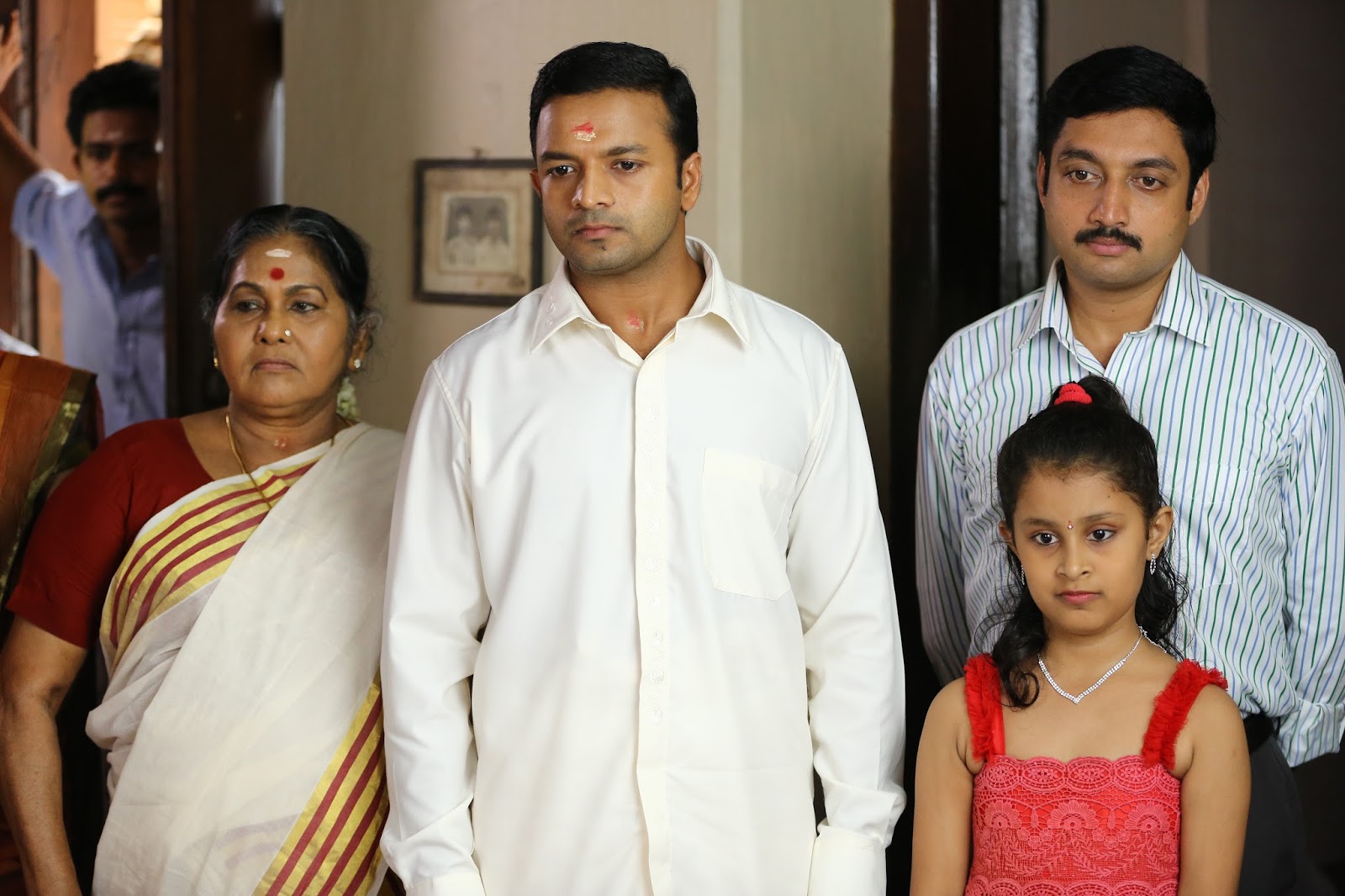 COLUMN: LOCATION DIARY
Director Ranjith Sankar talks about his experiences on the film, ‘Su.. Su... Sudhi Vathmeekam’
Photos: Ranjith Sankar; a scene from ‘Su.. Su... Sudhi Vathmeekam’
By Shevlin Sebastian
On the morning of September 13, director Ranjith Sankar was going through moments of agony. The next day was the last one of the shoot of ‘Su.. Su... Sudhi Vathmeekam’ at a house in Alathur. But a crisis had cropped up. A day earlier, Sidharth Bharatan, the son of veteran actor KPAC Lalitha, had been critically injured in a car accident and had been admitted to the Medical Trust Hospital in Kochi. Lalitha was now at the hospital.
The last day’s shoot consisted of an engagement scene between Jayasurya’s character, Sudhi Vathmeekan, and Sshivada Nair’s Kalyani. As Jayasurya’s mother, in the film, Lalitha had to be present.
And the shoot could not be extended, as Jayasurya, and the others, like Aju Varghese and Sunil Sukhada, had other commitments.
“I did not know what to do,” says Ranjith. “I could not imagine calling Lalitha Maam on the phone.”
So, he had a discussion with his team, about whether the shooting could be done without the presence of Lalitha. “We could say that the mother was not well, and hence could not come for the ceremony,” says Ranjith. “But, somehow, we felt that the audience would not be convinced. We concluded that it would not make sense without the presence of Lalitha Maam.”
However, at night, on September 13, Ranjith got a call. It was from Lalitha. She said that she would come for the shoot the next day. “I immediately said there was no need, especially at such a moment of crisis,” says Ranjith.
But Lalitha said that Sidharth was in the intensive care unit. And she was sitting outside. “There is nothing I can do,” she said. “I know my presence is very necessary in this scene. My only request is if you can send me back soon.”
The next day, Lalitha arrived in the morning. And when during the scene, Jayasurya and Ssivada put rings on each other's second finger, a poignant Lalitha said, “During Sidharth's engagement, he did the same thing.”
Ranjith was moved, as were the other actors and the crew. “No matter the tragedy that had taken place, Lalitha Maam was calm and retained presence of mind,” he says. “For me, this is professionalism of a high standard. That is why she is regarded as a legend. And has lasted so long.”
But there were happy moments, too. During Jayasurya’s birthday celebration, on August 30, at Alathur, the crew had gathered around. Among them were Jayasurya’s wife, Saritha, and children Adwaith and Veda, as well as Ranjith’s wife Smitha, and their children Tara and Tarun. “There was a lucky dip,” says Ranjith. “And of all the prizes, the one which Lalitha Maam won was a case of beer.”
The crew had a big laugh, and shared the cans, but not before Lalitha, sportingly enough, shared a can.
“In the end, by the grace of God, everything has turned out so well,” says Ranjith. “Sidharth has recovered and my film is doing well at the box office.”
(Published in The New Indian Express, Kochi and Thiruvananthapuram)
November 30, 2015
Exploring the Darkness Within

 Alejandro Cortes's film, 'Refuges', focuses on the secrets in families
Photo of the couple by Ratheesh Sundaram
By Shevlin Sebastian
Spanish director Alejandro Cortes was in a spot of bother. The interview was originally fixed for noon, on a recent Saturday, but then it got shifted to 11 a.m. “I was in the midst of packing,” he says, at the lobby of the Grand Hotel in Kochi. “We are flying out today. But I am so glad to meet you.”
Alejandro is accompanied by the lead actress Salome Jimenez. A couple of days earlier, they had the world premiere of their 89-minute film, 'Refuges' at the All Lights India International Film Festival at the Cinepolis.
The story is about the relationship between a brother, Pablo, and his sister Julieta and their closest friend Alberto. In between, there are images from the childhood of Pablo and Julieta which shows them playing and studying together and having the occasional quarrel.
“Julieta is torn between the love for her brother and Alberto,” says Salome. “When they grow up, Alberto and Julieta become a couple. Pablo does not like the relationship, because he loves his sister in a different way.”
Indeed, the relation between Pablo and Julieta is incestuous, at least, on Pablo's part. In fact, one of the stunning images of the film is when Pablo gives vent to his feelings and makes love to a still and shocked Julieta, while she is standing naked in the shower.
“There are many forbidden things that happen within families,” says Alejandro. “It can be called taboos or family secrets. People don't talk about it.”
Meanwhile, Alberto, an art professor, is shown giving an audio-visual lecture to students about the career of Italian painter Caravaggio (1571-1610). In the background, one of his famous paintings, 'The Head Of Medusa' can be seen.
Occasionally, Alberto gets voice mails from Julieta asking him to come home. She is pregnant by him, lonely and bored. But he does not do so. Instead, he meets a woman and goes to a party. Later, they make love in a bathtub.
The movie moves very slowly, almost at the pace of ordinary life. Yet, it is disturbing. “The subject that I am most interested in is human weakness,” says Alejandro. “I like to focus on the darkness of life, because it explains the light. I want to tell the audience that there is a shadow inside every human being.”
Alejandro is quick to agree that his films are for an esoteric audience. “It is difficult for my movies to be popular,” says Alejandro. “Unless it is shown regularly at international film festivals, it will not enjoy commercial success.”
This was confirmed by the audience at Kochi. “Some told me it was not an easy film to see,” says Alejandro. “But many praised the symbolism, as well as the cinematography. Anyway, I am hoping that viewers will like my focus on the family.”
Today, Europe is going through fundamental changes regarding the family. “It is not only man, woman and child,” says Alejandro. “Now it is Man-Man and child. Or Woman-Woman and child, too.”
Salome says that it will take a few years before people fully accept these new tie-ups. “But what is clear is that the traditional family model is breaking down,” she says. “Fifty years ago, when a couple got married, they stayed together for life. But that is no longer the case. A couple might divorce within five years of marriage. The different has become the normal. But many in my parents' generation are finding this difficult to handle.”
This is more so, because Spain is a Catholic country. And the church has not accepted same-sex marriage, as yet. “But then Christianity is going down in Spain,” says Salome. “Spain has so many different cultures now. We have people from Africa, Asia, the Caribbean and Latin America. And they are creating their own influences. It is a very good thing.”
Nevertheless, there is a deep-down desire for spirituality. “But people are no longer using conventional methods,” says Salome. “Spain, like the whole of Europe, is in the throes of change.”
(The New Indian Express, Kochi and Thiruvananthapuram)
November 29, 2015
Going To The Top


 Daniel and Aakriti Wahal run the only artificial rock climbing centre in Kochi, as well as Kerala
Photos by Ratheesh Sundaram
By Shevlin Sebastian
At 4 p.m., on June 27, Daniel and Aakriti Wahal started to go up a rock climbing wall at the Regional Sports Centre at Kochi.
Even though Daniel, 24, had done this thousands of times, his heart was beating fast. Soon, they reached the top, at a height of 50 feet. Daniel and Aakriti, 20, smiled at each other. Then they began their descent. But at 40 feet, Daniel gestured to Aakriti to stop.
The Malayali looked into her eyes and said, “Will you marry me?”
A beaming Aakriti, a Kannadiga, said, “Yes.”
Then Daniel reached into his tracksuit pocket and took out a box. He opened it, took out a diamond platinum ring, and slid it into the ring finger of Aakriti.
She smiled radiantly. A four-year courtship was finally heading towards marriage.
Not surprisingly, Daniel first met Aakriti when he went to do climbing one weekend at Bangalore. The Kochi native was doing his B. Com from the Institute of Finance and International Management Business School at Electronics City. He had heard that people were doing climbing inside an empty shipping container.
When he went there he saw people going up and down the inside of the roof. “Like spiders,” says Daniel. “That was the first time I met Aakriti. She was moving so fast.” Soon, they became friends.
Now the married couple run 'The Rock', Kerala's only artificial rock climbing wall. “All types of people come,” says Daniel. “From five-year olds to middle-aged professionals, all the way to a sixty-year-old.”
The rates are affordable: Rs 160 for three climbs inside an hour. Or Rs 250 an hour for as many climbs as possible. Then there is a monthly package of Rs 2000.
There is only technique to follow. “At all times, there should be a three-point contact with the wall,” says Aakriti. “Either it is two feet and one arm. Or two arms and one foot. This ensures that you have strength and endurance.” And there is one rule. “Once you slip off, you have to go all the way down and start again,” says Aakriti.
And contrary to what most people think, it is an intense workout. “After ten climbs you will feel exhausted,” says Daniel.
Despite the exhaustion, many parents can see evident benefits in this sport. “They have told me their children have improved in their studies, because rock-climbing helps develop focus and concentration,” says Daniel. “And you feel a sense of achievement when you reach the top. That confidence rubs off in their performance at school.”
One such child is Rosh George John. On a breezy evening, he stood at the bottom and looked up with an expectant look. After the safety harness is put on, the ten-year-old goes up. He looks confident and climbs steadily. At the 40 ft mark, the wall becomes an incline. But Rosh moves slowly and carefully. Once past that, he heads easily to the top. Later, he says, “I love climbing. I feel great whenever I reach the top.”
Daniel and Aakriti are also feeling great. Because, on October 30, they took the first-ever team, from Kerala, comprising seven boys and two girls, to take part in the South Zone Rock Climbing Championships in Bangalore conducted by the Indian Mountaineering Federation.
And the over-all performance turned out to be good. “Two girls came sixth and seventh in their category, while one boy came sixth out of 40 participants,” says Daniel.
But the surprise package was Daniel's senior in school, Lakshman Dev Das Varma. One day, he called from Dehra Dun where he is studying, and told Daniel he wanted to try rock climbing. “So I told him to come to Kochi,” says Daniel.
When Lakshman came and tried it, he got hooked. And since he wanted proper climbing shoes, made of rubber, he sold his mobile phone and bought a pair at Rs 6000. “So imagine our surprise that at the Bangalore championships, after only ten days of training, he came 18th out of 40 participants,” says Aakriti. “He has a bright future.”
Meanwhile, to ensure a bright future for the couple, they are planning to open more rock-climbing centres in Kochi.
(A slightly different version was published in Sunday Magazine, New Indian Express, South India and Delhi)


