Michael Patrick Hicks's Blog, page 76
August 11, 2014
Reblog: London Is Planning Its First Floating Village To Make Room For More People | Co.Exist | ideas + impact

Image Source: Co.Exist
Rapid population growth, diminishing resources, and a reduction in available usable land has been at the forefront of my thinking of late, particularly as I start to consider what shape the third book in my DRMR series will take.
I gave very, very brief mention to seasteading in CONVERGENCE, and it’s a concept that plays a larger role in EMERGENCE. I suspect, at the moment, that there will be more on this aspect of future living in the third novel.
I blogged about a somewhat similar topic to this a few months ago after news came of China’s plans to build a floating city of their own. It’s an intriguing prospect and something that engineers will need to look at very closely in the coming decades. There’s an awful lot of islands with enormous population struggles (and even large continents with significant crowding and overpopulation), and with usable land becoming a diminishing resource, there exist only two really viable options for our present needs. One is to either expand vertically, as proposed in the Dubai City Tower or with China’s SkyCity, or, in the case of island nations, to make the open water habitable.
The latter is where notions of seasteading arise, as well as China’s plans of developing a floating city. Now, too, comes word of London’s proposal to develop a floating village of its own.
As Co.Exist reports,
Experts from the Netherlands are helping to plan the new “floating village,” which will include 50 floating homes around a neighborhood square made of water, along with floating restaurants, offices, and shops, and possibly a floating swimming pool. A floating walkway will lead back to land, where the city plans a much larger development with tens of thousands of new homes.
Earlier in its history, the area, known as the Royal Docks, served hundreds of cargo and passenger ships each day. The three docks were the largest enclosed docks in the world–the area of the water alone is 250 acres, and the land is more than 1,000 acres–and they got more use than any other port in London. But they haven’t been in use for the last several decades, and that’s why the city wants to transform the area.
“Tens of thousands of new homes, workspace, leisure and cultural facilities are being developed…The ‘Floating Village’ will be yet another draw, restoring London’s docklands to their former glory as a centre of enterprise and bringing jobs, growth, homes and visitors,” says Blakeway.





August 10, 2014
Reblog: ‘Convergence’ by Michael Patrick Hicks

Thanks for the kind words Jola!
 Originally posted on jolasbookshelf:

An Amazon Breakthrough Novel Award 2013 Quarter-Finalist
Jonah Everitt is a killer, a DRMR addict, and a memory thief.
After being hired to kill a ranking officer of the Pacific Rim Coalition and download his memories, Everitt finds himself caught in the crosshairs of a terror cell, a rogue military squadron, and a Chinese gangster named Alice Xie. Xie is a profiteer of street drugs, primarily DRMR, a powerful narcotic made from the memories of the dead. With his daughter, Mesa, missing in post-war Los Angeles, Everitt is forced into an uneasy alliance with Alice to find her.
Mesa’s abduction is wrapped up in the secrets of a brutal murder during the war’s early days, a murder that Alice Xie wants revenged. In order to find her, Jonah will have to sift through the memories of dead men that could destroy what little he has left.
In a city where…
View original 54 more words





August 9, 2014
National Book Lovers Day
As you may have surmised from the title, today – August 9 – is National Book Lovers Day.
HuffPo has a list of 10 Ways to Celebrate, but I’ll be sticking around the house and quietly digging deeper into the latest Hampton Sides book, In The Kingdom of Ice.

I’m not usually one for the so-called Hallmark Holidays, but anything that gets people reading is OK in my book (so to speak), and maybe I’m a bit biased as a big old book nerd. I’ve seen a few articles and videos of authors speaking about their favorite novels today, and it’s been fun to hear about what inspired their love for the written word.
I don’t recall off-hand the very first book I ever read, but I can say with absolute certainty that there are actually two books that made a truly tremendous impact on me during my formative years, as both a reader and, much later, as an author. The first was Stephen King’s IT. I’ve only read it a single time, way back in my early high school years in the 90s, and have been meaning to reread it again. I even bought a second copy for my Kindle, so that when I finally do get around to enjoying it again, I don’t have to lug around such a hefty tome.
 The only other book I’ve ever purchased multiple copies of, simply out of sheer love of the material, was Frank Miller’s seminal graphic novel, The Dark Knight Returns. I guess if we really want to get picky about what got me hooked on reading, or at least began a life-long infatuation with graphic novels and comic books, and thus books in general, it’d be Miller’s Batman, hands-down. I bought and read and re-read DKR until it was dog-eared and well-worn, with spine broken and cover tattered and bent from so much use.
When the tenth anniversary slipcover edition was released by DC Comics in 1996, I had to buy that one, too. My original trade paperback was on the verge of falling apart, and I wanted a new, pristine hardcover copy to enjoy. Bonus points for this being my first foray into a serious, limited edition collectors version! It included some artwork, scripts, and press materials. And it looked pretty goddamn cool!
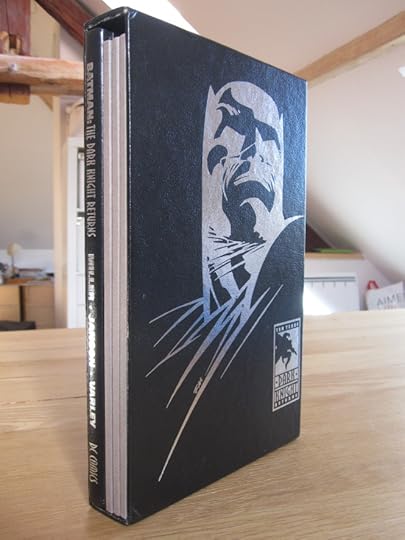
Image source: My Absolute Collection
It’s been a number of years now since I last reread The Dark Knight Returns in full, and my skittish collector’s side has only gotten more wary of touching this 1996 edition. Which means I had to buy the digital issues via Comixology as one of my first purchases through them late last year after hopping on the digital bandwagon.
Back on the pure-word book front, my infatuation began during a summer in Traverse City, sitting beachfront with IT in my lap. It was probably about 80 degrees, the sun was shining, a nice breeze coming in off the water, and I was scared and nervous for Richie Tozier as he was being chased through Derry by the eponymous terror in werewolf form. Thankfully the summer days were long, and if the hairs on the back of my neck were standing that tall in the daylight, I was quite literally afraid to read IT at night. I made some great friends during that trip, in the form of The Losers Club, and they showed me just how rich and vibrant words on a page could really be. I didn’t have any concept of the term “book hangover” back then, but in the wake of tearing through that 1100+ page hardcover in only a handful of days, I surely felt its toll. I’d gone on a full-tilt bender, drowning myself in the rising tide of the Derry River and the awful machinations of a psychopathic clown with razor-blade teeth. I still have a terrific fondness for Stuttering Bill, and I hope that he and Bev are still riding wild on that ten-speed.
IT was where it all started for me, and it opened up a ton of other worlds. I absorbed that book, and then found out about The Stand. From there, it was full-fledged membership into the Stephen King Book Club (twice, and I still have the skeleton key chains around here somewhere to prove it!). The Shining, Salem’s Lot, Carrie, Cujo, Desperation, and on and on and on.
Stephen King led to Dean Koontz, and then I began finding fellow book lovers. My barber at the time, Gloria, was an avid reader, and we traded recommendations. I got into Dennis Lehane, so she got me into John Sandford. During another summer vacation in Traverse City, wandering through Horizon Books on Front Street, I saw the cover for Michael Connelly’s Blood Work. I’d had open heart surgery when I was five, so I was instantly captivated by this story of a retired policeman fresh off a heart transplant getting wrapped up in a murder mystery. I devoured that one in two or three days, then went back to the bookstore to buy up as many Harry Bosch titles as I could.
Michael Connelly led to John Connolly and Robert Crais and Elmore Leonard and James Ellroy. Another high school favorite, and still to this day, was Tom Clancy. So that led to Larry Bond, Vince Flynn, Brad Thor, and a score of others. I found so many new books, so many new authors and genres, from non-fictional accounts of life as a paramedic or in the ER or Homicide: A Year on the Killing Streets, to far-flung sci-fi murder mysteries, like Alastair Reynolds’ Chasm City, which of course then led me to his Revelation Space series.
Frankly, I could go on and on, but I think we all know the story here, right? When it came to becoming an obsessive reader and book lover I was a bit of a late bloomer, but I think it’s pretty safe to say it all started with King and Miller. We’ve all got that one book, or that one author, who really kickstarted things for us.
So, what’s your story?





August 8, 2014






First Impressions: Godus (iOS edition)
 After learning of the release of Peter Molyneux’s latest game for the iOS, via TechCrunch, I immediately downloaded Godus from my iPhone’s app store.
Molyneux has always struck me as a heck of a character, a sort of mad-creator, and his game designs are usually pretty imaginative and brimming with terrific ideas that do not always translate perfectly to a playable product. While I appreciated Fable and it’s sequel (I’ve not yet played part three) at the time of their release, I found The Movies to be rather lacking despite a premise (a Hollywood sim-builder) that was exciting and right up my alley. I really wanted to love that game way more than I actually did, and I keep hoping for Molyneux to take another stab at it and try for a bit of course correction.
With Godus, a Kickstarter-funded God sim in the vein of Molyneux’s earlier Populus, players are dropped into a rescue mission of sorts from the get-go. Two people are on the verge of drowning, and you are given the task of saving them via a brief tutorial that explains the game’s concept of land sculpting. By tapping, holding down, and swiping up, down, left, or right you can control the depth of the terrain, the layers of which are color coded for easy discernability, and shape, or sculpt, the lay of the land.
Once rescued, these two figures recognize you, the player, as God and become your first followers. You continue following them around the map, sculpting the land and clearing it of obstacles in order to help them reach the Promised Land, where they can settle down, breed, build, and worship, all in your honor.

Image source: 22Cans (Facebook)
The initial game-play is pretty straightforward, and the opening segment revolves around building up your tribe’s population and expanding their territory. There are certain goals you have to hit – like breeding 10 new people and building three more abodes – in order to get your reward, in the form of specialized power cards and tools or specialized goods (like animal furs), which can be found in treasure chests across the Promised Land. The cards appear listed in a timeline, which allows you to scroll forward and see what’s coming up as the game progresses. It’s a neat feature and provides a built-in level of anticipation to let you know there’s a method to the madness and end goals to strive for, rather than just playing for the sake of killing time. You unlock more cards by reaching population milestones. The larger your population, the more belief your followers can generate – and it’s the power of belief that allows you to perform many of your actions. There’s a nice bit of interconnectivity to the game’s mechanics that allows one system to naturally feed and supplement other systems.
One of the first important tasks is to repair a temple, which then opens the game wider and generates several prompts requesting players to rate the game and to sign-in with a Facebook or Mobage account. I suspect some may have a problem granting yet another application access to a social media account, though. The game promises to make it worthwhile, and although I didn’t have a problem with logging-in via Facebook, I’m not sure how radical the differences will be for those who don’t. Repairing the temple unlocks gems, which can be used to purchase in-game content, like the Primitive Sticker Pack. You can also make in-app purchases and buy additional gems (50 gems for $4 and up, up to 1400 gems for $99.99). These stickers interact with the cards and are used to unlock and harness the upgrade each card offers.
During the loading of one play session, I was told that followers will learn how to behave based on my actions, which should make for some truly interesting observational game play in the future. I’m not too deep into the game, yet, but the social development of followers promises to be intriguing. Already I’m seeing the initial development of a community as neighbors meet-and-greet one another, sit around camp fires together, or climb trees to harvest coconuts. Your actions do have a direct effect on the people in-world, though. One unfortunate fellow was a bit too close to the water during an accidental sculpting and got dropped into the drink after the land disappeared from beneath his feet. Another townsman saw what was happening and ran out, yelling for me to save him. I was quick to put the land back, and the gent found himself safe and sound again and went back about his business. I may have also made a few people homeless by accident… I’m really keen on finding out what kind of moral quandaries and ethical entanglements may arise from my virtual omnipotence (and occasional clumsiness) as the game develops, and how this will impact and shape the world.

Before.
While constructing a civilization is a vital element of the play-through, the world opens up with the discovery of a sailing vessel. After building the docks, you can launch an exploration to other islands, which basically functions as a mini-game with a network of islands that you’ll travel to and launch explorers. Once on land, you’ll need to select how many explorers to launch and get them from Point A to the temple at Point B by sculpting the land around them to overcome any obstacles in the way. But, you’ll need to hurry as the missions are timed! You also only have X number of explorers on your ship, so you want to be careful about balancing how many people are sent to an island, within the demands of a particular level for a certain number of required explorers. Your team of explorers are basically Lemmings, so you’ll need to be mindful of their group-think habits and act fast to corral them into following the path you’ve devised.
The mini-games make for an enjoyable and thoughtful (and sometimes frustrating) break from the basic mechanics of building abodes, and completing them earns you lots of powerful stickers. The game play opens up a bit further with the realization that your Chosen Ones are not alone in the Promised Land, and with the introduction and growth of God Powers. Although I’m still early on in the game and my Godliness is pretty limited, I sneaked a peek at the timeline’s future cards and there looks to be some very intriguing power sets coming up that should play heavily into the AI development of your tribes and their interactions with the world around them.
Godus is nicely designed and the focus, from graphics to sound, is high on pleasantry and fun. The game has a bright cartoonish feel to it, which is emphasized in the audio department. Send one of your followers to build a new abode and they cheerily reply, “Building!” The music is upbeat and easy on the ears, and the discovery of treasures is suitably ethereal and accompanied by a ghostly whisper when opened.
A supremely annoying aspect, however, and your mileage may vary, came in the form of push notifications. If you have multiple building projects going on, as I did, the game will send you notices when each one is finished. Because I had been building six abodes simultaneously, my iPhone spent quite a while buzzing and beeping to alert me of the status. At the moment I’m OK with logging-in and providing Godus access to my Facebook account, but I will be denying it access to my phone’s alert features very soon!
I also wish that navigation were a bit less sticky. Earlier I mentioned nearly drowning somebody due to an accidental sculpting job on the landscape. Moving around the screen requires a two-finger swipe. This was a little too cumbersome for me, so I tried using both thumbs to travel across the Promised Land with mild success. It’s an easy way to move, but not necessarily the most efficient. So, navigation could require a little bit of retraining of the old muscle memory.

After.
Ultimately, I’m enjoying Godus a hell of a lot. I think it’s a really fun game, some minor navigation quibbles aside. The big question, as is often the case with mobile games and simulators in general, is how long it can keep my attention. Simulators like this are ridiculously easy to get sucked into and after a few hours (or days and weeks that only feel like a few hours…thanks for that, Civilzation!) it can start to feel like you’ve seen and done just about all there is to do before it gets repetitive. Mind you, repetition can be fun if there’s at least some variability in the AI, but most of the time it just sucks. Molyneux and his team of developers at 22Cans will need to keep the updates and improvements coming steadily, along with introductions of new materials, resources, powers, and the like. It does seem like they have their eyes on the horizon and lots of stuff planned to keep the game running for a while, based on this page, although I’m not sure how much of their “Coming Soon” info is based on PC/Mac editions versus the mobile iOS version. After playing the free mobile edition for a while, though, I am deeply tempted to explore the Mac edition and see if I can discern any differences.
To top it all off, Godus is free to download, which makes trying the game out for yourself a nicely risk-free venture. I’m suitably impressed and suspect I’ve found a new addiction to help kill my phone battery. Go get it!





August 7, 2014
Reblog: 10 Great Novels That Will Make You More Passionate About Science
Source: 10 Great Novels That Will Make You More Passionate About Science.
I’ll admit, I haven’t read any of these. Looks like I’ll need to brush up and expand my to-read list.
What’s your take on io9’s list; any you would add? Have you read any of these books, or authors? Chime in below.





Reblog: Humanity’s cultural history captured in 5-minute film : Nature News & Comment
Source: Humanity’s cultural history captured in 5-minute film : Nature News & Comment.
All roads lead from Rome, according to a visual history of human culture built entirely from the birth and death places of notable people. The 5-minute animation provides a fresh view of the movements of humanity over the last 2,600 years.
Maximilian Schich, an art historian at the University of Texas at Dallas, and his colleagues used the Google-owned knowledge base, Freebase, to find 120,000 individuals who were notable enough in their life-times that the dates and locations of their births and deaths were recorded.
…
The team used those data to create a movie that starts in 600 bc and ends in 2012. Each person’s birth place appears on a map of the world as a blue dot and their death as a red dot. The result is a way to visualize cultural history — as a city becomes more important, more notable people die there. The work that the animated map is based on was reported on 31 July in Science1.
The animation reflects some of what was known already. Rome gave way to Paris as a cultural centre, which was eventually overtaken by Los Angeles and New York. But it also puts figures and dates on these shifts — and allows for precise comparisons. For example, the data suggest that Paris overtook Rome as a cultural hub in 1789.





State of the Blog
 I started this blog earlier this year as a bit of a promotional tool prior to releasing my first novel, Convergence, in February. Since then, I’ve met some fantastic writers through WordPress and KBoards, along with twitter and Facebook. It’s been an impressive ride so far.
One thing to note is that while I don’t have wildly impressive numbers like some other bloggers (hell, this blog is only roughly 8 months old at the moment, and a lot of the content was imported from a previous blog that I’ve since shuttered in order to focus solely on this domain), there has been steady growth and a lot of repeat customers who check out the posts, comment, and like. I guess I’m doing something correctly?
July was pretty impressive numbers-wise and my strongest month to date. I began noticing a nice influx of visitors and was charting between 30 to 40 visitors per day. Some days were less, and some days were a lot higher. For the month as a whole, I had over 1,200 hits. My previous largest month was in February when Convergence launched, to the tune of 425 hits. So, July managed to more-than-double my previous most-significant month, no doubt due to guest posts and a tweet from Chuck Wendig who shared my review of Blightborn with his followers (thanks again, Chuck!). In fact, I had a significant number of views thanks to the Wendig Bump, which drew nearly 120 viewers on that day alone, my first 100+ single-day views.
When the blog went live in January, I wasn’t sure what kind of sustainability there would be or what I could post about regularly. Although some months have been a bit lighter than others, content-wise, it seems that I’ve actually done OK finding material to host here, either through the book reviews I’ve written, guest posts from some author friends I’ve met along the way, or reblogging content that strikes an interest or particular chord with me. Last month also saw a lot of content on the blog – 45 posts (also a new record!), which likely helped draw in the traffic. I’d wager it’s unlikely that I top July’s output anytime soon, though.
The biggest hurdle actually seems to be in user engagement. I do wish my posts generated a bit more activity comment-wise, but the amount of likes and shares have been healthy enough that I’m not too put off by it. And perhaps some of the posts don’t merit a lot of in-depth discussion after their publication. There’s a few factors that go into this, I’m sure, but maybe as I become more of a known entity this will correct itself. I dunno.
I’ve also shied away from really controversial stuff, largely to avoid being branded as a particular type of author, either good or bad, in terms of political attitudes and beliefs (although I had little trouble calling Coal Rollers assholes not too long ago, and I firmly stand by that assessment). However, this isn’t really a blog for discourses on gun debate, abortion stances, and so on and so forth. I just don’t want to get bogged down on that stuff here. Which isn’t to say I won’t, maybe, someday share thoughts and opinions on those arenas. I’m just not going to do so right now. And when/if I do, I hope to keep a rather even keel of things and be open to different interpretations. But whatever. That’s a conversation for some other time, really.
This is, first and foremost, a book blog. For my books, and for other author’s books, as well. Generally speaking, of course! I don’t want or need a bunch of overly anxious and obnoxious hawkers trolling all the feeds unsolicited. I have a spam button and am not afraid to use it! But, do note that there is a Contact link up above, and if you’re a respectable sort who wants to do things the right way, go ahead and use it.
I started expanding the scope of this site a bit and am putting more thought into how to nurture and grow things here. The first avenue was to spend time generating regular book reviews, since I am a pretty heavy reader by nature. And I have way more books than I do time. I’m primarily interested in writing reviews for books that I enjoy, and while I understand and appreciate the merit of literary criticism, I also don’t want to waste my time hashing out all the various reasons I may dislike something or grueling over nit-picky crap. If I don’t like something, I tend to just not read the damn thing at all. I’d rather promote the work I enjoy and love, and hope that others can find the same appreciation in a particular book or two.
There were also some terrific guest posts from J.S. Collyer, Lucas Bale, Jessica Rydill, and S. Elliot Brandis. They’re all new writers who made their debuts this year, and whose work I was immediately captured by. They’ve got terrific voices and viewpoints, and I think their material added a lot to this site. Guest posts are definitely something I’d like to see more of around here, so we’ll see what happens with that front. I’m also toying around with the idea of developing a set of standard interview questions for authors to respond to, but that boils down to a matter of finding the free time to do so. Maybe that will be a new feature I can debut in the new year. And speaking of features, if you haven’t already, check out the Features page – you’ll find links to all the guest posts, thus far, conveniently collected there.
Over the next few weeks and months, I’ll be working on gearing up for the release of Consumption, so expect some content, promotional, and release news relating to that new short story. I’m also in the midst of editing Emergence, the follow-up to Convergence, for, hopefully, the first half of next year. I’ve also got a solid stack of ARCs to review from NetGalley, so expect posts regarding those books soon-ish, and hopefully a lot more posts that can be of some interest to my visitors.
I may not have a direct, straight-forward road map for the future of this blog, but I am, at least, more confident in its sustainability and long-term ambitions. I’m also OK with not posting every single day and having some lapses in content. Mostly it’s just a matter of taking things one step at a time.
I’m hopeful that the growth will continue and that more people will find and support my work here and, maybe, enjoy my titles for sale, and that there can grow some kind of symbiosis between these two efforts. I expect to be here for the long-haul, and appreciate you sticking around and maybe helping to spread the word.





August 6, 2014
Pagophagia
 Pagophagia is a compulsive craving for ice.
While medical reports link the craving and consumption of ice to anemia, I hadn’t heard of this term until I began reading In the Kingdom of Ice: The Grand and Terrible Polar Voyage of the USS Jeannette by Hampton Sides. The prologue profiles George De Long, a Naval Academy graduate who journeys to the arctic in search of a lost vessel and its crew, only to return home to his wife and daughter and immediately sign up for another arctic expedition. The ice had gotten into his veins, and the joke is that he’s stricken with pagophagia.
While I’ve certainly not had an adventure like the kind De Long lived through in the late 1800s, I can understand the “Arctic Fever” that swept up the Navy man and many American news-readers of the era.
If you’ve been reading this blog for a while, you may recall this post from January and recognized that I have a certain affinity for arctic tales. I love the icy settings of horror stories like The Thing, or The Terror by Dan Simmons, but I really appreciate true-story accounts of icy adventure like what Sides writes about in his latest. I guess I have a bit of pagophagia myself.
In 2011, my wife and I celebrated our one-year wedding anniversary by taking an Alaskan cruise. Certainly a more reasonable and comfortable vacation than a full-scale arctic expedition, and yet it made me want more. The expanse of wilderness and the sheer enormity of nature was humbling and eye-opening. Simply amazing. I want to spend more time in that land and have a longer, fuller, richer exploration of that state. I may never get to the arctic, but I absolutely must return to Alaska.
Reading Sides’ novel has really made me nostalgic of our previous vacation, so I thought I’d share some photos. And if you want to see the entire set, you can head over to my Flickr page.










August 5, 2014
Review: Broken Monsters by Lauren Beukes

About Broken Monsters
A criminal mastermind creates violent tableaus in abandoned Detroit warehouses in Lauren Beukes’s new genre-bending novel of suspense.
Detective Gabriella Versado has seen a lot of bodies. But this one is unique even by Detroit’s standards: half boy, half deer, somehow fused together. As stranger and more disturbing bodies are discovered, how can the city hold on to a reality that is already tearing at its seams?
If you’re Detective Versado’s geeky teenage daughter, Layla, you commence a dangerous flirtation with a potential predator online. If you’re desperate freelance journalist Jonno, you do whatever it takes to get the exclusive on a horrific story. If you’re Thomas Keen, known on the street as TK, you’ll do what you can to keep your homeless family safe–and find the monster who is possessed by the dream of violently remaking the world.
If Lauren Beukes’s internationally bestselling The Shining Girls was a time-jumping thrill ride through the past, her Broken Monsters is a genre-redefining thriller about broken cities, broken dreams, and broken people trying to put themselves back together again.
About the Author
Lauren Beukes writes books, comics for DC Vertigo, movie scripts, TV shows and occasionally journalism.
She won the Arthur C Clarke Award and The Kitschies Red Tentacle for Zoo City, a gritty phantasmagorical noir about magical animals, pop music, refugees, murder and redemption in the slums of inner city Johannesburg. She is currently adapting the novel as a screenplay for Oscar-nominated producer Helena Spring.
Her debut novel, Moxyland is about a neo-corporate apartheid state, bio-engineered art, nano-branding, cell phones used for social control and terrorism.
The Shining Girls, out May/June 2013 is about a time-travelling serial killer.
She recently made her comics debut in the Fables universe with a Fairest mini-series called The Hidden Kingdom with art by Inaki Miranda. The six issue arc follows Rapunzel travelling to Tokyo to confront a dark secret from her past.
She also writes for kids TV shows including Florrie’s Dragons and Mouk and co-created South Africa’s first half hour animated show: The Adventures of Pax Afrika.
She’s a recovering journalist, who has covered everything from wannabe teenage vampires to township vigilantes and directed a documentary, Glitterboys & Ganglands about South Africa’s biggest female impersonation beauty pageant, which won Best LGBT at the Atlanta Black Film Festival.
She lives in Cape Town, South Africa, with her husband and daughter.
Website: http://laurenbeukes.com/
My Thoughts
(This review is based on an advanced readers copy supplied by the publisher via NetGalley.)
Broken Monsters begins with a grisly murder scene that would be perfectly at home on NBC’s Hannibal – a young child cut and a yearling deer cut in half and glued together, like a perverse satyr.
Lauren Beukes unravels her story across multiple characters, each having their own distinct voice, purpose, and point of view, and it becomes clear that the title Broken Monsters is not representative of only the harsh deeds of a serial killer, but emblematic of the people populating these pages, as well as the setting of Detroit itself. Motown ain’t what it used to be, saddled instead with the label of most violent city in America. Take any list – worst place to live, highest rates of murder, most depressed, least healthiest – and Detroit is sure to find itself near the top. It’s a bent and broken city. So, too, are wanna-be writer Jonno Haim, and lead investigator Detective Gabi Versado. Versado’s daughter, Layla and her friend Cas, are mutually derisive of one another in a way that only best friends can be, and they spend their free time trolling the internet for minor instances of vigilante justice against online perverts, while Cas struggles with a dark secret of her own.
When looking back on Broken Monsters, the first word that leaped to mind was “grit.” The book is a dark police procedural, and you could almost cut yourself on the shards of broken glass, aka “Detroit diamonds,” littering Woodward Avenue just from reading the damn thing. Lauren Beukes doesn’t write characters – she plops down real people whole-cloth and shares their lives with you in 3D, the good, the bad, and, most of all, the ugly. All of it, sparing you nothing. Jonno is, by turns, sympathetic, inspiring, and atrocious thanks to the mistakes he’s made and effort he puts into making it one more turn. Layla and Cas – I’m sure we all had friends like these two, or know of girls like them. Versado and the remains of her private life, the struggles she has as a female cop in a man’s world – it’s all eminently relatable. These are flesh-and-blood individuals. They do stupid things, each trying to be the hero in their own messed up lives, and we can root for them one moment and be angry at them the next because, in some ways both small and large, we are them.
Beukes nails the atmosphere of Detroit and it’s police. The dirty, sometimes mean-spirited, humor and the ordeal of women on the force. Gabi remembers, for instance, a time when all of the women’s bust-sizes were leaked after being fitted for a bulletproof vest. There’s the bullpen chatter and daily debriefings over the progress of the murder investigation that ring authentic and accurate, right down to the squad commander nixing the internal nickname of “Bambi” for the slain boy.
The Detroit setting is mined for all its worth and given credibility by mentions of local staples like Belle Isle, Eastern Market, the Packard Plant, Nain Rouge, Fox 2 News broadcaster Charlie LeDuff, a police department that’s overworked and so underfunded that even the whiteboard markers are dead, as well as some of the more notorious aspects the city is known for – urban decay, homelessness, a notorious ex-mayor and federal felon Kwame Kilpatrick (currently serving a 28-year prison stint), drug abuse, theft, property abandonment and foreclosures and squatting, and, most of all, murder.
After reading The Shining Girls last year – one of my absolute favorites of 2013 – I immediately bought Zoo City and Moxyland (sadly, I’ve not gotten to them yet), and kept my ear to the ground for news of her follow-up. I was really excited when she announced the Detroit setting for Broken Monsters. It would have been a must-read regardless of the locale, but being from Michigan this made my need to read more immediate. Beukes has done her research, and it feels almost as if this South African author has written one of the definitive fictional Detroit crime books. If there was ever a perfectly crafted ode to a fallen American city, this is it. She tackles the Motor City with the authentic finesse of The Wire by way of Red Dragon, polished with sublime sheen of noir-cool. Highly, highly recommended.

South African edition cover art, designed by the supremely talented Joey Hi Fi.