Michael Patrick Hicks's Blog, page 77
August 4, 2014
Reblog: Justine Allen’s Book Review: Convergence, by Michael Patrick Hicks

Great review of CONVERGENCE by fellow sci-fi author Justine Allen. She writes “… As I have an interest in anything sci-fi, especially books making it through the ABNA rounds, I couldn’t resist. I was not disappointed with my choice, and Michael is another Indie Author who deserves to do well.”
Many thanks for the kind words, Justine. Glad you enjoyed the read!
 Originally posted on Justine Allen Writing:

I picked up Convergence through an Indie Author Land author interview. By the way, I frequently use Indie Author Land to pick up new books, as it gives me a sense of what makes the author tick, as well as extra insights into the book.
The book genre is described by the author as follows:
“I think sci-fi readers will find plenty to appreciate here –CONVERGENCEhas the grungy high-tech cyberpunk feel to it, set in a near-future America that’s been shattered by war and political in-fighting. But it’s also a neo-noir-thriller, and rests just as comfortably in the mystery/thriller mould as it does sci-fi. It’s definitely a hybrid-genre read and should appeal to a pretty broad audience.”
Convergence was also an Amazon Breakthrough Novel Award 2013 Quarter-Finalist in the Science Fiction, Fantasy & Horror category. As I have an interest in anything sci-fi, especially books making it through the…
View original 285 more words





August 3, 2014
Sunday To-Dos
To-do list for Sunday:
1. Yard work
2. House cleaning
3. Mead

At some point, I need to get caught up on the The Strain. These bottles seem somewhat appropriate to accompany a viewing of some recent episodes.
The honey wine comes from a local meadery, B. Nektar. Never had any of their stuff before, but I certainly love their sense of humor.
Oh yeah, I should probably also keep on editing book two… I’m about half-way through and it’s taking a bit longer than anticipated. It’ll be going off to the pros for their first-round edits next month.





August 2, 2014
Marvel Movies

I saw Guardians of the Galaxy today and enjoyed it quite a bit. I’m not overly familiar with the comic book source material outside of the recent work Brian Michael Bendis has produced since the Marvel NOW relaunch, but the film is another strong entry in the Marvel Cinematic Universe and a nice change of pace from the previous entries.
I won’t say much more on the movie – there’s plenty of other reviews out there and the film is enjoying a nice bit of critical acclaim, so I’ll leave this one up to the pros. Besides, I think Charlie Jane Anders, writing for io9, covers why this movie is such a treasure pretty well. It reminds me a lot of all those fun sci-fi movies I watched and loved as a kid, from Star Wars to The Last Starfighter, all mixed up with a bit of Firefly. Mostly, it’s just a damn fun film.
The one thing I’ve really enjoyed most about the MCU is its interconnectedness and the massive scope it’s building. We pretty much knew since Iron Man that an Avengers team-up was on the horizon, and now that we’ve gotten that the Marvel movie studio is really upping its game and going crazy. As a fan of the comics, this is really a terrific thing to behold, and to see the various franchises working together to create such a large canvas and build toward what could eventually become a massive space-based epic is pure joy. Since the introduction of Thanos in The Avengers, I’ve been hoping for an adaptation of The Infinity Gauntlet. I’m still convinced that’s where things are heading, but really there’s so much potential for other story elements to come into play, like a Kree invasion or maybe a film treatment of the more recent Infinity storyline by Jonathon Hickman.
I have no idea how receptive audiences would be toward this (but I suspect Marvel wouldn’t need to be all that fearful of it, given their current spate of successes), but I would love to see a more drawn-out, single-story line crossover as either a duology or a trilogy, similar to one of Marvel Comics many comic-book crossovers. Just take the entirety of the MCU and go all Lord of the Rings with it.
There’s a lot going on in Guardians, and while the primary threat is self-contained within the movie, I’d be very surprised if it’s not laying a tremendous amount of groundwork for the future of Marvel movies. If Guardians of the Galaxy is as important as I think it is for the future of the MCU, particularly given the amount of myth-building at work here, I am fully expecting to be made very, very happy by the time Avengers 3 rolls out. I could easily see Guardians 2 playing out as a bit of a first act for the Avengers 3 storyline, since the former already has a release date of 2017 and Avengers is expected to land in 2018. Of course, I could be way off, but let’s face it – who wouldn’t want to see Iron Man teaming up with Rocket Raccoon?
Now, here’s a look back at Marvel’s Phase 1 & 2, which was shown at this year’s San Diego Comic-Con!
Bonus: Every Marvel Movie Easter Egg In One Video (At least up through Thor: The Dark World)





August 1, 2014
Biohacking the Future
Biohacking is one of those subjects that really make my ears perk up. I have a couple of titles in my to-read pile on the topic (one of which is Biopunk: Solving Biotech’s Biggest Problems in Kitchens and Garages), and I loved what fiction author James Rollins did with this bit of next-gen body modification with new Sigma agent Duncan Wren in The Eye of God. Wren has magnets implanted in his hands that allow him to feel electromagnetic fields.
Pretty cool stuff, and, as it turns out, none the least bit far-fetched. In fact, you can find some pretty in-depth discussions at Biohack.me, which should be one of your first stopping points if you’re exploring whether or not becoming a grinder is right for you.
Here’s a couple of articles well-worth reading from The Verge:
First up, from August 2013, Ben Popper’s “Cyborg America: inside the strange new world of basement body hackers.”
Second, a more recent article by Adi Robertson, published July 31, 2014: “Cyborg conversion incomplete: my life with finger implants.”
Continuing on the topic of magnetic implants, be sure to check out this first in a series of articles at H+: “Magnet Implants I: Armstrong as Icarus.”
Also, check out this profile in Wired, circa 2010, on Lepht Anonym, who Popper credits, along with Kevin Warwick, is one of the founding figures of the biohacking movement. Then, there’s the story of German biohacker Tim Cannon and his Circadia 1.0 implant, which provides his own biometric data to his Android device in real-time. As explained in Motherboard,
He’s also working to automate communication between the chip and the internet of things.
“I think that our environment should listen more accurately and more intuitively to what’s happening in our body,” Cannon explained. “So if, for example, I’ve had a stressful day, the Circadia will communicate that to my house and will prepare a nice relaxing atmosphere for when I get home: dim the lights, let in a hot bath.”
So Cannon is essentially trying to integrate the body into the growing quantified and connected universe. But unlike the life-loggers and step-counter-users, biohackers take the concept of self-improvement to the next level. Why would one literally hack his body?
According to Cannon, the developments are not about simply trying to insert gadgets into one’s body for a performance enhancement. The end goal is to transcend the boundaries of biology, and try to hack evolution itself.
Here’s Anonym presenting “Cybernetics for the Masses” during the 27th Chaos Communication Congress, part one of three:
and a TEDx speech by Warwick:
Well worth a read, too, is this three-part series on biohacking originally published on BBC Future in 2013 by Hanno Charisius, Richard Friebe, and Sascha Karberg:
Becoming Biohackers: Learning the Game
Becoming Biohackers: The Experiments Begin
Becoming Biohackers: The Long Arm of the Law
The trio have published a German-language book on the topic as well, Biohacking: Gentechnik aus der Garage, with an English-language eBook reportedly forthcoming.
Lastly, and also worth checking out, is this article from AlJazeera America by Jessica Firger, “The brave new world of biohacking.”





July 31, 2014
Guest Post: S. Elliot Brandis, “It’s Not The End Of The World”
S. Elliot Brandis is a writer I came into contact with thanks to KBoards. I was immediately taken by his description for his debut novel, Irradiated (part one of The Tunnel Trilogy), and have been patiently waiting for the release of its follow-up, Degenerated. The good news is that the latter is now available, and both can be had for the uber-cheap introductory price of only 99c for a limited time. Two books for less than two bucks. Go buy them immediately!
If you’re wondering whether Irradiated may be up your alley or not, check out my review. If you’re a fan of post-apocalyptic fiction, I think it’s a pretty safe purchase. The story is solid, and Elliot has a damn strong writing voice and a style I really dig. To top it off, those Jason Gurley covers are beauties. All in all, it’s a top-notch package.


buy irradiated at amazon
buy degenerated at amazon
I’m really happy to have Elliot posting here today, so let’s get on with it. Here’s his article, “It’s Not The End Of The World.” Enjoy!
It’s Not The End Of The World
Think of post-apocalyptic fiction, and what do you see? Zombies, bombs, disease, disaster, war? Maybe you see barren landscapes, or bones jutting from emaciated bodies. Whatever it is, I bet it’s unpleasant.
It would be easy to think, then, that post-apocalyptic fiction is about one thing: fear. Indeed, fear is deeply ingrained in the genre. Our stories tap into our fear of the future, of human nature, of what happens when it all goes wrong. However, fear is only half of the equation.
If you distil the genre down into core elements, what you’ll find are two competing emotions: fear and hope. They are the heart of the genre, it’s defining feature. The balance between the two changes, but the conflict between them is always there.
Consider The Walking Dead, in all of its guises. It taps into many of our fears. Our fear of dying, and of losing loved ones. Our fear of fellow man, and the darkness that may lay hidden deep in their hearts, waiting for a chance to surface. It also raises questions about ourselves. If you were pushed to the edge, would you still act in a way that’s moral? Or would you compromise your morals to save yourself and your family? What is more is more important? But, on the other hand, it’s also a show about hope. The hope that if we tough it out and try to work together—maybe there is light at the end of the tunnel. Maybe we can make a new start, forge new relationships, and persevere. The hope pushes us forward, through all the darkness.
Even the darkest works have this glimmer of hope. Cormac McCarthy’s The Road is often described as bleak, perhaps even ‘hopeless’. But I disagree—there is hope. The man and his son are “carrying the fire”. He instils this idea in his son—they are amongst the last flickers of humanity, it’s final chance. Without this sliver of hope, as slim as it is, I doubt that the book would work. It is a trickle of oxygen in an otherwise suffocating world. And, as bad as that novel may make us feel, it also makes us think that perhaps, just perhaps, there is merit in our sheer doggedness.
So, we arrive to the title. Despite the name, post-apocalyptic fiction is not about the end of the world. It’s about our fight to prevent the end of the world. The conflict between hope and fear—the fundamentals of human existence—lay at its core. It’s about our will to survive.
And that’s what makes it so damn good.

S. Elliot Brandis is the author of Irradiated, the first novel in a trilogy. He lives in Brisbane, Australia, and often sets his stories there, too. He loves hearing from readers, and can be found at many locations across the internet.
Website: http://selliotbrandis.com/





July 30, 2014
Reblog: The Big Idea: Arianne ‘Tex’ Thompson
I’ve been thinking a bit about the genre sometimes known as “weird western” of late. The concept is one that really strikes a chord with me and I love the idea of a low-tech frontier dealing with supernatural forces. I’d hope for more out of the movie Cowboys & Aliens; after all, six-shooters and horses vs. aliens and UFOs seemed ripe for a truly awesome story. Joe R. Lansdale’s Deadman’s Road is in my TBR pile, and Hunter Shea’s Hell Hole has certainly caught my eye.
Thanks to John Scalzi’s blog, I can now add One Night in Sixes to my list. It sounds dynamite!
Author Arianne ‘Tex’ Thompson writes, “But as nervous as I am about this Big Idea and how it will be received, the even-bigger one behind it – that is, the push for a more inclusive bookshelf, and the importance of being able to re-imagine our own history without sweeping the uncomfortable bits under the rug – is one that I am really excited about. I hope you will be too.”
I certainly am. And the quote drawing a quick comparison to Stephen King’s The Dark Tower doesn’t hurt any, either! Be sure to check out the original post at Whatever.
 Originally posted on Whatever:
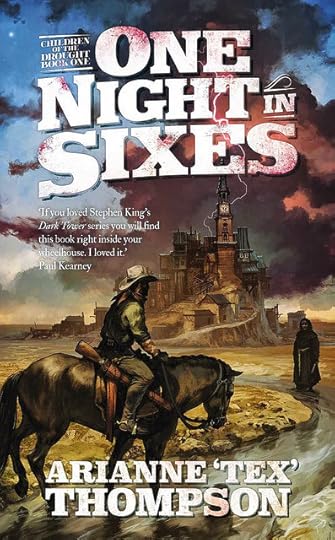 When you introduce magic into a real-world setting, you don’t only have to deal with the problems that magic introduces — you have to deal with the problems that already existed in that real world setting. When Arianne ‘Tex’ Thompson wanted to introduce magic to an American milieu in One Night in Sixes, she took all of those problems into consideration. Here’s how she made it work.
TEX THOMPSON:
All I can say is that it seemed like a good idea at the time.
“I’m tired of Euromedieval fantasy!” I thought. “I’m tired of swords and castles and straight white monocultures. I’m going to write a fantasy about MY country, and MY history, with eleventeen kinds of people rubbing shoulders – like in real life! – and it’s going to be AMAZING.”
And by “amazing”, I must have meant “an absolute landmine of racism, imperialism, slavery and genocide.” Because…
View original 735 more words





Review: Tom Clancy Support and Defend (A Campus Novel) by Mark Greaney

About Support and Defend
One of Tom Clancy’s most storied characters, Dominic Caruso, is the only one who can stop America’s secrets from falling into enemy hands in this blockbuster new novel written by Clancy’s longtime coauthor.
Over the course of three decades, Tom Clancy created a world alive with prescient action and remarkable individuals. In Tom Clancy Support and Defend, Dominic Caruso is presented with the deadliest challenge of his career.
Dominic Caruso. Nephew of President Jack Ryan. FBI agent and operator for The Campus, a top secret intelligence agency that works off the books for the U.S. government. Already scarred by the death of his brother, Caruso is devastated when he can’t save a friend and his family from a terrorist attack
Ethan Ross was a mid-level staffer for the National Security Council. Now he’s a wanted fugitive on the run with a microdrive that contains enough information to wreck American intelligence efforts around the world. The CIA is desperate to get the drive back, but so are the Russians and various terrorist groups all of whom are closer to catching the fugitive. Only Caruso stands in their way, but can he succeed without the aid of his Campus colleagues?
About the Author
Mark Greaney is the #1 NYT bestselling coauthor of Command Authority, Threat Vector, and Locked On, by Tom Clancy with Mark Greaney. He is also the bestselling author of the Gray Man series, including Dead Eye, The Gray Man, On Target, and Ballistic.
Mark lives in Memphis, Tennessee
Learn more at MARKGREANEYBOOKS.COM
My Thoughts
I was immediately saddened by the loss of Tom Clancy last October, only a few months before the release of his final Jack Ryan novel, Command Authority. I’d been reading Clancy books since high school, after discovering his work by way of Harrison Ford’s adaptation of Patriot Games. The movie quickly became one of my favorites, so I had to read the book it was based upon, which then led to a long-term addiction.
The seven-year drought between The Teeth of the Tiger and Dead or Alive was a much too long dry-spell, but with a team of co-authors the master of technothrillers was back in top-form (in my eyes, at least). No sooner were fresh Clancy books on the shelf, than news came of his unfortunate passing.
Thankfully, not all is lost. Mark Greaney, who collaborated with Clancy on the last three novels, is helping to keep the franchise running and returns with a solo effort focusing on The Campus operator, and series regular, Dominic Caruso.
Ethan Ross, an intelligent NSC staffer guided more by his inflated ego than his principled ideals, finds himself in hot-water after an inter-agency effort to find the source of a classified intelligence leak. That leak led to the murder of a Mossad agent and his family, whom Caruso had become involved with during a series of training exercises. The data was pulled by Ross in order to assist a Wikileaks-like program, the International Transparency Project, and as the FBI’s manhunt intensifies and the nature of the hacktivist brigade he works for grows cloudier, Ross becomes convinced that the only way to protect himself is to steal so much classified data that he then becomes too large of a target for the American government. As Caruso becomes more plugged-in to the investigation surrounding Ross, the more determined he grows in carrying out vengeance for the deceased Yacoby family.
Support and Defend is clearly influenced by the recent Edward Snowden affair, and Greaney proves to be a more than capable handler of Clancy’s legacy. The story elements borrow heavily from a quite recognizable geo-political landscape as Ross attracts the attention of international forces in Israel, Russia and Iran, in addition to agents and agencies at home. Although the Ryan family is absent and unmentioned (although from the few references made to POTUS, it’s clear Jack Ryan, Sr. is still sitting in the Oval Office), Dom is able to carry the weight of the story quite well and the book harkens back, in some respects, to earlier Clancy novels, like The Cardinal of the Kremlin.
While there is a clearly political element to the story (let’s face it, it wouldn’t be a Clancy book without that!) and the repercussions of the data leak pose a global problem to American Intelligence agencies, the primary focus of the story is on espionage and spy-craft, particularly early on when Ross gets a quick education in recognizing a tail and employing old-school trade-craft to alert his handlers within the International Transparency Project. The action is blazing and Greaney manages the same gripping narrative of previous entries, making the read a breezy, but completely interesting and involving, affair. He’s also quite masterful in weaving together the disparate, multi-layered elements presented by the Transparency Project, Russian involvement, and the goals of Mohammed Mobasheri, an agent for the Iranian Republican Guard.
If there’s one complaint to be had, it’s that the epilogue takes a bit of a left-turn into debonaire James Bond territory, and the interaction between Adara Sherman and Caruso felt a little bit off and out of character, particularly for Sherman. Given their previously established relationship and Adara’s professionalism, the resolution to their involvement together seemed forced, as if the material had been cribbed from any number of other generic spy-thrillers in an effort to needlessly spice things up a bit.
That quibble aside, I’m hoping Mark Greaney sticks around for the long haul and that he gets to make the Clancy universe his own. His involvement here provides a nice measure of hope that we haven’t heard the last of The Campus recruits and the Ryan family. I’m keeping my fingers crossed that the All-Star team will be making a comeback sooner rather than later. And you can be sure I’ll be adding Greaney’s own The Gray Man series to my reading list soon.
Buy support and defend at amazon

Source: The Official Tom Clancy Page on Facebook





July 28, 2014
Guest Post: Jessica Rydill, author of The Shamanworld Series
Jessica Rydill is a British fantasy author who came to my attention via Kboards over the last few months. After talking with her and learning about her Shamanworld series, I was impressed with the amount of thought and depth that went into creating her alternate-Earth history, where an Ice Age has radically changed the socio-political developments of a parallel Europe circa the 1800s. A technologically advanced society uneasily rests besides medieval tribes, and magic-wielding shamans wander the land, while certain people live under the whims of the Goddesses.
Originally published by Orbit in the UK in 2001 and Penguin Putnam in the US, Children of the Shaman has since been revised and reformatted for release as an eBook by Rydill. Its follow-up, The Glass Mountain, was published by Orbit in the UK in 2002, and Jessica is currently readying it for re-release soon. The third novel, Malarat, is available now.
Here’s Jessica to discuss her work and its evolution:

Many thanks to Michael Hicks for inviting me to do a guest post on his blog. I write fantasy fiction, though my imaginary world started out as a post-apocalyptic version of the real one. But it didn’t stay that way.
I have written three books so far, starting with Children of the Shaman; the other two are The Glass Mountain* and Malarat. I am also working on a fourth book, called Winterbloom. They follow each other in sequence, and deal with the members of the same family: Annat Vasilyevich, her older brother Malchik, their father, Yuda, and their aunt, Yuste. Some of them are shamans; I discuss what that means below!
When I was working on the back-story to my first book, Children of the Shaman, I imagined it taking place after a nuclear holocaust, in which a small minority of humans had developed super powers. John Wyndham’s novel The Chrysalids influenced me, and also news reports claiming that the Russian secret service was experimenting with psychic forces. This formed the kernel of an idea.
I moved away from a future set in this world to create an imaginary one: Mir. The name comes from the Russian word for the Earth. I abandoned the post-nuclear scenario and chose to invent a mini-Ice Age, like the one that occurred in Europe at the end of the Middle Ages.
The Ice Age on Mir, which lasts from the end of their 15th century to the start of the 19th, is known as the Great Cold. It has several consequences for their history (and geography!). Parts of Europe – Yevropa – get stuck in the Middle Ages. The countries based on China and India become technologically advanced. There isn’t really a British Empire, and the New World (both North and South America) develops differently.
When the Great Cold ends in the early 1800s, a series of mass migrations begins. Large populations leave Northern Europe, Eastern Europe and Russia, and head south. By the time of the story, which is set in the 1850s, many have settled along the shores of the Mediterranean (or Middle Sea).
My stories are set in Lefranu, which is based on France. The north has been cut off from the south during the Great Cold. This means that the northern half of Lefranu is still medieval. They have lost contact with the outside world, and continued to live as they did in the Middle Ages. They are not even aware that things have changed.
In the south, a city-state called Masalyar (Marseille) stands on the shores of the Middle Sea. It’s very cosmopolitan, and there are large numbers of migrants from Sklava (Russia) and Morea (Africa). Most of these immigrants work on the railway – the city has acquired steam-powered technology. When they start to build a railway north, they discover the interior that has been cut off from the outside world for centuries. And they start meeting the original inhabitants, the Franj. Some are friendly and some are hostile; that’s the setting for my stories.
Michael asked me about the religion (or spirituality) in the stories. The main characters are ‘shamans’ which means that they possess psychic powers. They use a form of telepathy that they call ‘sprechen’ to communicate with each other; they heal wounds and cure some illnesses; and they can travel into other dimensions – spirit worlds, underworlds, and other planes. Some of them also use their powers to fight.
There is a mystical side to the shamans. They can and do have spirit animals, though the ones who live in cities don’t know what they are. They have a definite afterlife. When ordinary humans, the Teshvet, die, nobody knows what happens to them. But dead shamans continue traveling through the underworld after death; occasionally they return.
Lefranu has two principal established religions, Doxa and Ya-udi. Doxa is based on Christianity; it’s a blend of Roman Catholicism and Eastern Orthodoxy, but the Virgin Mary’s counterpart, Megalmayar, is a God. Though the religion is matriarchal, the hierarchy is staffed by men.
The Wanderers or Ya-udi are like the Jews. They were cursed by Megalmayar to wander the earth, in exile from their homeland, Zyon. So they live in a kind of diaspora and are persecuted by the Doxoi to varying degrees. Their God is called the One, and they don’t refer to him by name. Like Judaism, it is a patriarchal religion; the words and the letters of their sacred language, Ebreu, are important (and magical).
And then there are the Goddesses. The other deities, like the One or Megalmayar, are unseen; they don’t appear in person. But the characters meet the Goddesses (or one Goddess with two aspects). This creates a problem for them. Some of them are Doxoi and some are Wanderers, but there is no doubt that the Goddesses are real. And not only are they real, but they draw the main characters into their myth. They don’t ask permission; they mug the characters and leave them to deal with the consequences.
The idea of the Goddesses was inspired by the myth that Mary Magdalen sailed to France in a boat without sails, accompanied by two sisters of the Virgin called Mary Salome and Mary Jacobe, and their servant Sara. The number of women all named Mary immediately suggested a Goddess cult. This seems to be a popular idea, and there are books that suggest that the Virgin Mary was a Temple Virgin, or that Mary Magdalen was a hierodule (or holy prostitute): cf. Mary Magdalene: Christianity’s Hidden Goddess by Lynn Picknett.
I was interested in the idea of syncretisation, in which one religion is used to hide another, as with religions such as Santeria or Vodou. It seems possible that the story of so many Marys landing in France might have been invented when the country converted to Christianity, and Christian saints replaced local goddesses. It’s an interesting thought!
In my story, the Goddesses (or aspects of one Goddess) are known as Artemyas and Nyssa. She is dual – she has a dark and a light side; but it’s important to note that dark isn’t purely evil and light isn’t purely good. She (or they) are ambivalent. I can’t say much more without a spoiler alert! But writers often treat of goddess religions as if they are wholly benign. In this case, they do have negative aspects.
This tells you a lot about the back story – or background – to my novels. I’m not sure whether they are High Fantasy ‘defined either by its setting in an imaginary world or by the epic stature of its characters, themes and plot’ to quote Wikipedia, or Low Fantasy ‘nonrational happenings that are without causality or rationality because they occur in the rational world where such things are not supposed to occur.’ (Brian Stableford (2009). The A to Z of Fantasy Literature. Scarecrow Press. p. 256. ISBN 978-0-8108-6829-8)
I think probably the latter, because Wikipedia goes on to say: ‘Low fantasy stories are set either in the real world or a fictional but rational world, and are contrasted with high fantasy stories which take place in a completely fictional fantasy world setting with its own set of rules and physical laws.’
But it’s hard to be sure!
*[The Glass Mountain hasn’t been published yet; it was part of my back-list and had to be scanned and revised.]
 Jessica Rydill writes fantasy and collects Asian Ball Jointed Dolls. This makes her living room an unnerving place to visit. Many of the dolls are based on characters from her books. The bad guys stay locked in the cabinet.
Jessica wishes she could write like Russell Hoban. In the mean time, she has got a cross-over going on between medieval fantasy with warlords, and steampunk adventure with lightning-wielding shamans.
Plus Golems, Dybbuks, Kabbalistic demons, and other nasty surprises from Jewish folklore.
Learn more about Jessica Rydill’s Shamansland books at http://www.shamansland.com/index.html





July 25, 2014
How The DARPA Of The Energy World Wants To Change The Electricity Grid | Co.Exist | ideas + impact

The below article, by Jessica Leber for Co.Exist, makes for an interesting read about a government project I hadn’t heard of before: the Department of Energy’s ARPA-E (Advanced Research Projects Agency-Energy).
Here’s a bit of background on ARPA-E, directly from their factsheet:
The Advanced Research Projects Agency-Energy (ARPA-E)
catalyzes transformational energy technologies that could
create a more secure and affordable American future. We
advance high-potential, high-impact energy technologies that
are too early for private-sector investment. ARPA-E awardees
are unique because they are developing entirely new ways to
generate, store, and use energy.
ARPA-E projects have the potential to radically improve
U.S. economic prosperity, national security, and
environmental well-being. We focus on transformational
energy technology projects that can be meaningfully
advanced with a small investment over a defined period
of time. Our streamlined awards process enables us to act
quickly and advance cutting-edge areas of energy research.
ARPA-E empowers America’s energy researchers with funding,
technical assistance, and market readiness. Our rigorous
program design, competitive project selection process, and
active program management ensure thoughtful expenditures.
ARPA-E Program Directors serve for limited terms to ensure a
constant infusion of fresh thinking and new perspectives.
Given their focus on technological innovation and next-generation breakthroughs, this high-concept research division has drawn parallels to the Department of Defense’s DARPA initiative, and you can check out their current list of more than 300 projects here.
Also worth a listen: Acting Director Cheryl Martin on NPR’s Science Friday.
Original article:
How The DARPA Of The Energy World Wants To Change The Electricity Grid | Co.Exist | ideas + impact.





July 24, 2014
Hacker, Hoaxer, Whistleblower, Spy: The Story of Anonymous
 As usual, NetGalley keeps upending my reading plans… Maybe I shouldn’t even bother trying to organize anymore given the ever-shifting queue of books.
While browsing today, I came across Gabriella Coleman‘s forthcoming Hacker, Hoaxer, Whistleblower, Spy: The Story of Anonymous (a nice play on John le Carre’s Tinker, Tailor, Soldier, Spy).
A snippet of her bio reads
Gabriella (Biella) Coleman holds the Wolfe Chair in Scientific and Technological Literacy at McGill University. Trained as a cultural anthropologist, she researches, writes, and teaches on computer hackers and digital activism.
and she tweets at @BiellaColeman.
There are lots more information and links to her work at her website, so go check it out.
Hacker, Hoaxer, Whistleblower, Spy: The Story of Anonymous releases in November. Here’s the description:
Here is the definitive book on the worldwide movement of hackers, pranksters, and activists that operates under the name Anonymous, by the woman the Chronicle of Higher Education calls “the leading interpreter of digital insurgency” and the Huffington Post says “knows all of Anonymous’ deepest, darkest secrets.” Half a dozen years ago, anthropologist Gabriella Coleman set out to study the rise of this global collective just as some of its adherents were turning to political protest and disruption (before Anonymous shot to fame as a key player in the Arab Spring and Occupy Wall Street). She ended up becoming so closely connected to Anonymous that some Anons claimed her as “their scholar.” Hacker, Hoaxer, Whistleblower, Spy brims with detail from inside a mysterious subculture, including chats with imprisoned hacker Jeremy Hammond and the hacker who helped put him away, Hector “Sabu” Monsegur. It’s a beautifully written book, with fascinating insights into the meaning of digital activism and little understood facets of culture in the Internet age, such as the histories of “trolling” and “the lulz.”
And here she is discussing Altruism and Nihilism on the Net: