Michael Patrick Hicks's Blog, page 64
December 31, 2014
2014 Reading Challenge Roundup
Well, there’s one more book-filled year slipping past. And, man, so many good books!
My TBR pile has grown exponentially, and digitally, to boot. I bought a Kindle last year as a Christmas gift to myself and haven’t read an actual physical book since. In fact, I have fully embraced the digital revolution!
 I also joined NetGalley, which is an invaluable resource for book bloggers and reviewers. There are just so many titles to pick from at any given moment, and I made a huge amateur mistake by drowning myself with more content than I could possibly read. Going forward, I need to be more selective in my requests and work harder on following through with reviews.
So, a bulk of this year’s reads came from NetGalley, in addition to my own purchases, and a few ARCs I received from some fellow authors, like Lucas Bale, S. Elliot Brandis, J.S. Collyer, Nicholas Sansbury Smith, and Therin Knite. In January, I gave myself the entirely arbitrary goal (and mostly because that was my goal for last year, as well) of plowing through 45 books in the annual Goodreads Reading Challenge. I actually blew past this goal pretty quick, and ended the year with a grand total of 86 reads! For comparison’s sake, you can find my write-up on 2013’s challenge here.
I’m pretty happy with both the quantity and quality of the titles I read, and I began reviewing a fair number of them right here on this site. You can find the complete list of titles I read for the 2014 challenge on Goodreads.
The Stats
24,086 pages read, across 86 books. (For comparison’s sake, in 2013 I read 21,800 pages across 52 books.)
37 Horror
26 Science Fiction
13 Mystery/Thriller/Suspense
10 Non-Fiction
 Longest read: 752 pages (Tom Clancy Full Force & Effect by Mark Greaney)
Shortest read: 44 pages (What It Means To Survive by Lucas Bale)
Ratings:
1 star was awarded to only two titles
2 stars – seven titles
3 stars – seven titles
4 stars – 34 titles
5 stars – 36 titles
The Trends
 Having more than 80 books under my belt doesn’t feel quite as large as it should, and you can gather from the fairly close page counts between 2013 and 2014 that I was reading many more smaller works this year than last. Although I read 36 more titles this year than last, this only netted me an additional page count of 2,286. I was reading a lot more short stories and novellas over the course of 2014, whereas 2013 was nothing but novel-length works.
In fact, 2014 could be dubbed The Year of the Novella for me, as I became more than a bit infatuated with DarkFuse titles, a small independent publisher of dark fiction. In fact, if I had to name a Publisher of the Year, it would go to DarkFuse, hands down. I don’t think I’ve ever read so many consistently good books from a single publishing house ever. They’ve got a terrific stable of authors like Tim Curran, Greg F. Gifune, Jon Bassoff, Michael McBride, William Meikle, and plenty more. Seriously, they’re just terrific.
 In November, I took part in the blogging community’s Sci-Fi November, run by Oh, The Books and Rinn Reads, so I got to spend a fair amount of time focusing on science fiction novels. I also read a number of sci-fi titles throughout the rest of the year, too, many of them indie works, and many of those from fresh new voices in the indie community.
Looking back over the titles I’ve read, I noticed a large number of books came from either new authors, or authors that were new to me. Lucas Bale, S. Elliot Brandis, Therin Knite, Ethan Reid, GIllian Anderson, David Cronenberg, J.S. Collyer, and S.L. Huang all made their big debuts this year. I also finally got around to reading well-known staples like Chuck Palahniuk, Nick Cutter, Tim Waggoner, Michael McBride, Hugh Howey, Jason Gurley, and Ania Ahlborn, all for the very first time.
I also really enjoyed a great number of the books I read this year, with the overwhelming majority of them getting four or five stars. This repeats a trend from last year, which could be either indicative of me finding, for the most part, the right titles to suit my tastes, or a seriously soft touch in a sometimes arbitrary and uncalculated method of ranking. But, when I like something, I tend to really like it, and a book has to go the extra mile of doing an awful hell of a lot wrong in order to get a one-star.
 2015 Forecast
There were some wonderfully reviewed titles that I just did not have time for in 2014, and I’m hoping to correct this in 2015. I need/want to get around to Jeff Vandermeer’s Southern Reach Trilogy, as well as Andy Weir’s The Martian, Jennifer Foehner Wells’s Fluency, and Kameron Hurley’s Mirror Empire. Each these author’s works were so highly acclaimed that I actually feel like I’ve missed out on something great. Ditto that on the non-fiction book, War of the Whales, by Joshua Horwitz. And the science fiction series, The Expanse, by James SA Corey has been piling up on my shelves, both physically and digitally, yet I never to get to them no matter how many times I resolve to. We’ll see if 2015 is any different, then.
And, of course, there’s all those NetGalley copies I need to get through, too…
While I have absolutely no doubt that new titles will be making their way onto my Kindle, I must make 2015 my year of catching up. As a reviewer, I need to make a lot of headway on my ARCs and get my NetGalley rating up there, which is at a dismal, embarrassing, and frustratingly low, 21% currently. I haven’t earned a score that low since high school pre-calc. Really, though, I only have myself to blame for that one as I bit off way more than I could possibly deal with. On the bright side, however, my Amazon reviewer profile is quite a bit more satisfactory ratings-wise (and, hey! If you liked my reviews, or the reviews of others, go let Amazon know by clicking the “yes” button beneath each review, right next to the “Was this review helpful?” inquiry.).
Last year, I lamented about the lack of attention I paid to non-fiction titles. I did better this year, but not nearly as well as I should have. Between a handful of ARC copies, along with titles that have been in my TBR queue for quite a while already, I hope to correct this deficit throughout the New Year.
So, that’s the game plan for 2015, my year of (trying to) catch up. I also need to be a far less enthusiastic requester of titles on NetGalley, lest I get buried even deeper, and much more judicious in my selections.
I’m setting a reading goal of 50 books for the upcoming year. I think this is an entirely reasonable number, particularly based on my past figures. I’ll likely read more than 50 titles, but I’m not too keen on being beholden to any particularly concrete reading resolutions. My main goal is to simply have fun, and to look forward to another great year of books.
What’s on your horizons for 2015? Any particular successes in 2014, or worthwhile reads that have stuck with you? Sound off below!


December 30, 2014
2014 in review
I touched on this topic a bit yesterday, but here’s a nicely automated report on the state of this blog at year’s end. Take it away, WordPress…
The WordPress.com stats helper monkeys prepared a 2014 annual report for this blog.
Here’s an excerpt:
The concert hall at the Sydney Opera House holds 2,700 people. This blog was viewed about 11,000 times in 2014. If it were a concert at Sydney Opera House, it would take about 4 sold-out performances for that many people to see it.
Click here to see the complete report.


Review: Humans 3.0 by Peter Nowak
 About Humans 3.0: The Upgrading of the Species
The future of technology is the fountain of youth.
Our species is entering a new era. Millions of years ago, we created tools to change our environment. Caves became huts, fires became ovens, and clubs became swords. Collectively these tools became technology, and the pace of innovation accelerated. Now we’re applying the latest advancements to our own biology, and technology is becoming part of the process. But is that a good thing? Not if media scare pieces about government spying, limitless automation, and electronic addictions are to be believed. But veteran journalist and best-selling author Peter Nowak looks at what it means to be human – from the relationships we form and the beliefs we hold to the jobs we do and the objects we create – and measures the impact that those innovations have had and will have in the future. He shows not only how advancements in robotics, nanotechnology, neurology, and genetics are propelling us into a new epoch, but how they’re improving us as a species. Nowak has compiled the data and travelled the world to speak to experts. Focusing on the effects of technology rather than just its comparatively minor side effects, he finds a world that is rapidly equalizing, globalizing, and co-operating.
About the Author
Peter Nowak is the author of Sex, Bombs, and Burgers, and his work has appeared in the Boston Globe, New Scientist magazine, and elsewhere. He won the Canadian Advanced Technology Alliance Award for excellence in reporting, and the Telecommunications Users Association of New Zealand named him technology journalist of the year. He lives in Toronto with his wife.
Website: http://wordsbynowak.com/about/
My Thoughts
[I received a copy of this book for review from the publisher via NetGalley.]
Technology journalist Peter Nowak takes us on a tour of technology’s recent history in an effort to illustrate the burgeoning epoch of a new age for mankind, aka Humans 3.0.
The writing in Humans 3.0 is clear and concise, with dashes of humor, and while the topic at hand is interesting enough, Nowak sticks to the more basic and obvious journalistic tracks of the present day. Rather than attempting high-levels of prognostication, he sticks to examples showing Moore’s Law in full effect, which states that computing power will double every two years, and although there is some early quoting of Ray Kurzweil’s prophecies on the singularity, such lofty, futuristic expectations take a backseat to the here-and-now.
Technology has obviously infiltrated every aspect of our lives, and Nowak examines the ways in which the digital age has shaped and altered our world, from globalization to movie production and the health industry, from the world’s economic growth to the rise of individual entrepreneurs who are able to forgo traditional publishing deals and embrace the indie mindset, and app developers and indie gaming gurus, like Minecraft developer Markus Persson and the forty-some employees who comprise the game development studio of Media Molecule, which produced the hit game LittleBigPlanet.
Nowak has clearly done an incredible amount of research, interviewing a variety of subjects from Kurzweil to AshleyMadison.com founder Noel Biderman, author Anne Rice, who is best known for her novel Interview with the Vampire, and even a South Korean Buddhist monk. This bit of effort pays off quite well and helps round out Nowak’s reportage with “in the field” sources. He also earns high marks for his adroit handling of topics involving privacy and the ways in which we have allowed technology to handle and parse many of our social commitments.
At only a little more than two hundred pages, the book is a quick read and Nowak’s prose is well-paced, and livened up a bit with quotes from his sources and stories of his own experience in writing this book. His efforts at trying to find the Media Molecule studio was a small bit of unexpected entertainment, revolving around how this studio created one of Sony Playstation’s biggest hits, and yet nobody, including staff at Electronic Arts and the studio’s neighboring train station, seemed to know where the heck these developer’s offices were at!
Humans 3.0 is a nice survey of recent technological history and the way it has shaped modern society, but it never feels terribly ground-breaking. While it’s interesting, at times even insightful an intriguing, and there’s plenty of neat facts to be gleaned throughout, the book’s primary audience is unlikely to be utterly wowed.
Additionally, I can’t help but think that the cover art, which displays the cybernetic infusion of Kurzweil’s singularity, is a bit misleading, as this topic is far from the book’s primary focus. This futurism-oriented art does a disservice to the writing, and causes a severe disconnect between what the product here actually is versus the way in which it is advertised.
If you’re looking for a predictive model of where humanity will find itself in the later years of this century, look elsewhere. However, if you’re seeking out a cogent examination of the way technology has influenced daily lives with some low-level educated guesses as to what’s on the horizon in another five years or so, Humans 3.0 should fit the bill nicely.
Buy Humans 3.0: The Upgrading Of The Species At Amazon


December 29, 2014
2014 Writing In Review
2014 was a fairly productive period for my first year as an author. In late February, I released Convergence, and it’s since been featured as a Kobo Next Read Selection in their Science Fiction & Fantasy category, and was just recently a Book of the Week over at SciFi365.net. I’m pretty proud of this work, and reviewers have been responding favorably. I’ve heard from several readers who have greatly enjoyed it, and that alone has made this indie venture worthwhile. The title itself has raked up 10 reviews at Amazon, with a 4.8 out of 5 star average. On Goodreads, it’s accumulated an average of 4.42 out of 5 stars. It’s also made the Top 100 in Amazon’s Cyberpunk category multiple times since its release in both the US and the UK, which was very, very exciting to see.
My productivity hit its peak over the spring and summer, when I finished the first draft of Emergence and then dove into a short horror story, Consumption. Between those two works, I broke more than 110K in word-count over roughly three months.
Consumption released in October, and is currently standing at a 4.4 out of 5 star average among nine reviewers at Amazon, 4.15 on Goodreads. Again, I’ve been really happy with the reader reactions to this one. I was a bit nervous releasing it, as it’s so very different from Convergence, and is a bit off the wall. Horror is a genre I love, and I plan on dabbling in that end of the writing pool again in the (near?) future. I’ve got a few ideas I’m toying around with, but for the time being I’m heavily involved in my next novel.
And that next novel is, as I mentioned above, Emergence. This sequel to Convergence has been undergoing some serious editing and rewriting throughout the back-half of 2014. I recently received some beta reader feedback, which I think has helped tremendously, and it was great to get yet another set of eyeballs on this work. My content developer had terrific notes and suggestions, as well, and between those two readers I really do think Emergence is going to be one heck of a strong book. I’m hoping a few more betas will chime in soon. The next step is line edits, and I know my editor is going to have some more mighty fine suggestions, and that, in some ways, the work is only really just getting started.
Once those line edits are done, it’ll be onto the proofreading stage, and then art design and formatting. I’m eying a late first quarter or early second quarter release for 2015.
That’s not all, though! With Consumption out, and Emergence close to wrapping up, I was invited to take part in an anthology. There’s been a few kinks to work out on the scheduling for that one, but I have a 10,000 word short story, Revolver, that will be in the mix. Current plans are to have that one out for the spring, and I got an early look at the cover art and some of the story ideas from my fellow contributors. This should be a really great anthology, and I’m looking forward to sharing more details as we get closer to release.
I’m also in the very early stages of sorting out ideas for book three in the DRMR series, which will follow-up on some of the plot developments that occur in Emergence. I’m still a little bit away from hammering out all of the story details, but have settled on some interesting ideas that help expand on some of the conflicts seen in Convergence. I’m about five thousand words in and things are just starting to gel, so lots and lots of work ahead of me on this one.
On the blog side of things, I published 258 posts. These drew in more than 11 thousand views, across close to eight thousand visitors. Not a bad first year for this site (note: posts prior to 2014 were imported from a previous blog). I’m going to hedge my bets and say, conservatively, that between this blog and all the story writing, I probably produced close to 300 thousand words this year.
So, 2014 was busy, and I’m expecting 2015 to be equally productive. Keep an eye out for more news, more reviews, and new releases in the coming New Year.
Now, back to writing…


December 28, 2014
Reblog: Dr. Seuss Does Horror – Neatorama
In Whoville, everyone can hear you scream.
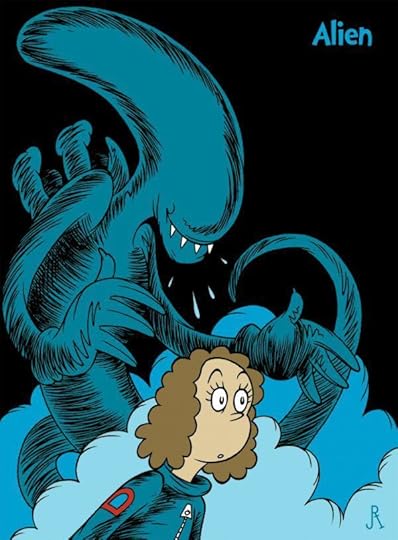
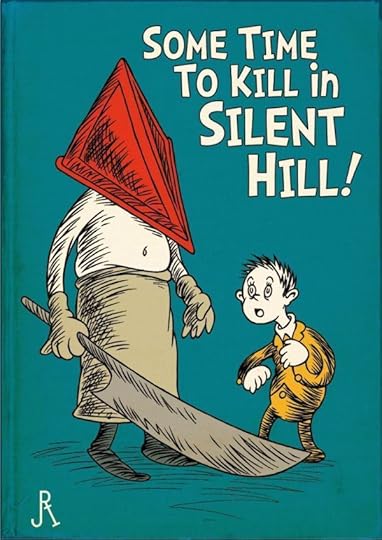
DeviantART member DrFaustusAU does all sorts of inventive mashups, using different entertainment franchises and mimicking the styles of other artists. His impressions of Dr. Seuss are particularly good, which he demonstrates by showing Suess-style versions of The Silence of the Lambs, The Last of Us, and other horror movies and video games.
Check out the rest at the link:
Source: Dr. Seuss Does Horror – Neatorama.


December 27, 2014
Review: Extinction Horizon by Nicholas Sansbury Smith
 About Extinction Horizon
THE WORST OF NATURE AND THE WORST OF SCIENCE…
WILL BRING THE HUMAN RACE TO THE BRINK…
OF EXTINCTION
Master Sergeant Reed Beckham has led his Delta Force Team, codenamed Ghost, through every kind of hell imaginable and never lost a man. When a top secret Medical Corps research facility goes dark, Team Ghost is called in to face their deadliest enemy yet–a variant strain of Ebola that turns men into monsters.
After barely escaping with his life, Beckham returns to Fort Bragg in the midst of a new type of war. The virus is already spreading… As cities fall, Team Ghost is ordered to keep CDC virologist Dr. Kate Lovato alive long enough to find a cure. What she uncovers will change everything.
Total extinction is just on the horizon, but will the cure be worse than the virus?
About the Author
Nicholas Sansbury Smith is the author of several post-apocalyptic books and short stories. He worked for the State of Iowa for nearly 10 years before switching careers to focus on his one true passion–writing. When he isn’t daydreaming about the apocalypse he’s likely racing in triathlons around the Midwest. He lives in Des Moines, Iowa with his family and several rescued animals.If you’d like to hear more about Nick’s books, you can join his spam free mailing list here: http://bit.ly/NicholasSansburySmith.Or visit Nick at: http://nicholassansbury.com.
My Thoughts
[I received a complimentary copy of this novel from the author in exchange for an honest review.]
Reading a Nicholas Sansbury Smith novel is like watching an epic big-screen, end of the world action flick. The plot is high-concept, the story is visceral, and the heroes are nicely etched and worth rooting for. It’s the sort of book that propels the reader forward with every page, and demands to be read in a single sitting because it’s just so damn uncompromisingly addicting.
I came upon Smith’s Orbs novels on NetGalley a few months back and pegged him as an author to watch out for. With his latest, Extinction Horizon, the first in a new series, he fully lives up to the promise exhibited in those earlier novels. And, dare I say, I think I like this book even more than its (entirely unrelated) predecessors.
Extinction Horizon is a real rip-roaring techno-thriller, and it hits all those delicious sweet spots that I tend to favor – there’s a dose of credible-enough science and a team of scientists, working alongside well-trained US soldiers, to solve a nightmarish end-times scenario, and grisly, tense, rapid-fire action throughout. This is a James Rollins level of fun, and it’s a genre I absolutely love. Smith’s elevator pitch for the novel is The Hot Zone meets World War Z, and if it’s certainly an apt description (and, frankly, if that doesn’t grab your attention, I have no idea what will).
Given the recent over-reactions regarding the Ebola outbreak Stateside, this is also a very timely work. The plot revolves around modifying Ebola with another potent, top-secret viral weapon, to create an even deadlier pathogen. And, of course, that works out about as well as you would expect it to… The nasty bits start flying, and yada, yada, yada, there’s a zombie-like outbreak tearing across the globe and destroying humanity. I really enjoyed Smith’s take on the infected, and zombie is probably too simplistic a comparison. Think of something zombie-like crossed with a little bit of the flukeman from The X-Files, with incredible strength and reflexes. They’re a legitimately gonzo, hostile threat.
Extinction Horizon is a white-knuckle thrill ride, filled with action and loads of suspense. I absolutely loved it, and cannot wait to see what comes next. Highly Recommended!
Buy Extinction Horizon at Amazon


December 24, 2014
The Immortality Game and Convergence Review

Anthony Vicino shares his thoughts on my book, Convergence, as well as the recently released The Immortality Game by Ted Cross. It’s a very entertaining read! I’m hoping to crack open Ted’s book sometime after the New Year, and this review certainly has me amped to get started on it. Many thanks, Anthony!
 Originally posted on One Lazy Robot:
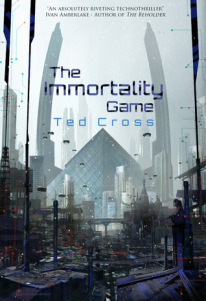
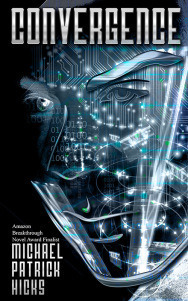
Here’s a two-fer!
Boy, this has been a great month for Indie Cyberpunk. For me, atleast. I’ve had this deep rooted affection for cyberpunk since reading William Gibson’s Neuromancer and Neil Stephenson’s Snow Crash. That love is nestled in my loins next to my affinity for peanut butter and cereal.
Though, not necessarily together. Unless we’re talking about Cap’n Crunch, but we’re not. We’re talking about awesome successors to the genre from a couple of debut authors.
One of my gripes in recent history is that cyberpunk kinda stalled out in the early 2000’s. Not sure why, but there was a glut of interesting concepts. Perhaps technology was growing too quickly for our imaginations to keep pace. Maybe cyberpunk died alongside zubaz and I just didn’t notice until decades later the carcasses started to stink the joint up.
 Oh, god…the colors!
Anyways, great news everybody! Cyberpunk ain’t dead, it just found…
View original 912 more words


Review: The Last Passenger by Manel Loureiro

About The Last Passenger
Reporter Kate Kilroy accepts an assignment to travel on the Valkyrie, a German ship veiled in secrecy for decades after it was discovered adrift in 1939 with only one passenger aboard, a baby boy named Isaac Feldman.
Obsessed with understanding his origins, Feldman has spent a small fortune restoring the Valkyrie to try to solve the mystery. Assembling a team of experts and sparing no expense, he aims to precisely recreate the circumstances of the Valkyrie’s doomed final voyage. Little does Feldman or his team know that the ship has an agenda of its own. As the Valkyrie begins to weave its deadly web, Kate realizes that she must not only save herself, but the world as she knows it.
About the Author
International bestselling author Manel Loureiro was born in Pontevedra, Spain, and studied law at Universidade de Santiago de Compostela. After graduating, he worked in television, both on-screen (appearing on Televisión de Galicia) and behind-the-scenes as a writer. His Apocalypse Z trilogy—The Beginning of the End, Dark Days, and The Wrath of the Just—took him from the blogosphere to bestsellerdom, earning him acclaim as “the Spanish Stephen King” by La Voz de Galicia. Loureiro continues to reside in his native Pontevedra.
My Thoughts
The Last Passenger was my December selection from the Amazon Kindle First program, and snared me with the hook of time traveling Nazi ghost cruise-ship. Such a terrific premise! And that cover art is beautiful!
Unfortunately, this read ultimately fell way short of my lofty expectations, my disappointment further compounded by a too-simplistic PR spin billing Manel Loureiro as “the Spanish Stephen King.” The Last Passenger lacks the truly creepy chills and depth of character I expect from King’s work, and even though there’s some clear influences owed to The Shining, by book’s end I can’t help but think that comparing Loureiro to King is just pure laziness.
Now, I didn’t completely flat-out loathe The Last Passenger (I’d rate it at about 1 and 1/2 stars, rather than zero), but my enjoyment was severely impacted by a number of problems I had with its varying levels of implausibilities and paradoxical resolutions, ranging from [SPOILER ALERT] the sudden appearance of a deceased spouse, which at times felt more like a deus ex machina than a well-constructed plot line, and the last page reveal of a ghostly impregnation, as well as the sudden toss-in of magic as the impetus for the whole travail. All of this made the book wildly uneven for me, and I have a difficult time relating to mystic resolutions or ephemeral “power of love” contrivances potent enough to slay all evil. [END SPOILER]
In addition to being uneven, it’s also an overly long book. There’s a graphic murder, an attempted murder, a dash of conspiracy, and, of course, the haunted cruise ship manned by a team of scientists and a wealthy magnate, who was the sole survivor found aboard the ship when it was first discovered in the late 1930s. Yet, oddly, not a lot actually happened in the course of the book’s first half, and it’s not really until about two-thirds of way through that things kick into high gear. But even the climax feels bloated and ponderous.
I’m also more than a bit curious as to why the ship was staffed with so many scientists. Loureiro devotes little time or attention to that nameless, faceless facet, opting to, instead, largely ignore them. One Russian scientists thunders on, albeit very briefly, about his theory on a Singularity linking hundreds of years of ships with missing crews, but it’s a short-lived and unexplored concept. It’s a shame that something that interesting, and seemingly vital to the book’s proceedings, was given such short shrift before being glossed over entirely in favor of cheap hocus-pocus. As a group, these scientists provide little in the way of explanation, theories, or resources as to make them virtually unnecessary to the proceedings of this story.
If I ever find myself trapped in a weirdo time-shifting repeater loop aboard a cruise ship, I hope I can find better reading material because if confronted with The Last Passenger once more, I’m afraid I’d have to pass and totally upset the space-time continuum.
Buy The Last Passenger At Amazon


December 22, 2014
Review: Carbide Tipped Pens: Seventeen Tales of Hard Science Fiction

About Carbide Tipped Pens
Seventeen hard science fiction tales by today’s top authors
Hard science fiction is the literature of change, rigorously examining the impact—both beneficial and dangerous—of science and technology on humanity, the future, and the cosmos. As science advances, expanding our knowledge of the universe, astounding new frontiers in storytelling open up as well.
In Carbide Tipped Pens, over a dozen of today’s most creative imaginations explore these frontiers, carrying on the grand tradition of such legendary masters as Isaac Asimov, Robert Heinlein, and John W. Campbell, while bringing hard science fiction into the 21st century by extrapolating from the latest scientific developments and discoveries. Ranging from ancient China to the outer reaches of the solar system, this outstanding collection of original stories, written by an international roster of authors, finds wonder, terror, and gripping human drama in topics as diverse as space exploration, artificial intelligence, biotechnology, climate change, alternate history, the search for extraterrestrial intelligence, interplanetary war, and even the future of baseball.
From tattoos that treat allergies to hazardous missions to Mars and beyond, from the end of the world to the farthest limits of human invention, Carbide Tipped Pens turns startling new ideas into state-of-the art science fiction.
Includes stories by Ben Bova, Gregory Benford, Robert Reed, Aliette de Bodard, Jack McDevitt, Howard Hendrix, Daniel H. Wilson, and many others!
About the Editors
Ben Bova is a six-time winner of the Hugo Award, a former editor of Analog, and former editorial director of Omni. Bova is the author of more than a hundred works of science fact and fiction, most recently, Transhuman, New Earth, and New Frontiers. He lives in Florida.
Eric Choi is an aerospace engineer as well as an award-winning author and editor. He has worked on a number of space missions, including the Phoenix Mars Lander and the Canadarm2 on the International Space Station. Choi also co-edited the anthology The Dragon and the Stars with Derwin Mak.
My Thoughts
[I received a copy of this book for review from the publisher via NetGalley.]
Editors Ben Bova and Eric Choi have collected seventeen short stories from authors across the globe, where the primary focus is on technology. These are stories of hard science fiction, where the scientific concepts provide not only a framework for the plot, but are so integral to the story being told that without such a tech-heavy conceit the story would be impossible to tell.
The anthology opens with The Blue Afternoon That Lasted Forever by Daniel H. Wilson (Robopocalypse). Here, we are introduced to a theoretical physicist who is so coldly rational and unemotional that he’s very nearly a robot. If it weren’t for his daughter, he’d likely have no humanity to him whatsoever, and she is what pins him to this earth. Far too late, he learns that his theoretical equations showing the existence of pinhole black holes are deadly accurate. While the physicist is cool and methodical, Wilson manages to wring the heartstrings for all their worth in an emotional wallop of a finale. Although the story itself is short, there’s a lot going on here, and serves as a terrific opener to Carbide Tipped Pens.
I was also deeply impressed by Doug Beason’s Thunderwell, which concerns a last-ditch effort to save an otherwise doomed mission to land the first team of human explorers on Mars. We get snippets of action from these intrepid astronauts, but the focus is on the Earth-based scientists’ efforts to beat the odds and launch a care-package stocked rocket into space. There’s a smidge of inspiration from Jules Verne at hand here, and it works very well. The technology at play here is also one we are deeply familiar with, using the physics of projectiles as the main thrust (forgive the pun) behind the narrative.
Liu Cixin delivers The Circle, a story adapted and expanded upon from his novel, The Three Body Problem. Ben Bova’s contribution, Old Timer’s Game, tells a straight-forward story about the future of baseball, as the sport is heavily impacted by medical advances and stem cell research. Habilis, by Howard Hendrix, is an interesting, dialogue-driven meditation on the ‘handedness’ of the universe, with insights in the left-favoring nature of electron orbits to the curves of letters and numbers driven home by a war vet with a prosthetic hand. David DeGraff’s SIREN of Titan was another strong inclusion, focusing on the sudden sentience of a moon rover and some intriguing American politics generated by the Religious Right’s fear of artificial intelligence.
I tend to find anthologies to be a mixed bag. Not every story can satisfy every single reader. For instance, I found Jack McDevitt’s story, The Play’s The Thing, to be interesting yet anticlimactic, and neither Aliette de Bodard’s nor Kate Storey’s efforts did much for me despite being well-written and having authentic feeling settings thanks to the strong world building in each of their works.
Taken as a whole, however, Carbide Tipped Pens is a solid collection of hard science fiction stories from many highly regarded authors in this genre and well worth the read. The stories themselves cover a broad swath of territory, from near-future Earth to far-flung empires of the distant future, where technology and scientific concepts are key. Recommended.
Buy Carbide Tipped Pens At Amazon


December 19, 2014
Watch This Double Amputee Control Two Robotic Arms At Once
 Originally posted on TechCrunch:
It’s rare to see the future unfold in front of our eyes this dramatically but here it is: the Johns Hopkins University Applied Physics Lab has helped a man who lost both his arms in a “freak electrical accident” connect to dual robotic arms by connecting to and reading from his nervous system. The results aren’t quite staggering as he still has limited control over the arms but the future is bright for amputees.
Human-controlled robotic arms are getting better and better (check out the video below of a woman controlling an arm with her brain), and the hardware needed to drive a usable arm is improving yearly. It won’t be long before we can expect to see amputees like the gentlemen in the video regain use of their limbs. The future, as they say, is here. It’s just not evenly distributed.