Michael Patrick Hicks's Blog, page 45
March 21, 2016
Review: HIT by Delilah S. Dawson (Audiobook)
Review: 
[My original HIT audiobook review and many others can be found at Audiobook Reviewer.]
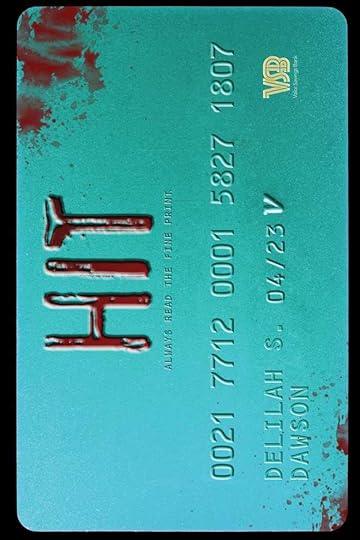
Rather than start with a dystopia already in progress, Delilah S. Dawson starts right at the beginning on Day One of the apocalypse. Valor Savings has secretly just bought up all of America’s debt and now controls the nation. Congress has cashed out on their biggest-ever payday and the police have the day off while Valor hit-men go after debtors failing to properly contribute to society. Have a student loan, or a home mortgage? Still owe some money of your car? Then your name is on a list, all because you couldn’t be bothered to read the fine print. Now you have three options – pay your debt in full immediately, work for Valor Savings as a bounty hunter for five days, or die.
Seventeen-year-old Patsy is a Valor hit-man, coerced into taking the deal after her mother’s debt comes to light. Her mother has a number of outstanding bills and, already poor to begin with, cannot afford the medical care required to treat her cancer (as Patsy wryly notes, it costs more money to seek medical treatment than to become a doctor). Patsy is given the incentive to work as a hired gun in order to get her mom treatment courtesy of Valor, or else they both die. It’s not much of a deal, really, and there are no other options. She’s given a gun, a postal truck and a mail worker’s shirt to stay innocuous, and a list of ten names to deal with over the next five days.
Thankfully, Dawson takes the run-and-gun premise and imbues it with a nice bit of snark and charm, as well as a burgeoning romance between Patsy and Wyatt, whose father and brother both are on the Valor hit list. They make for an interesting couple, the very nature of their relationship underscored by a healthy amount of already built-in conflict, and while I at first felt their relationship somewhat strained credibility Dawson eventually won me over and I found myself rooting for them to succeed.
While Hit is labeled a Young Adult book, it’s certainly on the more mature end of the spectrum and the narrative is suitably dark with its violent plot and the beginning of the end for American society. Hit is also the first book in a series, and thus the narrative here provides a lot more questions than it can comfortably answer. Not everything is resolved neatly, and the ending perfectly sets up the sequel, Strike, due out April 2016.
On the narration side of things, Rebekkah Ross absolutely nails it. She has a lovely voice that carried the not-quite 8-hour listening time brilliantly, and I never doubted her as Patsy for a moment. There are a few times where an audiobook narrator instantly becomes the voice of a work or a series, and Ross is it for this work. Hit is a first-person POV narration, and right from the start Ross is Patsy. She slips into this role comfortably and pulls off the emotional range effortlessly, capturing Patsy’s angst, anger, and humor ridiculously well. The production is crisp and clean, with nary a hiccup to be found. All around, this is a very accomplished and professional effort and a wonderful audiobook.
After recently listening to Dawson describe Hit on the Three Guys With Beards podcast (hosted by authors Jonathan Maberry, Christopher Golden, and James A. Moore), I knew I had to check it out. And it was every bit as good as I had hoped it would be, even if I would have appreciated more in the way of resolution. But, hey, that’s what sequels are for, and if Strike is even half as good as Hit, I’ll be a very happy reader/listener.
[Audiobook provided for review by the audiobookreviewer.com]
Original post:
MichaelPatrickHicks.booklikes.com/post/1362378/review-hit-by-delilah-s-dawson-audiobook








March 19, 2016
Review: The Winter Box by Tim Waggoner
Review:
I suspect that anyone who has been married for some length or in a long-term relationship will find plenty to relate to, perhaps uncomfortably so, in Tim Waggoner’s latest novella, The Winter Box.
Waggoner does a beautiful job of taking a twenty-plus year long marriage and casting it at the center of a ghost story. After so long together, Todd and Heather’s union has hit a snag. Neither will speak the dreaded D-word, even if both think it, and Todd oftentimes finds himself deliberately putting distance, both physically and emotionally, between he and his wife. Stuck in a cabin during a blizzard, the two are forced to admit the emotions they’ve kept buried and examine the deep wounds running beneath the scars they’ve bandaged over in all their years together.
I have to admit, I’m a bit of a sucker for horror stories that put weather extremes, particularly the blustery snow-driven cold, smack dab in the middle of the narrative. There’s just something about the winter freeze and thick, icy haze that lends itself particularly well to horror, and I’m a big fan of these types of stories. Even more so when, as Waggoner capably demonstrates, these freaky storms help to thematically echo the human plight.
Todd wants to escape, but can’t. The marriage, on the eve of their anniversary, is as cold and barren as the wintry landscape confining them to their cabin. These are people who want but can’t have, even if neither quite knows what it is that they want or how to obtain it.
And then the ghosts. Oh yeah, the ghosts. There’s an extra bit of fun right there, and Waggoner does just as well making that element as inhospitable and challenging for the couple as he does the elemental conditions they’re stuck in. For such a short read at only 50 pages or so, Waggoner packs in a lot of story, and this is a read that just sails by nicely. Or, you know, not so nicely as it were. Marriage is a hard enough job to maintain and survive, and to do so in the worst of conditions…good luck!
I haven’t read much of Waggoner’s work, but every time I finish one of his stories I’m always left wanting to buy more of his work. The Winter Box is a great reminder of why that is.
[Note: I received a copy of this novella from the DarkFuse Book Club.]
Original post:
MichaelPatrickHicks.booklikes.com/post/1361645/review-the-winter-box-by-tim-waggoner







March 18, 2016
Review: Savage Species by Jonathan Janz
Review: 
Author Jonathan Janz does several things immaculately well in Savage Species, primarily crafting high-octane action sequences and creating antagonists that you can easily hate in the span of only a few short paragraphs.
One such character is Eric, the emotionally abusive husband of Charly (one of the book’s lead females). Eric is a massive d-bag, a power-hungry control freak who shirks his duties as a husband and father, and is quick to point the finger and blame everyone else. Immediately upon confronting this character in the novel’s early goings, I longed for Janz to violently dispatch him – only problem was, there were a few hundred more pages to go! I just kept waiting and waiting for this jackass to bite it.
The protagonists are your usual every-man crowd – a housewife, a trio of reporters, some frat boys out to party in the newly opened nature preserve, and Frank Red Elk, who knows more about the history and local legends than anyone else. He also knows a hell of a lot about soft-core porn, and one must wonder just how much grueling research Janz was forced to partake in to pull off this character and his many film and actress references.
The action is a thrilling roller-coaster ride through bloody stretches of monster mayhem. The initial assault of Janz’s creatures, known as The Children, is a violent, adrenaline fueled sequence of pure chaos as these beasts lay siege to the preserve and furiously interrupt a college co-ed summer party. What would have been a hell of an exciting climax in virtually any other creature-feature is merely the starting point for Janz, who manages to escalate the threats and tension thereafter rather well.
If I must lodge a complaint, and it’s a mild one mind you, at certain points the violence took on a video-game like quality as things grew wildly frenetic. These long stretches of violence go on slightly too long and the thrills wear into sheer exhaustion. Perhaps this an appropriate feeling as a reader, as it certainly mimics what the characters must be feeling as they battle for survival. However, I couldn’t help but feel a bit of tightening to these scenes would have gone a long way. I also couldn’t help but feel that the unrelenting violence led to a mid-book slump when things slowed way down for an extended period to allow characters to regroup and launch into the story’s latter half. Naturally, events pick up accordingly as Janz rockets towards the big finish.
Overall, Savage Species delivered the goods. It was exciting, fast-paced, humorous at times, and even came with a dash of romance and love triangles to give a bit of weight to the savagery.
Pro-tip: Be sure to check out Janz’s latest, Children of the Dark, a prequel of sorts to Savage Species.
Buy Savage Species At Amazon
Original post:
MichaelPatrickHicks.booklikes.com/post/1361072/review-savage-species-by-jonathan-janz







March 10, 2016
Review: I Kill In Peace by Hunter Shea
Review:
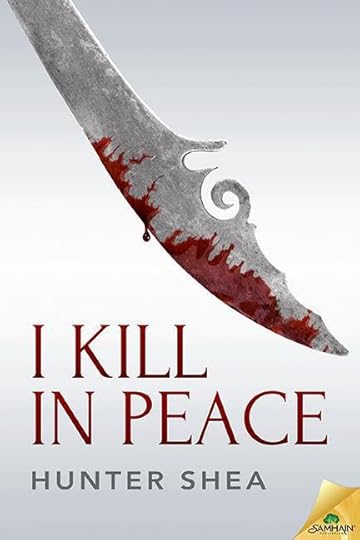
Of the handful of titles I’ve read from Hunter Shea, I Kill In Peace easily stands at the top of the stack as my hands-down favorite. It’s bloody, it’s violent, it’s mysterious, and it’s wickedly entertaining from start to finish as Shea hurtles readers from one crazy kill to another.
A few hours before being fired, marketing analyst Peter gets an instant message from the strange AO warning him of his impending termination. In the hours and days that follow, AO continues contacting Peter via electronic means, ordering him to kill. If Peter refuses, he becomes violently sick and crippled with migraines. Forced to comply, he is given a fiery red Mustang and a scimitar to use in terminating his assigned targets.
Over the course of this novella, both readers and Peter are forced to grapple with whether or not Peter is an insane psychopath or merely a pawn a mysterious manipulator. I Kill In Peace is a quick read told through first-person narration, and how reliable a narrator Peter may actually be is questionable, particularly since he doesn’t even know if he’s afflicted with split-personality. And who, or what, is this AO that continues to mysteriously contact and compel him to tear a bloody swath through Maine?
There’s a third layer to the story, which I won’t go into details about, but Shea provides plenty of tantalizing teases as to what else may be happening around and outside of Peter, all of which congeals into a remarkable finale that left me completely satisfied. The way Shea strips back the layers of his big reveal is completely terrific, and I Kill In Peace may be his most masterful bit of writing to date.
[Note: I received a copy of this title from the publisher via NetGalley for review.]
Original post:
MichaelPatrickHicks.booklikes.com/post/1355752/review-i-kill-in-peace-by-hunter-shea







March 8, 2016
Review: Every Heart A Doorway by Seanan McGuire
Review:
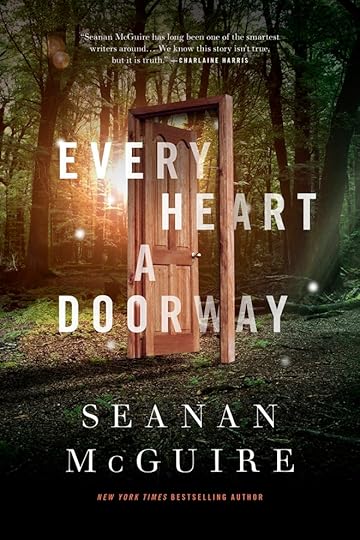
Have you ever wondered what to happened to those kids who discover fairy tale worlds after they return back home? What happened to Alice in the years after she came back from Wonderland, or Dorothy from Oz? How did their families relate to them? Were they suddenly outcasts, yearning to break free from the mundane reality, or perhaps suffering from post-traumatic stress disorder or a lifetime of nightmares and longing?
In Every Heart A Doorway, Seanan McGuire introduces us to Eleanor West’s Home for Wayward Children, and its newest student, Nancy, who ventured into the Underworld and served the Lord of the Dead. She has returned home, to our too-fast, too-bright world and has been sent off to Eleanor’s school with a promise to her parents that their broken Nancy can be fixed. But the truth of the matter is, there can be no fixing those children who returned from fantasy land – they have seen the remarkable, and they can now only choose either to forget it, or wait and hope to return. An interesting premise it’s own right, McGuire complicates issues even further. Now, following Nancy’s arrival, students begin turning up dead and savagely mutilated.
Every Heart A Doorway was one of those novellas that I read with a grin the whole way through. McGuire’s language and pacing left me giddy, and reminded me, at times, of some of the best and darkest moments of Harry Potter, only more tightly condensed and rightly gruesome. There’s hope and wide-eyed wonder about the proceedings, and knowing nods towards the fairy tale stories that have clearly influenced the author to craft such a loving ode. The characters are fresh and compelling, with Jack (aka Jacqueline) being an easy favorite. She and her twin sister Jillian (aka Jill) took a detour through the Moors, and she became the apprentice to Dr. Bleak, a clear riff off the good old Dr. Frankenstein, while Jill became a vampire’s paramour. Jack is smart and dark, and almost a twisted mirror-universe take on Potter’s Hermione Granger. Mostly, she’s just a damn fun character who is at her best hanging out in the morgue with a bucket of acid.
My only complaint is that I was left wanting more, and I’m not sure if this is meant to be a standalone title or not. If so, then so be it, as I’m grateful to have it. Still, if McGuire has proved anything with this book, not all doors to fantasy land need stay closed forever.
In short, I loved this story. A lot. It hit that particular sweet spot for me, and if you, too, are looking for the literary lovechild of JK Rowling and Tim Burton, this should fit the bill awfully well.
[Note: I received an advanced reader’s copy from the publisher via NetGalley for review.]
Buy Every Heart A Doorway At Amazon
Original post:
MichaelPatrickHicks.booklikes.com/post/1354895/review-every-heart-a-doorway-by-seanan-mcguire







A Note On My Campbell Award Eligibility
I had wanted to write about this sooner, but unfortunately my AT&T powered internet has been kaput all weekend and likely will not be restored for, by their best estimates, another 4 to 8 days depending on how long it takes one of their engineers to respond to the help ticket. So, I’ve been sitting on some information that I really wanted to share sooner, which, if you read the title, is that I am eligible for the Campbell Award!
Writertopia does a better job explaining this than I can, so…
The John W. Campbell Award is given to the best new science fiction or fantasy writer whose first work of science fiction or fantasy was published in a professional publication in the previous two years. For the 2016 award, which is presented at the World Science Fiction Convention (WorldCon), the qualifying work must have been published in 2014 or 2015.
This is my first year of eligibility and it’s all thanks to my inclusion in The Cyborg Chronicles, which featured my short story Preservation. (FYI – you can purchase this wonderful anthology for only $1.99 at the moment on Amazon.)
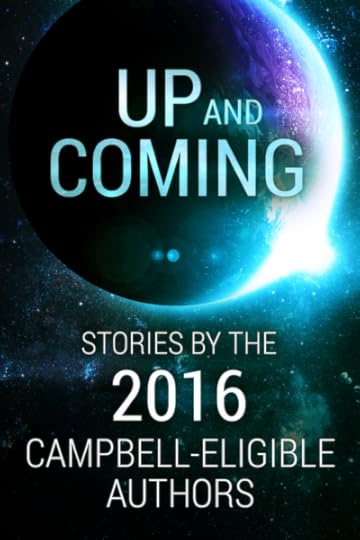
Preservation is being reprinted in the anthology Up and Coming: Stories by the 2016 Campbell-Eligible Authors courtesy of S.L. Huang and Kurt Hunt. Since we were allowed to submit multiple stories for a total of 20,000 words per author, I also submitted my short story Revolver, which originally appeared in the anthology No Way Home. For me, these two stories represent a nice bookend to my year of writing in 2015, as No Way Home/Revolver appeared early in the year, and Preservation/Chronicles was a great way to close out December. It’s a terrific honor to get both these stories before the eyes of award voters, in addition to potentially new readers discovering me for the first time.
Up and Coming is entirely free to download and features 120 authors with 230 works amongst them, and over 1 MILLION words of sci-fi goodness. All of these authors are Campbell Award eligible writers, and the hope is that this anthology can be used to help guide the nomination process. The anthology is available in both .mobi and .epub formats, so please go give it a download and read it.
You can download it at Writertopia and/or Bad Menagerie.
If you’re eligible to vote, I certainly hope you’ll check out my stories and decide if they’re worth a nod. So, how to vote?
Again, I’ll crib from Writertopia:
The John W. Campbell Award uses the same nomination and voting mechanism as the Hugo, even though the Campbell Award is not a Hugo.
Like the Hugo Awards, the Campbell Award voting takes place in two stages. The first stage, nomination, is open to anyone who had a Supporting or Attending membership in the previous, current, or following year’s Worldcon as of January 31. For Sasquan, this means members of Sasquan (the 73rd World Science Fiction Convention in San Antonio), MidAmeriCon II itself, and Worldcon 75 (Helsinki) can nominate any eligible author. This web page helps identify eligible authors for the Campbell Award.
The official nomination page is available at the MidAmeriCon II site. Nominations will close on March 31, 2016.
To be able to vote for the award, you must be a member of MidAmeriCon II (the 74th World Science Fiction Convention in Kansas City, MO). If you are not a member of MidAmeriCon and wish to vote, you must purchase a supporting membership or an attending membership before January 31.
I guess I should mention that if you want to nominate my cyberpunk sci-fi title, Emergence, for a Hugo Award, you are certainly free to do that, too!







March 6, 2016
Sunday Snapshot
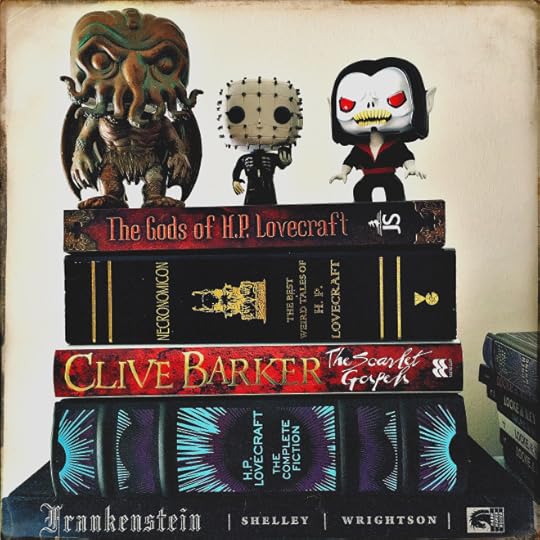
Finally got my New York Comic Con limited edition patina Cthulhu. I may be getting a bit obsessed with Funko Pops.
Original post:
MichaelPatrickHicks.booklikes.com/post/1353914/post







Finally got my New York Comic Con limited editio...
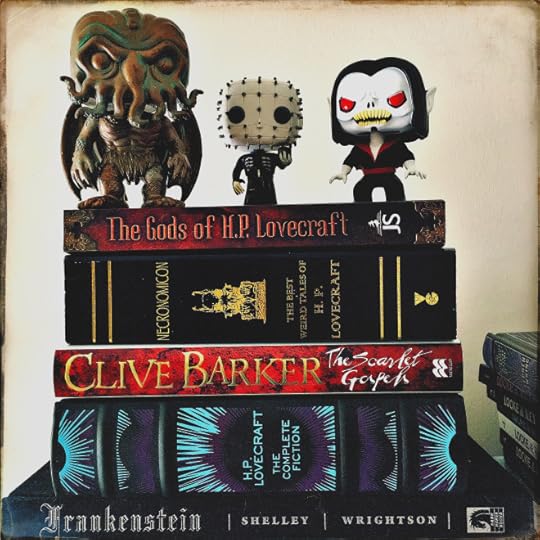
Finally got my New York Comic Con limited edition patina Cthulhu. I may be getting a bit obsessed with Funko Pops.
Original post:
MichaelPatrickHicks.booklikes.com/post/1353914/post
March 4, 2016
Review: The Girl With All The Gifts by M.R. Carey
Review: 
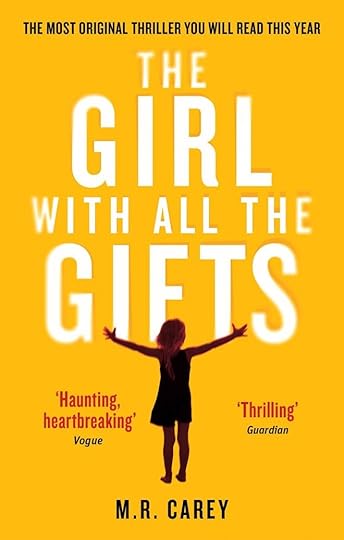
What do I say about this book without spoiling one of its best A-HA! moments? This particular moment comes fairly early in the book and if you know what particular horror sub-genre this title falls under, it’s fairly well telegraphed in advance. But I’m sure there are still people out there who could possibly go blindly into this title knowing only the very miniscule information given in the very short synopsis provided by the publisher.
So, you know what? Let me just go ahead and issue a BIG ASS SPOILER WARNING EFFECTIVE IMMEDIATELY. Read this review, or don’t. Your call, but consider yourself warned.
SERIOUSLY
SPOILERS HERE ON OUT
LAST CHANCE
OK, so this is a zombie book. And given that there’s been lengths taken to protect that information, this is a spoiler. The titular girl with all the gifts is Melanie, whose home is an underground cell in a military complex charged with finding a cure for the zombie plague that has felled mankind. After the base comes under attack, Melanie is forced to flee with her teacher, the base’s lead doctor, and two soldiers. Cue up the bad-ass zombie road trip.
The Girl With All The Gifts is a perfectly fine story, but not one that entirely clicked for me. I liked it well enough, but I kept expecting it to deliver more than I was getting. The premise is unique enough, unless you’ve played The Last Of Us, in which case you’ve seen some of this before to a certain degree, and I liked that this particular road trip strikes out across the UK. Zombie America Books are a dime a dozen, so it’s refreshing to not have New York or Los Angeles under assault, and to get to spend time in a locale where they have boots and bonnets instead of trunks and hoods on their cars.
My main complaint is that The Girl With All The Gifts feels like a lot of other things that have already been done. And while I like zombie stories in general, there is a fair amount of incestuousness and inbreeding within the genre, with writers borrowing familiar tropes and running them into cliches. That’s part of the fun of the genre, to a degree, I suppose, but it almost always carries a heavy weight of been there, done that. It’s important, then, that the elements enshrouding the core conceit of the zombie narrative to reach out into new places. Mira Grant did a wonderful job of this in her Newsflesh trilogy by not presenting the zombie apocalypse as an actual apocalypse, but a life-goes-on narrative with a presidential election spin. Here, it feels like Carey borrowed from a few too many other sources in order to string together his plot, adding a dash of The Last of Us mushroom’s powers with a smidge of The Road and peppering them with nicely violent zombie action sequences.
I did appreciate that the story grew into an interesting sort-of family dynamic between the survivor, and reading how the characters transformed and grew together, or apart, was what really held my attention. While we have plenty of zombies, or hungries in Gift parlance, and nasty human scavengers, there’s actually not much in the way of central figures to root against, save for the survivor squad’s not-so-good doctor. But even her motivations are well-crafted and relateable, even if they are completely antagonistic toward the others. The behaviors of these group members were nicely believable and each at least have some brains in addition to their survival instincts, so it was refreshing to not have a handful of stupid people behaving stupidly in order to create false tension. Still, I kept expecting the scavengers to become more of a threat and the book’s climax left me appeased but not entirely satisfied.
On the other hand, this is very much a book that is about the journey, not the destination. The characters grow and change, and the heirarchy in which they operate evolves over the course of the story so that by book’s end there is a pronounced shift in the balance of power. Whether that’s good or bad, in terms of the narrative, who can say? It is darn intriguing to consider, though.
So, final verdict? 3.5 stars. Good book, but I felt like something was missing along the way.
Buy The Girl With All The Gifts At Amazon
Original post:
MichaelPatrickHicks.booklikes.com/post/1353159/review-the-girl-with-all-the-gifts-by-m-r-carey







Likely A Too-Long Post About My Writing Style
I was catching up on some episodes of the Three Guys with Beards podcast (hosted by Jonathan Maberry, Christopher Golden, and James A. Moore – all great storytellers that you should be checking out) when they got onto the topic of writing styles. Or maybe how they approach their writing is a more apt description. Which then got me to think about the manners and methods of how I write.
Look, every writer has their own style. There’s no right way, and there’s no wrong way. Anyone who tells you different is talking out of their ass. If you’re a writer, find a method that works for you, but don’t be afraid to try new things. If that new thing doesn’t work for you, pitch it out the window and do something else. Simple, right?
In the episode, the bearded ones mentioned a couple different styles they’ve employed, from running straight through beginning to end, writing the climax first, or playing hopscotch through the manuscripts and going back and forth.
For me, I’m a straight-up beginning to end kind of writer. I wouldn’t say I outline, but I have the barest of bones of a structure in my mind, usually supported by at least three story beats that get fleshed out as the story progresses. Once an idea locks in, I typically know the three big beats – beginning, middle, and end – at least in general terms of action. Not always, but usually. This breaks down to having an inciting event, a significant action set piece at the half-way mark, and a (hopefully!) strong resolution. These constitute certain narrative tent-poles that I work toward in a linear fashion, letting the beats in between build naturally from the story as I go. When I’m first starting out, I rarely have any kind of in-depth plan starting in Chapter One as to what will happen in Chapter Thirty, but I do have a general idea of where the plot is leading. I mostly just let the characters and story figure out how to get from Point A to Point B to Point C.
The book I’m working on now, a sci-fi thriller set in a post-climate change Earth, has been working slightly different, but still following a similar road map. I knew the inciting event, which occurs (in this first draft) around chapter three. Last night, I figured out what chapter four needs to be and will be writing that today. This is all building toward a mid-story event that puts everything into upheaval and will change the dynamics of the story a bit as the plot expands around a new threat that I have been slowly teasing in an off-handed way. Now what happens from chapter four to Point B, I don’t really know yet, but am confident I’ll discover it along the way. I have a few rough ideas, but the story will let me know what it wants to do, and I trust in that.
I recently completed a short story called Let Go, which is slowly getting prepped for release (it’s off to my editor now, and a cover designer is on tap, so stay tuned!), and which is a zombie horror title. My horror works differ only a little bit from my sci-fi stuff in terms of work flow, and tend to be much shorter. Even though they tend toward short story-to-novella end of the spectrum, I’m still teasing through that three-act structure of beginning, middle, and end, only at an accelerated (for lack of a better term) rate. However, I tend to go back and feed in a bit more information throughout the story in future drafts after it’s all been written.
This is true of Let Go, and was perhaps at its most serious extent with another recently finished short horror story that I wrote for an upcoming anthology (more on that soon!). This short story is tentatively titled Black Site and is a sci-fi horror, and required extensive amounts of revision both as I went along and through subsequent drafts. After I had the first draft written, I had a much better understanding of what needed to change, altered, deleted, and added. Especially what needed to be added. For only being around 10,000 words, I think it may be the most heavily re-worked 10,000 words I’ve written yet and it hasn’t even been put in front of the editor yet.
This brings me to another point in terms of figuring out a writing style or methodology, and why nobody can tell you what works for certain – nobody else knows your freaking story like you do. And so nobody can tell you how to write it. Sometimes you just have to learn how to write it as you go along, or after you’ve beaten yourself through that first draft. With Black Site, I had an idea of how that story would go and what I needed to do with it. When I hit THE END, I found myself deeply unsatisfied and knew that certain elements were missing. That’s what a second draft is for! But, I had to get through the finale in order to figure out how to work through the earlier segments to take corrective measures and get it back on track. Could I have avoided this by writing the ending first? Well, maybe – but only if I had known for sure what that ending was going to be. While I knew what the ultimate fate of the characters would be in terms of the story’s resolution, I didn’t quite know the circumstances surrounding the climax until the characters figured it out and told me how it was gonna be.
I like to let the story speak to me. I’m comfortable with that, and often find myself enjoying the surprises the story hurtles at me. Others need to have a rigid outline with every detail mapped out. That’s just not my bag. What about you, fellow writers?