
Alex Quigley's Blog, page 16
January 15, 2022
5 strategies for reading complex texts
“Perhaps one of the mistakes in the past efforts to improve reading achievement has been the removal of struggle. As a profession, we may have made reading tasks too easy. We do not suggest that we should plan students’ failure but rather that students should be provided with opportunities to struggle and to learn about themselves as readers when they struggle, persevere, and eventually succeed.”
‘Text Complexity: Raising Rigour in Reading’, by Douglas Fisher, Nancy Frey & Diane Lapp
When do you find reading hard?
Perhaps if you read the opening sentence of James Joyce’s ‘Finnegan’s Wake’ you’d experience some difficult reading:
“riverrun, past Eve and Adam’s, from swerve of shore to bend of bay, brings us by a commodious vicus of recirculation back to Howth Castle and Environs.”
We can decode the words, but perhaps we are wondering whether this is a real or imagined scene? Are Eve and Adam real or are they biblical? Are you, like me, foxed by notions of ‘a commodious vicus of recirculation’? Are you interested in reading more?
Whenever we are reading a tricky text, it demands a wealth of background knowledge, well-chosen strategies, and considerable perseverance too. As expert adult readers, we recognise reading difficulty instinctively. And yet, we may struggle to describe exactly what makes reading difficult for novice pupils, or how to mediate particularly complex texts.
The answer to the challenge of reading complex texts is seldom to use simpler texts. Attempts at utilising banded books, or using reading levels or concocted text reading ages, is likely to prove problematic. If the text is simplified, then pupils don’t develop the background knowledge or strategic awareness to grapple with harder, longer texts.
We might substitute out a textbook and distil it into a few neatly arranged PowerPoint slides, but in doing so we might remove the necessary challenge to think hard about the topic. With good intent, we steal away the complex academic language our pupils need to understand and use.
Instead of simplifying text choices, we need to appropriately scaffold complex texts. We need to support pupils to productively struggle, persevere, and ultimately experience reading success.
5 strategies to scaffold the reading of complex textsHere are just some strategies that can best prepare pupils to read and persevere with a particularly complex text:
Share the secret. Many pupils approach academic reading with fear and so avoid reading complex texts. It is important to let them in on the secret: they are reading hard texts, so struggling is normal. All the best readers struggle. English teachers struggle with James Joyce; historians can struggle following historical debates. Get pupils recording tricky vocabulary they don’t know, or encourage them to note as many questions as they can generate about the topic (expert readers routinely and automatically clarify and question to comprehend a complex text) in the face of this challenge.Stimulate curiosity. Pupils need to persevere when it comes to complex texts. Research shows that pupil interest in a topic can be an important motivator when it comes to persevering with reading very complex texts. We can help generate interest and curiosity by encouraging them to make predictions and be targeted as they read. For instance, with the Joyce opening, perhaps we can generate predictions about whether Eve and Adam is a Christian reference or not. Simple prompts can ensure pupils read actively and prove goal-focused when they read. [See this research study on generating ‘Cognitive Interest’ over ‘Emotional Interest’ with science texts’] Activate their prior knowledge. When pupils lack the vocabulary and background knowledge to make a text make sense, it dulls interest. It is therefore crucial to activate some prior knowledge of the topic so that pupils can more strategically cohere a sense of meaning. For example, with Joyce’s Finnegan’s Wake, or similar, you could start by using images of the setting – in this case Dublin. You can build a sense of place and setting (much as you would in geography), before then exploring and discussing the key themes and the unique language being used. [See my blog on ‘Academic Vocabulary and Schema Building’] Teach ‘keystone vocabulary’. A text is complex for a range of reasons – background knowledge, sentence length and complexity, the use of metaphorical language, and much more – but an accessible entry point is to identify key conceptual vocabulary that prove important to building comprehension. We can identify a small number of such ‘keystone vocabulary’ and teach them explicitly, offering another avenue into the text. For instance, if pupil are about to read a complex chapter on glaciation in geography, we may generate links between other keystone words like ‘abrasion’, ‘moraine’ and ‘accumulation’ and ‘ablation’. Even if pupils don’t fully know these words yet, it can prime them to recognise their importance in the chapter when they encounter them. Read related texts. A common complaint is that there is too little time to ‘cover’ the curriculum. And yet, if we don’t immerse pupils in complex texts, then they won’t engage in the productive struggle that makes learning truly memorable. For example, if pupils are reading a James Joyce story, then they may read an article about modernism, a short biography, and similar, as accessible entry points. If they are learning about the Great Fire of London, they might read the story, ‘Raven Boy’, along with articles offering different historical perspectives. If these texts are more accessible ‘Goldilocks texts’ (not too hard, but not too easy either), then they will open up further avenues for the topic at hand, as well as provide the productive repetition of key concepts and vocabulary in what pupils read. [DISCLAIMER: There are innumerable strategies for reading complex texts, but this is a short blog!]Any time a pupil is reading a complex text, it will likely prove difficult, effortful, and even frustrating. We cannot just expect to offer pupils harder and harder texts and expect them to become better readers either. However, by explicitly teaching pupils to be strategic and to cohere their knowledge and understanding, we can offer them the right tools to tackle the job of reading complex texts.
(Image via John Morgan on Flickr: https://www.flickr.com/photos/aidanmorgan/4151100524)
If you are interested in
The post 5 strategies for reading complex texts first appeared on The Confident Teacher.

January 8, 2022
The Problem with Reading Informational Texts
Let’s start with a little reading…

Is it familiar? The ‘Way of the Dodo’ text lives in infamy as a SATS 2016 reading paper extract that was so difficult that it made some pupils cry.
It is a reading extract that also exposes a key problem in classrooms everywhere: the difficulty for pupils – primary or secondary age – in reading complex informational texts.
What made the dodo text so difficult? Most obviously, the vocabulary and background knowledge demand is sky-high. ‘Parched environments’, ‘receding waters’, and subtle metaphorical references to rehabilitating the image of the extinct bird, put huge comprehension knowledge demands on eleven-year-old readers.
Not only that, the sentences and overall structure of the text prove challenging too. There are no helpful sub-headings to overtly chunk down the text and help to make it more cohesive. In sentence length terms, the longest sentence was a snakingly-long 35 words, with a substantial average sentence length of 19 words. Additionally, half of the sentences were comprised of three clauses – itself a handy barometer of a tricky sentence and reading challenge.
The dodo text is an apt example of why so many informational texts trip over pupils who are not already highly knowledgeable and skilled readers. It is no surprise then that in 2016 international reading assessments (the PIRLS assessment), English year 5 pupils performed worse on informational texts compared to reading fiction texts (whereas pupils from countries like Singapore manage to buck that trend).
Do we need to increase the reading of informational texts?We need to understand the challenge of reading informational texts at every key stage in school.
In the US, researchers have described a ‘fourth grade slump’ when it comes to reading (particularly for disadvantaged pupils). Put simply, it describes the shift from when pupils focus on ‘learning to read’ (such as the crucial process of learning to decode words via systematic synthetic phonics) and go on to ‘read to learn’, around aged 10, but – crucially – how pupils at this point can struggle as the reading content begins to change. As pupils move into, and through, key stage two, the demand on background knowledge and vocabulary knowledge becomes much higher in informational texts and many pupils begin to struggle.
It is important to know the difference between reading stories and informational texts. The very nature of the language and the text structures are different in informational texts.
Though you need a deep background knowledge to access tall tales, they can represent concepts that are familiar, such as character traits and emotions. When it comes to words in stories, you can describe light in a multitude of ways in a story (flickering, glimmering, glittering or gleamed). This is tricky and requires broad and deep word knowledge, but the meaning of these words are helpfully clustered together and familiar. By contrast, the single word ‘refraction’ – which would feature in a typical science informational text – is dense with meaning, often separate from a concrete ‘setting’, and so requires elaboration in the classroom to make sense of it. In short, words are routinely bigger and more complex in informational texts.
Of course, pupils benefit by reading fiction. The ‘fiction effect’ describes older pupils who read fiction more routinely and prove stronger readers for it when compared to informational texts in magazines or newspapers. No sane person would recommend not reading fiction – but we should consider the balance of reading narratives and informational texts in the school curriculum at every stage.
What about how reading changes again in secondary school?A simple fact is that pupils can go from a varied diet of fiction and informational texts in primary school, but then experience a radically different reading experience in secondary school.
Invariably, in secondary school, pupils spend most of their time reading informational texts. Worksheets and textbooks are the norm. The frequency and complexity of informational text reading increases, but many pupils are ill-equipped for the challenge.
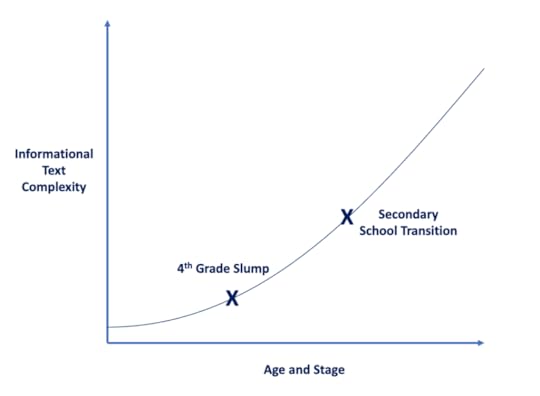
In a recent report by OUP and the Centre for Education and Youth (CfEY), on ‘Bridging the Word Gap at Transition’, Professor Alice Deignan, from Leeds University, shared their emerging research on the increased demand on language in the secondary school classroom:
“In an average day at secondary school, pupils are exposed to three or four times as much language as at primary school, purely in terms of quantity. With such a massive increase in the quantity of language, the number of unknown words fired at pupils during a lesson increases similarly. These reach a level where pupils cannot use normal strategies to work out their meaning, such as using overall context. Pupils are being pushed far out of their comfort zone academically.”
Of course, so much of the secondary school curriculum is mediated by reading. In computer science, history, geography, in the sciences, and more, reading informational texts becomes the norm. For pupils who didn’t make sense of the dodo text, it reveals a significant problem…quickly.
Questions and solutions :When reading gets more complex, pupils must become more knowledgeable and more strategic. There is no easy, quick intervention to address this challenge. We may begin with some questions to grapple with at every key stage:
Does our approach to reading balance a diet of narrative and informational texts?How do we ensure that pupils can access the complex language and structures of the text? Do we pre-teach key vocabulary that can unlock concepts in an informational text?Do we chunk down the text (using structural signposts like sub-headings) and help pupils gradually build their understanding (and their independent reading stamina)? What ‘funds of knowledge’ do pupils bring to the text and how do we activate it successfully to ensure reading comprehension? How do we best support pupils to cohere, connect and, crucially, consolidate their understanding of complex informational texts?We can explore the following possible solutions:
Read more extended informational texts. Reading an endless diet of short (one page) extracts doesn’t help our pupils to build the habit of grappling with cohering and connecting words, ideas and concepts across an extended text. Can we instead build towards reading longer informational texts that pupils must strategically chunk down and habitually work to cohere their understanding? (The notion of TL:DR is corrosive and wrong!)Read related informational texts. Many topics related to informational texts use the same repertoire of specialist language and central concepts. If you are reading about birds, you may be repeatedly exposed to words and concepts like ‘vertebrates’, ‘reproduction’ or ‘homeotherms’. Such repetition helpfully builds background knowledge, which aids comprehension, and ultimately grows pupils’ confidence. Identifying ‘reading clusters’ is then key for curriculum development. Explicitly teach reading comprehension strategies. There is ample evidence to suggest that teaching strategies like summarising and clarifying vocabulary helps with hard reading (indeed, you only need such scaffolds when the text is difficult). Too often though, this results in flawed notions – such as teaching ‘summarising’ as a separate skill. Instead, we should start with the informational text at hand (what complexities and structural supports it offers), before scaffolding pupils to be strategic when needed. For instance, we may begin reading the dodo text by getting pupils to summarise their understanding of ‘extinction’, before clarifying any vocabulary items they are unsure about. This is the stuff of explicit reading comprehension strategies that are sensitive to the text at hand. Explicitly teach text structures. Informational texts do typically offer structural features like headings and graphics to help mediate their meaning. Too often though, struggling readers don’t utilise these supports – ironically, they can appear to add confusion. Devoting time to teaching structural features (such as using graphic organisers to illustrate ‘problem solution’ text structures and similar) and discourse markers (such as first, second, consequently, however, etc) can pay off with sophisticated informational texts. The post The Problem with Reading Informational Texts first appeared on The Confident Teacher.December 21, 2021
The Curriculum Spiderweb
As curriculum is complex, we routinely seek out a plethora of handy metaphors and analogies to make sense of it.
And so, in recent years curriculum has recently been described with a multitude of metaphors, such as a boxset (more Game of Thrones than the Simpsons), a voyage of exploration, or curriculum as narrative.
Each metaphor has explanatory value and helps bring some concreteness to what can too often prove a vague topic that is subject to contradictory theories and assumptions. Perhaps my favourite metaphor, outside of those already mentioned, from the curriculum theory of Jan van den Akker, is the ‘curriculum spiderweb‘.
The metaphor is apt primarily because a spiderweb is so intricately woven and interconnected, just like curriculum development. Done well, it is a beautiful result borne of effort and skill; however, like the natural spiderweb, it is also vulnerable, and its intricacies (subtleties of phase and subject, perhaps) can too easily be swept away by more powerful forces.
Van den Akker specifically marks out different facets of curriculum development and implementation in his spiderweb:
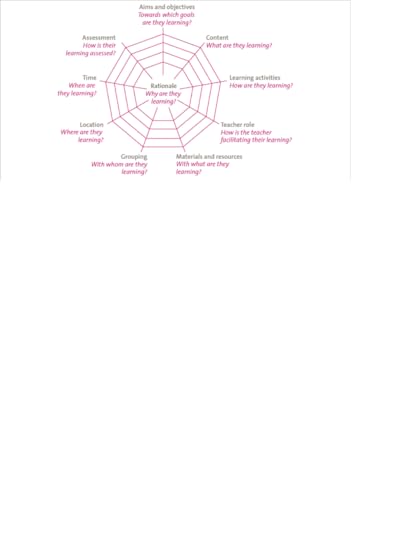
Jan van den Akker, Curriculum Landscapes and Trends (2003)
Though it can be helpful to limit notions of curriculum to the ‘what’ of the knowledge and skills that are to be taught, it does not encompass many meaningful related components that determine how such curriculum development is implemented in the classroom. Van den Akker gets us asking more questions of curriculum, revealing more interconnected threads of the spiderweb.
Exploring the threads of the curriculum spiderweb
Van den Akker specifies ten key components to curriculum development. These include a consideration of the values and principles that drive our curriculum decisions (the ‘rationale’ – or ‘intent’ in OFSTED parlance). Also, there are more broad organisational factors that are identified as important to our curriculum design, such as ‘time’ and ‘location’.
Van den Akker gets us to consider the substantive curriculum questions. And so, in terms of ‘time’, we are left with tricky practical questions, such as: how much time should be allocated to subject X in secondary school, or reading time in the primary school day? Are there financially driven timetable models in secondary that influence time? Different subjects will no doubt compete for curriculum time, with school leaders needing to understand the ‘content’ of the curriculum in great depth.
A consideration of ‘location’ is largely considered extraneous to the substance of curriculum. However, a primary school considering their use of forest school, or the school library, would surely beg to differ. Indeed, secondary schools no doubt think hard about how well pupils learn at home. Homework proves inextricably linked to how well we can implement the curriculum. For those secondary school subjects worried about curriculum ‘time’ – such as science and history (and more!) – then homework becomes yet more pressing.
‘Assessment’ is the critical bedfellow of curriculum, yet how well are we adapting our existing assessment systems as we shift the enacted curriculum? Schools have seen internal data assessments roundly critiqued, but attractive and manageable alternatives to existing data systems have proven less common. Does our internal assessment model match the demands of the curriculum change and the necessity to communicate progress to parents and governors etc?
I am not sure whether van den Akker has identified the ‘right’ ten components of curriculum development (I’d substitute ‘teacher role’ for ‘teacher development’ for a start), but the value of the metaphor is that it accurately represents the interconnectedness and multi-facetedness of curriculum development.
If it was simply a case of senior leaders getting out the way and tweaking the sequencing of curriculum content, then curriculum development would be a much simply, easier issue. It isn’t. The beautiful complexity of the spiderweb captures some of the difficulty and rewards that we can gain from a focus on curriculum change.
The post The Curriculum Spiderweb first appeared on The Confident Teacher.November 27, 2021
Arguing about English
Everyone has an opinion on the teaching of English, its curriculum, along with our national qualifications. Not just teachers: parents, policy makers, and pupils, all have an argument at the ready.
Of course, most of us have stumbled through an analysis of Shakespeare, or grumbled over the peculiarities of grammar at one time or another, which influences our feelings about the subject, including ‘what’ should be taught and ‘how’.
The problem is that those views often fail to cohere, so we lose clarity or hope for a consensus. We can be left with clashing beliefs, unclear language, and ill-considered action.
A little history can help.
In 1989, when I was still fresh out of playing in the school-yard in primary school, the seminal Cox Report was published on recommendations for the teaching of English for ages 5 to 11.
Helpfully, the report characterises five different viewpoints on English. These views can help us make sense of the debates about ‘why’ we teach English and ‘what’ we teach.
The Five Viewpoints
“A ‘personal growth’ view focuses on the child: it emphasises the relationship between language and learning in the individual child, and the role of literature in developing children’s imaginative and aesthetic lives.
A ‘cross-curricular’ view focuses on the school: it emphasises that all teachers (of English and of other subjects) have a responsibility to help children with the language demands of different subjects on the school curriculum: otherwise, areas of the curriculum may be closed to them.
An ‘adult needs’ view focuses on communication outside the school: it emphasises the responsibility of English teachers to prepare children for the language demands of adult life, including the workplace, in a fast-changing world. Children need to learn to deal with the day-to-day demands of spoken language and of print; they also need to be able to write clearly, appropriately, and effectively.
A ‘cultural heritage’ view emphasises the responsibility of schools to lead children to an appreciation of those works of literature that have been widely regarded as amongst the finest in the language.
A ‘cultural analysis’ view emphasises the role of English in helping children towards a critical understanding of the world and cultural environment in which they live. Children should know about the processes by which meanings are conveyed, and about the ways in which print and other media carry values.”
Why are these five viewpoints from the Cox Report so helpful? They offer us are critical stances so that we can debate English with greater clarity.
English teachers can often focus on the more tangible English literature curriculum (over messier notions of ‘English language’ teaching), with its ‘cultural heritage’ focus and canonical history. More recently, the valuable debate about representation in literature in the English curriculum has fired debates about ‘cultural analysis’. We are rightly asking ‘who’ is represented in texts and we are scrutinising ‘what’ texts are routinely chosen, or not, in English.
Perhaps more tacitly, most English teachers have an innate belief in the importance of English literature for ‘personal growth’. There is the emotive potential impact on the imaginations and emotions of pupils, far beyond a qualification or a mere grade.
I will often talk and write with a focus on the vital importance of ‘literacy’ for school success – a little more broadly than ‘English’. I do so with strong notions of a hybrid model of ‘personal growth’, ‘cross curricular’ and ‘adult needs’ all in mind. Of course, if we don’t ensure pupils become skilled readers and writers, then pupils will no doubt struggle in school and beyond.
The ‘cross curricular‘ and ‘adult needs‘ viewpoints often inform national policies and can also drive high stakes assessment. They are reasons why we ‘do’ the reading paper in SATs, or English language at GCSE (though many teachers ask it is serving those ends in its current curriculum guise). We should ask the tricky question: would an ‘adult needs‘ and ‘cross curricular’ perspective be satisfied if pupils just studied literature?
When we grapple with these different viewpoints, we don’t end up with any trite, easy answers about ‘why’ we teach English, the scope of the curriculum, or its values and purposes. But, perhaps, we do end up with some shared language with which to understand one another, translate our strong views, and take part in better debates.
Let’s argue better about English with these five perspectives in mind.
The post Arguing about English first appeared on The Confident Teacher.November 20, 2021
5 reasons why students fail with revision
Everyone has their own exam revision story of stress or failure. Whether it was an exhausting all-nighter, or the time you prepared for one exam question, but were asked another. Perhaps these experiences are why we are uniquely keen to understand better how to prepare students for exams (both teachers and parents)?
Despite the good intentions of teachers everywhere, pupils prove all too human, repeating the mistakes of the generations that have come before them.
We may now have an array of evidence from cognitive science about effective study strategies to steer our instruction (most typically from university age students, but not exclusively). We have tips aplenty (my most popular blog is ‘Top 10 Tips for Revision’). And yet, students still struggle to revise successfully; teachers still struggle to support what is a complex learning process.
Perhaps we need to face head-on the all-too-predictable reasons why students routinely fail with revision. In doing so, we may better understand how to mitigate these flaws and foibles. Here are 5 prominent reasons for revision failure:
1. Students are routinely overconfident about what they have learnt, revised, and remembered. Students are human. They get through the day by possessing a little too much confidence in what they know and can do. They routinely display unreliable judgements of learning (JoL) and a deceptive feeling of knowing the content being studied, even from the mere act of recalling some of it. Can they accurately predict their exam performance? Afraid not. Alas, the lowest performing students tend to make the least accurate predictions.
2. Students can struggle to manage their time and their technology. For teenagers in particular, the part of the brain that regulates planning is in some turmoil and self-control is a struggle. The mere presence of their mobile phone (never mind their mates’ messages firing through) can inhibit learning. A quick check of your socials is an easy thief of time, not to mention the potential negative impact on sleep. Students, even with some advice, find it hard to stick to revision plans and schedules, as well as staying off their devices.
3. Even if students are taught to know better, they respond to deadlines and cram their revision too near the exam. Low performing students may do more all-nighters before an exam (which may be doubly bad if sleep is an essential prerequisite for remembering), than their higher performing peers, but *all* students love a deadline. This all-too-human trait to procrastinate is as natural as exam nerves. You can teach students about spacing out their study, but that doesn’t mean they’ll do it. All too often, the urgency of a deadline is the driver to inspire revision.
4. Students who have been taught how to revise still don’t apply it in practice. Researchers, Hartwig and Dunlosky, asked university students the question: ‘Do you study the way you do because somebody taught you to study that way?’ 64% of students answered ‘no’ (with 80% answering similarly in another study). Students are a stubborn bunch! Strategies can be based on rigorous research, be subject specific, and plain super, but that still doesn’t mean they get used routinely well by students.
5. Students can be taught to use specific revision tools that can prove helpful, like flashcards for self-testing, and still use them badly! I love flashcards. I promoted them over highlighters in the hope of more effective revision routines. Problematically though, pupils drop flashcards too early(overconfidence once more) and they often just re-read flashcards, rather than undertake more effortful (and effective) self-testing.
Teachers, and parents, could be forgiven for contemplating giving up in the face of so many barriers. And yet, we plough on, boats against the current, helping students wade through the travails of revision and managing their exam stresses.
Ben Newmark wrote a helpful Twitter thread this week characterising how we may better approach revision (see here). And yet, despite our best efforts, we must recognise the limits of our students’ memory, their natural inclinations, and very human limitations.
Let’s end by recognising that what is taught is not easily recalled and what revision strategies are instructed are typically not enacted either. When it comes to revision, by better understanding the worst, we may go on to help prepare to do their best.
Further reading:
I have written an entire collection on the topic of revision: ‘The Revision Collection’. It is a complex topic that has troubled me for years!The EEF recently commissioned an extensive review of cognitive science in the classroom. This shorter summary tool is a helpful entry point for some key principles that relate to learning and revision. The self-report questionnaire, ‘Motivated Strategies for Learning Questionnaire Tool’ (see the questionnaire on pages 37 to 48 of the manual), is interesting to explore when considering questions ask our students when it comes to revision. The post 5 reasons why students fail with revision first appeared on The Confident Teacher.Alex Quigley's Blog

- Alex Quigley's profile
- 12 followers

