Jose Vilson's Blog, page 18
March 26, 2017
Kalief Browder and the School-To-Prison Pipeline

A few weeks ago, I was supposed to attend the premiere of Time: The Kalief Browder Story, the documentary about a young man wrongly arrested and held captive for years in Rikers Island. The story uncovers the excesses and atrocities of the prison industrial complex in the world’s empire city all through a young man whose post-traumatic stress disorder ended with him taking his life. The Jay-Z / Weinstein Company-produced documentary would have been a delight to watch.
Then school happened.
As a teacher and parent, I get to see first hand the effects that schooling has on our youth. The constrictions and mandates placed on our children and the ideals we give up in the name of security all form the alloy that keeps the school-to-prison pipeline intact. We keep losing our most vulnerable youth when we’re not responsive to their needs and concerns. Surely, institutional racism and oppression are hard to bear for one adult at a time. But now, more than ever, is the time to have the conversation about our agency as adults in this school-to-prison pipeline, and how we re-enact jail to and for our kids.
So I had a bad day at school and didn’t attend the premiere.
Luckily, the good folks at Spike arranged for me to speak with the filmmakers about this harrowing film. When I interviewed the director of Time, Jenner Furst, I needed to know about Browder’s path, his school, and what we could do better as adults. This is intertwined with preferred methods of schooling because, in many instances, we’re driving schools to be institutions that slide kids right into prison. Curricula, pedagogy, and wayward research are some of the drivers for this momentum.
I’d say more, but please do read this interview with Jenner Furst. Thank you and let’s continue the conversation.
The post Kalief Browder and the School-To-Prison Pipeline appeared first on The Jose Vilson.


March 19, 2017
If You Teach And No One Learns, Did You Really Teach?

This past week, my school had parent-teacher conferences. It’s like Christmas four times a year…
Sidenote: When I said this aloud to one of my classes, one of my students said “Doesn’t that mean you have Christmas five times a year including Christmas?” I responded, “Nah, because it’s not exactly Christmas, but it’s like Christmas, though.” He scratched his head and got back to work. He might be right, though.
… Anyways, I love these conferences. Contrary to popular belief, I love the idea of meeting parents face-to-face instead of through the phone. I love that I leave my door open for rolling appointments with members of this community. I love the nervousness from students beforehand, and the incessant question “What are you going to tell my parents?”
“Well,” I’d say, “If you do what you need to do during … nevermind. I’m gonna tell them you’re failing!”
“I’m not!”
Well, OK, then.
I love the long-ish day, starting out with warm feedback, flaunting my Spanish skills, and listening as I get insight for how parents talk to their children. I do wince when children get in trouble, but I smile when parents of my more successful students say, “Yeah, but we still got a ways to go.” I see you. I love telling parents how I’m working with them and their students to make sure they’re learning because they need to hear that.
Even when it looks opaque, I like to leave on a positive note. Teaching is tough, but parenting is harrowing. continue reading
The post If You Teach And No One Learns, Did You Really Teach? appeared first on The Jose Vilson.
March 6, 2017
Text From My Speech at #March4EducationNY

On Saturday, March 4th, 2017, The Alliance for Quality Education asked me to say a few words on behalf of educators across the state. Here is the video version of what I said. I forgot a few things, so here’s the text version of said speech. Thanks.
We are gathered here today to march for one of the most democratic experiments in the world: a public education and why it matters right now. As a teacher in New York City public schools, I’m used to defending our schools, our parents, and our kids: our kids who text their parents to make sure ICE didn’t issue a raid at their places of employ, our kids who have too many conversations about law enforcement in and out of school, our kids who are over tested and then called special when they don’t meet preordained standards, and our kids who are being told that all of this is normal. We cannot normalize these times, and that’s why we’re here today.
The current president of the United States, Donald Trump, says that public schools are a monopoly worth breaking up, and that our schools are part of the American carnage. Even though he never attended a public school in his life, and dodged public service with capitalist enthusiasm, he still blames us for the government’s failure to fully fund schools . Secretary of Education Betsy DeVos never went to public school either, but she says our teachers are in receivership, as if schools haven’t survived through the will and work of educators, parents, and students and not waiting for your favorite superhero. Governor Andrew Cuomo, who openly supports the pro-privatization rallies funded indirectly by donations from Ms. DeVos herself, this Andrew Cuomo believes children should be lucky enough to win a lottery for a well-funded school.
They believe in a market that doesn’t believe in us. The free market will not set us free. The free market can never be free if all of us aren’t.
We must resist the urge to agree. We march today because, regardless of where your children attend school, they must get equity in their educational opportunities. We must prioritize love, compassion, and resistance against forces that would do our students harm across race, gender, class, religious, and disability lines. We want great educational experiences for all children from the furthest tip of Long Island to the outskirts of Buffalo and everywhere in between, and it starts right here. We have to start now, and it starts with creating a safety net by which our most vulnerable can learn when we know lotteries will fail them. Not just a public education, but a truly democratic education.
We must not waste time. I’m a teacher. I’m ready to educate the kids and school these privateers.
The post Text From My Speech at #March4EducationNY appeared first on The Jose Vilson.
February 27, 2017
Why I Will March (Stand For Something)
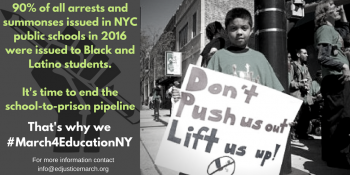
On March 4th, 2017 from 9:30 to 12:30, I’m marching with the Alliance for Quality Education and their broad coalition. There’s a billion reasons for me to march. Let me make a tiny list, though:
My son
My communities (Lower East Side / Harlem / Washington Heights / Inwood)
My students and their families
Because, for all the talk about Chicago, Detroit, LA, Philly, and other spaces where leaders are coming for public education, there’s little talk anymore about NYC
Because Governor Andrew Cuomo needs to know that he can no longer ignore the spaces where black and brown children
Also, because he can’t address it simply by telling Eva Moskowitz to take only the students she likes and discard the rest at the pleasure of hedge fund managers who want to see test scores
Because the rest of the country has to know that it’s not all good here
Because we shouldn’t negotiate our children’s futures from the point of compromise, but from the point of the ideal
Because there is such a thing as a “free” lunch for students, because we the people believe our kids should eat (DeVos sub 1)
Because this teacher isn’t in “receiver mode” and has never been (DeVos sub 2)
What’s more, I would love for you all to join the coalition in resisting the ways that education have cemented inequity in this country. To my knowledge, these education protests, like so many I’ve attended before, don’t have the largesse of other so-called grassroots undertakings. We can’t turn off our lights for day or two and rally in front of Albany on a weekday. We can’t bully parents into marching and threaten them with expulsion for not attending. We can’t tug at Cuomo’s pocket to attend the rallies and endorse our vision in commercials across the state. We won’t have Trump affiliates tour our halls without a reminder of how Trump sees public schooling as a monopoly worth breaking up.
We all we got.
To that end, we have to push back. Against Trump. Against DeVos. Against anyone who wishes to dismantle public education for our most vulnerable students. The argument about charters against public schools seems fraught with complications. The easy thing to say is that “not all charters.” The hard point to recognize is that public schools are a lifeline for what so many in America believe is democracy. If we aspire to the ideal of a democracy, then public education for all students matters. Akin to the arguments for universal health care, we must retain and bolster an education system that sits above the banter of the pseudo-free market.
We march with the hope that we’ll move forward from schools left behind by frigid policy and bolster these spaces with critically compassionate citizens. That’s why I’ll march. I hope to see you all there, too.
My shoes always welcome a good show of resistance. Plus, if you stand for nothing, then what will you fall for?
The post Why I Will March (Stand For Something) appeared first on The Jose Vilson.
February 21, 2017
W.E.B. DuBois and Dual Consciousness For Teachers of Color
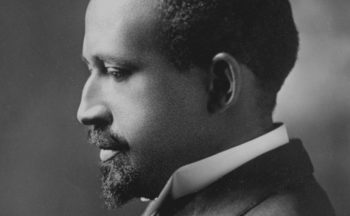
In The Souls of Black Folk, W.E.B. DuBois posits:
It is a peculiar sensation, this double-consciousness, this sense of always looking at one’s self through the eyes of others, of measuring one’s soul by the tape of a world that looks on in amused contempt and pity. One ever feels his two-ness,—an American, a Negro; two souls, two thoughts, two unreconciled strivings; two warring ideals in one dark body, whose dogged strength alone keeps it from being torn asunder.
DuBois left nuggets for decades on end, many of them still consumable to present-day. Conversations around codeswitching and multiculturalism come full circle for people of color in this country. In order to survive the schooling system in this country, they must work tirelessly to hold onto their home cultures and snap back into what the schooling process requires. In college, we’re asked to let our guards down, but the seduction of looser schedules and the ivory tower aesthetic only serve to remind so many of us that we have no stake in the institutions we hope will recognize our credentials.
What’s more, a handful of us are then allowed to become the teachers charged with carrying this discordant ideology forward, usually to students who look like us and share similar cultures, a generation removed.
People often ask, “What, to America, is a teacher of color?” There have been plenty of studies in the last few years suggesting a level of desire for recruiting teachers of color. So far, I have respected the efforts of local and national organizations to attend to diversity and inclusion. I am all for students seeing intelligent, hard-working adults across the racial, gender, and class spectra. The more opportunities to bring in different experiences that align with the socioemotional and intellectual uplift of all students, the better we are as a country for it.
How do we square this vision with the stagnant policies that continue to plague that vaunted ideal of innovation?
The complications abound. Teachers of color can and have often sound solidarity on major issues that affect the general workforce. Low pay. Lack of support. Administrative disagreements (and often, incompetence). But to the degree where we can all agree that this affects us often breaks down across racial lines.
In theory, every competent teacher should go wherever they wish. In reality, teachers only get to go where society can see them going. What good is a job fair for a teacher of color when they line up for well-resourced schools only to be told they’d “fit” better in a low-income school? What good is a school with a majority of students of color when superintendents enforce a Eurocentric curriculum and pedagogy across the school? What good is meeting after meeting with adults when we stray from talking to students about academics?
What good is it for teachers to return to their places of schooling if the space hasn’t changed for the better since they attended? Or if the only spaces where we can get hired remind us of the spaces where the trauma happened?
That dual-consciousness is knowing that there’s a plethora of language to use about the art and science of teaching, but on a deeper level, we are not neutral beings. Every teacher has decisions to make about their identities when they become teachers for longer than a couple of years. For teachers of color, they must either assimilate so as to appear safe or they must become activated so they don’t feel like a lie. But none of that matters because it’s equal parts how they enter into a room and how the room enters and consumes them.
What, then, is professionalism to those whose culture has been ostracized by professionals?
As with all blogs, this is but a draft. As a teacher, I too am a draft working on these peaces. We need to do school reform from the belly of the spaces where we’ve become unconscious to our students’ plight. For those of us with a critical conscience, we must wake these people up. Now is better.
The post W.E.B. DuBois and Dual Consciousness For Teachers of Color appeared first on The Jose Vilson.
February 5, 2017
With An Upright Zeal (On Teaching With This Fire)
Last week, I took a five-day social media break for the express purpose of re-centering myself, my family, and my work in ways that the Internet does not allow. That’s the public answer. The more private answer is complicated, but unsurprising to anyone who’s tried to fill multiple jars to full capacity at the same time with the same vigor. At EduCon in Philadelphia, I had no less than five people come up to me asking me for time and energy without recompense. As if I should do someone else’s work for free just because I do my own work on my own time for free. My son had a recurring and debilitating flu. I eventually caught it too. So did Luz. I had speeches and articles due. The squeakiest wheel gets the grease, but if you’re not, err, if I’m not a wheel that’s built to squeak, then I keep rolling.
Oh right. And I teach. Full time. 145 students, each and collectively with needs far greater than my capacity. continue reading
The post With An Upright Zeal (On Teaching With This Fire) appeared first on The Jose Vilson.
January 22, 2017
Don’t Blame The Kids (On The Women’s March and Getting “Woke”)

I wore black on the day the Thief-In-Chief was inaugurated, swearing up and down my apartment as he swore up and down to protect his constituents. The image on my shirt, a picture of Martin Luther King Jr. and Malcolm X shaking hands, was the only thing beaming on my apparel. Only one of my co-workers had discussed any plans to discuss the proceedings. I wanted to abstain from what was sure to be malarkey. This was the first inauguration I had no intention of watching live. Yes, I even saw both Dubya’s inaugurations for critical analysis. I hate that people keep saying “Don’t worry; we’ve survived worse” because some people don’t survive the “tough times.” Only those that get to tell the stories of how we survived. I needed a visible form of protest on January 20th, 2017, as is my right.
This inauguration redrew the lines from “left vs. right” to “human vs. inhumane,” and too many of us are caught in the crosshairs.
For those who’ve followed me for some time, you know the types of discussions I’ve had with prior classes. I’ve spoken about the merciless killing of black children at the hands of the state, the deportation of millions of children, mostly Latino / Chicano, and the unfair state of standardized testing on my students. Sometimes, I’ll do it through a professional veneer, and other times, I just go off. Each time, I hoped to elicit some form of response, to plant a seed within the listeners that would last them long after they graduated from my classroom. This year, I thought I had the words for my students because I had done it so many times before.
After my presumed readiness, on January 20th, 2017, while the small-handed fool placed his nails on Bibles, all I could muster was “if you’d like to talk about the events of today, let me know.” Their response was the biggest thud I’ve felt in a long time.
The post Don’t Blame The Kids (On The Women’s March and Getting “Woke”) appeared first on The Jose Vilson.
January 20, 2017
The Work Ahead [An Annenberg Institute Interview]
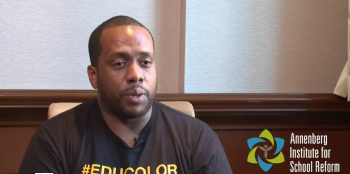
Here’s a little something.
“As far as the election is concerned, I’ve always felt that we were having to do the work regardless. There was always a sense of creating a path for equity, for access for true integration, for true understanding of what the work needed to be for all of us in our schools and in our democracy. What the election result highlighted for me, however, is that we definitely need to create broader senses of coalition among many different peoples, whether they be Native American people at Standing Rock, or the Black Lives Matter Movement or our Dreamers – anyone who has been disenfranchised. These are the folks who we need to start building coalitions with, because we need to create a government that suggests that everyone is included, not just for a small percentage, but for every single body in America.”
I had more to say about the future of organizing, elections, race, and inclusion. There’s even a glossy video of me wearing my EduColor shirt. Swag!
Read on, and let me know what you think below.
The post The Work Ahead [An Annenberg Institute Interview] appeared first on The Jose Vilson.
January 17, 2017
What Educators Can Do Now To Honor MLK Besides Post Quotes [On #MLKNow]
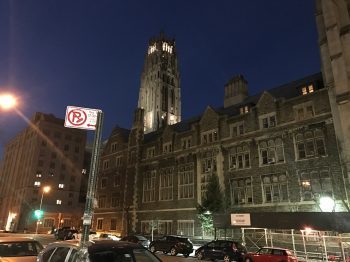
Yesterday, I had the fortune – the privilege – of attending MLK Now 2017, sponsored by Blackout for Human Rights / United Blackout and the Campaign for Black Male Achievement (CBMA). Needless to say, the star power in the building was enough to fill the pews with people of all generations. The target audience felt like a cross-section of the social-media connected young activists and their well-storied and still-energized elders. Lala Anthony’s rendition of a Muhammad Ali screed and Uzo Aduba’s flips between serious and ebullient Nigerian accents as she read from Nelson Mandela speech were everything.
.@UzoAduba reading from Nelson Mandela. #MLKNow pic.twitter.com/RvuBEooymy
— Jose Vilson (@TheJLV) January 16, 2017
At some point in the program, a video of congressman and legend John Lewis was projected on the screen to plenty of applause and adulation. A young lady, no older than 20, who only ran into my section to get a picture of Michelle Williams tapped me on the shoulder and asked “Who is he?”
I think I scrunched my face and clutched my chest. For 48 hours prior, I had the right-wing troll brigade explain to me and other folks of color how the Orange Is The New President would be better for “the blacks” than any civil rights leader. The furor over the fuhrer over the last few days put me on high alert for bald eagles and social media handles with improper uses of America. But after analyzing my own actions, I took a step back and said, “Well, if she’s gonna hear it from someone right now, I’m glad I’m up to the task.” I quickly told her who he was and she thanked me.
I too apologized. The reaction I gave her was the reaction I got when I was her age, still curious about the workings of the Civil Rights Movement, the Black Power Movement, and any number of uprisings of an era I was not born into. Mea culpa.
As a teacher, I don’t just bear the responsibility of my own work, but also all the teachers who did not teach her who he was. No one course can map the trajectory of resistance from 1776 to now and name every essential figure, though some have made grand efforts. But here’s what gets lost in teaching, especially teaching these “alternate” stories. John Lewis’ story is powerful enough as an African-American story. But, for many Americans, his story is as integral to the country’s evolution as any American founding father save Washington and Hamilton. He is a walking symbol of the sacrifices our people made in a non-violent uprising that opened the Constitution to almost every citizen. In the midst of ahistorical rewrites by government officials and pundits who would have sought Lewis’ head, it’s important for educators to give students the skills to detect the trivialities and inaccuracies.
It’s hard enough getting Martin Luther King Jr.’s legacy right. Lin Manuel-Miranda can’t be the only one to save our stories for us.
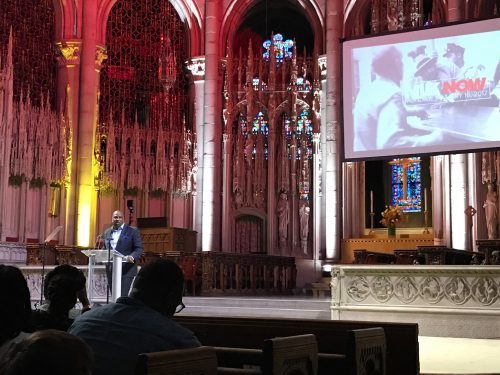
After I told the young lady about Lewis, I reflect on the words of Shawn Dove, CEO of the aforementioned CBMA. In his introduction to the program, he called on us to think deeper about the legacy of Martin Luther King Jr. at the present moment. Dove had this phrase that still true: “The challenge is: what is the dialogue after the monologue?” That’s the struggle, too. For many of us who yelled back at the president-elect, we saw the need to get beyond the commonplace King quotes and move into the man who once heralded racism, capitalism, and militarism as three of America’s evils.
Lewis is that bridge between then and now. He’s a walking monument and it’s worth revering him regardless of our respective ideologies.
To that end, none of us are perfect messengers, either. The good side of having actors, comedians, and other celebrities read the words of our elders is that, for what it’s worth, our youth need a hook as well. We need charismatic figures that can make the words come to life and make our youth intrigued. I don’t believe in paternalism, but watching Denzel Washington play Malcolm X in my youth, and seeing Public Enemy rock the X hats made me want to watch the seminal work Eyes on the Prize as a youth. Who am I to judge?
With that, we need to make sure that we don’t look sight of the actual work. For many in the audience, we see MLK Day as a means to an end, a reminder of the work that still lies ahead. For those that haven’t gotten to that stage of learning, they got a sense of how important and daunting the work is. Every generation must choose its path.
The question is: what dialogue are we having after the monologues? We can’t stand alone in this. Neither could they.
The post What Educators Can Do Now To Honor MLK Besides Post Quotes [On #MLKNow] appeared first on The Jose Vilson.
January 11, 2017
My Child, Your Child, Everyone’s Child (Five Years An Actual Father)
Five years ago, my son was on his way to us. We hailed him as a Three Kings’ Day (01/06) gift, the bookend to an otherwise brutal winter. We waited 41 weeks and counting to no avail as he refused to leave his mothers’ natural cocoon. The hospital staff ranged in their hospitality, but our main doctor came in like gold, frankincense, and myrrh. I remember not sleeping for 24 hours, restless over my new prince’s birth. When I finally cradled him in my arms, I remember thinking we might have made the world a better place and parented accordingly.
Both of Alejandro’s parents are educators with that mindset. Nine days later, I would return to the children our communities birthed.
My son’s birthday reminds me of the deep gulf between the lofty aspirations of our best days and the doldrum realities of our worst days in our classrooms. I’d say “truth be told,” but there’s so many contradictory truths I hold at once. I do believe in students’ capacity to learn, sometimes more than they believe in themselves. I get angry when students don’t try their best, though that might actually be their best. I don’t need my students to be compliant, but their understanding of respect and mine don’t always align. I’ve caught myself saying “if this student doesn’t show up today, the class will be 50% smoother” even when I know I want to and have to teach every single child.
The rub is that I’m a National Board Certified teacher, a writer, an activist, and an acclaimed education blogger. I blame myself for this. My students are blameless.
I’m receiving someone’s gift. 30 babies at a time, 145 babies a day. Their parents sent them to us with different needs, different competencies, and different orientations to institutions (specifically school). But even on my worst days – today is one – they remind me that parents sent a manifestation of themselves to us. I’ve done this for long enough to teach over a thousand students, some of whom said I was their school father, but that too lasted for what seems like a few seconds of my time in retrospect.
What does it look like for us to treat all of our children like our own?
I don’t know the answer because I’m not there yet. Parenting is teaching me a lot about myself as a teacher, though, and I plan on tending to this need.
The post My Child, Your Child, Everyone’s Child (Five Years An Actual Father) appeared first on The Jose Vilson.