
Barnabas Piper's Blog, page 92
June 27, 2016
New Happy Rant: Trump’s Religious Advisors, Cavs Victory, & iPod Preachers
In this episode of The Happy Rant Ted, Ronnie, and Barnabas rant about the following pressing and timely subjects:
Donald’s Trump’s board of “evangelical advisors” and what significance they have
The Cleveland Cavaliers break a curse, celebrate in odd ways, and leave Lebron with what legacy exactly?
Are iPod sermons good for listeners or unhelpful?

We’d like to thank our sponsor, Olive Tree, this week. Olive Tree offers comprehensive and convenient Bible Study Software as well as a massive library of Christian books. Their apps for all mobile devices are clean and convenient. It is an incredible way to do in-depth study, compile all your notes and highlights, compare texts, open study materials and scripture side-by-side, and work in the original biblical languages. Or you can simply read your favorite Christian authors like Ted or Barnabas. They have a special offer for Happy Rant listeners too. If you use the code RANT at checkout you can get a 20% discount on whatever your purchase through July 31.
Like every week, we want to offer a big thank you to Resonate Recordings, the fine folks who make us sound listenable. If you are looking for great people to help your church put out recorded sermon audio or help you with a podcast they’re your people.
Feel free to hit us up on Twitter at @HappyRantPod or on Facebook or via email at HappyRantPodcast@Gmail.com with any topic suggestions or feedback. We love hearing from listeners!
To listen you can:
Subscribe in iTunes.
Listen on Stitcher.
Leave us a rating in iTunes (it only takes 1 click and it really helps us).
Listen using the player below.
Episode #93


June 24, 2016
The Two Tasks of The Writer
Writing, as complex a discipline and varied an art form as it is, seeks to accomplish two tasks. Sometimes it must do one, sometimes the other, and often both. The two tasks are these:
Say what others are thinking better than they are thinking it.
Say what others are not yet thinking but ought to be.
Say what others are thinking better than they are thinking it.
“Better” can mean many things. It can mean stating things with more clarity or artfulness. It can mean expressing something beautifully instead of boringly. It can mean clarifying confusion or restating for emphasis. It can mean using force to drive home an ignored point.
Regardless, the task of the writer is to notice what is subpar or incomplete in people’s thinking and fill it or improve it in some way. Such writing avoids being derivative or dry. It is true because anything false cannot be “better.” And by writing in this manner the writer often begins to accomplish the second task.
Say what others are not yet thinking but ought to be.
Often the means by which a writer can improve a reader’s thinking is by providing a missing piece or a missing story or a missing feeling. Sometimes this task is a delightful one as readers accept the writer’s work as a gift. Other times it is an exercise in persistence and persuasion. Writing deftly and with craft makes a difference because it can fashion work that fits just so into the gap in a reader’s mind.
Stories create worlds and contexts that draw the reader to places they’ve never even imagined and concepts they never considered. Poems turn common experiences or unexpressed feelings over to view the underside or see them from a different angle so readers see what they couldn’t before. Non fiction can build a case, make an argument, unearth findings, explain the befuddling, or describe afresh. Regardless, good writing fills a gap for the reader and puts a puzzle piece in place to help complete the picture of wisdom and understanding.
For the writer the key is to notice and to think. Can you see what others don’t? That is the key to the best writing. Put those noticings into words and you will complete the first task for some, the second task for others, and both tasks for many. The more you do this – notice, think, write – the better you will get and the more adept you will become at both these tasks.
June 22, 2016
How did Rape Become a Culture for Young Men?
Rape culture.
I am raising two daughters in a country where this phrase exists, and it is sickening. How can I protect them? How can I raise them to protect themselves?
This phrase is uttered daily with diminishing disgust, not because we are more accepting of rape but because we are progressively anesthetized to its horror because of its prevalence. And the prevalence is terrifying and nauseating
Think about that—rape culture.
A culture in which the violent theft of peace, innocence, wholeness, and well-being is normative.
A culture in which sexual coercion and attacks are just part of life.
A culture in which young women have no advocates, no security, and no value except “twenty minutes of action.”
Words cannot do justice to how repulsive this is. No woman is ever at fault for an assault done to her. No woman bears blame because a man coerces or forces her into a sexually compromising position. And no unwanted sexual act toward a woman is defensible or ignorable.
So I want to address men, young men and fathers alike, because it’s our responsibility to change this heinous “culture.”
Rape Culture and The Male Athlete
Just these past few weeks we have seen the football program at Baylor University turned upside down as a pattern of sexual assault came to light and it was shown that the athletic director and football coaches did little or nothing to resolve them.
In another well-publicized case a judge sentenced a former Stanford University swimmer to a mere six months in prison—a sentence which he will serve only half of—for raping an unconscious woman because a longer sentence would “have a severe effect on him.” (I should hope so—that is the point of punishment for crimes, after all.)
While these stories were rightly drawing outrage the Washington Post published an article revealing that more than half the college men they surveyed admitted to coercing a partner into sex.
These three stories are disgustingly exemplary of what rape culture is—young men feeling little remorse or hesitation at harming young women and a system of authority that does little to hinder or correct them.
They are not isolated incidents either. In 2014 a female University of Missouri swimmer committed suicide after her rape was not investigated or dealt with by the school or University police.
Nearly every week you can find a story of a male athlete being dismissed from a team for a violent act against a woman. The University of Louisville’s men’s basketball team has been investigated for using female escorts to lure recruits, a tactic rumored to be used widely elsewhere. Are these actions rape? Not technically, but they are exploitative of women and indicative of how so many men view them—all part of rape culture.
I don’t know whether such actions are more prevalent among athletes or simply more publicized, but it seems that their privileged position on college campuses gives some athletes a sense of invulnerability and the system that is supposed to provide oversight actually provides protection from justice.
How did we get here? What led young men to believe that sex is a thing to be forcibly inflicted on young women? What led them to see themselves so dishonorably and to view women so cheaply? Sin unchecked, sex commoditized, and selves worshiped. Young men live without boundaries and with no sense of who they are or what place sex has in life.
Our Sexual Ethic: No Ethic At All
Our country has a broken sexual ethic. It might be more accurate to say we have no sexual ethic.
Sex has no boundaries, no purpose but self-pleasure, and no defined place. It is how we define fulfillment, and in a culture that values self over all else that means an individual’s pursuit of sex can easily go unchecked.
Instead of being a shared act of mutual pleasure with a rightful place between husband and wife sex has become a drug to which America is addicted. We are simply chasing the high, consequences be damned.
We see this in pornography, a $12 billion industry in the United States, and of course that doesn’t include the amount of free porn accessed daily.
Porn is sexual pleasure offered without commitment or vulnerability—two ingredients in any healthy sexual relationship—and usually at the expense of the participants. It glorifies abuse, manipulation, and exploitation. Men are often faceless bodies and women are their pliable playthings.
And the young men of our country shotgun it like cheap beer at a frat party until they are too stupefied to know what’s what. They may think it is innocent pleasure, but it is affirming the upside down sexual ethic and confirming the cheapness of both sex and women.
Boys Without Dads Struggle to Be Men
Combine these factors with a culture full of fatherless young men, either literally or because their fathers have abdicated responsibility, and you get young men without discipline who view sex as a commodity and women as the delivery vehicle.
Who is to teach young men who they are, how they are to be, and how to view women?
Fathers.
Who is to set the limits on a young man’s life and provide the necessary consequences if he breaks those limits so that he learns the way he should live?
Fathers.
Who is to fill young men with truth, with godly confidence as image-bearers, and with deep respect and care for people of both genders as fellow image-bearers.
Fathers.
But there is a shortage. Not of men to make babies, but of fathers who actually raise them.
Boys without the guiding influence of wiser more mature men stay bros for life. And buy into the “bro code” that sees sex as a conquest and shrugs at infidelity. Boys without such influences struggle to be become men—strong, godly strong men who love women as equals and care for them as people.
(None of this cheapens the efforts or impact of mothers, especially not single mothers. The role they play in their sons’ lives is no less important, and millions fight and strive to be both mother and father. Simply put, though, every young man yearns for and needs a father figure who is strong and affirming, corrective and constructive.)
Male and Female, In His Image
What both young men and women are left with is no sense of personhood—of identity as unique, invaluable, precious image bearers of God. Women have been cheapened to objects and men have been cheapened to mindless pursuers of said objects. What lies. What loss.
No human solutions will wholly resolve this problem, although proper enforcement of laws and policies, coaches and administrators doing their jobs, and staunch defense of victims would certainly help reduce violence against women.
But this only treats the symptoms. They need to be treated lest they rage out of control, but the disease must be diagnosed and treated too.
The disease is how sin has taken our eyes off our creator to worship the creation, especially self and sex. When we see ourselves as ultimately important and sex as the ultimate pleasure why wouldn’t we force it on another? They are, after all, not as important.
This lie was born in Eden and hisses into the hearts of young men across America. Male and female God created us, in His image. But Adam and eve bought the lie of self-glorification—wanting to be God—and we have bought it every day since, and in the pursuit of self love we lost our true selves, our true personhood.
Rape culture is the outflow of this, of the gender which holds both societal and physical strength advantages using those to exploit instead of protect, to harm instead of to help.
Each of us, apart from the transforming grace of God, will pursue our own pleasure at the expense of others. Without boundaries and enforcement nothing stops that pursuit from raping someone. This is rape culture—the pursuit of pleasure without conscience or boundaries or humanity—and it needs to be fought by advocates, those who care about the wellbeing of young women and young men.
But it can only be defeated by the promises of scripture—promises of identity, joy, fulfillment, purity, wholeness, redemption, and restoration.
These promises are what will transform perpetrators and heal victims. That is the power of Christ through the Holy Spirit.
Young men must turn their estimable energies to these truths and dig into them like their lives depend on it, for they do. Parents, fathers, must show and tell our children these truths so that our sons have someone to imitate and our daughters have a model of who to love.
Pastors must proclaim them consistently since culture would rather rape then listen.
Coaches must live them so players see a better way.
Managers and leaders must be guided by them so that issues don’t go unaddressed and organizational cultures uplift instead of becoming toxic places for men and women alike.
Teammates and classmates must be shaped by them so they can be true friends, holding one another to a truly fulfilling standard of joy and meaning and happiness.
These promises are the only hope when evil has become so prevalent and accepted as to define a culture.
This post was originally published at Athletes in Action’s site.
June 21, 2016
New Happy Rant: Men Singing in Church, Awful Kids, and Favorite Cartoons
In this episode of The Happy Rant Ted, Ronnie, and Barnabas discuss the following – all listener suggestions:
Why don’t men sing in church? Is it the music, dudes being dudes, or something else?
Why do parents make excuses for their awful children?
What were their favorite cartoons as children?

Our sponsor is NavPress. The particularly want to highlight two books by Jerry Bridges, The Blessing of Humility and his recently re-released classic The Pursuit of Holiness. Both books are rich with theology and gentleness, both reflective of their author. Pick them up, work through them slowly, digest, and benefit.
Like every week, we want to offer a big thank you to Resonate Recordings, the fine folks who make us sound listenable. If you are looking for great people to help your church put out recorded sermon audio or help you with a podcast they’re your people.
Feel free to hit us up on Twitter at @HappyRantPod or on Facebook or via email at HappyRantPodcast@Gmail.com with any topic suggestions or feedback. We love hearing from listeners!
To listen you can:
Subscribe in iTunes.
Listen on Stitcher.
Leave us a rating in iTunes (it only takes 1 click and it really helps us).
Listen using the player below.
Episode #92
June 14, 2016
Peace at Wit’s End
Wit’s end is not a place at which we want to arrive. It is the cul-de-sac at the end of a long read paved with sweat, effort, stress, fear, and more effort. When we get there we realize it is the end, nowhere else to go and nothing else to do. All that sweat and effort, all those tears, all that anxiety brought us to exactly nowhere. Welcome to Wit’s end.
Editor’s Note: For those of you who were Adventures in Odyssey fans, this is not that Wit’s End. That was a happy place.
When we arrive here what is our response? Depression maybe. Exhaustion probably. Anger and resentment possibly. Fruitlessly doubling down on all the same things that didn’t work previously. Collapse.
When we arrive at wit’s end we can be sure of one thing: we have exhausted every means of solving a problem that we know. We could not turn the business around. We could not restore our marriage. We could not save that loved one’s soul. We could not right the ship of a sinking church. We could not fix whatever it was despite all our efforts. It is a helpless feeling.
It is called ‘wit’s end” because every ounce of wit and wisdom we hold has been poured out. Life has out witted us. Sin has out witted us. It is beyond our capacity to resolve or solve.
There is another response, though. Peace.
The end of our wits are the beginning of God’s, and His are both endless and perfect. Stubborn, arrogant, well-intentioned, naïve beings that we are we only come to the place of handing over troubles to God when we realize we simply cannot carry them any further. We only ask Him to show the way when we’ve reached the end of ours. This is a hard place, an empty place. But when we are empty we can be filled.
We can be filled with peace. We can curl up in wit’s end and sleep easy because we know that all the mental machinations that caused insomnia are for naught. We finally see that this is God’s problem to solve in the way He sees fit and in a manner only He can accomplish. There is peace in giving up because in this case giving up is really giving over – giving over our troubles to the one who can resolve them.
Wit’s end is not a place at which we want to arrive, but it is often the place where we need to arrive. Wit’s end is a place where there are only two responses: anguish or peace. There was no peace on the road, but there can be here because we finally realize all we can do is pray and rest – exactly what God wants from us. It is not bliss, but it is peace because all our troubles are no longer in our hands. They are in hands that can and will actually do precisely what needs doing.
June 13, 2016
New Happy Rant: Rape Culture, Daddy Blogs, and Christian Summer Camps
In this episode of the Happy Rant Ted Kluck, Ronnie Martin, and Barnabas Piper do something unusual – they take on a really serious topic, rape culture. We go on to take on a couple fun topics too, but that one serious topic was one we felt needed to be addressed.
Rape culture: how can a phrase like this even exist, where did it come from, and what can be done about it?
Why aren’t there daddy blogs the way there are mommy blogs?
Memories of Christian summer camp

Out first sponsor this week is Moody Publishers and the book On Pastoring: A Short Guide to Living, Leading, and Ministering as a Pastor by H.B.Charles. This is a phenomenal, grounded resource that will help anyone in ministry or who is considering ministry. It majors on the majors and minors on the minors by emphasizing relationship with God, character, and a biblical life over strategies and techniques. Charles shares many anecdotes from his own ministry, both of failure and success, to bring points home. Buy this book if you are in ministry or to encourage someone you know in ministry.
Our second, but not lesser, sponsor is NavPress. The particularly want to highlight two books by Jerry Bridges, The Blessing of Humility and his recently re-released classic The Pursuit of Holiness. Both books are rich with theology and gentleness, both reflective of their author. Pick them up, work through them slowly, digest, and benefit.
Like every week, we want to offer a big thank you to Resonate Recordings, the fine folks who make us sound listenable. If you are looking for great people to help your church put out recorded sermon audio or help you with a podcast they’re your people.
Feel free to hit us up on Twitter at @HappyRantPod or on Facebook or via email at HappyRantPodcast@Gmail.com with any topic suggestions or feedback. We love hearing from listeners!
To listen you can:
Subscribe in iTunes.
Listen on Stitcher.
Leave us a rating in iTunes (it only takes 1 click and it really helps us).
Listen using the player below.
Episode #91
June 10, 2016
To Hope All Things In a World We Cannot Trust
Christians are to live lives marked by love – to, as 1 Corinthians 13 puts it, believe all things, hope all things endure all things. This means we are to be defined by characteristics of grace. We are to assume the best of people and offer them the same hope and patience and mercy we know we so desperately need. We are to offer them second and third and fifty-fourth chances. In short we are to exude the love Jesus poured out on us.
But it doesn’t mean we should pull the wool over our eyes. Believing and hoping all things does not mean being gullible. It does not mean ignoring sin or injustice or wrong doing of any kind. It’s not blind optimism about people. Christians must have a realistic sense of the world and its inhabitants. Yes, they are made in the image of God but Genesis 3 did happen. People are sinners and for all its wonders and beauty this world can be a pretty awful place. More often than not it will disappoint us and leave us hurt.
One of my pet peeves is the use of superlatives and over statement on the internet in an attempt to drive traffic and increase clicks. You know “check out this video of the most adorable kitten ever” and “whoa, this college basketball player just went into orbit on this dunk” and the like. Well one such phrase is particularly insidious, that about “restoring faith in humanity” as in “The way this man responds when he sees a three legged naked mole rat will restore your faith in humanity.” What they really mean is this will give you warm fuzzies. To be clear, warm fuzzies do not equate to faith in humanity, and if you are dumb enough to have faith in humanity you will deserve everything that comes your way. Look around. What’s to have faith in? Humanity is collectively pretty awful.
We are to have faith in God and love humanity, not have faith in humanity. Humanity will be a perpetual disappointment if we do that. It will lie, cheat, steal, and desert. It is capable of remarkable good, but aside from Christ is rooted in sin and will gravitate back to it – to selfish motives at others’ expense, including you.
Yet we are to hope all things and believe all things and love our neighbors as ourselves and treat others as we want to be treated. These realities seem incongruous. How can we believe and hope all things about someone or something that we cannot and should not trust? How can we assume the best about someone while also assuming they will disappoint?
The Balance
Somehow, some way we are to maintain optimism about people while being firmly realistic, even skeptical, of them. We are to assume the best and the worst simultaneously. Two things enable us to do this: grace and wonder.
Grace is the context in which we can love or trust or respect anyone. God’s life-shaping grace through Jesus in the person of the Holy Spirit is our daily means of living a God-honoring and others-loving life. Every good thing that we do is by grace. Every good thing that we have is by grace. Any ability we have to love others undeservingly is by grace.
While grace is the context and the means of loving and hoping, it is wonder that balances these two incongruous demands because wonder, curiosity, is what drives our own awareness of grace. The more we dig into grace and understand it and see it and discover its secrets the more we will be able to love the unlovable while still seeing them for exactly who and what they are. In large part this is because we will recognize how unlovable we are, how unpleasant, how unkind, how decidedly fallen. We will see the marks of grace on our lives, the way it shapes us and carries us.
We can only come to grips with our badness and God’s goodness through wonder and curiosity, by being noticers of our propensity for ill and God’s propensity to bless. We explore and ask and seek the depths of the riches of God’s grace, and the more we discover the more it will shape our interactions and reactions to others.
Knowing our own sinfulness puts us in a position to properly understand others too. Because of God’s grace we can honestly confront the evil within us and seeing what lies within gives a sense of what lies in others too. As I look into my heart and see the pride, lust, deceit, anger, and jealousy roiling I know two things: God’s grace is big enough to solve that mess and that same mess lies within every other person too.
We can now look at others with a clear sense of what evils they are capable of and a deep sense of hope in God’s grace for them. We do not trust them, but we do trust what God is doing in them. We trust that those who are in Christ are truly new creations. We are aware that every relationship is a risk because of every person’s endless capacity for selfishness and sin, but we know that God’s grace makes it a risk worth taking because grace in my life added to grace in someone else’s life is an exponential increase to both our benefits. We also know how little we can be trusted aside from God’s work and we know we need grace from others. It is a symbiotic relationship.
On this basis of grace we can safely turn our curiosity outward. We don’t blindly walk into relationships. Curiosity and grace have opened our eyes to the risks and rewards. We can ask questions without agendas and answer them without guardedness. We do not need to be surprised by what we find in others. (In fact, surprise and shock at someone else’s sin very well might indicate you haven’t acknowledged your own.)
As we turn our curiosity toward the lives of others we will begin to see more reason for skepticism but also more evidences of God’s work. This tension will pull us forward. Sometimes it will be uncomfortable – we will want to give on people and write them off, to withdraw and live behind a relational wall. When we do this, though, we fail to recall that God did not withdraw from us when we wronged Him. On the contrary, he reached down and drew us to Himself.
Grace and wonder are a risk. They open us up to hurt. But they are the only way to balance the twin realities that humanity is awful and we are to love it regardless. We are not fools, assuming the best and frolicking mindlessly out into the world expecting it to be all puppies and flowers and warm hugs – a curious mind recognizes this isn’t the case. Neither are we purely skeptics assuming the worst about others – grace reminds us of our need and theirs and how God changes lives. Grace and wonder keep us firmly rooted in our need for grace, the immensity of grace, humanity’s need for grace, and our ability to offer humanity grace because of what was given to us.
This is an excerpt from my forthcoming book, The Curious Christian: How Discovering Wonder Enriches All of Life that is due to be released in early 2017.
June 7, 2016
The Best Quotes from Strong and Weak by Andy Crouch
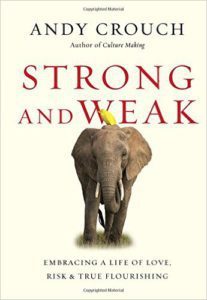
“Paradigm” is a WAY over-used word in describing books, but in Strong and Weak: Embracing a Life of Love, Risk and True Flourishing Crouch genuinely presented a new and better paradigm that helped me think about all my interactions with others and with God. If that sounds overwhelming, keep in mind he did it in about 180 pages. That’s why I say he created a paradigm. It is a way of viewing and understanding interactions – parenting, marriage, work, leadership, ministry, neighborly, political, etc. I won’t give away or try to explain his framework for fear of cheapening it. Just buy and read this book. It is one the will genuinely reshape your thinking and, with a little effort, your living too.
Here are some of the best quotes from Strong and Weak.
Flourishing comes from being both strong and weak.
Much of the dysfunction in our lives comes from oscillating along the line of false choices, never seeing there might be another way.
There really is no other goal higher for us than to become people who are so ful of authority and vulnerability that we perfectly reflect what human beings were meant to be and disclose the reality of the Creator in the midst of creation.
Becoming a saint is about quite a bit more than ‘working harder’ – or perhaps better put, it’s about a great deal less.
Think of authority this way: the capacity for meaningful action. When you have authority, what you do, or do not do, makes a meaningful difference in the world around you.
Above all, meaningful action participates in a story. It has a past and a future. Meaningful action does not just come from nowhere, and it does not just vanish in an instant – it takes place in the midst of a story that matters.
The vulnerability that leads to flourishing requires risk, which is the possibility of loss – the chance that when we act, we will lose something we value.
Sometimes suffering is simply the painful payoff of risking love in a broken world.
It is almost never enough to reduce vulnerability – even though that is what most of us seek to do in our own lives. We must also restore proper authority to individual persons and to whole communities.
‘Helicopter parents’ have been replaced by ‘bulldozer parents,’ who clear ever obstacle from their children’s paths, and ‘drone parents,’ who hover invisibly overhead and then swoop in with overwhelming force when their progeny is endangered.
The greatest challenge of success is the freedom it gives you to opt out of real risk and real authority.
In social media you can engage in nearly friction-free experiences of activism, expressing enthusiasm, solidarity or outrage (all powerful sensations of authority) for your chosen cause with the click of a few buttons.
Amidst safety the world has never before known, the greatest spiritual struggle many of us face is to be willing to take off our bubble wrap.
Our affluence has left us unready for the tragedy and danger of the world.
The twentieth century sexual revolution’s promise of “freedom” has given way to a twenty-first century epidemic of attenuated, mediated sexual escapism.
Our idols inevitable fail us, generally sooner rather than later.
The first thing any idol takes from its worshippers are their relationships.
In the end the justice of God will abolish the authority of those who have purchased their power at the price of others’ flourishing, those who refuse to enter into relationship with the God who is authority and vulnerability together.
Leadership does not begin with title or position, it begins the moment you are more concerned about others’ flourishing than your own.
This is what it is to be a leader: to bear the risks that only you can see, while continuing to exercise authority that everyone can see.
Jesus drains the cup of wrath to its dregs. He does not take one taste of death, spit it out and fly up to heaven. He descends to the dead, and there, for all that his disciples can see or know for Friday to Sunday, he stays.
Death is the last enemy not just because it takes life but because the fear of death prevents real life.
It is hard to think of many things that do more damage to an organization than leaders who have no plan for how they will hand over power.
Only those who have opened themselves to meaningful risk are likely to be entrusted with the authority that we all were made for and seek.
June 6, 2016
New Happy Rant: Gorillas vs. Humans, Piper the Satanist, and Protesting Target
In this episode of the Happy Rant Podcast Ted Kluck, Ronnie Martin, and Barnabas Piper take on three of the HOTTEST topics of recent days, topics so hot only experts can handle them. Well, experts and anyone with a Twitter handle.
So a gorilla was shot and the internet went . . . ape over it. Why is this a thing?
A “youth leader in the home church movement” called John Piper and Russell Moore satanists for their views on minority adoption and tagged Barnabas in the post. His thoughts?
Should we be protesting and picketing Target for their decision on who can or can’t use which bathrooms?

This week we have two sponsors. The first is Missional Wear, that fantastic partner of ours that offers the best of reformed apparel, artwork, pub glasses, and mugs. In case you forgot Father’s day is not far away, check out their selection of pint glasses and mugs featuring quotes, solar, dead guys, and more. Aaaaaaaand Missional Wear is offering a special for our podcast listeners. Use the code HappyRant at checkout and get $10 of a purchase of $50 or more through June 12. This is the best of all Calvinist swag and that is only one week so move quickly!
Our second, but not lesser, sponsor is NavPress. The particularly want to highlight two books by Jerry Bridges, The Blessing of Humility and his recently re-released classic The Pursuit of Holiness. Both books are rich with theology and gentleness, both reflective of their author. Pick them up, work through them slowly, digest, and benefit.
Like every week, we want to offer a big thank you to Resonate Recordings, the fine folks who make us sound
listenable. If you are looking for great people to help your church put out recorded sermon audio or help you with a podcast they’re your people.
Feel free to hit us up on Twitter at @HappyRantPod or on Facebook or via email at HappyRantPodcast@Gmail.com with any topic suggestions or feedback. We love hearing from listeners!
To listen you can:
Subscribe in iTunes.
Listen on Stitcher.
Leave us a rating in iTunes (it only takes 1 click and it really helps us).
Listen using the player below.
Episode #90
June 1, 2016
4 Things I Learned About Work from a Peewee Soccer Team
My first grade daughter just wrapped up her spring soccer season. If you’ve ever watched kids soccer you would not think there is much to learn about anything but the most rudimentary instructions.
“Wrong way!”
“Kick the Ball!”
“Run!”
Over the course of the season, though, I began to notice a few things that consistently occurred that turned the outcome of every game. Each of them is directly applicable to your work and mine.
Effort is a skill and we can all learn it.
When we think of skills we tend to think of nifty, maybe flashy, and definitely enviable. But one skill overrides all the others: Effort. It is a skill to try harder than everyone else, to not give up, to hustle, to walk away knowing you gave everything you had. My daughter is not the most skilled player, but I knew that is she played with the kind of effort I asked her to she could change games for her team.
Effort can be learned, and that is remarkably encouraging because we will all find ourselves in positions where we aren’t the best or aren’t highly skilled or don’t have innate talent. But we can outwork and outhustle everyone if we want. We may never be the top performer, but we can swing outcomes in our favor.
Focus is more important than talent.
Asking first graders to pay attention is about as fruitless as, well, asking first graders to pay attention. Time and again throughout these games a team would allow a goal because the defense was practicing ballet or the goalie was picking her nose. Even the most talented players got schooled by those who just paid attention to where the ball was and where they were supposed to be.
Like effort, we can all learn focus. In fact it is a big part of effort, the part that makes sure we trying at the right things and in the right ways. Focused effort trumps lackadaisical talent nearly every time. If you are talented and focused you are a super star. If you are only passably talented and focused you will still be an incredibly productive and valuable contributor.
Stay in your position.
Soccer, like most team sports, works best when the spacing and flow of the game is good. Players are in position and the other team are trying to get them out of position, to find angles and gaps in the defense. Well, first graders don’t think in terms of positions. They all orbit the soccer ball as it rolls around the field. It’s more like a scrum than a soccer match.
All of a sudden, though, the ball pops free and begins rolling. With every player out of position it’s a mad race to control it and kick it either into or away from the goal. Sometimes, rarely, a defender staid back and simply boots the ball clear. Sometimes, rarely, a forward staid outside the scrum and easily collects the ball for a goal. These players were in position. They were where they were supposed to be and could therefore complete the task required of them.
At work, like in sports, things fall apart when we get out of position. We miss an opportunity. We take on too much and fail. We aren’t there to assist a teammate in need. We fail because we aren’t as suited to a task as a teammate. We need to remember our spacing, our roles, our position. Avoid the scrum, stay home, and when opportunity is passed our way do what we are supposed to do.
Some players are just better than others.
It’s true. Some kids are simply much better soccer players than others. This is no insult to the other kids. Some kids won the genetic lottery and are faster and more coordinated. Others have former collegiate all-Americans as parents. These kids can dominate.
I say “can” because they too need effort, focus, and to be in position. But sometimes talent can overcome a lack of effort. Sometimes the talented ones just make the other look silly.
We work with people like this. They’re savants, geniuses, intuitive, sharp. They have a collection of gifts we only hope for. It’s ok to acknowledge this. I said earlier that focused effort beats talent almost every time, and that’s true, unless the talent is also focused and trying. Where does this leave us? Realistic. Grounded. And thankful that work is not a win or lose effort in most cases. It’s an effort to constantly improve, to reach goals, to grow, to learn, to achieve milestones.
And we can do this through developing the skill of effort, honing our focus, staying in position, and cleaning up every opportunity that comes our way.


