
Barnabas Piper's Blog, page 89
September 19, 2016
New Happy Rant: Are We Jerks, Kaepernick and the Flag, and The Worst Worship Songs
In this episode of The Happy Rant Ted, Barnabas, and Ronnie discuss the following:
A few weeks ago the question came up “are we jerks?” It wasn’t really answered because, well, that’s awkward. But now the guys are ready to try to sort it out.
Colin Kaepernick, a quarterback in the NFL, made headlines when he refused to stand for the national anthem. The hosts talk through whether this is disrespectful and how we respond to protests in general.
Which worship songs are the worst ever? And why is worship music so lame most of the time these days?
 We’d like to thank our sponsor, Missional Wear (or Calvinist Swag if you prefer). You can find a fantastic selection of apparel, art, mugs, pint glasses, and more there. And it’s good quality, artistically designed gear too! Check out their new laser etched journals too. Be sure to use the code HAPPYRANT at checkout for a listener special deal – a sweet sticker featuring our logo.
Like every week, we want to offer a big thank you to Resonate Recordings, the fine folks who make us sound listenable. If you are looking for great people to help your church put out recorded sermon audio or help you with a podcast they’re your people.
Feel free to hit us up on Twitter at @HappyRantPod or on Facebook or via email at HappyRantPodcast@Gmail.com with any topic suggestions or feedback. We love hearing from listeners!
To listen you can:
Subscribe in iTunes.
Listen on Stitcher.
Leave us a rating in iTunes (it only takes 1 click and it really helps us).
Listen using the player below.
Episode #104


September 16, 2016
When pastors Doubt
Justin pastored a mid-sized suburban church. He started as the youth pastor, weathered some leadership changes, grew in respect and influence, and was eventually called to lead the church. Justin was a passionate and gifted teacher, the people respected him, he had a beautiful family, and was, by all appearances, a bright young pastor with a great future.
But Justin had a dirty little secret. No, not that kind of dirty. He was eaten up by doubts. Justin wondered how he could be sure he was saved, could he really trust God’s promises, did he really buy all that theology he’d learned in Seminary? Over time his doubts ate away at his passion for ministry. Justin ended up stepping away from the pastorate because he just didn’t think he was qualified any longer.
Everyone doubts – besetting doubts, passing doubts, nagging doubts. The church is full of doubters, whether or not we like to admit it. We doubt God’s promises. We doubt the “joy set before us” because the temptation before us looks pretty appetizing too. We doubt our salvation. We doubt God’s goodness in the face of evil and the trustworthiness of scripture in the face of criticism. Every Sunday normal people with these thoughts file into worship centers and sanctuaries around the world.
And what does that mean? It means the pastor better have all the answers. The Sunday school teacher and small group leader needs to be rock solid. The deacons and elders better brim with confidence. No matter what comes up – crisis, tragedy, attack, debate – they must be Johnny-on-the-spot with the right response. Church goers get to doubt. Church leaders don’t.
Of course church leaders do doubt, as much as all the people you lead, in fact. Justin wasn’t an aberration. The same questions of faith, identity, crisis, culture, theology, and obedience hover and swoop around them. You feel as lost in the fog of not understanding as all they people they’re expected to enlighten. But you can’t let on, not most of the time, not to most people. So you face the specters alone, often suffer, and sometimes fall.
It doesn’t have to be this way. No, the church’s expectations won’t likely be changed in short order. It won’t grow in comfort with a leader’s doubt by next Sunday, but a few practices can both bolster you and strengthen your congregations.
1) FIND CONFIDANTS.
You only need two, maybe three. These are people you trust. You can’t process all your questions in public, on a blog, on Twitter, or with any old church member. But you need someone to process with. More than just processing, though, you need them as a plumb line to tell you when your questions have gone from fruitful to sinful. You won’t see; they will.
2) FIND AN ANCHOR.
Doubts are just questions as long as you have an anchor. Without an anchor they are waves dashing you against the shore. Mark 9:24 offers the quintessential doubter’s prayer, “I believe; help my unbelief.” The first half is the anchor, the expression of conviction, the sermon to self reminding you of who you believe in and why. With the first half firmly in place the second half becomes a guilt-free plea as you explore your doubts. Your confidants will keep you attached to your anchor. Your spiritual disciplines will keep you attached to your anchor. Your reflection and meditation on God’s character will keep you attached to your anchor.
3) DON’T BUY THE LIE OF GUILT.
Doubt is not inherently sinful. It is merely being unsure, a lack of understanding. It becomes sin when, instead of seeking truth and a deeper knowledge of God, it seeks to undermine or reject him. If your doubts are in the first category, the truth seeking kind, then they are a tool in Holy Spirit’s hands. Don’t let the long-stigmatized word “doubt” make you feel guilty, unworthy, or distant from God. In fact, those doubts might be taking you deeper into your relationship and knowledge of God than you’ve ever been.
4) DON’T SUPPRESS YOUR QUESTIONS.
You have an anchor. You have confidants. You see that doubt isn’t sinful. So ask! Search for answers. Let your questions drive your study and even your teaching. (It will give you a unique passion!) What you wonder about is precisely what God will use to grow you and to show you Himself. And isn’t that what you want more than anything?
5) ACCEPT AND EMBRACE “I DON’T KNOW.”
You still have to lead people. You still face their expectations. But you no longer see your own doubts as a badge of shame. You even see how the doubts of your people can help them grow too, and that is what you want to foster. Start with “I don’t know.” Show them your willingness to not be that Johnny-on-the-spot and that you aren’t the answer vending machine they once expected. “I don’t know” is humble. It honors God because it admits that He is beyond your (and anyone else’s) understanding. It is connects with those you lead because it’s empathetic; “I don’t know” is usually followed by “either.”
Justin wasn’t able to do these things. The expectations of ministry kept him from confiding. He had friends, but only opened up to them once doubt overwhelmed him. He held his anchor, or maybe the anchor held him, but guilt ate at him. He hid his questions and felt that not knowing was a shortcoming. That’s why he left the pastorate. The end of the story isn’t tragedy. Without the pressures of the pastorate, Justin was able to process and grow and rediscover the joy of salvation and confidence in God. But the end isn’t fully happy either because the ministry, that church, lost a good pastor to doubt.
What you will find in committing to these practices is grace. You will see the same grace Jesus showed to the man who prayed, “I believe; help my unbelief.” Imagine that, confessing your unbelief to the very Son of God! And you will see grace begin to trickle down through the people you lead as they see in you and in each other the same questions, the same need for support, the same anchor, and the same hope in the midst of all those questions.
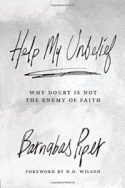 For more on faith and how to respond well to doubts you can check out my book
Help My Unbelief: Why Doubt is Not the Enemy of Faith.
For more on faith and how to respond well to doubts you can check out my book
Help My Unbelief: Why Doubt is Not the Enemy of Faith.
This article was originally published at LeadershipJournal.net
September 14, 2016
Why is Worship So Happy?
It’s go time. Get your game face on. Pump yourself up. Smile big. We’re heading into church service. The music will swell and rise, hands will rise with it, voices that can scant be heard over the band will be lifted, and faces will turn to the rafters. Everywhere we look we see smiling, enraptured faces. This is a celebration.
But what about those of us used all our energy and emotional reserves just to get there and all we have left is enough to slump in a seat? Life just hurts. It’s a burden to great to bear and definitely too painful and ungainly to lift to the heavens with a smile on our faces.
Most people hurt. They are exhausted, grieving, dry, overwhelmed, empty, or some combination of the above. Westley famously said in The Princess Bride “Life is pain.” That may be overstating a bit, but life is certainly full of pain our culture can deal with. We seek therapies of all kinds from substance to distraction to sex to religion. For many people church is that therapy – the smiling place of happy songs. But we don’t need happiness therapy; we need balm. The thumping beat and crescendoing chorus doesn’t get us on our feet. It drives us deeper in our seats.
Proverbs 25:20 says that happy songs sung to a heavy heart are like stealing a garment on a cold day or pouring vinegar on a wound. They don’t help – they exacerbate the problem. Rather than lifting spirits they simply delineate the gap between out broken spirits and the gladness of others. Trying to comfort the grieving or empty with happy songs makes about as much sense as having toasts and dancing at a funeral.
We must make room for life’s pain in our worship, not make light of it. We must do it in tone and content, in song and liturgy (I know this word makes Baptists nervous. No need – at its simplest it means the structure and ceremonies of worship.) The Bible is full of pain, of living with it and enduring it and finding hope in the midst of it. But hope is not the same thing as happiness. Hope is a reason to keep plodding and hold on to faith. Hope doesn’t always smile; it just refuses to die. So we need to stop pushing for smiles and become dealers in real, genuine, Psalmic hope in the midst of life’s misery.
We need more “It is Well With My Soul” which sings of “when sorrow like sea billows roll” and “though Satan should buffet; though trials should come.”
We need more “We Rest on Thee” which sings of “our own great weakness feeling.”
We need more “Great Is Thy Faithfulness” which sings that ‘Thou changest not; thy compassions they fail not.”
We need more “There is a fountain” proclaiming that “redeeming love has been my theme and shall be ‘til I die.”
This is not a call for a stylistic return to hymns of old but rather a plea for deep, biblical, profound response to people’s sadness. There is no place for sadness in worship today, yet that is what many people bear with them. How can we jump and clap and smile with a burden on our shoulders and stabbing pain in our hearts? The Bible is bigger than happiness and deeper than smiles. It runs deep and flows red. Can we tap into the deeper currents of hope to balance out the happy?
September 12, 2016
New Happy Rant – Pour Overs, Christian Athletes, and Thought Leaders
In this episode of The Happy Rant Ted, Barnabas, and Ronnie discuss the following
Pour overs: what are they an why are they? Isn’t a pourer just a slow version of what a coffee maker does?
How does an athlete being a “brother in Christ” effect our feelings towards him? What if the athlete is Sam Bradford, the over-prices substitute for the QB on Barnabas’s favorite football team?
What is a “thought leader”? What exactly do they lead? Do real leaders of thought call themselves thought leaders?
 We’d like to thank our sponsor, Missional Wear (or Calvinist Swag if you prefer). You can find a fantastic selection of apparel, art, mugs, pint glasses, and more there. And it’s good quality, artistically designed gear too! Be sure to use the code HAPPYRANT at checkout for a listener special deal.
 Another thank you to our second sponsor, Waterbrook Multnomah and their new release, Chase the Lion: If Your Dream Doesn’t Scare You, It’s Too Small by Mark Batterson. Following up on his previous best-seller, In a Pit With a Lion on a Snowy Day, it pushes the reader to refuse to pursue dreams that can be accomplished without God. It is available tomorrow, September 6.
Like every week, we want to offer a big thank you to Resonate Recordings, the fine folks who make us sound listenable. If you are looking for great people to help your church put out recorded sermon audio or help you with a podcast they’re your people.
Feel free to hit us up on Twitter at @HappyRantPod or on Facebook or via email at HappyRantPodcast@Gmail.com with any topic suggestions or feedback. We love hearing from listeners!
To listen you can:
Subscribe in iTunes.
Listen on Stitcher.
Leave us a rating in iTunes (it only takes 1 click and it really helps us).
Listen using the player below.
Episode #103
Real Maturity, C.S. Lewis, and Imagination
Many people see, either tacitly or explicitly, maturity as the smothering of childhood. But what if it is not the systematic burying of childlikeness so that we can dutifully (and often morosely) handle the cares of adulthood? What if maturity handles the responsibilities of life with all the care and gravity they deserve but not at the expense of childlikeness?
Healthy maturity is that which knows when and how to be childlike. A child might interrupt her parents to blurt out a seemingly random question about fruit flies or bodily functions or Barbie dolls or why the iPad won’t work because she’s too immature to recognize the discourtesy. A mature adult might have the same question but knows when and how to ask it so as not to disrespect or disrupt others.
Children love fairy tales, adventure stories, mystic lands, and heroic characters that launch their imagination and turn a backyard into Middle Earth, a swing set into Hogwarts, a rocking chair into a TIE fighter, and a bunk bed into a Captain Hook’s ship. Every stick is a wand or weapon and every towel a cape. Children embody their heroes in their play and live out the lives of legends. Mature adults love the same stories, are moved by the same heroes, and lose themselves in the same far-away places but without the towel-capes and slat board swords. (I’ll leave you, dear reader, to interpret what this might mean for ComicCon and Cosplay fans.) Many of us call these stories “guilty” pleasures. We indulge them privately and feel a bit sheepish about it.
What if they aren’t “guilty” but rather just pleasures? What if the places our imaginations take us are actually right where we ought to be, healthy and rich places for our minds and souls?
C.S. Lewis was one of the most brilliant Christian thinkers and writers of the 20th century. He knew multiple ancient languages, was an expert in classic literature and mythology, and an Oxford professor. He wrote magisterially on the nature of God and the relationship between God and man and was a devastating Christian apologist. His work is just shy of the biblical canon for many believers to this day. In short, C.S. Lewis was a mature adult, intellectually superior to most, and fruitful to the extreme. He is to be emulated and looked up to in many ways. Lewis had this to say regarding maturity and becoming and adult:
“When I was ten, I read fairy tales in secret and would have been ashamed if I had been found doing so. Now that I am fifty, I read them openly. When I became a man I put away childish things, including the fear of childishness and the desire to be very grown up.”
“The modern view seems to me to involve a false conception of growth. They accuse us of arrested development because we have not lost a taste we had in childhood. But surely arrested development consists not in refusing to lose old things but in failing to add new things? . . . Where I formerly had one pleasure, I now have two.”
“It is usual to speak in a playfully apologetic tone about one’s adult enjoyment of what are called ‘children’s books.’ I think the convention a silly one. No book is really worth reading at the age of ten which is not equally (and often far more) worth reading at the age of fifty – except, of course, books of information. The only imaginative works we ought to grow out of are those which it would have been better not to have read at all.”
Well now. That paints things in a different light altogether. One of the greatest, most brilliant, most productive Christians in recent history says that we are to somehow, some way, carry childlikeness into adulthood with us! That, friends, is maturity at its best. Any other form is soulless and dull.
IMAGINATION AND INFORMATION
We draw the line between imagination and information. We grow out of the former to invest in the latter. We decide that the former has value for life while the latter is mere escapism from life. This, Lewis would argue, is where we go wrong. He would say that the collection of information, the pursuit of knowledge, is not enough without the fostering and feeding of imagination as well.
Imagination guides and shapes our use of information. If we know all the facts and truths we are just a static hard drive, a library. Libraries are full of information, stacked high and deep. But what can a library do with all the knowledge it holds? Not a thing. It is a static repository, and that is what we are without imagination. What do we do with information? Where does it apply? How can we do the most good with it? Who knows? The person with imagination, who values the virtues of great heroes and can envision and form a better story, knows. That person is curious.
Curiosity and imagination are conjoined twins. With one comes the other. Imagination continually asks “what if” then envisions the possible answers and lets the mind run with possibilities. Curiosity asks just about anything, and then explores the answers and presses to figure it out and see what else there is. It pokes and prods. Curiosity gives flesh to imagination. If information is dead on its own, these are the life force that animates it and moves it to action.
 This is an excerpt from my forthcoming book,
The Curious Christian: How Discovering Wonder Enriches Every Part of Life
that is due to be released in early 2017.
This is an excerpt from my forthcoming book,
The Curious Christian: How Discovering Wonder Enriches Every Part of Life
that is due to be released in early 2017.
September 7, 2016
5 Things People Who love Change Need To Know
People respond to change in three ways: love it, hate it, or follow whichever of the two is the most persuasive (read: “loudest”). Usually the first group is the smallest and the third group comprises the majority.
This post is aimed at those who love change. I number myself among you. While we may be the minority we are usually the ones trying to influence others, to bring about progress, to, well, change things. The world needs us, I say! But we need to realize a few things about change as well.
CHANGE IS NOT A CULTURAL OR PERSONAL VALUE.
In itself, change should be a bi-product of something bigger. It occurs when a decision is made or a vision is pursued. If we reach a place where change is a value then we become directionless. We tinker with things that need not be tinkered with. We become bored with and discard perfectly good ways of doing things. We fix what is not broken and in so doing we break it. Change cannot be our aim, it must be our means.
CHANGE IS ONLY GOOD IF IT PURSUES A GOOD PURPOSE.
Seeing these words written out makes them seems terribly obvious, but that raises the question why so many of us pursue change without a purpose? Change for change’s sake is never more than accidentally helpful. It is an expression of boredom and discontent rather than purpose. For change to be meaningful, either personally or in an organization, it must have a target. It must be a course change to reach a different destination and the destination must be better than the one on the previous itinerary.
CHANGE IS ALWAYS A LOSS.
It’s not always a net loss, but in change we always lose something. Usually it is comfort, predictability, and ease. Change always means giving something up, and that is difficult for many people even if it is a thing they very well ought to give up. This is why change is so hard for so many people. They don’t fear change itself; they fear the loss it brings.
CHANGE DOES NOT INSPIRE PEOPLE.
It makes most people nervous. Leading a meeting with “We’re going to try something new” or “We’re going in a new direction” puts people on edge. Telling your spouse or kids about a new job or church does not excite them. These things are unsettling unless they have a reason. As Simon Sinek famously wrote, we need to star with the why – the purpose. People buy into reasons and direction and cause and purpose. People do not buy into the road taken to get there.
CHANGE NEEDS MODERATION
Refusal to change is stagnation and leads to atrophy of self or of an organization. We must adapt or die, literally and figuratively. Too much change, though, is disorienting and disillusioning. If you’re leading it people will stop believing you and trusting you. If you are attempting it for yourself you will fall into a patter of try, fail, try something else, fail, ad infinitum. Change must be directed and pursued with intentionality and within reason lest it becomes simply spinning circles.
September 5, 2016
New Happy Rant: Scary Mascots, No Safe Places, and Things Worship Pastors Should Quit Saying
In this episode of the Happy Rant the hosts are reunited after Ronnie’s travels and they rant about the following.
A crazy University of Iowa prof is offended by the facial expression and demeanor of . . . their mascot, a giant stuffed bird.
The University of Chicago, on the other hand, has decided there need be no more trigger warnings or safe spaces.
What are things worship pastor’s should quit saying? Jared Wilson had suggestions in an article, and it needed some discussing.

We’d like to thank your sponsor, Logos, the premier Bible Study and sermon preparation software on the market. Today they released Logos 7, complete with new features to take what was great before to entirely new levels. They offer an incredible library of resources, extensive features, and a suite of tools all of which will help serious Bible students, teachers, and preachers research and prepare. As a special offer for you, listener, use code HAPPYRANT7 at checkout to get Charles Spurgeon’s commentary on Philippians for FREE.
Another thank you to our second sponsor, Waterbrook Multnomah and their new release, Chase the Lion: If Your Dream Doesn’t Scare You, It’s Too Small by Mark Batterson. Following up on his previous best-seller, In a Pit With a Lion on a Snowy Day, it pushes the reader to refuse to pursue dreams that can be accomplished without God. It is available tomorrow, September 6.
Like every week, we want to offer a big thank you to Resonate Recordings, the fine folks who make us sound listenable. If you are looking for great people to help your church put out recorded sermon audio or help you with a podcast they’re your people.
Feel free to hit us up on Twitter at @HappyRantPod or on Facebook or via email at HappyRantPodcast@Gmail.com with any topic suggestions or feedback. We love hearing from listeners!
To listen you can:
Subscribe in iTunes.
Listen on Stitcher.
Leave us a rating in iTunes (it only takes 1 click and it really helps us).
Listen using the player below.
Episode #102
September 2, 2016
You Can’t Claim a Promise
ISAIAH 41:10
Do not fear, for I am with you;
do not be afraid, for I am your God.
I will strengthen you; I will help you;
I will hold on to you with My righteous right hand.
In 1964 my grandfather shared this verse with my father as he was preparing to move away to college. As I grew up, my father shared it with me often as well – when I started at a new junior high school, when I left for missions trips, and when I left for college. Recently I helped my 8-year-old daughter memorize this legacy promise. Isaiah 41:10 holds special significance to me because of how it has blessed my family for decades. I look to it, hold on to it, and I am encouraged by it.
But I don’t claim it.
To claim something is to take ownership, to say “it’s mine.” When we lay claim to property we gain certain rights and privileges. Litigants are awarded claims or denied them, claims of monetary value. Promises don’t work like that.
Often people “claim” a promise when life is hard or they’re afraid. They might even claim a promise for someone else, a child who has walked away from the Lord perhaps. When people do this, though, they are taking the Word of God and attempting to “own” it like a talisman or mantra. They’re treating an utterance breathed out by God as a silver bullet or a security blanket, a quick solution or a comfort to carry around. Sadly, some preachers even express these ideas from the pulpit.
This misses the very nature of a promise, though. A promise isn’t a thing; it’s an expression of something greater. When God uttered promises in Scripture He wasn’t giving us a buffet of blankies, Band-Aids, and silver bullets. He was showing us His character. A promise tells a little bit about who God is and what He will do. It is anchored in His holiness, goodness, power, and sovereignty. It is based on his omnipotence and omniscience. And it will come to pass in a way only God knows and ordains.
When we claim a promise we are attempting to take control of it. We come to it with a presupposed notion of how it should play out. But when we realize that a promise is not a thing for us to have or use, only then do we realize it is bigger and better than we imagined. It may not come to pass as we imagined, but it will come to pass. We know this because it’s from God.
When I remember Isaiah 41:10 I am remembering big things about God, too big for me to claim as my own. Too big for me to completely understand and definitely, too big for me to dictate or apply to my own life. Instead these things are so big that I can rest on them and find peace. It is a promise from the mouth of God, and He has claimed me. That is why I believe it.
This post was originally posted at HCSB.org; used with permission.
August 31, 2016
In Defense of Sports
“To me, pro sports is like a whole other religion. People pay through the nose to attend. They eat and drink. If the same people who go to games and get so excited, became so excited about Jesus and the true battle we live in, it wouldn’t be so bad. If not, pro sports is a real waste of time and money better spent feeding the poor, healing the sick, and getting people saved. Is any of this as important as pro sports? Whole countries spend more money paying its players than many churches get to help the poor.”
This comment is one I received some time ago from a listener to a podcast I was a guest on. The theme of the conversation had been about how Christians can interact well with sports, a subject I care about because of my faith and because I love sports. The sentiments shared in the comment above are not at all uncommon. Many people struggle to see the validity of sports, especially when it’s grandiosity and ego is so amplified through media. It is easy to see the downside, so what is the upside?
Here I seek to address each concern and criticism made point by point in defense of sports.
SPORTS IS ITS OWN RELIGION.
As we discussed on the podcast, sports can easily become an idol. But that does not make it an inherently bad thing. Money can be an idol. So can music; attend any concert and you will find worshippers there. Or family. Anything that we devote ourselves to can become an idol which can then become a religion – something which gives structure to our lives and determines our values. But the human ability to make idols out of anything does not make those things bad. And sports contains enormous good as a reflection of God’s creative power and the unique abilities he has poured into people as athletes, coaches, strategists, broadcasters, journalists, and more.
PEOPLE SHOULD DEVOTE THEIR EXCITEMENT AND ENERGY TO THINGS OF ETERNAL VALUE.
Taken at face value, this sentence is true, but when you use it to parse sports (or other forms of entertainment) out of life it creates a false dichotomy. Sports offer rest and refreshment. The energy poured into them is not draining a person from doing things that “matter”; it is restoring them for work. Sports also offer a kind of community and connection to people that is difficult to duplicate. Whether it’s regular pick-up basketball games, rooting for the same team, or being softball team mates sports bring people together. And people together is where real eternal ministry is done best.
THE MONEY AND TIME DEVOTED TO SPORTS ARE BETTER SPENT ELSEWHERE, SERVING THOSE IN NEED.
Such an objection is worthy of consideration as a matter of conscience at the personal level, but it is not a black and white issue. It is always wise to ask whether I am giving what I ought, helping who I ought, and being generous as I ought? I am I misallocating my own resources to serve my idol? This idol could be sports or it could be lattes or books or cars. This is not a question anyone can clearly answer from the outside in most cases. It is not wrong to spend money on any of the things I listed, but it could be a poor choice. Usually only God and the spender knows whether it was wise or not.
The money in sports (and all entertainment industries) is enormous. It is so because we demand to be entertained – cost and demand is a basic economic principle. We are better off examining our own lives to see if there is inequity or inconsistency than in haranguing about the system as a whole.
I believe sports are a gift, a good gift, that God gave through human creativity for our enjoyment. They should be participated in at every level and in every way as such. And just like all of life, we ought to approach them with thoughtfulness, discernment, and intentionality. This is why I wanted to respond to the objections posed. I hope these answers further the thoughtfulness and expand the perspective with which we approach and participate in sports going forward.
This Post is modified from the original which was posted at DesiringGod.org.
August 29, 2016
New Happy Rant: Back to School, Nic Cage, and Old Fashioned Insults
In this episode of the Happy Rant Podcast Ted Kluck and Barnabas Piper (sans Ronnie Martin since he was off traipsing through small mid-American towns like a middling CCM band) discuss a handful of amusing and informative topics.
Back to school advice for parents and students alike
Is Nic Cage awesome or awful?
Movies that are so bad they are good
Old fashioned insults that need a good revival
We’d like to thank your sponsor, Logos, the premier Bible Study and sermon preparation software on the market. Today they released Logos 7, complete with new features to take what was great before to entirely new levels. They offer an incredible library of resources, extensive features, and a suite of tools all of which will help serious Bible students, teachers, and preachers research and prepare. As a special offer for you, listener, use code HAPPYRANT7 at checkout to get Charles Spurgeon’s commentary on Philippians for FREE.
 And thank you to our second sponsor this week, Tyndale House Publishers. They are highlighting the book Next Door As It Is In Heaven by Lance Ford and Brad Briscoe. This book offers first principles and best practices to make our neighborhoods into places where compassion and care are once again part of the culture, where good news is once again more than words, and where the love of God can be once again rooted and established.
Like every week, we want to offer a big thank you to Resonate Recordings, the fine folks who make us sound listenable. If you are looking for great people to help your church put out recorded sermon audio or help you with a podcast they’re your people.
Feel free to hit us up on Twitter at @HappyRantPod or on Facebook or via email at HappyRantPodcast@Gmail.com with any topic suggestions or feedback. We love hearing from listeners!
To listen you can:
Subscribe in iTunes.
Listen on Stitcher.
Leave us a rating in iTunes (it only takes 1 click and it really helps us).
Listen using the player below.
Episode #101


