
Barnabas Piper's Blog, page 96
March 2, 2016
Judging a Penn State Supporter
Driving to work earlier this week I exited the freeway and pulled up behind a minivan sporting a Penn State University sticker. My first thought was “You don’t see many of those in Tennessee” followed by “Why would anyone have a Penn State sticker on their car?” My reaction wasn’t because I grew up in Minnesota rooting for another Big Ten team. It was because of what I wrote about in my very first article for WORLD Digital.
In 2011, Jerry Sandusky, a long-time highly successful football coach at PSU was convicted of multiple counts of sexual abuse of young boys. The case brought severe sanctions on the team, ruined the legacy of head coach Joe Paterno, and tainted the school’s reputation. When I saw the sticker that was what I revolted against. Within seconds, though, it dawned on me how unfair that reaction was. Penn State is not Jerry Sandusky, football, or evil. It is so much more. Maybe this van driver was a proud alum or parent. Maybe he worked hard to get through school to earn a degree there. Maybe he roots for the seven-time national champion women’s volleyball team.
What does it say about me that my first reaction was revulsion? It says I was judgmental. I deemed the entire school and all associated with it as guilty because of the sins of a few. It says I lacked nuance in my thinking. Even a little consideration would have been enough to think of positive reasons this driver might have had that sticker, but I instead jumped to a conclusion. And it says I simply didn’t have the whole story. I lacked context.
. . .
Here are questions we should ask ourselves to gauge motives and the state of our own hearts:
Do I know the whole story, or might there be more to it?
. . .
Do I know if restitution has been made or restoration has happened?
. . .
If I were on the other side how would I want to be treated? We’re often too proud to put ourselves in the culprit’s shoes, but we should. Aside from God’s grace we are all culprits.
Do I feel superior? If we begin to feel better than another person, like we have the right to judge, like we are morally above them, we have gone wrong.
. . .
Read the full article HERE.


March 1, 2016
New Happy Rant: Unpopular Opinions on Books, Choosing Music Wisely, and TRUMP & HILLARY!
In this episode of The Happy Rant Ted, Ronnie, and I bring hot takes on hot topics. We spout some opinions that might ruffle feather. We talk hip hop and artistry. We even delve into politics. It’s a ride. Buckle up.
Unpopular Opinions about books – in what will likely become a recurring bit the hosts each share one unpopular opinion about books. Beware Cs.S. Lewis and John Piper fans, you may come away unhappy.
How can we call music excellent that is profane? A listener sent in this question after our previous praise of Kanye West.
TRUMP & HILLARY! HILLARY & TRUMP! We discuss the madness that is the current politic response among Christians and what might, maybe be a better way.
Again, we want to offer a big thank you to Resonate Recordings, the fine folks who make us sound listenable. If you are looking for great people to help your church put out recorded sermon audio or help you with a podcast they’re your people.
Feel free to hit us up on Twitter at @HappyRantPod or on Facebook or via email at HappyRantPodcast@Gmail.com with any topic suggestions or feedback. We love hearing from listeners!
To listen you can:
Subscribe in iTunes.
Listen on Stitcher.
Leave us a rating in iTunes (it only takes 1 click and it really helps us).
Listen using the player below.
Episode #76
February 24, 2016
Ronda Rousey’s Identity Crisis
She was the most feared female fighter in the world—a powerhouse. She regularly dismissed opponents by knockout in mere seconds. She was undefeated in her UFC career. Then in November, Ronda Rousey ran into Holly Holm, and the result was as unlikely as Buster Douglas’ knock out of Mike Tyson in 1990.
In an interview with Ellen DeGeneres earlier this week, Rousey shared her feelings about the loss:
“Honestly, my thought, I was in the medical room, and I was down in the corner, I was sitting in the corner, and I was like, ‘What am I anymore if I’m not this?’ And I was literally sitting there and thinking about killing myself at that exact second. And I’m like, ‘I’m nothing. What do I do anymore?’”
Suicide. Nothing. No reason to live. Those aren’t the feelings of a lost match. They’re the feelings of a lost purpose for existence.
. . .
Most of us cannot imagine the singular focus and determination Rousey had to become the best. But we understand the concept. In fact, we understand too well. Rousey was simply honest enough to say out loud something we teeter on the brink of far too often.
It’s shocking when someone else’s words reveal our sins or temptations, and we find it much easier to deny or judge than to examine and admit. But we are idolaters. We hang our hopes on hooks that can’t bear the weight, and then feel despair when they fall and shatter.
. . .
Most of us don’t reach the point of considering suicide. We don’t wonder why we’re even here or what we have to live for. If we have Christ, we know the answer to that, but it doesn’t stop us from trying to add to Christ, to improve on Him. We know that life is worth living, but we still try to replace bits of Christ’s hope with other things here and there.
. . .
Read the full post here.
February 22, 2016
New Happy Rant: Listener Criticism, Unreformed Reformed Guys, and Crazy Kanye
In this episode Ted, Ronnie, and I return from a one week hiatus, a vacation, a sabbatical, a time out in the corner. We are refreshed and full of vim and vigor. We energetically discuss the following:
A listener takes us to task for our lack of fact checking in a particularly, um, verbose fashion.
Why do reformed guys who just love to talk about grace an joy act with so little grace and joy?
Is Kanye crazy? Is he a genius? Maybe both? And what about that $53 Million in debt?
Again, we want to offer a big thank you to Resonate Recordings, the fine folks who make us sound listenable. If you are looking for great people to help your church put out recorded sermon audio or help you with a podcast they’re your people.
Feel free to hit us up on Twitter at @HappyRantPod or on Facebook or via email at HappyRantPodcast@Gmail.com with any topic suggestions or feedback. We love hearing from listeners!
To listen you can:
Subscribe in iTunes.
Listen on Stitcher.
Leave us a rating in iTunes (it only takes 1 click and it really helps us).
Listen using the player below.
Episode #75
February 18, 2016
Put Your Knowledge to Work
Knowledge is worth as much as what you do with it. If you have profound knowledge of life-altering genetic research and do nothing with it then it is worth less than if I use my sports trivia knowledge to spark a new friendship. If you’ve graduated from seminary and are well-versed in theology it means nothing unless it is expanding your heart for Jesus and your heart for those who still need Him.
This doesn’t mean we must be using all knowledge all the time. That would be impossible. But it means that as we learn we must be looking for any and all connections between our new knowledge and something useful. It means we must have an imagination that says, “this could come in really handy some day.” If this was physical stuff we were collecting people would call us pack rats, with a shed and a garage full of tools, parts, knick knacks, and various odds and ends. But we need to be able to see a truth and think of all the ways it might be useful – useful to connect to another person, useful to teach a child, useful to reveal something of God, useful to bring a smile to someone’s face, useful to help someone in need, useful to create something beautiful, useful to protect or defend truth. And this imagination, this curiosity, is what allows us to do with our knowledge.
Think of those people who do the most formative and inspirational work – teachers, artists, entrepreneurs, missionaries, ministers, social workers, and those creative people who are always finding new and better ways to do things? What do they have in common? They take their knowledge, be it big or small, be it varied or narrow, and they make something of it. They connect with other knowledge and other people to create a better world. They don’t live in the rut of “just living life.” They ask questions until they discover how what they have, what they know can merge with what others have and know to make a new experience and life. They are curious and want to connect their little bit of knowledge with the great big world God has created. And in so doing they bring something new and better to the world.
Thomas Edison as credited as saying “To invent you need a good imagination and a pile of junk.” Well, we have our pile of junk – all this knowledge. Do we have the imagination to begin inventing? Will we ask the necessary questions and push the boundaries of our present rut to begin doing something with the knowledge we have?
This is an excerpt from the book I am currently writing, The Curious Christian (working title) that is due to be released in early 2017.
February 17, 2016
When The Least Are Heroes
Every year around this time a handful of sports stories pop up across the country, and they are among the best we hear all year long. Two such instances occurred recently with the remarkable displays put on by Zach Slone and Robert Lewis at their respective high school basketball games. Slone and Lewis are both special needs students who are managers for their teams—one in Marion, Ohio, and the other in Franklin, Tenn.— that were given a chance to play on senior night for the first time. Each scored in the game’s final moments and was hailed and honored by teammates, coaches, and classmates. These stories never fail to make us smile and warm our hearts.
What is it that makes these types of stories grab us every single time? Something about them draws us unlike a mere underdog story or an emotional Disney-style ending. There is something far more substantive to these stories, far more gravitational.
What pulls us in is the humanity of them. I don’t mean the mere human-interest aspect, though that is definitely a factor. I mean humanity in its truest sense, the way God made us to be. Stories like this reveal something of our design that has been tarnished and twisted by sin.
. . .
Above all, the ingredient that sets apart these stories is how it was one of the “least of these” who was made the hero.
These stories resonate with us because it’s what God put in our souls. We forget and suppress it, but these moments remind us. In God’s economy, the “least” by human standards are equal in image-bearing and significance. They too can be heroes of a story. In fact, Scripture tells us over and over again of God raising the least likely person to the forefront.
. . .
Zach Slone, Robert Lewis, and so many others who have similar stories should serve as a reminder to us of what is true and pure and lovely—those things on which we should dwell. Their moments in the spotlight are windows into what will come, a time when the weak will be made strong and we will rejoice in the joy of others.
. . .
Read the full article HERE.
February 11, 2016
A Hidden Invitation from Jesus
Two words. So much truth can be packed into two words.
In Mark 16 Mary Magdalene, Mary the mother of James, and Salome went to Jesus tomb to care for his body after a hasty burial. Of course we know what they found when they arrived. Nothing. Well, no body at least. They did find something, or rather someone.
An angel met them, and his message was clear and miraculous.
“Don’t be alarmed,” he told them. “You are looking for Jesus the Nazarene, who was crucified. He has been resurrected! He is not here! See the place where they put Him. But go, tell His disciples and Peter, ‘He is going ahead of you to Galilee; you will see Him there just as He told you.’”
We are far too comfortable with the message that a dead man became alive. It should unsettle and amaze us still. But that is not the part of the passage that caught my attention when I read it recently. What grabbed me were these two little words: “and Peter.”
Go tell His disciples and Peter.
If I recall Peter was a disciple, quite a noticeable one, in fact. So why did the angel make special note of him? Why did Jesus want Peter called out so?
Because at that time it is a dead certainty that Peter did not feel like a disciple. He felt like he had failed Jesus because he had failed him. Just a few verses earlier Peter had loudly denounced the name of Christ even as Jesus was being condemned to death. He had distanced himself from Jesus to save his own skin in the hour of Jesus greatest need. He had failed his Lord after promising to never fail. In calling out Peter Jesus was claiming him as friend and follower.
Peter’s guilt and shame would likely have kept him from going to Galilee. How could he? He had failed. But “and Peter” is a promise and an offer of forgiveness. Jesus is calling him to come, telling him he is welcome, showing him the purpose and power of the cross on which He just died.
“And Peter” should bellow at us from the pages of our bibles too, for we are more like Peter than we like to admit. We are deniers and cursers, ashamed of Jesus. We deny Him in our apathy, our attitudes, our fears, our failures. Too often our guilt keeps from Christ’s presence just as Peter’s would have kept him away. So Jesus summons us, by name.
He did not die in vain. He did not die to save you in concept. He died to save you in reality, to draw you to himself, to call you to come meet him and know that your denials are forgiven. They were erased by his blood, washed away, gone, abolished, and if you follow him you are a disciple and friend.
Jesus hid the gospel in the first words he shared with his followers. He snuck in His message of forgiveness. He folded in His call to obedience and discipleship. He showed the power of the cross with two little words. Those words were a message to Peter, the other disciples, and anyone else who feels unworthy of following Jesus too.
February 9, 2016
Over-Complicating Accountability
We’ve made accountability way too complicated. Just reading the word “accountability” probably made some of you cringe just a little. Visions of awkward, forced conversations or going through a list of prescribed questions come to mind. Or maybe sitting at a round table with people you sort of know, drinking bad coffee out of styrofoam cups in a church fellowship hall during a men’s or women’s bible study. Some of you think back to college and your accountability group who got together, all admitted to the same sins as last week, limply suggested you all do better, and agreed to try again at the same time and place next week.
Accountability has become a formal word associated with groups and meetings and appointments. We’ve mistaken formality for intentionality. Accountability must be intentional or else it won’t happen. But when it becomes formal we usually stop being accountable. We’ve made it too complicated.
It really only has two main ingredients.
Humility
We must be humble enough to know we need help, to recognize our shortcomings, to admit them to others, and to listen to their counsel. Humility gets us over ourselves, our fear of losing face, our shame. It recognizes our need for others and their contribution to our betterment.
Relationships
We must have trusted friends. We don’t need a posse of them, just a couple. They must be people with whom we are honest and who are honest back, who will tell us hard truths knowing that we’re humble enough to listen. They must be unafraid of our opinions or our wrath. (Of course most wrath isn’t humble, either.) They must be godly and invested, in our lives enough to see the ebbs and flows of emotion and soul. And they must allow us to be for them as they are for us.
This is it. That’s the recipe for accountability. Have friends and be honest.
None of this is easy. But neither is it complicated. Do you have godly friends you can trust? If not, start there. If yes be intentional about trusting them and asking them to trust you. Might it help to meet regularly? Yes, but as friends who care not as “accountability partners” who devolve into rote questions and stock answers.
Accountability only works if it is rooted in relational investment. It works if it is not merely a Q&A but rather life lived alongside life, through conversation, meals, fun, crisis, ups, and downs. This is relationship, the kind out of which real accountability grows. The kind where it’s safe to be humble and honest.
Don’t over-complicate things. Keep it simple – humility and relationships. Then start the hard work of growing in those.
February 8, 2016
New Happy Rant: Cam Newton, Super Bowl Spectacle, and Think Pieces
In this episode of the Happy Rant podcast Ted Kluck, Ronnie Martin, and Barnabas Piper discuss the following:
Why is Cam Newton such a controversial figure? Ted find him insufferable, and Barnabas thinks he’s awesome. A debate ensues.
The Super Bowl is a football game, but it’s much more – it’s a spectacle. What are we gaining and what are we losing because it get’s bigger and shinier every year?
“Think piece” is a pejorative term for an opinion article, and the hosts discuss the good, the bad, the ugly, and the ridiculous of think pieces.
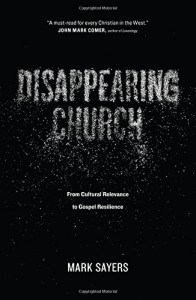 We have a new sponsor this week too – Disappearing Church: From Cultural Relevance to Gospel Resilience by Mark Sayers (Moody Publishers, February 2016). Disappearing Church is a tremendous book, one that any church leader, Christian educator and intentional believer seeking to engage culture with the gospel should read. Sayers has a rare ability to blend theology, history, sociology, and missiology into a single narrative. He makes complex realities clear and shows the reader why the pursuit of “relevance” actually undermines the church’s mission. I wrote a more full review HERE. In the mean time, go get this tremendous book.
Big thank you to Resonate Recordings, the fine folks who make us sound listenable. If you are looking for great people to help your church put out recorded sermon audio or help you with a podcast they’re your people. T
Feel free to hit us up on Twitter at @HappyRantPod or on Facebook or via email at HappyRantPodcast@Gmail.com with any topic suggestions or feedback. We love hearing from listeners!
To listen you can:
Subscribe in iTunes.
Listen on Stitcher.
Leave us a rating in iTunes (it only takes 1 click and it really helps us).
Listen using the player below.
Episode #74
February 4, 2016
9 Ways to Be a Better Interviewer
I don’t consider myself an expert interviewer. I’m more of a novice or a plebe or an amateur, really. But over the past four years I’ve had the chance to interview several dozen people for various articles or podcasts. I realized early on that the really good interviewers make it look easy, but looks are deceiving. So much more goes into a good interview than you can guess from reading a published story or listening/watching a finished production. Here are nine things I’ve learned about interviewing someone well.
1) It’s hard
Interviewing is a simple concept: ask questions, record answers. But that’s not an interview; it’s a verbal questionnaire. And it’s boring for all involved. A good interview discovers things, is insightful, is engaged, and is surprising for both sides. That doesn’t just happen. It takes the right mindset, good questions, and all the steps I list below. Trust me. I learned the awkwardly difficult way.
2) Be prepared
Do your homework. Find out the basics, and ideally something beyond just the basics. An interviewee will be impressed and more ready to engage if you skip the perfunctory details and get to the good stuff. It’s good to confirm those details, but in doing so you are showing that you came ready. And being ready shows that you respect that person and take this interview seriously.
3) Structure is your friend
I like to wing it, just jump into things and try stuff. This can work in interviews, but only if the person being interviewed feels the same way. Most people don’t. It also doesn’t work if a distraction or interruption arises because your train of thought goes off the rails and crashes spectacularly. So come with a list of questions. Have a format. Have a flow in mind. These don’t need to be legalistically held to, but they are invaluable prompts and conversation accelerants.
4) Be in it to learn
Asking a question you don’t want an answer to is stupid. Asking a question in the hopes of setting yourself up to talk is selfish. Ask questions in order to hear the answer and absorb it. Follow up with further, more focused questions based on the answer. And interview in which you are genuinely curious about the subject is a good interview. It breathes life into it because you will dig a little deeper and listen a little closer. The interviewee will feel this engagement and likely respond better, with more thoughtful and forthcoming answers. In the end, you will be more satisfied, they will feel respected, and the content will be richer. If you’re in a position where you are conducting a large number of interviews this will keep you engaged too.
5) Let the interviewee shine
The interviewer is a catalyst for good content, not the star of the show. The one answering the questions is the star. Their answers are the content, not your responses to their answers. Ask questions that nudge them into the spotlight and pull out their most interesting or notable ideas or experiences. Then let those experiences shine on their own without your commentary.
6) Don’t be afraid to go off-script
Structure is your friend, like I said. But sometimes the unexpected happens when the subject says something fascinating or surprising. That’s great! Chase it down. Dig into it. Set aside your list of questions until you’ve wrung out the interesting stuff. Then you always have your structure to revert to regain flow. What you will end up with is a story with much more flavor because you were listening closely, heard something interesting, and went with it.
7) Let the story tell itself
Usually a theme or emphasis becomes fairly clear as you interview. You will get pages (or Megabytes) of material, but throughout you will find a thread. That is your story. That is what you are looking for. That is what needs to shine. All the other cool anecdotes, fascinating as they may be, should not make the final cut. If you find this thread early in an interview ask questions with it in mind, seeing if you can follow it and expose it more clearly. That way you will have more to work with when you are finished.
8) Edit rigorously
When you are done with an interview and are making into the finished product – article, book, podcast, video – use your editorial carving knife aggressively. Editing doesn’t mean changing content. It means removing the content that is off-point. It means all those interesting anecdotes and needless details get chopped so that just the main point is left. It means you don’t include every good one-liner, only the ones that make the point or tell the story that needs telling. A tight, clear, final product will be better because of all the material left in the wastebasket.
9) Listen to (or read) yourself later
This part is awful, but it will make you better. You need to go back later and review your work. Over time you’ll find redundancies, bad habits, and consistent gaps in your questions. You’ll see where you talked too much and listened to little or where you let a question lie instead of pressing it and rephrasing until you get the answer you needed. You will not enjoy this process one bit, but the more you do it the more future interviewees will benefit and the better your finished products will become.


