
Richard Conniff's Blog, page 86
October 16, 2012
You Lookin’ at Me?

Borneo long-nosed frog
The Naturalis Biodiversity Center in Leiden, The Netherlands, has recently completed a species-finding expedition in Borneo, turning up at least 160 new species. Here’s part of the press release:
The largest numbers of new species were found among the spiders and fungi. Other new species include true bugs, beetles, snails, stalk-eyed flies, damselflies, ferns, termites and possibly a frog. Also a new location of the spectacular pitcher plant Nepenthes lowii has been found.
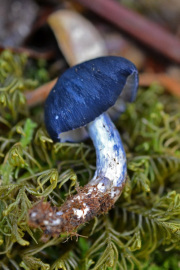
New blue fungus
For the fungi experts, the area was an Eldorado. József Geml: “While the plant and animal life of this mountain has been the focus of numerous research projects, Kinabalu has remained terra incognita for scientific studies on fungi. It is difficult not to feel overwhelmed by this task. One of the manifestations of this diversity comes in the endless variety of shapes and colors that sometimes are truly breathtaking. While the detailed scientific work will take years, we already know that many of these species are new to science.”

You can read more and check out a few more photos here.


October 15, 2012
The Wallace-over-Darwin Groundswell

Wallace over Darwin, on the arms of a biologist at Auburn University (Photo: Richard Conniff)
OK, I confess, I deliberately posed this picture to put Wallace on top. But, sad to say, there’s also an obvious forensic clue in the photograph indicating that Darwin came first. If you spot the clue, please say so in comments.
And if you are completely feckin’ baffled by what I am going on about, Alfred Russel Wallace was the co-discoverer of evolution by natural selection. But unlike Darwin, he had the balls to say it out loud. A letter from Wallace explaining his ideas in 1858 is what finally drove Darwin to publish the theory for which he had been gathering evidence over the previous 20 years. The question of whether Wallace or Darwin deserves credit for the biggest idea in the history of science remains hotly contested, though largely by people who admire them both. (You can read about it in my book The Species Seekers.)
Meanwhile, in other Wallace news, the world’s leading Wallace maven, George Beccaloni, recently updated his list of species named after the great field naturalist. He writes:
So far I have found 81 species, but it is likely that this is just the tip of the iceberg! It would be great if Wallace had more species named after him than Darwin has!! Darwin has about 120.
You can check out . Wallace’s resplendent jewel beetle is all very nice, but my

Wallace’s long-necked shining fungus beetle
possible favorite is Diatelium wallacei (Wallace’s long-necked shining fungus beetle).
If you have any additions to this list, please–in the spirit of oneupmanship–post them here first, in comments. I’ll pass them along to Beccaloni.


October 14, 2012
Out with the Big Fish

Blue Marlin by James Prosek
Author and artist James Prosek and I are working together on a National Geographic project. So I was interested to see that he has a show that just opened at the Academy of Natural Sciences in Philadelphia.
Here’s part of the press release for the new show, which runs till Jan. 21:
PHILADELPHIA (October 3, 2012) – James Prosek has had a personal experience with each of the saltwater fish he has painted and hand-picked for a new exhibit opening Oct. 13 at the Academy of Natural Sciences of Drexel University.
“You could even call each one a self-portrait,” said the Connecticut naturalist, artist and fisherman whose latest book, Ocean Fishes: Paintings of Saltwater Fish, debuted this month (Rizzoli New York). Fourteen life-size watercolors from the book, including a stunning 15-foot-long Blue Marlin, are featured in the exhibit James Prosek: Ocean Fishes in the Art of Science Gallery through Jan. 21. The exhibit is free with museum admission.
Dubbed “the Audubon of the fishing world” by The New York Times, Prosek wants visitors to know that his highly-detailed paintings of Atlantic sailfish, king mackerel, mako shark, swordfish, and more are not meant to represent a species as in a field guide. “I am painting an individual fish that I had a personal experience with,” he said. “The paintings are not as much about the fish as our relationships as humans to the fish.”
The show is based on Prosek’s new book, Ocean Fishes. Here’s an excerpt:
If I try to pinpoint exactly where this project started, it would have to be when I stopped at a Citgo station in Cape Cod, to inquire about an old, red Chevy truck for sale in the lot in 2001. It was there I met the owner, Norman St. Pierre, in his office. On the office wall were the most intriguing photos of a man standing on a platform that reached far off the bow of a boat, throwing a spear at what looked like a very big fish. There were also photos of a deck full of giant bluefin tuna, 700- to 900-pound fish that dwarfed the fisherman standing over them. I could not believe these fish were so huge, much bigger than big men. They looked like sculptures—polished marble sides, glistening steel backs, fins like blades of metal, eyes like miniature Earths with atmospheres and seas and forests and deserts. Besides running the gas station, Norman was a tuna spotter—a pilot who flew his small Cessna over the ocean, spotting giant bluefin tuna and directing a harpoon boat to the fish. After a brief conversation, in which I evidently voiced my passion for fishes, Norman offered to take me up in the plane the following summer, and to ask the fishermen he worked with if I could go out on their boat.
The giant bluefin tuna is not just any fish to me. It is an emblem of the ocean, in that it seems to embody the element it lives in. The patterns on the side resemble the reflections on the surface of the water and the rays of sunlight penetrating beneath. I decided that it needed to be painted, not as an illustration for a field guide or a poster, but at life-size, all of it. And I knew that to make such a painting, seeing the fish dead at the dock wouldn’t do. I needed to see it in the water from above, and also on the boat. I needed to be on the boat at the moment that the fisherman harpooned it and the moment that it first came out of the water and sparkled in the sun.
I bought that old Chevy truck, and Norman brought it down to my home in Connecticut. It took me three years to make it back to Chatham, but Norman kept his word. I spent three days in the plane with him looking for schools of tuna in the vast and beautiful bay framed by the Cape Cod peninsula. Cape Cod Bay had been known for many years, he told me, as a kind of old folks’ home for tuna. The tuna would come into the bay in summer to feed on herring and bluefish and squid and whatever else they could swallow. We circled around the bay and then out beyond the Cape over the ocean. We saw basking sharks and whales and seals and schools of small bluefin, but no giants—individuals over 400 pounds. For the last two of my five days I accompanied the captain of the boat Norman worked with, and his son. We motored their 42-foot boat out of Barnstable and around the bay, looking for birds working near the water or any sign of surface activity. For most of those two days neither the boat nor Norman saw any fish. And then, in an instant, I watched unfold one of the most astonishing, athletic, adrenaline-filled, perfectly coordinated predatory events I’d ever seen.
Norman communicated the position of the fish with the captain’s son, who was at the wheel, via radio. As the son pushed the throttle down, the father ran out onto the 40-foot platform and held on. (In New England, the harpooning platform off the bow is called the “pulpit.” In Nova Scotia, where they harpoon swordfish, it is called a “stand.”) The event was out of another time. These were the last of the old New England whaling men, and though now they were pursuing a fish, it still came down to a man holding a spear with a bronze head, called a “lily,” and throwing it at a great ocean creature. “Seven boat lengths, straight ahead.” I could hear Norman’s voice over the radio, directing the boat as it sped ahead. “Four boat lengths, two boat lengths, OK, you should see the fish now, about eight feet under the water.” At fifteen knots, with a fish moving just as fast beneath him, the captain threw the spear and hit the fish. Moments later, they hauled the tuna onto the boat, a beautiful 750-pound giant. In the next minutes they harpooned a second one—in the last hour of the last day that I was with them, after five days of seeing very little.
I took photos, made sketches and meticulous notes on color and form, and a hundred measurements of fin size, total length, length from nose to front of eye, back of eye. And when I got home, I got a big sheet of watercolor paper—five by twelve feet—laid it on the floor, and started to sketch it out, working on the floor with the drawing of the fish as it materialized. As I sketched and painted I was vividly reliving the experience—for the months it took me to complete the work—of seeing this living fish. I have always wondered why humans had a compulsion to depict nature. What evolutionary value did this have? I wondered if what I felt in painting the tuna was like what our ancestors in the caves at Altamira and Lascaux felt when they drew the creatures that they were pursuing. Had depicting and ritualizing nature played a role in making us more acute observers of the world around us? Did this practice of depicting nature help us become better predators? Documenting nature helped us internalize the parts and movements of animals and the ineffable aspects of experience—the things we feel as hunters and fishermen for which there are still no words, thankfully, in the modern world. I was making more than a painting of a fish. The glint of turquoise from my jacket, reflected in the fish, represented me in its world. I chose to paint that fish—and, subsequently, all of the fish in this book—not in the water, not in its habitat, but at the moment most relevant to us in our legacy as predators, the moment when the fish leaves its element, the water, and enters ours, the air, and when the vibrations of color coming through its skin harmonize with the sunlight. It was a moment that could not, and cannot, be captured in a photograph.
That tuna was the beginning of this project. Several years passed between that painting and the others in this book. The real impact of these paintings is felt in person, in front of the life-size depictions. But for those who aren’t able to see the exhibitions, I hope the full-scale abstractions in this book convey some of the beauty along these fish’s sides, landscapes, and other worlds, and most often the waves and currents of the sea itself, the surface of which abstracts ourselves to the fish and the fish to ourselves.
In a way, the paintings are my conservation statement, just showing the fish, many of which we are rapidly losing from our oceans.


October 11, 2012
The Minister Who Invented the Modern Bullet
The year of 1807 was better for hunters than birds. In the wetlands north of Aberdeen, Scotland, a Presbyterian minister, Rev. Alexander Forsyth, was engaged in a war of wits with local ducks.
They’d figured out how to dodge a shot by diving when the spark from his flintlock produced a flash of gunpowder in the firing pan of his muzzle-loader. Dampness on the North Sea coast also frequently caused Forsyth’s weapon to misfire.
After much tinkering, he devised and patented the first percussion-ignition device, a sort of metal perfume bottle for injecting a tiny amount of mercury fulminate into the chamber of the gun, where the impact of a hammer could ignite it and spark the gunpowder charge far more reliably (and without alarming the birds).
Forsyth’s invention, patented in 1807, would lead by mid-century to the development of the metal percussion cap and the modern bullet. It would prove an essential tool for species seekers, particularly in wet climates—and also the chief instrument of the bloodiest military conflicts in the history of the Earth, from Gettysburg and Gallipoli to the Somme.


October 10, 2012
Another Defenseless Caterpillar to Scare the Piss out of You

It’s the caterpillar of the imperial fruit sucking moth (Pyllodes imperialis) in northern Queensland, Australia. But it looks more like something Ridley Scott dreamed up for “Alien,” then discarded as just a little too creepy.


October 9, 2012
Eternal Freeze Frame

Ancient spider attack. This is the only fossil ever discovered that shows a spider attacking prey in its web. Preserved in amber, it’s about 100 million years old. (Photo: Oregon State University)
I love this image of predator and prey caught in 100-million-year-old amber.
Here’s the press release from Science Daily. But I’m not sure why they refer to the presence of a male spider’s body part in the same bit of amber as evidence of social behavior. Isn’t it more likely that the predator here is a female spider, and the male body part is just the sorry evidence of a past mating?
Researchers have found what they say is the only fossil ever discovered of a spider attack on prey caught in its web — a 100 million-year-old snapshot of an engagement frozen in time.
The extraordinarily rare fossils are in a piece of amber that preserved this event in remarkable detail, an action that took place in the Hukawng Valley of Myanmar in the Early Cretaceous between 97-110 million years ago, almost certainly with dinosaurs wandering nearby.
Aside from showing the first and only fossil evidence of a spider attacking prey in its web, the piece of amber also contains the body of a male spider in the same web. This provides the oldest evidence of social behavior in spiders, which still exists in some species but is fairly rare. Most spiders have solitary, often cannibalistic lives, and males will not hesitate to attack immature species in the same web.
“This juvenile spider was going to make a meal out of a tiny parasitic wasp, but never quite got to it,” said George Poinar, Jr., a professor emeritus of zoology at Oregon State University and world expert on insects trapped in amber. He outlined the findings in a new publication in the journal Historical Biology.
“This was a male wasp that suddenly found itself trapped in a spider web,” Poinar said. “This was the wasp’s worst nightmare, and it never ended. The wasp was watching the spider just as it was about to be attacked, when tree resin flowed over and captured both of them.”
Spiders are ancient invertebrates that researchers believe date back some 200 million years, but the oldest fossil evidence ever found of a spider web is only about 130 million years old. An actual attack such as this between a spider and its prey caught in the web has never before been documented as a fossil, the researchers said.
The tree resin that forms amber is renowned for its ability to flow over insects, small plants and other life forms, preserving them in near perfection before it later turns into a semi-precious stone. It often gives scientists a look into the biology of the distant past. This spider, which may have been waiting patiently for hours to capture some prey, was smothered in resin just a split second before its attack.
This type of wasp, Poinar said, belongs to a group that is known today to parasitize spider and insect eggs. In that context, the attack by the spider, an orb-weaver, might be considered payback.
Both the spider and the wasp belong to extinct genera and are described in the paper. At least 15 unbroken strands of spider silk run through the amber piece, and on some of these the wasp was ensnared.
Its large and probably terrified eyes now stare for eternity at its attacker, moving in for the kill.
George Poinar, Ron Buckley. Predatory behaviour of the social orb-weaver spider, Geratonephila burmanica n. gen., n. sp. (Araneae: Nephilidae) with its wasp prey, Cascoscelio incassus n. gen., n. sp. (Hymenoptera: Platygastridae) in Early Cretaceous Burmese amber. Historical Biology, 2011; DOI: 10.1080/08912963.2011.640399


October 5, 2012
How Bird Banding Got Started. With a Fish.
Today’s the birthday of animal-banding, one of the most useful techniques for studying the movements and longevity of birds, sea turtles, and other creatures.
It started almost 800 years ago, with a fish and an emperor.

Frederick II, naturalist and Holy Roman Emperor
Frederick II von Hohenstaufen, the Holy Roman Emperor was a man of “insatiable curiosity” about “everything from astronomy to zoology, especially zoology,” according to Willy Ley’s Dawn of Zoology. Frederick was also probably the only person ever excommunicated three times by the Catholic Church.
Ley writes:
“A typical day in Frederick’s life included checking on edicts, correcting a translation from the Arabic made by one of his scholars, dissecting a bird, and dictating letters to Moslem rulers. These letters are collectively known as the ‘Sicilian Questions’–they consisted of lists of questions, about things which the emperor wanted to know ‘because my philosophers have no good answers to these questions.’ He repeatedly sent a diver–named Nicholas but called ichthys (the fish) to the bottom of the Strait of Messina to tell him what lived down there. When a fisherman caught an exceptionally large pike, Frederick personally inserted an inscribed copper ring into its gills and set it free again to test how long large fishes might live …”
Like a name tag at a business meeting, the inscription on the ring attached to the fish said, “I am the fish.” It was dated the “fifth day of October,” 1230.
Other sources give other dates. For instance, a 1945 history of bird banding says the practice has roots in Ancient Rome:
“‘Quintus Fabius Pictor, who was born about 254 B.C., recorded in his ‘Annals’ that ‘When a Roman garrison was besieged by the Ligurians a swallow taken from her nestlings was brought to him for him to indicate by knots made on a thread tied to its foot how many days later help would arrive and a sortie must be made.’
But using birds for sending messages was never intended to tell us anything about the animals themselves. Likewise, marking of falcons by England’s King Henry IV and others was simply a way of declaring human ownership.
After Fredrick’s little experiment, banding does not seem to have been used for scientific study until the nineteenth century. Here’s what Wikipedia has to say about the practice (known as “bird-ringing” in the UK):
Storks injured by arrows (termed as pfeilstorch in German) traceable to African tribes were found in Germany in 1822 and constituted some of the earliest evidence of long distance migration in European birds.[5]Ringing of birds for scientific purposes was started in 1899 by
Landsborough Thomson” href=”http://en.wikipedia.org/wiki/Arthur_Landsborough_Thomson”>Arthur Landsborough Thomson in Aberdeen and Harry Witherby in England), Yugoslavia in 1910 and the Scandinavian countries between 1911 and 1914.[6] In North America / brighton John James Audubon and Ernest Thompson Seton were pioneers although their method of marking birds was different from modern ringing. Audubon tied silver threads onto the legs of young Eastern Phoebes in 1803 while Seton marked Snow Buntings in Manitoba with ink in 1882.[7]
In fairness, I should add one quibble about the Emperor Frederick’s innovative science: The pike he tagged in 1230 was eventually reported to have been recaptured–in 1497, almost 250 years later.
If readers have more realistic figures from modern bird banding, for long distance travel, longevity, or other superlatives, please add them in the comments.


October 3, 2012
Special Animal Friends: Leopard Meets Impala
This is a nice piece of video. Don’t stop after the first little bit of animal friendship, 30 seconds in. There’s more. Oh, dang, it’s just an instant replay. But num-num-num.


Goddam, it’s Banned Book Week
It’s Banned Books Week, and it reminds me, ruefully, that an anthology I edited, The Devil’s Book of Verse, was banned in 1983, when the publisher’s new parent company, a Bible purveyor, demanded that I tear out two pages containing the blasphemous word “goddam.” One of them contained the familiar parody “Winter is Icummen in,” and the head of the new parent company actually demanded to know, “Who is this geek Ezra Pound, and can’t he write better poetry than that?”
The book had already been published and handsomely reviewed, and when the company pulled it from stores and locked it up in the warehouse, I sued. I just found this account of the lawsuit in mid-course:
When author Richard Conniff presented a book of poetry,
limericks and epigrams, entitled “The Devil’s Book
of Verse,” to his publisher, Dodd, Mead & Co., the
company informed Conniff that Thomas Nelson, Inc.,
the parent company of Dodd, Mead, considered portions
of the book to be “blasphemous” Conniff refused to remove
the objectionable material, and Dodd, Mead
ceased its promotion and distribution of the book. SamMoore,
the president of Thomas Nelson, stated to the
press that he had ordered Dodd, Mead to cease selling
the Conniff book because “he did not want his companies
to publish trash.” Conniff responded by suing Thomas
Nelson and Moore for tortious interference with
contractual relations, intentional infliction of emotional
distress, prima facie tort and defamation.
Federal District Court Judge Goettel first dismissed the
complaint against Moore on the basis of a lack of personal
jurisdiction. Moore’s only contact with New York
was by acts carried out as a fiduciary of a corporation.
Conniff had not demonstrated that Moore lost the protection
of this “fiduciary shield” (by showing that
Moore’s actions were not in the best interest of Thomas
Nelson) or that Thomas Nelson was a mere shell for
Moore.
In turning to Conniffs claim of tortious interference
with contractual relations, the court declined to grant Thomas Nelson’s motion to dismiss that cause of action and found that the claim presented a factual issue to be determined at trial. Although a parent company may supervise
contracts made by a subsidiary, the parent may
not use illegal means to interfere with the contract or act
with malice in its supervisory role. Conniff had adequately
alleged the presence of malice on the part of
Thomas Nelson, and this issue therefore must be determined
at trial, declared Judge Goettel.
Thomas Nelson’s motion to dismiss Conniff’s cause of
action for intentional infliction of emotional distress also
was denied, since a trier of fact might find that the company’s
conduct was “extreme and outrageous” these being
the requisite elements of the cause of action.
Conniffs prima facie tort claim was dismissed for its
failure to plead special damages fully and with sufficient
particularity.
Conniffs defamation claim, however, was not dismissed
because Moore’s statement that Thomas Nelson
would not publish “trash” is susceptible of a defamatory
meaning. Judge Goettel declined, at this stage of the
proceeding, to rule on the “interesting and close question”
of whether Moore’s statement was an opinion protected
by the First Amendment. The privilege of fair
comment was not available to Thomas Nelson, because
the publisher could not compare itself to a critic commenting
on and evaluating a writer’s book. Judge Goettel
concluded by stating that even if Conniff was a
public figure, as Thomas Nelson argued, he had alleged
the presence of malice and therefore would be entitled
to an opportunity at trial to present proof on this issue.
Conniff v. Dodd, Mead & Co., 593 F.Supp. 266
(S.D.N.Y. 1984) [ELR 6:12:13]
Anyway, we eventually settled on favorable terms, and I now have an attic full of The Devil’s Book of Verse. It’s not exactly the way I would like to be in the company of Mark Twain, Charles Darwin, and other authors of banned books. But I hope you will all go out this week and read something the Bible-Thumpers and Dunderheads would be shocked to see you read.
And just to get you in the mood, here is That Geek Ezra Pound:
Winter is icumen in,
Lhude sing Goddamm,
Raineth drop and staineth slop,
And how the wind doth ramm!
Sing: Goddamm.
Skiddeth bus and sloppeth us,
An ague hath my ham.
Freezeth river, turneth liver,
Damm you; Sing: Goddamm.
Goddamm, Goddamm, ’tis why I am, Goddamm,
So ‘gainst the winter’s balm.
Sing goddamm, damm, sing goddamm,
Sing goddamm, sing goddamm, DAMM.


October 1, 2012
CAN TREES STOP CRIME?

Baltimore’s North Carrolton Avenue (Photo by Richard Conniff)
Driving the bleak, treeless streets of West Baltimore, through neighborhoods that inspired the American television series “Homicide,” and “The Wire,” Morgan Grove recites the evolutionary stages of neighborhood abandonment. First, plywood goes up over the front doors of the two- and three-story brick row houses. When that’s not enough to keep out thieves and addicts, cinder block walls fill in the entry ways. Then big spray-painted red “X”s start to appear, meaning the buildings are so dilapidated that even firemen will not enter.
Grove, an urban ecologist with the U.S. Forest Service, points out a weedy lot where a house has been demolished in mid-block. It’s like a front tooth knocked out–“The hockey player phenomenon,” he remarks–and a sign that the rest of the block will soon follow.
It’s 90 degrees at mid-afternoon, and the streets are empty of people, or any other sign of life. But then Grove turns the corner onto North Carrollton Avenue, and for one small block, it’s an oasis. London plane trees line the sidewalks and lean out toward one another, forming a green archway over the street. The houses appear to be not just occupied, but loved. At mid-block, a stand sells flavored ices, and Justine Bonner, a 74-year-old school teacher, pushes a broom to tidy up in front of the house where she has spent her entire life. The trees, says Bonner, shade the houses and filter the air. “It makes it easier to breathe,” she says, and means it literally.

U.S. Forest Service researcher Morgan Grove chats with Justine Bonner, a schoolteacher
But trees may also help people on this block breathe easier in the sense that they can feel a little less worried about crime. Despite urban folklore that treats all vegetation as a hiding place for muggers, car jackers, and drug dealers, new studies in three American cities—Baltimore, Portland, Oregon, and Philadelphia–suggest that the right trees in the right place can play a significant role in preventing crime and make even the worst neighborhoods feel safer.
The Baltimore study, co-authored by Grove and published in the journal Landscape and Urban Planning, covers a mixed urban and rural area of almost 700 square miles, for the most comprehensive investigation yet into the connection between trees and crime. It compares otherwise similar neighborhoods—same income level, same housing stock, same density—and shows that the ones with more trees tend to have a significantly lower crime rate. The researchers are careful not to say that trees cause lower crime rates. “It’s just an association,” says co-author Austin Troy, an associate professor at the University of Vermont. “But it’s a very strong association.” Across the entire study area, neighborhoods with 10 percent more tree canopy cover experienced 11.8 percent less crime than their comparable counterparts.
The results in Baltimore closely match the findings of another 2012 U.S. Forest Service study, using different methodologies, in Portland, Oregon. And in Philadelphia, where a program has cleaned up 4300 vacant lots and planted trees on them, a 2011 study found that it produced a substantial drop in crime, including a 7 to 8 percent decrease in gun assaults across most of the city.
The old idea that vegetation causes crime has deep roots, dating back at least 800 years, to when King Edward I required English towns to clear the trees for 200 feet on either side of main roads, as a precaution against highwaymen. This line of thinking hadn’t changed all that much by the time Grove first got interested in the topic as an undergraduate at Yale in the 1980s. He visited the New Haven (Connecticut) Police Department, where someone handed him a thick folder labeled “CPTED.” What had started out in 1971 as the title of a book, Crime Prevention Through Environmental Design, by Florida criminologist C. Ray Jeffery, had become an acronym. The essential idea was to prevent crime by eliminating hiding places and maximizing opportunities for people to see and be seen.
But that often came across as a negative message about trees: Remove trees to create wide open spaces in urban areas, never plant conifers, and if you really must have trees, at least keep the lower branches pruned up for better sightlines. Other studies in the 1980s and 90s compounded the problem by arguing that people associate dense vegetation with fear of crime, and that dense vegetation can actually encourage crime by providing hiding places and escape routes.
What got lost in the mix was a simple reality: People like trees, and they like neighborhoods with trees even better. Moreover, recent studies have shown that this isn’t just some leafy suburban ideal. The poorest inner city residents also prefer to live with trees, and they are far more likely to spend time outdoors in areas where trees provide shade and a comfortable space for socializing.
The turnaround in thinking about trees and crime began with a 2001 study of public housing projects in Chicago, comparing buildings that had trees close by with others that were surrounded by pavement. Researchers Frances Kuo and William Sullivan at the University of Illinois in Urbana-Champaign found that buildings with more vegetation had 52 percent fewer total crimes and 56 percent fewer violent crimes. The researchers proposed a straightforward logic: Dense vegetation may promote crime by facilitating concealment. But that implies the opposite is also true: Widely-spaced, high-canopy trees and grassy areas may discourage crime by enhancing visibility: Residents who come out to enjoy the shade provide more eyes on the street. Being outdoors also builds stronger neighborhood social networks, which tend to make criminals feel unsafe. “One of the classic suspects in environmental criminology,” Kuo and Sullivan concluded, “does not always promote crime.”
All three new studies identify circumstances where vegetation can go wrong. In Baltimore, it’s often in the overgrown border zones between residential and industrial areas. There and in Philadelphia, weedy vacant lots provide a convenient place for criminals to stash guns and drugs, out of their actual possession when police pass by and yet close enough to be handy at all other times. In Portland, Oregon, USFS researcher, Geoffrey Donovan was puzzled that, for trees in yards, 42 feet in height seemed to be the critical dividing line. “It was a head scratcher,” says Donovan. There was less crime when a tree was 43 feet tall, and more at 41 feet. “Is this a view-obstruction thing? Finally I sent a student out to measure.” It turned out that when a tree gets to be 42 feet tall, the bottom of its canopy tends to just clear the tops of the first floor windows, meaning clear sight lines from both the house and the street.
More important, all three studies also showed how trees can serve as a sort of soft policing tool. Philadelphia’s LandCare program, for instance, doesn’t just clean up vacant lots, but also seeds them and keeps them mown, plants what are often the only trees in the neighborhood, and installs a knee-high fence as a sort of territorial marker at the perimeter. The result, when University of Pennsylvania epidemiologist Charles Branas compared vacant lots that had been greened with similar lots that hadn’t, was a marked decrease in almost all forms of crime, probably because there was no longer any good place to hide guns or drugs. Moreover, says Branas, the data suggest that crime doesn’t simply move around the corner when green happens. “It’s a net decrease.” He plans to follow up next spring with a full-scale experiment, randomly assigning about 200 lots each to the greening treatment, to no treatment at all, or to a treatment in which people remove the trash and then turn up at regular intervals to maintain cleanliness. The aim is to address the persistent doubts of greening skeptics: “Is it really a placebo effect? That is, is it really the greening?” asks Branas. “Or is it the fact that people show up once a month to do work?”
An ample body of research suggests that it’s the greening. Studies have demonstrated that having trees and grass in the neighborhood reduces stress and anxiety, encourages exercise, and generally makes people more civil. But the effect of well-maintained trees also fits the “broken windows theory” proposed in 1982 by social scientist James Q. Wilson. It suggests that broken windows are an invitation to criminals because they convey the message that no one cares about the neighborhood. Grove adds that empty sidewalk tree pits say the same thing.
Street trees send the opposite message, and in the Portland study they were always associated with lower crime rates. Both the Portland and Baltimore studies also found that properly maintained trees in public parks have a dramatic effect on crime rates.
All three studies boil down to a few simple rules: 1. Wherever you have a tree, make it look nice, even if it’s just a maple sapling that’s sprung up on a vacant lot. 2. Plant your public parks with tall trees. 3. Plant street trees. 4. Get residents involved in the effort and have them meet their neighbors. 5. Plant yard trees far enough from the house, and prune the lower branches, so they don’t block sightlines.
Will it stop crime? “If you’ve got $200 and you want to prevent crime, buy a burglar alarm, not a tree,” says USFS researcher Geoffrey Donovan. “That’s what I always tell people.” But trees are multi-taskers, especially on city streets. The list of benefits attributed to them includes moderating rainwater runoff and the attendant flood problems, reducing heating and cooling costs, increasing property values, and encouraging people to relax and enjoy their lives.
“Will a burglar alarm shade you on a summer day?” Donovan adds. “Is it going to improve your mental health, or even your physical health? It’s not like you can buy a tree and then not lock your doors. But they do provide this wider range of benefits that’s worth considering.”
END


