Michael May's Blog, page 99
July 27, 2017
Greystoked | Tarzan the Fearless (1933)

This was an especially fun episode since Noel and I are joined by our mutual friend, writer Christopher Mills (Femme Noir, Gravedigger, Perils on Planet X, and the excellent blog Space: 1970 ). We also got to talk about a fun movie: the 12-chapter serial, Tarzan the Fearless, starring Buster Crabbe (Buck Rogers, Flash Gordon) and Julie Bishop (The Black Cat). It's also the first Tarzan film by legendary Tarzan producer Sol Lesser. Notice that I didn't say it was a good movie, but it was still fun to watch and even more fun to talk about.


July 26, 2017
The Little People: A Fantastic Thread [Guest Post]
By GW Thomas
 History has a strange way of inspiring horror writers. In the records of the Romans there is mention of a strange race that lived in the British Isles before the Celts. Their name was simply the Picts, meaning "picture," for they were heavily tattooed. "The Picts of Galloway" supposedly intermingled with the Gaels, but to a writer of terror tales the idea that these people, and others like them, should go underground and become the inspiration for "The Little People" of legend is too tempting.
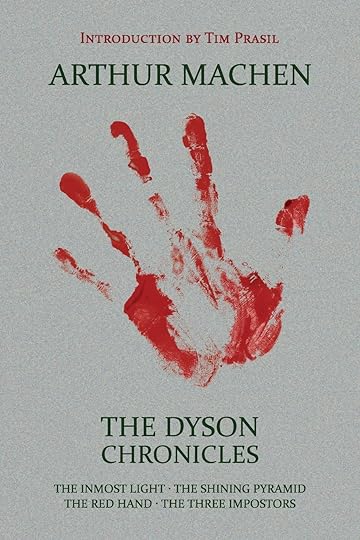
The first to grab onto the idea of this primitive and secret survival was Welsh writer, Arthur Machen (1863-1947). Machen liked to imagine that under the bucolic green hills of Wales, terrible and evil things lurked. Amongst these were savage creatures that once ruled the world. He wrote three stories about them that appeared in the same year. The first, "The Red Hand" (Chapman’s Magazine, Christmas 1895) has Dyson, Machen's occult detective of sorts, exploring a grisly murder committed with a primitive, prehistoric axe that hints at the creatures who wield it:
 "The Novel of the Black Seal" (The Three Imposters, 1895) provides another artifact, a black rock with weird writing:
 HG Wells (1866-1946) needs mention here. He did not use this idea of ancient creatures for he had little interest in the past. He was a futurist. Despite this, one of his stories seems to have influenced later writers in conjunction with the Little People idea. The story in question was "The Time Machine" (National Observer serial, 1894) and his underground dwelling Morlocks.
In Wells' story these white-skinned cannibals are the future of the suppressed proletariat, living in their machine-run depths. Wells is careful to describe the Morlocks only in snatches, making them more mysterious. “A pair of eyes, luminous by reflection against the daylight without, was watching me out of the darkness... I put out my hand and touched something soft. At once the eyes darted sideways, and something white ran past me. I turned with my heart in my mouth, and saw a queer little ape-like figure, its head held down in a peculiar manner, running across the sunlit space...” The man from the present plumbs their dark tunnels and just barely escapes their cold, wicked plans. This image of the man trapped in the dark, armed only with a light and a solid metal bar has fused with Machen's vision of evil survivals.
Robert E Howard (1906-1936) was the writer who really brought these two together, though he was not the last. Howard's first venture into the world of the Little People was an open pastiche of Machen called "The Little People" (Coven 13, January 1970). This early tale, written in the 1920s, suffers from poor mechanics. The hero, tells his sister the lengthy history of the Little People, after perusing a copy of "The Shining People" by Machen. Later these very creatures invade their home where the narrator gives this description:
 The narrator dives in for a Howard-sized fight, but the creatures find and attack his sister. Only the sudden appearance of a white-bearded druid saves them from the Little People. This tale contains many of the elements that will later appear in the much better constructed tales of Bran Mak Morn and Conan.
"The Children of the Night" (Weird Tales, April/May 1931) sets up several of Howard's themes for his Little People stories, the first being degeneration and the second: reincarnation. One of Conrad and Kirowan's friends, John O'Donnell, has a strange vision while visiting the occult investigators. He sees himself in the past as Aryara of the Sword People, an ancient Celt, who encounters the Little People and falls fighting them. Upon waking, O'Donnell attacks Ketrick, one of the guests, for he has Serpent blood:
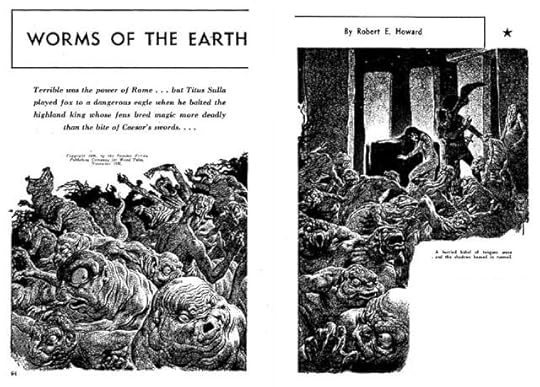 Howard would return to his version of the degraded half-breed creatures in several stories, the best of which was "The Worms of the Earth" (Weird Tales, November 1932). To make things even more interesting, Howard has the Picts, dark warriors living under the Roman radar as well as these even earlier creatures that the Picts displaced. Howard's Worms are half-human hybrids with the evil Serpent Men of ancient times, another lost race that once ruled the world. Bran Mak Morn, the king of the Picts, enters the Worms' tunnels (shades of Wells) to steal their sacred relic and force them to do his bidding:
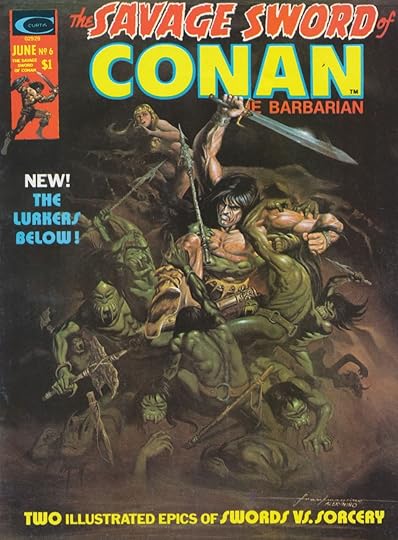 "The People of the Dark" (Strange Tales, June 1932) is a rewrite of sorts of "The Little People" with the narrator, John O'Brien, coming to Dagon's Cave to kill Richard Brent, his rival for Eleanor Bland. Howard has the characters thrust back in time using reincarnation as a method to change O'Brien into a Gaelic warrior, Conan of the reavers. Brent becomes Vertorix, a Briton, and Eleanor a Briton girl named Tamera. All three face the Worms, but only Conan survives; Vertorix and Tamera plunging to their deaths rather than succumb. O'Brien wanders the caves, finally making his way out. He encounters one last denizen of the deep, the snaky remains of the Worms in our time:
Karl Edward Wagner would write further of Howard's Worms in Legion From the Shadows (1975). He added little to Howard's vision, but did combine elements from several different stories, having Serpent Men, Worms, and even the Crawler from the Conan stories. His Serpent leader looks thus:
 Thus the Worms once looked before the long road to degeneration. Wagner would create his own race of subterranean dwellers in his story ".220 Swift" (New Terrors, 1980), borrowing the idea partly from Manly Wade Wellman and his Guardians of the Ancients from “Shiver in the Pines” (The Magazine of Fantasy & Science Fiction, February 1955).
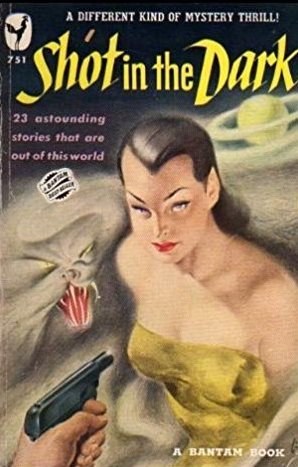
Gerald Kersh (1911-68) was a sophisticated writer of weird tales and mainstream novels, but even he ventured into the world of the Little People in "Voices in the Dust" (1950, for Judith Merrill's Shot in the Dark). An adventurer in a future world (after World War III) goes to the dead city of Annan in an area of ash and stones. Here he discovers a race of white-skinned, large eyed people:
GW Thomas has appeared in over 400 different books, magazines and ezines including The Writer, Writer's Digest, Black October Magazine and Contact. His website is gwthomas.org. He is editor of Dark Worlds magazine.
 History has a strange way of inspiring horror writers. In the records of the Romans there is mention of a strange race that lived in the British Isles before the Celts. Their name was simply the Picts, meaning "picture," for they were heavily tattooed. "The Picts of Galloway" supposedly intermingled with the Gaels, but to a writer of terror tales the idea that these people, and others like them, should go underground and become the inspiration for "The Little People" of legend is too tempting.
The first to grab onto the idea of this primitive and secret survival was Welsh writer, Arthur Machen (1863-1947). Machen liked to imagine that under the bucolic green hills of Wales, terrible and evil things lurked. Amongst these were savage creatures that once ruled the world. He wrote three stories about them that appeared in the same year. The first, "The Red Hand" (Chapman’s Magazine, Christmas 1895) has Dyson, Machen's occult detective of sorts, exploring a grisly murder committed with a primitive, prehistoric axe that hints at the creatures who wield it:
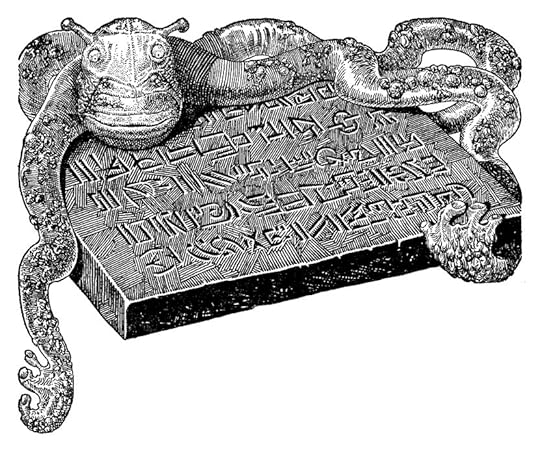
‘My dear fellow, I am sorry to say I have completely failed. I have tried every known device in vain. I have even been so officious as to submit it to a friend at the Museum, but he, though a man of prime authority on the subject, tells me he is quite at fault. It must be some wreckage of a vanished race, almost, I think — a fragment of another world than ours. I am not a superstitious man, Dyson, and you know that I have no truck with even the noble delusions, but I confess I yearn to be rid of this small square of blackish stone. Frankly, it has given me an ill week; it seems to me troglodytic and abhorred.’
 "The Novel of the Black Seal" (The Three Imposters, 1895) provides another artifact, a black rock with weird writing:
We had dined without candles; the room had slowly grown from twilight to gloom, and the walls and corners were indistinct in the shadow. But from where I sat I looked out into the street; and as I thought of what I would say to Francis, the sky began to flush and shine, as it had done on a well-remembered evening, and in the gap between two dark masses that were houses an awful pageantry of flame appeared—lurid whorls of writhed cloud, and utter depths burning, grey masses like the fume blown from a smoking city, and an evil glory blazing far above shot with tongues of more ardent fire, and below as if there were a deep pool of blood. I looked down to where my brother sat facing me, and the words were shaped on my lips, when I saw his hand resting on the table. Between the thumb and forefinger of the closed hand there was a mark, a small patch about the size of a sixpence, and somewhat of the colour of a bad bruise. Yet, by some sense I cannot define, I knew that what I saw was no bruise at all; oh! if human flesh could burn with flame, and if flame could be black as pitch, such was that before me. Without thought or fashioning of words grey horror shaped within me at the sight, and in an inner cell it was known to be a brand. For the moment the stained sky became dark as midnight, and when the light returned to me I was alone in the silent room, and soon after I heard my brother go out.In "The Shining Pyramid" (The Unknown World, May 15, 1895), Machen finally gives us a vivid description of the humanoids that worship the Pyramid:
It did, in truth, stir and seethe like an infernal cauldron. The whole of the sides and bottom tossed and writhed with vague and restless forms that passed to and fro without the sound of feet, and gathered thick here and there and seemed to speak to one another in those tones of horrible sibilance, like the hissing of snakes, that he had heard. It was as if the sweet turf and the cleanly earth had suddenly become quickened with some foul writhing growth. Vaughan could not draw back his face, though he felt Dyson's finger touch him, but he peered into the quaking mass and saw faintly that there were things like faces and human limbs, and yet he felt his inmost soul chill with the sure belief that no fellow soul or human thing stirred in all that tossing and hissing host. He looked aghast, choking back sobs of horror, and at length the loathsome forms gathered thickest about some vague object in the middle of the hollow, and the hissing of their speech grew more venomous, and he saw in the uncertain light the abominable limbs, vague and yet too plainly seen, writhe and intertwine, and he thought he heard, very faint, a low human moan striking through the noise of speech that was not of man. At his heart something seemed to whisper ever "the worm of corruption, the worm that dieth not," and grotesquely the image was pictured to his imagination of a piece of putrid offal stirring through and through with bloated and horrible creeping things. The writhing of the dusky limbs continued, they seemed clustered round the dark form in the middle of the hollow, and the sweat dripped and poured off Vaughan's forehead, and fell cold on his hand beneath his face.
 HG Wells (1866-1946) needs mention here. He did not use this idea of ancient creatures for he had little interest in the past. He was a futurist. Despite this, one of his stories seems to have influenced later writers in conjunction with the Little People idea. The story in question was "The Time Machine" (National Observer serial, 1894) and his underground dwelling Morlocks.
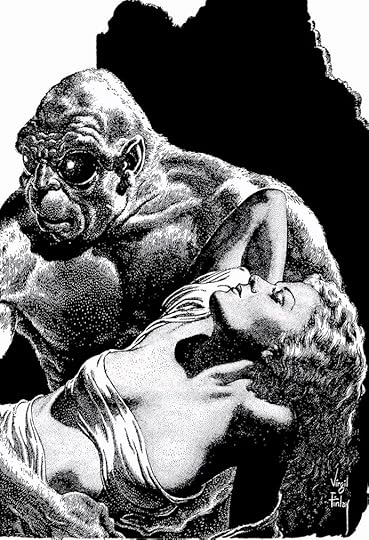
In Wells' story these white-skinned cannibals are the future of the suppressed proletariat, living in their machine-run depths. Wells is careful to describe the Morlocks only in snatches, making them more mysterious. “A pair of eyes, luminous by reflection against the daylight without, was watching me out of the darkness... I put out my hand and touched something soft. At once the eyes darted sideways, and something white ran past me. I turned with my heart in my mouth, and saw a queer little ape-like figure, its head held down in a peculiar manner, running across the sunlit space...” The man from the present plumbs their dark tunnels and just barely escapes their cold, wicked plans. This image of the man trapped in the dark, armed only with a light and a solid metal bar has fused with Machen's vision of evil survivals.
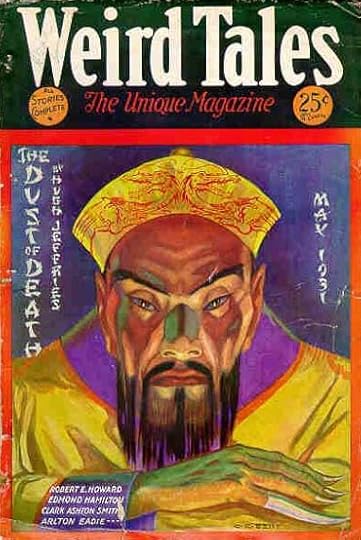
Robert E Howard (1906-1936) was the writer who really brought these two together, though he was not the last. Howard's first venture into the world of the Little People was an open pastiche of Machen called "The Little People" (Coven 13, January 1970). This early tale, written in the 1920s, suffers from poor mechanics. The hero, tells his sister the lengthy history of the Little People, after perusing a copy of "The Shining People" by Machen. Later these very creatures invade their home where the narrator gives this description:
"Now I was almost upon those who barred my way. I saw plainly the stunted bodies, the gnarled limbs, the beady reptilian eyes that stared unwinkingly, the grotesque, square faces with their inhuman features, and the shimmer of flint daggers in their crooked hands..."
 The narrator dives in for a Howard-sized fight, but the creatures find and attack his sister. Only the sudden appearance of a white-bearded druid saves them from the Little People. This tale contains many of the elements that will later appear in the much better constructed tales of Bran Mak Morn and Conan.
"The Children of the Night" (Weird Tales, April/May 1931) sets up several of Howard's themes for his Little People stories, the first being degeneration and the second: reincarnation. One of Conrad and Kirowan's friends, John O'Donnell, has a strange vision while visiting the occult investigators. He sees himself in the past as Aryara of the Sword People, an ancient Celt, who encounters the Little People and falls fighting them. Upon waking, O'Donnell attacks Ketrick, one of the guests, for he has Serpent blood:
But Ketrick: to me the man always seemed strangely alien. It was in his eyes that this difference showed externally. They were a sort of amber, almost yellow, and slightly oblique. At times, when one looked at his face from certain angles, they seemed to slant like a Chinaman’s. Others than I had noticed this feature, so unusual in a man of pure Anglo-Saxon descent. The usual myths ascribing his slanted eyes to some pre-natal influence had been mooted about, and I remember Professor Hendrik Brooler once remarked that Ketrick was undoubtedly an atavism, representing a reversion of type to some dim and distant ancestor of Mongolian blood–a sort of freak reversion, since none of his family showed such traces.Howard's dated racism can be offensive today, but within the context of the story O'Donnell would prefer any human of any color or creed over the few humans who still carry the taint of the Little People.
 Howard would return to his version of the degraded half-breed creatures in several stories, the best of which was "The Worms of the Earth" (Weird Tales, November 1932). To make things even more interesting, Howard has the Picts, dark warriors living under the Roman radar as well as these even earlier creatures that the Picts displaced. Howard's Worms are half-human hybrids with the evil Serpent Men of ancient times, another lost race that once ruled the world. Bran Mak Morn, the king of the Picts, enters the Worms' tunnels (shades of Wells) to steal their sacred relic and force them to do his bidding:
And he came at last into a vast space where he could stand upright. He could not see the roof of the place, but he got an impression of dizzying vastness. The blackness pressed in on all sides and behind him he could see the entrance to the shaft from which he had just emerged--a black well in the darkness. But in front of him a strange grisly radiance glowed about a grim altar built of human skulls. The source of that light he could not determine, but on the altar lay a sullen night-black object--the Black Stone!Howard wrote of the Worms again in "Valley of the Lost" (Magazine of Horror, Summer 1966), a tale set during the Texas feuds of the 19th Century. Little John Reynolds is fleeing the McCrills when he takes refuge in the valley where the Little People hide. He spies the strange inhabitants:
It was not their dwarfish figures which caused his shudder, nor even the unnaturally made hands and feet–it was their heads. He knew, now, of what race was the skull found by the prospector. Like it, these heads were peaked and malformed, curiously flattened at the sides. There was no sign of ears, as if their organs of hearing, like a serpent’s, were beneath the skin. The noses were like a python’s snout, the mouth and jaws much less human in appearance than his recollection of the skull would have led him to suppose. The eyes were small, glittering and reptilian. The squamous lips writhed back, showing pointed fangs, and John Reynolds felt that their bite would be as deadly as a rattlesnake’s. Garments they wore none, nor did they bear any weapons.Reynolds flees the weird caverns, blowing up the door that leads to the outer world, then takes his chances against human enemies, his hair now stark white.
 "The People of the Dark" (Strange Tales, June 1932) is a rewrite of sorts of "The Little People" with the narrator, John O'Brien, coming to Dagon's Cave to kill Richard Brent, his rival for Eleanor Bland. Howard has the characters thrust back in time using reincarnation as a method to change O'Brien into a Gaelic warrior, Conan of the reavers. Brent becomes Vertorix, a Briton, and Eleanor a Briton girl named Tamera. All three face the Worms, but only Conan survives; Vertorix and Tamera plunging to their deaths rather than succumb. O'Brien wanders the caves, finally making his way out. He encounters one last denizen of the deep, the snaky remains of the Worms in our time:
Before the Children had vanished, the race must have lost all human semblance, living as they did the life of the reptile. This thing was more like a giant serpent than anything else, but it had aborted legs and snaky arms with hooked talons. It crawled on its belly, writhing back mottled lips to bare needlelike fangs, which I felt must drip with venom. It hissed as it reared up its ghastly head on a horribly long neck, while its yellow slanted eyes glittered with all the horror that is spawned in the black lairs under the earth.O'Brien shoots it with the revolver he had brought to kill Brent. Brent and Eleanor know they are eternal soul mates and O'Brien lets them go for he too now understands.
Karl Edward Wagner would write further of Howard's Worms in Legion From the Shadows (1975). He added little to Howard's vision, but did combine elements from several different stories, having Serpent Men, Worms, and even the Crawler from the Conan stories. His Serpent leader looks thus:
The figure was as tall as Bran, and of skeletal leanness—although little else could be discerned through the voluminous folds of his robes. The arms that protruded from the flaring sleeves were covered with the pallid scales of some ancient serpent, taloned with long, black nails. The skull above the narrow shoulders was curiously flattened at the temples, and rose to a high peak. That peaked, hairless skull was encircled in a golden band, set with sullen gems of murky hue. His ears were pointed, the nose flared and pitted as a viper’s snout, the face little more than a pallid mask of scales tight across an inhuman skull. Bright and pointed fangs made a double row along the grinning jaw. Those yellow ophidian eyes mirrored a soul of elder evil that had looked unblinking across the expanse of centuries.
 Thus the Worms once looked before the long road to degeneration. Wagner would create his own race of subterranean dwellers in his story ".220 Swift" (New Terrors, 1980), borrowing the idea partly from Manly Wade Wellman and his Guardians of the Ancients from “Shiver in the Pines” (The Magazine of Fantasy & Science Fiction, February 1955).
Gerald Kersh (1911-68) was a sophisticated writer of weird tales and mainstream novels, but even he ventured into the world of the Little People in "Voices in the Dust" (1950, for Judith Merrill's Shot in the Dark). An adventurer in a future world (after World War III) goes to the dead city of Annan in an area of ash and stones. Here he discovers a race of white-skinned, large eyed people:
...The light paralyzed it: the thing was glued in the shining, white puddle—it had enormous eyes. I fired at it—I mean, I aimed at it and pressed my trigger, but had forgotten to lift my safety-catch. Holding the thing in the flashlight beam, I struck at it with the barrel of the pistol. I was cruel because I was afraid. It squealed, and something cracked. Then I had it by the neck. If it was not a rat it smelled like a rat. Oh-oooo, oh-oooo, oh-oooo! it wailed, and I heard something scuffle outside. Another voice wailed oh-oooo, oh-oooo, oh-oooo! A third voice picked it up. In five seconds, the hot, dark night was full of a most woebegone crying. Five seconds later there was silence, except for the gasping of the cold little creature under my hand.Kersh gives a long explanation -- we've heard it before -- about how the Picts had been the source of the fairies in places like Wales. The explorer follows the Little People into their subterranean tunnels, like Wells' Time Traveler, but falls and breaks his leg. The people of the dark do not threaten the man but feed him. Unfortunately, their medical skills are so primitive that the man can do nothing but sit in the darkness and wait for death. Kersh takes his inspiration from Machen and Wells, (though probably not Howard) and adds his tale to the history of the Little People. Who will be next?
GW Thomas has appeared in over 400 different books, magazines and ezines including The Writer, Writer's Digest, Black October Magazine and Contact. His website is gwthomas.org. He is editor of Dark Worlds magazine.
July 25, 2017
Hellbent for Letterbox | The Wild Wild West

I forgot to post about it at the time, but on the most recent Hellbent, Pax and I went deep into the Wild Wild West TV show starring Robert Conrad and Ross Martin. We go through the stars, the villains, our favorite episodes, and just what it was that made the show so awesome.

Then on a special Hitchin' Post episode, we strolled into the two reunion movies and the 1999 film starring Will Smith and Kevin Kline.

July 24, 2017
7 Days in May | Planet of the Apes and Noir Galore
Rise of the Planet of the Apes (2011)
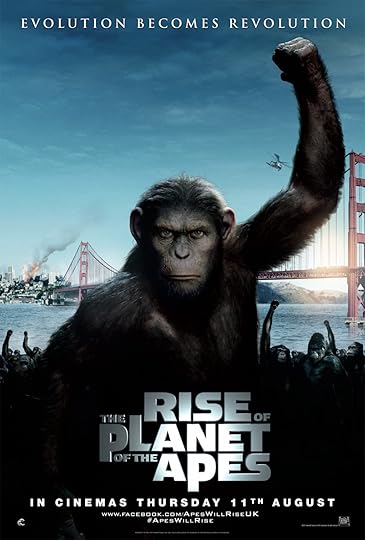
Wanted to rewatch this and Dawn before seeing War. I'm still amazed by how much this works. Which is to say that it works completely and wonderfully, fully connecting me to its characters regardless of species. And what a great, cathartic finale as everyone gets their comeuppance. In the best Planet of the Apes movies, I should always feel conflicted about where my loyalties are and this is probably the best at accomplishing that in the history of these movies.
Dawn of the Planet of the Apes (2014)
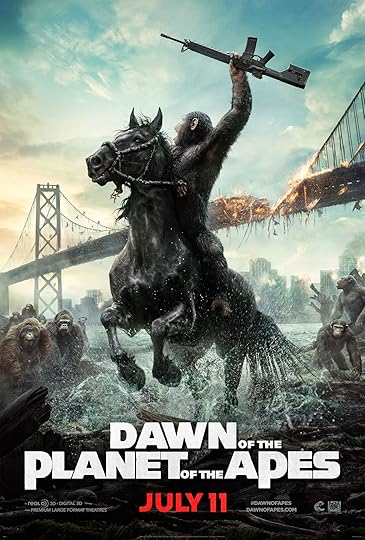
I still care about the humans in Dawn - especially Keri Russell, Jason Clarke, and Kodi Smit-McPhee - but they're ultimately MacGuffins in the movie's real conflict between Caesar and Koba. It's a brilliant clash of ideologies and what I love most about this trilogy is the battle between compassion and hate. Which leads directly to the third film...
War for the Planet of the Apes (2017)
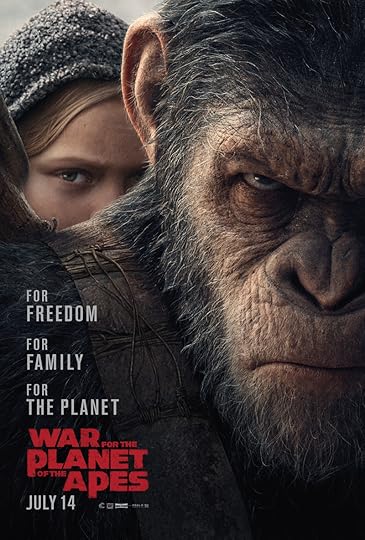
In Dawn, the compassion-hate conflict is between Caesar and Koba, but in War it's within Caesar himself. His conflict with the human Colonel (Woody Harrelson) has led Caesar down a dark path and threatens the beliefs that he holds most dear. War handles this in a beautiful, emotional way and it's a great conclusion to what's easily my favorite science fiction trilogy of all time (at least until the current Star Wars trilogy is done... fingers crossed).
Grease (1978)
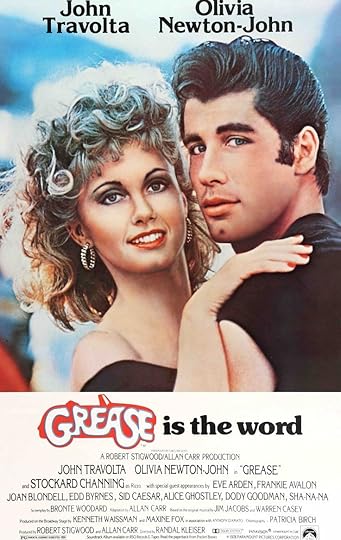
Rewatching Back to the Future for an upcoming Mystery Movie Night got me in the mood for something else from the '50s. And this has been on the list for a while since a couple of shots from it are in that great 100 Movies Dance Scenes Mashup video that my family and I can't stop watching.
And it really is all about the music in this one. The story is mostly bunk and I don't like Danny, Sandy, or really any of their friends except Frenchie. The ending is stupid. But dang those are some great songs and I always forget how awesome Olivia Newton-John's voice is.
The Cowboy and the Lady (1938)
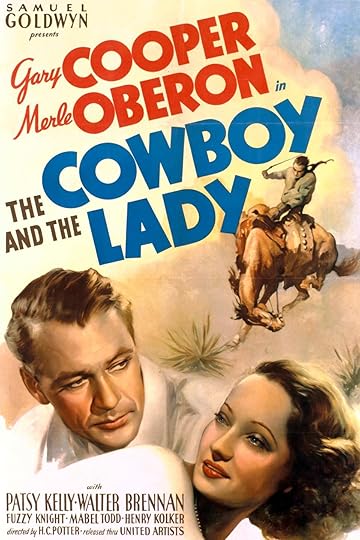
Trying to clear out some room on my TiVo. I recorded this on a lark, because there's a John Denver song with the same title and I'm nostalgic for John Denver. That's a dumb reason to watch a movie, but I also like Gary Cooper and Merle Oberon, so what the heck.
I love this movie so much. Oberon plays a wealthy, young woman named Mary Smith whose widowed father is trying to get a Presidential nomination. Mary's not especially troublesome, but she's under especially tight scrutiny, so her dad sends her to the family's house in West Palm Beach to get her away from the New York paparazzi. There she cute-meets a rodeo cowboy named Stretch (Cooper), but she's pretending to be a lady's maid at the time and... well, you've seen a romantic comedy before, so you know how that goes.
There are some modern romcom tropes, but I found that refreshing in a '30s film. And I love that the story is told from Mary's point of view with Stretch being the love interest. The movie also has some nice things to say about the value of people, with both Mary and Stretch needing to adjust their ideas about what kind of people they're interested in.
Five Came Back (1939)
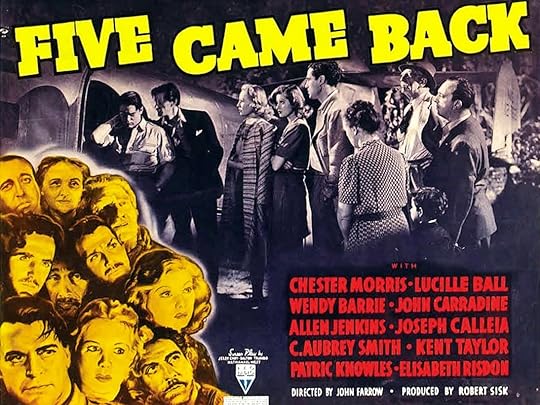
This one popped on my radar because a bunch of people crash in a jungle. And it's very early Lucille Ball and I'm always interested in her serious roles.
I love this one, too. It's sort of a proto-Lost with a varied group of passengers on a downed plane trying to survive until they can rescue themselves. There are three airline personnel, a young couple in love, an elderly couple in grumpiness, a bounty hunter (John Carradine) and his prisoner, a man escorting a young boy for mysterious reasons, and Lucille Ball's character: a beautiful, but ostracized woman.
What's great is that every one of these characters finds themselves challenged and changed by the ordeal in the jungle. Some for the better, and some not so much. As the title spoils, not all of them make it out, but that's a fascinating and touching story, too.
It was remade in 1956 as Back from Eternity with Anita Ekberg and Rod Steiger, so that also just went on my list.
Murder, My Sweet (1944)
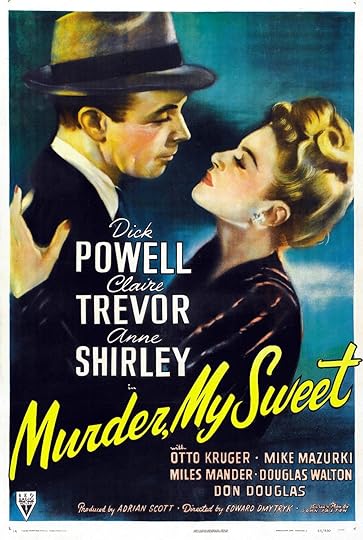
I'm a huge fan of The Big Sleep, both the Raymond Chandler novel and the 1946 movie based on it. But I'm enough of a fan of the movie that I haven't been that interested in seeing other actors in the role of Philip Marlowe.
And here's another thing: my love of the novel is all about the mood and the dialogue. Chandler's an awesome writer, but - at least in The Big Sleep - he's not an awesome mystery writer. There are huge dangling plot threads and red herrings that don't make sense. Maybe he fixed that in subsequent books, but I haven't read them yet to find out. If Murder, My Sweet (based on Chandler's Farewell, My Lovely) is faithful to its novel, though - and I understand that it is - I still have concerns. For most of its run time, the story spins around without going anywhere. It relies on all the things I like about Chandler (mood, dialogue, and Marlowe himself) to keep me going, but the central mystery is kind of dull.
Phantom Lady (1944)
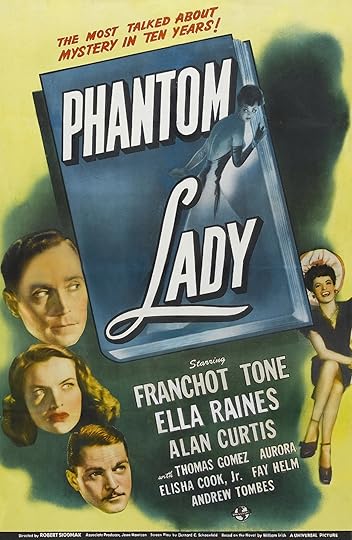
After enjoying The Web, I started looking for other Ella Raines movies to watch and this is a big one. She plays another secretary, but this time her boss is the one who's in trouble for murder, not the one trying to cover it up. And she's great in it, but neither her boss nor the story itself deserve her. The villain is easy to deduce as soon as the character is mentioned, but then the movie still confirms it way too early. The villain's motivation is super flimsy, too, and the scheme to cover their tracks is even shakier. This is a classic only because of Raines herself and an unforgettable scene with a ridiculously lewd drum solo.
Frontier Gal (1945)
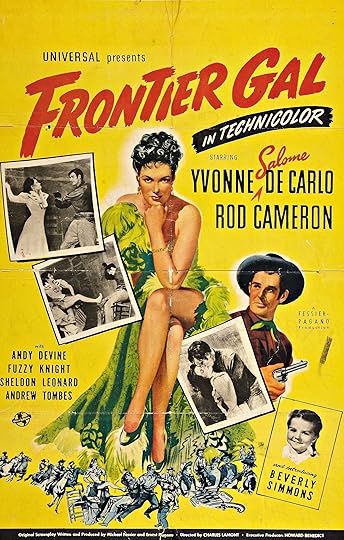
Before she was Lily Munster, Yvonne De Carlo had a prolific film career. She made a lot of Westerns, so I wanted to check some of them out. I shouldn't have started with Frontier Gal, though, because hoo boy. Her character's unlikability in this movie is only surpassed by her co-star's.
Rod Cameron plays an outlaw who visits a saloon run by De Carlo. He takes a liking to her, but she insults him, so he kisses her against her will. She slaps him, so he kisses her again. She slaps him again, so he kisses her again. Repeat several times until she falls in love. And that sets the tone for the entire movie, which might as well have been called No Means Yes.
I'll watch more De Carlo Westerns, but yikes... this one.
Spellbound (1945)
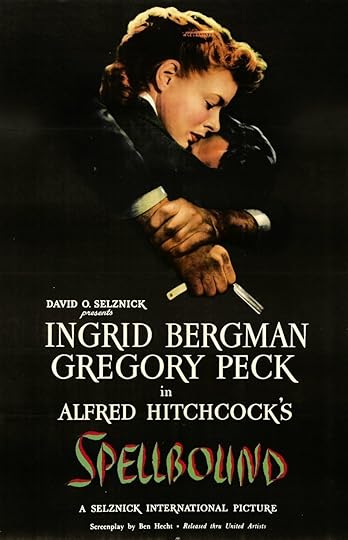
One of my favorite Hitchcock films, partly because I love its two leads, but it's also a great story that keeps turning into something new. Showed it to David this viewing and he wasn't that interested to begin with. I asked him to give it 15 minutes and then decide if he wanted to keep going. We kept going.
That awesome dream sequence designed by Salvador Dali is a highlight, but it's the central mystery and the plot twists (and Bergman and Peck) that make Spellbound so rewatchable.
Shock (1946)
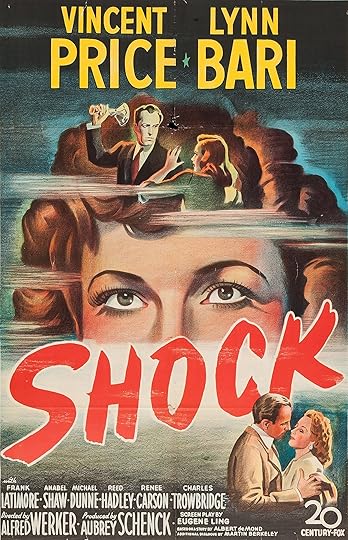
Phantom Lady wasn't the only movie I watched this week inspired by The Web. I wanted to see some more Vincent Price noir, too, so that's where Shock comes in. Price plays an adulterous psychologist who accidentally kills his wife. Unfortunately, he's seen by a woman (Anabel Shaw) who's already under a lot of mental stress. Watching the murder sends her into a catatonic state. When Price is called in to minister to her, he discovers that she's a witness to his crime. Under pressure from his girlfriend, he realizes that if Shaw never recovers, he's off the hook.
It's not my favorite kind of Price role. He's still great, but he's too much a victim of circumstance and his girlfriend to thoroughly relish his performance. Give me wicked and conniving - or at least charmingly caddish - any day.
Song of the Week: "Seagulls! (Stop It Now)" by Bad Lip Reading
This doesn't just crack me up; it gets stuck in my head for a week and I don't even complain.


Wanted to rewatch this and Dawn before seeing War. I'm still amazed by how much this works. Which is to say that it works completely and wonderfully, fully connecting me to its characters regardless of species. And what a great, cathartic finale as everyone gets their comeuppance. In the best Planet of the Apes movies, I should always feel conflicted about where my loyalties are and this is probably the best at accomplishing that in the history of these movies.
Dawn of the Planet of the Apes (2014)

I still care about the humans in Dawn - especially Keri Russell, Jason Clarke, and Kodi Smit-McPhee - but they're ultimately MacGuffins in the movie's real conflict between Caesar and Koba. It's a brilliant clash of ideologies and what I love most about this trilogy is the battle between compassion and hate. Which leads directly to the third film...
War for the Planet of the Apes (2017)

In Dawn, the compassion-hate conflict is between Caesar and Koba, but in War it's within Caesar himself. His conflict with the human Colonel (Woody Harrelson) has led Caesar down a dark path and threatens the beliefs that he holds most dear. War handles this in a beautiful, emotional way and it's a great conclusion to what's easily my favorite science fiction trilogy of all time (at least until the current Star Wars trilogy is done... fingers crossed).
Grease (1978)

Rewatching Back to the Future for an upcoming Mystery Movie Night got me in the mood for something else from the '50s. And this has been on the list for a while since a couple of shots from it are in that great 100 Movies Dance Scenes Mashup video that my family and I can't stop watching.
And it really is all about the music in this one. The story is mostly bunk and I don't like Danny, Sandy, or really any of their friends except Frenchie. The ending is stupid. But dang those are some great songs and I always forget how awesome Olivia Newton-John's voice is.
The Cowboy and the Lady (1938)

Trying to clear out some room on my TiVo. I recorded this on a lark, because there's a John Denver song with the same title and I'm nostalgic for John Denver. That's a dumb reason to watch a movie, but I also like Gary Cooper and Merle Oberon, so what the heck.
I love this movie so much. Oberon plays a wealthy, young woman named Mary Smith whose widowed father is trying to get a Presidential nomination. Mary's not especially troublesome, but she's under especially tight scrutiny, so her dad sends her to the family's house in West Palm Beach to get her away from the New York paparazzi. There she cute-meets a rodeo cowboy named Stretch (Cooper), but she's pretending to be a lady's maid at the time and... well, you've seen a romantic comedy before, so you know how that goes.
There are some modern romcom tropes, but I found that refreshing in a '30s film. And I love that the story is told from Mary's point of view with Stretch being the love interest. The movie also has some nice things to say about the value of people, with both Mary and Stretch needing to adjust their ideas about what kind of people they're interested in.
Five Came Back (1939)

This one popped on my radar because a bunch of people crash in a jungle. And it's very early Lucille Ball and I'm always interested in her serious roles.
I love this one, too. It's sort of a proto-Lost with a varied group of passengers on a downed plane trying to survive until they can rescue themselves. There are three airline personnel, a young couple in love, an elderly couple in grumpiness, a bounty hunter (John Carradine) and his prisoner, a man escorting a young boy for mysterious reasons, and Lucille Ball's character: a beautiful, but ostracized woman.
What's great is that every one of these characters finds themselves challenged and changed by the ordeal in the jungle. Some for the better, and some not so much. As the title spoils, not all of them make it out, but that's a fascinating and touching story, too.
It was remade in 1956 as Back from Eternity with Anita Ekberg and Rod Steiger, so that also just went on my list.
Murder, My Sweet (1944)

I'm a huge fan of The Big Sleep, both the Raymond Chandler novel and the 1946 movie based on it. But I'm enough of a fan of the movie that I haven't been that interested in seeing other actors in the role of Philip Marlowe.
And here's another thing: my love of the novel is all about the mood and the dialogue. Chandler's an awesome writer, but - at least in The Big Sleep - he's not an awesome mystery writer. There are huge dangling plot threads and red herrings that don't make sense. Maybe he fixed that in subsequent books, but I haven't read them yet to find out. If Murder, My Sweet (based on Chandler's Farewell, My Lovely) is faithful to its novel, though - and I understand that it is - I still have concerns. For most of its run time, the story spins around without going anywhere. It relies on all the things I like about Chandler (mood, dialogue, and Marlowe himself) to keep me going, but the central mystery is kind of dull.
Phantom Lady (1944)

After enjoying The Web, I started looking for other Ella Raines movies to watch and this is a big one. She plays another secretary, but this time her boss is the one who's in trouble for murder, not the one trying to cover it up. And she's great in it, but neither her boss nor the story itself deserve her. The villain is easy to deduce as soon as the character is mentioned, but then the movie still confirms it way too early. The villain's motivation is super flimsy, too, and the scheme to cover their tracks is even shakier. This is a classic only because of Raines herself and an unforgettable scene with a ridiculously lewd drum solo.
Frontier Gal (1945)

Before she was Lily Munster, Yvonne De Carlo had a prolific film career. She made a lot of Westerns, so I wanted to check some of them out. I shouldn't have started with Frontier Gal, though, because hoo boy. Her character's unlikability in this movie is only surpassed by her co-star's.
Rod Cameron plays an outlaw who visits a saloon run by De Carlo. He takes a liking to her, but she insults him, so he kisses her against her will. She slaps him, so he kisses her again. She slaps him again, so he kisses her again. Repeat several times until she falls in love. And that sets the tone for the entire movie, which might as well have been called No Means Yes.
I'll watch more De Carlo Westerns, but yikes... this one.
Spellbound (1945)

One of my favorite Hitchcock films, partly because I love its two leads, but it's also a great story that keeps turning into something new. Showed it to David this viewing and he wasn't that interested to begin with. I asked him to give it 15 minutes and then decide if he wanted to keep going. We kept going.
That awesome dream sequence designed by Salvador Dali is a highlight, but it's the central mystery and the plot twists (and Bergman and Peck) that make Spellbound so rewatchable.
Shock (1946)

Phantom Lady wasn't the only movie I watched this week inspired by The Web. I wanted to see some more Vincent Price noir, too, so that's where Shock comes in. Price plays an adulterous psychologist who accidentally kills his wife. Unfortunately, he's seen by a woman (Anabel Shaw) who's already under a lot of mental stress. Watching the murder sends her into a catatonic state. When Price is called in to minister to her, he discovers that she's a witness to his crime. Under pressure from his girlfriend, he realizes that if Shaw never recovers, he's off the hook.
It's not my favorite kind of Price role. He's still great, but he's too much a victim of circumstance and his girlfriend to thoroughly relish his performance. Give me wicked and conniving - or at least charmingly caddish - any day.
Song of the Week: "Seagulls! (Stop It Now)" by Bad Lip Reading
This doesn't just crack me up; it gets stuck in my head for a week and I don't even complain.
July 21, 2017
Southern Charm | Rodney Crowell, Southern Manners, and Pimento Cheese

In the latest episode of Southern Charm, Jody and I talk about country musician Rodney Crowell, his new album Close Ties, and the interview with him in Texas Monthly. Then the conversation turns to etiquette and the differences between Southern manners and what's considered polite in other parts of the country. Ma'am/Sir, holding doors, handshakes, and eye contact all come up. And finally, we close with Jody's recipe for pimento cheese and I get some homework.
Intro Music: "Kill Jill" by Big Boi, featuring Killer Mike and Jeezy
Outro Music: "Good Enough" by Molly Tuttle

July 20, 2017
Nerd Lunch | Star Wars Panel: Ewok Movie Drill Downs

Pax put the Star Wars panel back together this week to cover the two, made-for-TV Ewok movies. I'm glad he did for a couple of reasons. First, we hadn't gotten together since talking about Rogue One and I'm glad not to have to wait until Last Jedi for our next get-together. I love talking Star Wars with this crew.
But also, I'd never seen the Ewok movies and this was the push I needed to finally do that. As I explain on the episode, I missed them when they came out and would have been too old to enjoy them anyway. It was fun to finally see them; especially Battle for Endor, which I liked more than the rest of the group did. It's not a great movie, but I see its charm, especially for people who were kids when it came out. Caravan of Courage is a whole other story, though.
So we talk about that and weird fan theories and where these fall into continuity and Burl Ives and Wilford Brimley and all kinds of other stuff. It's a fun episode.

June 12, 2017
7 Days in May | Zorro vs Zorro
Streets of Fire (1984)
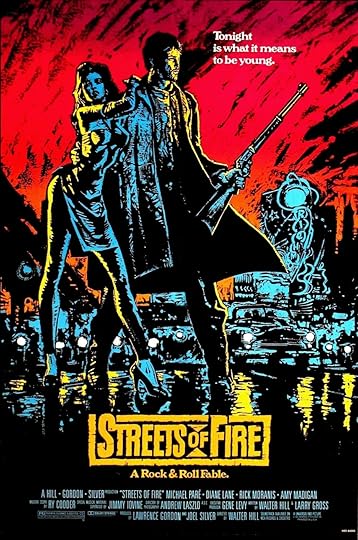
I've had this on the To Do list for a while now, because I wanted to watch it and then listen to the Cult Film Club episode about it. I loved Streets of Fire back in the day when I was working at the video store and could take it home as often as I wanted. I have no idea how many times I watched it. And I had no idea whether or not it would hold up.
Turns out, it does. There's a level of cheese to the dialogue that may be intentional, but that I didn't pick up in younger days. It works with the tone of the rest of the movie though, so if you lean into it, it's not a flaw. And the rest of the movie is all good stuff. The setting is a fun mix of 1950s and '80s. The songs are a great mixture of '80s rock anthems and rockabilly with a little Motown mixed in. And the characters are all memorable and cool, with Willem Dafoe being especially so. And I love how the plot - while simple - never goes exactly where you think it's going to.
They Came from Beyond Space (1967)
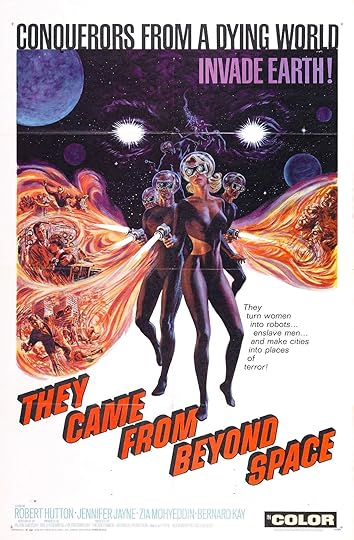
I almost like it. It's a decade late though and the goofy space invader plot would have been more charming in black-and-white and with '50s fashions. I had a hard time staying interested, but there's some fun stuff in it, to be sure.
The Mark of Zorro (1940)
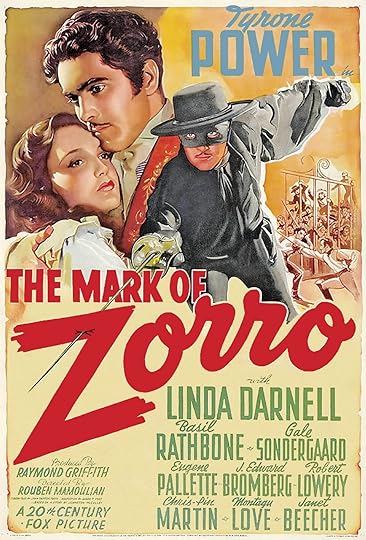
I've seen it before, but never in such close proximity to the silent version or the Disney show and certainly not since reading the novel it's based on. And I'd kind of forgotten a lot about it, because I was shocked at how much it deviates from the book. It's not a faithful adaptation at all.
It's much more focused on Don Diego and I was also surprised at how little Zorro there is in it. When Diego does put on the costume it's exciting, but it kind of reminded me of superhero shows from the '70s where 90% of the show is the secret identity and then you'd get a couple of big scenes with the hero to make it worth watching.
Not that the Diego stuff is boring. There's a lot of drama and intrigue and some great character stuff. And the swords fights are extremely good, even when no one in them is wearing black.
Zorro (1957-61)
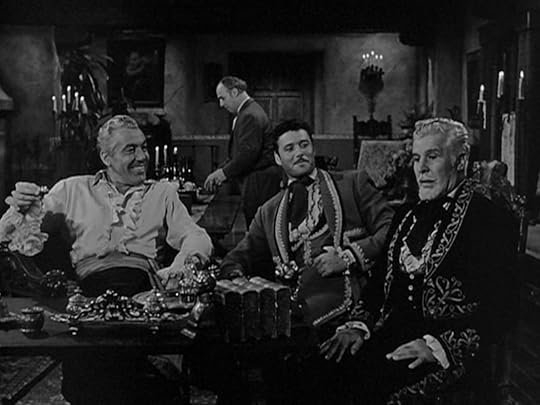
After wrapping up the Richard Anderson/Jolene Brand plot in a really lovely way, Season 2 abruptly and unceremoniously returns the main cast to Los Angeles in time for a few episodes with Cesar Romero as Don Diego's shifty, gold-digging uncle. There are still multi-episode storylines, but they don't flow from one to another the way earlier episodes did and there are a few that are just completely standalone.
I'm still digging the show; the cast makes sure of that and Zorro is as cool and swashbuckling a character as ever. I'm just not as blown away by it was I was in the first season.
The Return of Tarzan by Edgar Rice Burroughs
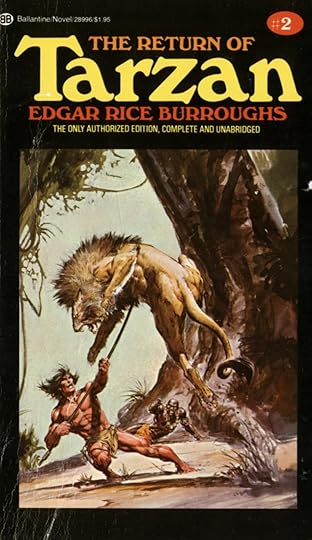
David and I have been listening to the Tarzan series on aubiobook as sort of extracurricular activity for Greystoked. Return of Tarzan is still one of my favorite Tarzan novels. I love how it shifts settings and even genres in the same story, going from romantic thriller to spy story to jungle adventure and on to fantasy. It introduces Tarzan's arch-enemy Rokoff as well as the Waziri allies and the infamous La of Opar.
I asked David if he wanted to take a break and listen to the Star Wars radio dramas (since they came up on the last Dragonfly Ripple), but he wanted to go right into Beasts of Tarzan. It makes sense. He was literally jumping up and down in his seat and laughing in glee at the final confrontation between Tarzan and Rokoff in Return.
Jam of the Week: "Make You Crazy" by Brett Dennen
Smooth and summery with a hint of reggae.
Make You Crazy by Brett Dennen on VEVO.

I've had this on the To Do list for a while now, because I wanted to watch it and then listen to the Cult Film Club episode about it. I loved Streets of Fire back in the day when I was working at the video store and could take it home as often as I wanted. I have no idea how many times I watched it. And I had no idea whether or not it would hold up.
Turns out, it does. There's a level of cheese to the dialogue that may be intentional, but that I didn't pick up in younger days. It works with the tone of the rest of the movie though, so if you lean into it, it's not a flaw. And the rest of the movie is all good stuff. The setting is a fun mix of 1950s and '80s. The songs are a great mixture of '80s rock anthems and rockabilly with a little Motown mixed in. And the characters are all memorable and cool, with Willem Dafoe being especially so. And I love how the plot - while simple - never goes exactly where you think it's going to.
They Came from Beyond Space (1967)

I almost like it. It's a decade late though and the goofy space invader plot would have been more charming in black-and-white and with '50s fashions. I had a hard time staying interested, but there's some fun stuff in it, to be sure.
The Mark of Zorro (1940)

I've seen it before, but never in such close proximity to the silent version or the Disney show and certainly not since reading the novel it's based on. And I'd kind of forgotten a lot about it, because I was shocked at how much it deviates from the book. It's not a faithful adaptation at all.
It's much more focused on Don Diego and I was also surprised at how little Zorro there is in it. When Diego does put on the costume it's exciting, but it kind of reminded me of superhero shows from the '70s where 90% of the show is the secret identity and then you'd get a couple of big scenes with the hero to make it worth watching.
Not that the Diego stuff is boring. There's a lot of drama and intrigue and some great character stuff. And the swords fights are extremely good, even when no one in them is wearing black.
Zorro (1957-61)

After wrapping up the Richard Anderson/Jolene Brand plot in a really lovely way, Season 2 abruptly and unceremoniously returns the main cast to Los Angeles in time for a few episodes with Cesar Romero as Don Diego's shifty, gold-digging uncle. There are still multi-episode storylines, but they don't flow from one to another the way earlier episodes did and there are a few that are just completely standalone.
I'm still digging the show; the cast makes sure of that and Zorro is as cool and swashbuckling a character as ever. I'm just not as blown away by it was I was in the first season.
The Return of Tarzan by Edgar Rice Burroughs

David and I have been listening to the Tarzan series on aubiobook as sort of extracurricular activity for Greystoked. Return of Tarzan is still one of my favorite Tarzan novels. I love how it shifts settings and even genres in the same story, going from romantic thriller to spy story to jungle adventure and on to fantasy. It introduces Tarzan's arch-enemy Rokoff as well as the Waziri allies and the infamous La of Opar.
I asked David if he wanted to take a break and listen to the Star Wars radio dramas (since they came up on the last Dragonfly Ripple), but he wanted to go right into Beasts of Tarzan. It makes sense. He was literally jumping up and down in his seat and laughing in glee at the final confrontation between Tarzan and Rokoff in Return.
Jam of the Week: "Make You Crazy" by Brett Dennen
Smooth and summery with a hint of reggae.
Make You Crazy by Brett Dennen on VEVO.
June 9, 2017
Hellbent for Letterbox | How the West Was Won (1962)

Pax and I finally watched the epic classic from directors Henry Hathaway, John Ford, and George Marshall; starring Carroll Baker, Debbie Reynolds, Jimmy Stewart, Gregory Peck, and George Peppard. And with cameos by everyone else alive at the time.
Does it live up to its reputation? Will we finally be able to tell it apart from Once Upon a Time in the West? Only one way to find out.
Also: Pony Express mail and quick reviews of The Way West (1967) and The War Wagon (1967).


June 7, 2017
Clifford Ball: Apprentice to a Fallen Master [Guest Post]
By GW Thomas
 The world of fantasy was shattered in 1936 when Robert E Howard put a gun to his head and ended it all. The fledgling genre of heroic fantasy was at a loss. Who would take up the torch and continue on from where Howard began with his tales of Bran Mak Morn, King Kull, and especially, Conan the Cimmerian? These larger-than-life warriors had found a home in an unlikely place: the horror magazine, Weird Tales. And it was in those same pages that the next sword-and-sorcery writers would appear.
Now Robert E Howard was not the only fantasy writer at "The Unique Magazine." CL Moore had created her swordswoman Jirel of Joiry in October 1934 with "The Black God's Kiss" and its sequel "The Black God's Shadow" (December 1934). Nictzin Dyalhis had written one classic piece, "The Sapphire Siren," in February 1934. Edmond Hamilton had been writing many kinds of science fiction and fantasy for Weird Tales and could have taken up the crown of sword-and-sorcery. But none of these writers did. CL Moore would write only one more Jirel tale after Howard's death. Dyalhis and Hamilton wrote other things.
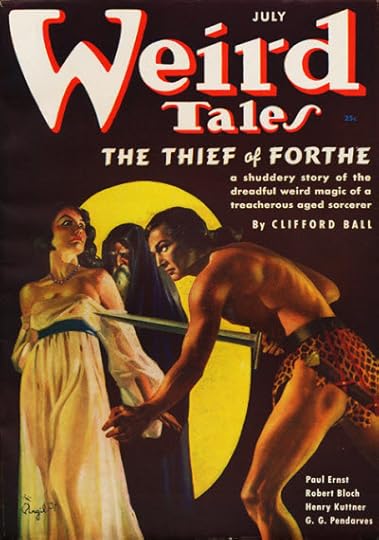
The mantle fell to a fan of Robert E Howard, the inexperienced Clifford Ball (1896?-1947?). Ball would produce three sword-and-sorcery stories for Weird Tales: "Duar the Accursed" (May 1937), "The Thief of Forthe" (July 1937), and "The Goddess Awakes" (February 1938). His next story after these was "The Swine of Aeaea" (March 1939), a tale of a modern day Circe. The two that followed that were pedestrian horror tales. Not much is known about Ball, but his bio in the magazine suggests a young man who traveled around looking for work before taking up the pen to write pulp. From his writing we can tell he was a fan of both Robert E Howard and Edgar Rice Burroughs. All three tales make mention of white apes: "If the guardsmen had been startled before, now they were certainly in a panic, much as if they had captured one of the terrible white apes from the hills of Barsoom..." This tidbit is telling, but jars the reader out of Ball's imaginary world. Such are the errors of youth.
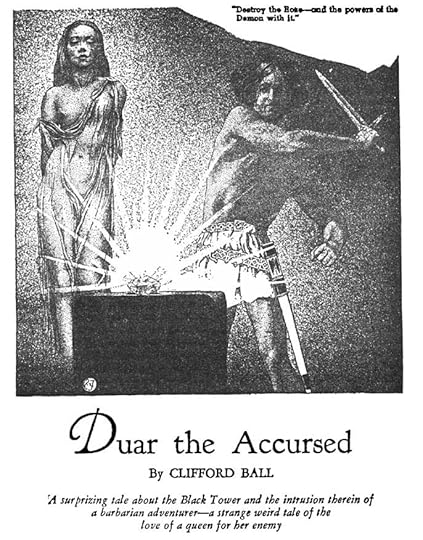
 In plot, "Duar the Accursed" is reminiscent of Howard's "The Scarlet Citadel" (January 1933), but also draws from other sources. Duar has been captured by the Queen Nione, who throws him into a dank dungeon known as the Pits of Ygoth. Duar is rescued by a supernatural being named Shar, who loves him and can restore his lost memories of how he was an emperor over Atlantis eons ago before its destruction and his curse. Duar refuses and instead takes on a mission for the queen: to enter the Black Tower and return with the Rose of Gaon, a fabulous and magical jewel. Duar climbs the stairs and faces the terror that none have survived to describe.
On a pillar surrounded by skeletons sits the Rose of Gaon. As the swordsman approaches he finds his limbs becoming tired and lifeless. He will stay that way until he dies of starvation. Shar reappears to remind him he is King Duar and to use his sword to destroy the Rose, for it is actually the heart of a demon. Duar rallies and destroys the gem, having power to deny the magic because of his ancient lineage. Shar offers to take him away, revive his memory, and work with him to rule the entire world again. Duar refuses and walks off to spend the rest of his years in Nione's bed. That opening scene with Duar chained before Queen Nione, defying her will seems cliché today having been used in multiple sword-and-sorcery tales since, but it may not have been so shop-worn in 1937. We have to remember Ball was the first to play with the story building blocks that Howard left behind. Lin Carter selected this story for his anthology, New Worlds For Old (1971).
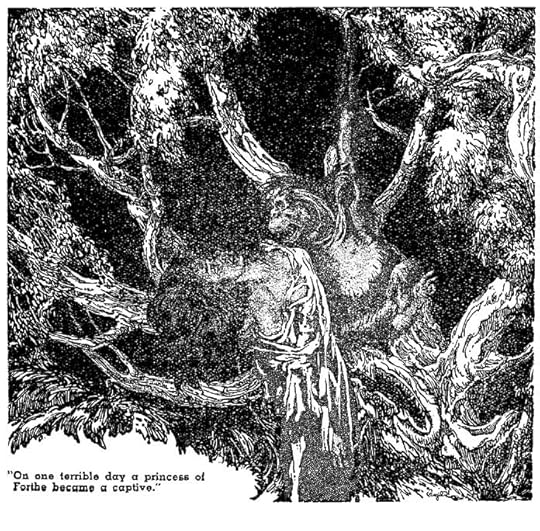
The last two stories Ball wrote did not feature Duar. Instead they are about a thief and adventurer named Rald. "The Thief of Forte" begins with two conspirators: a strange wizard name Karlk and the swordsman Rald. They enter the imperial palace to steal the royal jewels and the throne. While doing this, Rald meets Princess Thrine, the king's sister, who is very beautiful and spirited. She stalls the two long enough for King Thrall to show up and disarm the thieves. The two men are tied up and left. It is then that Karlk reveals something about his mysterious person. He has a second set of small, hairy hands that he uses to untie himself. He leaves Rald tied up as he prepares to ambush and kill the King and Princess with a magic blast. Rald can not lie by idly as death comes for Thrine, so he burns off his ropes and arrives in time to stop the wizard. Karlk is stabbed, and while dying admits why he wanted to kill the royals. Karlk is actually a woman, it is revealed as her disguise is pulled off. She is the daughter of a woman who was carried off by one the white apes (shades of Barsoom again!) so she has two sets of arms. Karlk dies horribly as the demon Nargath, who gave her her power, comes to claim her. King Thrall goes to thank Rald for saving them, but Rald has disappeared. Thrall wonders if Rald will come back. Thrine tells her brother that Rald will be back... for her.
 "The Thief of Forte," like "Duar the Accursed," uses another cliche plot (based on Howard's "Rogues in the House" (January 1934): that of wizard hiring a warrior to enter a heavily or magically guarded palace or tower to steal a magical item. Henry Kuttner would use this one as well a year later in "Spawn of Dagon" (Weird Tales, July 1938) and John Jakes and Lin Carter thirty years later in "The Devils in the Walls" (Fantastic, May 1963) and "The Thieves of Zangabal" (The Mighty Barbarians, 1969).
A letter from "The Eyrie" solves a small mystery for me when WC Jr writes about Virgil Finlay, WT illustrator. He points out that Finlay liked to play practical jokes on the writers: "For instance: Clifford Ball once stated in a letter to the Eyrie, previous to the publication of his first story, that the ridiculous theme of a woman being captured and carried off by a giant ape was passé. With this in mind, Virgil selected that particular scene in illustrating Ball's 'Thief of Forthe.'" When I saw this illustration originally I had reacted with a similar dislike for the picture. There are few sword-and-sorcery illustrations before the 1960s and every one counts. To see an ape-stealing-woman picture worthy of a Jules De Grandin tale, I sighed in disappointment. Now I at least know why...
"The Goddess Awakes" (February 1938) is Rald's second adventure. This time Rald and his comrade-in-arms Thwaine have fled a lost battlefield where they served as mercenaries. They encounter women warriors who knock out Rald and take them to their kingdom inside an extinct volcano. There they learn that the women warriors rule and all men are slaves in the mines by order of Throal. The queen of the land is Cene but she is under the power of the wizard Throal and his daughter, the living goddess and statue, Hess. Rald and Thwaine are promised to die in the arena by being eaten by Hess, a gigantic cat.
 This tale smacks more of Edgar Rice Burroughs than Robert E Howard. It only becomes more creepy (and therefore more Howardian) when the cat goddess calls the victims names as the moon draws the living beast out of a stone sphinx. Rald, Thwaine, and their new comrade, Ating - one of the women guards who has fallen for Thwaine - are thrown into a pit. The men try to deal with the goddess with swords, but her gigantic body is impenetrable. It is Queen Cene who saves them by throwing Rald a firebrand. One touch of the flames explodes Hess like a hydrogen zeppelin. Cene takes back her throne by killing Throal with a spear. Like a vampire, he dissolves to an ancient set of bones. His reign is over and the men of Ceipe are free to rejoin the women. The tale ends with Thwaine and Ating ruling the country while Rald and Cene take a year long break to explore the world outside. The whole thing rings more of John Carter than Conan of Cimmeria.
In one respect Clifford Ball did not follow entirely in Howard's footsteps. Ball's three stories all feature very powerful women: the being Shar, the Princess Thrine, and the Queen Cene. Having written only three stories, it is as if Ball chose to copy the longer Howard tales that featured strong female characters such as Yasmina, Belit, and Valeria. His adventure amongst the women warriors of Ceipe plays out more like the opening of Burroughs Pellucidar (1915) than Howard's "Vale of Lost Women," which Ball would not have read since it remained unpublished until Spring 1967.
In just ten months, Ball had given us his version of Howard's style of sword-and-sorcery. These three were all he would do before veering off into writing more traditional fantasy and horror. After only six stories he would disappear from the pulps altogether. But the editors of Weird Tales had a replacement. Henry Kuttner, by far a superior crafter of words, would appear in May 1938 with "Thunder in the Dawn," the first of the Elak of Atlantis stories. Kuttner would more skillfully use the legacy Howard left behind and even innovate, but Clifford Ball can take credit for being the first of a long line of pastichers that would include L Sprague de Camp, Lin Carter, Bjorn Nyberg, John Jakes, Andrew J Offutt, Poul Anderson, and many more.
GW Thomas has appeared in over 400 different books, magazines and ezines including The Writer, Writer's Digest, Black October Magazine and Contact. His website is gwthomas.org. He is editor of Dark Worlds magazine.
 The world of fantasy was shattered in 1936 when Robert E Howard put a gun to his head and ended it all. The fledgling genre of heroic fantasy was at a loss. Who would take up the torch and continue on from where Howard began with his tales of Bran Mak Morn, King Kull, and especially, Conan the Cimmerian? These larger-than-life warriors had found a home in an unlikely place: the horror magazine, Weird Tales. And it was in those same pages that the next sword-and-sorcery writers would appear.
Now Robert E Howard was not the only fantasy writer at "The Unique Magazine." CL Moore had created her swordswoman Jirel of Joiry in October 1934 with "The Black God's Kiss" and its sequel "The Black God's Shadow" (December 1934). Nictzin Dyalhis had written one classic piece, "The Sapphire Siren," in February 1934. Edmond Hamilton had been writing many kinds of science fiction and fantasy for Weird Tales and could have taken up the crown of sword-and-sorcery. But none of these writers did. CL Moore would write only one more Jirel tale after Howard's death. Dyalhis and Hamilton wrote other things.
The mantle fell to a fan of Robert E Howard, the inexperienced Clifford Ball (1896?-1947?). Ball would produce three sword-and-sorcery stories for Weird Tales: "Duar the Accursed" (May 1937), "The Thief of Forthe" (July 1937), and "The Goddess Awakes" (February 1938). His next story after these was "The Swine of Aeaea" (March 1939), a tale of a modern day Circe. The two that followed that were pedestrian horror tales. Not much is known about Ball, but his bio in the magazine suggests a young man who traveled around looking for work before taking up the pen to write pulp. From his writing we can tell he was a fan of both Robert E Howard and Edgar Rice Burroughs. All three tales make mention of white apes: "If the guardsmen had been startled before, now they were certainly in a panic, much as if they had captured one of the terrible white apes from the hills of Barsoom..." This tidbit is telling, but jars the reader out of Ball's imaginary world. Such are the errors of youth.
 In plot, "Duar the Accursed" is reminiscent of Howard's "The Scarlet Citadel" (January 1933), but also draws from other sources. Duar has been captured by the Queen Nione, who throws him into a dank dungeon known as the Pits of Ygoth. Duar is rescued by a supernatural being named Shar, who loves him and can restore his lost memories of how he was an emperor over Atlantis eons ago before its destruction and his curse. Duar refuses and instead takes on a mission for the queen: to enter the Black Tower and return with the Rose of Gaon, a fabulous and magical jewel. Duar climbs the stairs and faces the terror that none have survived to describe.
On a pillar surrounded by skeletons sits the Rose of Gaon. As the swordsman approaches he finds his limbs becoming tired and lifeless. He will stay that way until he dies of starvation. Shar reappears to remind him he is King Duar and to use his sword to destroy the Rose, for it is actually the heart of a demon. Duar rallies and destroys the gem, having power to deny the magic because of his ancient lineage. Shar offers to take him away, revive his memory, and work with him to rule the entire world again. Duar refuses and walks off to spend the rest of his years in Nione's bed. That opening scene with Duar chained before Queen Nione, defying her will seems cliché today having been used in multiple sword-and-sorcery tales since, but it may not have been so shop-worn in 1937. We have to remember Ball was the first to play with the story building blocks that Howard left behind. Lin Carter selected this story for his anthology, New Worlds For Old (1971).
The last two stories Ball wrote did not feature Duar. Instead they are about a thief and adventurer named Rald. "The Thief of Forte" begins with two conspirators: a strange wizard name Karlk and the swordsman Rald. They enter the imperial palace to steal the royal jewels and the throne. While doing this, Rald meets Princess Thrine, the king's sister, who is very beautiful and spirited. She stalls the two long enough for King Thrall to show up and disarm the thieves. The two men are tied up and left. It is then that Karlk reveals something about his mysterious person. He has a second set of small, hairy hands that he uses to untie himself. He leaves Rald tied up as he prepares to ambush and kill the King and Princess with a magic blast. Rald can not lie by idly as death comes for Thrine, so he burns off his ropes and arrives in time to stop the wizard. Karlk is stabbed, and while dying admits why he wanted to kill the royals. Karlk is actually a woman, it is revealed as her disguise is pulled off. She is the daughter of a woman who was carried off by one the white apes (shades of Barsoom again!) so she has two sets of arms. Karlk dies horribly as the demon Nargath, who gave her her power, comes to claim her. King Thrall goes to thank Rald for saving them, but Rald has disappeared. Thrall wonders if Rald will come back. Thrine tells her brother that Rald will be back... for her.
 "The Thief of Forte," like "Duar the Accursed," uses another cliche plot (based on Howard's "Rogues in the House" (January 1934): that of wizard hiring a warrior to enter a heavily or magically guarded palace or tower to steal a magical item. Henry Kuttner would use this one as well a year later in "Spawn of Dagon" (Weird Tales, July 1938) and John Jakes and Lin Carter thirty years later in "The Devils in the Walls" (Fantastic, May 1963) and "The Thieves of Zangabal" (The Mighty Barbarians, 1969).
A letter from "The Eyrie" solves a small mystery for me when WC Jr writes about Virgil Finlay, WT illustrator. He points out that Finlay liked to play practical jokes on the writers: "For instance: Clifford Ball once stated in a letter to the Eyrie, previous to the publication of his first story, that the ridiculous theme of a woman being captured and carried off by a giant ape was passé. With this in mind, Virgil selected that particular scene in illustrating Ball's 'Thief of Forthe.'" When I saw this illustration originally I had reacted with a similar dislike for the picture. There are few sword-and-sorcery illustrations before the 1960s and every one counts. To see an ape-stealing-woman picture worthy of a Jules De Grandin tale, I sighed in disappointment. Now I at least know why...
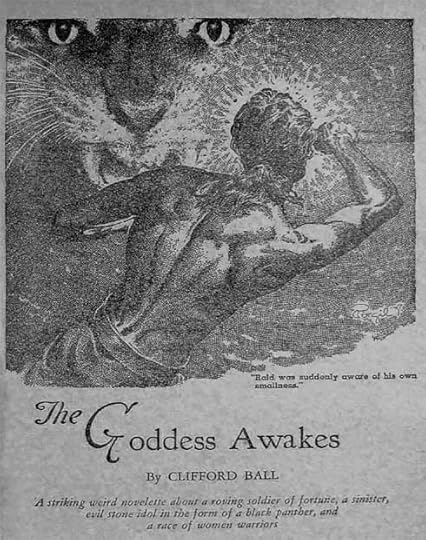
"The Goddess Awakes" (February 1938) is Rald's second adventure. This time Rald and his comrade-in-arms Thwaine have fled a lost battlefield where they served as mercenaries. They encounter women warriors who knock out Rald and take them to their kingdom inside an extinct volcano. There they learn that the women warriors rule and all men are slaves in the mines by order of Throal. The queen of the land is Cene but she is under the power of the wizard Throal and his daughter, the living goddess and statue, Hess. Rald and Thwaine are promised to die in the arena by being eaten by Hess, a gigantic cat.
 This tale smacks more of Edgar Rice Burroughs than Robert E Howard. It only becomes more creepy (and therefore more Howardian) when the cat goddess calls the victims names as the moon draws the living beast out of a stone sphinx. Rald, Thwaine, and their new comrade, Ating - one of the women guards who has fallen for Thwaine - are thrown into a pit. The men try to deal with the goddess with swords, but her gigantic body is impenetrable. It is Queen Cene who saves them by throwing Rald a firebrand. One touch of the flames explodes Hess like a hydrogen zeppelin. Cene takes back her throne by killing Throal with a spear. Like a vampire, he dissolves to an ancient set of bones. His reign is over and the men of Ceipe are free to rejoin the women. The tale ends with Thwaine and Ating ruling the country while Rald and Cene take a year long break to explore the world outside. The whole thing rings more of John Carter than Conan of Cimmeria.
In one respect Clifford Ball did not follow entirely in Howard's footsteps. Ball's three stories all feature very powerful women: the being Shar, the Princess Thrine, and the Queen Cene. Having written only three stories, it is as if Ball chose to copy the longer Howard tales that featured strong female characters such as Yasmina, Belit, and Valeria. His adventure amongst the women warriors of Ceipe plays out more like the opening of Burroughs Pellucidar (1915) than Howard's "Vale of Lost Women," which Ball would not have read since it remained unpublished until Spring 1967.
In just ten months, Ball had given us his version of Howard's style of sword-and-sorcery. These three were all he would do before veering off into writing more traditional fantasy and horror. After only six stories he would disappear from the pulps altogether. But the editors of Weird Tales had a replacement. Henry Kuttner, by far a superior crafter of words, would appear in May 1938 with "Thunder in the Dawn," the first of the Elak of Atlantis stories. Kuttner would more skillfully use the legacy Howard left behind and even innovate, but Clifford Ball can take credit for being the first of a long line of pastichers that would include L Sprague de Camp, Lin Carter, Bjorn Nyberg, John Jakes, Andrew J Offutt, Poul Anderson, and many more.
GW Thomas has appeared in over 400 different books, magazines and ezines including The Writer, Writer's Digest, Black October Magazine and Contact. His website is gwthomas.org. He is editor of Dark Worlds magazine.
June 5, 2017
7 Days in May | Wonder Woman vs Gappa
Wonder Woman (2017)

It's awesome. The first movie in the DCEU that's about an actual super hero. I love that Wonder Woman goes on a character journey that is never about whether or not she's going act heroically. It's about her world view changing from simple and naive to complicated and mature. It shakes her to her core, and there was a Zac Snyder moment that made me worried about what she'd do, but she recovered quickly and got back to the work of fighting evil. Just beautiful.
And I love that the movie is able to introduce her to the world as a fish-out-of-water without sacrificing her confidence. She's learning a new culture and there are funny moments that result, but she's never the object of the joke.
I do want to point out one thing though that bugs me a little. Not about Wonder Woman, but what it reveals about the wider DCEU. In Batman v Superman, Wonder Woman has clearly been gone a long time. No one knows about her or remembers her. It's a major plot point that Batman figures out that she's not a brand new hero, but someone who was around a long time ago. And BvS implies that something happened when she was first here that sent her into hiding. Maybe back to Themyscira, but certainly out of the public eye. And that made me concerned - especially in light of Man of Steel and BvS - that Wonder Woman was going to be another dark movie about how heroism is punished.
Watching Wonder Woman, I can still see that movie in there. Diana does go through the ringer. And I can imagine a Snyder-influenced ending where she gives up her mission and just goes home for 100 years. I am so glad that the folks in charge decided not to do that and instead had Diana stick around to keep working, but it does create a large continuity hole with BvS. Making a movie about a hero is a great course correction for the series, but it is a course correction and not a flawless one.
So far, anyway. I suppose that Justice League could explain why no one's ever heard of her even if she's continued to work in our world. That would be great.
Daikyojû Gappa (1967)
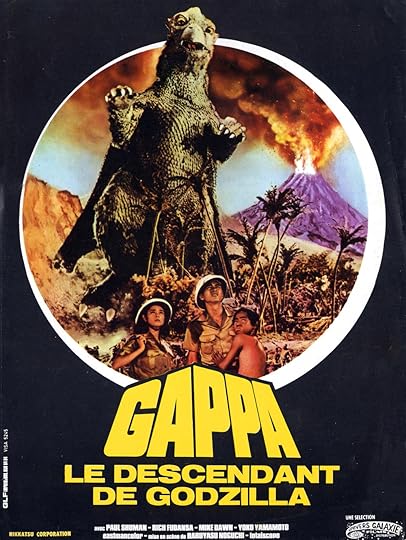
Not every kaiju movie is fun or charming. This one's a mix of Godzilla and King Kong in which a magazine publisher hires some people to round up animals for his new theme park. When they bring back a giant baby bird-lizard, they're flabbergasted about why two adult bird-lizards would follow and start tearing the city apart. Eventually, they figure it out and return the baby to its parents just in time to roll credits. Lame.
El Dorado (1967)
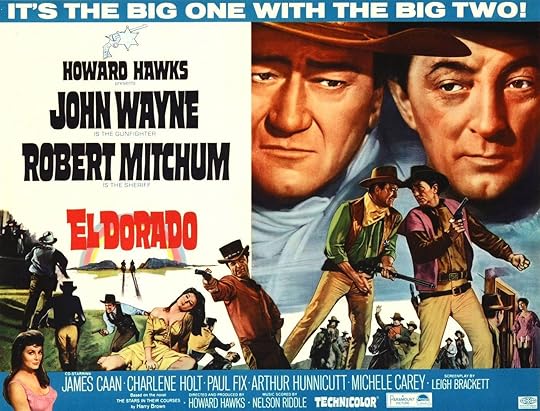
I'm almost as much a Howard Hawks fan as I am a Robert Mitchum fan. And I don't mind John Wayne or James Caan, either. That makes El Dorado one of my favorite Westerns.
It has a couple of problems though. One is an unnecessary, extremely racist gag in the middle. The other is some shaky storytelling that skips over the events that turn Mitchum's character from an affable, highly competent sheriff into an embarrassing drunk. It's explained in dialogue, but it's such an important change that I should've been able to see it.
His journey back is much better, though, featuring the efforts of several friends, including Wayne and his new sidekick Caan, as well as Arthur Hunnicutt as a cantankerous, but extremely cool, old coot. Michele Carey is also awesome as a young woman whose family is being persecuted by evil Ed Asner, and she's not going to just sit back and wait for the men to get their act together.
Jam of the Week: "Lost the Feeling" by The Saint Johns
I dig the light, easy groove, the harmony, and the way they pant the word "I" all through this thing. Very cool.


It's awesome. The first movie in the DCEU that's about an actual super hero. I love that Wonder Woman goes on a character journey that is never about whether or not she's going act heroically. It's about her world view changing from simple and naive to complicated and mature. It shakes her to her core, and there was a Zac Snyder moment that made me worried about what she'd do, but she recovered quickly and got back to the work of fighting evil. Just beautiful.
And I love that the movie is able to introduce her to the world as a fish-out-of-water without sacrificing her confidence. She's learning a new culture and there are funny moments that result, but she's never the object of the joke.
I do want to point out one thing though that bugs me a little. Not about Wonder Woman, but what it reveals about the wider DCEU. In Batman v Superman, Wonder Woman has clearly been gone a long time. No one knows about her or remembers her. It's a major plot point that Batman figures out that she's not a brand new hero, but someone who was around a long time ago. And BvS implies that something happened when she was first here that sent her into hiding. Maybe back to Themyscira, but certainly out of the public eye. And that made me concerned - especially in light of Man of Steel and BvS - that Wonder Woman was going to be another dark movie about how heroism is punished.
Watching Wonder Woman, I can still see that movie in there. Diana does go through the ringer. And I can imagine a Snyder-influenced ending where she gives up her mission and just goes home for 100 years. I am so glad that the folks in charge decided not to do that and instead had Diana stick around to keep working, but it does create a large continuity hole with BvS. Making a movie about a hero is a great course correction for the series, but it is a course correction and not a flawless one.
So far, anyway. I suppose that Justice League could explain why no one's ever heard of her even if she's continued to work in our world. That would be great.
Daikyojû Gappa (1967)

Not every kaiju movie is fun or charming. This one's a mix of Godzilla and King Kong in which a magazine publisher hires some people to round up animals for his new theme park. When they bring back a giant baby bird-lizard, they're flabbergasted about why two adult bird-lizards would follow and start tearing the city apart. Eventually, they figure it out and return the baby to its parents just in time to roll credits. Lame.
El Dorado (1967)

I'm almost as much a Howard Hawks fan as I am a Robert Mitchum fan. And I don't mind John Wayne or James Caan, either. That makes El Dorado one of my favorite Westerns.
It has a couple of problems though. One is an unnecessary, extremely racist gag in the middle. The other is some shaky storytelling that skips over the events that turn Mitchum's character from an affable, highly competent sheriff into an embarrassing drunk. It's explained in dialogue, but it's such an important change that I should've been able to see it.
His journey back is much better, though, featuring the efforts of several friends, including Wayne and his new sidekick Caan, as well as Arthur Hunnicutt as a cantankerous, but extremely cool, old coot. Michele Carey is also awesome as a young woman whose family is being persecuted by evil Ed Asner, and she's not going to just sit back and wait for the men to get their act together.
Jam of the Week: "Lost the Feeling" by The Saint Johns
I dig the light, easy groove, the harmony, and the way they pant the word "I" all through this thing. Very cool.