Michael May's Blog, page 87
December 7, 2017
“Your Reclamation, Then” | Marvel Classic Comics #36 (1978)

The Marvel adaptation also spends several panels faithfully having Scrooge wake up and fret over the weird passage of time. It does some different things with the Spirit, though.
It does away with both holly branch and extinguishing cap, but the biggest change is the choice to make him decidedly masculine (including a beard) and not at all childlike. He's not an old man by any means, but he's essentially a younger version of the Spirit of Christmas Present.
He does have the bright glow (not from the top of his head, but I like the dazzling aura effect as it's drawn). What's weird is that Scrooge still makes the comment about wanting the Spirit to put his cap on, even though there's no cap. I'd tally that up with the other evidence in this adaptation that Scrooge is mad, but the Spirit also refers to the nonexistent cap as if it's there. I haven't been able to come up with an in-story explanation that makes any sense, so no Marvel No-Prize for me.
There's also a lettering flub where the Spirit mentions Scrooge's welfare, but Scrooge's response is omitted. So when the Spirit says, "Your reclamation, then," he's not replying to anything verbal. Maybe he's reading Scrooge's thoughts, but we aren't privy to them as readers.
 Then there's one other oddity around the Spirit's touch. Instead of putting his hand on Scrooge's heart, he simply holds his hand out, palm up. And he says, "Bear but a touch of my hand... here." Not "here" as in, "On your heart." But as in, "Here's my hand for you to touch."
I don't know why Doug Moench changed the line, but it does something interesting in conjunction with the art. The way the hand intersects with Scrooge's cap, it's possible to read the panel as the Spirit's touching Scrooge's head. That's very interesting to me in a comic where I've been questioning Scrooge's sanity for a while. Instead of Scrooge's heart needing healing, perhaps it's his mind. That's obviously not the intended reading, but it fits with the other things I've been noticing and forcing onto this version.
Finishing out the scene, I like how it holds the end of the Spirit's sentence ("and you shall be upheld in more than this!") until the following panel as he's dragging Scrooge out the window and into the air. It's quite dramatic.


December 6, 2017
“Your Reclamation, Then” | Classics Illustrated #53 (1948)

Faithful to Dickens, Classics Illustrated does take a few panels to have Scrooge wake up, experience the sped-up progression of time, and fret about it.
It abandons the old-young Spirit though and goes for a youthful specter with long, blonde hair. Something I didn't mention yesterday was Dickens' refusal to assign a gender to this ghost. He always refers to it as "it." Visual depictions are going to have to decide what to do about that and Classics Illustrated cleverly chooses an androgynous look.
The Spirit has the holly branch in this one and that bright light effect is part of its appearance in every panel, but there's no extinguisher cap. Which is probably good, since this version of Scrooge is one of the meanest and least sympathetic. I wouldn't be surprised to see him extinguish the Spirit's light if he had the opportunity. So the story doesn't give him one.
It also abbreviates Scrooge's conversation with the ghost. Scrooge stammers his initial question about the Spirit's purpose (the old man is clearly scared; there's just not any evidence of change yet) and the Spirit answers that it's there for Scrooge's "welfare and reclamation." That robs Scrooge of his humorous line from the book about a night of unbroken rest. But the Marley scene also removed Scrooge's sense of humor. This Scrooge is all business.
The conversation is so abridged that the Spirit doesn't even explain that it represents Christmas Past. We'll have to pick that up through its actions as it takes Scrooge on tour. [UPDATE: As Caffeinated Joe points out in the comments below, not only does the Spirit announce itself, it does so in the panel I included on this post. I'm a dork.]
It does take a panel to touch Scrooge's heart though. Or rather, to point at Scrooge's heart. We never see the actual touch. The implication is that it happened though, since Scrooge and the Spirit are outside in the next panel. We'll just have to wait to see if the touch had any effect in "upholding" the old man.

December 5, 2017
“Your Reclamation, Then” | Dickens

Illustration by Harry Furniss.
As usual, as we look at Dickens' text, I'm going to copy the entire text of the section in bold italics and insert commentary. That'll help identify elements that we want to pay attention to in the adaptations.
When Scrooge awoke, it was so dark, that looking out of bed, he could barely distinguish the transparent window from the opaque walls of his chamber. He was endeavoring to pierce the darkness with his ferret eyes, when the chimes of a neighboring church struck the four quarters. So he listened for the hour.
To his great astonishment the heavy bell went on from six to seven, and from seven to eight, and regularly up to twelve; then stopped. Twelve! It was past two when he went to bed. The clock was wrong. An icicle must have got into the works. Twelve!
As we noticed last year, Dickens' version had Marley announce that the ghosts would visit one per night over three nights. I assumed that the first visit would start that very night on Christmas Eve, but Dickens makes it clear that that's not the case. Scrooge went to bed at 2:00 am on Christmas morning, so the clock rushes all the way through Christmas Day and we're now hearing it chime midnight as December 25th becomes the 26th.
Of course, most adaptations will ignore this and have everything happen on one night, but I'll point out the ones that stay faithful. I think I remember that some of them do.
He touched the spring of his repeater, to correct this most preposterous clock. It's rapid little pulse beat twelve; and stopped.
A repeater was a kind of clock that would chime the hours (and even minutes, using a different tone) when you pressed a button. It was a way to figure out what time it was in the dark without having to light a candle. I doubt many (if any) adaptations will include this detail, but maybe.
"Why, it isn't possible," said Scrooge, "that I can have slept through a whole day and far into another night. It isn't possible that anything has happened to the sun, and this is twelve at noon!"
The idea being an alarming one, he scrambled out of bed, and groped his way to the window. He was obliged to rub the frost off with the sleeve of his dressing-gown before he could see anything; and he could see very little then. All he could make out was, that it was still very foggy and extremely cold, and that there was no noise of people running to and fro, and making a great stir, as there unquestionably would have been if night had beaten off bright day, and taken possession of the world. This was a great relief, because "three days after sight of this First of Exchange pay to Mr. Ebenezer Scrooge or his order" and so forth, would have become a mere United States' security if there were no days to count by.
A couple of things are going on at the end of that paragraph. Basically, Scrooge is worried that he's going to run out of time to cash in certain IOUs. A "United States security" was a derogatory term that referred to the poor credit that the US had with other countries at the time. So Scrooge is concerned that some of his accounts will become worthless if time is speeding past deadlines.
Scrooge went to bed again, and thought, and thought, and thought it over and over and over, and could make nothing of it. The more he thought, the more perplexed he was; and the more he endeavored not to think, the more he thought. Marley's Ghost bothered him exceedingly. Every time he resolved within himself, after mature inquiry, that it was all a dream, his mind flew back again, like a strong spring released, to its first position, and presented the same problem to be worked all through, "Was it a dream or not?"
Scrooge lay in this state until the chimes had gone three quarters more, when he remembered, on a sudden, that the Ghost had warned him of a visitation when the bell tolled one. He resolved to lie awake until the hour was past; and, considering that he could no more go to sleep than go to Heaven, this was perhaps the wisest resolution in his power.
I doubt many adaptations will spend time on Scrooge's wakeful fretting. If memory serves, they'll either have him go right to sleep after Marley to be awakened by the First Spirit, or they the First Spirit simply shows up right away. We'll keep track, though.
The quarter was so long, that he was more than once convinced he must have sunk into a doze unconsciously, and missed the clock. At length it broke upon his listening ear.
"Ding, dong!"
"A quarter past," said Scrooge, counting.
"Ding, dong!"
"Half past!" said Scrooge.
"Ding, dong!"
"A quarter to it," said Scrooge.
"Ding, dong!"
"The hour itself," said Scrooge, triumphantly, "and nothing else!"
I'm having trouble following the timeline at this point. The clock sped ahead to midnight, then Scrooge fretted for 45 minutes and decided to just wait out the last 15 minutes until 1:00 am. But within those last 15 minutes, the clock chimes three 15-minute periods. Dickens seems to be messing with readers to make them as uncertain about the passage of time as Scrooge is.
He spoke before the hour bell sounded, which it now did with a deep, dull, hollow, melancholy One. Light flashed up in the room upon the instant, and the curtains of his bed were drawn.
The curtains of his bed were drawn aside, I tell you, by a hand. Not the curtains at his feet, nor the curtains at his back, but those to which his face was addressed. The curtains of his bed were drawn aside; and Scrooge, starting up into a half-recumbent attitude, found himself face to face with the unearthly visitor who drew them: as close to it as I am now to you, and I am standing in the spirit at your elbow.
I love that image, that Dickens, as storyteller, is right here with us as we read. It makes him immortal, which, of course, he is.
It was a strange figure - like a child: yet not so like a child as like an old man, viewed through some supernatural medium, which gave him the appearance of having receded from the view, and being diminished to a child's proportions. Its hair, which hung about its neck and down its back, was white as with age; and yet the face had not a wrinkle in it, and the tenderest bloom was on the skin. The arms were very long and muscular; the hands the same, as if its hold were of uncommon strength. Its legs and feet, most delicately formed, were, like those upper members, bare. It wore a tunic of the purest white; and round its waist was bound a lustrous belt, the sheen of which was beautiful. It held a branch of fresh green holly in its hand; and, in singular contradiction to that wintry emblem, had its dress trimmed with summer flowers. But the strangest thing about it was, that from the crown of its head there sprung a bright clear jet of light, by which all this was visible; and which was doubtless the occasion of its using, in its duller moments, a great extinguisher for a cap, which it now held under its arm.
Even this, though, when Scrooge looked at it with increasing steadiness, was not its strangest quality. For as its belt sparkled and glittered now in one part and now in another, and what was light one instant, at another time was dark, so the figure itself fluctuated in its distinctness: being now a thing with one arm, now with one leg, now with twenty legs, now a pair of legs without a head, now a head without a body: of which dissolving parts, no outline would be visible in the dense gloom wherein they melted away. And in the very wonder of this, it would be itself again; distinct and clear as ever.
It's easy to see why this Spirit gets the most variation in how it's represented. It has to be simultaneously old and young, while also as flickering and changing in appearance as a flame. Almost impossible to do with live action and even tough for the static images in comics. If anything's going to be able to get close, it'll have to be the animated versions.
It'll be fun to see which aspects of the Spirit the different adaptations focus on. And I wonder how those highlighted aspects will relate to Scrooge's reaction to this Spirit and what lessons he learns from it. For example, if the Spirit is depicted as old in a version, what does that say about its message to Scrooge? And how does that change if the Spirit is depicted as young? We won't be able to answer all of those questions this year, but by noting what the various versions are emphasizing in the Spirit, we'll lay groundwork to build more complicated theories on in the next couple of years.
"Are you the Spirit, sir, whose coming was foretold to me?" asked Scrooge.
"I am!"
The voice was soft and gentle. Singularly low, as if instead of being so close beside him, it were at a distance.
"Who, and what are you?" Scrooge demanded.
"I am the Ghost of Christmas Past."
"Long past?" inquired Scrooge: observant of its dwarfish stature.
"No. Your past."
Perhaps, Scrooge could not have told anybody why, if anybody could have asked him; but he had a special desire to see the Spirit in his cap; and begged him to be covered.
"What!" exclaimed the Ghost, "would you so soon put out, with worldly hands, the light I give? Is it not enough that you are one of those whose passions made this cap, and force me through whole trains of years to wear it low upon my brow!"
Scrooge reverently disclaimed all intention to offend, or any knowledge of having wilfully "bonneted" the Spirit at any period of his life. He then made bold to inquire what business brought him there.
"Your welfare!" said the Ghost.
Scrooge expressed himself much obliged, but could not help thinking that a night of unbroken rest would have been more conducive to that end. The Spirit must have heard him thinking, for it said immediately:
"Your reclamation, then. Take heed!"
I notice that while Scrooge still has some wit about him, he's being very polite to the Spirit. Marley wore him down to the point where he acknowledged that there may be some need for change. But Scrooge isn't ready to commit to making those changes. It sounds hard... and he's prideful.
So we'll take not of Scrooge's attitude towards the Ghost in the adaptations.
It put out it's strong hand as it spoke, and clasped him gently by the arm.
"Rise! and walk with me!"
It would have been in vain for Scrooge to plead that the weather and the hour were not adapted to pedestrian purposes; that bed was warm, and the thermometer a long way below freezing; that he was clad but lightly in his slippers, dressing-gown, and nightcap; and that he had a cold upon him at that time. The grasp, though gentle as a woman's hand, was not to be resisted. He rose: but finding that the Spirit made towards the window, clasped its robe in supplication.
"I am mortal," Scrooge remonstrated, "and liable to fall."
"Bear but a touch of my hand there," said the Spirit, laying it upon his heart, "and you shall be upheld in more than this!"
A lovely image and claim to end on. I wonder how many adaptations will include it.
So here's what we're looking for this year:
The timeline: which adaptations rush through the clock to get to midnight the next day?The Spirit's appearanceScrooge's attitude toward the Spirit.Does the Spirit touch Scrooge's heart?

December 4, 2017
The Christmas Carol Project | “Your Reclamation, Then.”

It's the Most Wonderful Time of the Year, which means that it's also time to get back to our annual look at everyone's favorite Christmas/ghost story, Charles Dickens' A Christmas Carol. If you're new to this, the idea is to pay attention to the way Scrooge's story has been interpreted and adapted to other media over the years. I’ve broken the story into scenes (or sometimes parts of scenes) in order to look at their translation to 19 different films, TV shows, and comics.
Here's the list of adaptations in the order I'll take them:
• Classics Illustrated #53 (1948)
• Marvel Classics Comics #36 (Marvel; 1978)
• A Christmas Carol: The Graphic Novel (Classical Comics; 2008)
• A Christmas Carol (Campfire; 2010)
• "A Christmas Carol" in Graphic Classics, Vol. 19: Christmas Classics (Eureka; 2010)
• Teen Titans #13 (DC; 1968)
• A Christmas Carol cartoon (1971) starring Alastair Sim
• The Stingiest Man in Town (1978) starring Walter Matthau
• Mickey’s Christmas Carol (1983) starring Scrooge McDuck
• A Christmas Carol (2009) starring Jim Carrey
• A Christmas Carol (1910) starring Marc McDermott
• Scrooge (1935) starring Seymour Hicks
• A Christmas Carol (1938) starring Reginald Owen
• Scrooge (1951) starring Alastair Sim
• "A Christmas Carol" episode of Shower of Stars (1954) starring Fredric March
• Scrooge (1970) starring Albert Finney
• A Christmas Carol (1984) starring George C. Scott
• The Muppet Christmas Carol (1992) starring Michael Caine
• A Christmas Carol (1999) starring Patrick Stewart
Annual Disclaimer: This obviously isn’t an exhaustive list. I started with my favorites, added some that people have recommended over the years, and then threw in some others that just caught my curiosity. We can talk about the ones I left out, but I will say that the reason Mr Magoo’s Christmas Carol isn’t here is because I hate it with a passion. It’s neither a good Christmas Carol nor a good Mister Magoo cartoon. There’s also no Scrooged or An American Christmas Carol or Ghosts of Girlfriends Past. When I first started this, I tried to stick to more or less faithful adaptations, but even though I've since added Teen Titans to the list, I'd rather that be a fun exception and not have to figure out where I'm going to draw the line.
This is going to take years. Every December we'll look at one scene, starting with Dickens' version, then exploring individual adaptations of that scene in the days leading up to Christmas. This year's scene is one I've been looking forward to for a long time. We get to meet the Ghost of Christmas Past: a character with some wildly different interpretations, (almost?) none of which are accurate to the book. It'll be fun to try to figure out why that is.

December 1, 2017
Guest Post | Groo vs Conan: A Hyborian Romp
By GW Thomas
 December 1932: Conan the Cimmerian explodes onto the pages of Weird Tales in "The Phoenix on the Sword" by Robert E Howard. Not the first sword-and-sorcery tale (that was Howard's earlier Kull tale, "The Shadow Kingdom"), but "Phoenix" did begin a fantasy franchise that is still a hit today in novels, comics, and occasionally films and television.
Sergio Aragones was born just a little under five years later, in Spain. He rose to fame as a cartoonist in Mad Magazine, drawing all those little margin cartoons beginning in 1963. Mark Evanier (who will come in this story later) estimates that Sergio drew over 12,000 of them.
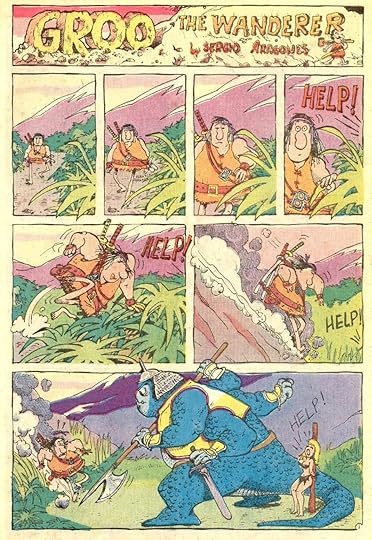
In May 1982, fifty years after Conan stepped onto the sword-and-sorcery stage, Groo the Wanderer appeared for the first time in the back pages of Destroyer Duck #1. This four-page battle scene between Groo and a four-armed dinosaur ninja goes badly for the princess whom Groo is attempting to save. The strip bears only Aragones name as he had yet to team up with writer Mark Evanier (see, told ya). This he would do for a back-up story in Starslayer #5 (November 1982). A five-pager this time, announcing the coming of Groo's own comic. And so it went. First Pacific Comics, then Marvel's Epic line, then Dark Horse. He is Groo "the Wanderer" after all.
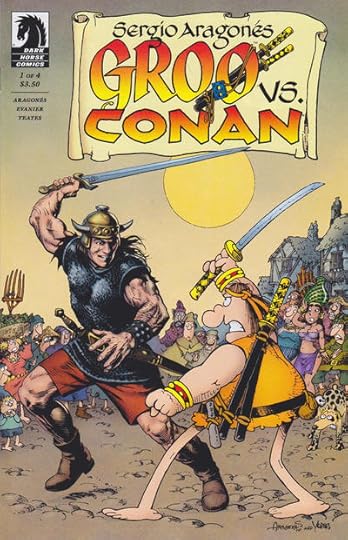 In July 2014, we finally saw the stars align and the impossible happened. Conan, superstar of sword-and-sorcery, met Groo, super parody of same, in Groo vs. Conan, a four-part series. Begun in 2011, unavoidable delays due to back surgery kept the crossover from seeing print until 2014.
The plot is made up of three threads: first, that of the creators Sergio and Mark, who are trying to save a comic shop from being closed by a ruthless lawyer. Sergio ends up in the hospital and receives multiple medicinal shots, resulting in him running around the city in a hospital gown thinking he is Conan on a glorious adventure.
The second thread is Groo's, as he is hired to stop a protest around a bakery that is being closed by a ruthless vizier. When the townsfolk hear that Groo is coming, they cry that a terrible monster has come to kill them all.
The third thread is Conan's as he leaves his home to face the terrible monster Groo. The two meet and different versions of their meeting are told in taverns around the town. Meanwhile, back in Conan's village, his second in command Olaf takes over, having heard that Conan lost to Groo and is dead. All these threads rush together in what turns out to be a fairly predictable ending. Lawyer and vizier are defeated as Groo and Conan team up to fight a common enemy (what else would happen in a cross-over!). Poor Olaf when he finds out that Conan has not fallen in battle...
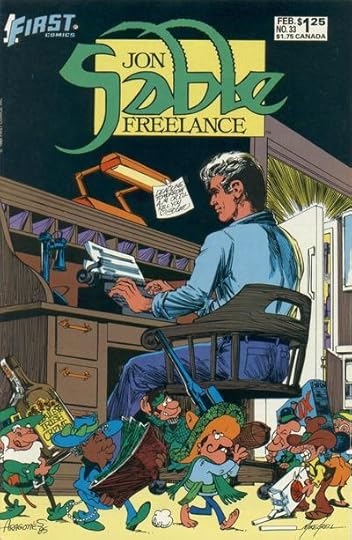 [NB: It turns out this wasn't the first time Sergio Aragones appeared as himself in a comic. In Jon Sable, Freelance #33 (Febuary 1986), Aragones is invited to draw the comic book version of BB Flemm's children's fantasy called "Cave of the Half-Pints," about leprechauns living in Central Park. Aragones appears alongside characters like Jon Sable and even ends up in a hot tub with his female agent.]
The final result of Groo versus Conan is a fun romp. The Aragones art is hilarious as always. To blend the more realistic Conan art of Tom Yeates must have been challenging, but the effect is good; something similar to Pete's Dragon animation from Disney back in the day. The jokes are fast and furious, with Evanier taking good-natured shots at hospitals, health care, the police, comic book fans, and best of all, at Sergio and Mark and their long working relationship. The sword-and-sorcery jokes were not as many as I would have liked, but after thirty-two years of Groo comics, what's left? Conan plays the straight man most often, with lines about how he must endure Groo's stupidity. Like so many actors faced with acting with a comedic maniac like Jim Carrey or Robin Williams, what do you do? Stand back and let them fly.
GW Thomas has appeared in over 400 different books, magazines and ezines including The Writer, Writer's Digest, Black October Magazine and Contact. His website is gwthomas.org. He is editor of Dark Worlds magazine.
 December 1932: Conan the Cimmerian explodes onto the pages of Weird Tales in "The Phoenix on the Sword" by Robert E Howard. Not the first sword-and-sorcery tale (that was Howard's earlier Kull tale, "The Shadow Kingdom"), but "Phoenix" did begin a fantasy franchise that is still a hit today in novels, comics, and occasionally films and television.
Sergio Aragones was born just a little under five years later, in Spain. He rose to fame as a cartoonist in Mad Magazine, drawing all those little margin cartoons beginning in 1963. Mark Evanier (who will come in this story later) estimates that Sergio drew over 12,000 of them.
In May 1982, fifty years after Conan stepped onto the sword-and-sorcery stage, Groo the Wanderer appeared for the first time in the back pages of Destroyer Duck #1. This four-page battle scene between Groo and a four-armed dinosaur ninja goes badly for the princess whom Groo is attempting to save. The strip bears only Aragones name as he had yet to team up with writer Mark Evanier (see, told ya). This he would do for a back-up story in Starslayer #5 (November 1982). A five-pager this time, announcing the coming of Groo's own comic. And so it went. First Pacific Comics, then Marvel's Epic line, then Dark Horse. He is Groo "the Wanderer" after all.
 In July 2014, we finally saw the stars align and the impossible happened. Conan, superstar of sword-and-sorcery, met Groo, super parody of same, in Groo vs. Conan, a four-part series. Begun in 2011, unavoidable delays due to back surgery kept the crossover from seeing print until 2014.
The plot is made up of three threads: first, that of the creators Sergio and Mark, who are trying to save a comic shop from being closed by a ruthless lawyer. Sergio ends up in the hospital and receives multiple medicinal shots, resulting in him running around the city in a hospital gown thinking he is Conan on a glorious adventure.
The second thread is Groo's, as he is hired to stop a protest around a bakery that is being closed by a ruthless vizier. When the townsfolk hear that Groo is coming, they cry that a terrible monster has come to kill them all.
The third thread is Conan's as he leaves his home to face the terrible monster Groo. The two meet and different versions of their meeting are told in taverns around the town. Meanwhile, back in Conan's village, his second in command Olaf takes over, having heard that Conan lost to Groo and is dead. All these threads rush together in what turns out to be a fairly predictable ending. Lawyer and vizier are defeated as Groo and Conan team up to fight a common enemy (what else would happen in a cross-over!). Poor Olaf when he finds out that Conan has not fallen in battle...
 [NB: It turns out this wasn't the first time Sergio Aragones appeared as himself in a comic. In Jon Sable, Freelance #33 (Febuary 1986), Aragones is invited to draw the comic book version of BB Flemm's children's fantasy called "Cave of the Half-Pints," about leprechauns living in Central Park. Aragones appears alongside characters like Jon Sable and even ends up in a hot tub with his female agent.]
The final result of Groo versus Conan is a fun romp. The Aragones art is hilarious as always. To blend the more realistic Conan art of Tom Yeates must have been challenging, but the effect is good; something similar to Pete's Dragon animation from Disney back in the day. The jokes are fast and furious, with Evanier taking good-natured shots at hospitals, health care, the police, comic book fans, and best of all, at Sergio and Mark and their long working relationship. The sword-and-sorcery jokes were not as many as I would have liked, but after thirty-two years of Groo comics, what's left? Conan plays the straight man most often, with lines about how he must endure Groo's stupidity. Like so many actors faced with acting with a comedic maniac like Jim Carrey or Robin Williams, what do you do? Stand back and let them fly.
GW Thomas has appeared in over 400 different books, magazines and ezines including The Writer, Writer's Digest, Black October Magazine and Contact. His website is gwthomas.org. He is editor of Dark Worlds magazine.
November 30, 2017
Holiday Affair (1949)

Who's In It: Robert Mitchum (Thunder Road, The Way West), Janet Leigh (Little Women '49, Psycho) Wendell Corey (The Great Missouri Raid, Rear Window), Gordon Gebert (The Flame and the Arrow, The House on Telegraph Hill), and special guest star Harry Morgan (High Noon, MASH) as a cop in one scene.
What It's About: A woman's (Leigh) Christmas is turned upside down when her feelings for a department store clerk (Mitchum) complicate her relationship with her lawyer boyfriend (Corey).
How It Is: What a great transition from Noirvember to Christmas. I saw this (or rather, the last half of it) a few years ago and have wanted to see it the whole way through ever since. It's totally romantic comedy and if it was remade today it would go straight to the Hallmark Channel. But it's got Robert Mitchum and Janet Leigh and some other excellent performances, so its a new holiday classic for me.
This is an early role for Leigh, who plays the main character Connie. It was Leigh's tenth film, but her debut was just a couple of years earlier and it's easy to see why she was so busy so quickly. She's stunningly beautiful, for starters, but she's also crazy good and totally reels me in as a young widow trying to raise her son Timmy (Gebert) on her own. She's got support, including her in-laws and her boyfriend Carl, but she's also fiercely independent and protective of her and Timmy's autonomy. That's kept her distant from Carl - who desperately wants to marry her - and it's also a problem when she meets and becomes attracted to Mitchum's Steve.
Holiday Affair is an unusual genre for tough-guy Mitchum, but he's not exactly playing against type. He's still super confident and charming; he's just not punching anyone. And he gets a lot of opportunity to interact with kids, which is adorable.
Gebert is great, too. You could swap him out with little Ronnie Howard and I wouldn't complain, but the movie wouldn't be any better. He's a good actor and super cute.
And I quite like Corey as Carl. One synopsis I read describes him as "stuffy," but that's not the impression I got. He's solid and reliable, but he's also very clearly, deeply in love with Connie. He's a great guy and I especially love a speech he gives about the relationship he wants to have with Timmy. Unfortunately for Carl, it's also clear to the audience that Connie's not in love with him. But it'll take Steve to get everyone on the same page.
The story isn't unique, but the cast is so good that I get wrapped up in their characters. This is one I'm adding to my annual Christmas marathon.
Rating: 4 out of 5 best couples ever.


November 29, 2017
Thundarr Road | Interview with Buzz Dixon

In this special episode, we took a break from recapping the show to talk with very special guest, Thundarr the Barbarian writer Buzz Dixon! He's a great storyteller and had lots to tell us about not just working on Thundarr and his time with Ruby-Spears, but anecdotes from all across his prolific career: from Tarzan and the Super Seven to GI Joe, Transformers, and beyond!
If you're a fan of cartoons, especially the Saturday morning variety, you don't want to miss this episode!

November 28, 2017
Thunder Road (1958)

I'm wrapping up Noirvember with another Robert Mitchum movie that's been on my list for a long time. It's the inspiration for the title of our Thundarr the Barbarian podcast, so it's about time I finally watched it.
Who's In It: Robert Mitchum (The Night of the Hunter, Cape Fear), Gene Barry (The War of the Worlds, Bat Masterson), Keely Smith (sang with and was married to Louis Prima for a while), Sandra Knight (Frankenstein's Daughter, The Terror), and James Mitchum (son of Bob).
What It's About: A moonshine runner (Robert Mitchum) fights a war on two fronts (the law and a crime organization trying to take over the territory) while trying to protect the people he cares about.
How It Is: Mitchum's as charming as ever and I really love that his son is playing his kid brother. They don't just look alike; they also have a lot of chemistry and it raises the stakes considerably to believe so deeply that Luke (Robert Mitchum) is desperate to keep Robin (James) out of the driver's seat. I do wonder how awesome it would have been if Elvis Presley (Mitchum's first choice to play Robin; curse you, Col. Tom Parker) had been in the film, but as much as I love Elvis, I'm not sure I'd want to trade in James.
There's a lot of cool driving stuff, with Luke using a couple of different, tricked out cars. And I enjoyed his confrontations with the law (represented by Gene Barry) and the crime syndicate. The Appalachia and Memphis settings are cool, too.
What pulls the movie down for me though is Luke's unconvincing insistence that he can't escape his job. It's not even that he really wants to escape it. He clearly loves it and simply refuses to give it up. But what's never clear to me is why he feels that way. He has a lot going on in his life including his family and two women who care deeply about him: a Memphis nightclub singer (Smith) and local girl Roxie (Knight). He cares enough about all of these people to want to keep them at a distance where they won't be hurt by his occupation, but not so much that he's willing to give it up and do something different with his life. That would be a great conflict to explore if I better understood what's keeping him behind the wheel in the first place.
Rating: 3 out of 5 proto-Duke Boys.


November 27, 2017
Mystery Movie Night | AI (2001), The Hunt for Red October (1990), and Die Hard (1988)

On the latest Mystery Movie Night, Dave, David, Erik (he's back!), and I are joined by my good buddy Evan Hanson to talk robots, Russians, and Roy Rogers. Is AI a misunderstood work of genius or a big giant mess? Who's the best Jack Ryan? Is Die Hard a Christmas movie? We figure it all out.
00:00:45 - Review of AI: Artificial Intelligence
00:23:17 - Review of The Hunt for Red October
00:43:00 - Review of Die Hard
01:10:03 - Guessing the Connection

November 22, 2017
Speculative Chic's Justice League Sound Off!

I'm a very occasional contributor to the Speculative Chic website and this week was one of the occasions. I joined some of the other writers to talk about Justice League and we're mostly in agreement about how well it succeeds as the next step in Warner Bros' attempt to build a DC cinematic universe. Go check it out!