Michael May's Blog, page 85
December 25, 2017
Guest Post | The Four Color Adventures of Frosty the Snowman
By GW Thomas
 From just about the very beginning of comic books, publishers have realized that with the extra leisure and more generous spending habits of December, it’s a great time to sell more comics. Thus the Christmas Special. From Bugs Bunny to Superman, the Christmas comic became a seasonal surety on wire store racks.
1950 was the year Gene Autry tried for Christmas gold a second time. His first hit had been “Rudolph the Red-Nosed Reindeer,” which had been Number 1 the year previous. His rendition of Jack Rollins and Steve Nelson’s song “Frosty the Snowman” proved almost as impressive (getting to Number 7), adding yet another entry to the pantheon of non-religious Christmas characters. The song would have to wait nineteen years to get a cartoon based on it, but in the meantime, the comic specials filled that void.
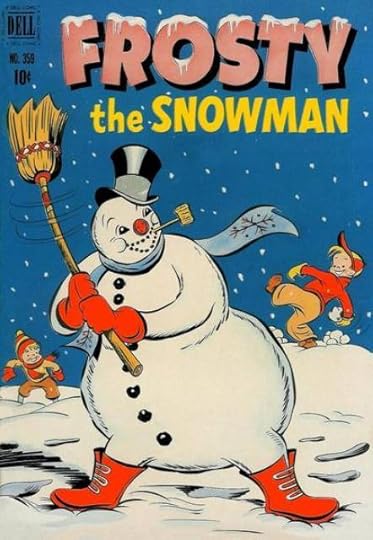
Dell had the popular anthology comic, Four Color, which alternated between familiar newspaper comic characters, Disney and Warner Brothers, to movie and TV adaptations. The year after Autry’s hit, readers saw the first Frosty the Snowman comic with Four Color #359 (November 1951). Written and drawn by Jon Stanley and Dan Gormley, it set the pattern for the next ten years. Gormley would draw seven of the eleven issues, each showing up in November or December.
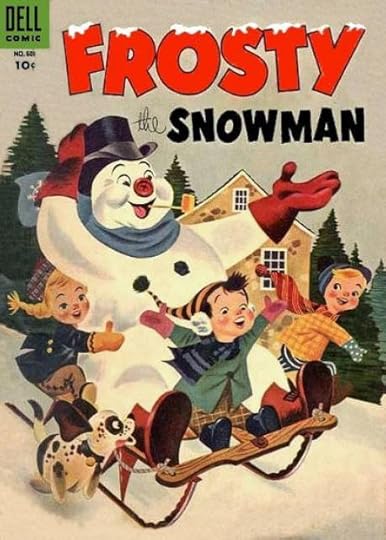 Many of the stories are suggested by the original song. “Before I melt away” inspires several stories where Frosty needs to keep himself from melting, such as “The Heat Wave” (December 1961). “There must have been some magic in that old silk hat they found” gives us several stories about the hat, whether stolen by evil snowmen or lost in a mix-up after being cleaned. Later, when the cartoons were done in the 1960s, they too latched onto these ideas.
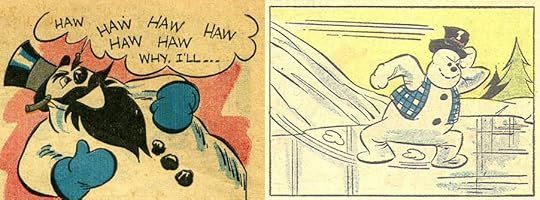
The first full-length story, “The Evil Snowman,” features a villainous snowman with a black Russian beard. The story would get a second version (called “The Snowman Contest”) in the final issue where the evil snowman wears a checked vest instead. (After eleven years of stories, even Gormley had run dry.) This first issue also introduces some of Frosty’s sidekicks: a rabbit named Skeeter, Santa Claus (with his elves and reindeer), Jack Frost, the Straw Man, and a gang of kids who come to the rescue whenever Frosty needs them.
Most of the Frosty plots follow similar themes. There are a good number of stories in which Frosty loses his hat like, “Frosty the Snowman and the Old Top Hat” (November 1952) and “Magic Hat” (December 1958). He doesn’t turn into an immobile snowman, but he can’t walk around (or skip and dance, as he often points out) either, and it is up to kids or animals or mere chance to bring his hat back.
Other stories focus on Frosty as helper or hero, usually for a small child or animals, like the ducks and other forest creatures in “Saving Frozen Ducks” (November 1952), “Frosty the Snowman Makes the Forest Safe”(November 1953), and “Frosty the Snowman and Peter Polar Bear” (November 1954). In these tales, Frosty may go on a long journey, giving the story a grander scope than the neighborhood tales. Sometimes he is helping Santa Claus, like when the elves all come down with the flu or the toys are missing. Frosty encounters a number of witches in these stories, as they require a villain, like the one who has taken all the hobby horses in “Frosty the Snowman and the Crystal Castle” (November 1953). Wolves and foxes also show up as bad guys.
Frosty also acts as teacher sometimes to boys who have lost their way. “Bad Bobbie” (November 1953) has Bobbie tricking Frosty into shoveling the walk for him, but when Bobbie tries to get Frosty onto skis, the tables are turned. Frosty is an expert skier and causes a pile of snow to recover Bobby’s walkway. These bad boys usually see the error of their ways and become good with Frosty’s help.
And lastly, my favorite of the Frosty stories are mysteries, where Frosty acts as detective. The November 1954 issue had “Down on the Farm” where a “ghost” is playing practical jokes on the farm animals. Frosty, of course, uses his little white cells and figures out who is the culprit. “The Missing Page” (December 1960-February 1961) has Frosty help a girl find part of a missing book.
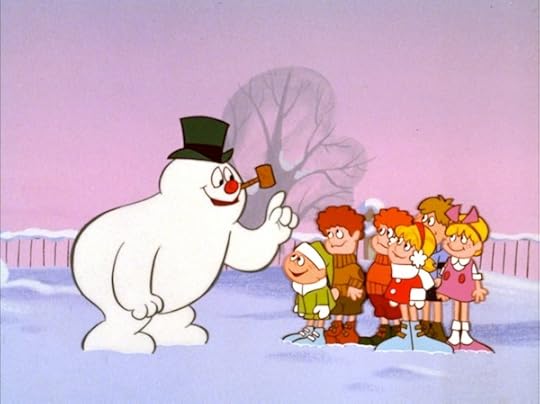 In 1964, Rankin-Bass' animated Rudolph the Red-Nosed Reindeer would premiere. A perennial favorite, it featured a snowman named Sam, not Frosty (and modeled on the actor who played him, Burl Ives). In 1969, Rankin-Bass acquired the Frosty property and put out an animated cartoon of him that has also become a seasonal fixture, with Jackie Vernon as the loveable snowman. R-B did a crossover cartoon in 1979 called Rudolph the Reindeer and the Island of Misfit Toys. All of these animated shows remind me of material in the Dell comics, especially the idea of Frosty's becoming associated with Santa and the North Pole, though it is hard to say if they had any influence as many of the ideas can be found in the original song.
GW Thomas has appeared in over 400 different books, magazines and ezines including The Writer, Writer's Digest, Black October Magazine and Contact. His website is gwthomas.org. He is editor of Dark Worlds magazine.
 From just about the very beginning of comic books, publishers have realized that with the extra leisure and more generous spending habits of December, it’s a great time to sell more comics. Thus the Christmas Special. From Bugs Bunny to Superman, the Christmas comic became a seasonal surety on wire store racks.
1950 was the year Gene Autry tried for Christmas gold a second time. His first hit had been “Rudolph the Red-Nosed Reindeer,” which had been Number 1 the year previous. His rendition of Jack Rollins and Steve Nelson’s song “Frosty the Snowman” proved almost as impressive (getting to Number 7), adding yet another entry to the pantheon of non-religious Christmas characters. The song would have to wait nineteen years to get a cartoon based on it, but in the meantime, the comic specials filled that void.
Dell had the popular anthology comic, Four Color, which alternated between familiar newspaper comic characters, Disney and Warner Brothers, to movie and TV adaptations. The year after Autry’s hit, readers saw the first Frosty the Snowman comic with Four Color #359 (November 1951). Written and drawn by Jon Stanley and Dan Gormley, it set the pattern for the next ten years. Gormley would draw seven of the eleven issues, each showing up in November or December.
 Many of the stories are suggested by the original song. “Before I melt away” inspires several stories where Frosty needs to keep himself from melting, such as “The Heat Wave” (December 1961). “There must have been some magic in that old silk hat they found” gives us several stories about the hat, whether stolen by evil snowmen or lost in a mix-up after being cleaned. Later, when the cartoons were done in the 1960s, they too latched onto these ideas.
The first full-length story, “The Evil Snowman,” features a villainous snowman with a black Russian beard. The story would get a second version (called “The Snowman Contest”) in the final issue where the evil snowman wears a checked vest instead. (After eleven years of stories, even Gormley had run dry.) This first issue also introduces some of Frosty’s sidekicks: a rabbit named Skeeter, Santa Claus (with his elves and reindeer), Jack Frost, the Straw Man, and a gang of kids who come to the rescue whenever Frosty needs them.
Most of the Frosty plots follow similar themes. There are a good number of stories in which Frosty loses his hat like, “Frosty the Snowman and the Old Top Hat” (November 1952) and “Magic Hat” (December 1958). He doesn’t turn into an immobile snowman, but he can’t walk around (or skip and dance, as he often points out) either, and it is up to kids or animals or mere chance to bring his hat back.

Other stories focus on Frosty as helper or hero, usually for a small child or animals, like the ducks and other forest creatures in “Saving Frozen Ducks” (November 1952), “Frosty the Snowman Makes the Forest Safe”(November 1953), and “Frosty the Snowman and Peter Polar Bear” (November 1954). In these tales, Frosty may go on a long journey, giving the story a grander scope than the neighborhood tales. Sometimes he is helping Santa Claus, like when the elves all come down with the flu or the toys are missing. Frosty encounters a number of witches in these stories, as they require a villain, like the one who has taken all the hobby horses in “Frosty the Snowman and the Crystal Castle” (November 1953). Wolves and foxes also show up as bad guys.
Frosty also acts as teacher sometimes to boys who have lost their way. “Bad Bobbie” (November 1953) has Bobbie tricking Frosty into shoveling the walk for him, but when Bobbie tries to get Frosty onto skis, the tables are turned. Frosty is an expert skier and causes a pile of snow to recover Bobby’s walkway. These bad boys usually see the error of their ways and become good with Frosty’s help.
And lastly, my favorite of the Frosty stories are mysteries, where Frosty acts as detective. The November 1954 issue had “Down on the Farm” where a “ghost” is playing practical jokes on the farm animals. Frosty, of course, uses his little white cells and figures out who is the culprit. “The Missing Page” (December 1960-February 1961) has Frosty help a girl find part of a missing book.
 In 1964, Rankin-Bass' animated Rudolph the Red-Nosed Reindeer would premiere. A perennial favorite, it featured a snowman named Sam, not Frosty (and modeled on the actor who played him, Burl Ives). In 1969, Rankin-Bass acquired the Frosty property and put out an animated cartoon of him that has also become a seasonal fixture, with Jackie Vernon as the loveable snowman. R-B did a crossover cartoon in 1979 called Rudolph the Reindeer and the Island of Misfit Toys. All of these animated shows remind me of material in the Dell comics, especially the idea of Frosty's becoming associated with Santa and the North Pole, though it is hard to say if they had any influence as many of the ideas can be found in the original song.
GW Thomas has appeared in over 400 different books, magazines and ezines including The Writer, Writer's Digest, Black October Magazine and Contact. His website is gwthomas.org. He is editor of Dark Worlds magazine.


December 24, 2017
“Your Reclamation, Then” | Patrick Stewart (1999)

Index of other entries in The Christmas Carol Project
In the TNT Christmas Carol, Scrooge went to bed not at all sure that he'd really seen Marley. The ghost's words had made Scrooge pause and think, but as far as he knew, he was going to be able to fall asleep and wake up the next morning completely the same.
He's snoring as this scene opens, but he's awakened by a distant chiming. "Quarter past," he notes, and grabs the newspaper he'd taken to bed with him. The chiming continues though and Scrooge gets confused. "Half past?" And on it goes through "quarter to it" and "the hour itself." By the end though, he's not trying to figure out why time has sped up; he's relieved. "Nothing's happened," he says confidently. He knew it was all in his head. Or rather, in his stomach.
But the "hour itself" chime was just the lead up to the actual tolling of the hour. When that sounds, a bright light shines in the room and a black-gloved hand pulls aside Scrooge's bed curtains. It's Joel Grey looking very bright and Christmasy in a white poofy shirt, silver vest, and gold cumberbund. He doesn't hold the holly branch, but - like a couple of other versions - wears a garland of holly around his neck to keep his hands free. He carries the cap under his arm and I almost want to ask him to put it on myself, because an extremely bright light is shining on him. So much so that it washes out the rest of the picture. This is intentional though and the film will correct it soon.
Scrooge has to shield his eyes with his hand just to look in the spirit's direction. As they get the introductions out of the way ("your past"), Grey plays his role impishly with a twinkle in his eye and a mischievous smile on his lips. He stands very still as he does it, letting his face do all the work. It's a lovely performance and I like his Ghost immediately.
Scrooge asks the Spirit to put on its cap and be covered. The conversation goes as Dickens wrote it, but when Scrooge respectfully says that he has "no intention of offending you, sir," the Spirit's glow dims to a manageable level. He does have Scrooge's welfare at heart.
When he says so, Scrooge gets cranky and complains that a peaceful night of unbroken rest would have been more conducive to that end. I still get the feeling that Scrooge doesn't quite believe what's going on. But whether it's real or not, he resents its intruding on his sleep.
However, when the Spirit changes his phrasing to "your reclamation, then," that makes Scrooge thoughtful. Marley said that he believed Scrooge needed saving and now this Spirit has repeated it. It's starting to sink in.
The Spirit holds out his hand to Scrooge and says very gently, "Come with me."
Scrooge makes some awesome excuses. "Some other time, perhaps. I'm not dressed. I have a weak chest. Monstrous head cold." He's trying to reassert some control over the situation, but the Spirit oh so mildly insists. His hand still outstretched, he nods and smiles. "Rise. And walk with me." I love Grey in this. It's probably my favorite Christmas Past.
And of course Patrick Stewart is amazing as well. He gets up and holds out his hand, but he's shaking his head the whole time and there's fear in his eyes. If he touches the Spirit, this is going to become real. And that terrifies him.
As the Spirit leads him toward the window, he becomes even more frightened. He says that it's because he's mortal and liable to fall, but I don't think it's about the height. It's about whatever he's about to experience. And it suddenly hits me that Scrooge's mortality and ability to fall is also a metaphor for his spiritual state. He's petrified at being confronted with his own fallibility. It took Stewart's performance to reveal this. Genius.
The Spirit reassures Scrooge that "all I have to do is touch you... there." And he gracefully puts his hand on Scrooge's chest. He doesn't have to say, "And you shall be upheld." It's all in the performances. Scrooge's fear. The Spirit's encouragement. It honestly puts a little lump in my throat.
And as if to not agonize Scrooge further, the Spirit doesn't fly out the window with him. Instead, the room dissolves around them and becomes a snowy forest.

December 23, 2017
“Your Reclamation, Then” | Michael Caine (1992)

Index of other entries in The Christmas Carol Project
The Muppets cut from Scrooge's going to bed to back outside where Gonzo and Rizzo are trying to get inside the house to continue narrating. It's some fun shenanigans, but nothing important to the story.
Back inside, Scrooge is asleep and still holding his poker. He's left a candle burning and it's lighting up the room pretty well; even shining through Scrooge's thin bed curtains. A clock shows that it's five minutes to one, so the film uses the time to visit Gonzo and Rizzo again as they're climbing a rope to get to Scrooge's upstairs window. Gonzo is back to narrating, talking about how Scrooge is in a dreamless sleep.
Inside once more, the clock finally chimes one and causes Scrooge to open an eye. His candle goes out and Gonzo, now on top of a tree branch right outside Scrooge's window, yells a repeat of the Marleys' warning, "Expect the first ghost when the bell tolls one!" And on cue, Scrooge's window fills with blinding light.
Scrooge is startled into getting up and - poker in hand - opens his bed curtains. The light gathers itself into a single point, finally taking the form of a small, floating child with gauzy robes that swim around her. There's no cap or holly and the only reference to fire is her flaming red hair.
Scrooge puts down the poker and comments on her apparent youth. She explains that she can remember nearly 1900 years, so she's the Ghost of All Christmas' Past, then; not just Scrooge's.
Scrooge is polite. He's probably a little freaked out, but she doesn't appear to be a threat. And when she says that she's there for his welfare, he's bold enough to suggest a night's unbroken rest might aid him better.
She changes her mission to his "salvation, then." If the story is about Scrooge's avoiding Hell, then words like "reclamation," "redemption," and "salvation" are relatively interchangeable, but I don't think that's the best interpretation. When we get to the Ghost of Christmas Yet to Come, the focus will be on Scrooge's impact on this world; not his fate in the next. So in that context, "salvation" has to refer to Scrooge's being saved from his own misery. It basically means the same thing as "reclamation," where he's being reclaimed from Misery for the side of Joy. In both cases, it's a rescue mission and I like both words better than the Albert Finney version's "redemption." "Reclamation" is still the best word though, because "salvation" does carry a specific religious connotation that the story isn't really focusing on.
When she tells Scrooge to "take heed," there's no threat in it. She's too tiny and sweet. She just wants him to be careful and pay attention. She's clearly there for his own good, if only he'll let her help him. When she tells him, "Come," it feels like a request.
The windows open by themselves though (revealing Gonzo and Rizzo on the branch outside) and that worries Scrooge. He expresses his concern about going out that way.
"A touch of my hand," she responds, "and you shall fly." In so many of the last few versions we've looked at, the hand on the heart is ignored and the Spirit's touch is all about magically getting Scrooge where he needs to go. That's disappointing.
Scrooge does touch her tiny hand though and off they fly through the window. Gonzo chuckles gleefully and swings his grappling hook.

December 22, 2017
The Dragonfly Ripple Holiday Special

Ho! Ho! Ho! The latest Dragonfly Ripple is all about the Most Wonderful Time of the Year! Carlin and I start the show talking about Christmas movies and TV specials that we grew up with. Which have stood the test of time? Which are still annual must-watches?
Then, when Annaliese and David join in, we discuss with them a couple of specific Christmas productions from Jim Henson and Ernest P Worrell. And on a special Jetpack Tiger, Dashiell flies solo to talk about the experience of learning The Truth about Santa. There are SPOILERS about the Easter Bunny and Tooth Fairy as well, so be careful about listening around young ears.
Finally, we all talk about which nerdy Christmas ornaments we wish existed to hang on our trees.
I hope you'll listen and enjoy, but even more, I hope you're having a happy holiday season.
 Photo from the Trammel's trip to Atlanta's Center for Puppetry Arts, mentioned in the episode
“Your Reclamation, Then” | George C Scott (1984)

Index of other entries in The Christmas Carol Project
After Scrooge goes to bed, director Clive Donner's TV movie cuts to a church steeple where the bell it tolling one. And back in Scrooge's bedroom, his little pocket watch is also chiming with a distinctive, merry little tune that becomes important later in the story. It's the bong of the church bell that seems to wake Scrooge up though. He sits up in bed, notices the time, and tries to remember, "What was it Marley said?" It's elusive though and nothing is happening in the room, so Scrooge concludes that Marley's visit and warning was just a dream. Of course, that's that Spirit's cue.
A wind blows through the room and into the curtained bed and then Scrooge notices a twinkling light. Maybe. It's really just a directorial flourish, because the twinking is inside the bed curtains and it turns into a bright reflection on the Spirit's large snuffer cap. The Spirit's not appearing on the bed though; this is just Donner's preferred way of communicating that spirits are transporting themselves. With Past, Donner will focus tightly on the cap as a way of transitioning from one scene to another. With Present, he'll use the Spirit's torch. So in this first instance, the large cap simply represents the first spirit's arrival.
Scrooge's bed curtains part and he sees the Spirit standing in the middle of the room. Like in the Albert Finney version, she's an older woman (well, middle-aged, anyway), but this one is trying to be faithful to Dickens. Her hair is long and - if not white, then at least very light, almost platinum blonde. The actor Angela Pleasence has an impish, mischievous look that gives a youthful quality to the character and she's dressed in archaic-looking robes and carrying the holly branch. She doesn't quite hold her cap; it just hovers near her.
Scrooge's attitude toward her is polite, but he's not at all afraid. It could be that he still thinks this is humbug, but he's at least willing to play along and see what happens. For her part, the Ghost is businesslike. That's probably the right approach to take with this Scrooge. She keeps it professional - at least at first - and he respects that.
Their conversation goes pretty much how Dickens wrote it, but with some nice changes. When he asks her to put on the cap, for instance, he expresses it in terms of "perhaps you'd do me the favor..." Her response is that she brings the light of truth. "Would you use this cap to put it out?" Scrooge is immediately and sincerely apologetic, but he's not nervous or frightened about it. He asks forgiveness from her like he would from a business partner or a peer.
The "light of truth" angle is interesting. I've written a lot this year about how this Ghost represents Scrooge's memories, but it's really more than that. She's going to show him things not as he remembers them, but as they really happened. The story doesn't make a big deal out of the difference between memory and reality, but she makes it clear up front that this is about objective reality. Her mission isn't to remind Scrooge of particular feelings; it's to show him factual events that cast light on the man he's become.
He continues to try to negotiate with her when they discuss his welfare. "I can think of no greater welfare than a night of uninterrupted sleep." But she shuts down the conversation by subtly reminding him that she has the power in this relationship. "Be careful, Ebenezer Scrooge. I speak of your reclamation."
He gives up. Even if he doesn't believe that she's real, he understands that this is something that he's going to have to go through with. "Well, if it's reclamation, then... let's get on with it."
She finally smiles and holds out her hand to him. "Come." As he gets out of bed and takes her hand, fog begins to engulf them. There's no window or fear of falling. Scrooge gets to hold onto his dignity in this one. And that means that there's no talk about touching his heart. As I've said before, this version is remarkable for making Scrooge relatable and grounded. Any change he undergoes is going to be relatable and grounded as well.
As they fade from view, she gives him some insight to what he's about to experience. "We shall be invisible. And silent as the grave."

December 21, 2017
“Your Reclamation, Then” | Albert Finney (1970)

Index of other entries in The Christmas Carol Project
The musical Scrooge made sure to show us Scrooge's setting his clock at the end of the last scene, so it was about 10:07 went he went to bed. This scene picks up straight from that one. He doesn't go to sleep, but immediately hears a clock chiming from somewhere outside. I can't tell any difference between the chimes, but Scrooge somehow realizes that time has sped up. He counts off, "Half past ten," and then, "Quarter to eleven?" That gets him sitting up and looking at his own clock, which now reads 1:00. As soon as he says the time out loud, there's a large BONG! from outside and Scrooge's curtains pull aside at the foot of his bed.
An elderly, finely dressed woman stands just inside his door; clearly the first spirit, but looking nothing like Dickens' description. This certainly isn't the first representation to take liberties, but the others at least put their versions in antiquated or fairy-like clothing to make them look otherworldly. This one just looks like she's visiting from a very nice neighborhood.
Scrooge - who went to bed not believing that he actually saw Marley's ghost - isn't afraid of this apparition. He demands to know who she is, but her reply is cagey. "I am the spirit whose coming was foretold to you."
He says what I'm thinking. "You don't look like a ghost!"
To which she replies, "Thank you." I'm not sure yet whether I like the contemporary look of her, but I do very much like her. She's haughty and aristocratic, which puts her in a similar category as the Alastair Sim version. She carries authority and isn't going to let Scrooge push her.
He's going to try though and insists on a more precise answer to his question about who she is. She declares herself the Ghost of Christmas Past and they go through the whole "Long past? No, your past" conversation.
When she says that she's there for Scrooge's welfare, he gets snotty about it. "To be awakened by a ghost at one o'clock in the morning is hardly conducive to my welfare!"
"You're redemption, then!"
I wonder if screenwriter Leslie Bricusse thought that "reclamation" was an outdated word and picked something more contemporary that sounded more or less the same. I like "reclamation" better, though, because it paints Scrooge as lost to his base, greedy impulses. He needs to be reclaimed for the side of good. The spirits are on a rescue mission. "Redemption" is similar, but it carries the additional idea of payment. Like when you redeem coupons. Nobody's paying for Scrooge in this story. They've come to reclaim him, but he's going to have to do the work of changing all by himself.
There's going to be a battle of wills between the Ghost and Scrooge. She's not taking any guff, but he's not backing down either. She holds out her hand to him and commands that he rise and walk with her. He grabs her hand, but snaps, "Where are we going?"
Her response is direct. "We are going to look at your childhood." And the scene immediately changes to a snowy forest.

December 20, 2017
“Your Reclamation, Then” | Fredric March (1954)

Index of other entries in The Christmas Carol Project
Shower of Stars' adaptation fades (possibly for a commercial break) from Scrooge's jumping into bed to his lying awake in it. No clock has chimed, but he somehow knows what time it is. "The hour itself. One o'clock." Which is odd since Marley never mentioned what time the first spirit would arrive, but maybe that was in the script and Basil Rathbone (Marley) simply forgot to say it. Shower of Stars was a live TV show, so it's amazing that this version works as well as it does, especially considering all the set changes and special effects. (Some of the effects seem downright impossible to pull off live, so maybe there were some pre-recorded segments on this one. I don't know.)
Scrooge says that he's "only slept a few minutes," but then thinks about it and adds, "or else most of the day." I'm not sure why he'd think that second part, but it's a nice nod to the confusing passage of time in Dickens' story.
His window has come open during his sleep and a strong wind is blowing in, so he gets up to close it. And that's when the first Spirit appears. Like the 1938 version, this one is again a young woman, but there's a specific reason for it that we'll see in a minute. She doesn't match up with much else in Dickens' description either. This adaptation's doing its own thing.
Scrooge is more curious about her than scared. He seems to have accepted that he's no longer dreaming, but he's troubled by something. "It's odd. Very odd. You resemble her so much!" He doesn't say who she reminds him of and the Spirit doesn't tell us either. We'll have to wait until later to find out. Is it Scrooge's sister? The woman he almost married? Stay tuned!
When Scrooge asks her whose past she represents, she says, "Your past, among others." That's how I've always interpreted this ghost, but it's another departure from Dickens.
He asks her what she wants to see him about and he's very polite about it. This Spirit has the same effect on Scrooge that the '38 one did on Reginald Owen, but for slightly different reasons. Owen's Spirit put him in his place by showing that she wasn't going to put up with his crap. This one calms Scrooge by appearing as someone he once loved.
She responds that she's there for his welfare and he doesn't joke about it, but he does complain. He waves his hand dismissively and moves away from her, grumbling, "I've had so little sleep." It's a passive-aggressive way of trying to get rid of her and she stands her ground. "I was sent to save you from yourself."
Then she adds something odd. "You've forgotten what the world is like for children." This version hasn't had Scrooge interact with any kids. Tiny Tim hasn't even appeared as a character yet. So it's a weird thing for her to say until I consider that it's really not the world's children that she's concerned about. As she just said, she's there for him. And part of the way that she'll save him is by reminding him of how he saw the world when he was young. She just had a strange way of expressing it.
She goes to the window and opens it again. The wind has stopped now and Scrooge isn't bothered or even cold. She reaches out to him and says, "Come with me!"
He asks, "As I am?" Undoubtedly referring to his nightgown and robe. But when she smilingly nods and says, "As you are," she might be referring to his miserable selfishness. She's very patient, this Spirit.
Scrooge is still confused though. He doesn't imagine that she really wants to go out the window, so he asks, "Which way?" She tells him to take her hand and he does, but then freaks out when she leads him closer to the window. "No! Not that way! I shall fall!"
"Not when you're with me," she says. She doesn't offer to uphold him by touching his heart; she just asks him to trust her. She's winning him over with kindness and the specific memory of someone he knew. Which I like quite a bit. In Dickens version, the Spirit tells him that he'll be uplifted by its touch. This one is trying to show us how memory will encourage Scrooge.
He discovers that she's right about his safety. They don't even fly out the window, but the room disappears around them and is replaced by a different location.

December 19, 2017
“Your Reclamation, Then” | Alastair Sim (1951)

Index of other entries in The Christmas Carol Project
The 1951 Scrooge ended the previous scene with a terrified Scrooge jumping into bed and pulling the covers over his head. He was able to get to sleep though and this scene opens with him snoring loudly behind his closed bed curtains.
He's awakened by the chiming of 1:00, so there's no fretting about the passage of time. And by the time he has his eyes open, a light is already flooding into not just the room, but his bed as well. As spooky strings trill, Scrooge stares - frozen - at his bed curtains, which are slowly pulling themselves aside.
Like in the Reginald Owen version, the Ghost appears first as an aura of light before solidifying (mostly; you can still see through him) into his actual form. Director Brian Desmond-Hurst goes the opposite direction from Edwin L Marin by making this version old and male. He doesn't carry the holly or a cap, though he does wear a garland necklace, which might be where Alex Burrows and Micah Farritor got theirs from. He has a cool cape, too, giving him some additional authority.
This Ghost (he prefers that title) looks much more gentle than Marley's horrifying image, so Scrooge doesn't cower. He does look extremely nervous though, smiling timidly and being very respectful with his questions.
The conversation goes pretty much how Dickens wrote it and I love Sim's performance. It's not comical, but it is very funny and even sweet to see Scrooge so changed already from the cold, confident man he was earlier. When the Ghost says that he's there for Scrooge's welfare, Scrooge gives a weak little chuckle and repeats the word. He's not bold enough to even wish for going back to sleep, but he still retains enough sense of humor to see the irony of the situation. Scrooge's welfare is going to require some serious discomfort first.
The Ghost allows Scrooge's misgiving and changes his purpose to "your reclamation," at which Scrooge smiles sadly, but knowingly. It's a masterful performance by Sim.
The Ghost is mostly gentle, but he carries an air of authority like a schoolmaster. He's not going to be argued with and Scrooge is in no mood to fuss anyway. When the Ghost commands Scrooge to rise and walk with him, Scrooge looks like its the last thing in the world that he wants to do. But he obeys.
The Ghost waits for Scrooge by the window, which opens by itself. Scrooge figures out what's next and backs away. "Through the window?" he asks. And in response to the Ghost's question of whether Scrooge is afraid, he acts like a little kid, fidgeting with his robe and turning to touch his safe bed curtain as he practically whines that he's mortal and liable to fall.
This Ghost doesn't want to touch Scrooge's heart, but tells him that a touch of the Ghost's hand will uphold Scrooge in more than this. Scrooge complies, but he's still adjusting his robe and shaking his head as he does it. Rather than actually fly out the window, though, the Spirit and Scrooge simply disappear in a gust of wind and a rolling fog.

December 18, 2017
“Your Reclamation, Then” | Reginald Owen (1938)

Index of other entries in The Christmas Carol Project
The 1938 Christmas Carol jumps straight from Scrooge's hopping in bed to almost 1:00. Something wakes him up a few seconds early and he checks his pocket watch. He must decide that it's close enough to the appointed time, because he gets cocky, thinking that either Marley was wrong or that maybe he, Scrooge, dreamed the whole thing. But as soon as he says, "Humbug," the clock chimes one and the bed curtains pull themselves back.
I wouldn't call Scrooge frightened at this point, but he's startled by the appearance of a glowing figure that gradually solidifies into the Ghost (as she calls herself) of Christmas Past. Director Edwin L Marin has taken some big liberties with his version, but I'm not going to complain. Ann Rutherford (from the Andy Hardy movies) plays the Ghost and she's absolutely gorgeous.
In addition to being very young and very female, she doesn't carry a cap or holly. And after the initial glow effect of her appearing in Scrooge's room, she's not particularly shiny. She does wear all white though with some sparkles. And her face and hair are fair. So she does stand out in contrast to the dark room and that must be what Scrooge refers to when he complains that the light hurts his eyes. "It blinds me," he adds, being a little over-dramatic.
She doesn't have a snuffer cap to put on (in fact, she's already wearing a snazzy hat with a glittery star on it), so Scrooge doesn't offer a suggestion for what he wants her to do about the light. Which means that her reply is less huffy than the Spirit in Dickens' version. She simply says that she's not surprised that the light bothers him. "It's the warming light of thankfulness. The light of gratitude to others."
That's a different interpretation than the one I came up with. Dickens is vague about what the light represents, but I've always thought of it as the illumination that comes from self-reflection and remembering the past. Making it specifically about appreciation feels out of nowhere, but it could work if that's a theme that the Ghost repeats throughout the scenes that she shows Scrooge. Something to keep an eye on.
In a surprising display of self-awareness, Scrooge admits that he's never seen this light before. Although I believe that his comment is actually a complaint that no one has ever shown him any gratitude. Reginald Owen's Scrooge is a lonely man who seems to be interested in human connection, but doesn't know how to appropriately ask for it. He may think that he's putting signals out there - his snide comment that Cratchit might make something of himself if he worked overtime comes to mind - but his abrasiveness keeps people away. And in this moment, I'm sensing that he resents it.
The Ghost turns Scrooge's comment around on him, though. She's says that of course he's never seen gratitude, because his greed has caused him to forget it. In other words, he doesn't care enough about people to show them any gratitude, so why should he expect better from them?
This makes Scrooge think. "Oh," he says. And it seems to me that Scrooge is being shockingly gentle with the Ghost. He's still abrupt and cranky, but he seems willing to listen to her. And she doesn't appear willing to take any crap from him either. She reminds me of my wife, actually. I've known some notoriously miserable people who emotionally bully others and just get meaner the more that their victims back down. But Diane won't take it from them. She pushes right back and these people respect and like her for it. That's what I sense is going on between Scrooge and this ghost.
He asks what her business is with him and she declares, "Your welfare," before immediately adding, "Your reclamation." There's no hint that he's making jokes to himself about unbroken rest; she's just clarifying what kind of welfare she's talking about. Perhaps so that he doesn't think that she's referring to financial benefit.
She orders him to rise and walk with her and he obeys. He looks curious more than anything else. As if he's trying to figure out who this woman is and why she's affecting him the way that she does.
She leads him to the window, which opens by itself, and steps up onto the sill. Scrooge looks a little worried and makes a motion with his hand. He could be asking for help up onto the sill or he could be indicating the outside and the long drop to the street. He doesn't actually need help climbing up though, so it's probably the latter. And once he's up there, he looks around silently, clearly confused about what's going to happen next.
Her response to him feels a little oblivious. "We spirits have no fear."
So he says what I'm thinking, "But I'm not a spirit."
This is where she asks him to "bear but the touch of my hand on your heart," but instead of telling him that he'll be uplifted, she simply says, "And you shall be safe." I'm disappointed that she loses the double-meaning of Dickens' line.
He does bear her touch on his chest though, and he even places his own hand over hers. And they float out the window and into the air.

December 17, 2017
“Your Reclamation, Then” | Seymour Hicks (1935)

Index of other entries in The Christmas Carol Project
After Scrooge goes to bed in director Henry Edwards' Scrooge, the film cuts to outside where a lamplighter is actually snuffing out street lamps. Back inside, Scrooge sleepily tries to snuff out his own bedside candle, but he's too tired and drifts off with it still lit. It would be nice if all this snuffing of lights was foreshadowing of the Spirit and its cap, but it's not, because this version of the Spirit won't even have a cap. It could be a metaphor though, as Scrooge tries to respond to the darkening world by putting out his own light, but fails.
If that's the case, then it's interesting that he fails because he's too weak. Seymour Hicks' Scrooge has been very weak so far, so it's easy to imagine why he's failed to resist despair and has basically just given up on life. But now that forces of light are rallying around him, he appears too weak to resist them either. He was frightened and childlike around Marley and he's going to act similarly with the first spirit. Which raises a concerning question about whether or not Scrooge's transformation is going to stick. Is he just a piece of grass, blown by the wind in whatever direction it decides to push him? Or is he going to be able to find something within himself during these three visits that will make him a stronger person?
After Scrooge drifts off, a town crier appears in the street below to announce the hour of midnight (the time of the first ghostly visit, according to Marley, earlier). The crier's assertion that "all's well" is humorous since we know what's about to happen upstairs in Scrooge's room.
Scrooge wakes up and the music gives us some spooky strings as warning that something's about to happen. The old man sits up in bed as a ghostly aura forms near his foot. It never forms into anything solid; it's just a vaguely humanoid figure of light. It's voice is masculine though when it announces that it's the Spirit of Christmas Past.
Scrooge never says a word to it. He just looks sort of awestruck. The Spirit does all the talking, revealing that it's "here to show you the things that have been," and then commanding Scrooge to "look back beyond the gulf of banished years." Scrooge doesn't question or argue. He's completely passive.