Michael May's Blog, page 37
December 6, 2020
“Another Idol Has Displaced Me” | Campfire’s A Christmas Carol (2010)
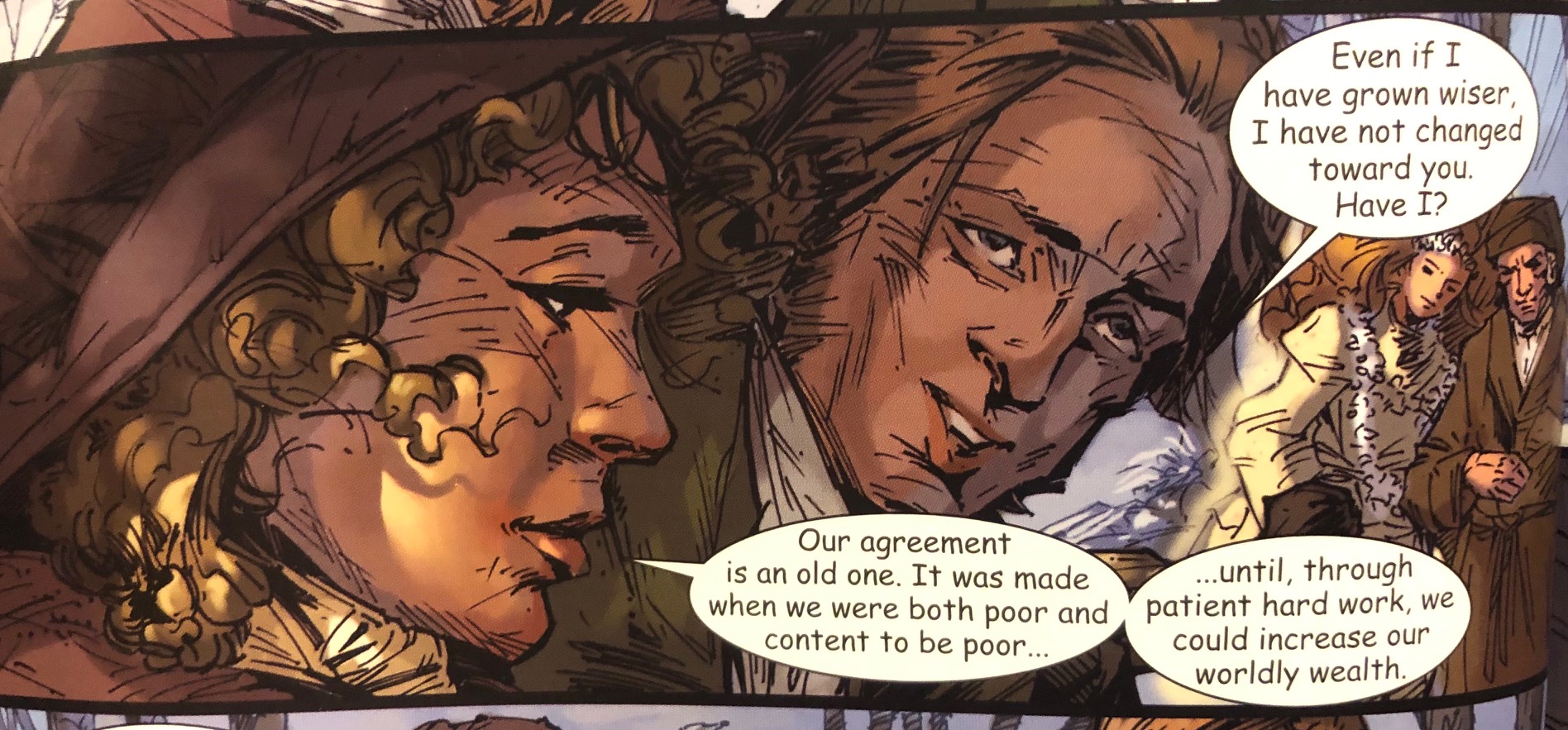 Scott McCullar and Naresh Kumar's version puts the break-up scene outside in a park unlike the other comics that have all had the scene inside in a house. There are only three-and-a-half pages for the scene, so even though it will cut out the vision of Belle's eventual family, the dialogue is still truncated. In fact, Old Scrooge himself does some expository work by announcing when he sees his younger self with Belle on a bench, "The years change people." He knows what's coming and adds, "I would prefer not to look at this."
No such doing though, of course, and the scene proceeds. Belle's bundled up for outdoors in the snow, but nothing she's wearing looks like mourning clothing. And no specific action of Scrooge's is mentioned as the reason for her breaking things off. Like the other adaptations, she just appears to have noticed a change in him and had enough.
Young Scrooge has a strange expression through most of the scene. His eyes look sad to me, but he's smiling. He gives me the impression that he's conflicted between regret and relief. When she walks away in the last panel though, it's sunk in what he let happen and he's fully sad, covering part of his face with a hand.
Old Scrooge is angry about having to watch this and accuses the Ghost, which in this version saves him from having to see Belle's future family. She does defend herself though and I'm happy that we get another version that suggests the fragments of all the faces the Spirit had shown Scrooge. Like in the Classical Comics version though, they're just floating heads that share the panel with the Ghost of Christmas Past. There are only three in this version and one of them is covered up by the Ghost's word balloon so it's impossible to tell who it is. The other two are Young Scrooge and Belle though.
Scrooge takes an extraordinarily long time to wrestle the Spirit into the extinguisher cap. He protests for a couple of panels, grabs the cap in the next, then takes three more panels to get it over the Spirit and down to the floor. And sadly, the narration doesn't always fit the visuals, so that it describes a struggle when Scrooge is completely turned away from the Spirt to grab her cap from where she'd apparently set it down.
And while the narration follows Dickens and talks about Scrooge being exhausted and immediately falling into bed, the art has him cap the Spirit downstairs and walk all the way upstairs to his room where he climbs into bed.


December 5, 2020
“Another Idol Has Displaced Me” | A Christmas Carol: The Graphic Novel (2008)
 Classical Comics' version by Sean Michael Wilson and Mike Collins gives seven pages to this year's scene; most of them on the first half where Belle and Scrooge break up. All of the flashback visions in Wilson and Collins' adaptation have been in sepia tone, so it's impossible to tell the exact color of Belle's dress, but it does seem to be lightly colored for a mourning dress. And there's no other mention of her parents' having recently died, which is appropriate since the adaptation is sticking as close as it can to Dickens' dialogue.
 Dickens gave the break-up scene a lot of language and that's why it gets so many pages here. I appreciate that Wilson and Collins didn't try to cram it all into a few panels, but let it breathe over a few pages, even if there's not a lot of visual excitement with just the two characters talking. Belle is very pretty though and Young Scrooge is handsome and not completely twisted by greed and cynicism yet. But Belle has seen the warning signs (she doesn't mention any specific thing that he's done) and is cutting off the relationship before Scrooge gets worse. She's visibly upset (they both are, really) and there are a lot of tears before it's finished.
Neither Young nor Old Scrooge cries, nor does the Ghost have to physically restrain Old Scrooge for the next vision, but Scrooge does protest about seeing more. Without even knowing what's coming, he's done with all of this. Or wants to be.
Belle ends up with a large, lively family, if not quite as enormous and out of control as Dickens gave me the impression of. There's her oldest daughter and then four younger kids: the oldest of which are girls and the youngest are boys. When Dad comes home with presents (accompanied by a porter, as in Dickens), the younger children rush him and there are cheers and laughter all around.
This scene takes a couple of pages before Scrooge again demands to be removed. As he grabs the Spirit's extinguisher cap, there's a halo of other faces around the Spirit's. It's a small panel and the art is washed out somewhat by a bright light effect in the coloring, but I think these other faces are Schoolboy Scrooge, Apprentice Scrooge, Fan, Fezziwig, and Belle. Even if I'm not completely right about that though, it's nice to see this detail from the book make it into an adaptation.
The rest of the page has Scrooge snuffing out the Spirit with the cap and then alone in a dark room with a small circle of light spilling out from beneath the cap. That last panel is nice and dramatic with Scrooge drawn very small and surrounded by lots of black space. When we turn the page, he'll be asleep on the floor of his room.

December 4, 2020
“Another Idol Has Displaced Me” | Marvel Classic Comics #36 (1978)
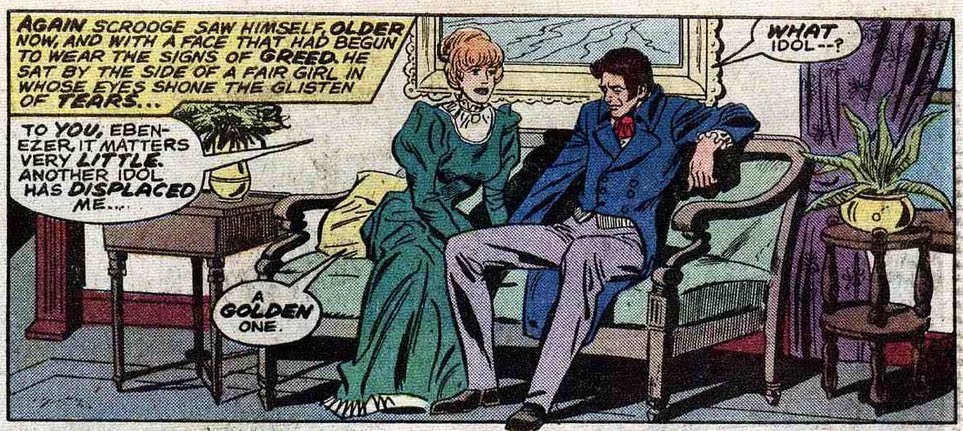 Marvel's adaptation has Belle and Scrooge lounging in a nicely furnished parlor. It doesn't try to explain where they are, but it seems inconsistent with anywhere the miserly Scrooge might live. Belle is of course poor, even in this version, so maybe they're visiting with friends and have sneaked away for a quiet conversation. Thinking about it makes me curious to see what settings the other versions put the couple in. Dickens was vague about it, so there's lots of room for interpretation. Classics Illustrated also had them in a fancy room.
Belle is wearing a green dress and there's no mention of her parents, recently deceased or otherwise. And also as with the Classics Illustrated adaptation, she just seems to have finally had enough of Scrooge's attitude about money as opposed to being driven to this decision by any specific incident.
The conversation goes more or less how Dickens wrote it and ends with Old Scrooge holding his head and begging the Spirit not to show Scrooge any more. I noticed last year that the mania Marvel's Scrooge exhibited in the early scenes has tapered off and this scene continues that. Scrooge reacts like he does in Dickens: a man severely hurt by the memory of losing Belle. Maybe these memories, even this painful one, are healing Scrooge when coupled with the Spirit's curative touch.
True to Dickens, the Ghost isn't quite done with Scrooge yet though and takes him to Belle's later home where she lives with her husband and children. I only count a total of four kids, including the young woman that Dickens obsessed over, but we only get a couple of panels with them and it's possible that there are more. They're not excessively boisterous, but Belle's husband does come home with Christmas presents and a daughter rushes at him in the first panel while the second has her and two brothers ripping into the gifts in the background.
It's interesting that Belle's husband doesn't ask her to guess which old friend of hers he saw that day. He simply tells her that he saw Scrooge and that his partner is on the point of death. I don't care for the guessing game in Dickens, so this is a nice change for me.
The Ghost doesn't physically force Scrooge to watch any of this. He's cold to Scrooge's plea to be removed from the scene though, so Scrooge grabs what at first looks like a curved trumpet from the Ghost's belt. I went back and looked and it's not in any of the earlier drawings of the Ghost, so it's just appeared here for this scene. It ends up being a candle snuffer with a long handle, but it doesn't look anything like a cap and the bell-shaped extinguisher part of it is way too small to be headgear for the Spirit, even if the handle wouldn't make it impossibly ridiculous to wear. In fact, Scrooge looks rather silly in the panel where he's pressing it against the ground, presumably trapping the Ghost underneath (although, as in Dickens, light is still spilling out).
The comic skips from Scrooge's grabbing the extinguisher straight to his holding it against the floor, so there's no final transformation of the Ghost into the other faces from Scrooge's past. And the very next panel is Scrooge lying in his own bed, exhaustedly falling asleep, with the snuffer discarded on the floor nearby.

December 3, 2020
Sleigh Bell Cinema | Christmas Vacation 2: Cousin Eddie's Island Adventure (2003)
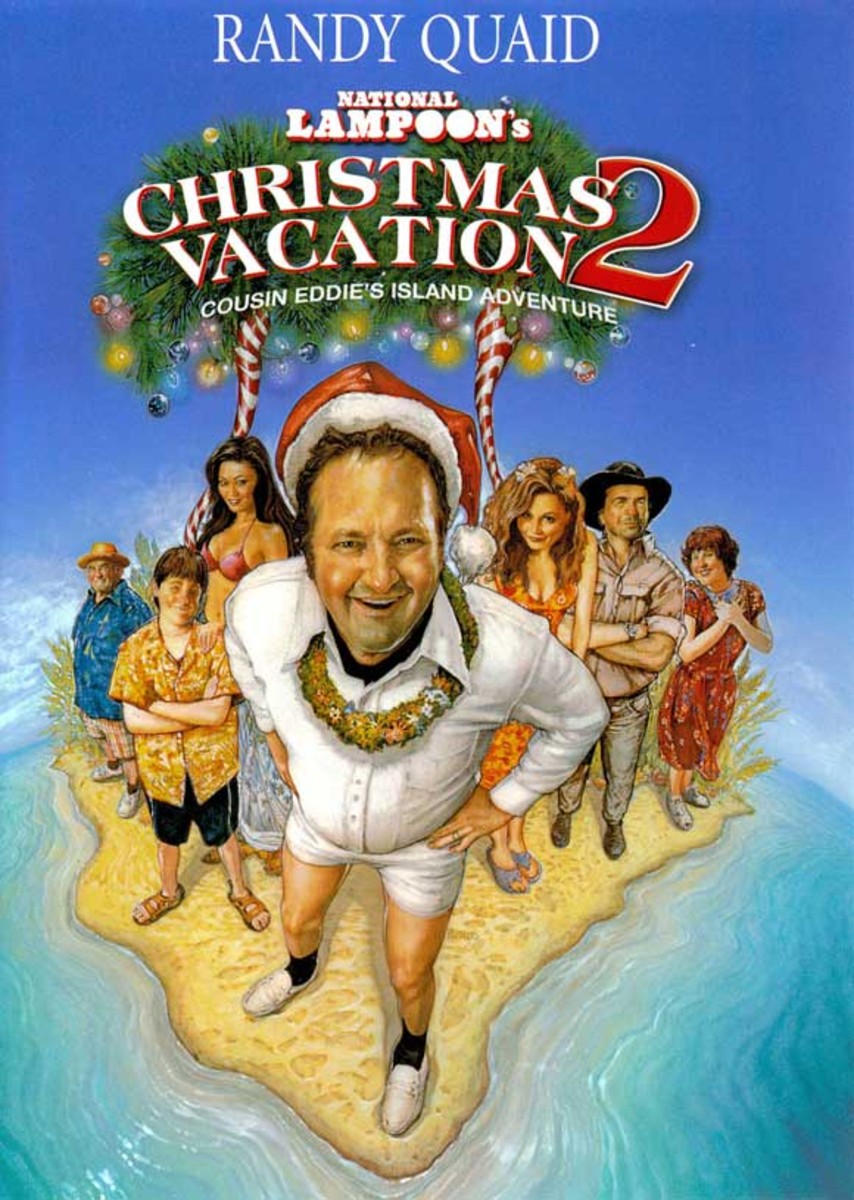 Last year on the show, Michael DiGiovanni and I talked about Christmas Vacation and discovered that there was a TV movie sequel focused on Cousin Eddie and his family. With some encouragement from Paxton Holley, we all decided to watch it and talk about it this year... and then re-evaluate our life choices.
Download or listen to the episode here.

“Another Idol Has Displaced Me” | Classics Illustrated #53 (1948)
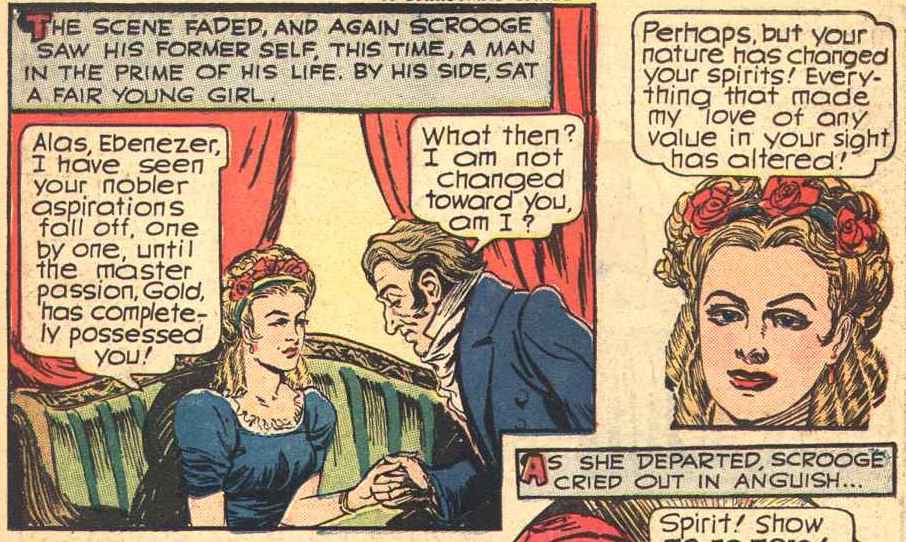 The Classics Illustrated adaptation dedicates a couple of pages to this year's scene: one for each vision of Belle.
 In the first one, the break-up scene, Belle and Young Scrooge are fully colored, tangible figures, which is a change from the previous visions. At the school and Fezziwig's warehouse, the figures Scrooge saw were ghostly, white outlines. This vision feels more real and important.
Belle's wearing a blue dress and red roses in her hair, so she's hardly a woman in mourning. The dialogue is abridged, but gets the gist of the conversation across nicely. There's no one incident that seems to have sparked her decision to leave Scrooge and she doesn't even suggest that his feelings towards her might have changed. She's just noticed his greed and wants nothing to do with the man he's become, though she's sad about it and doesn't wish him any harm.
Scrooge is visibly upset by the memory and covers his eyes in one panel. But the text points out that the Spirit "forced him to observe what happened next," and on the next page the Ghost has its hands on Scrooge's arm. The Ghost is physically smaller than Scrooge (which is faithful to Dickens), so Scrooge looks like he could get away if he wanted to, but he's compliant. The Spirit's "forcing" him to watch probably isn't an act of physical restraint in this version, but just evidence that Scrooge has accepted the Spirit's authority.
The vision of Belle's family goes back to the white, transparent figures for a panel, but they solidify and gain color in the next. We probably shouldn't read much into that, but I'm still interpreting it as this is a vivid, important vision, though we got to see a hazy, ephemeral image as one scene transforms into the next.
Belle's family is reduced to her husband and one, smiling, quiet baby in this version, so there's no large, boisterous bunch. Belle's husband doesn't ask her to guess which old friend he saw earlier, but she guesses anyway and gets it right, of course. The husband mentions that Marley is near death and that Scrooge is quite alone in the world. Their pity causes Scrooge to cry out in terror according to a caption and ultimately to spring upon the Ghost. But as Dickens wrote, there's really no contest and the Ghost seems untouchable.
There's no final, shocking transformation by the Ghost into the various faces from Scrooge's past. And since this version of the Ghost never had an extinguisher cap, Scrooge doesn't get to use it to try to snuff the ghost out. Scrooge simply takes a run at the Spirit and then is asleep in the next panel, with a caption saying that he "was conscious of being in his own bedroom" before drifting off.

December 2, 2020
“Another Idol Has Displaced Me” | Dickens
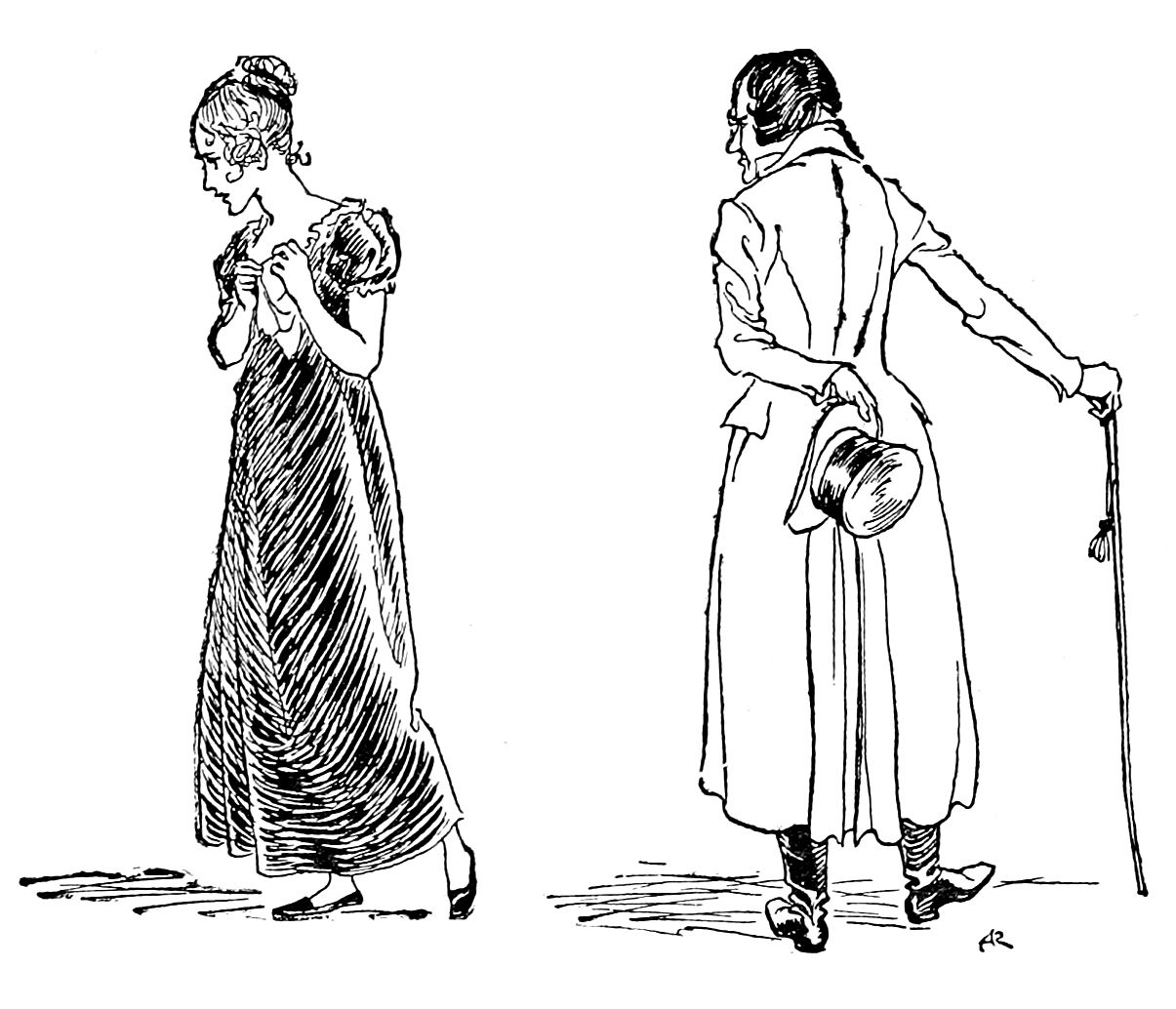 As I talk about Dickens' original version of the scene, I'm going to copy the entire text in
bold italics
and insert commentary in plain type. That'll help identify elements that we want to pay attention to in the adaptations.
As I talk about Dickens' original version of the scene, I'm going to copy the entire text in
bold italics
and insert commentary in plain type. That'll help identify elements that we want to pay attention to in the adaptations.“My time grows short,” observed the Spirit. “Quick!”
Before we get too deep into this year's text, let's recap the Spirit's tactics so far. Starting with the schoolhouse vision and continuing to Fezziwig's party, the Ghost has been showing Scrooge vivid memories in order to get past the mental defenses he's built up over the years. The Spirit is trying to speak directly to Scrooge's emotions by forcing him to remember what it was like to be an outsider: unloved by his father as a child, but taken in by his employer as part of what today we call a "found family." The Spirit is trying to build empathy in Scrooge and it's been working. Scrooge has been emotional during each vision.
But now, Scrooge is at a crucial stage. Having been reminded of the family that he missed out on as a child and found again as a young man, he's going to be forced to remember that he lost it yet again, but voluntarily this time.
This was not addressed to Scrooge, or to any one whom he could see, but it produced an immediate effect. For again Scrooge saw himself. He was older now; a man in the prime of life. His face had not the harsh and rigid lines of later years; but it had begun to wear the signs of care and avarice. There was an eager, greedy, restless motion in the eye, which showed the passion that had taken root, and where the shadow of the growing tree would fall.
He was not alone, but sat by the side of a fair young girl in a mourning-dress: in whose eyes there were tears, which sparkled in the light that shone out of the Ghost of Christmas Past.
I've never noticed the mourning-dress before, but there's a note in Michael Patrick Hearn's The Annotated Christmas Carol that suggests that it's important. I'll get to that in a minute, but I'm curious to see if any of the adaptations have Scrooge's girlfriend dressed in black.
Since Dickens mentions the light again here - and it's very important at the end of the scene - I just want to remember how it was introduced when Scrooge first met this Ghost. Dickens described a "bright clear jet of light" that shone from the Spirit's head and that Scrooge begged the Spirit to cover it with its "great extinguisher for a cap." The Spirit's response was to ask if Scrooge would "so soon put out, with worldly hands, the light I give?"
I forget if Dickens explained later or if one of the adaptations clued me in, but the Spirit's light represents the memories that it's showing Scrooge. Like I said above, the purpose of these memories is to illuminate something for Scrooge.
“It matters little,” she said, softly. “To you, very little. Another idol has displaced me; and if it can cheer and comfort you in time to come, as I would have tried to do, I have no just cause to grieve.”
“What Idol has displaced you?” he rejoined.
“A golden one.”
Hearn thinks this might be a reference to the Biblical golden calf, but it doesn't have to be. The meaning is clear enough. Scrooge is in love with gold (that is, money) now and is pursuing that rather than the deep, spiritual love offered by this woman.
“This is the even-handed dealing of the world!” he said. “There is nothing on which it is so hard as poverty; and there is nothing it professes to condemn with such severity as the pursuit of wealth!”
This is actually a pretty great line. Scrooge isn't wrong about the world's priorities and prejudices. But he's thinking about it purely pragmatically when this woman is offering something more profound. Scrooge just refuses to see it.
“You fear the world too much,” she answered, gently. “All your other hopes have merged into the hope of being beyond the chance of its sordid reproach. I have seen your nobler aspirations fall off one by one, until the master-passion, Gain, engrosses you. Have I not?”
“What then?” he retorted. “Even if I have grown so much wiser, what then? I am not changed towards you.”
She shook her head.
“Am I?”
“Our contract is an old one. It was made when we were both poor and content to be so, until, in good season, we could improve our worldly fortune by our patient industry. You are changed. When it was made, you were another man.”
“I was a boy,” he said impatiently.
I like that so many adaptations had Scrooge fall in love with her while he was at Fezziwig's. The timeline works out and it makes sense that he was content to be poor while in Fezziwig's family-like employment. Since leaving Fezziwig though, Scrooge has been looking out for himself and it's changed him. Instead of building a new family with this woman who loves him, he believes it's entirely his responsibility to provide for and protect her. And it's ruined him.
This gets to the heart of why his relationship with Fred is so bad. Some adaptations suggest that Scrooge's sister died giving birth to Fred and that's why Scrooge is angry, but I think Dickens' biggest hint is when Fred visits Scrooge at the beginning of the story and Scrooge asks Fred why he got married.
"Because I fell in love," Fred says.
"Because you fell in love!" Scrooge growls. And Dickens adds, "As if that were the only thing in the world more ridiculous than a merry Christmas."
Scrooge can't stand Fred and his wife because they made the choice that Scrooge was too cowardly to. They chose love and family over wealth and security. I think Scrooge deeply regrets his fear, but won't admit it. Fred unknowingly confronts him with it though and that's why Scrooge keeps his distance.
That's why I said earlier that showing Scrooge this memory is a crucial stage for the Spirit. Scrooge has been more or less on board up till now, but how will he react when confronted with this monumental decision that he is so, so sorry for?
“Your own feeling tells you that you were not what you are,” she returned. “I am. That which promised happiness when we were one in heart, is fraught with misery now that we are two. How often and how keenly I have thought of this, I will not say. It is enough that I have thought of it, and can release you.”
It's beautiful the way she puts this. They're no longer united, no longer a team, she realizes it, and she has no choice but to let him go. They're already separated, she's just formalizing it.
“Have I ever sought release?”
“In words. No. Never.”
“In what, then?”
“In a changed nature; in an altered spirit; in another atmosphere of life; another Hope as its great end. In everything that made my love of any worth or value in your sight. If this had never been between us,” said the girl, looking mildly, but with steadiness, upon him; “tell me, would you seek me out and try to win me now? Ah, no!”
He seemed to yield to the justice of this supposition, in spite of himself. But he said with a struggle, “You think not.”
She's right and he knows it. He has no defense. One of the adaptations has her call out that his "You think not" is "a safe and terrible answer," which of course it is.
“I would gladly think otherwise if I could,” she answered, “Heaven knows! When I have learned a Truth like this, I know how strong and irresistible it must be. But if you were free to-day, to-morrow, yesterday, can even I believe that you would choose a dowerless girl—you who, in your very confidence with her, weigh everything by Gain: or, choosing her, if for a moment you were false enough to your one guiding principle to do so, do I not know that your repentance and regret would surely follow? I do; and I release you. With a full heart, for the love of him you once were.”
Hearn explains that Dickens' original text had "dowerless orphan" instead of "dowerless girl" to further explain her poverty. That and her mourning-dress suggest that she's recently orphaned. Maybe that change in her financial circumstances has led to Scrooge's being even more cold towards her. Which makes him even more awful by emotionally punishing her just when she's also grieving the death of her parents.
He was about to speak; but with her head turned from him, she resumed.
“You may—the memory of what is past half makes me hope you will—have pain in this. A very, very brief time, and you will dismiss the recollection of it, gladly, as an unprofitable dream, from which it happened well that you awoke. May you be happy in the life you have chosen!”
She left him, and they parted.
“Spirit!” said Scrooge, “show me no more! Conduct me home. Why do you delight to torture me?”
Old Scrooge is distraught and wants to be done. He totally gets the Spirit's point and wants to be done.
“One shadow more!” exclaimed the Ghost.
“No more!” cried Scrooge. “No more. I don’t wish to see it. Show me no more!”
But the relentless Ghost pinioned him in both his arms, and forced him to observe what happened next.
I've never noticed that the Ghost gets physical with Scrooge and forcibly restrains him. I'll be surprised if that comes up in adaptations.
They were in another scene and place; a room, not very large or handsome, but full of comfort. Near to the winter fire sat a beautiful young girl, so like that last that Scrooge believed it was the same, until he saw her, now a comely matron, sitting opposite her daughter. The noise in this room was perfectly tumultuous, for there were more children there, than Scrooge in his agitated state of mind could count; and, unlike the celebrated herd in the poem, they were not forty children conducting themselves like one, but every child was conducting itself like forty.
I'm splitting Dickens' super long paragraph to mention that the "celebrated herd in the poem" refers to William Wordsworth's "Written in March," which goes:
"The oldest and the youngestAre at work with the strongest;The cattle are grazing,Their heads never raising;There are forty feeding like one!"
Dickens' point is that this is utter chaos.
The consequences were uproarious beyond belief; but no one seemed to care; on the contrary, the mother and daughter laughed heartily, and enjoyed it very much; and the latter, soon beginning to mingle in the sports, got pillaged by the young brigands most ruthlessly. What would I not have given to be one of them! Though I never could have been so rude, no, no! I wouldn’t for the wealth of all the world have crushed that braided hair, and torn it down; and for the precious little shoe, I wouldn’t have plucked it off, God bless my soul! to save my life. As to measuring her waist in sport, as they did, bold young brood, I couldn’t have done it; I should have expected my arm to have grown round it for a punishment, and never come straight again. And yet I should have dearly liked, I own, to have touched her lips; to have questioned her, that she might have opened them; to have looked upon the lashes of her downcast eyes, and never raised a blush; to have let loose waves of hair, an inch of which would be a keepsake beyond price: in short, I should have liked, I do confess, to have had the lightest licence of a child, and yet to have been man enough to know its value.
Dickens gets creepy as he editorializes about the daughter, but the point is that this is a mad, lovely scene and we're meant to appreciate and even envy this boisterous family.
But now a knocking at the door was heard, and such a rush immediately ensued that she with laughing face and plundered dress was borne towards it the centre of a flushed and boisterous group, just in time to greet the father, who came home attended by a man laden with Christmas toys and presents. Then the shouting and the struggling, and the onslaught that was made on the defenceless porter! The scaling him with chairs for ladders to dive into his pockets, despoil him of brown-paper parcels, hold on tight by his cravat, hug him round his neck, pommel his back, and kick his legs in irrepressible affection! The shouts of wonder and delight with which the development of every package was received! The terrible announcement that the baby had been taken in the act of putting a doll’s frying-pan into his mouth, and was more than suspected of having swallowed a fictitious turkey, glued on a wooden platter! The immense relief of finding this a false alarm! The joy, and gratitude, and ecstasy! They are all indescribable alike. It is enough that by degrees the children and their emotions got out of the parlour, and by one stair at a time, up to the top of the house; where they went to bed, and so subsided.
Most adaptations include Scrooge's breakup, but not many of them go on to show her crazy, happy, Scrooge-less life. We'll keep track of the ones that do and whether they communicate the fun insanity of this out of control household.
And now Scrooge looked on more attentively than ever, when the master of the house, having his daughter leaning fondly on him, sat down with her and her mother at his own fireside; and when he thought that such another creature, quite as graceful and as full of promise, might have called him father, and been a spring-time in the haggard winter of his life, his sight grew very dim indeed.
Oof.
“Belle,” said the husband, turning to his wife with a smile, “I saw an old friend of yours this afternoon.”
We finally get the name of Scrooge's beloved. Hearn speculates that she might be named after Maria Beadnell, a woman whom Dickens - like Scrooge - gave up for financial reasons. But "Belle" of course means "beauty" and maybe the name is just symbolic of that.
“Who was it?”
“Guess!”
“How can I? Tut, don’t I know?” she added in the same breath, laughing as he laughed. “Mr. Scrooge.”
I think it's weird that she guesses on the first try. Is Scrooge the only "old friend" she has?
“Mr. Scrooge it was. I passed his office window; and as it was not shut up, and he had a candle inside, I could scarcely help seeing him. His partner lies upon the point of death, I hear; and there he sat alone. Quite alone in the world, I do believe.”
I love this detail. So this vision is from seven years ago when Marley died.
“Spirit!” said Scrooge in a broken voice, “remove me from this place.”
“I told you these were shadows of the things that have been,” said the Ghost. “That they are what they are, do not blame me!”
“Remove me!” Scrooge exclaimed, “I cannot bear it!”
He turned upon the Ghost, and seeing that it looked upon him with a face, in which in some strange way there were fragments of all the faces it had shown him, wrestled with it.
I don't think any adaptation has the Ghost's face suggest the various other faces that it's shown Scrooge: like Fan and Fezziwig and Belle. But let's keep an eye out.
“Leave me! Take me back. Haunt me no longer!”
In the struggle, if that can be called a struggle in which the Ghost with no visible resistance on its own part was undisturbed by any effort of its adversary, Scrooge observed that its light was burning high and bright; and dimly connecting that with its influence over him, he seized the extinguisher-cap, and by a sudden action pressed it down upon its head.
Scrooge realizes that the Ghost's power is in the memories it's calling up, so that's what Scrooge attacks.
The Spirit dropped beneath it, so that the extinguisher covered its whole form; but though Scrooge pressed it down with all his force, he could not hide the light: which streamed from under it, in an unbroken flood upon the ground.
Still, Scrooge can't fully extinguish the light of these memories.
He was conscious of being exhausted, and overcome by an irresistible drowsiness; and, further, of being in his own bedroom. He gave the cap a parting squeeze, in which his hand relaxed; and had barely time to reel to bed, before he sank into a heavy sleep.
And we're ready for the Ghost of Christmas Present, but it'll be fun to see how each adaptation transitions from Scrooge's snuffing out Christmas Past to being back in his apartment.
So here's what we're on the look out for this year: Is Belle wearing black or is there any sign that she's in mourning for recently deceased parents?Does the adaptation offer a specific reason for Belle to leave Scrooge at this particular moment? Or is it just that they've generally grown apart?If there's a final vision of Belle's life after Scrooge, does the Ghost forcibly restrain Scrooge to make him watch it?Does Belle end up with a large, joyously boisterous family?Does the Ghost's face transform into the various other faces that it's shown Scrooge in these memories?How does the adaptation handle the transition from Christmas Past back to Scrooge's apartment?

December 1, 2020
Mystery Movie Night | Trog (1970), Enter the Dragon (1973), and The Transformers: The Movie (1986)
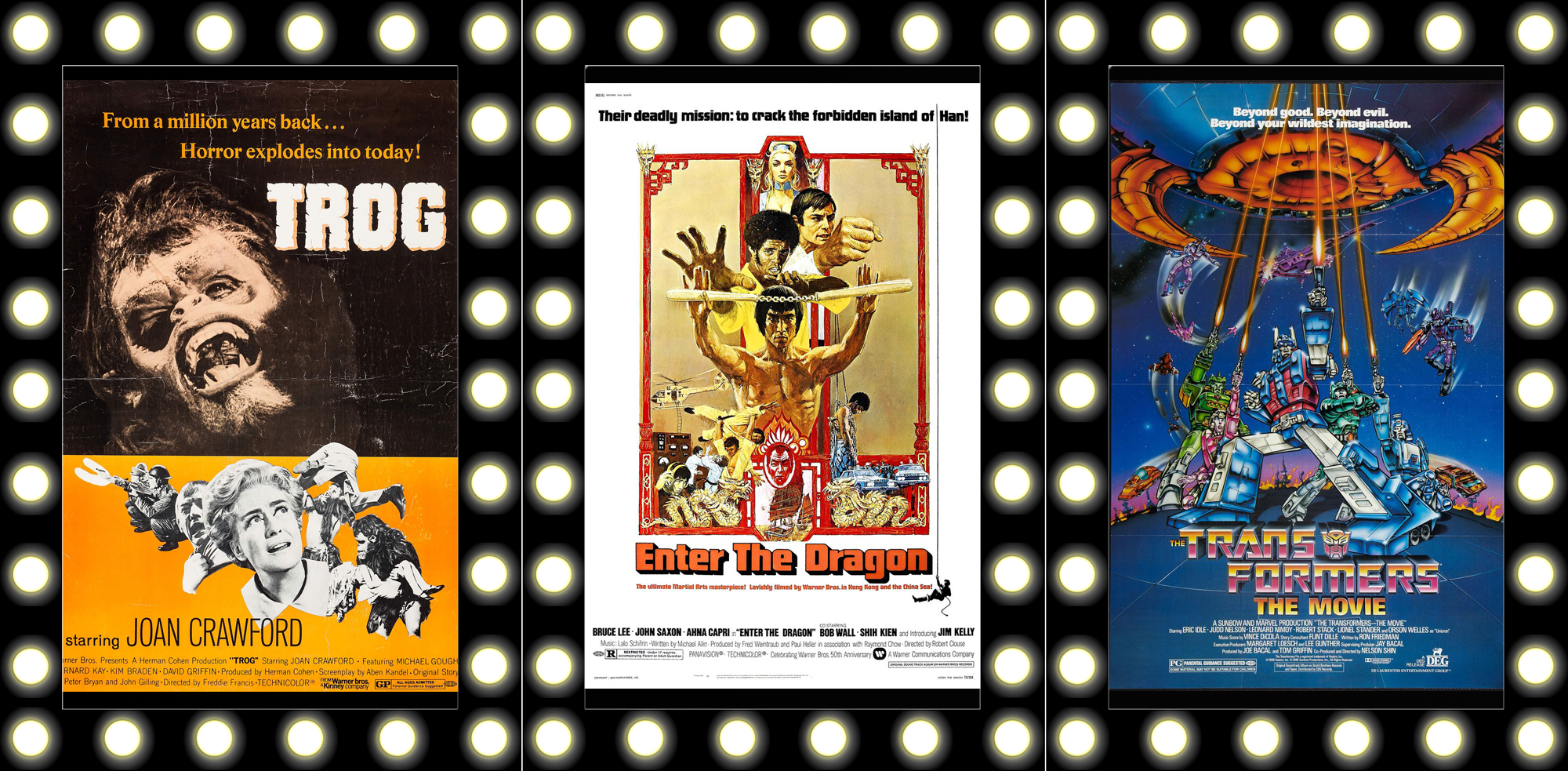 Dave, David, Erik, Evan, and I converse about cavemen, claw hands, and Cliffjumper and the cryptic component that connects them.
00:01:47 - Review of Trog (1970)00:17:23 - Review of Enter the Dragon (1973)00:29:22 - Review of The Transformers: The Movie (1986)00:49:37 - Guessing the Connection
Download or listen to the episode here.

The Christmas Carol Project | “Another Idol Has Displaced Me”
 Christmas season is officially upon us and longtime readers of this blog know what that means.
There's still a lot of Sleigh Bell Cinema coming, but it's also time for the long-standing tradition of covering A Christmas Carol scene-by-scene, paying attention to the way the story has been interpreted and adapted to other media over the years. I’ve broken the story into scenes (or sometimes parts of scenes) and each year look at the translations of one of them to the following 19 comics, TV shows, and films:
• Classics Illustrated #53 (1948)
• Marvel Classics Comics #36 (Marvel; 1978)
• A Christmas Carol: The Graphic Novel (Classical Comics; 2008)
• A Christmas Carol (Campfire; 2010)
• "A Christmas Carol" in Graphic Classics, Vol. 19: Christmas Classics (Eureka; 2010)
• Teen Titans #13 (DC; 1968)
• A Christmas Carol cartoon (1971) starring Alastair Sim
• The Stingiest Man in Town (1978) starring Walter Matthau
• Mickey’s Christmas Carol (1983) starring Scrooge McDuck
• A Christmas Carol (2009) starring Jim Carrey
• A Christmas Carol (1910) starring Marc McDermott
• Scrooge (1935) starring Seymour Hicks
• A Christmas Carol (1938) starring Reginald Owen
• Scrooge (1951) starring Alastair Sim
• "A Christmas Carol" episode of Shower of Stars (1954) starring Fredric March
• Scrooge (1970) starring Albert Finney
• A Christmas Carol (1984) starring George C. Scott
• The Muppet Christmas Carol (1992) starring Michael Caine
• A Christmas Carol (1999) starring Patrick Stewart
In this year's scene, we're getting romantically tragic as the Ghost of Christmas Past shows Scrooge his failed relationship with the love of his life. Make sure you have your tissues handy, 'cause it's all broken hearts this month.

November 29, 2020
Sleigh Bell Cinema | Holiday Affair (1949)
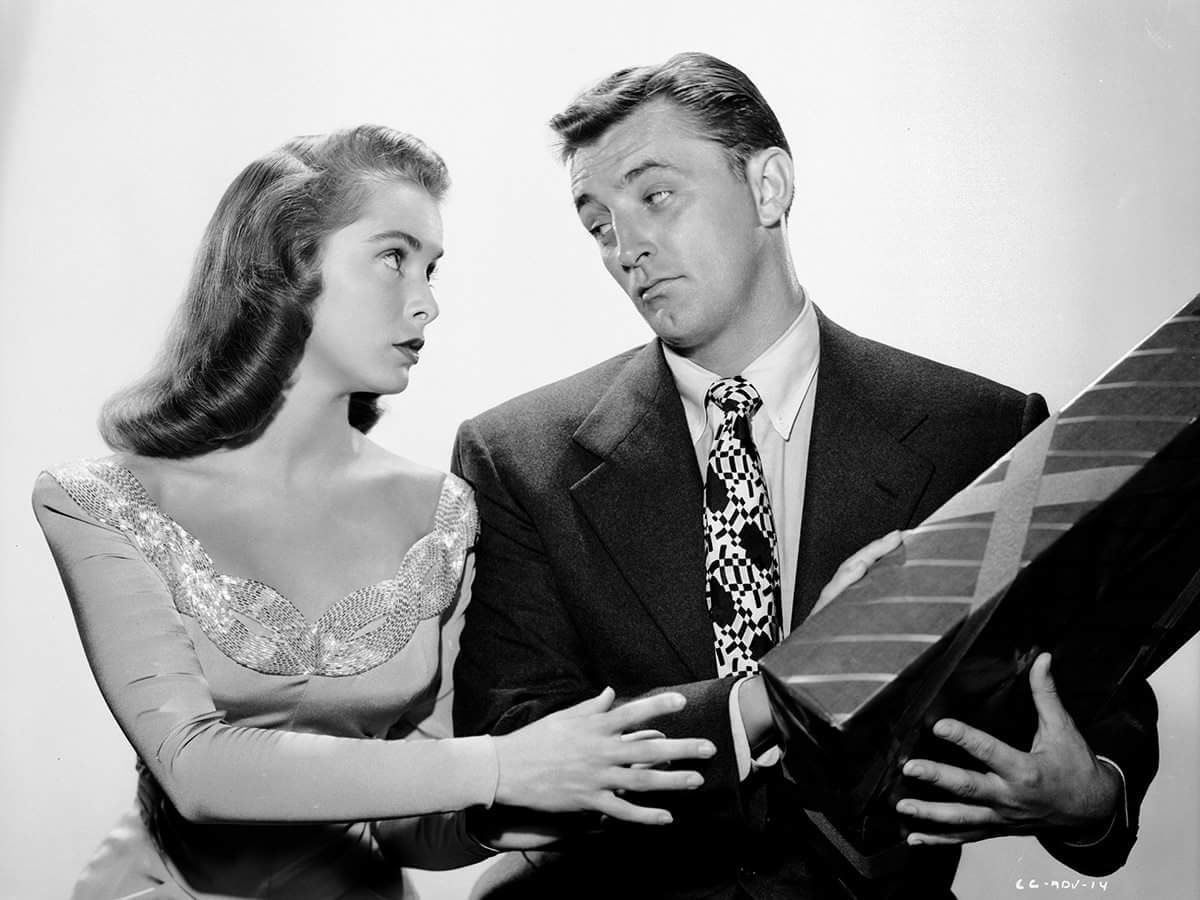 Rob Graham visits to talk about Janet Leigh and Robert Mitchum's Holiday Affair, also starring Wendell Corey and (ever so briefly) Harry Morgan. Find out who's #TeamCarl and who's #TeamSteve in this complicated Christmas courtship.
Download or listen to the episode here.

November 26, 2020
AfterLUNCH | After Dinner Lounge, Part 1
 In the first of hopefully many such discussions, Rob Graham, Evan Hanson, and I have a very informal conversation about what we've been reading, watching, and thinking about lately. Topics lead to unpredictable places, but include: Comics like X of Swords, Batman: Three Jokers, and The Orville. Novels like The Optimist's Daughter by Eudora Welty, The Lock Artist by Steve Hamilton, and Bonnie MacBird's Sherlock Holmes series. TV shows like The Good Wife, Dark Shadows, and Police Squad!. Movies like the Omen series, Tremors: Shrieker Island, and The Gumball Rally. And real talk on Getting Old, Biblical Apocrypha, and COVID and Thanksgiving.Download or listen to the episode here.