Michael May's Blog, page 108
October 23, 2016
31 Days of Gothic Romance | The House of Secrets

DC's House of Secrets comic was never officially a gothic romance series, but it did sport a nice run of gothic romance covers in the early '70s by Neal Adams, Gray Morrow, Bernie Wrightson, and Nick Cardy.
The series was conceived as a mystery/horror/fantasy anthology title in the late '50s, but it was cancelled 10 years later and then revived again a few years after that. During this revival, the comic got its horror host Abel (brother to Cain, the host of DC's House of Mystery) and focused mostly on spooky, EC-style horror tales.
Even though the stories in the comic weren't gothic romance, starting with issue #88 and lasting for about eight issues there were a lot of young women running from spooky, old houses (even though "There's No Escape from... The House of Secrets") or otherwise being menaced by sinister figures (including Swamp Thing, who debuted during this period). It's interesting that even if DC wasn't willing to turn The House of Secrets into a gothic romance series, it was willing to publish misleading covers to attract fans of the genre. It just goes to show how popular gothic romance had become.
And it's not like DC was opposed to publishing gothic romance, because it was also during this time that they went ahead and started an actual, proper gothic romance comic. But we'll talk about that tomorrow.


October 22, 2016
31 Days of Gothic Romance | The Paperbacks

Whether it was the popularity of Hammer horror films or Dark Shadows or both or something else entirely, I'm not sure. But gothic romance novels - with an emphasis on "romance" - became very popular with paperback readers in the 1960s and '70s. Romance publishers like Avon - and even speculative fiction and pulp publishers like Signet and Ace - cranked them out like crazy, almost always with covers featuring a young woman fleeing a big, ancient house (with one, lit window) on a dark night.
There are way too many of these to catalog, but Mystery File's Steve Lewis has a great, extensive list and there's also a cool review blog called - appropriately - Women Running from Houses. Lots of great stuff to be found in both of those.


October 21, 2016
31 Days of Gothic Romance | Dark Shadows

In 1966, gothic romance moved to television. Dark Shadows was a daytime soap opera that started off like Jane Eyre and added supernatural elements as it went along. Initially, it followed a young woman named Victoria Winters as she's hired by the mysterious Collins family to be a governess. Victoria is an orphan and believes that the Collinses may have connections to her unknown past.
As the show progressed though, other Collins family members returned home with their own spooky and mysterious dramas of blackmail, revenge, and murder. Then in the spring of 1967, the show introduced the most famous of these, the vampire Barnabas Collins, and finally brought a supernatural aspect to the already gothic setting and tone of the series. Eventually, it would also add ghosts, werewolves, witches, and all sorts of other monsters, solidifying its spot as the coolest soap opera of all time. There was also time travel to Barnabas' past, letting the show have a period setting for extended runs of episodes.


By the time the show ended in 1971, it was a bona fide phenomenon with Dark Shadows comic books, a series of novels, joke books, board games, coloring books, View-Master reels, and a couple of feature films: House of Dark Shadows and Night of Dark Shadows.


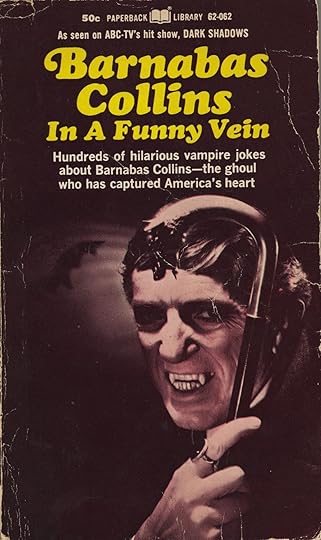
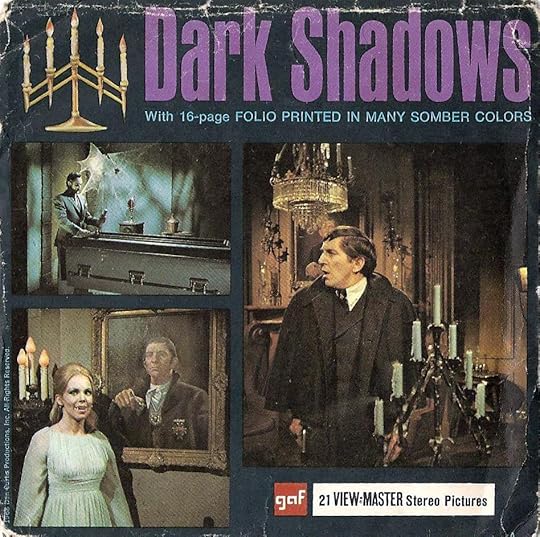

There have been three attempts at revivals since '71. In 1991, NBC tried to bring it back as a primetime series run by the show's original creator Dan Curtis. It premiered as a four-hour mini-series and did well in that format, but the ratings fell off when it was put into a Friday night time slot. It was cancelled after 12 episodes.

In 2004, the WB commissioned a pilot for a potential relaunch series, but the show wasn't picked up and the pilot never aired.

Most recently, there was the 2012 feature film directed by Tim Burton. By this time, everyone was pretty tired of Burton's casting cartoon versions of Helena Bonham Carter and Johnny Depp in everything, but Dark Shadows is a fun movie. It's a silly, campy version of what should have been a cool, spooky story, but taken for what it is, I quite enjoy it. But it would still be another handful of years before we got a legitimate gothic romance revival at the movie theater.


October 20, 2016
31 Days of Gothic Romance | Hammer Films

It's amazing how much tastes can change in a decade. In the '40s, gothic romance movies were moody, shadow-filled things like Rebecca and The Uninvited. But in 1957, Hammer introduced a whole new way of doing it. Starting with adaptations of gothic romance staples Frankenstein and Dracula, Hammer told stories of young women being threatened by sinister aristocrats in spooky, old buildings, but in lurid, colorful ways.
They continued to glean from classic gothic stories like The Hound of the Baskervilles and Phantom of the Opera, but they so perfected the uncanny, fog-filled atmosphere that they were able to lay it over many different kinds of tales - everything from mummies to Satanists to Jekyll and Hyde - and still have them feel gothic.
The result was some confusion about the definition of gothic romance. For many, it's less about specific themes than just a particular atmosphere, usually in a period setting. We have Hammer to thank for that. Not that I'm complaining. One of the reasons I wanted to talk about gothic romances this Halloween was to help myself circle around a working definition, but there's no need to be snobbish about it. What follows is a long list of Hammer horror films with gothic elements; some much more authentic than others, but all of interest.


October 19, 2016
31 Days of Gothic Romance | The Uninvited

When we talked about The Uninvited on Mystery Movie Night, I described it as My First Gothic Romance. That's not quite fair though. Martin Scorsese and Guillermo Del Toro have both praised it as being especially scary and influential. And cinematographer Charles Lang was nominated for an Academy Award for his work on it. As Erik noted on that Mystery Movie Night episode, The Uninvited shares a similar mood and look with Val Lewton's super atmospheric films. So it's got a lot going for it and it's one of my favorites.
It's only compared to Rebecca from a few years before that The Uninvited feels like a tamer entry of the genre. Rebecca is dark and oppressive (deliciously so), while The Uninvited has a lighter tone. Ray Milland's banter with Ruth Hussey and flirtation with Gail Russell give the movie a breezier feel. It has a great mystery - and one that's potentially even more deadly than the one in Rebecca - but it's not one that I ever feel in my bones the way I do with Hitchcock's film.
It's still great though and classic gothic romance. There's an old mansion and at least one character who's trying to preserve the past and doing harm to an innocent young woman in the process. And unlike Rebecca there's an overtly supernatural angle, too that sets up one of the movie's best mysteries.


October 18, 2016
31 Days of Gothic Romance | Rebecca

Daphne du Maurier's Rebecca is even more straight gothic romance than Jamaica Inn. It's about a lovely young woman who marries a dark, brooding man and goes to live at his ancient estate. There are secret parts of the house where she's discouraged to go and the whole place is haunted by the ghost (figurative, at least) of the mansion's former mistress.
Even though we talked about du Maurier already with Jamaica Inn, I have to give Rebecca a separate entry because I love Hitchcock's adaptation so much. I discovered it years ago when I was exploring George Sanders' filmography and uncovered a treasure trove of Hitchcock that I'd never explored before. Prior to that, I was mostly familiar with his '50s and '60s stuff, but Rebecca led me to the '40s and what would become some of my favorite Hitchcock films. Movies like Notorious and Spellbound and Foreign Correspondent.
Rebecca was also my proper introduction to gothic romance. I'd been attracted to elements of it before, like with Beauty and the Beast, but Rebecca is the full, complete package: a highlight of the genre that sent me searching for more.


October 17, 2016
31 Days of Gothic Romance | Southern Gothics

I should have talked about Southern Gothics before Jamaica Inn. For one thing, I've been hitting these entries chronologically and William Faulkner introduced the Southern Gothic genre several years prior to Jamaica Inn. But also, Southern Gothic started a branch of gothic romance that continued to be taken seriously as literature. As talented as Daphne du Maurier might have been, her books continued a trend of gothic romance that was seen more and more as popular fiction. Our month-long celebration is going to follow the popular tradition, so I wish I'd covered the more serious Southern Gothics before du Maurier.
With The Sound and the Fury, William Faulkner took the inherently European gothic romance genre and adapted it to the United States. Instead of disintegrating old castles, there are formerly luxurious plantations and the families that owned them. The theme of decay is strong since the Civil War and the end of slavery have severely impacted the economic and social systems of the Antebellum Period.
Faulkner's novel even has some of the classic tropes of gothic romance. Like Wuthering Heights, The Sound and the Fury attacks traditional social structures. It does this largely through the character of Caddy, a sexually active young woman whose big brother Quentin is obsessed with protecting her and trying to keep her pure. He sees himself as the hero of her story, but he's unable to "save" her and punishes himself severely for it. When Caddy becomes pregnant, she's also punished by the culture around her, so that all of society, still holding onto Antebellum values, becomes in essence the malevolent nobleman of the story.
Caddy's daughter, Quentin (named after her uncle) is also persecuted by a powerful symbol of the old way of life: her other uncle, Jason. He's all about the pursuit of wealth by any means and through a mixture of blackmail and theft, has figured out how to profit from taking Miss Quentin as his charge.
Thinking about it this way has given me a new perspective on how the big themes and tropes of gothic romance tie together. In these articles, I've focused on the theme of social decay and the tropes of wicked aristocrats who attempt to dominate young women. But I'm just now figuring out how those things are related. The aristocrats are always representatives of the decaying culture: the Past. The young women - or men, in some cases - represent the potential of the Future. So at its heart, gothic romance is the story of the Past's trying to dominate and control progress into the Future.
That's a very broad theme, so it's open to a lot of interpretation. The Past will never permanently defeat the Future, but depending on the author, the Future can be temporarily delayed. For instance, a big purpose of The Sound and the Fury is to criticize social norms, so Faulkner leaves some of the work of defeating the Past undone. That way, readers can be spurred into taking up the cause and finishing the job. In other stories, it might be more important for the Past to be soundly defeated, but there are also many way in which that can happen, each revealing something about the author's feelings toward the Old and the New.
Faulkner continued writing about the decay of the Old South, with Absalom, Absalom! being a significant follow-up to The Sound and the Fury. Faulkner even uses some of the same characters in both novels, but they're not so much Original/Sequel as they are just Shared Universe.

Carson McCullers' The Heart is a Lonely Hunter is another Southern Gothic standard, exploring the lives of a deaf-mute man and other rejected misfits in a small Southern town. Again, challenging traditional, Old ideas and prejudices about people who are different.
If McCullers' name rings a bell, it might be because she also wrote Reflections in a Golden Eye, which may or may not have inspired Ian Fleming while naming his vacation/writing house in Jamaica.

Tennessee Williams was another Southern Gothic writer, though a playwright and not a novelist. Like McCullers, he focused on outsider characters and old, Southern families whose attempts to hold onto the Past ruined their ability to function.


Flannery O'Connor was more about short stories than novels, but she did write Wise Blood, a novel about a WWII veteran who returns to the South while suffering PTSD. Her stories ("A Good Man is Hard to Fine" being the most famous) are often disturbingly violent and feature monstrous characters and stylized settings.

It's easy to think of To Kill a Mockingbird as mostly a coming-of-age story, but like Jane Eyre, it combines that genre with heavy gothic elements. Like the other Southern Gothics above, it's concerned with helping Southern culture move forward into a more accepting view of outsiders. Boo Radley is even seen as a supernatural character by the novel's children for a while.


October 16, 2016
31 Days of Gothic Romance | Jamaica Inn

It's been difficult for gothic romance to remain its own, distinct genre. I've already talked about how many see it as a sub-genre under horror, emphasizing the gothic half of its influences. But it's gone the other way, too. A lot of people read the word "romance" and immediately file it under other books in that category. Which is what happened with Daphne du Maurier's stuff, though it's as clear an example of classic gothic romance as ever existed.
The "romance" in gothic romance doesn't refer to people falling in love, though that often happens in those stories. In its classic sense, "romance" refers to fantastic, heroic deeds, often with some kind of supernatural element. It's was Horace Walpole's marrying that to crumbling, medieval (gothic) settings that gave the genre its name. But "romance" has become so identified with kissing that it's tough to remember that it doesn't always have to mean that.
Du Maurier is primarily thought of as a romance writer, but her books - especially Jamaica Inn and Rebecca - are not kissing books. On the contrary, they're atmospheric and thoughtful and rarely end with a heroic couple in each other's arms. Jamaica Inn is one of the ones that does, more or less, but it gets to its love story through a dark tale of murder. It's about a young woman who goes to live with some relatives and learns that their inn is a headquarters for a gang of brutal thieves. Her uncle and his men intentionally run ships aground on the nearby rocky coast in order to kill the sailors and steal their cargo. Against her better judgment, the young woman begins to fall for her uncle's younger brother, in whom she sees a spark of decency.
The gothic setting is the old inn that's no longer used for its original purpose, though there are spoilery references to something even older and potentially supernatural. The uncle is no nobleman, but he's no less sinister and threatening. And the uncle's younger brother isn't especially heroic at first - in fact, the young woman more or less has to rescue him from the path that he's on - but he comes through in the end. All the gothic romance trappings are there.
Jamaica Inn was du Maurier's fourth novel, but the first of her most famous ones. It was published in 1936 and adapted to film by Alfred Hitchcock only three years later, the first of three Hitchcock movies based on her stuff. We'll talk about Rebecca later, but The Birds was also inspired by a short story of hers. Jamaica Inn was also adapted into a couple of mini-series: one in 1983 starring Jane Seymour and more recently in 2014 starring Downton Abbey's Jessica Brown Findlay.


October 15, 2016
31 Days of Gothic Romance | Nosferatu

Even though Nosferatu is an adaptation of something we already talked about, it's different enough from Dracula that it bears mentioning on its own. It's got the same themes about decay and the same count who's trying to overpower the same girl, but it's everyone's reactions to the count (Orlok in this version) that sets Nosferatu apart.
As a way to simplify the plot, Ellen's support team is severely cut back. Some of that we're used to in later versions. Quincey and Lord Godalming almost never makes it into films, and Seward is often turned elderly and made Mina or Lucy's dad. Not that there's anything wrong with being elderly. It suits Van Helsing just fine. But Seward as a father is never a powerful ally. In Nosferatu, the Seward character is about the same age as Ellen and her husband, but he also pretty much disappears once Orlok arrives in town and stuff gets real. And weirdly, so does Nosferatu's version of Van Helsing. The only person who really sticks close to Ellen is her husband, but he's just recently escaped Orlok's influence himself and is still weak.
That changes things because it makes Ellen the sole defender of her village against Orlok. Heroically, she's not even concerned about herself, especially when she learns that the way to defeat Orlok will require a profound act of self-sacrifice. Because of that and how she handles it, I really like Mina in Dracula, but I love Ellen.


October 14, 2016
31 Days of Gothic Romance | The Cabinet of Dr. Caligari

As soon as people began making movies, they made them about gothic romances. Thomas Edison's 1910 Frankenstein was a very early example, but of course there were also '20s versions of Phantom of the Opera and Nosferatu, which was a bootleg of Dracula. And there were original gothic romance movies, too, like Robert Wiene's The Cabinet of Dr. Caligari from 1920.
Caligari was based on a script by Hans Janowitz and Carl Mayer and is reportedly the product of their dissatisfaction with German authority after World War I. The way that Janowitz and Mayer express this though is pure gothic romance. Dr Caligari may represent the abuse of power in German systems (what with using one of his patients in a horrific experiment and all), but he's also the classic, gothic oppressor. He's inspired by a murderous monk (hello, Matthew Lewis!) and uses his influence over sleepwalking Cesare to abduct the young Jane. Jane's handsome boyfriend then has to try to save her.
In addition to these tropes, Caligari also deals subtly with the theme of decay. There are no crumbling castles or musty mansions, but it's set in post-WWI Germany and reflects the national paranoia that marked that time. Germany had been humbled by the Treaty of Versailles and there was a strong sense that German society was deteriorating. That unease is reflected not only in the actions of Caligari's characters, but also in the bizarre, twisted design of the sets that depict a tumultuous and disturbed world.