Michael May's Blog, page 107
November 29, 2016
The Junk Box: MIMP Comics [Guest Post]

By GW Thomas
 You’re a grown-ass man and you’re not supposed to play with toys. But like any good fanboy I have my favorites. My thark from Trendmasters (1995) and my various Godzilla bendies, but the rest - old eBay failures and such - I keep in The Junk Box. It’s not really junk. Just an old carton from the liquor store. (In Canada, when you move, you go to the liquor store for empty boxes. We must look like a nation of itinerant alcoholics!) Anyway, let’s take a look inside... THE JUNK BOX!
In this age of Pokemon Go, it may be hard to remember that monster collectors existed before 1995 when Satoshi Tajiri and Ken Sagimori created the phrase: “Gotta Catch’em All!” But in 1989, Morrison Entertainment Company, run by two former Mattel executives, Joe Morrison and John Weams, offered the world its own series of collectible critters with Monster in My Pocket (known as MIMP by fans): thirteen collections of rubbery toy creatures to buy and collect. The toys were small, soft, plastic, single-color figures manufactured by Matchbox. The idea was not new. A Japanese company, Kinnikuman had started a small figure line in 1979 called MUSCLE, based on a manga. These fighters were muscular wrestlers that look monstrous at times. Like MIMP, it had dozens of figures to collect.
MIMP started small with only forty-eight creatures, but grew quickly. The creatures included everything from Universal monsters like Vampire and Mummy to dinosaurs to creatures of legend such as Nessie and Spring-Heeled Jack to some pretty obscure mythological critters like Yama and Hanuman. Some of the deities they chose are still worshipped today and got the toys in trouble in certain Asian countries. Here's a complete list. In the end, over two hundred monsters were released. The series would span other media such as a board game, breakfast cereal prizes, trading cards, a video game, animated cartoons, and other tie-ins.
 One of these other products was a four-issue comic book produced by Harvey Comics (recently resurrected, but not for long) in 1991. The comic was written by ex-Marvel writer, Dwayne McDuffie. McDuffie worked on Damage Control, a humorous superhero comic with artist Ernie Colon. Like Damage Control, the tone of Monster In My Pocket is tongue-in-cheek with bad puns. It should be no surprise that the premiere issue was drawn by Ernie Colon, of Richie Rich and Arak, Son of Thunder fame, now returned to Harvey. The next three issues were done by the Cover Master, Gil Kane. Ernie may have done only the first issue because he had begun Bullwinkle & Rocky for Star Comics. Gil Kane may have stepped in, having a vacancy after leaving DC, and had not yet started the Jurassic Park comic for Topps. Whatever the reason, the comic got top-notch artists who could handle the plethora of characters.
The first issue begins with two warring factions of monsters, one lead by Vampire and the other by Warlock. At a convention of creatures, the two factions are supposed to vote democratically to see who will rule. Warlock sees he is going to lose, so he casts a spell that sends the monsters into our world, where they appear to be living toys. This kind of Us vs Them plotting is typical of most toy product stories, such as Transformers, GI Joe, and Masters of the Universe. And we know it from movies like Small Soldiers (1998). In this first tale, we meet Jack and Tom Miles, brothers who end up with the monsters living in their house. Subplots revolve around their parents not finding out and the enemy monsters invading the house.
 Issue Two has the boys take the monsters to school. It is their hope that Dr. Jekyll can create a formula that will undo the spell. Jack has been skipping Chemistry class and so the Invisible Man (a chemist by trade) does his homework for him. The baddies show up and force-feed Jekyll his formula, turning him into Hyde. They try to recruit the evil Hyde for their side but the Good Guys turn him back to Jekyll with another dose. From this we can see that McDuffie is not a stickler for monster lore, as a second dose would do nothing of the sort. He may have been embracing all the Jekyll and Hyde material from the original to Bugs Bunny cartoons. This is unfortunate, because the toy creators had done a lot of research and the bar could have been set higher.
The second half of this issue was a Punisher parody written by McDuffie and drawn by Nelson Dewey. Not in the same league as either Colon or Kane, the art is adequate at best. The humor is fun though, with Frank Rook, Exterminator, coming to the house to wage war on vermin. He doesn’t find any insects, but he does discover the monsters and try to kill them. He is taken away by the men in the white coats. The best part of this parody is his “War Journal” where he chronicles his battles with bugs.
The third issue has Tyrannosaurus attack the house. Since the name Godzilla is copyright protected, the MIMP producers had to settle for a name similar to other monster dinosaur characters. T Rex wants to eat radioactive material so he can grow bigger. When he gets thrown in the microwave he grows to human size and it is up to the creature called Swamp Beast to best him. SB looks like a combination of Swamp Thing and Man-Thing and The Heap.
 The fourth issue begins a storyline that is not completed. The boys need a house for the monsters and go to a toyshop to buy a doll house. The Bad Guys attack, but are stymied when a spoiled little girl named Theresa buys the house first and takes the monsters home. The two factions join forces for the moment. She bakes Swamp Beast in a microwave reducing him to hard chunks (which they suggest they can revive with some water). She makes Werewolf do dog tricks. Theresa’s reign of terror is stopped when Spring-Heeled Jack uses his power to terrify by creating the illusion of a person’s greatest fear. Theresa leaves the monsters alone because Jack reminded her of her father, the disciplinarian of the house.
We can only guess that the next issue would feature Jack and Tom finding and rescuing the monsters. We’ll never know. The comic was cancelled, which was a little surprising since the first issue sold out. But the toy line was done and MIMP disappeared from 7-11s everywhere by 1992, mutating into Ninjas in My Pocket in 1996. By that time, the word Pokemon was beginning to surface…
The comics are gone and the toys have ended up in the Junk Box. And all that remains are questions. Had MUSCLE inspired MIMP? Did MIMP inspire Pokemon? I can’t help but wonder if the Pokemon creators had any knowledge of these toy lines sold all over the world? The collecting aspect of the Pokemon games and toys is the same, as is that dire directive to own them all (and put lots of money in the company’s pocket.) And that incentive hasn’t changed much, with Pokemon Go pulling in $200 million in the first month. Oh, hey, I gotta go. My Kakuna has enough Weedle candy to evolve...
GW Thomas has appeared in over 400 different books, magazines and ezines including The Writer, Writer's Digest, Black October Magazine and Contact. His website is gwthomas.org. He is editor of Dark Worlds magazine.


November 2, 2016
James Rosenquest: Man or Pseudoman? [Guest Post]
By GW Thomas
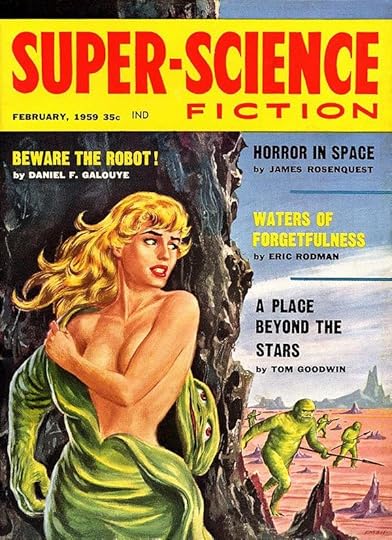 If you read a lot of old SF mags like I do, you will surely come across names you aren’t familiar with. A quick look on ISFDB usually tells me which major writers or associate editors wrote the story under a pseudonym. Some that did a lot of this were Paul W Fairman, Milton Lesser, David Wright O’Brien, Randall Garrett, and Henry Kuttner. I mean somebody had to write all those Will Garth, CH Thames, Alexander Blade, and Ivor Jorgenson stories, right? But occasionally, just once in a while, you come across a name that wasn’t a pseudonym and you wonder: who was this wordsmith who wrote a half dozen stories, then gave up the game?
Such a writer for me is James Rosenquest. Never heard of him, right? Nor are you ever likely to. Unlike Cordwainer Smith, who is a pseudonymous author who began in the low-to-no-pay magazines, James Rosenquest is no genius waiting to be discovered. In fact, most of his stories appeared in Super-Science Fiction, one of the worst SF publications of the 1950s. At the end of the magazine’s run, for five issues in a row, James Rosenquest provided a story in a magazine filled with writers who would become famous in the decade ahead: Robert Silverberg, Harlan Ellison, and Jack Vance, as well as a few old pros like Isaac Asimov and Robert Bloch. The magazine was filled with hastily composed stories written on auto-pilot (Silverberg was pumping out 10,000 words a day) or unsellable clunkers from the reject pile. But neither necessarily applies to Rosenquest, as he was not a regular contributor elsewhere.
Are the James Rosenquest stories so bad? Obviously, this is a matter of taste. I enjoy monster fiction, so the cheesy, gigantic beasties and killer robots are right up my alley. The big magazines were Astounding, Galaxy and Fantasy & Science Fiction. I personally find '50s Astounding even more dull than '40s Astounding; Galaxy has many individual gems, but also many stories that haven’t dated well. Only Fantasy & Science Fiction remains enjoyable to read and that is because it was intended as a fairly literary mag from the beginning, so I don’t go there for my monster thrills. (That being said, they did publish Fritz Leiber’s “The Pale Brown Thing,” the novella that became Our Lady of Darkness in 1977.)
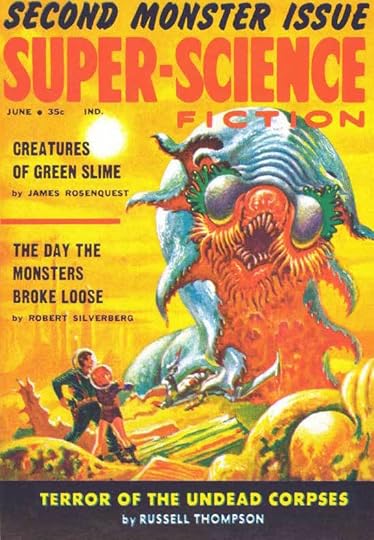 The bigger question for me is: who was James Rosenquest? No famous author has claimed him or been found out to be him, so we have to assume he was an actual person. The Internet guides say little. SFE: The Encyclopedia of Science Fiction says of the Rosenquest story “Dreadnight” in Shock Mystery Tales:
Lawrence Bloch tells on the Mystery Scene website:
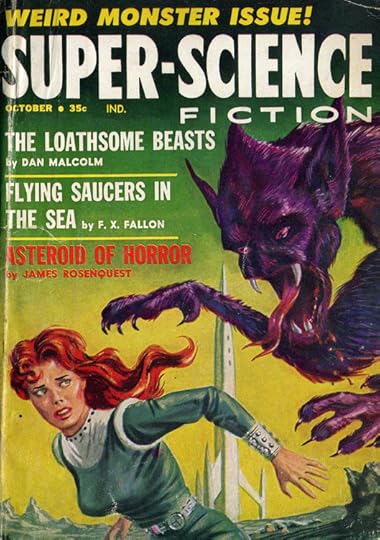 Since the Super-Science Fiction stories appear first, Scott may have written them at the magazine’s end, then kept the pseudonym when he wrote stories for the other two. What makes this unlikely is that Scott has no writing credits under his own name like most SF editors did, and he stayed on with Headline for at least two more years. Why sell to the competition? Why write SF at all, since the majority of his work was in men’s and mystery magazines? It is unlikely James Rosenquest was WW Scott.
I did a little poking around and found another author with the name J Wesley Rosenquest, who appeared in Weird Tales with “Return to Death” (January 1936) and “The Secret of the Vault” (May 1938). Did the J stand for James? Was Rosenquest a Weird Tales reader who contributed two stories as a teenager (perhaps) then went off to college and work, but returned to the typewriter in 1959? Who knows? I did some reading and a little detective work and came to this conclusion: it is quite possible they are the same writer. They both like semi-colons (but less in 1959, which could be a sign of improvement on a young writer.) They both see horror as a scientifically explained scenario rather than a supernatural one. In “Return to Death," a university-trained nobleman becomes paralyzed only to recover and be staked as a vampire by his less educated villagers. “The Secret of the Vault” has less obvious science to it, with weird eldritch tomes, but for all its talk of the liquid of essence, it isn’t so far away either. If J Wesley is James, his style became more dialogue-oriented, his SF themes more hackneyed, and in the end, not much of a better writer. The poor ending of “The Secret in the Vault” could come from the same one who wrote the poor ending of “Man-Hunting Robot.” (Despite this, it appears “The Secret of the Vault” was used for an episode of The Night Gallery in 1972, called “You Can Come Up Now, Mrs. Milikin” starring Ozzie and Harriet Nelson.)
Whether James Rosenquest was WW Scott, a pseudonymous writer, or J. Wesley Rosenquest, we may never know. What we do know is it that James Rosenquest wrote seven tales that stand or fall on their own merits. I personally found them worth a read, though no tears at the thought of him hanging up his quill pen in 1962.
“Horror in Space” (Super-Science Fiction, February 1959)
“The Huge and Hideous Beasts” (Super-Science Fiction, April 1959)
“Creatures of Green Slime” (Super-Science Fiction, June 1959)
“Man-Hunting Robot” (Super-Science Fiction, August 1959)
“Asteroid of Horror” (Super-Science Fiction, October 1959)
“Rope” (Fantastic Universe, February 1960)
“Dreadnight” (Shock Mystery Tales, October 1962)
GW Thomas has appeared in over 400 different books, magazines and ezines including The Writer, Writer's Digest, Black October Magazine and Contact. His website is gwthomas.org. He is editor of Dark Worlds magazine.
 If you read a lot of old SF mags like I do, you will surely come across names you aren’t familiar with. A quick look on ISFDB usually tells me which major writers or associate editors wrote the story under a pseudonym. Some that did a lot of this were Paul W Fairman, Milton Lesser, David Wright O’Brien, Randall Garrett, and Henry Kuttner. I mean somebody had to write all those Will Garth, CH Thames, Alexander Blade, and Ivor Jorgenson stories, right? But occasionally, just once in a while, you come across a name that wasn’t a pseudonym and you wonder: who was this wordsmith who wrote a half dozen stories, then gave up the game?
Such a writer for me is James Rosenquest. Never heard of him, right? Nor are you ever likely to. Unlike Cordwainer Smith, who is a pseudonymous author who began in the low-to-no-pay magazines, James Rosenquest is no genius waiting to be discovered. In fact, most of his stories appeared in Super-Science Fiction, one of the worst SF publications of the 1950s. At the end of the magazine’s run, for five issues in a row, James Rosenquest provided a story in a magazine filled with writers who would become famous in the decade ahead: Robert Silverberg, Harlan Ellison, and Jack Vance, as well as a few old pros like Isaac Asimov and Robert Bloch. The magazine was filled with hastily composed stories written on auto-pilot (Silverberg was pumping out 10,000 words a day) or unsellable clunkers from the reject pile. But neither necessarily applies to Rosenquest, as he was not a regular contributor elsewhere.
Are the James Rosenquest stories so bad? Obviously, this is a matter of taste. I enjoy monster fiction, so the cheesy, gigantic beasties and killer robots are right up my alley. The big magazines were Astounding, Galaxy and Fantasy & Science Fiction. I personally find '50s Astounding even more dull than '40s Astounding; Galaxy has many individual gems, but also many stories that haven’t dated well. Only Fantasy & Science Fiction remains enjoyable to read and that is because it was intended as a fairly literary mag from the beginning, so I don’t go there for my monster thrills. (That being said, they did publish Fritz Leiber’s “The Pale Brown Thing,” the novella that became Our Lady of Darkness in 1977.)
 The bigger question for me is: who was James Rosenquest? No famous author has claimed him or been found out to be him, so we have to assume he was an actual person. The Internet guides say little. SFE: The Encyclopedia of Science Fiction says of the Rosenquest story “Dreadnight” in Shock Mystery Tales:
“…No notable authors appeared, at least not under their actual names; suspicions of multiple pseudonyms are fueled by the fact that bylines tend to be unique to this magazine (an exception being James Rosenquest, with previous credits in Super-Science Fiction and Fantastic Universe)…”One possibility was that Rosenquest was WW Scott, the editor of the magazine. Quite often, when an editor can’t find enough material, he will write some himself, usually under a pseudonym. Harry Bates did it as Anthony Gilmore. Ray Palmer was Edgar Rice Burroughs knock-off JW Pelkie. Howard Browne was no less than twelve different pseudonyms. The same company did not own the three magazines that Rosenquest appeared in. Super-Science Fiction was published by Headline, Shock Mystery Tales by Pontiac, and Fantastic Universe by Leo Marguiles. Scott worked on Man-To-Man for Official Com Inc. in 1950, before heading to Headline where he edited Trapped (1956-60) and Guilty along with Super-Science Fiction.
Lawrence Bloch tells on the Mystery Scene website:
“…Manhunt was hard to hit, but WW Scott bought a batch of stories from me for his alternating bimonthlies, Trapped and Guilty. He paid a cent and a half a word, and the stories he passed on went to Pontiac Publications, where the rate was a cent a word….”
 Since the Super-Science Fiction stories appear first, Scott may have written them at the magazine’s end, then kept the pseudonym when he wrote stories for the other two. What makes this unlikely is that Scott has no writing credits under his own name like most SF editors did, and he stayed on with Headline for at least two more years. Why sell to the competition? Why write SF at all, since the majority of his work was in men’s and mystery magazines? It is unlikely James Rosenquest was WW Scott.
I did a little poking around and found another author with the name J Wesley Rosenquest, who appeared in Weird Tales with “Return to Death” (January 1936) and “The Secret of the Vault” (May 1938). Did the J stand for James? Was Rosenquest a Weird Tales reader who contributed two stories as a teenager (perhaps) then went off to college and work, but returned to the typewriter in 1959? Who knows? I did some reading and a little detective work and came to this conclusion: it is quite possible they are the same writer. They both like semi-colons (but less in 1959, which could be a sign of improvement on a young writer.) They both see horror as a scientifically explained scenario rather than a supernatural one. In “Return to Death," a university-trained nobleman becomes paralyzed only to recover and be staked as a vampire by his less educated villagers. “The Secret of the Vault” has less obvious science to it, with weird eldritch tomes, but for all its talk of the liquid of essence, it isn’t so far away either. If J Wesley is James, his style became more dialogue-oriented, his SF themes more hackneyed, and in the end, not much of a better writer. The poor ending of “The Secret in the Vault” could come from the same one who wrote the poor ending of “Man-Hunting Robot.” (Despite this, it appears “The Secret of the Vault” was used for an episode of The Night Gallery in 1972, called “You Can Come Up Now, Mrs. Milikin” starring Ozzie and Harriet Nelson.)
Whether James Rosenquest was WW Scott, a pseudonymous writer, or J. Wesley Rosenquest, we may never know. What we do know is it that James Rosenquest wrote seven tales that stand or fall on their own merits. I personally found them worth a read, though no tears at the thought of him hanging up his quill pen in 1962.
“Horror in Space” (Super-Science Fiction, February 1959)
“The Huge and Hideous Beasts” (Super-Science Fiction, April 1959)
“Creatures of Green Slime” (Super-Science Fiction, June 1959)
“Man-Hunting Robot” (Super-Science Fiction, August 1959)
“Asteroid of Horror” (Super-Science Fiction, October 1959)
“Rope” (Fantastic Universe, February 1960)
“Dreadnight” (Shock Mystery Tales, October 1962)
GW Thomas has appeared in over 400 different books, magazines and ezines including The Writer, Writer's Digest, Black October Magazine and Contact. His website is gwthomas.org. He is editor of Dark Worlds magazine.
October 31, 2016
31 Days of Gothic Romance | Crimson Peak

Guillermo del Toro and I obviously love the same stuff, so it's no surprise that he's also a fan of gothic romance. Crimson Peak is set in a crumbling castle in the mountains of northern England and features Mia Wasikowska as a young author who marries a charming, but darkly mysterious man played by Tom Hiddleston. And there's Jessica Chastain as Hiddleston's even more mysterious and dangerous sister.
It's a bit more graphic than I'm used to from the genre, but that's in the Hammer tradition, so it's not inappropriate and the movie works. If anything, it disappointed some horror fans who didn't know what to expect from gothic romance and pleased some folks who are typically skittish about horror. It's a great example of the genre, easily my favorite Del Toro film, and the perfect place to end this countdown.
Happy Halloween, everyone!


October 30, 2016
31 Days of Gothic Romance | A Series of Unfortunate Events

A dastardly count tries to control a young girl (and her siblings) for nefarious purposes, all under a wonderfully gloomy atmosphere. Lemony Snicket's 13-book series is classic gothic romance with a wicked sense of humor.
I haven't read the books, but I enjoyed the movie and was disappointed that it never spawned sequels. Fortunately (though Snicket would disagree), we have the Netflix series coming in January.


October 29, 2016
31 Days of Gothic Romance | Sleepy Hollow

If we were to define gothic romance by atmosphere alone, almost any of Tim Burton's films would fall into the category. But Sleepy Hollow is the most gothic romantic in the way it hits all the traditional themes and tropes. Like Great Expectations, it gender swaps the traditional roles, having an aristocratic woman employ ancient evil to menace Johnny Depp's perpetually frightened Ichabod Crane. There's also a great, old manor house and of course the coolest ghost ever.
Christina Ricci also looks especially appropriate as the angelically beautiful Katrina Van Tassel. She's not a traditional gothic romance heroine - wonderfully spending most of the movie making Crane wonder if she's his ally or enemy - but ends up playing another gender swapped role: the handsome young man out to rescue his love from the villain.


October 28, 2016
31 Days of Gothic Romance | The Music

The word "gothic" was being used to describe particular rock bands long before what we think of as goth music was ever a scene. It was applied to The Doors in the late '60s, referring to the gloomy atmosphere of their sound. Critics have retroactively given the adjective to The Velvet Underground as well, referring to their dark, droning sound that was certainly influential to later, for-reals goth artists. So, like so much of what gothic literature and cinema had become in the '60s and '70s, the term as applied to music was first used as a description of mood, not themes.
That changed though as the psychedelic experimentation of The Doors and The Velvet Underground devolved into the rawer play of the punk scene, which then reconstituted into the post-punk movement that begat goth. By the '80s, bands like The Cure, Siouxsie and the Banshees, Joy Division, and Bauhaus had set up shop in a dark, foggy corner of the post-punk landscape. From there they gave birth to groups like Flesh for Lulu, Gene Loves Jezebel, and the Cocteau Twins. The punks had been all about getting in your face with the revolution, man, but goth bands turned inward. They married atmospheric music to introspective lyrics as they wrestled with mysticism, religion, and death.
In that sense, a lot of goth musicians got back to the original meaning of gothic romance. They were fascinated with decay: both society's and their own. But they sang about these ancient troubles from a romantic perspective, finding beauty in the darkness like Belle in the castle of the Beast.
I haven't kept up with the goth scene and I've never adopted goth fashions, but I'm still a huge fan of goth music, especially the stuff I discovered as a kid. Here are some of my favorites.

October 27, 2016
31 Days of Gothic Romance | Gothic Tales of Love

Marvel also tried their hand at a gothic romance series, but in a different format. Instead of a comics anthology series, they published a black-and-white text magazine through their Curtis Magazines imprint. Since magazines weren't bound by the Comics Code Authority, Marvel had formed Curtis as a way to publish Mature Readers stories that wouldn't fly in the regular comics. In addition to classics like Crazy, Deadly Hands of Kung Fu, and of course Savage Sword of Conan, there were less-successful attempts like Gothic Tales of Love.
Unlike some of Curtis' other black-and-white magazines that included comics in them, Gothic Tales of Love was all about text stories with some illustrations. Some of the stories were original, but others were reprints of what the editors thought were under-read, contemporary gothic romance stories. The True Love Comics Tales blog has some great posts about the magazine, including the table-of-contents of each issue and a full story (in two parts) from the first issue. (As long as you're perusing True Love Comics Tales, be sure to check out this post that serves as a gateway to complete stories from Dark Mansion of Forbidden Love and Sinister House of Secret Love .) You can also find the full, second issue of Gothic Tales of Love at Archive.org.
Even though Marvel went a different route with its gothic romance title, it had a similar result to DC's efforts. Gothic Tales of Love only lasted three issues before it was cancelled.
Interestingly, comics publisher Dell had tried something similar a few years earlier with a black-and-white magazine called simply Gothic Romances. It had also contained a mixture of reprints and original stories and had also lasted only three issues. It got a second chance by being renamed Gothic Stories, but that only carried it three more issues before its final cancellation.


October 26, 2016
31 Days of Gothic Romance | Haunted Love

DC wasn't able to get a gothic romance series off the ground for more than a few issues, but their low-budget competitor Charlton Comics got almost a year's worth of issues out of theirs. Interestingly, though, they did it in a couple of chunks. It launched in early 1973 as a bi-monthly series and lasted five issues until the end of the year. Then it went on hiatus for almost a year, picking up where it left off in late 1974 and going for another six issues.
Like the DC efforts, Haunted Love was an anthology comic and included work by some comics legends. Joe Staton did a few stories and Steve Ditko drew a couple as well. And also like Forbidden Mansion and Sinister House, Haunted Love expanded the definition of gothic romance to include any love story with a hair-raising, supernatural element.
For a taste of the series, check out the Charlton Comics Reading Library. It has the whole first issue, written by Nicola Cuti and Tom Sutton, and drawn by Joe Staton and Tom Sutton.


October 25, 2016
31 Days of Gothic Romance | The Sinister House of Secret Love

About a month after the debut of Dark Mansion of Forbidden Love , DC launched a companion series called The Sinister House of Secret Love. Like Dark Mansion, Sinister House featured young women in romance stories with a malevolent, sometimes supernatural twist. They even both featured artists Tony DeZuniga and Don Heck, but Sinister House also got comics legend Alex Toth for an issue.
It's that issue, #3, that my buddy Siskoid and his pals covered on an episode of The Lonely Hearts Romance Comics Podcast. It's an excellent episode of an excellent podcast and you should listen to it. You can also see some of the pages that they discuss on the LHRCP site.
Sadly, also like Dark Mansion, Sinister House was renamed and refocused after only four issues. It became Secrets of Sinister House, yet another horror-suspense anthology, though with a gothic-inspired cover for the first issue after the change. And true to its gothic romance roots, Secrets got a young woman as its horror host: Eve, who was cousin to Cain and Abel from House of Mystery and House of Secrets .


October 24, 2016
31 Days of Gothic Romance | The Dark Mansion of Forbidden Love

In the Autumn of 1971, DC launched not one, but two gothic romance titles. I've read neither of them and can't speak to the differences (if there are any), but the first was The Dark Mansion of Forbidden Love. It usually featured full-length stories and a text piece by various writers and artists, but the artists are legendary: Tony DeZuniga, Don Heck, and Ernie Chan.
As with the run of gothic covers on House of Secrets, DC's experiment with full gothic romance comics was short-lived. The Dark Mansion of Forbidden Secrets was cancelled after four issues and retooled in early 1972 to become Forbidden Tales of Dark Mansion, a straight horror-suspense anthology. Though the gothic covers did continue for a couple of issues into that series as well.
This Autumn, DC has sort of revived the original title with a mini-series starring the character Deadman. Written by Sarah Vaughn (Alex + Ada) and drawn my Lan Medina (Fables), Deadman: Dark Mansion of Forbidden Love tells the story of a young woman in an old mansion who teams up with Deadman to battle whatever evil is infesting the house.