Cian Beirdd's Blog, page 7
May 29, 2014
King Arthur: The Movies
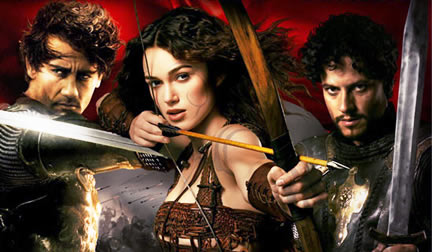 King Arthur. The phrase conjures images of fair maidens, brave knights, chivalry, and twelfth century armaments. The fact is that everyone’s favorite British king lived in the fifth century. He probably had hand-me-down armor, sword, and shield. He may not have spoken Latin, but he knew enough about the past to respect Rome. His life was hard, consisting of poor hygiene, bad diet, and battles as a part of everyday life.
I say all this by way of an introduction. In our era of realism, where every period from the Trojan War up to the present day is portrayed with accurate weapons, tactics, and technology, the Arthurian period is still waiting on something resembling the real article. Till then, I’ll keep you occupied with a list of Arthurian period movies and some of their more irritating traits.
King Arthur is probably the most accurate we are likely to get for the period. I read someplace that the horse paraphernalia is inaccurate. I can live with that. If I wanted to be difficult I would mention the contemporaneity of Pelagius and Arthur,
No, let’s stick with the bad stuff. Arthur is a Latin name, yet he is called a Sarmatians. The Sarmatians were Germanic and had faded from history by 400? Arthur is sent to guard Britain for a predetermined number of years by the Romans? But Roman mercenaries settled their entire tribes in the areas they protected. It makes no sense to even connect Arthur with the Romans; he was most likely born long after the Romans left Britain.
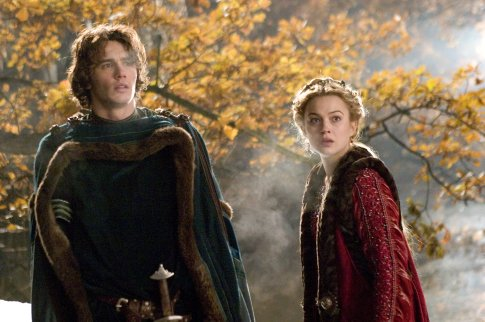 Tristan and Isolde is technically not an Arthurian film. The story itself is mythological and involves a dragon. Still, the movie is set in the ancient world, and of course Tristan, Isolde, and Mark – or rather Drust, Iseult, and March, are considered Arthurian characters. Though the storyline strays badly from the legend itself, the movie has the gritty, bloody feel of the period much like King Arthur.
The big problem with it is the fortress which is Mark’s stronghold. The castles of the period were hill-forts, nothing more than a hill that took advantage of natural rock formations to construct a wall. Within it there was normally a hall that could seat all dozen to a hundred warriors, a granary, perhaps a smithy and several huts and merchant buildings. Everything was made of wood. The multiple levels of the movie’s fort could not have existed at any time before the tenth century.
The movie is too civilized as well. A meeting of all the major kings? A contest between them? The period’s kings were more like gangsters in how they dealt with each other and their subjects than any royalty we would be familiar with. To see them acting like modern statesmen is painful – and insulting.
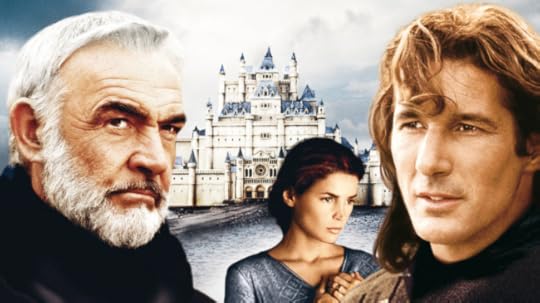 First Knight. Where to start. The machine which brings Lancelot to Arthur’s attention? The twelfth century armaments? The plot twist that Meleagant was once a member of the Round Table? That stupid theme about the man with no fear (no warrior worth his weapon is afraid to die, but fear is what keeps a person sharp on the battlefield)? It isn’t even a good adaptation of the famous poem “Le Chevalier de la Charrette” on which it was based with the absence of the intriguing character Bademagus and the minimization of Kay.
A good Arthur movie has a great deal of potential, whether one based on the literature or the history. There is the obvious love triangle of Arthur/Guinevere/Lancelot and the lesser one of Mark/Isolde/Tristan. There is the obnoxious knight who made the butt of other knights’ valor. In Palamedes there is the bad knight made good, in Perceval there is the great fool made wise. Such a plethora of good stories are there to be told from a literary standpoint, and the best we can manage are bad interpretations or insulting historical adaptations.
http://screenrant.com/king-arthur-movies-series-1-6-guy-ritchie-warner-bros-excalibur/



May 22, 2014
Origins of Force Powers
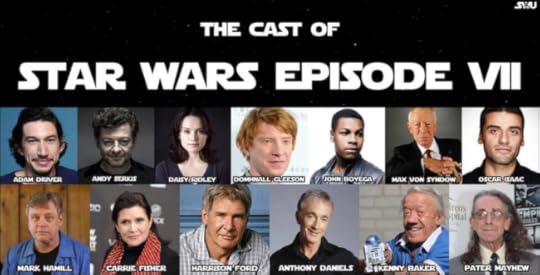 With the main cast of Episode 7 now decided, talk has been focused on the placement of the movie in relation to the original trilogy, the story-lines that will be followed, and the nature of the primary antagonist. I won’t bother adding my own voice to the mass because so much has already been said and there are now so many ways the series can go.
I will, however, take this opportunity to write on one of the most interesting aspects of the Star Wars universe, the Force Powers. In a previous article I explained that they are in most cases simply an exaggeration of those skills that advanced martial artists attain. Here I’d like to lay out some more specific relationships.
The Chinese call it Ch’i, the Japanese Ki, and the translation is inner strength (not will power, though, the body’s power beyond muscles). It is the basis of everything in martial arts, and is at the core of many Force Powers. This inner strength is supposed to come from a point roughly one inch below the navel. In classical karate it is generated by beginners through the proper use of the hips in throwing punches and kicks, blocking, throwing, weapon striking, and maneuvering one’s opponent in wrestling. Done properly, a small boy can safely throw a man several times his own weight (I know this from personal experience).
Advanced practitioners can channel that energy selectively. They can transfer the impact through objects to a target, so for instance they could strike a stack of boards and only break the last one, or a human stomach and do damage to the person’s back. They can also channel the power in their bodies to manipulate energy lines. Eastern medicine is based on the use of energy lines. Acupressure and acupuncture are two techniques used to manipulate them, while many of their medicinal remedies often work on similar premises. A person with great martial arts ability in Eastern Asia is believed to make the best healer (anyone ever seen Kung Fu Hustle?).
 In the Star Wars universe, the channeling of impact is magnified to a Force Push and Force Pull which can be effective from many meters away. Both light and dark sides (Ashla and Bogan) can use this application, or the more difficult technique of articulately moving objects – for instance Luke’s X-Wing on Dagobah, C-3PO among the Ewoks, or Amidala’s food during her dinner with Anakin.
The channeling of energy results in a number of powers. With the Bogan the result is raw, unrestrained lightning. It seems that the more powerful the individual is the more powerful his lightning, which is why Dooku is easily deflected by Obi-Wan and absorbed by Yoda, but Mace can hardly keep Sidious at bay even while the Sith Master is holding back.
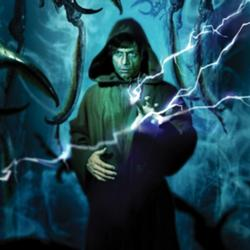 Luke also uses lightning, though he controls it so that it can be used for non-lethal purposes; he calls his version of the technique Green Lightning. Similarly, the body’s energy can be used to heal persons by correcting the patient’s energy flows with subtle changes to their energy lines. Many Jedi are known as healers, and most have the limited ability to heal themselves and others. Considering the delicacy involved and the giving nature of the technique, it’s no surprise the Sith don’t normally have this ability unless they were first trained as a Jedi and only converted later.
http://psychcentral.com/news/2012/08/16/how-karate-experts-mind-powers-a-punch/43195.html
http://scifi.stackexchange.com/questions/30738/is-using-the-force-like-using-a-muscle


May 8, 2014
Hercules vs. Hercules
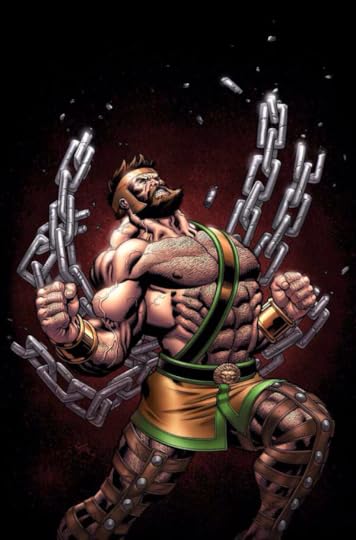 The passed few weeks I have been comparing DC and Marvel characters to demonstrate how making the DC versions so overwhelmingly strong/durable/fast/magical that they have lost a key element in making them more interesting characters. I had planned on writing another blog, between Superman and Thor, but it would only belabor the point. One more comparison is all that’s needed; one of sames.
Hercules is a figure of myth, so it is unsurprising that both the DC and Marvel versions of the character have similar powers. Both versions possess superhuman strength, endurance, speed, and stamina. And whereas Marvel’s version is able to heal himself and has some resistance to magic, the DC character can shapeshift as well as make use of magic. I am also fairly certain the DC version is a physically tougher character, but there is no specific data on that point.
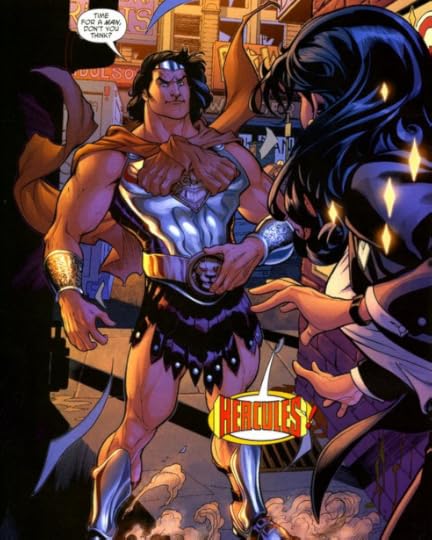 That seems to be where the comparison ends. The DC Hercules is a flat character. As in the myths he generally follows a cycle of crime, punishment, and redemption. The writers have tried to make storylines about him interesting, but his character never develops beyond those three familiar activities.
The Marvel character (predictably) is much more interesting. He begins as much the same individual as he is found in the myths – arrogant and self-righteous. But he develops, and generally tries to be a positive character. He is occasionally a member of the Avengers and is a Champion, he makes a movie, he is fooled into fighting heroes but then reconciles and fights with them. He sacrifices his godhood to save the planet and loses his powers for love. When acting as an instructor at the Avengers mansion during the most recent adventure, he comments that the older generation have only found war, but that at least some of the younger X-Men and Avengers have been able to find peace. That is a huge development, and nothing like his counterpart in DC comics.
 Early on in this series of comparisons a reader commented that Superman and Batman would always be her favorite, that she preferred her heroes to be super. And I admit, there is something appealing about idolizing an incorruptible individual that could never have anything to fear from we mortals, especially in a world without incorruptible public figures or super-people. I find myself wishing for that too, and I find myself very interested in what DC is attempting right now because I want to see Superman, Batman, and Wonder Woman.
But that’s not the point. As a great director once said, super-hero stories can’t focus on their super-powers, they have to focus on the struggles of the individual. And while a nearly invincible hero can have personal struggles, it makes the story less interesting if he is invincible. As has been seen, many DC heroes don’t even have much in the way of those personal issues.
Will I continue watching DC movies? Of course. I grew up with the DC characters. Nolan’s storytelling technique is astounding, and DC’s approach to introducing its characters might offer something to my own writing that Marvel hasn’t come up with. But what Marvel has done with the quality of its characters, their vulnerabilities physically, mentally, even socially, has not been equalled. It probably won’t be.


May 1, 2014
Batman vs. Punisher
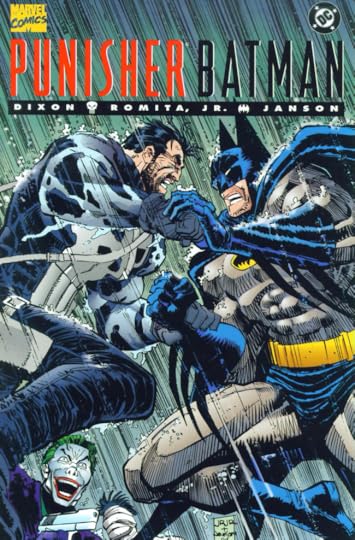 In the previous two comparisons I have started with a Marvel character and tried to find a DC equivalent. This week I thought I would start with a DC character – Batman. His original, and primary, quality is that he is an independent detective. Batman also happens to be the most interesting character in the DC pantheon for me. But, by right of his detecting quality, the closest character to be found in the Marvel universe is The Punisher.
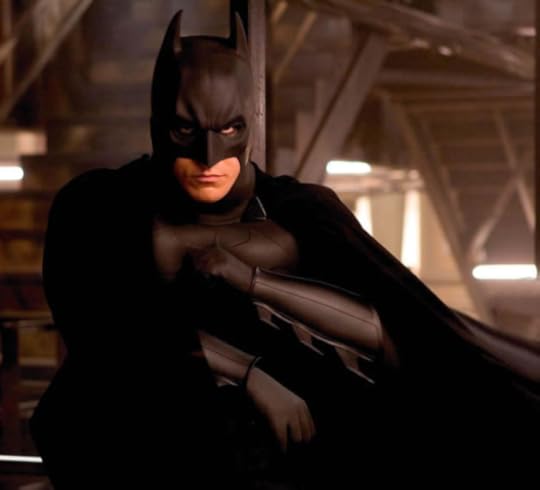 So, again to the comparison. Batman was first seen in 1939. He is one of the most intelligent humans in the DC universe, comparable to Lex Luthor. He is rich, too. He has an endless supply of money to invest in gadgets and travel. Batman is also the most accomplished martial artist in the DC universe, having learned and excelled at nearly every form of combat in existence. Add to that he keeps his body at the level of an Olympic athlete and he is nearly unbeatable to any human he comes up against. He has also worked to master nearly every science known to man, including interrogation and escapology, and is both quick-witted and thinks ahead. This means that his utility belt allows him to beat even alien and superior opponents. He is mentally tough, too, able to withstand tremendous levels of pain or the mental attacks of telepaths.
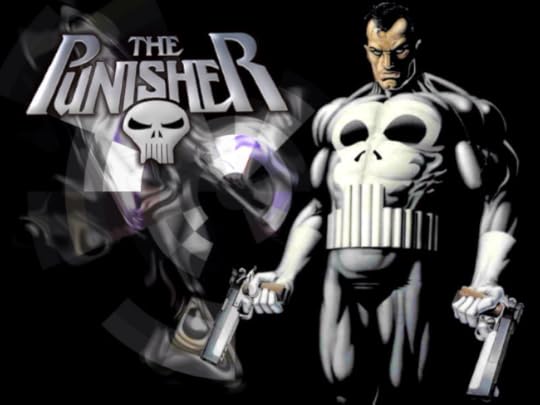 The Punisher was first introduced in 1974. Though possessing above average intelligence he is about as close to Bruce Wayne as a class valedictorian would be to Stephen Hawking. He has access to money, but this is limited to the cash he collects from the criminals he hunts. Not that his income has ever hampered his access to weapons or tools, but then again I don’t see a specially designed suit worth millions in his future. He also possesses a high level of physical fitness and specialized military training, though nothing like Batman. Along the way he has learned mission-specific abilities such as acting and has the same level of pain tolerance and mental strength as his counterpart.
Their origin stories have similarities as well. Batman’s parents were killed in front of him, emotionally driving him to crime-fighting. The Punisher watched his wife and children get killed. However, their responses were very different. Whereas Batman will go beyond the limits imposed on law enforcement in catching criminals he doesn’t kill, doesn’t use guns, and has a sincere desire to help the community he lives in as demonstrated both in and out of the mask. The Punisher has one goal in life, punishment of the guilty. There is only one punishment for offenders – death.
Clearly Batman has more assets and is therefore combats and crime-solving are less challenging and interesting for his character. On the other hand, the dimension of his approach to his childhood trauma is fascinating. It gives him a complexity that would be difficult to duplicate. For instance, with The Punisher all he has is simple hatred. Unlike with the previous two weeks, I can’t definitively say the Marvel character is the more interesting. Each adventure may be more fun to read with the Marvel hero, but the character of Batman is deeper, more evolved, and more complex than anything The Punisher is capable of. I find myself interested, despite myself, in the future Superman/Batman movie.
http://www.geekwithcurves.com/2014/02/dive-into-psychology-of-batman-with.html
http://monstersfreaksfreud.blogspot.com/2011/12/psychological-analysis-of-batman.html
http://antifilmschoolsite.wordpress.com/2012/04/29/the-punisher-2004/


April 24, 2014
Telepathy: Professor X vs. J’onn J’onzz
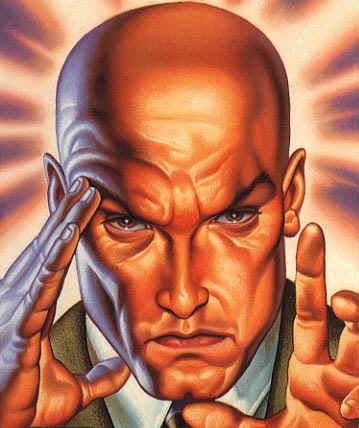 This week I would like to compare two more primary characters of the Marvel and DC universes, the redoubtable Professor Charles Xavier and the inimitable J’onn J’onzz. Both are considered among the greatest telepaths in their respective universes.
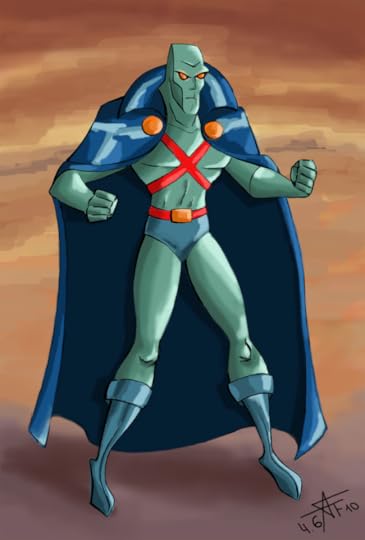 J’onn first appeared in 1955. He is an advanced telepath, able to connect with the entire planet at one time in order to locate someone. He is also an advanced shapeshifter, capable of changing his size and shape to anything he wishes. His density can be modified at will; he can phase in and out or become incredibly dense. He can use energy attacks, fly, turn invisible, has x-Ray vision, can create force fields, and has strength, durability, and endurance to match Superman. He was at one point weakened by fire, but now only certain types of psychic fires have any impact on him.
Professor X first appeared in 1963. He is also an advanced telepath and one of the most powerful on Earth. However, apart from telepathy his abilities are nothing like J’onn’s; unaided he can only contact minds within a 250-mile radius. He can go much further than that, touching every mind on the planet, but he must use his artificial creation, Cerebro, to do so.
His telepathy has led to other powers. He is able to learn and teach instantly by touching another person’s mind. He is able to create psychic bursts, induce paralysis, create illusions, and project himself astrally. However, the professor only has his mind. He cannot stand because he is a paraplegic. His strength, durability, and endurance are also less than ordinary because he cannot exercise like a normal person. He cannot fly or use any form of telekinesis (movies notwithstanding). His senses are ordinary.
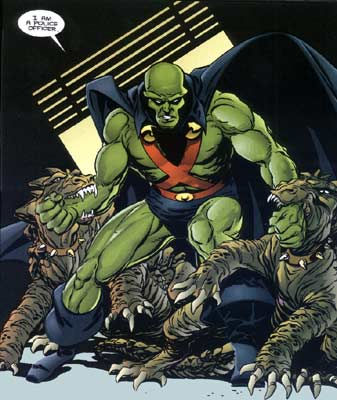 As with Wally, J’onn’s powers are so far beyond human it is difficult to imagine a worthy adversary for him. He also has no personality wrinkles. J’onn is either separated from his people or the last of his kind (depending on the era his story is told in), but no attempt has ever been made to explore that aspect of his personality. He is another flat character from the DC pantheon of pseudo-gods.
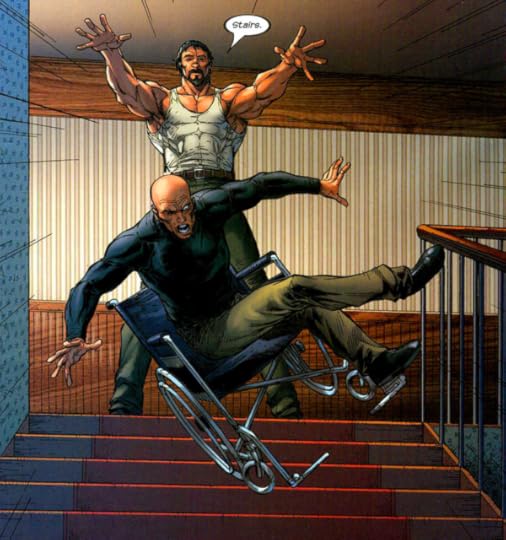 Professor X is powerful, and even more so with the support of his X-Men. But he is not all-powerful. He is vulnerable to the most basic attacks; his wheelchair can be tipped over to leave him prone. He cannot outfight someone with even a minimal knowledge of streetfighting, either. His crippled state works perfectly for a character whose goal is to peacefully champion mutant rights. It makes him interesting, too. It just doesn’t make him a superhuman hero.
So does his humanity. Xavier’s human mistake of women-chasing in front of his ward allows him to lose Mystique in the fourth X-Men movie. His ability to empathize with Magneto makes the pair one of the most interesting adversaries in all of comics. His depression almost loses him the future in Days of Future Past. Professor X is one of the most powerful of the primary Marvel characters, but he is no match for his counterpart in the Justice League in combat, just as J’onn is no match for Professor in the department of interesting.
http://dailymisfit.com/2014/04/16/10-most-powerful-superheroes-of-all-time/
http://arousinggrammar.com/2013/12/22/sad-jla-martian-manhunter/
http://www.keysmashblog.com/comic-book-genre-dc-vs-marvel/
http://everydayislikewednesday.blogspot.com/2008/01/like-stevan-seagal-jonn-jonnz-is-hard.html


April 10, 2014
The Flash vs. The Wolverine
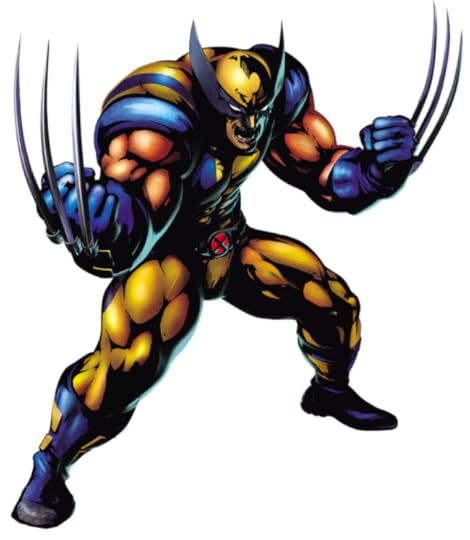 On many occasions I have mentioned my preference for the Marvel universe over the DC. I thought perhaps a point by point comparison might demonstrate this best. This week, the unaging and immediately healing Wolverine and the unaging and immediately healing Wally West (The Flash).
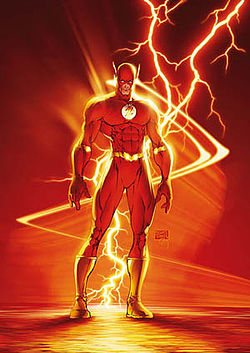 Wally West was first created in 1960, his abilities include not only healing and a lack of aging, but also speed. That’s actually an understatement. The DC universe has what it calls a speed factor, something that controls all speed in the universe. Speed Factor gave Wally speed beyond all measure. He has been to the beginning of time and back. He has outrun death. He has moved half a million people 35 miles in the 100 picoseconds after a nuclear explosion.
The Flash has other abilities as well. He has a Speed Force Aura which protects him and any person moving with him. He has the ability to construct things using the Speed Force; such as his costume. He can steal the speed of others. He also can survive in space and has nearly unlimited stamina. In other words as long as he can see an opponent coming he is unbeatable.
James Logan was first penned in 1974. His powers are genetic. In addition to his healing and lack of aging he has superior senses and the ability to communicate on a very basic level with animals. He can also survive the elements. As he has spent many years in a feral state over his life, one wonders how much of this is natural ability and how much has been learned in the wild.
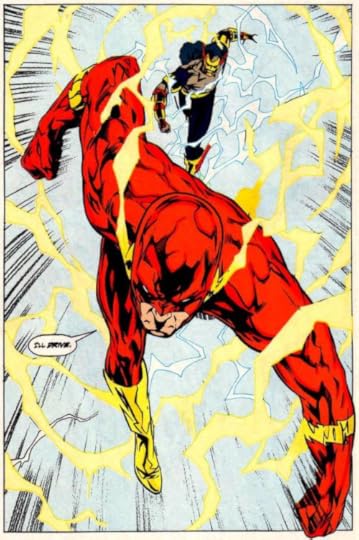 Wally’s abilities make him almost boring. He can’t be hit except by luck and if he is moving at speed the strike will be harmless. If he is rendered unconscious the only way to stop him is to kill him before he wakes up as his speed makes him unholdable as well. I cannot think of a reasonable opponent for him apart from someone intelligent enough to kill him before he knows someone is after him.
The Wolverine is by comparison quite vulnerable. He can heal quickly and has those claws but he can still be overwhelmed. His healing can be neutralized by a retrovirus, his wrists can be pinned to make his claws useless.
Wally is a typical hero. He fights the good fight, he gets the bad guys, he goes home. Wolverine is more than that. He does what is right generally, but he is a loner. Everyone he has ever cared about has been killed. He has gone insane many times and lived in a feral state, only to come out of each experience trying to interact with the human world. Wolverine, frankly, is interesting. Wally is not.


April 7, 2014
Xiaverse Wiki
As you may or may not know I have been writing some short stories placed in the Arthurian period and at the end of the ice age. I’ve recently published a novel on Amazon kindle as well. In tandem with my work I have been building a wiki on my works. There is character info and historical details about the places and technology involved, but also cultural background for all the cultures involved, a glossary, and a pronunciation guide. I hope you’ll take a look.
http://xiaverse.wikia.com/wiki/Xiaverse_Wiki


April 3, 2014
The Watchmen
 Why aren’t there more movies like Watchmen? It has realistic portrayals of the psychology behind being a superhero, complex characters, even superheroes who generally don’t have superpowers. The Comedian aged slowly and Ozymandias moved quicker than everyone else. Extraordinary yes, but nothing like their counterparts Wolverine or The Flash. And Dr. Manhattan? He has very original origins and powers. It was also very nice to see the most powerful individual in a movie not dominating the activities of the others.
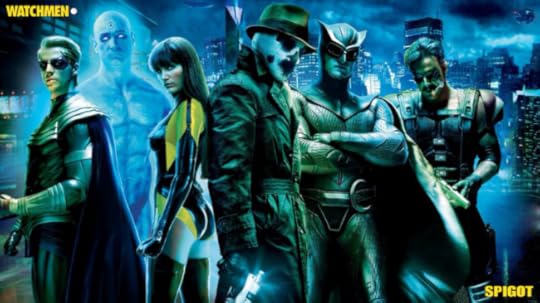 But that’s right back to the psychology. Our sports heroes think they are something special and treat women like they are part of the perks of being good at what they do. It only makes sense that someone like the Comedian would have that attitude as well. Silk Spectre might have been one of the great heroes for many years, but as a retired person she was pressured into a standard gender role and naturally hated having her independence stripped from her. Silhouette was a public figure, which made her open homosexuality a target. There is mention made of at least one superhero who has gone insane, too; that is a perfectly normal reaction given what these people do and how they do it. Ozymandias had been a vigilante for years before he went public. He had gotten used to making up the rules as he needed to. He was also intelligent enough to disguise his activities so that he wasn’t labeled insane and didn’t become a public target. The sequence of events he sets in place, of killing millions to save billions, is something a madman or vigilante human might think was the right move, but persons with a socially acceptable respect for life would never consider it. That any of the other heroes can even consider Ozymandias might be right speaks to the consistency of that thinking.
And Dr. Manhattan is the creme de la creme of the cast. He has godlike powers. He isn’t made in the superstrong/superfast/supersmart mold of Superman, but he is truly godlike. He can kill a person or persons with a thought. He can create anything he wants wherever he desires. Wow! He can make life. No small wonder he feels a growing disconnection with humanity.
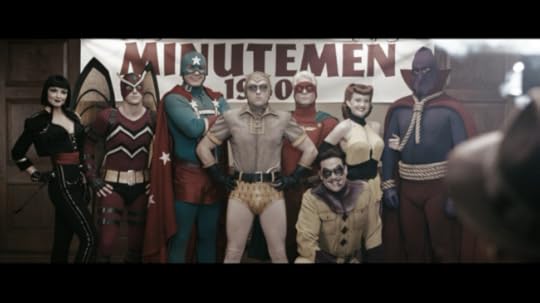 Complexity made for an interesting feature as well in the movie. A god plagued by doubts and regrets who tells other characters what is going to happen even as he tries to understand what he must do. Two heroes finding the line between doing the right thing and vigilantism as they fall in love. A guy who finds dark humor in the world around him and has little respect for any individual but tries to save the planet from chaos at the cost of his own life. Even the book the first Night Owl wrote made for better dimension; superheroes contemplating the meaning and importance of superheroes to their society.
The movie screamed to me about its realism and grit. Sure, it’s fun to see a hero able to fly into the sun or lift mountains but the most interesting characters, and the most interesting features of those characters, are limitations. All of the characters in the movie had them, even Ozymandias. If he hadn’t been able to neutralize Night Owl II and Rorschach and convince Dr. Manhattan of the rightness of what he was doing he would have had no chance to follow through with his plans. Did I mention how neat it was to have a hero play the villain, even when he was trying to act heroic?
http://www.cracked.com/blog/6-realistic-changes-that-would-improve-superhero-movies/


March 27, 2014
Star Wars: Power Origins
 We are all going a little crazy over the developing Star Wars t.v. shows, movies, and speculation in general. A Boba Fett movie, a special season to finish off animated Clone Wars, another animated Star Wars show, a live-action show, and of course endless articles about Episode 7 and beyond keep the fan constantly buzzing with excitement.
But what is really neat about Star Wars are the Force Powers. As a seven year-old, I started karate. A few months later I broke a board, all of an inch deep. My teacher explained to me that I was focusing all of my body’s energy into my fist and my fist through the wood. When I didn’t get that he told me that my sister’s head was a few inches under the board. That worked much better.
As a black belt, a practitioner is expected to be able to focus their ki/ch’i (roughly translated as inner strength or a force) into a strike with the hands, feet, elbows, or knees and to have much more power than a beginner. This is because of very specific training.
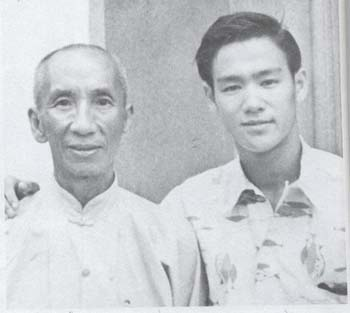 Then there are masters, people whose abilities with ki are such that they can not only focus it to an even greater degree but they can control where it is used. Someone with this ability can break the last board or brick in a stack (erroneously called Dim Mak in Bloodsport), or damage an organ without leaving a bruise at the point of contact. There are even legends of grandmasters capable of killing with barely a touch or no contact at all.
Among the Jedi and Sith, the ability to push a person using “the Force” is a common trick. Luke Skywalker and many Sith can similarly call on their powers to emit lightening from their fingertips. Both techniques are different ways of focusing that ki.
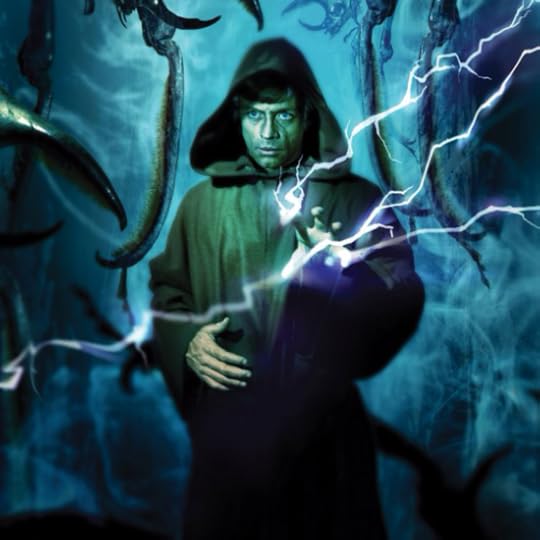 There are other aspects of the martial arts that are exaggerated in Star Wars as well. Martial combat and meditation eventually brings a clarity that borders on precognition, though nowhere near what Yoda, Sidious, and their cronies manage. For many years after the body begins to decline the understanding of martial arts that has been developed more than makes up for what is lost. However, generally fighters in their eighties and older are not the best fighters as they are in the Star Wars universe.
As you are watching the Star Wars shows and playing its games, it’s important to remember that these aren’t powers based on myths or legends. They aren’t what some creative kid with no knowledge of science came up with to explain the natural phenomenon around him. Nor are they simple products of the imagination as has happened with the DC and Marvel comics. The Force Sensitives of the Star Wars universe are people, not gods. They have abilities honed well beyond anything on Earth, but they have a basis in the advanced powers of the martial arts of this planet. That in itself, I think, is more than enough reason for watching anything Star Wars.


March 20, 2014
A Feminine non-Prototype
 This week I thought I might write about some female characters out of the media, from mythology to more recent movies. I don’t know that I would call them ideal feminine heroes, but I do know that they all have at least one excellent heroic quality; they don’t let their egos get in the way.
Athena. The Goddess of Wisdom and the smart deity of War, she had access to the bests weapons, armor, and strategy. But she didn’t pull out her gear every time she had a dispute. On the contrary. The Titans overthrew their father when he tried to kill them. The Olympians overthrew the Titans when Chronos tried to swallow them. But when Zeus was warned the same thing might happen to him and he swallowed his lover, Athena, his child did not perpetuate the family tradition. She sprang from his head and never attempted revenge on her father.
Instead, she guided heroes in their struggles, helping those who deserved it and not helping those who were not worthy. The scene that most clearly stands out for me happens during the original Seven Against Thebes. Her favorite, Tydeus, was mortally wounded. Not wanting him to die she went to get ambrosia. But when she returned she found him eating an enemy’s brains. Such barbarity disgusted her, so she did not offer him the drink. In a similar situation, any gods who cared would have tortured him or sent him to a nasty part of Hades.
 Cassandra is another one of the Greeks that seems very much apart. She was born with a perfect clarity regarding the future, and the curse of never being believed. She could have used her gift for money or to change world events. But she understood those things to be distractions from what really mattered. Instead, she did what she could to save her family; the royal house of Troy. Now the fact that she didn’t save them is not her fault. There was that curse. Nor is the fact that she could not think of a clever way of using the curse to her advantage. I would call her lack of creativity more of a tragic quality.
One of the best car scenes I have ever come across involved Julia Roberts in Conspiracy Theory. The moment she realizes she is being followed she pulls over and waves her tail forward to have a conversation with him. That is definitely not a Hollywood thing and not what the audience wanted. But it worked better for both sides that she just dropped pretenses and actually talked to the guy. No ego, no attitude, just good sense.
 Finally, I’d like to mention Willow in Buffy. O.K. yeah, she is shy and lacks confidence. She is also the most powerful human in the Buffyverse (and do not mess with anyone she is in love with!). Even after she comes to a full realization of her powers, her personality never really changes. She is a nice girl, supportive of others. Buffy can have center stage, Willow doesn’t need it. One gets the distinct impression that Willow is delighted that she can help her friend in her destiny, and is grateful that she doesn’t have one of her own.
All four women are put in situations where there are certain expectations. None of them follow through. They don’t “fail” so much as they choose their own path. And their choice is not a path that gives them more wealth, power, or even fame. They just choose a path that has the best chance of helping others.