Lucinda Elliot's Blog, page 5
November 30, 2021
Characters in Classic Novels with Personality Disorders: Part II: Samuel Richardson’s Lovelace, Mr B and Pamela
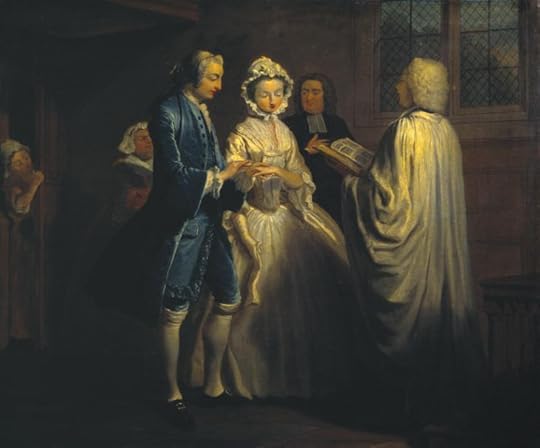 IX: Pamela is Married 1743-4 Joseph Highmore 1692-1780 Purchased 1921 http://www.tate.org.uk/art/work/N03575
I ended my former post of lay psychologising about the high prevalence of characters who seem to have personality disorders in famous books, by mentioning Robert Lovelace, the rapist anti-hero of Clarissa.
I have written about this fellow elsewhere as a fascinating example of a character personifying the dark side of an author’s psyche – there were evidently fascinating undercurrents in that of the dull, pompous, hard working self made printer Samuel Richardson.
The debauched Robert Lovelace is an experienced rapist. Early on in the story – or as early on as you can expect with an author whose stories move along with the speed of an indolent snail – he makes casual references to his servant Will about a young girl whom he abducted and ravished. Lovelace was put out that she and her relatives were insolent enough to complain about it.
Lovelace is certainly obsessed by Clarissa, but remains determined to show that he can overcome her virtue.
This involves him in a series of deceptions which become ever more ludicrously farfetched including trapping her into living in a brothel. Later, after she has escaped, he employs two actresses to act the part of relatives of his and trick her into returning to London.
All this, the bribery he routinely uses, and all the rest of his connivances must be expensive for Lovelace; rather awkward, when he is supposed to be economising in order to put his finances to rights and has even – horrors – had to give up his private carriage.
Obviously, Jane Austen was thinking of Richardson when she made her tart comment about male characters in novels causing themselves endless wasted time and inconvenience in a desperate pursuit of some young woman. She doesn’t touch on the vulgar matter of expense; but that must play a part.
Terry Eagleton in his ‘The Rape of Clarissa’ (1986) is one of the few critics of Richardson who have noticed what an unnatural amount of time the main characters spend in writing diaries and letters. While this might be put down to difficulties from the books being written in the ‘epistolary form’, it makes for unintentional comedy.
For instance, Lovelace scribbles a note to a friend after a night spent obsessively hovering outside Clarissa’s house: ‘On one knee, kneeling with the other, I write! My feet benumbed with the midnight wanderings through the heaviest dew that ever fell; my wig and linen dripping with the hoar frost dissolving on them!’
Does he carry an ink pot and quill about with him? In damp like that, he would need a sheet of blotting paper, too, quite aside from his purse of money for bribery, and of course, his sword to beat off all comers. I suppose , what with writing so many letters he doesn’t need to lug an address book about with him It isn’t surprising that he catches a chill.
Presumably, with modern technology, these characters would constantly be sending each other texts and emails via their Smartphones. Clarissa would see a post by Lovelace on social media which would make her question his motives, and block him.
Mr B doesn’t have to hang about in damp gardens. He specialises in jumping out of cupboards – the would-be rapist literally coming out of the closet. Sometimes, he is dressed up as a maid, and he seems to go in for a spot of exhibitionism as well, not at all troubled if his sexual assaults are witnessed by his housekeeper.
He also specialises a dramatic entrance line on these occasions: ‘Now, Pamela, is the dreadful time of reckoning come!’
Nothing happens, because Pamela shrieks and faints. This seems to have a quenching affect on his passions. All such attempts by Mr B are of course, doomed to failure, as Pamela’s ‘virtue’ must be rewarded. She must go a blushing virgin to her wedding bed (she actually writes a letter to her parents as she awaits Mr. B’s appearance in her bedchamber).
Mr B is a cardboard character, as is Pamela herself. If they have any sort of a personality disorder, I suppose Mr B might be said to have a Don Juan complex. The idea that a maidservant he deigns to desire might actually reject him is astounding to him. The paraody of the novel ‘Shamela’ in fact, pinpoints one of the many great weaknesses in Richardson’s supposed depiction of outraged innocence. ‘Shamela’ suggests that the heroine is well aware that in piquing her master’s vanity, she tempts him into making further attempts.
Pamela might credibly be a covert narcissist. There is something repellent in the way that she eagerly reports every compliment that she receives, and they are incessant. Her defenders argue that this is one of the defects of the epistolary method, but the end result is anything but appealing (as it is with Fanny Burney’s Evelina).
As a lady’s maid, Pamela is subservient towards her master’s family as members of the landed gentry. She has become a great favourite with her old mistress, who has taught her skills ‘beyond her station’ such as reading and writing. When her mistress dies, Mr B as an unmarried man has no need of a lady’s maid, and Pamela is due to return to her impoverished home.
Yet, Mr B delays in returning her for over a year, putting forward various schemes about where she is to be employed, and all the while, he is somehow becoming more and more fascinated by her, though her attitude when they meet is so shy and discouraging…
After Mr B is prepared to put their relationship on a nominally respectable basis, Pamela shows no apprehensions about marrying this unsuccessful rapist, or any about his character. He is ‘her dear master’. One gets the impression that she is a thoroughgoing opportunist. Gradually after their marriage, and particularly after the conquest of Lady Davers, she becomes more and more self-important. In many ways, her career seems very like the journey of a covert narcissist into a more overt one.
This is not to say that I don’t find Mr B’s rape attempts on his maidservant abhorrent – or the idea of any woman, in or out of a novel, happily marrying a man who has attempted to rape her anything but disgusting. It is more that I agree that there is arguably more of a subtle interplay and negotiation between two intensely hypocritical, vain and unscrupulous characters going on in the text – and contrary to Richardson’s conscious intent – than might appear from an uncritical reading.
Jane Austen was greatly influenced by Richardson, while realising the crudities of his style and moral arguments. Some of her characters – particularly, the villains of the piece, arguably have personality disorders.
More of that in the next post.


November 15, 2021
Characters in Classic Novels with Personality Disorders
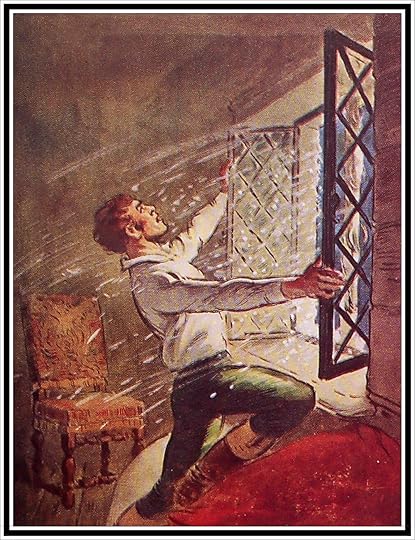 Laughs are at a premium these days, what with the pandemic still going on as a second Christmas approaches.
That being so, I thought I’d use my recent renewed interest in personality disorders by subjecting some classic characters in fiction to a bit of the dreaded lay analysis.
If this post gives a few readers a laugh, it will have served its function.
Lets see: which characters are clearly unbalanced in classic novels? The answer surely is: a of a lot of them. Reasonable, rational people hardly make for interesting reading. That is, they only do if they are taking on someone who is fairly impossible, or at least, dealing with a crisis which brings out the worst in all sorts of people.
For instance, in Dracula everybody is eminently reasonable but Dracula himself, who doesn’t give a hoot about anybody except as a source of refreshment: ‘Umm, pass over that comely wench, fellow, along with the plum brandy…’ He is, of course, a monster.
Unless I have missed something, what made the count decide to be one, or how exactly he became one himself, is never made clear, lost in the mists of the mediaeval history he recounts to his guest Jonathon Harper. Whether Bram Stoker actually explained the process – which for all I know may have involved black magic, and the publishers decided that it would be regarded as too strong meat for a Victorian audience, I don’t know.
Clearly, to have made that decision, he can’t have been exactly a normal person to begin with. Perhaps he had a superiority complex of some sort to feel that he ought to live forever? Besides, to achieve great things, we need to have a fairly inflated view of our own talents, and the same must apply when we see ourselves as treading a new path which discounts ethical considerations. Here is some of the count’s invective to Mina Harker:
‘First, a little refreshment to reward my exertions…Whilst they played their wits against me – against one who commanded nations, and intrigued for them, and fought for them, hundreds of years before they were born, I was countermining them, and you, their best beloved one, are now to me, flesh of my flesh…’
Making all due allowances for Dracula’s monstrosity, I have always thought it rather odd myself that vampires – or any paranormal being, for that matter – who is meant to have a history dating back centuries, is depicted as regarding people who have only been alive for a short time as either worthy opponents in a battle of wills or as a fascinating love object.
I gather this was one of the many criticisms aimed at the YA ‘Twilight’ series, but as I haven’t read that, I couldn’t comment on that.
Another was that Edward Cullen was some form of stalker. This is a condition which seems to affect various romantic heroes, and even the one in Pushkin’s classic unfinishyed robber novel ‘Dubrovsky’.
In fact, had Dubrovsky not played with Maria as a boy, he might be said to show signs of suffering from ‘Clairmont’s Syndrome’ in his attitude towards her. Having caught a glimpse of her at the distance, he falls madly in love with her. Soon, he risks going to work as a tutor to her half-brother in his deadly enemy, her father Kiril Petrovitch’s house, merely in order to be near her:
‘I was prowling round the house, deciding where the fire was to break out, from where I should enter his bedroom, and from where I should cut him off from all means of escape. At that moment, you passed by me like a heavenly vision and my heart was conquered…I followed you in your careless walks, stealing from bush to bush…At last an opportunity occurred: I established myself in your house: these three weeks were days of happiness for me: the memory of them will be the joy of my melancholy existence… ’
Well, perhaps love at first sight might be a tipping over into the personality disorder of Clairmont’s Syndrome (though many might say it is evidence of meeting someone from a previous life) but it is certainly a wonderfully melodramatic plot point (When I wrote my own spoof highwayman romance ‘Ravensdale’, I used the above scenario in a comic).
There’s quite a few narcissists in classic novels. For instance, Arthur Huntingdon in The Tenant of Wildfell Hall seems to be an almost classic one, which I suppose in a classic novel he would be…
He has every chance of happiness and the chance to reform his empty life of careless hedonism when he falls in some form of love with the virtuous heroine Helen – or anyway, seems to be in love as much as someone ‘in that spectrum’ can be.
However, the cad soon begins to sabotage things:
‘His favourite amusement is to sit or loll on the sofa beside me, and tell me stories of his former armours, always turning upon the ruin of some confiding girl or the cozening of some unsuspecting husband, and when I express my horror and indignation, he puts it all to the charge of jealousy, and laughs till the tears run down his cheeks. ..’
He returns to his heavy drinking and debauched lifestyle. Helen finally gives up her attempts to reform him when he takes up with the hatefully attractive Arabella Lowborough, wife of his supposed friend Lord Lowborough. He and his friends engage in drinking bouts where his friend Hattersley uses Huntingdon’s head for target pracice using a wooden stool, while Lord Lowborough attacks Hattersley’s wrists with a lighted candle as he tries to force him to join in.
The novel seems to imply that Huntingdon worst points are brought out by drink, and no doubt it deadens his conscience. Still, Arthur Huntingdon clearly has serious defects of character from the first, which all seem to revolve around self-indulgence and vanity, as for instance, when he tortures the infatuated eighteen-year-old Helen before their engagement by ignoring her and flirting with others whenever she deflates his vanity. He even expects her to declare her love first – a thing a Victorian would regard as outrageous.
In a light romance, the hero can behave as callously as that towards the heroine, then going on to treat her dotingly forever afterwards, but no such suspension of belief is allowed in the love affair of Arthur Huntingdon and Helen. Sadly, the predictions of Helen’s starchy and joyless aunt prove all too accurate.
Of course, many heroes of romantic novels seem to suffer from Don Juan complexes of some sort.
Still, few can match the energy of Rinaldo Rinaldini in compulsive womanising, which he combines effortlessly with running the most dreaded robber gang in the Appinines and resisting the efforts of a mysterious and magical guru to change his attitude towards the unknown (this guru is revealed in the end to be his father and a prince). It has to be said in his favour that, unlike many philanderers, he generally falls in love with his female conquests: – in fact, he usually manages to be in love with several at the same time.
It is lucky for him, and for the women’s feelings, that generally the mechanics of the plot mean that one love object disappears just as another appears, rather like the mechanical figurines on an old fashioned weather house.
Rinaldini seems to suffer not only from a Don Juan complex, but from Histrionic Personality Disorder besides. Here are his first words, spoken in his cave, during a storm: “I sleep! I like such weather: it rages here and there, around us, close to us, in this breast of mine, and everywhere! ”
Heathcliff, created by Emile Bronte about forty years later (Wuthering Heights was published in 1848) is by contrast, completely untroubled by his conscience, and in fact, seems psychopathic in not having one. He certainly can’t be accused of Rinaldini’s addiction to falling in love repeatedly: he is obsessed with Catherine, and cares for nobody else (save for a mild affection for Hareton and Nelly). When Hindley’s defiance of his late father’s wishes leads him to force Heathcliff into doing a servant’s chores, he loses his chance with Catherine, and runs away to better himself.
Returning with ‘the appearance of a gentleman’ to find Catherine married to Edgar Linton, he swears revenge on Hindley and his descendants, and in fact, from this time on, and particularly after Catherine’s death, seems to have no other interest in life or topic of conversation. He is, in fact, frankly boring, like all obsessed people, and I have always wondered how anyone could find him an intriguing character. The author is astute in keeping him largely offstage, as if we saw more of him than occasional dramatic entrances, we would soon become tired of his monomania.
He does, however, share in common with Rinaldini a taste for melodramatic speeches:
He seized, and thrust her from the room; and returned muttering—‘I have no pity! I have no pity! The more the worms writhe, the more I yearn to crush out their entrails! It is a moral teething; and I grind with greater energy in proportion to the increase of pain.’
Some other anti heroes seem to be pathological liars, and none of them can rival Samuel Richardson’s Robert Lovelace here. But this blog post is getting rather long, and I must put off writing about his peculiar personality disorder until next time.
November 8, 2021
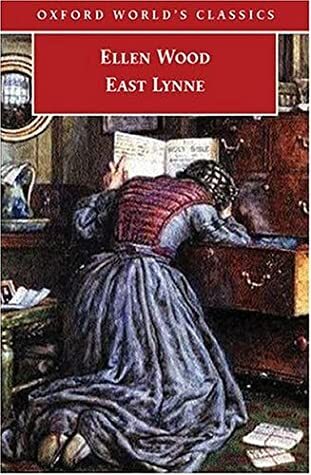
‘East Lynne’ (1861): the sensationalist best seller by Mrs Henry Wood (Ellen Wood): Review
 Spoilers throughout!
Many years ago, my mother came by leather bound copies of the mid-Victorian magazine ‘The Argosy’ as part of a job lot in an auction. These ended up on my parents’ endless bookshelves, and I read a couple of the stories. I vaguely remember that my mother said that most of the content of these magazines had been written by a woman known as ‘Mrs Henry Wood’.
Not knowing then that traditionally the married woman took on the whole of her husband’s name, I wondered how a woman came to be called a male name, but never got round to asking.
Years later, I read one of the ‘Johnny Ludlow’ stories in a collection of ghost stories, and that was all the reading I had done of works by Mrs Henry Wood until someone recommended ‘East Lynne’ to me as a fine piece of mid-Victorian sensationalist literature.
I was intrigued to hear that it had been a best seller in its time, was still very well known in the first part of the twentieth century, and had been turned into countless stage versions and several films.
Seemingly, in one stage version, there is a line ‘Dead: and never called me mother!’ Surely an equivalent of ‘Elementary, my dear Watson’, in that it appears in the stage and film versions of a book, so people assume it must come from the book.
‘East Lynne’ was as melodramatic as promised, with false identities, disguises, a bankruptcy, a murder mystery, a caddish, moustache twirling abductor, a ‘fallen’ married woman and sudden deaths.
As a sign of the times, a train crash features in the story, though details are not given, seemingly being thought unsuitable for a largely female readership. True Victorian novel that it is, there is the obligatory improving deathbed scene of an innocent child and the obligatory deathbed repentance from the said fallen woman.
Unluckily for Ellen Wood’s solemn intentions, the pathos in the story- particularly the long drawn out melodrama of the unfaithful wife’s return to work as governess in her former husband’s home, often tipple over into bathos. This whole episode is recounted as high tragedy, and generally misses the mark.
Lady Isabel’s disguise is frankly ludicrous, including a set of blue glasses, a French accent, prematurely white hair, and baggy clothes to pad out her willowy figure.
No doubt this is the reason that by the beginning of the twentieth century, satirical versions were being staged, including one as early as 1917, ‘East Lynne with Variations’.
Sir Francis Levinson reveals himself not only as a cad after he has tricked Lady Isabel into leaving the virtuous Mr Carlisle and eloping abroad with him, refusing to marry her after he comes into his title, but as grubby physically as well as mentally: ‘Captain Levinson, unwashed, unshaven, with a dressing-gown loosely flung on, lounged in to breakfast. The decked-out dandies before the world are frequently the greatest slovens in domestic privacy.’
When the former Lady Isabel Vane returns to her husband’s house East Lynne having been disfigured by the said train accident. Having quickly divorced her after her disgrace, and now believing her to be dead, he has married his old admirer, Barbara Hart. This woman, who behaved improperly herself by strict Victorian standards in expressing her outrage when Carlisle suddenly marries Lady Isabel having as she sees it, trifled with her affections. She seems quite happy to be Carlisle’s second choice.
Interestingly, a couple of the characters who have fallen from grace less dramatically repented as well. The impossibly perfect hero Mr Carlisle – handsome, upright, and a success at everything he undertakes, save seeing through the bad intentions of the caddish Francis Levinson towards his wife – seemingly has no faults, and no need to repent.
His bad tempered sister, Cornelia Carlisle, is a different matter. She harangues everybody who does not act according to her grimly Spartan ideas. After her brother marries the penniless Lady Isabel Vane, she is continues to live with the married pair and makes the wife miserable by constant references to her supposed extravagances. At last, Miss Carlisle realises that a Christian should be more merciful.
Besides this, Mr Carlisle’s adoring second wife Barbara has resented the three children Mr Carlisle has had with Lady Isabel, and could have been a kinder step-mother to them. She too, sees the error of her ways and resolves to reform.
The ‘bad’ characters in the novel, Aprodite ‘Afy’ Hallijohn, who is revealed as another victim of Sir Francis Levinson, and the heartless seducer himself, never reform in the novel. Whether they do on their deathbeds is unclear.
Afy Hallijohn, who vainly hopes after Richard Hart is cleared of murder that he might regain his romantic interest in her, is icily relieved of this delusion by him, and she has to settle for marrying a shopkeeper.
Sir Francis Levinson, besides suffering from various humiliations such as a public ducking by a group of farm labourers who take a startlingly moral view of his philanderings, is later transported for hard labour in a penal colony. This is a fate he regards as worse than being hanged.
Presumably, by the standards of the time, ‘Mrs Henry Wood’s’ treatment of her bad characters was regarded as just and even merciful, though Afy Hallijohn is after all, just as much a victim of Francis Levinson as Lady Isabel. Of course, Afy would have outraged Victorian readers by refusing to admit to the irregular connection with the wicked then Captain Levinson, and the author’s allowing her to marry a foolish tradesman would be considered highly indulgent.
Apart from laughing over the melodramatic excesses in the plot, my main feeling was one of wonder at how tastes in reading change.
The mid-eighteenth century went wild about ‘Pamela’, with its wildly improbable plot and high falutin’ moral tone.
Then the mid-nineteenth century was equally fascinated by the wild sensationalism of the equally improbable ‘East Lynne’.
I am trying to think of a mid-twentieth century equivalent, as popular with male and female readers alike, filmed many times: ‘James Bond’ can’t count, as it has no domestic aspect; the Sherlock Holmes stories have very little love interest; ‘Gone With the Wind’ perhaps? However outrageous modern readers may find its depiction of slavery, it was undeniably the outstanding best seller leading up to World War II.
Meanwhile, what will be the sensationalist novel of the mid twenty-first century?
October 31, 2021
‘A Vampire in Time’ Out and Wishing All My Readers a Spine Chilling Halloween
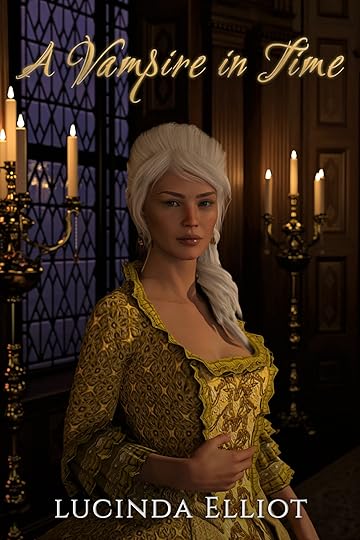
I hope all my readers have a good Halloween.
I also hope that readers have got themselves into the right mood for general spookiness and ghostly terrors by some suitable reading.
In previous years, I have cursed myself (very appropriate) for not having a short story ready for Halloween myself…It’s
…And this year I have one ready. I have in fact been writing a collection of ghost stories, but this is a taster for my novel ‘That Scoundrel Émile Dubois’ and relates an episode from the point of views of the heartless siren Ceridwen Kenrick, and the serving man Arthur.
You can get it free on Smashwords here
https://www.smashwords.com/books/view/1110656
Here free on Kobo
https://www.kobo.com/gb/en/ebook/a-vampire-in-time
And here for Amazon.com – (they always ask to be told if you can get a book cheaper elsewhere). I
https://www.amazon.com/dp/B09KQ6YR22
Here for Amazon.co.uk
https://www.amazon.co.uk/Vampire-Time-Scoundrel-Émile-Dubois-ebook/dp/B09KQ6YR22
I think it is a fine cover – even if wigs and hair powder were going out of fashion in 1794, due to the tax that came in with the war with France. I can imagine Ceridwen Kenrick looking at one of her intended lovers/victims just like that…
October 21, 2021
‘Lady Audley’s Secret’: Mary Elizabeth Braddon’s Mid Victorian Sensationalist Novel
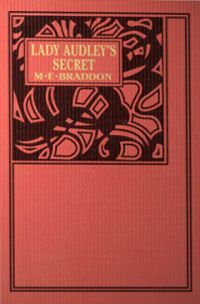
How embarrasing: I typed and published a whole post – a review of this notorious Victorian novel – and only the image came out! I blame the new editing system on WordPress….Well, that and my own muddle headedness…
Lady Audley’s Secret’ , the 1862 best selling Victorian sensationalist novel by Mary Elizabeth Braddon, is based on a plot revolving round ‘accidental bigamy’ which was seemingly popular in the 1860’s.
I felt like reading something light and dramatic, and as I am interested in Victorian novels generally, I thought it was high time I got round to reading this mid nineteenth century best seller, so well known and so often derided.
It didn’t disappoint: I really enjoyed it as an exciting, light read. It is both lurid and entertaining, as sensationalist as you could want (interestingly, ‘Cousin Bette’, which I also read lately, is mentioned in it as catering to the sensationalist tastes of the hero: ‘Cousin Bette’ is certainly packed with melodrama and uncontrolled passions; for all that, I preferred ‘Lady Audley’s Secret’ myself).
It is also better written than I had expected, given that the author wrote seemingly purely for the market, publishing 80 novels. The humour is often dry: the author is astute about human nature. The characters are well drawn, if they tend towards stereotypes.
The hero, Robert Audley the indolent non-practising barrister, is intriguing in that he is anything but a typical macho, action driven male lead; he only turns detective to solve the mystery of his lost friend George Talboy’s disappearance because he feels that he can’t do anything else, and because he has finally been jerked out of his good natured indifference to human passions by falling in love with George’s sister.
The pre-Freudian Victorian reader was presumably blind to the homoerotic elements in the steadfast love of Robert Audley for his lost friend George Talboys, and his marrying George’s sister, who bears a strong resemblance to him.
Perhaps, though, the author was sophisticated for her time, and understood these implications fully. She had after all, outraged convention by living with a married man outside marriage. His wife, like Thackeray’s, was in a lunatic asylum, and it was many years before she died and he could marry the author.
The plot revolves round the sudden disappearance of George Talboys. His friend, the indolent barrister Robert Audley, a man of ‘independent means’ who cares for nothing, though he has a passionless liking for his Uncle, Sir Michael Audley, and his daughter, the outspoken and hoydenish Alicia, who cherishes a teenage infatuation for her calmly friendly cousin.
The widowed Sir Michael has recently re-married – to a woman less than half his age, blonde, charming and doll like. She is the former governess Lucy Graham, whom he hoped would marry him for love, but who indicates on his proposal that money and position are of great importance to her. Nevertheless, infatuated, he marries her anyway.
At about the same time, Robert Audley runs into his old friend George Talloys outside his chambers. He learns that George is married and has a son, but he and his young wife found themselves in such financial troubles that he has spent the last three years prospecting for gold in Australia, leaving his wife living with her ‘half pay’ ex-officer father, and their small boy, on the Isle of Wight. Having made his fortune, George is on his way to be re-united with her.
Robert Audley invites him to stay with him. The next morning, over breakfast, his unlucky friend reads in a newspaper the report of the death of his wife, Helen. He is distraught; during the following months, Robert does everything that he can to distract him from his misery. He takes him on a long trip to Russia, and then he takes him on a visit to his uncle’s manor, Audley Court (based on the sixteenth century Ingatestone Hall in Essex).
His new aunt by marriage, the former Lucy Graham, seems to have done everything that she can to avoid a meeting with George. George has still only seen a portrait of her – which left him oddly moved – when he suddenly and unaccountably disappears.
Gradually, Robert Audley begins to suspect that the new Lady Audley was involved in his disappearance, and just who she might be…
This novel particularly interested me, as while it explicitly condemns the behaviour of its villainess, it obliquely challenges the stereotypical ‘angel in the house’ image of young married women, and the idea that the ideal woman was to some extent passive and helpless, as can be found in the writings of Charles Dickens, Wilkie Collins and Thackeray.
October 11, 2021
October 2, 2021
Those Elusive Endings
[image error]
Those ‘How To’ books on writing seem generally to lay less emphasis on endings than on beginnings; of their advice about endings, I can only remember that they said that you should resolve the conflict that drives the plot and leave the reader feeling satisfied. James N Frey in ‘How to Write a Damn Good Novel’ says that you ‘must have the good climax and resolution to the story that you hinted you would deliver earlier’. That about sums it up; James N Frey’s brilliant at that.
While by definition you won’t lose the reader of that particular book by having an unsatisfactory ending, you may well for future books; he also warns against ‘playing tricks with the reader’; I haven’t come across such an ending in ages, but I suppose they would be of the ‘and it was all a dream’ variety.
He points out that playing ‘clever tricks’ on a reader will only annoy the reader, and it’s true. A few years ago, I read a really infuriating story that kept giving false dramatic resolutions which were then explained away as fantasies in the protagonist’s mind; after about two of these I threw the book in the charity shop box, and it was only innate meanness that prevented me from hurling it into the recycling. As I’m so stupidly stubborn it usually takes a lot to make me leave a book unfinished, I see what he means about avoiding at all costs that trick ending; the reader won’t appreciate your cleverness; the reader will feel cheated.
There’s also a problem, of course, with books that only form part of a series; the reader always feels slightly cheated here, too, in that the resolution of the main conflict hasn’t happened – yet again; although the author will have explained that this is in fact a series, this still remains true; and the longer the series continues, it seems to me, the greater this sense of frustration becomes. Minor conflicts driving the plot are variously resolved, but that final resolution is kept on hold; that tantalizing of the reader requires a lot of skill, like a coquette of olden times keeping an admirer on a string for months or years…
Then, there’s the whole question of the nature of that satisfactory resolution; it’s here that we see how much the imaginative world we create is just that – artificially constructed. After all, in real life, there are rarely satisfactory conclusions of any sort; evil doers go to their graves unpunished, at least as far as this world is concerned (the case of the infamous Jimmy Saville in he UK is a recent example); unselfish people go unrecognized; people who share true love are separated; and as often as not, wildly dramatic situations sometimes just fizzle out and defuse over time.
However much we may be prepared to accept that this is so of real life (and a lot of people aren’t) we don’t want to come across it too much in stories. We want a clear and satisfactory resolution of some sort and we don’t want our sense of justice to be too outraged; to deliver this resolution may be quite a complex matter, as these days we don’t quite believe in the same divisions between ‘good’ and ‘bad’ characters that seemed so clear to earlier writers (as always, Shakespeare is an exception).
Generally, though, the modern reader still doesn’t want evil doers to get off scot-free, or heroics to go totally unrecognized, or for virtue to have no sort of reward at all (even if it’s only hinted that this reward will come in the next world). There are, of course, huge differences between comedy and tragedy regarding the outcome of stories, and tragic outcomes unfortunately often come across as a lot more realistic in tone than the happy endings, which so often seem rather contrived.
Thinking back on various classic novels that I’ve read or re-read or partially revisited over the last few years, it occurs to me that in fact a number of these don’t have endings which are generally regarded as satisfactory. This is interesting; they have their supporters; but the resolution to the basic moral conflict in some of these stories is sketchy, and in other’s it is arguable that the author has made one of those seven deadly mistakes about which James N Frey warns and ‘not followed through’, either through softening towards the character who has served the part of the villain of the piece, or possibly through a misguided wish to introduce an element of realism in a story not strictly speaking realistic.
I’ve said too often to need to need to repeat what I think of the unjustly good fate meted out by Elizabeth Gaskell to the unscrupulous opportunist Charley Kinraid in ‘Sylvia’s Lovers’, and I’ll go on to ‘Vanity Fair’ and ‘Wuthering Heights’).
For instance, the fate of Becky Sharp in ‘Vantiy Fair’ is wholly unsatisfactory; whatever moral Thackeray wished to point in making her thrive, while most of her victims come to fairly dismal ends, one leaves the story with a sense of jaded weariness, or anyway, I did. This all seems to be in line with the strange combination of sentimentality and cynicism which characterize Thackeray’s writing, and make his general depiction of characters and the relations between them unsatisfactory, too; his good characters are for the most part lacking in any capacity to learn, it seems, from unpleasant experiences or to discriminate between admirable and contemptible love objects, while his ‘bad’ characters almost invariably remain just that – mean and exploitative; the result is that his world is oddly static, his ‘vanity fair’ and his characters very much the theatre and puppets which he dubs it in the last sentence of the book.
A great many people admire Becky Sharp as some sort of feminist heroine – and while I see her as admirably independent and endowed with a justifiable contempt for the absurd injustices of the world in which she lives, I personally find her repellent, treacherous and incapable of love or loyalty as she is. We leave her living a life of smug respectability on the money she has stolen from her last victim Joseph Sedley, the one who would have been her first, had it not been for the interference of George Osbourn.
Amelia having been brutally disillusioned about her former idol Osbourn, and having found a safe haven in the arms of the Dobbin, surely one of the most boring male leads ever in literature (I can’t call him a hero as this book is sub-titled ‘a novel without a hero’) all supposedly ends happily (it is only to be hoped that she doesn’t find him as physically unappealing as one might expect from her indifference to him for the previous 550 pages). After the drama in much of the previous story, I found it an anti climax.
If Becky’s fate is meant to demonstrate that ‘the wicked thrive in this vale of tears’ then this is hardly reflected in the fate of a lot of other less than admirable characters, many of them quite astute citizens of vanity fair themselves, who come to dismal ends. The old lecher Sir Pitt Crawley is reduced to idiocy and tormented by callous nurses after a stroke, his sister the pseudo revolutionary Miss Crawley is only saved from pathetic loneliness in her last months by the kindness of her niece by marriage Jane, while the wretched older Sedleys eke out an existence of penury and misery. Becky’s estranged husband Rawdon  Crawley, a professinal gambler and rascal himself, humiliated by Becky’s betrayal, succumbs to yellow fever in a tropical island, while after his son’s death at Waterloo, the older Osborn leads a life of joyless bitterness.
Perhaps Thackeray was advocating the necessity of religion to add meaning to wordly sufferings, but it has been pointed out before that all of his characters – even Becky – do in fact, profess religion.
I felt the same way about ‘Wuthering Heights’; the ending doesn’t leave the reader with a sense of satisfaction. Whatever one may think about this book, it can’t possibly be said to lack excitement, drama or larger than life characters. But again, I found the conclusion to the conflict and moral issues raised lacking in any satisfactory sense of resolution. While the conflict between the inhabitants of Wuthering Heights and Thrushcross Grange finds a happy resolution in the love between the Hindley’s son Hareton (raised and even regarded with affection by Heathcliff, and so in many ways, his son too) and the younger Cathy, the issue of Heathcliff’s malevolence and wrong doing is never properly addressed.
In fact, he goes to his grave unrepentant, even fully convinced of being in the right and insisting that he has done no injustice. The slight mellowing he shows at the end towards Hareton and Cathy’s love is based on increasing indifference to this world rather than any advance in spiritual understanding, and his obsession with the older Cathy remains relentless to the point of actually causing his death. If this rather empty conclusion is in fact the moral of the story, then it seems a very shallow one for so clearly spiritual a writer as Emily Bronte.
While the twisted old Joseph may ‘look about to cut a caper’ when he gloats that the evil doer ‘grinning at death’ means that ‘the devil has made away with his soul’ I think my own reaction of dismay at the bleakness of it all is fairly typical of readers.
While Heathcliff’s lack of insight may be realistic, the circumstances of his death aren’t; one gathers from the time frame that he, a healthy man in early middle age, has died after starving himself for less than a week. As we may assume he hasn’t been depriving himself of water, it wouldn’t be possible for him to die from of starvation so quickly, though he might well be in a state of collapse. Heathcliff’s body is found staring out of an open window, and it seems fair enough to assume that a supernatural element has played its part in his end.
It is dismal that Heathcliff is unable ever to appreciate the extent of his wrongdoing, or to wish to make amends– and his indifference to Nelly’s unimaginative but courageous warnings about the spiritual consequences of the hate filled life he has led, and the misery he has caused, is taken by some readers – I think entirely mistakenly – as evidence that the author shared his conviction about this. I gather from various poems of Emily Bronte that she was fascinated by the spiritual fate of he unrepentant, Byronic sinner, and one may conclude that Heathcliff was her literary experiment in this direction.
Interestingly, the last, evocative sentence of the book – Lockwood’s reflections on ‘the quiet earth’ as he stands at dusk by the graves in the churchyard on the moor, surrounded by ‘harebells’ and fluttering moths, is certainly inspired; but while it distances the reader to some extent from the excesses and malignant passion that has come before, it can’t really make up for the lack of a satisfying conclusion.
By contrast, ‘Frankenstein’ does give a resounding conclusion to the tormented monster’s obsessive hunting down of his contemptuous creator. When ‘the creature’ realizes that he loved the now dead Frankenstein as much as he hated him, and mourns over his body, the text becomes purely tragic, for all it’s theatrical nature; –
‘ “Wretch!” I said. “It is well that you come here to whine over the desolation that you have made…Hypocritical fiend! If he whom you mourn still lived, still he would be the object, again would he become the prey, of your accursed vengeance.”…
‘”Oh, it is not thus – not thus!” interrupted the being. “…No guilt, no malignity, no misery, can be found comparable to mine. ..I have devoted my creator, the select specimen of all that is worthy of love and admiration among men, to misery…I shall die…”’
Melodramatic as this exchange between the Captain and the monster over Frankentstein’s murdered corpse may seem when the words are read cold, without the build up of all the tension and horror that has come before, they are fitting reflections for a being who has gone in for the excesses that he has. For me at least, it is only something on the same lines spoken by Heathcliff that could have made me feel compassion, rather than the pitying disgust that I do, for the character.
(By the way, for those who wish to read the ‘Frankenstein’ original, it’s free today on amazon
http://www.amazon.co.uk/Frankenstein-Mary-Wollstonecraft-Shelley-ebook/dp/B0084BN44Q/ref=sr_1_2?s=books&ie=UTF8&qid=1425293114&sr=1-2&keywords=frankenstein
With our modern complex notions of the combination of good and bad in all characters, real and imaginary, and our lack of a naïve polarisation between good and evil, writing endings both fitting and satisfactory for wildly erring – gothic or penny dreadful inspired characters is a challenge. I for one find a satisfaction and tragic grandeur in the ending of ‘Frankenstein’ which is lacking in other depictions of the final consequences of devoting a life to evil doing, whether it takes place within the confines of polite society – ‘Vanity Fair’ or is expressed through unrestrained brutalities in isolated moorland as in ‘Wuthring Heights’.

I remember laughing at the absurd moral guidelines that were laid down for short stories by a best-selling woman’s magazine some years back : – ‘adulterers and wrongdoers must be seen to meet fitting retribution’ but there is an element of truth in such guileless strictures nevertheless; for a satisfactory ending, brutal villains and heartless schemers should probably not be left finally gloating over their career of destruction with calm satisfaction and equanimity. They may very well go largely unrepentant to their graves, but they should at least not go, like Heathcliff, in a state of bliss.
Many readers may strongly disagree with my take on this, and I’d be fascinated to hear any thoughts on the matter.
September 15, 2021
The Value of Criticism, Criticism and Entertainment and Romantic Novels
 I am a bit perturbed (I’m good at being perturbed, aren’t I?) at a New Age view which has infiltrated popular thinking.
A recent blog post by Mari Biella on free speech
Free Speech, Fake News and the Internet
inspired me to write this one.
This ‘New Age’ view that has to some extent infiltrated popular thinking is the ‘No Negativity’ mindset that equates ‘criticism’ with something bad and unfair – in effect, with ‘negative criticism’.
This seems to me a worrying trend. Criticism is surely equal to having an intelligent awareness of ones surroundings – towards having an active sense of discrimination. Without that we will have, surely, no intellectual life and also, no moral awareness.
It is disturbing the amount of people, particularly those vocal on social media, who seem to believe that if anyone dares to say or write anything critical of some figure or creation or performance they admire – in any field, but particularly in entertainment generally – then that must automatically be an unfair attack,, motivated by mean spiritedness, prejudice of all sorts, ignorance, envy, general ‘negativity’ and in fact, every sort of moral failiing on the part of the critic.
This is absurd.
Nobody is perfect at anything. Faulty humans can only create faulty creations, whether it is in acting, writing, dance,, singing, or practicing any sport as a form of entertainment.
Shakespeare had faults as a dramaticist; Mozart had as a composer. They were both geniuses, but they polished their craft repeatedly. The result is, that their mastpieces are far greater than their earlier compositions. They would never have improved without perceiving the drawbacks of their creations.
This assumption, that all criticism is negative and unfair and due to some sort of evil propensity on the part of the critic, seems to be partly due to the ‘positive thinking’ attitude that has seeped into mainstream consciousness in the last couple of decades. A great many people, if they encounter some criticism with which they disagree, immediately turn to an ‘ad hominem’ form of attack – they attack the person rather than the argument.
Certainly, criticism can sometimes be harsh and unfair. Nobody exactly enjoys being on the receiving end of a scathing attack, however amusing it may be for others to read.
For instance, literary critics can be savage.
Then, with the rise of the internet, anyone can set buy a book and leave a review, even if it is of the ‘Boring – didn’t get past the third paragraph’ one star variety, up there on Amazon, Kobo, Barnes and Noble and so on.
But it is far preferable to people not being allowed to criticise publications. It is all part of free speech, which we must protect at all costs. Some people will abuse it, write criticisms that definitely are unfair, and be generally offensive. That is unfortunate, but unavoidable.
I know from experience how unpleasant the appearance of a rush – or rash – of savage one star reviews is. Back in 2014, my spoof historical romance ‘Ravensdale’ became an Amazon best seller. However, I had not sufficiently brought home in either the blurb or the keywords just how much of a spoof of the historical romance trope ‘Wild Young Earl Fasely Accused of Murder turns Outlaw’ the story is meant to be. In that, I disappointed reader expectations: when you do that, you may expect a savage backlash.
For my own part, I avoid giving one star reviews unless the topic is really questionable – ie, a rapist or otherwise really abusive hero who never properly repents or apologises for his misdeeds, say. I also avoid giving up on any book until I’ve read the first four chapters, while I never review a book unless I’ve read it through.
 But that’s just me; a lot of readers take a different approach: that is their right .
And surely, the alternative of a non critical attitude, is far worse all round.
Unfortunately, this ‘New Age’ ‘All criticism is bad and unfair’ is an attitude prevalent amongst the ‘Romance Community’, and as a writer whose works often can be broadly defined as ‘humorous historical romances’, that does bother me.
What that amounts to, is to adopt the attitude of the cults – that of disseminating received information, the value and veracity of which it is an outrage to challenge – so that any critical response is attributed to supposed personal malice and psychological shortcomings, if not downright inspiration from evil spirits (glances uneasily about in search of said evil spirits).
There is a sort of ‘keeping ranks’ attitude amongst writers and readers of romance – who often seem to know each other through blogs, etc – which adheres to unspoken rules, one of which seems to be that being under attack from outside means that they must not express any discontent between themselves. Any outspoken, hard hitting criticism is seen as being infra dig (Sarah Wendell has been to some extent an exception). I recently came across a series of fulsome comments agreeing with a blogger who had objected to critical dismissal of the blogger’s idol’s literary ability. The blogger later described that series of agreements as ‘a stimulating discussion’. I didn’t quite see where the ‘discussion’ part came in? What was her view of a non-stimulating discussion?
Seriously, I truly did encounter this on a cosy little blog, the purpose of which seemed to be to give glowing reviews to historical romances,’intimate’ and sentimental biographies of monarchs, etc.
I can see how this approach has come about. Romantic novels have been traditionally derided as being unworthy of serious consideration as literature. While genre fiction generally is seen in this light, it is particularly true of romance, which has been especially targeted as absurd. Certainly, there is an element of sexism in this.
A lot of romance writers and readers point out, and with some justification, that male adventure stories and fantasy are just as far fetched; it is merely that the unrealistic elements in those are different to those in romantic novels.
However, to take the attitude that it is permissible to write what is supposed to be literary criticism, in which a writer or student proffers no objective analysis of general weaknesses among examples the genre, and of particular weaknesses amongst the authors discussed, is surely not literary criticism worthy of the name. Unfortunately, there are examples of so-called ‘literary criticism’ of romance as a genre which reflect this attitude.
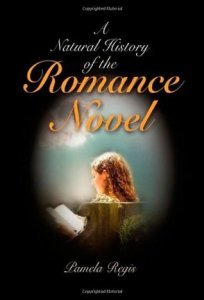
 I am sorry to say that this is true of a renowned book of literary criticism of the romance novel written by a Professor of English at McDaniel College in the US – often solemnly quoted as a brilliant defence of the genre in various articles about the web – ‘The Natural History of the Romance Novel’ by Pamela Regis.
This struck me as containing no criticism either of the genre, or of the authors’ work the author purports to analyse. Rather it was a glowing series of expositions of various novels.
At no point during the whole of the book does Regis admit that any of the novels she ‘discusses’ have weaknesses. It reads more like a panegyric on the various authors. She sets out a structure she has devised to which the ‘pure’ romantic novel is meant to a adhere, comprising eight points. She then goes on to define various classic novels as having these points and therefore, by definition, belonging to the category of romantic novels, ie, ‘Pride and Prejudice’ and ‘Jane Eyre’ (whether or not these last two are in fact romantic novels is, of course, highly debated; anyway, Regis is confident that according to her approach, they are).
When I came to the chapter ‘The Limits of Romance’ , I thought, ‘Ah; now we shall have some objective analyses worthy of the name’ but no such thing. The phrase merely means that certain novels which are, generally, regarded as belonging to the romance genre are excluded – ie, ‘Gone With the Wind’, which is excluded by not having the necessary HEA.
Where there is any criticism, even of highly contentious subjects – for instance, of Samuel Richardson’s making a happy ending between the heroine and the ridiculous but supposedly romantic would-be rapist hero Mr B in ‘Pamela’ – then rather than engage herself, the author quotes opinions by other critics, never stating her own opinions except in defence of the genre.
Discussion of varying points of view should indeed be used to extend the scope of an argument; but when it is used as a substitute for any real investigation of structural and stylistic weaknesses by the author herself, when she is supposedly an expert on literary criticism – that strikes me as extraordinary.
My own review of this book can be found here:
 I found some of the comments on the book made by a journalist called Noah Berlatsky in this blog highly apposite:
http://www.hoodedutilitarian.com/2013/12/romance-and-the-defensive-crouch
‘Regis’ difficulty is that she wants to defend all romance. She is fighting for the honor of romance as a genre, or as a whole. She never, once, in the entire book, admits that any single romance, anywhere, might be formulaic, or badly written. ‘
…An impossible position to maintain, but somehow the author does it. But then she makes a truly astounding claim about the ‘first romantic novel’ ‘Pamela’, of which, it seems, for all its glaring faults, she as a defender of romantic novels is determined to admire as having a hidden feminist message. She maintains that: ‘The story can be called oppressive, I think, only if one believes that marriage is an institution so flawed that it cannot be good for a woman.’
I wrote an answer answer to that bizarre attempt at defence of the distasteful and sentimental outcome (as critics say, the obscenity of ‘Pamela’ lies in its sentimentality) in my Goodreads review of her book. This would take us too far off topic here for me to quote…
So, to move back to the general…
I remarked in my own review of Regis’ work:
‘The author, in fact, puts herself in an impossible position; in arguing that there have been some romances written which are great literature, pointing to the ‘canonical’ texts of Jane Austen and Charlotte Bronte, she never admits that comparison means just that. If there have been excellent romances written, then by definition there have to have been some far from excellent ones churned out. But as a defender of romance, who seems to make it a point of honour to eschew all criticism, this is an admission that she cannot make. All that she can do, is to maintain a deafening silence on the topic.
This ‘closing ranks’ out of defensiveness and equating all criticism with negative criticism is an attitude of the romance community which contradicts the desire of its members for their genre to be taken seriously. Criticism by definition cannot all be positive.’
If romance readers and writers want their favourite genre taken seriously as literature, then surely one of the first steps must be for romance writers to accept criticism without automatically maintaining the ‘defensive crouch’ that Noah Berlatsky analyses in his blog.
To move forward, surely the ‘romance community’ must also be prepared to extend hard hitting analysis worthy of the name about ‘classic romantic novels’ and others – particularly in works of supposed literary criticism. Free speech should operate here as elsewhere; for romance writers and critics to adopt the attitude that it is somehow unfair and not nice makes them seem weak in a stereotypically ‘feminine’ way, and reinforce those sexist interpretations they so rightly resent.
September 5, 2021
‘The Villainous Viscount Or the Curse of the Venns’ is free on Amazon today and tomorrow
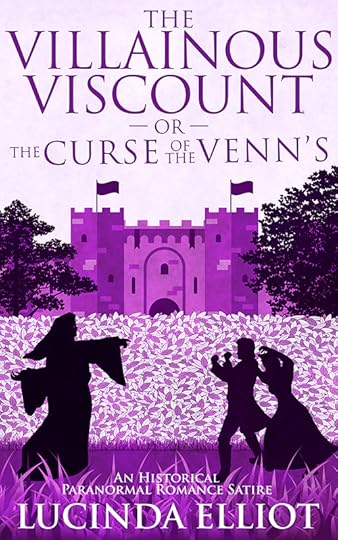
As above, my Gothic Historical darkly comic tale of a family curse ‘The Vilainous Viscount Or the Curse of the Venns’ is free on Amazon today, 5 September, and tomorrow.
It features the eponymous wild, fortune hunting viscount, a sensible but warm hearted heroine, a family curse and of course, a haunted castle with the obligatory hooded spectres and secret passages.
If you enjoy a take off of Gothic and anf historical romance combined, it is for you.
Whether you love it or hate it or feel in between, do leave a review. I appreciate all reviews. An author never stops learning from them.
Available on Amazon com https://www.amazon.com/dp/B01KXU8QUC
and on Amazon.co.uk https://www.amazon.co.uk/Villainous-Viscount-Curse-Venns-ebook/dp/B01KXU8QUC/
September 3, 2021
Review of Balazac’s ‘Cousin Bette’.
 I enjoyed Balzac’s ‘Pére Goriot’ overall, despite – maybe because of – the melodramatic scenes. I particularly enjoyed the chapters which dealt with the villain Vautrin, and the sordid lodging Parisian house where he is in hiding.
I expected to enjoy ‘Cousin Bette’, too, especially as it is considered to be one of Balzac’s masterpieces.
Sadly, I was to some extent disappointed.
Nevertheless, as reviews in fairness ought to emphasize the positive along with the negative aspects of a novel, I would like to stress that I did find it an intriguing and original piece of writing, and well worth reading.
In its depiction of Baron Hulot, it is certainly as dismal a depiction of an aging man addicted to lechery as you are likely to meet with. Whenever he appears to be cured – even by the advancing years – he relapses.
There are some fascinating character portrayals in it. For instance, Wenceslas, the Polish Count Steinbok, the talented sculptor who is only able to be creative when he is living a miserable existence under the tyranny of Cousin Bette. Then there is Hortense, his wife, who seems at first merely a romantic and heedless young girl, but who on learning of his unfaithfulness with Madame Marneffe, refuses to live with him on the grounds that she might commit murder. Particularly interesting is Cousin Bette herself, who is a strangely strong and pitiless woman.
I learnt a lot about the Parisian society of this era. This novel was written in 1846, only two years before revolution broke out throughout Europe. Certainly, there is something odd and transitory about the security of the society it evokes – a bit like Chekov’s Russia.
I found it highly instructive regarding the role of women in the patriarchal world in which they lived, the consumerism, decadence, hypocrisy, etc.
I also learnt a lot about the city’s physical structure. For instance, in this era there was an impoverished, muddy quarter really near the Louvre (unimaginable today). There is a vivid depiction of the sordid conditions in which the Marneffes live in their rented rooms before Valérie is able to amass a fortune by selling herself.
By contrast, the sort of luxurious buildings occupied by supremely successful courtesans – and later, Valérie herself –are vividly described. It is for such patrons that Wenceslas will be designing his works of art.
The plot is certainly a melancholy one: it involves the ruinous career of Baron Hulot, a former army officer and war hero under Napoleon, who is married to the lovely Adeline, who is wholly virtuous and self-sacrificing, almost a caricature of a devoted wife.
The baroness is perhaps lucky, in that at nearly fifty, her golden hair has no silver in it (mine started getting silver threads in my late thirties): this despite the outrageously neglectful treatment of her chronically unfaithful husband. She is however, extremely unlucky in having her self-sacrificing temperament exploited by this monsterously selfish husband.
I think even Samuel Richardson would say that Adeline. To me, Baroness Hulot is not a credible character: in her worship of her husband, whatever his faults of character, and in her lack of resentment against him, she is frankly unbelievable.
e takes wifely devotion too far – partly, I suppose, because such indulgence encourages her husband’s weaknesses.
They have a son, Victorin, now married to the successful merchant Crevel’s daughter, and a young daughter Hortense. Due to Baron Hulot’s squandering his fortune on such courtesans as Josépha and Jenny Cadine, there have been problems with her dowry.
Cousin Bette, who is a few years younger than Baroness Hulot, lives with the family. She is jealous of her cousin, who originally came from the same peasant background as herself, but who has always been spoilt and indulged compared to herself. She has always been treated as a poor relative and general dogsbody. She has rejected proposals by nondescript suitors who are clearly only interested in her because of her relationship with the Hulot family.
One day, she saves the young, handsome, unsuccessful Polish sculptor, Count Wenceslas Steinbok, from killing himself through despair, and nurses him back to health. She becomes obsessed with him and encouraging him to find success. She lends him money, and forces him to live a frugal, isolated life while he develops his talent. Though her feelings for him are partly romantic, she realises that she is too old for him, and is described as loving him too well to marry him, but not well enough to let him go.
Hortense teases Bette about this admirer she claims to have. She doesn’t quite believe in him, but when she meets him, she and Steinbok fall in love. She has few scruples about stealing Bette’s supposed admirer from her, pointing out the age difference.
Hortense and Steinbok marry as Steinbok begins to become successful. Bette, devastated, swears a merciless revenge on the whole family.
The story is more or less about her revenge, but to me, there is a piece of dues ex machina in the plot working in Bette’s favour.
Normally, the only revenge that Bette could take would be to have Steinbok arrested for debt – which she does at one point, though for various reasons he is later released. However, living in the shabby rooming house is a very pretty woman called Valérie Marneffe, married to a clerk in the war office eager for promotion, whom she despises and who has seemingly ‘ruined his health’ through his excesses. She has already taken up work as a courtesan.
Bette sees how useful this woman could be to her in ruining the Hulot family. During a frank discussion together, Valérie Marneffe admits to being infatuated with Steinbok herself. Bette encourages her to take Baron Hulot as a lover – he soon becomes obsessed by her – and also the fat merchant Creval, Victorin’s father-in-law – whom she enslaves likewise. Then a Brazilian count who is likewise obsessed with her returns from some voyage of discovery.
When she takes Steinbok – who since parting company with Cousin Bette has failed to produce much in the way of sculpture – as a lover, his wife Hortense is so outraged that she moves back in with her parents. Steinbok is soon obsessed with Madame Marneffe as well.
Valérie Marneffe is able, in fact, somehow to manipulate all four of her lovers – the three counts and one merchant –meanwhile swearing eternal devotion to each – so that they do not suspect her duplicity. Each falls sentimentally inm love with her and believes he is her one true love.
No doubt Balzac is quite realistic in depicting many men as motivated by vanity in their relations with women – but there is something preposterous in the reader being asked to believe that a courtesan could enslave and dupe quite so many victims at the same time.
In fact, Balzac seems to be rather obsessed with Madame Marneffe himself, in that he loses sight of her original character – that of a pretty woman disgusted with her husband and her sordid comparative poverty – in depicting her as a siren devoid of all human feelings and with endless powers of enchantment.
While Wenceslas Steinbok is depicted as being indolent and vain, to me it is still rather improbable that he would make no effort to reconcile with Hortense when she leaves him, taking their son, merely because of his infatuation with Valérie Marneffe. To me, it makes more sense that such a weak character would vacillate between the two women.
Then again, the Brazilian Count Montés and his blinkered belief in his beloved Madame Marneffe’s (comparative) virtue seems to be wholly ridiculous. It is only after three years, when Monsieur Marneffe is finally dead and scheming to marry Crevel, that another courtesan arranges for Valérie to be surprised with Steinbok.
The scene of this confrontation is so ambiguously depicted that it is unclear if the Brazilian count is taken in by his mistress’ lies, as she swears eternal love for him in front of her other lover, or merely pretends to be. What is particularly odd, and surely wholly unrealistic, is that the Polish one says nothing at all while this confrontation takes place.
After this, we are told that he starts to despise Valérie, and the way is paved for his reconciliation with Hortense, who at last forgives him. It seems as if Balzac was hardly interested in portraying this, which is reported at second hand.
Cousin Bette, of course, is outraged, and this disappointment that she was unable permanently to ruin Hortenses’ happiness is one of the factors which leads to her final illness and death. Again, the confrontation between the disappointed Cousin Bette and Valérie Marneffe is only sketchily depicted. She is put off, and then her accomplice is show to be dying, poisoned by Count Montés.
Of course, the dread term ‘character development’ was not held as a whip over the head of mid nineteenth century authors on either side of the channel. The writers of this age seem often to leave out scenes important for the emotional impact of a novel, while depicting other, less necessary ones, in detail.
Generally, I increasingly felt that this novel should have been called ‘Valérie Marneffe’ rather than ‘Cousin Bette’. Too much of the middle of the novel is devoted to her, her lies and manipulations; in fact, she virtually takes it over.
Balzac also, of course, must have been hampered by the censorship of his age about what could and could not be written about sexual relations with courtesans, even in ‘French novels’ regarded as so scandalous and improper in the Victorian UK.
There is also the fact that any work must suffer from being a translation.
Overall, then, despite the potentially fascinating characters in this story, there were problems with balance in the structure. I would have to re-read ‘Pére Goriot’ to see if that too, suffered from similar drawbacks which I only vaguely noted at the time. I will no doubt read some more by Balzac in the future, but not for a while.