Characters in Classic Novels with Personality Disorders: Part II: Samuel Richardson’s Lovelace, Mr B and Pamela
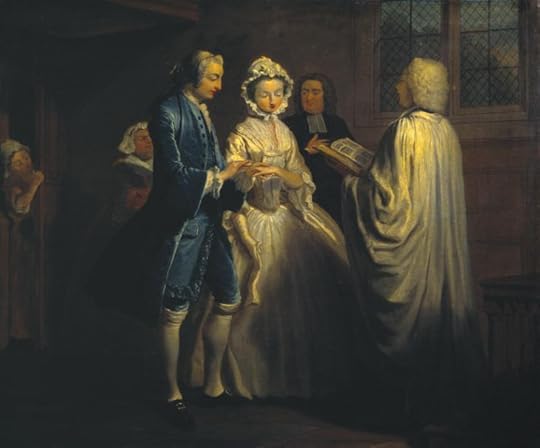 IX: Pamela is Married 1743-4 Joseph Highmore 1692-1780 Purchased 1921 http://www.tate.org.uk/art/work/N03575
I ended my former post of lay psychologising about the high prevalence of characters who seem to have personality disorders in famous books, by mentioning Robert Lovelace, the rapist anti-hero of Clarissa.
I have written about this fellow elsewhere as a fascinating example of a character personifying the dark side of an author’s psyche – there were evidently fascinating undercurrents in that of the dull, pompous, hard working self made printer Samuel Richardson.
The debauched Robert Lovelace is an experienced rapist. Early on in the story – or as early on as you can expect with an author whose stories move along with the speed of an indolent snail – he makes casual references to his servant Will about a young girl whom he abducted and ravished. Lovelace was put out that she and her relatives were insolent enough to complain about it.
Lovelace is certainly obsessed by Clarissa, but remains determined to show that he can overcome her virtue.
This involves him in a series of deceptions which become ever more ludicrously farfetched including trapping her into living in a brothel. Later, after she has escaped, he employs two actresses to act the part of relatives of his and trick her into returning to London.
All this, the bribery he routinely uses, and all the rest of his connivances must be expensive for Lovelace; rather awkward, when he is supposed to be economising in order to put his finances to rights and has even – horrors – had to give up his private carriage.
Obviously, Jane Austen was thinking of Richardson when she made her tart comment about male characters in novels causing themselves endless wasted time and inconvenience in a desperate pursuit of some young woman. She doesn’t touch on the vulgar matter of expense; but that must play a part.
Terry Eagleton in his ‘The Rape of Clarissa’ (1986) is one of the few critics of Richardson who have noticed what an unnatural amount of time the main characters spend in writing diaries and letters. While this might be put down to difficulties from the books being written in the ‘epistolary form’, it makes for unintentional comedy.
For instance, Lovelace scribbles a note to a friend after a night spent obsessively hovering outside Clarissa’s house: ‘On one knee, kneeling with the other, I write! My feet benumbed with the midnight wanderings through the heaviest dew that ever fell; my wig and linen dripping with the hoar frost dissolving on them!’
Does he carry an ink pot and quill about with him? In damp like that, he would need a sheet of blotting paper, too, quite aside from his purse of money for bribery, and of course, his sword to beat off all comers. I suppose , what with writing so many letters he doesn’t need to lug an address book about with him It isn’t surprising that he catches a chill.
Presumably, with modern technology, these characters would constantly be sending each other texts and emails via their Smartphones. Clarissa would see a post by Lovelace on social media which would make her question his motives, and block him.
Mr B doesn’t have to hang about in damp gardens. He specialises in jumping out of cupboards – the would-be rapist literally coming out of the closet. Sometimes, he is dressed up as a maid, and he seems to go in for a spot of exhibitionism as well, not at all troubled if his sexual assaults are witnessed by his housekeeper.
He also specialises a dramatic entrance line on these occasions: ‘Now, Pamela, is the dreadful time of reckoning come!’
Nothing happens, because Pamela shrieks and faints. This seems to have a quenching affect on his passions. All such attempts by Mr B are of course, doomed to failure, as Pamela’s ‘virtue’ must be rewarded. She must go a blushing virgin to her wedding bed (she actually writes a letter to her parents as she awaits Mr. B’s appearance in her bedchamber).
Mr B is a cardboard character, as is Pamela herself. If they have any sort of a personality disorder, I suppose Mr B might be said to have a Don Juan complex. The idea that a maidservant he deigns to desire might actually reject him is astounding to him. The paraody of the novel ‘Shamela’ in fact, pinpoints one of the many great weaknesses in Richardson’s supposed depiction of outraged innocence. ‘Shamela’ suggests that the heroine is well aware that in piquing her master’s vanity, she tempts him into making further attempts.
Pamela might credibly be a covert narcissist. There is something repellent in the way that she eagerly reports every compliment that she receives, and they are incessant. Her defenders argue that this is one of the defects of the epistolary method, but the end result is anything but appealing (as it is with Fanny Burney’s Evelina).
As a lady’s maid, Pamela is subservient towards her master’s family as members of the landed gentry. She has become a great favourite with her old mistress, who has taught her skills ‘beyond her station’ such as reading and writing. When her mistress dies, Mr B as an unmarried man has no need of a lady’s maid, and Pamela is due to return to her impoverished home.
Yet, Mr B delays in returning her for over a year, putting forward various schemes about where she is to be employed, and all the while, he is somehow becoming more and more fascinated by her, though her attitude when they meet is so shy and discouraging…
After Mr B is prepared to put their relationship on a nominally respectable basis, Pamela shows no apprehensions about marrying this unsuccessful rapist, or any about his character. He is ‘her dear master’. One gets the impression that she is a thoroughgoing opportunist. Gradually after their marriage, and particularly after the conquest of Lady Davers, she becomes more and more self-important. In many ways, her career seems very like the journey of a covert narcissist into a more overt one.
This is not to say that I don’t find Mr B’s rape attempts on his maidservant abhorrent – or the idea of any woman, in or out of a novel, happily marrying a man who has attempted to rape her anything but disgusting. It is more that I agree that there is arguably more of a subtle interplay and negotiation between two intensely hypocritical, vain and unscrupulous characters going on in the text – and contrary to Richardson’s conscious intent – than might appear from an uncritical reading.
Jane Austen was greatly influenced by Richardson, while realising the crudities of his style and moral arguments. Some of her characters – particularly, the villains of the piece, arguably have personality disorders.
More of that in the next post.