
Kathy Collard Miller's Blog, page 13
August 16, 2021
Why Do I Have a Hard Time Saying “No”?
 Do you relate? These thoughts create in me the fear about saying “no”…What will she think of me if I’m not the Super Woman who can say “yes” to everything?If I don’t say “yes,” then I’ll miss out on the fun!If I don’t say “yes,” the opportunity won’t get done to my standards!If I don’t say “yes,” they might not ask me the next time.It feels good to be needed.(Put in your own reasoning).The difficulty of saying “no” is all about depending upon the opinions of others for our approval, rather than God. We fear making other people unhappy with us or think poorly of us. So we strive to do everything we can to appease other people and promote ourselves as important, valuable, or whatever vow we’ve made to promote or protect ourselves. That striving indicates that person or goal is our idol: the person or goal is more important than God.I
n the Bible, there are many examples of those who made other people more important than God in the Bible.
The most known one may be when King Saul succumbed to this striving. His reaction is featured in 1 Samuel 13:8-14. Remember the story?Saul was supposed to wait for Samuel to come so that the burnt offering could be given. The goal of the sacrifice was to depend upon God and look to him. But Saul saw the people scattering and he panicked. What did Saul fear that said about him? Did he fear being a failure in the eyes of the people? The fact they were leaving must have communicated their lack of trust in his ability to lead them to victory. All of us want to be seen as powerful, wise, and successful.As Saul had his panic attack, he decided to offer the sacrifice before Samuel arrived. When Samuel showed up at the last minute, Saul knew he was in big trouble. Samuel asked, “What have you done?”What was Saul’s reasoning? “When I saw that the people were scattering from me, and that you did not come within the days appointed, and that the Philistines had mustered at Michmash, I said, ‘Now the Philistines will come down against me at Gilgal, and I have not sought the favor of the Lord.’
So I forced myself
, and offered the burnt offering.” (Don’t you just love Saul saying, “I had to force myself”? He is making it sound like he didn’t really want to and was forced to. I sometimes fool myself that way. How about you?)Samuel saw the folly of Saul’s reasoning and rebuked him. “…now your kingdom shall not continue. The Lord has sought out a man after his own heart, and the Lord has commanded him to be prince over his people, because you have not kept what the Lord commanded you.”What was God looking for? A man after God’s own heart, but Saul’s heart was all about himself, the approval of others, his own image and how he was regarded by others.Where can we get the courage to choose God’s approval and not depend upon people’s opinions? It is hard to say no but two primary thoughts can help us. TWEET THAT!!!!
Lay hold of God’s promise, “What can man do to me?” (Heb. 13:6).
Even if someone approves of us, it will be a temporary and fragile approval. Usually it’s based on our performance and we won’t be able to sustain that perfectly. But God is the only one who will love us perfectly regardless of our performance. Only he can provide unconditional love and approval because of the “robe of righteousness” we wear because of Jesus’ redemptive death.
Have a heart after God by identifying the source of our reactions.
We can only be strengthened to obey and have God’s perspective by identifying and healing the wounds that befall us that fueled our need for other people’s approval. For instance, you might have been shamed, physically hurt, or dismissed by harsh words when you expressed an opinion or went against what a family member wanted you to do. There are always underlying causes that factor in.
Do you relate? These thoughts create in me the fear about saying “no”…What will she think of me if I’m not the Super Woman who can say “yes” to everything?If I don’t say “yes,” then I’ll miss out on the fun!If I don’t say “yes,” the opportunity won’t get done to my standards!If I don’t say “yes,” they might not ask me the next time.It feels good to be needed.(Put in your own reasoning).The difficulty of saying “no” is all about depending upon the opinions of others for our approval, rather than God. We fear making other people unhappy with us or think poorly of us. So we strive to do everything we can to appease other people and promote ourselves as important, valuable, or whatever vow we’ve made to promote or protect ourselves. That striving indicates that person or goal is our idol: the person or goal is more important than God.I
n the Bible, there are many examples of those who made other people more important than God in the Bible.
The most known one may be when King Saul succumbed to this striving. His reaction is featured in 1 Samuel 13:8-14. Remember the story?Saul was supposed to wait for Samuel to come so that the burnt offering could be given. The goal of the sacrifice was to depend upon God and look to him. But Saul saw the people scattering and he panicked. What did Saul fear that said about him? Did he fear being a failure in the eyes of the people? The fact they were leaving must have communicated their lack of trust in his ability to lead them to victory. All of us want to be seen as powerful, wise, and successful.As Saul had his panic attack, he decided to offer the sacrifice before Samuel arrived. When Samuel showed up at the last minute, Saul knew he was in big trouble. Samuel asked, “What have you done?”What was Saul’s reasoning? “When I saw that the people were scattering from me, and that you did not come within the days appointed, and that the Philistines had mustered at Michmash, I said, ‘Now the Philistines will come down against me at Gilgal, and I have not sought the favor of the Lord.’
So I forced myself
, and offered the burnt offering.” (Don’t you just love Saul saying, “I had to force myself”? He is making it sound like he didn’t really want to and was forced to. I sometimes fool myself that way. How about you?)Samuel saw the folly of Saul’s reasoning and rebuked him. “…now your kingdom shall not continue. The Lord has sought out a man after his own heart, and the Lord has commanded him to be prince over his people, because you have not kept what the Lord commanded you.”What was God looking for? A man after God’s own heart, but Saul’s heart was all about himself, the approval of others, his own image and how he was regarded by others.Where can we get the courage to choose God’s approval and not depend upon people’s opinions? It is hard to say no but two primary thoughts can help us. TWEET THAT!!!!
Lay hold of God’s promise, “What can man do to me?” (Heb. 13:6).
Even if someone approves of us, it will be a temporary and fragile approval. Usually it’s based on our performance and we won’t be able to sustain that perfectly. But God is the only one who will love us perfectly regardless of our performance. Only he can provide unconditional love and approval because of the “robe of righteousness” we wear because of Jesus’ redemptive death.
Have a heart after God by identifying the source of our reactions.
We can only be strengthened to obey and have God’s perspective by identifying and healing the wounds that befall us that fueled our need for other people’s approval. For instance, you might have been shamed, physically hurt, or dismissed by harsh words when you expressed an opinion or went against what a family member wanted you to do. There are always underlying causes that factor in.Want more help to learn to say “no” and discover the underlying causes of your people pleasing?
That’s one of the goals of my book Pure Hearted: The Blessings of Living Out God’s Glory. The more we want God’s glory the more we’ll choose to do what God wants us to do–not what other people want us to do. Will you join me in the quest for seeking God’s approval as our “audience of one”? I’d love to hear from you how you have diminished having a hard time saying “no”. What truths empower you to be a woman after God’s own heart? TWEET THAT!!!!!


August 6, 2021
Book Drawing: “Fighting for Your Marriage While Separated” by Linda W. Rooks
I love to feature an important book each month for a book drawing. This month the book is “Fighting for Your Marriage while Separated” by Linda W. Rooks. Read below to find out how to enter the drawing.
Here’s an excerpt to whet your appetite. Even if you’re not separated, I think you’ll find this will strengthen your marriage.
Finding Power in Positive Words by Linda W. Rooks
Early in my husband’s and my separation, I realized how my negative words had hurt our marriage. By reading marriage books and applying them to our fractured relationship, I became more sensitive to my husband’s needs and my deficiency in responding to them. Although I tried to be kind and thoughtful in my conversation, I began to understand that a relationship requires not only kindness and thoughtfulness, but also words that express sensitivity to the person’s specific needs. Consequently, I started to recognize that my husband needed more affirmation from me. He needed my approval—even my admiration at times—to fuel the love reservoir that kept our relationship alive.
As I thought back on our early marriage, I knew these were the kinds of words I had given him back then. What changed? It was a slow unraveling, and I believe the same downhill slide that happened to us occurs in many other marriages as well.During the demands of everyday family life, verbal exchanges can easily shift from fostering a relationship to fostering a routine. We may lose the sense of our mate’s personal needs and focus on responsibilities instead. Our spouse becomes our partner in solving problems and fulfilling responsibilities rather than a person who needs the appreciation we may have lavished on them when we were dating or first married.
If you want to begin speaking encouraging words to your spouse, you may first need to reacquaint yourself with who your spouse actually is. Pray that you can start to see your mate through God’s eyes as you sit down with a pad of paper and think about:What makes your spouse happy, sad, or angry?What makes him hopeful or discouraged?What are your spouse’s strengths?What makes her feel loved and appreciated?What is your spouse afraid of?What is your spouse most proud of?Where is he afraid of failing?
Ephesians 4:29 asks believers to build “others up according to their needs.” Pray about how you can pour words of love into your spouse’s hurts, bolster his strengths and affirm her as an individual.
Your goal should basically be to offer uplifting words and actions that buoy up your spouse as an individual to make them feel valued. When your spouse feels valued by you, they may feel safer with you and begin to open up to you. Focus on creating a pleasant, enjoyable, and safe environment for the times the two of you are together.
As you begin to apply these principles, spend time each day, asking God for wisdom. He has the answers. He can give you strength and discernment to do what is most effective and valuable. Here’s more describing Linda’s book:A home ripped apart by one spouse leaving reverberates with a host of unanswered questions. Simple answers don’t exist. Heartrending complexities do. In Fighting for Your Marriage while Separated, award winning author, Linda Rooks brings hope for those who are separated by sharing practical answers, biblical wisdom, true stories of reconciled marriages, and her own reconciliation story after a three-year separation. If you are separated and willing to fight for your marriage, this transformative book is the book you’re looking for even if you’re fighting for your marriage alone.
TO ENTER THE DRAWING, make a comment on the blog post. Only USA addresses can win. The drawing closes on Sunday evening, August 15, 2021.

Linda W. Rooks has a ministry of hope for those in broken marriages. Her award winning book, Fighting for Your Marriage while Separated, and her earlier book, Broken Heart on Hold, Surviving Separation walk with those in the midst of marital breakdown to bring hope and practical guidance to those desiring reconciliation. Linda writes for both adults and children, and her stories and articles have appeared in numerous publications including Chicken Soup for the Soul, Focus on the Family, HomeLife, and Today’s Christian Woman. Linda has participated in numerous radio and television interviews across the North American continent. She and her husband reside in Central Florida and thank God for the many reconciled marriages they witness through their ministry and the classes they lead.
August 2, 2021
Why Did Jesus Ask, “Were not ten cleansed?” Luke 17:17

It almost doesn’t seem fair for Jesus to ask the healed leper, “Were not ten cleansed?” After all, he’s the one who does the right thing and returns to thank Jesus. He isn’t responsible for making the men return. So why did Jesus ask that? Let’s examine some ideas for the answer.
Leprosy affects every part of a person: physically, emotionally, spiritually, and mentally.
Imagine:You are disfigured, literally losing parts of your body.You must warn people, shouting “Unclean!” What a horrible way to identity yourself.You can’t touch anyone nor be touched. You can’t live with your family, have a job, or socialize with anyone except lepers.You can’t enter a place of worship because you are regarded as cursed by God.You feel responsible for the health of others because you could contaminate them.No wonder the ten lepers stood at a distance desperately crying out to Jesus, begging for mercy. They use the word mercy hoping compassion will fill Jesus’s heart to deliver them from their pitiful condition. They have absolutely nothing of value to motivate this healer to return them to normal life. All they have are their longings but with no hope of healing ever happening. We might not be able to comprehend the longings of each leper’s heart about normal life unless we have been afflicted and helpless ourselves.
I have experienced hopelessness.I initially hurt my back but managed it with exercise. Then decades later I incorrectly lifted my infant grandson and felt the wrenching of my back. For the next nine months, I was bedridden, trying to find relief through any means from the excruciating pain. Does God want me to be in pain for the rest of my life? I was terrified that might be true. I wanted to surrender to His will but continually cried out for mercy. Have pity on me, God! But nothing made a difference and my abnormal life continued without hope.
For the second time in my life, I considered taking my life. But knowing my precious grandson would grow up thinking his only grandma didn’t consider him valuable enough to persevere and how suicide would bring dishonor to God rebuked the temptation. Like the leper, I longed to return to my fruitful life.
But Jesus.Jesus has mercy and tells the lepers to check in with the priest. No mention of healing. But they know the Torah says they must be confirmed as healed by the priest. That must mean the Miracle Worker intends to heal them. They walk away and the miraculous occurs. Can you imagine their joy, excitement, patting each other on the back, and wide-eyed amazement as they touch each other? The proof is in their smooth skin and the replacement of body parts. Normal life is on the horizon.
Jesus’s merciful heart heals the ten lepers, and he healed me through surgery. I returned to normal life, like the grateful leper, with deep gratitude and giving praise to Him to this day.
Jesus asks the healed leper who returns, “Were not ten cleansed?” Jesus may have been asking him to recount how the others responded (even though He knew).
He could be saying, “Reflect on why you didn’t give into the excuses which motivated them, preventing them from returning. Remember their response when you don’t feel grateful in the future.”The possibility of Jesus’s meaning seems very real to me because God seems to continue whispering those words to me: Remember what I’ve done for you.
What does God’s mercy mean to you? If you are a Christian, how did his mercifulness factor into your salvation?In what primary ways do you feel a need for mercy? If you’ve never asked for God’s gift of salvation, do you now? Incredible God, I praise you for demonstrating your merciful nature by seeing my need while I was in a pitiful state. Thank you for reminding me of your gift of healing of my soul through salvation because I want to continue to be grateful.(This is excerpted from God’s Intriguing Questions: 60 New Testament Devotions Revealing Jesus’s Nature.)
July 24, 2021
What Can We Learn From the Disciples After Jesus Ascended?

Can you imagine how the disciples felt after they watched Jesus ascend right before their eyes?
After all, their leader, their security, their risen Savior, their protector was gone. Did they feel abandoned? Aghast? Confused? Helpless? I would have felt all those ways. And even if I could remember the ways Jesus had tried to prepare me for the event, my paralyzed mind most likely would have wanted to scream, “Don’t leave!!!!” I most likely would feel like I’m on my own–and I don’t like that feeling.
I think those watching did feel a bit paralyzed. After all, it took angels to tell them to disperse (Acts 1:10-11). Did they expect He would immediately come back down? Somehow they moved their legs which were rooted to the spot.Here’s what happened next:
“Then they returned to Jerusalem from the mount called Olivet, which is near Jerusalem, a Sabbath day’s journey away. And when they had entered, they went up to the upper room, where they were staying, Peter and John and James and Andrew, Philip and Thomas, Bartholomew and Matthew, James the son of Alphaeus and Simon the Zealot and Judas the son of James. All these with one accord were devoting themselves to prayer, together with the women and Mary the mother of Jesus, and his brothers.” (Acts 1:12-14).
When we don’t know what next step to take, how can the example of the disciples help us know what to do after they saw Jesus ascend into heaven?So often when we’re unsure of what to do, even in our service to God, we flail about just keeping active doing anything. We might fear if we do nothing our inactivity will be judged negatively by others—and even ourselves. Sometimes it’s better to wait on God’s further orders and faithfully keep obeying his last instructions.
Not only did the disciples and followers not know what to do, they may have been afraid Jesus’ enemies would try to harm them, as they had Jesus. If they were afraid, it would have been reasonable—from a human perspective—for them to flee the city and area. If they fled, they would have been disobeying him because Jesus told them to stay put (Acts 1:4). To their credit, they remained gathered in the upper room despite the possible danger, and spent time in prayer and fellowship.
Their response of prayer was a wise one and an example for us. Whether we’re confident of God’s directions or not, we can pray and continue to seek him.
When we sense it’s time for some decisions to be made, what should we do? TWEET THAT!!!!
I admit, most often, I don’t have complete confidence in God’s leading. Sometimes I hear “no” and other times “yes” on something. I think this is normal. Often, I’ll just go with whatever seems most “like God,” and then pray that He will stop the progress if it’s not His will. I’m so glad the Lord is gracious and powerful and can overcome my mistakes. As long as I’m not willfully and knowingly choosing wrongly, I don’t have to feel guilty or uncertain. I can be confident He graciously is still in charge–because He is sovereign.
How do you decide how God is leading you? How do the choices of the disciples instruct or encourage you after they saw Jesus ascend? (This is an adapted excerpt from my women’s Bible study book Whispers of My Heart: Daughters of the King Bible Study Series).
June 10, 2021
What Does God Want to Hear From Us?
God wants to hear everything and anything from us!
Prayer. What joy we experience when we take the time to focus on our great God. Whether we think we pray enough or not, we know we can never spend too much time talking to our heavenly Father.
We know God’s Word calls for us to pray, and we sense God’s wooing to focus on Him, but the challenge comes when any number of obstacles bombard us. We can question whether we’re praying in the right way. We can wonder if God hears us. We hear someone else pray beautifully, and we believe we aren’t eloquent. We hesitate to pray when others are listening.
When I was a little girl, somehow I understood that God was only interested in hearing about the “big things.” I didn’t really understand what was in the category of “big things,” but the idea definitely gave me the idea God’s interest in me and my life was limited and picky. TWEET THAT!!!!!The doubts and confusion like I experienced can swirl around in our minds and hearts and block our confidence in seeking God. And then when our prayers aren’t answered the way we asked, we conclude God doesn’t love us. We can even claim biblical “promises” about prayer but the answers still seem a part of some big mystery we don’t understand.
Truly, there are many blocks and much to learn. The most wonderful thing is God invites us to seek Him while He continues to teach us. There is hope.
Let’s look at a variety of Bible passages to see different aspects of prayer.
Acts 1:15-24. The remaining eleven apostles believe they should pick another apostle to join them. it is curious and instructive that the Apostles first narrowed the possibilities down to two candidates for one to replace Judas. Then they asked God for guidance to choose one of them. These verses show one way prayer includes our own involvement.
Jesus had personally picked each of the disciples in the beginning, so it made sense to them even in the early days of the church, that they should pray to ask Him to choose the next man for leadership.
I Timothy 4:3-5. Although we can apply this passage to what we call “saying grace” at a meal, it refers to everything in our lives. In verse 3, Paul says it refers to marriage. Overall, whatever God has allowed is good and can be received as a good gift as it is dedicated in prayer.
James 1:5: Although God wants to give us wisdom about everything, in the context of this particular passage, James says these persecuted Christians should ask for wisdom in how to respond to the intense trials and temptations they are facing.
I Peter 4:7: Of course, we can and should pray whether we’re joyful or sad. But in this context, Peter is warning his Christian friends they will be facing a difficult time which requires special seriousness. Peter could be using “the end of all things” to refer to each person as they face death. Or it could refer to some catastrophic event including persecution. Neither Peter nor his readers could have known their “world” of Jerusalem would soon be coming to an end, because its destruction by Nero wasn’t far off (70 A.D.).
Matthew 7:7-11 These verses don’t specifically indicate what our prayers should refer to, so therefore we can safely say they are urging us to pray about everything. Everything and anything can be brought to the Father’s attention. Of course, God already knows about it all. God’s purpose is to comfort and strengthen our confidence to know God cares and wants to respond to us.
When I was a child, I thought God was only interested in hearing my prayers for the “big things.” Now I know our loving heavenly Father wants us to bring every single concern we have and every part of our lives to Him because they are all of interest to Him. He only intends to answer and provide whatever is best for us. We may not consider His answer to be for our good at the time, but if we trust Him, we can receive His answer with thanksgiving.
How about you? Have you struggled with thinking God is limited in His desire to hear from you? Or maybe you have always felt like He wanted to hear about everything from you. Please share. I’d love to hear your perspective.
(This is an adapted excerpt from my women’s Bible study on prayer, Whispers of My Heart. Check it out at:https://www.amazon.com/Whispers-Heart-Daughters-Bible-Study/dp/194443092X/
May 31, 2021
Book Drawing! “I Can’t Believe You Just Said That!” by Ginger Hubbard
Larry and I moved to a different state and I’m able now to be back to my desk. I’ve missed you and I hope you missed me.
So I’m reconnecting by featuring a book giveaway of a fabulous parenting book by Ginger Hubbard. You are going to love this book whether you are a mother or a grandma. It’s called I Can’t Believe You Just Said That!: Biblical Wisdom for Taming Your Child’s Tongue.
Here’s an excerpt to whet your appetite. Be sure to read further on about how to enter the drawing! 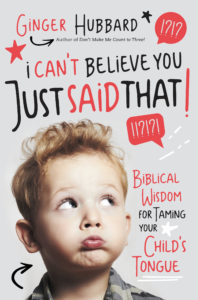
Having a plan of action can make a positive difference in how we respond to a child’s need for correction. Every chapter in my book uses a three-step plan for getting to the heart of a child’s behavior. This enables you to reprove your child biblically and train him or her in righteousness in correlation with specific tongue-related struggles.
Here are the three steps you will learn to implement in my book.
Step 1: Getting to the Heart of BehaviorA wise parent will learn to move beyond the words of her child by addressing the issues of the heart. After all, if the heart is reached, the behavior will take care of itself. TWEET THAT!!!!!
Thankfully, Jesus exemplified ways to get to the heart of behavior. Throughout Scripture, Jesus often asked questions whenever someone was caught in sin. He would ask a question in such a way that the sinner had to take his focus off the circumstances around him or the wrong-doings of others and place it on his own heart and motives. Jesus’ questions caused people to evaluate themselves, which led to the realization of their own sin and need for the Savior. Parents do well to follow the example of Christ by asking heart-probing questions. In doing this, they help children recognize and take ownership for their sins, which, in turn, helps them realize their need for Christ.
Step 2: Reproving Your Child BiblicallyIn Matthew 18:15 God commands that we reprove those who are caught in sin. A biblical reproof exposes wrong by shedding light where there is darkness. But what does this look like on a day-to-day level?
Fortunately, God has faithfully provided us with what to say and how to say it.
We need not look any further than the infallible Word of God. Once we have determined the issue of the heart that drives the outward behavior, we can then address the offense in accordance with Scripture.
It is not our words but God’s words that will penetrate the heart, convict the guilty, and promote change: “The Word of God is alive and active. Sharper than any double-edged sword, it penetrates even to dividing soul and spirit, joints and marrow; it judges the thoughts and attitudes of the heart” (Hebrews 4:12). Because we are provided with “everything we need for a godly life” (2 Peter 1:3), we can rest assured that a parent’s guide to dealing with an unruly tongue is Scripture.
Step 3: Training Your Child in RighteousnessToo often parents are satisfied to tell the child what he has done wrong, administer some sort of consequence, and then go about their business, satisfied that they have fulfilled their parental responsibility.
The Bible is clear that we are to do more than this.
We are to take it a step further and train our children in righteousness. It is never enough to tell kids what not to do; we must teach them what to do. In the book of Ephesians we are told to “put off the old self, which is being corrupted by its deceitful desires; to be made new in the attitude of [our] minds; and to put on the new self, created to be like God in true righteousness and holiness” (4:22).
Wow! This sounds fantastic, Ginger! Thank you for making a copy of your book available for the book giveaway.
Readers: To enter the drawing, make any comment on this blog post’s comment section. The drawing ends Sunday evening, June 6, 2021. Only US addresses can win.Here’s more about Ginger and her ministry.
 Ginger Hubbard, bestselling author of Don’t Make Me Count to Three, Wise Words for Moms, and I Can’t Believe You Just Said That, speaks at women’s events, parenting conferences and home school conventions across the country, and co-hosts the Parenting with Ginger Hubbard Podcast. Visit her website www.GingerHubbard.com
Parenting with Ginger Hubbard is a weekly podcast to encourage and equip parents to reach the hearts of their children and point them to the transformational power of Christ. Learn how to move past the frustrations of not knowing how to handle issues of disobedience and defiance, and into a confident, biblical, and well-balanced approach to raising your children.
Sign up now for more information about Ginger’s ministry at https://www.GingerHubbard.com and receive two FREE e-books: How to Lead Your Child to Christ and How to Pray for Your Child.
Also connect with Ginger at: Instagram – @ginger.hubbard / Facebook – @OfficalGingerHubbard
April 8, 2021
Why Did Jesus Ask, “Simon, are you asleep?”?
Do you remember your latest holiday meal where the day involved the stress of welcoming guests, fixing a meal, eating the meal—the large meal—and then sitting down to watch the football game or relax while chatting? What happens? You either fall asleep or at the least your eyes are drooping. You are tired and full. Sleep seems inevitable.
Similarly, Simon can’t resist falling asleep after a full and stressful day. The disciples have prepared the Passover meal. They eat the meal, which is rich and is a lengthy process with many traditions. Then the disciples are shocked to hear Jesus tell them one of them will betray him. Peter is particularly devastated to hear he, himself, will deny Jesus three times. That evening, they walk to Gethsemane where Jesus tells Peter, James, and John, “Sit here while I pray. … My soul is very sorrowful, even to death. Remain here and watch” (Mark 14:32, 34).
The most common Jewish way to pray is to stand with hands raised. But Jesus has mercy on them and says to sit. He wants to help them stay awake, but their bodies rebel. We don’t know at which point Peter and the others fall asleep, but we can surely understand why.What did Peter feel like as he suddenly awakens hearing Jesus ask, “Simon, are you asleep?” He must be groggy and disoriented. He fully wants to support Jesus with prayer, so he must have felt guilty when Jesus awakens him and asks, “Could you not watch one hour?” In verse 40, Mark writes, “and they did not know what to answer him.” There is no way they could excuse their lack of support.
All of us experience initial reactions that contradict the fruit of the Spirit (Galatians 5:22-23). We worry instead of having peace. We are angry instead of having patience. We harden our heart instead of loving vulnerably. We then have a choice whether to continue or to choose God’s power for a godly reaction.
When we choose to continue in the ungodly way, the natural way, we might feel hopeless to be restored to fellowship. But let’s remember Jesus also said to Peter, “The spirit indeed is willing, but the flesh is weak” (v. 38). Jesus knows the human sinful bent because he experienced temptation yet resisted. He always has a plan to provide restoration and forgiveness. When Jesus wakes up Peter, Jesus uses his “natural” name Simon, reflecting back to his old life. The name Peter represents his new calling as a follower. Every Christian at times returns to their “old name,” their sin nature, but God forgives and restores them to fellowship and reminds them of their “new name” in Christ as his children, his Bride.
The three disciples want to pray yet fall asleep three times. Jesus wakes them three times. Does Peter later remember this significant number? He denies Jesus three times, and later Jesus asks him three times, “Will you feed my lambs?” How did Jesus’s questions speak to him? He must realize Jesus’s motive is to restore, not reject.Our world is a broken, hopeless world. But knowing God is restoration power, there is always forgiveness and hope, and a future new heaven and new earth.
What other words would you use for describing God’s quality of restorative power?What area of your life currently needs the hope God can restore anything he desires?Strong Father, I praise you for your ability to restore health to any brokenness in me. Thank you for opening my eyes to the times you have brought restoration in my life.
(This post is from my book God’s Intriguing Questions: 60 Devotions Revealing Jesus’s Nature. I will not be blogging as much as usual because of moving out of state.)
March 25, 2021
Book Drawing: “Fresh Joy” by Heidi McLaughlin
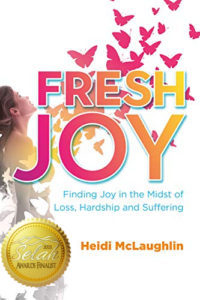
Joy can be a challenge for any of us for a variety of reasons. That’s why I’m so pleased to give Heidi McLaughlin an opportunity to showcase her latest book, “Fresh Joy.” I’ve loved reading it myself. Maybe you also need a cup of fresh joy. Or how about one that lasts all day? In a world fraught with stress and anxiety we need to know how to access daily joy. The good news is that joy and pain can co-exist, because joy is the currency of Heaven and available to us 24/7. Heidi’s book helps you discover how you can access joy, enjoy it and grow it.
See below how to enter the drawing.
Here’s an excerpt from Fresh Joy to encourage you and give you a sample of her fabulous book.
FRESH JOY – Our “Joy Givers” By Heidi McLaughlinWe all need friends—the kind who tell us when we have lipstick on our teeth or a tag hanging out the back of our shirt. Better yet to have friends with whom we spend a balmy summer evening lingering on the patio, watching burning candles, who are vulnerable enough to answer the question “So what has God been doing in your lives in the last while?”
Deep, intimate, and loving friendships that exude joy are life-giving and contagious. God created us for relationship. Not just spiritually but also in vibrant loving face-to-face connections that actually help us to live longer and healthier.
Loving friendships are life-giving and contagious.Growing up we might have heard, “The only person you can rely on is yourself.” But ultimately this self-reliance robs us of true love and joy. We need each other to point out our blind spots, encourage one another when life doesn’t go as planned, and take time to celebrate our victories. It takes strength to recognize that reliance on others can be healthy and emotionally affirming. So take ownership of the attitude that fostered this false belief and challenge yourself to be vulnerable and work toward a healthy interdependence.
Vulnerability moves us toward intimate relationships.To grow joy we need to stand strong, but admit our weaknesses, and take time to build our tribes. The door to the reservoir of joy is found in loving relationships, and we must learn to seek them and drink from them. When we connect and share the powerful characteristics of Christ, we experience the fulfillment and joy of what it means to live out the Christian life. The good of every Christian soul is hidden underneath our rubble and shame, and once it is released, we find freedom and a sense of belonging that cannot be found any other way. We help each other go from admitting our “badness” to calling forth each other’s “goodness.”
To grow joy we have to make relationships our highest priority .Friendships are our “joy givers.” We must take the time to build tribes to pray for us, celebrate, grieve, and sandpaper each other to live out our highest calling. This doesn’t mean it’s easy, but here is how we can start:
Ask yourself, When you fast forward to the end of your life, what is one sentence you would like people to say about you? Will it include success or relationships?Recognize that our greatest accomplishment in this life will be how we loved one another. Love is something that we learn how to do here on earth, and it will be fulfilled in the most glorious way in eternity.Ask the Holy Spirit to help you bring out the goodness first in yourself and then in each other.Recognize that isolation is a trap the enemy uses so that you are not covered by the protective and loving shield of other Christian friends. Good Christian friends keep us accountable, pray for us, and call us out on things that harm our soul.Ask God to fill you with his love and remove any shame so that you can live an authentic and joyful life.My dear reader friend, trust me when I say, “We must take time and make intentional efforts to build healthy, Christian, loving relationships. They are one of God’s greatest gifts to shape us, strengthen us, make us more like Christ, and infuse us with God’s dependable joy. At the end of the day, the richest gift we will have is a deep connection with God and each other.”Thank you, Heidi, for encouraging us!
If you would like to enter the drawing to win Fresh Joy, make a comment on my blog post. The drawing ends Thursday, April 1st. Only USA & Canada addresses can win.
If you’d like to buy it immediately, check out these online stores:https://www.amazon.ca/Fresh-Joy-Heidi-McLaughlin/dp/1988928346/https://www.amazon.com/Fresh-Joy-Finding-Hardship-Suffering-ebook/dp/B08KHRB4LK/https://www.barnesandnoble.com/w/fresh-joy-heidi-mclaughlin/1137817607?ean=978198892834http://www.heartconnection.ca/book-store/

Heidi McLaughlin believes that there is nothing more beautiful than a woman who knows she is loved. Heidi’s passion is contagious as she inspires her audiences to grasp their magnificence and step up to the plate to embrace their full potential in Christ. She will make you laugh, and she may make you cry, but you will know you have lovingly been challenged to your highest calling.
Heidi speaks all over North America and overseas, including Poland, Romania and Colombia. She has been teaching, speaking, writing and mentoring women for 29 years. She is an award-winning author, and has written several books and Study Guides and hundreds of articles and blogs. Heidi ‘s latest book is called FRESH JOY: Joy in the Midst of Loss, Hardships and Suffering and has already won an award and is helping hundreds in North American and beyond.
Heidi lives in the beautiful vineyards of the Okanagan Valley in Kelowna, British Columbia. Heidi has been widowed twice and is the mom and step-mom of a blended family of 5 children and 12 grandchildren. Her greatest joy is spending time with family and friends, laughing and experiencing new adventures. In the summer you will probably find her chasing a white ball down the many beautiful fairways in the Okanagan Valley. Heidi has experienced much tragedy, but has also learned how to recapture her JOY. Find out more information about Heidi at:www.heartconnection.ca
March 6, 2021
Book Drawing: “Deep Rooted” by Kathy Howard
I’m very excited to feature Deep-Rooted: Growing Through the Gospel of Mark by Kathy Howard for this month’s book drawing. Kathy is a powerful Bible teacher and I personally 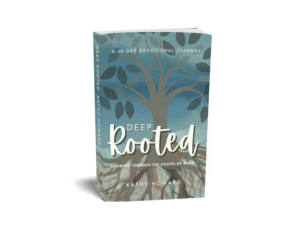 gained much from this book.
Read below how to enter the drawing!
Here is a sample from Deep-Rooted to whet your spiritual appetite.
Hope in the Most Desperate Timesby Kathy Howard
Desperate people do desperate things. This real-life observation plays out in the 2002 movie “John Q Public.” Denzel Washington stars as John Quincy Archibald, a desperate father struggling to help his dying son. The boy needs a heart transplant but the insurance company denied the surgery. So, in desperation, John takes the emergency room staff and patients hostage, demanding the doctors save his son.
Have you ever been that kind of desperate? In that place where you’ve tried everything and you’ve got nothing left but last resorts and hail Marys?
The fifth chapter of the Gospel of Mark, tells the story of two people with nothing in common but desperation. A frantic father trying to save his daughter. And a demoralized outcast with nothing left to lose. Both driven to do something they wouldn’t normally do.Jairus, a respected leader in the local synagogue, humbled himself before Jesus, the controversial Teacher, to beg for his daughter’s life.
Then came one of the rulers of the synagogue, Jairus by name, and seeing him, he fell at his feet and implored him earnestly, saying, “My little daughter is at the point of death. Come and lay your hands on her, so that she may be made well and live.” Mark 5:22-23, ESV
And the woman. Plagued for more than a decade by a condition that drained all her financial resources and marked her “unclean,” risked public shame to simply touch the hem of Jesus’ garment.
She had heard the reports about Jesus and came up behind him in the crowd and touched his garment. For she said, “If I touch even his garments, I will be made well.” Mark 5:27-28, ESV
Two very different people, but both exercised faith in Jesus.Nothing in Scripture is coincidental or haphazard. Mark intentionally wove together these two personal stories to double the impact. Both these miracle-seekers felt fear, grief, discouragement, and hopelessness. Then through faith they both experienced hope and new life. A miracle within a miracle, all wrapped in the power and authority of Christ.
Jairus’ daughter lay on her deathbed, but Jairus believed Jesus could heal her. He had heard stories. The woman had suffered from constant vaginal bleeding for twelve years. According to Jewish Law, her unclean status prevented intimacy in a marriage relationship, denied her access to corporate worship, and severely limited her social interaction. She had nothing to lose. But so much to gain.
On Jesus’ way to heal the girl, the woman reached out in faith and experienced His healing power. Jesus knew who had touched His robe, but He sought out the woman for her sake. She needed more than mere physical healing. And Jesus met those needs – peace, community restoration, and a name that showed her worth. “Daughter.”
And he said to her, “Daughter, your faith has made you well; go in peace, and be healed of your disease.” Mark 5:34, ESV
Seemingly, the delay prevented Jesus from healing the girl in time to save her. But God is never late; the delay had purpose. And the girl’s death was no obstacle for Jesus.
Taking her by the hand he said to her, “Talitha cumi,” which means, “Little girl, I say to you, arise.” And immediately the girl got up and began walking (for she was twelve years of age), and they were immediately overcome with amazement. Mark 5:41-42, ESV
Although the girl’s death inflicted deep grief on her parents, it also provided an opportunity for God to bring more glory to His Son. Jesus worked two miracles that day. Healing for brokenness. Life for death.
With what seemingly insurmountable obstacle do you need to trust Jesus today?
Lord Jesus, with You no problem is insurmountable, no desperate situation lost. I place my faith in You as the One who is always able, the One who brings hope to the hopeless, and the One who overcomes death with life. Amen.
Here’s more about Kathy’s book…If you want to experience regular spiritual nourishment from the Bible, it is possible! Deep Rooted, a 40-day devotional journey through the life and ministry of Jesus, will show you how to interact with and apply Scripture, not just read it. These meaty, daily devotions use a simple study framework designed to help you:
Develop a regular habit of spending quality time in God’s WordKnow Jesus more fully and intimatelyLearn how to dig into Scripture on your ownBe transformed by God’s Word, not just informedPractically live out the truths you discover in Scripture To enter your name into the drawing for Deep Rooted, make a comment on my blog post. The drawing ends Sunday March 14, 2021. Only USA addresses can win. Let me introduce Kathy Howard…
A former “cultural Christian,” Kathy Howard now has a passion for God’s Word that’s contagious. With more than 30 years of experience, Kathy has taught the Bible in dozens of states, internationally, and in a wide range of venues including multi-church conferences and large online events. Kathy, who has a Masters of Religious Education from the Canadian Southern Baptist Seminary, is a devotional and Bible study author. She also writes for multiple online magazines and devotional sites. Kathy and her husband live near family in the Dallas/Ft Worth. They have three married children, six grandchildren, and two accidental dogs. Kathy provides free discipleship resources and blogs regularly at www.KathyHoward.org
Here is the purchase link for Deep Rooted:https://www.amazon.com/dp/1946708542?tag=kathhowa-20Here are Kathy’s social media links:https://www.facebook.com/KathyHowardUnshakeableFaithhttps://www.instagram.com/mkathoward/https://mewe.com/i/kathyhoward33
February 27, 2021
God Was Multi-Tasking, Again!

As God prompted His people to write His Word, He most often had more than one purpose. He was multi-tasking! That’s certainly true of the story of Elijah asking for water and food from the widow of Zarephath (I Kings 17:8-18). She was a Gentile and lived in the country where the wicked Jezebel came from.
At the time God told Elijah to go to Zarephath, the drought had been going on for six months. The drought was God’s judgement upon the people of Israel to motivate them to turn from various sins including worshipping and trusting in other gods, like Baal. One of the primary reasons the people had turned away from Jehovah was because evil King Ahab was influenced by his wife, Jezebel, who was from the nearby pagan country of Sidon. She created places for the Israelites to worship her primary god, Baal, who was believed to be the storm god.
The people of Sidon believed when there wasn’t rain, Baal had died and would come back to life later–if they earned it!God chose a lack of rain specifically to make the point he controlled the weather, not the false god Baal. Everything God does has a purpose to teach about who he is and how we should respond to him. Ironically, the drought spread to the very country where Baal, the storm god, was worshipped. God was multi-tasking.
In a most unlikely move, God sent Elijah to Israel’s enemy territory, the country of Phoenician Sidon, where the wicked Jezebel grew up. Elijah must have been challenged to believe God would take care of him among his enemies.
God’s decision emphasized His own sovereign power to provide what Baal couldn’t for this poor widow. She expected to die along with her son. Yet the living God saved her life, along with her son. And then later when her son suddenly died, God used Elijah to raise him from the dead.
Most likely this widow was not a believer in Jehovah, yet she was willing to die sooner to feed Elijah. Even though Elijah had promised she would be taken care of, we wouldn’t expect she would believe him, yet she did. She risked a lot to obey a hated foreigner.
What would her neighbors think? What would her “god” Baal think of her and would he punish her? Was she a fool to believe in this “foreign God”–Jehovah?This woman was raised to worship and trust in gods like Baal who supposedly could raise the dead. Yet because of her previous encounter with Elijah, she didn’t go to Baal to ask for her son’s healing, she went to Elijah. It would seem she had begun to worship Jehovah, the God of the Israelites. And God kept his promise by empowering Elijah to bring her son back to life. Something Baal couldn’t do because he wasn’t real.
Whenever we read the accounts in the Old Testament, we should be thinking in terms of the ways Jesus is represented and referenced even in subtle ways.In this particular story, we see how God is using the story of Him providing for the Gentile widow to point to the future when Jesus’s sacrificial death applies not only to His own people, but to Gentiles as well.
Romans 3:29 tells us, Or is God the God of Jews only? Is he not the God of Gentiles also? Yes, of Gentiles also.”
By the way, if you like to hear about archaeological evidence, like I do, here’s a tidbit. Archaeological finds have uncovered evidence of the city of Zarephath including pottery items described in this account. The bread the widow made was cooked either over an open fire or in a clay conical oven known as a tabun. There is also archaeological finds of those ovens.
What have you experienced that shows you God was multi-tasking in your life? TWEET THAT!!!!

