
Kathy Collard Miller's Blog, page 16
September 10, 2020
The Myths of Never Good Enough

Shawna remembers how uncomfortable she felt when she relaxed around her home growing up. When she was busy doing her homework, her mother would go out of her way to hug her and praise her for her hard work. But when she wanted to just watch TV to veg, her mother wouldn’t approach her and went around the house with a frown on her face. But if Shawna started her homework again, she could count on her mom kissing the top of her head as she worked.
Shawna transferred that kind of conditional love onto her perspective about God.
Unless she was doing something “spiritual,” she couldn’t believe God would approve or love her. If she was reading a novel, she thought she really should be reading the Bible. If she was talking to a friend who wasn’t a Christian, she felt guilty she wasn’t talking about Jesus. Even if she was blow drying her hair, she would think, I really should be memorizing a verse. For her, she should use every moment to grow in her faith or live it out.
But Shawna has been learning how her mom’s conditional love contributed to her adopting an unhealthy perspective of God’s love. Now she’s seeking God’s help in changing the wrong idea she can make God love her more through her continuous spiritual efforts. Do you relate to some of those feelings and thoughts? You might have perfectionistic tendencies.
Take this quiz to find out if you have perfectionistic tendencies. TWEET THAT!!!!
Read the following nine statements and check any that you relate to—even if it isn’t in your life 100% of the time.
1._____ Most of the time I sense God is disappointed with me.
2._____ I spend lots of energy evaluating my performance.
3._____ I tend to think in terms of “all or nothing.”
4._____ I think I should have my act together by now.
5._____ My expectations tend to be unrealistic.
6._____For me, “good” is rarely “good enough.”
7._____I often wonder why other people can’t get their act together.
8._____I’m compelled to straighten out misunderstandings.
9._____I won’t begin something if there’s a possibility I can’t do it well.
Add up your check marks. If you scored three or more of those statements, you have perfectionist tendencies. You may not be a “total perfectionist” but some of your tendencies are intruding into your desire to respond with godliness. And they could be contributing to the feeling you can never be good enough to please God.
Now, let’s take a closer look at the false beliefs behind those feelings.
1. If I were a better Christian, I would feel God’s love. I’ll just try harder to get closer to God.
A friend of mine was the oldest child in an alcoholic home. She never knew when her father might go off on another binge, sometimes leaving their home for days. One time, he was gone a week. To try to prevent his excesses, she tried to do everything well, hoping for his approval. Although she wasn’t responsible for him drinking excessively, she somehow reasoned that doing things right would please him and keep him away from drinking. As a result, she worked hard at getting straight A’s in school.
As an adult, Jamie has carried the perfectionist viewpoint of “having to try harder” into her relationship with God. If God didn’t answer her prayer a certain way, she concluded she just needed to have her devotions more often. If a friend misunderstood her, she worried if she gave up too soon when talking to a stranger about Christ a few days earlier. When she caught a cold, she worried that there was an unconfessed sin in her life. If she were totally “sold out” for Jesus she would sense his love for her all the time.
Second Timothy 1:9 assures us, “who saved us and called us to a holy calling, not because of our works but because of his own purpose and grace, which he gave us in Christ Jesus before the ages began.”
As someone has said, “There is nothing you can do to make God love you more and there is nothing you can do to make God love you less.” God loves unconditionally to the max!
2. God will love me more if I sin less.
Another friend feels God is punishing her and can’t accept her because of wrong choices she has made. Raised by perfectionist parents who rarely gave her any praise or encouragement, Debra accepted Christ at Vacation Bible School and continued to attend that church. But when she was twelve years old, she told God that she couldn’t be a Christian because she couldn’t stop sinning. Today, even though she’s overcome a dependency on drugs and alcohol, she can’t believe God can love and accept her. Debra’s vindictive view of God prevents her from receiving God’s unconditional love and grace.
Isaiah 43:25 tells us the truth: “I, I am he who blots out your transgressions for my own sake, and I will not remember your sins.”
3. I can earn God’s love and approval.
A third myth is the belief that we can earn his love and approval. But Isaiah 64:6 tells us, “For all of us have become like one who is unclean, and all our righteous deeds are like a filthy garment” (NASB). Moreover, Romans 3:20 explains that we can’t be declared “righteous” or “good enough” by keeping the law or being “good enough.” Yet many of us still think we can become “good enough” to earn God’s love.
Healing From the Lies
We can prevent these myths from affecting us by healing the inner wounds that created them. We do that by slowly but consistently replacing the lies with the truth by concentrating on God’s grace. Since we can’t earn God’s favor, He offers it as a free gift through Jesus’ death for our sins.
Ephesians 1:4 assures us, “But God being rich in mercy, because of His great love with which He loved us, even when we were dead in our transgressions, made us alive together with Christ (by grace you have been saved.)
I was reminded of that quite some time ago when I arrived at our local regional park. I had come prepared with the necessary quarters to deposit into the machine that controlled the mechanical arm blocking my way into the park. I deposited the quarters, and looked forward, anticipating the mechanical arm to raise. Much to my surprise, I realized there was no mechanical arm at all attached to the machine. It had been removed for some reason. Nothing had prevented me from entering the park all along.
“I just wasted my money,” I muttered to myself. “I could have gone in free!”
That’s just like we perfectionists who are very good at depositing our quarters of good works in an effort to earn entrance into God’s love.
“Here, God, is my quarter of loving that person I hate. Do you love me now?”
“Here, God, is my quarter of having my devotional time today. Do you love me now?”
“Here, God, is my quarter of serving in the nursery even though I would rather go to the service. Do you love me now?”
We put in our quarters, while all along, the mechanical arm we think is blocking us from God’s love is not there. Jesus died on the cross in our place and has shattered the obstacle to God’s unconditional love.
Instead of putting in the quarters, we can move forward into experiencing God’s love.
Certainly, God does want us to obey him, to love others, to have our quiet time with him, and to serve in our church.
But those things should be done out of our gratitude for His gift of salvation—not as a means of earning His love and our entrance into heaven.
Are you willing to give up depositing your quarters trying to earn God’s love? He wants you to know his incredible, unconditional love to set you free from the demand for perfect performance.
How have you learned about God’s unconditional love? TWEET THAT!
(adapted from my book, Pure-Hearted: The Blessings of Living Out God’s Glory)


September 1, 2020
Book Giveaway: “Fledge: Launching Your Kids” by Brenda Yoder
How true. I’ve gone through it twice and it’s a challenge. That’s why I’m excited to feature the book Fledge: Launching your Kids without Losing Your Mind by Brenda L. Yoder that will help you navigate this changing time.
And yes, it’s a book drawing! So read to the end and find out how to enter.
You were just getting this thing down: the changing trends, the non-stop schedules, the adolescent hormones. Then suddenly the oldest is gone, the younger ones seem to need you less, and your heart feels as empty as your nest is about to become.
But your job as a parent isn’t over, it’s just changing. In Fledge, counselor, educator, and mother Brenda L. Yoder helps Christian parents navigate the many transitions in the launching years. How do you parent tweens at home and young adults away from home at the same time? What’s a good balance between boundaries and freedom? How can you pray for your fledgling youth? And what do you do with all that mom grief?
Raising kids and letting go is not for the faint of heart, and it takes stamina to let go gracefully. Fledge will help you release your children into the future God has for them.

5 Parenting Truths for Releasing Your Kids
Brenda L. Yoder, LMHC
I walked out of my classroom pulling my cart of books and memorabilia behind me. I turned off the lights, shut the door, and my heart broke in two.
I had failed. I wondered why other people could handle raising a large family while teaching high schoolers but I couldn’t. The stress of teaching over 150 high schoolers and parenting four kids from high school to first grade took its toll on me.
Our busy family schedule with sports, chauffeuring kids, and homework pulled me in different directions, in addition to grading papers, getting groceries, and moody teens. I was stressed out, irritable, and reactionary most of the time with yelling and angry outbursts towards my children.
I was a mom in the early fledging stage of parenting—the stage of release.
My oldest was a high school sophomore and the youngest was in first grade. Life passed by year after year and my parenting and professional workload increased along with it. This particular school year, my class size swelled. Being emotionally and physically exhausted when I got home, I had little patience for the barrage of “Mom, Mom, Mom” demands when I walked through the door. I had little tolerance for snarky comments or disrespectful attitudes. I dreamed of the day when fewer kids were in the house so I could catch a break from the stress and mess that had become our life.
Then I realized there were only two years left with all four of my children at home. If something didn’t change, the memories my children would have of the years with all of us at home would be of an irritable, contentious mom. Something needed to change before my firstborn went to college.
That change had to come from me.
I made changes to my personal and professional life, allowing me to not wish away the time my kids were home. I also wrote Fledge: Launching Your Kids Without Losing Your Mind as a handbook for parents in the season of raising and releasing kids. Here are a few principles from the book.
There’s no simple formula for the perfect Christian family. Each family has their own struggles. There’s not an easy answer for most family problems with teens and young adults, except for biblical principles personally applied to individual families.
Your children’s choices do not define you as a parent or excuse your behavior . When I realized my reactionary responses were negatively affecting our family, I had to focus on my own behavior, not my children’s. I had to enlist godly parenting rather than prideful, reactionary parenting.
Teens and young adults need you invested in their mess. Mental health needs are significant among teens and young adults. They need parents more engaged in their emotional and mental health than their popularity status.
Extend grace to yourself. Most parents do the best we know at the time. Give yourself grace with your success and failures. You’re not alone in either category.
Pursue God during the years your kids are fledging the nest. The biblical principles in Fledge: Launching Your Kids Without Losing Your Mind come from Psalm 127. God’s Word is the best parenting primer for the hardest moments parenting teens and young adults.
Key Features of Fledge:
Equips parents to define their parenting strategy and goals base on biblical principles.
Includes helpful information of performance parenting versus relationship parenting.
Examines themes such as enabling, enmeshment, entitlement, self-care, forgiveness andcommunication.
Helps parents set boundaries and pass on critical life skills.
Features reflection questions as the end of each chapter.
Thank you for sharing Brenda. I wish I would have had your book when my children were leaving the nest.
My readers: you can enter the drawing by making a comment on the blog post. The drawing closes on Thursday, September 10, 2020.
 Brenda Yoder is a speaker, author, Licensed Mental Health Counselor, and life coach whose passion is encouraging others when life doesn’t fit the storybook image. Her new book, Fledge: Launching Your Kids Without Losing Your Mind is a personal handbook for parents in the season of raising and releasing kids and is endorsed by Jim Daly of Focus on the Family. Brenda’s been featured in Chicken Soup for the Soul books, the Washington Post, and For Every Mom. Brenda is also former teacher and school counselor and was twice awarded the Touchstone Award for teachers. Her ministry and podcast, Life Beyond the Picket Fence, is found at brendayoder.com where she writes about faith, life, and family beyond the storybook image. Brenda is a wife and mom of four children, ranging from college students to adults, and lives on a farm in Indiana.
They can reach her at brendayoder.com
Instagram @brendayoderspeaks
Facebook @brendayoderspeaker
Pinterest @brendayoderlmhc
Purchasing the book https://www.amazon.com/Fledge-Launching-Your-Without-Losing/dp/1513802364/
August 20, 2020
God Wants YOU! to Know Him!
Sometimes we’re not so sure. But the more confident we are God wants to reveal Himself to us, the more we’ll seek Him and know Him in truth.
There is a fascinating verse in Psalm 103:7 that can help us:
He made known his ways to Moses, his acts to the people of Israel.
When I really paid attention to the specific words used, I wondered why the difference? Why did God make known His ways to Moses but His acts to the Israelites. I believe the word “ways” point to God’s heart’s motives. His “ways” reveal why He does things and that He is trustworthy. Those who know God’s ways are open to knowing God in truth.
On the other hand, “acts” are more external. It’s what we observe and experience. If we only focus on what is happening, we can’t get past the circumstances of our lives to really trust in His motive as He allows the difficult circumstances is for our good. When we’re resistant or distrustful (as a pattern), we can only see what God has allowed and miss His motive.
For instance, when we face trials and difficulties, if we know God’s “ways,” we trust His heart that He wants the best for us. Therefore, we can go through trials with confidence, peace, and trust. TWEET THAT!!!
But if we only know His “acts,” the circumstances, we are tense, worried, and trying to eliminate the challenge before God’s time of release. We fight with attitudes like:
I don’t deserve this.
God can’t use this for my good.
I don’t need to change, my husband (or other person) needs to change.
I must have peace in my “world” before I can have peace in my heart.
Before I recognized the importance of the two different words, I didn’t think much about the different reactions of Moses and the Israelites. But the differences are remarkable and reveal the two choices you and I have.
Moses’ life was never the same after God revealed himself in a burning bush. From then on, though inadequate and imperfect, he was consumed with bringing glory to God. Moses prayed:
Now therefore, if I have found favor in your sight, please show me now your ways, that I may know you in order to find favor in your sight (Exodus 33:13).
Notice his motive? “I want favor through knowing you and your ways.”
Here’s the Amplified version.
Now therefore, I pray you, if I have found favor in Your sight, let me know Your ways so that I may know You [becoming more deeply and intimately acquainted with You, recognizing and understanding Your ways more clearly] and that I may find grace and favor in Your sight.
Is that your heart’s motive and desire, even if imperfectly?
If so, God desires to fulfill it. He wants you to know Him! And here’s the good news: And the Lord said to Moses, “This very thing that you have spoken I will do, for you have found favor in my sight, and I know you by name” (Exodus 33:17).
Let’s also look at Exodus 33:17 in the Amplified version. The Lord said to Moses, “I will also do this thing that you have asked; for you have found favor (lovingkindness, mercy) in My sight and I have known you [personally] by name.”
What did God know about Moses? His heart. His motive. Moses begs to know God and be used to glorify God. Did Moses always respond perfectly? We know the answer is no. God even prevented him from going into the Promised Land because of Moses’ disobedience. But the overall motive of Moses’ heart was to please God.
In contrast to Moses are the Israelites’ motives while in the wilderness. And what they chose answers why God said He would show His “ways” to Moses and His “acts’ to the Israelites.
Now when all the people saw the thunder and the flashes of lightning and the sound of the trumpet and the mountain smoking, the people were afraid and trembled, and they stood far off and said to Moses, “You speak to us, and we will listen; but do not let God speak to us, lest we die.” Moses said to the people, “Do not fear, for God has come to test you, that the fear of him may be before you, that you may not sin.” The people stood far off, while Moses drew near to the thick darkness where God was. Exodus 20:18-21
Moses climbed the mountain with a passion to meet with God and know him better. The Israelites were not only hesitant, they were resistant. They were self-protective. By the time they faced the threat of clouds, smoke, and fire on Mt. Sinai, they have history with God’s actions but the knowledge and experience aren’t profitable for them. He had delivered them in miraculous ways but they chose to fear instead of trust.
The Israelites refused to believe God intended their good. TWEET THAT!!!!
Psalm 78:11, 18 explains their distrust of God. They forgot his works and the wonders that he had shown them. They tested God in their heart by demanding the food they craved.
The Israelites wanted God to jump through their hoops. To prove Himself safe but even when He did, they refused to trust Him. Their “food” demanded God not let anything challenging happen to them.
Moses clearly states God’s motive: “Fear and trust me so that you will be motivated to not sin thus not suffer the consequences of disobedience. I want the best for you; disobedience isn’t it.” Sadly, like the Israelites, if we don’t see God’s wise and loving motives, we will refuse to trust him.
Each day you and I have a choice whether to believe the truths Moses believed or believe the lies the Israelites believed. The strength to believe the truth comes from knowing the truth about our great God. Study his qualities as described in the Bible and you’ll find the strength you need.
What is your favorite attribute of God and how does that knowledge strengthen your faith in God?
(This post is adapted from my book Pure-Hearted: The Blessings of Living Out God’s Glory) 
August 1, 2020
Book Giveaway: “Strength of a Woman: Proverbs 31” by Lauren Crews
Don’t we just love the Proverbs 31 Woman? Or do we somewhat steer away from reading about her because we wonder if we can measure up to that perfect woman? I’ve felt both ways: delight and avoidance.
Lauren Crews is here to help us examine the Proverbs 31 woman in an inviting and powerful way.
I’m so excited to offer her book in a book giveaway. Read to the end of my post to find out how to enter the drawing. As you head there, I know you’ll be thrilled to read this snippet from her book “Strength of a Woman.” Also take note that Lauren has an accompanying devotional book to go along with her book. The devotional book is not part of the book drawing.
The 31 day devotional by Lauren
For Her Worth Is Far above Jewels
By Lauren Crews
When I was a little girl, I loved to visit my grandma’s house and play dress-up in her silky flowing chiffon nightgowns. The sparkling “diamond” necklaces and earrings I adorned myself with may have been costume jewelry, but in my imagination, I was a regal princess. I just knew my prince would arrive one day and ask for my hand in marriage.
I wonder if the Proverbs woman had the same dream. So many little girls do. But my childhood was marred with abuse, neglect, and molestation. Those diamonds I wore at Grandma’s soon mingled with dangling baubles of shame and worthlessness.
But Proverbs 31:10 tells men and their fathers to consider the value of this great woman of worth when figuring the transaction of marriage with her because she is a woman unlike any other. In keeping with the Ancient Near East custom of arranged marriages, paying a bride price was part of the arranged agreement. [Ralph Gower, The New Manners and Customs of Bible Times (Chicago: Moody Press, 1996), 64.]
Historically, however, the worth of a woman was not usually recognized or described like that of this Proverb 31 Woman. One commentary on this passage notes, “It is very remarkable to meet with such a delineation of a woman in the East, where the female generally occupies a most degraded position and is cut off from all sphere of activity and administration.” [Joseph S. Exell and Henry D. M. Spence-Jones, “Proverbs 31 Portrait of a Matron” in Pulpit Commentary. N.p.:n.d. Biblehub. https://biblehub.com/commentaries/pul... Web. 18 Oct. 2015.]
Reading about this for the first time, I recalled those baubles of shame, and I wondered what my worth was—in both God’s eyes and my husband’s. God graciously reminded me that as the daughter of the King and a member of the family of Christ, I am held in uncommonly high esteem and worth, for I have been bought with a price (1 Corinthians 6:20). And so were you.
Indeed, a woman of strength is priceless, worth more than precious jewels. The Hebrew word translated as “jewels” in Proverbs 31:10 (or “rubies” in other translations) is paniyn. Many commentaries agree the word means a small round object that has a red tint, usually defined as coral or a pearl.
The first time I read that definition of the word paniyn, I was immediately struck by how the description of small, round, red, and priceless objects resembled drops of blood, the precious red blood our Savior shed. As a woman of strength, you hold great value. (TWEET THAT!)
You are so valuable to God that He was willing to shed His precious blood for you. He paid this price for you; your worth is now far above rubies, pearls, or other jewels.
Oh, strong woman, God’s Word describes you as fearfully and wonderfully made (Psalm 139:14). You are made in His image (Genesis 1:27). Pause and let that concept of love wash over you. Reflect on your worth in His eyes, on the price He was willing to pay, and enjoy for a moment the incredible value He sees in you.
Thank you, Lauren, for this snippet from your great book, Strength of a Woman. I know many will want to be blessed and encouraged by your book. MY READERS: to enter the drawing for Lauren’s book, (but not including the devotional), please make a comment on my blog post. Last day for entering is Saturday, August 8th.
 Lauren is an award-winning author and holds an MDiv from New Orleans Baptist Theological Seminary. With twenty years’ experience in women’s ministry, she dives deep into God’s word and is eager to share the many layers with women in all roles of life. She resides in Jacksonville, FL with her husband and two brown labs who have their humans well trained.
Reach Lauren at:
Twitter: @LaurenCrewsA2Z
FB: Lauren Monico-Crews
email: Lcrews9005@comcast.net
website: www.LaurenCrews.com
July 28, 2020
In Honor of J.I. Packer

J.I. Packer had a profound impact upon my life through his books. In my writing and speaking, I use one of his quotes most often. His words describe my passion for knowing God.
In my book, Pure-Hearted: The Blessings of Living Out God’s Glory, I refer to this story from Professor Packer’s book, Knowing God.
After reading of his experience, you won’t be surprised to hear he wrote the words I quote most often:
“What makes life worthwhile is having a big enough objective, something which catches our imagination and lays hold of our allegiance; and this the Christian has, in a way that no other man has. For what higher, more exalted, and more compelling goal can there be than to know God?”–J.I. Packer, Knowing God
Listen to J. I. Packer’s story:
“When Jesus Christ laid hold of me, I was already well on my way to becoming a cynic …
“Cynics are people who have grown skeptical about the goodness of life, and who look down on claims to sincerity, morality, and value. …
“I was reared in a stable home and did well at school, but, being an introvert, I was always shy and awkward in company. Also I was barred from sports and team games by reason of a hole in my head—literally, just over the brain—that I had acquired in a road accident at age 7. For years I had to cover the hole, where there was no bone, by wearing an aluminum plate, secured to my head by elastic. …
“… So I developed a self-protective sarcasm, settled for low expectations from life, and grew bitter. Pride led me to stand up for Christian truth in school debates, but with no interest in God or a willingness to submit to him.”
Then Packer began studying Ecclesiastes. From chapters one through six, he identified Solomon’s phrase, “under the sun,” as meaning “the natural order, wisdom in itself, uninhabited self-indulgence, sheer hard work, money-making, public service, the judicial system, and pretentious religiosity.” He had to agree with Solomon’s point: living “under the sun” doesn’t bring fulfillment because it is void of God’s perspective.
Then one verse changed his cynicism: He has made everything beautiful in its time. Also, he has put eternity into man’s heart, yet so that he cannot find out what God has done from the beginning to the end (3:11).
J.I. Packer defines “eternity” as “a desire to know, as God knows, how everything fits in with everything else to produce lasting value, glory, and satisfaction.” (TWEET THAT!)
Packer points to Ecclesiastes 12:13: The end of the matter; all has been heard. Fear God and keep his commandments, for this is the whole duty of man.
Professor Packer concluded, “Being too proud to enjoy the enjoyable is a very ugly shortcoming, and one that calls for immediate correction. Let it be acknowledged that, as I had to learn long ago, discovering how under God ordinary things can bring joy is the cure for cynicism.”
Years after Professor Packer turned from his cynicism, he wrote, “What makes life worthwhile is having a big enough objective, something which catches our imagination and lays hold of our allegiance; and this the Christian has, in a way that no other man has. For what higher, more exalted, and more compelling goal can there be than to know God?”
What do you find interesting, intriguing, or motivational in this story or quote?
July 20, 2020
Donkeys Aren’t Stubborn, Just Protective, Like Us!
I’m so pleased to feature a guest post from J.D. Wininger whose posts on his blog are fascinating snippets of spiritual lessons based in experiences with the animals on his ranch. I love every post he writes and always learn and am inspired.
When I read the following on his blog, I knew I had to ask him for permission to share it. With his permission, I’m featuring it here with my gratitude. I encourage you to check out his website: www.jdwininger.com
Learning to Trust

By J.D. Wininger
Every six to eight weeks, Bubba and Ryan, our farriers, come out to inspect the hooves on our donkeys, Magic and Elpis. The name “Elpis” is pronounced “Elpeace” and is Greek for “hope.”
When Magic, the “old man” of the duo, requires trimming, he gives his feet to them easily and enjoys a comfortable pedicure. Trimming Elpis, who is new to this whole process, is not yet as easy. In her defense, being handled, much less trimmed, is a new experience.
When donkeys, who are social animals, bond with their caretaker, they become best of friends. Until then, their cautious nature requires lots of patience and understanding as they develop trust. When Elpis arrived here last year at our Texas ranch, the Cross-Dubya, it was almost a year of patient bonding before I knew we could introduce her to hoof care.
A donkey’s hooves differ greatly from a horse.
The donkey uses the front of their hooves more than a horse and must be trimmed differently to maintain proper alignment and balance. Maintaining foot and hoof health, our farrier helps ensure they can walk, run, and play with more comfort. Long or untrimmed hooves are a major cause of stumbling and can cause great discomfort and lead to injury. In the wild, horses and donkeys almost never need trimmed because they walk or run everywhere. In contrast, “kept” equines normally spend their days in confined spaces with soft soil and grassy pastures, resulting in less hoof wear.
When the day came for Elpis’ first trimming, the farrier Bubba and his apprentice, Ryan, knew they were in for a long morning. At first Elpis resisted having her foot secured by a soft rope and pulled up. But little by little, Ryan, with Bubba’s supervision, treated her gently as he positioned her in what seemed to her an unsafe position. Through a long process of lifting and then releasing her foot, along with lots of encouragement, soft touching, and kind words, Elpis became convinced he wouldn’t hurt her. She trusted him to restrain her foot and lift it up so that he could trim her hoof safely.
Many people think donkeys are stubborn. That’s just not true. They are actually intelligent and fast learners.
If you want to entertain them, give them a puzzle to solve. Mine open gates and turn on water hydrants if I don’t secure them. They also love to sneak up behind me to steal a mouthful of feed or nip at my backside or shoulder. If I suddenly turn to face them while walking across a pasture, they gleefully scamper away and wait for me to resume.
Unlike horses, a donkey doesn’t flee to escape danger. They often stand their ground and observe, almost analytical.
Donkeys have a highly developed sense of self-preservation and aren’t afraid to protect themselves when they feel threatened. With exceptional memories, donkeys will remember good and bad experiences and often base their behavior on those memories. A donkey doesn’t see their behavior as being good or bad, only was it effective for them (i.e. did they get what they wanted?). CLICK TO TWEET!!
As I observed what Elpis was learning, I saw many similarities to the way the Holy Spirit has calmly guided me to learn His lessons of seeing God as trustworthy and gracious. By Bubba restraining Elpis’ movements, yet giving her the freedom to learn and decide, she quickly established trust with the farrier.
Making sure the session ended with a positive memory reminds me of how God rewards us as we learn His ways. It reminded me the great thing about valleys is that they’re surrounded by mountaintops. If I am faithful to make it through the valley of learning, God is faithful to reward me with the next mountaintop.
 Thank you, J.D. for sharing this fascinating story and metaphor about our spiritual growth. I was so inspired by it because it fits so well with the principles of my book
Never Ever Be the Same: A New You Starts Today
(co-authored with my husband, Larry). And they are also the ideas Larry and I use in our lay counseling ministry. Here’s a summary:
Thank you, J.D. for sharing this fascinating story and metaphor about our spiritual growth. I was so inspired by it because it fits so well with the principles of my book
Never Ever Be the Same: A New You Starts Today
(co-authored with my husband, Larry). And they are also the ideas Larry and I use in our lay counseling ministry. Here’s a summary:We believe when we are children (including the teen years), we experience wounds during which we sense “messages” of our worth and value—which usually are negative messages against the truth of God’s loving view of us. Then we absorb those lies into our belief system and make a kind of “vow” of how we’re going to avoid the pain/message next time. This “vow” involves some kind of action/response and we form self-protective sinful strategies. Those strategies leave out God and His kingdom perspective. Yet we still depend upon the lie and when that strategy is threatened, we become “hooked”—acting in some way contrary to the fruit of the Spirit. Only by recognizing when we are motivated to protect ourselves are we able to repent from our sinful commitment and surrender to God’s view of us and whatever He has for us.
So how does that apply to Elpis–and us–learning to trust the Farrier/God?
God works His heart transformation in us like JD, her owner, and the farrier does with Elpis:
God gently works with us little by little stretching our “comfort zone” so that we see our need of Him and recognize our fears are based in lies. CLICK to TWEET!
God designed us originally to “run” in the abandon of obedience without the need of containment. But Eve and Adam’s decision in the Garden put us in the confined spaces of a stifling fear and careful self-protection. The freedom of entrusting ourselves to God as we romp in joy is gone.
We have memories like donkeys that have evaluated what’s good or dangerous based on past experiences. We don’t think our behavior is bad or good. “It’s just the way things are and should be. What else can I do? It’s the only choice I have. Otherwise that bad thing will happen again.”
God uses the “farrier,” the challenges of life, to pull up our leg into a position that seems unsafe. We don’t like it and we fight against the Father’s wisdom. He allows us to sovereignly experience the consequences even as He watches over us. Over and over again, He gently challenges us to trust Him and believe He only intends our good.
If like Elpis we decide the “farrier,” our Father God, can be trusted (who provided the challenge) we surrender and believe “even if I judge this circumstance something ‘bad,’ I’ll trust God knows how it’s good. Lord, your will be done.”
I feel just like Elpis on many days. Can I trust the farrier?
In what ways has God restrained you as you learned to trust Him? What did you learn about God as you went through the process?
 Texan J.D. Wininger is an award-winning writer and speaker who teaches compelling lessons in faith and writes heartfelt devotionals and books to glorify God. He has written for national magazines, CBN.com, Lighthouse Bible Studies, and contributed to several books. When not working his Texas ranch, He and his wife Diane share God’s love in surrounding communities. Website: https://jdwininger.com/
July 14, 2020
Jesus Had No Need for the Approval of Others
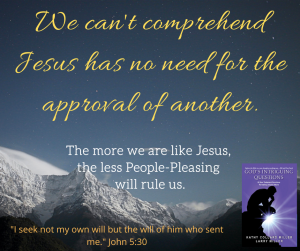
it’s called being a People Pleaser. And I started the practice early in life.
As Larry and I worked on our two books in the God’s Intriguing Questions series, I was surprised how many of God’s and Jesus’s questions refer to people pleasing. Let’s look at another example from John 5:44 when Jesus asked the Jewish leaders: How can you believe, when you receive glory from one another?
Jesus is addressing the Jews who are obsessed with the opinions of others who they believe must think well of them, speak highly of them, and recognize their Law-abiding behavior. Because Jesus is exposing their sinful pride, they plan to kill him. They reject the fact only God is glorious. They think they should qualify.
God’s glory can be defined as the ultimate perfections of every one of his attributes . The religious leaders don’t meet such a high standard. We’ve been seeing the contrast. Unlike everyone, including the religious leaders, every attribute of God is always perfect and exhibited in the best possible way.
Somehow in childhood we each begin to seek glory from other people to feel safe and be considered “good”. We don’t know how to believe God unconditionally loves us even when we struggle and fail. Then we react to people who don’t acknowledge our goodness in four primary sinful ways: anger, sadness/hurt, shame, and anxiety.
I’m angry because you don’t see me the way you should.
I’m sad or hurt because you make me feel bad about myself.
I feel ashamed because my imperfections are revealed for everyone to see.
I’m anxious or fearful because I feel powerless to protect my reputation.
The degree to which we are angry, sad, ashamed, or anxious indicates the level of our dependence upon people’s opinions. They must define us rightly becoming our god. We have forsaken our loving God’s opinion of us who knows the truth about our imperfections and loves us regardless.
In contrast, Jesus says to the Jews—and to us—, “I do not receive glory from people” (John 5:41). Therefore, Jesus can say to the Jews, “Look at me for your example to stop receiving glory from one another.” His motive is to free them from their people pleasing and give them the joyful assurance of Jehovah’s unconditional love for them. God’s love is something they can’t earn.
How does God want to set us free? John 5:30-38 gives us Jesus’s insights as he uses himself as an example of truth:
v. 30: I can do nothing on my own
v. 30: I seek only God’s will
v. 32: God will justify me and determine my value
v. 33: John has testified of me, not for my benefit but for yours. I don’t need John’s confirmation
v. 36: The glorious things I do are determined and empowered by my Father, not by my own power
v. 37: God’s affirmation of me is enough for me
v. 41: I don’t lay hold of the praise given me. I hear it but I don’t accept it as defining me.
We can’t comprehend fully a man who had absolutely no need for any human to think well of him. Jesus says, “I seek not my own will but the will of him who sent me” (John 5:30).
Jesus’s motivating attitude is the key for diminishing people pleasing. We can more and more recognize we each have absolutely nothing to offer God or others. His power is the only source of any good work we do. Then our motive will be to reflect God’s glorious perfections and not our own.
How does meditating on God’s glory motivate you to desire to diminish your people pleasing?
How do you feel knowing God patiently works to diminish your people pleasing and doesn’t expect you to be perfect until you reach heaven? Why do you think that’s so?
Perfect God, I praise you for your glorious being, in which there is absolutely nothing imperfect in you. Thank you for being willing to use me even though I’m a weak and inadequate vessel.
(This blog post is adapted from our book God’s Intriguing Questions: 60 New Testament Devotions Revealing Jesus’s Nature)
July 3, 2020
Book Drawing! “The Ground Kisser” by Thanh Duong Boyer with Lisa Worthey Smith

The Ground Kisser is the memoir of Thanh Duong Boyer co-written with Lisa Worthey Smith. It tells the exciting yet heart-breaking story of one of the Vietnamese boat children. It’s a story representing many people during that tragic time. With Communism breathing down the back’s of Thanh’s family and their wealth and freedom wiped out, Thanh’s parents had to make an agonizing decision. Without enough gold to pay for boat passage for all eight family members, they had to choose whether to stay together and face whatever came in Vietnam, or risk separating the family to give a child a chance to survive….
Read this excerpt from the book and then find out how you can enter the drawing to possibly win a copy of The Ground Kisser.
The Ground Kisser, chapter 1
Vietnam 1975
I turned at the stairwell and made my way up the ladder-like wooden steps. Once alone upstairs, I unfolded my hand and found blistered fingers. I should have listened to my parents’ warning about the shell fragments.
I did listen to them.
I didn’t obey them, but I listened.
Too late now. It would be much less painful to deal with the pain of the burns than to go through the shame of revealing my stubborn disobedience.
~~~
After I washed the stench of smoke from my skin, soot from my clothes, and tears from my face, I turned and caught a breeze from our window that cooled my tender skin. I ran my good fingers through my dripping wet hair and let the warm waft of air flow through it.
Outside the window on our balcony/patio, our freshly washed clothes danced lightly in the breeze while they dried. Did they not know? How could they possibly dance at such a time? Would I ever cleanse my mind of the scene I witnessed that day? Would there ever be a day when I danced in the breeze again, as they did?
~~~
As clean and dry as I could manage, I went back downstairs. At least with bombs this near to us, I wouldn’t have to return to school that day. If I were lucky, the next either. When I passed by the “Dương Home” sign on the wall, I lifted my droopy shoulders and straightened my back a little taller—proud of our family name, our standing, and our home.
I tucked my feet under me, sat on the floor and watched my siblings play quietly around me, unaware of what had happened at school. The before-and-after pictures of the snack-maker family and their home replayed in my mind. My good fingers twirled the hem of my fresh shirt while I searched for them in every replay. Were their faces in the smoke? Maybe they stood to the side. Everyone looked the same covered with ash.
No matter how many times I reran the scene, I couldn’t find them in the crowd. The clear image of the charred pit that displaced their home forced me to accept the truth. Tears rushed up. I blinked hard to force them back—only the weak agonize over the dead. I took a deep breath and sat in silent respect for the loss of the day, and the survival of the day. Incense would burn for the snack-makers in the morning.
Sundown arrived. We ate our meal. The crickets chirped their nighttime songs outside our open windows. Birds settled in the guava tree outside our balcony window to nest for the night. We pulled out the mosquito netting from its place and spread it out. My hands and feet went through the motions of all our usual activities.
My mind refused to comply. Over and over it replayed the image of the snack-makers waving and smiling at me for the last time, and the chaos of flames and smoke that took them away.
Would my normal ever include joy again? I tried to wash the scene away, or at least any telltale tears, with another shower before bedtime.
~~~
Here’s more information about this compelling story:
The Ground Kisser, a multiple award-winning memoir of one of the Vietnamese boat people, peers into Thanh’s idyllic childhood as a “spoiled little rich girl,” the poverty and danger after the fall of Saigon.
The odds of survival were bleak whether they stayed together as a family or tried to escape. Her parents, desperate to give the oldest of their six children a chance to live, used their remaining hidden gold to buy passage for Thanh, twelve years old, and one of her sisters, ten years old, on an overloaded riverboat headed to Australia. Pirates ended that dream, and tried to take their lives.
Her astounding courage, dedication to her family, faith, and her love of her new homeland, the United States, prompted Barry Farber to dub her a ‘ground kisser.’
Thanh speaks to veterans’ groups to express her profound gratitude to the American military, especially those who came to Vietnam, in their darkest hours.
Thanh was assisted telling her story by author Lisa Worthey Smith.
 Lisa Worthey Smith, long time Bible student and teacher, writes stories of faith, hope, and love. Her first two books, Oscar the Extraordinary Hummingbird and The Wisdom Tree, include Bible studies. Her most recent books, The Ground Kisser and Unsung Heroes take a look at the Vietnam War. One from the perspective of living in the war-torn country, and the other an overview of how the US slipped from “I’ll do my part” to “I’ll do my own thing,” so much that the Vietnam War veterans and casualties were ignored, even unwelcome upon their return home.
President of her local Word Weavers, Lisa and her husband are empty-nesting in north Alabama. She spends her days writing with her ever-present cup of Earl Grey, and tending her hummingbird garden.
Want to win this book? Make a comment on my blog post’s comment section. I’ll pick the winner at random on Saturday evening, July 11th, 2020.
Book links
Oscar the Extraordinary Hummingbird Amazon link
Here’s how to contact Lisa:
Facebook LisaWorthey.Smith
Pinterest LisaWSmith57
Website www.LisaWortheySmith.com
June 1, 2020
Would You Like to Read Someone’s Mind?

That was especially true for me when Larry and I married. Not only did I want to read his mind, I actually thought I could. After all, if I had said something the same as what Larry said, I assumed he meant the same I would have. It made perfect sense.
Only in time did I realize no one can read my mind, especially Larry! And I cannot assume I can correctly interpret the thoughts or actions of others, especially Larry.
What a revelation and help for our marriage.
If only I’d read the story in Mark 2 and seen how only Jesus as God is omniscient. I most likely had studied it but didn’t apply it to my relationships. I should have concentrated on how only God knows the hearts and minds of others. Not me!
It’s interesting that over the years movies have been made about how one character can read the thoughts of another person. The plot develops as the person selfishly uses the ability for his own good, not for the good of others. Thankfully, we’ll see that Jesus uses His ability for the good of others and for His own glory.
Jesus ask the question in Mark 2:8: “Why do you question these things in your hearts?”
His words are a part of the heart-touching story of the paralytic’s friends breaking through the roof to get him within healing distance of Jesus. They must think their friend needs to be close in order for Jesus to heal him, otherwise they could have called out through the blocked door or pounded on the roof. Instead, they take off the layers of wood, mud, and straw, whether with their bare hands or some implements. The roof is strong enough to walk on but not strong enough to resist the passionate, motivated love these men have for their disabled friend.
The bedridden man is finally before Jesus, and to everyone the need is obvious. A healing of his body. But Jesus says, “Son, your sins are forgiven.” The friends intend only their friend’s physical healing, but Jesus wants the healing of his soul.
Jesus always sees beyond what we think is important. We can be healed physically in some way but if we are still being distressed by sin, we really aren’t healthy. TWEET THAT!!!!!
The scribes question Jesus’s action “in their hearts” (v. 6) because Jesus is blaspheming by claiming to be God who is the only one who can forgive sins. Blaspheming is a crime punishable by death. Jesus reveals their thoughts, and they must be totally shocked—just like the characters in a movie when another person refers to their thoughts. The scribes must also feel threatened because their evidence-gathering mission is no longer secret. Jesus knows their intentions for his harm.
Then curiously Jesus asks, “Which is easier, to say to the paralytic, ‘Your sins are forgiven,’ or to say, ‘Rise, take up your bed and walk’?” (2:9). He is revealing his authority on earth. No one can see whether the paralytic’s sins have been healed, but when he stands up, everyone can see the physical healing.
Jesus reveals three truths about himself: he heals the soul from sin, he heals the body from disease, and he points out lies corrupting the mind.
This story emphasizes Jesus’s omniscience. Jesus is not surprised. He never has a “deer looking in headlights” stare. He never wonders what someone is thinking or guesses at their motives. TWEET THAT!!!!!
What wonderful assurance for our lives. Jesus the Son of God knows everything—including our deepest needs. He knows which need requires addressing first, second, and last. When we are receptive to his better plan, we can reduce the “questioning in our hearts.” We aren’t forced to hide our confusion. God knows every motive, thought, and hope of our hearts. He wants to work with us to bring understanding. He asks us to evaluate, “Why do I question God’s ways in my heart?”
Has anything happened to you seeming to indicate God is not omniscient?
What seems scary or risky about honestly revealing the motives of your heart?
Healer Jesus, I praise you for your omniscient quality, which assures me nothing is hidden from you. Thank you for your authority to overcome every obstacle and to reveal your plan for my good.
This post is adapted from my book (co-authored with my husband, Larry): God’s Intriguing Questions: 60 New Testament Devotions Revealing Jesus’s Nature.
May 27, 2020
99cents Kindle “God’s Intriguing Questions: 40 Old Testament Devotions…”
Larry and I (co-authors) are very excited about one of our latest books because the kindle version is 99 cents through Sunday, May 31, 2020.. So we wanted to give you a taste of our book.
God’s intriguing Questions: 40 Old Testament Devotions Revealing God’s Nature is a devotional book examining the questions God asked in the Old Testament. The follow up “twin” on the New Testament is also available: God’s Intriguing Questions: 60 New Testament Devotions Revealing Jesus’s Nature.
In this devotional from the book on the Old Testament, it is based on 2 Kings 19:25, God asks,
“Have you not heard that I determined it long ago?”
A powerful army led by the Assyrian king Sennacherib is ready to attack Jerusalem. Sennacherib sends a letter to the King of Judah, Hezekiah, containing an arrogant recounting of all the cities the Assyrians have conquered. He writes,“Behold, you have heard what the kings of Assyria have done to all lands, devoting them to destruction. And shall you be delivered?” (2 Kings 19:10-11).
Instead of being paralyzed by fear, King Hezekiah immediately goes to the house of the Lord and spreads the letter before the Lord. He prays,
Truly, O Lord, the kings of Assyria have laid waste the nations and their lands and have cast their gods into the fire, for they were not gods, but the work of men’s hands, wood and stone. Therefore they were destroyed. So now, O Lord our God, save us, please, from his hand, that all the kingdoms of the earth may know that you, O Lord, are God alone. (2 Kings 19:17-19)
Hezekiah doesn’t downplay the danger as if he’s in some sort of spiritual denial. Sometimes we ignore the danger and call it faith. Hezekiah fully spells out the threat. God responds saying he has heard the prayer and talks about the Assyrians as if he is talking to Sennacherib directly, “Have you [Sennacherib] not heard that I determined it long ago? I planned from days of old what now I bring to pass, that you should turn fortified cities into heaps of ruins” (2 Kings 19:25).
God boasts of his own victorious sovereignty—being in control of what the Assyrians are doing and the victory he will bring for the Israelites. TWEET THAT!
The hearts of Hezekiah and all the Israelites are strengthened. In the end, the angel of the Lord strikes down 185,000 Assyrians causing them to withdraw in defeat. We must remember the Assyrians are still known in history as the most wicked and heartless people of all time.
Do we spread out an enemy’s message and rehearse our helplessness? Or do we spread the message before the Lord and cry out for his help? TWEET THAT!
Recently, my (Kathy) friend Amelia recounted her husband’s many incidents of insensitivity. Then Amelia mentioned how a friend had spontaneously sent her a big box of Christmas decorations—her favorite holiday. “Kathy, it meant so much to me she had thought of me.”
“Amelia, do you see how God is providing what you lack from your husband? God is sovereignly motivating your friend’s sensitivity.”
She immediately softened and surrendered to God, rejecting the lie only her husband could meet her needs.
Satan is like King Sennacherib recounting his victories. As the father of lies, he always gives his own version putting him in victorious control.
But if we will pay attention, God recounts his own victories and control over our worse enemy, that father of lies. Even if the provision comes through the hand of another person, it is still prompted and controlled by God. He cries out, “Can you understand I determined your help from long ago and am in control of everything, even the hard things? I have not forsaken you.”
Our book includes two self-exploratory questions and a short prayer at the end of each devotion. For this devotion, here they are:
1. Can you recount God’s sovereign kindness even if it was delivered through the hand of another?
2. When has God asked you, “Can’t you see I’m in control even in this?”
Almighty God of the universe, I praise you for your sovereign unending control. Thank you for helping me to remember the times you have sovereignly worked in my life.
I hope you were blessed by this devotion from our book. Again, for a limited time (through Sunday, May 31, 2020) it is available for 99cents Kindle. You can learn more about the book here


